Volume 13 · pp. 477–478
Sermon XIV. On Blessed Matthias the Apostle, Opening
A marker with ≈ is an approximate page boundary, placed by measure of the text; the page photographs remain the authority. In the paired views, clicking a page marker brings that page into view.
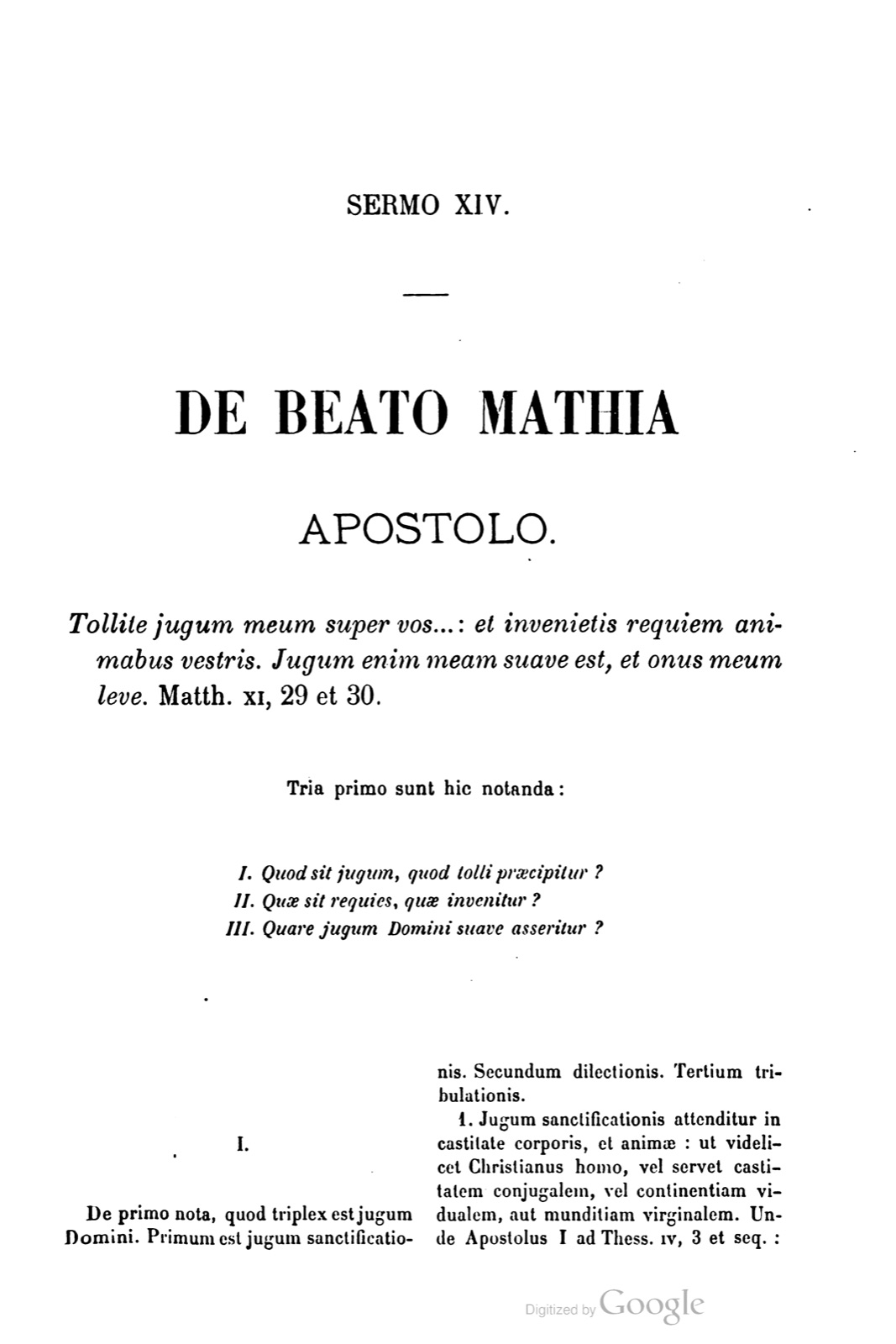
SERMO XIV.
DE BEATO MATHIA APOSTOLO.
Tollite jugum meum super vos...: et invenietis requiem animabus vestris. Jugum enim meum suave est, et onus meum leve. Matth. XI, 29 et 30.
Tria primo sunt hic notanda:
I. Quod sit jugum, quod tolli præcipitur? II. Quæ sit requies, quæ invenitur? III. Quare jugum Domini suave asseritur?
I.
De primo nota, quod triplex est jugum Domini. Primum est jugum sanctificationis. Secundum dilectionis. Tertium tribulationis.
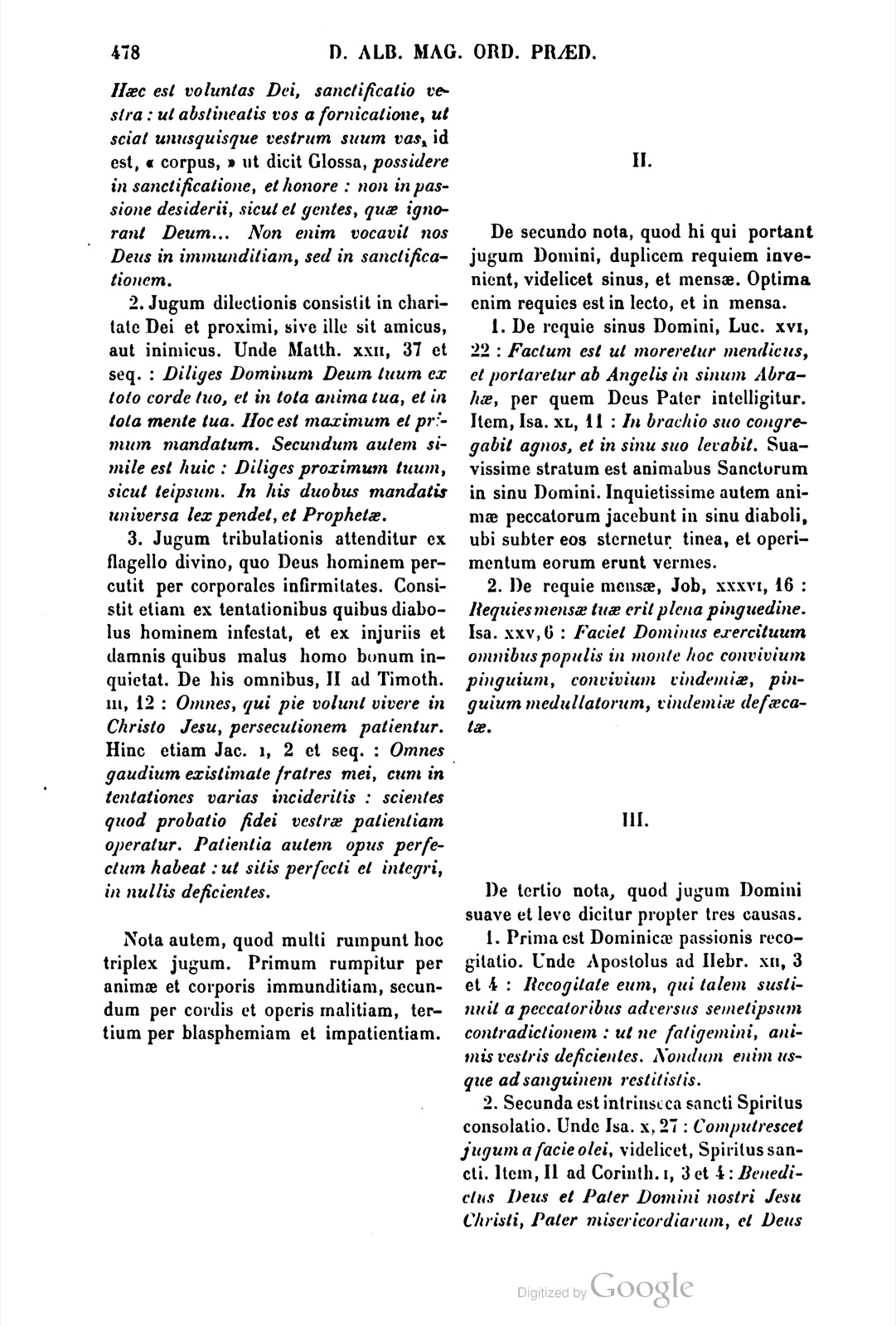
1. Jugum sanctificationis attenditur in castitate corporis, et animæ: ut videlicet Christianus homo, vel servet castitatem conjugalem, vel continentiam vidualem, aut munditiam virginalem. Unde Apostolus I ad Thess. IV, 3 et seq.: Hæc est voluntas Dei, sanctificatio vestra: ut abstineatis vos a fornicatione, ut sciat unusquisque vestrum suum vas, id est, « corpus, » ut dicit Glossa, possidere in sanctificatione, et honore: non in passione desiderii, sicut et gentes, quæ ignorant Deum... Non enim vocavit nos Deus in immunditiam, sed in sanctificationem.
2. Jugum dilectionis consistit in charitate Dei et proximi, sive ille sit amicus, aut inimicus. Unde Matth. XXII, 37 et seq.: Diliges Dominum Deum tuum ex toto corde tuo, et in tota anima tua, et in tota mente tua. Hoc est maximum et primum mandatum. Secundum autem simile est huic: Diliges proximum tuum, sicut teipsum. In his duobus mandatis universa lex pendet, et Prophetæ.
3. Jugum tribulationis attenditur ex flagello divino, quo Deus hominem percutit per corporales infirmitates. Consistit etiam ex tentationibus quibus diabolus hominem infestat, et ex injuriis et damnis quibus malus homo bonum inquietat. De his omnibus, II ad Timoth. III, 12: Omnes, qui pie volunt vivere in Christo Jesu, persecutionem patientur. Hinc etiam Jac. I, 2 et seq.: Omne gaudium existimate fratres mei, cum in tentationes varias incideritis: scientes quod probatio fidei vestræ patientiam operatur. Patientia autem opus perfectum habeat: ut sitis perfecti et integri, in nullis deficientes.
SERMON XIV.
ON BLESSED MATTHIAS THE APOSTLE.
Take my yoke upon you... and you will find rest for your souls. For my yoke is sweet, and my burden light. Matthew 11:29 and 30.
Here three things first are to be noted:
I. What is the yoke that is commanded to be taken? II. What is the rest that is found? III. Why the yoke of the Lord is asserted to be sweet?
I.
On the first, note that the yoke of the Lord is threefold. The first is the yoke of sanctification. The second, of love. The third, of tribulation.
1. The yoke of sanctification is considered in chastity of body and soul, namely so that the Christian man either preserves conjugal chastity, or widowly continence, or virginal cleanness. Hence the Apostle, 1 Thessalonians 4:3 and following: This is the will of God, your sanctification: that you abstain from fornication, that each one of you know how to possess his vessel, that is, "body," as the Gloss says, in sanctification and honor; not in the passion of desire, as also the gentiles who do not know God... For God has not called us into uncleanness, but into sanctification.
2. The yoke of love consists in charity of God and neighbor, whether he is a friend or an enemy. Hence Matthew 22:37 and following: You shall love the Lord your God from your whole heart, and in your whole soul, and in your whole mind. This is the greatest and first commandment. But the second is like this: You shall love your neighbor as yourself. On these two commandments the whole Law and the Prophets hang.
3. The yoke of tribulation is considered from the divine scourge, by which God strikes a man through bodily infirmities. It also consists of temptations by which the devil troubles a man, and of injuries and losses by which an evil man disturbs a good man. Concerning all these, 2 Timothy 3:12: All who wish to live piously in Christ Jesus will suffer persecution. Hence also James 1:2 and following: Esteem it all joy, my brothers, when you fall into various temptations, knowing that the testing of your faith works patience. But let patience have a perfect work, that you may be perfect and entire, lacking in nothing.
Nota autem, quod multi rumpunt hoc triplex jugum. Primum rumpitur per animæ et corporis immunditiam, secundum per cordis et operis malitiam, tertium per blasphemiam et impatientiam.
II.
De secundo nota, quod hi qui portant jugum Domini, duplicem requiem invenient, videlicet sinus, et mensæ. Optima enim requies est in lecto, et in mensa.
1. De requie sinus Domini, Luc. XVI, 22: Factum est ut moreretur mendicus, et portaretur ab Angelis in sinum Abrahæ, per quem Deus Pater intelligitur. Item, Isa. XL, 11: In brachio suo congregabit agnos, et in sinu suo levabit. Suavissime stratum est animabus Sanctorum in sinu Domini. Inquietissime autem animæ peccatorum jacebunt in sinu diaboli, ubi subter eos sternetur tinea, et operimentum eorum erunt vermes.
2. De requie mensæ, Job, XXXVI, 16: Requies mensæ tuæ erit plena pinguedine. Isa. XXV, 6: Faciet Dominus exercituum omnibus populis in monte hoc convivium pinguium, convivium vindemiæ, pinguium medullatorum, vindemiæ defæcatæ.
III.
De tertio nota, quod jugum Domini suave et leve dicitur propter tres causas.
1. Prima est Dominicæ passionis recogitatio. Unde Apostolus ad Hebr. XII, 3 et 4: Recogitate eum, qui talem sustinuit a peccatoribus adversus semetipsum contradictionem: ut ne fatigemini, animis vestris deficientes. Nondum enim usque ad sanguinem restitistis.
2. Secunda est intrinseca sancti Spiritus consolatio. Unde Isa. X, 27: Computrescet jugum a facie olei, videlicet, Spiritus sancti. Item, II ad Corinth. I, 3 et 4: Benedictus Deus et Pater Domini nostri Jesu Christi, Pater misericordiarum, et Deus
But note that many break this threefold yoke. The first is broken through uncleanness of soul and body, the second through malice of heart and work, the third through blasphemy and impatience.
II.
On the second, note that those who carry the yoke of the Lord will find a double rest, namely of the bosom and of the table. For the best rest is in bed and at table.
1. Concerning the rest of the Lord's bosom, Luke 16:22: It happened that the beggar died and was carried by the Angels into the bosom of Abraham, by whom God the Father is understood. Likewise, Isaiah 40:11: In his arm he will gather the lambs, and in his bosom he will lift them. Most sweetly spread for the souls of the Saints is the bed in the bosom of the Lord. But most restlessly will the souls of sinners lie in the bosom of the devil, where beneath them the moth will be spread, and their covering will be worms.
2. Concerning the rest of the table, Job 36:16: The rest of your table will be full of fatness. Isaiah 25:6: The Lord of hosts will make for all peoples on this mountain a banquet of fat things, a banquet of vintage, of fat things full of marrow, of purified vintage.
III.
On the third, note that the yoke of the Lord is called sweet and light for three causes.
1. The first is the reconsideration of the Lord's Passion. Hence the Apostle at Hebrews 12:3 and 4: Think again on him who sustained from sinners such contradiction against himself, so that you may not be wearied, failing in your souls. For you have not yet resisted unto blood.
2. The second is the inward consolation of the Holy Spirit. Hence Isaiah 10:27: The yoke will rot away from the face of oil, namely, of the Holy Spirit. Likewise, 2 Corinthians 1:3 and 4: Blessed be the God and Father of our Lord Jesus Christ, the Father of mercies, and God
If a page does not appear, its photograph has not been uploaded yet.