Volume 13 · pp. 474–476
Sermon XIII. On the Feast of the Chair of Saint Peter
A marker with ≈ is an approximate page boundary, placed by measure of the text; the page photographs remain the authority. In the paired views, clicking a page marker brings that page into view.
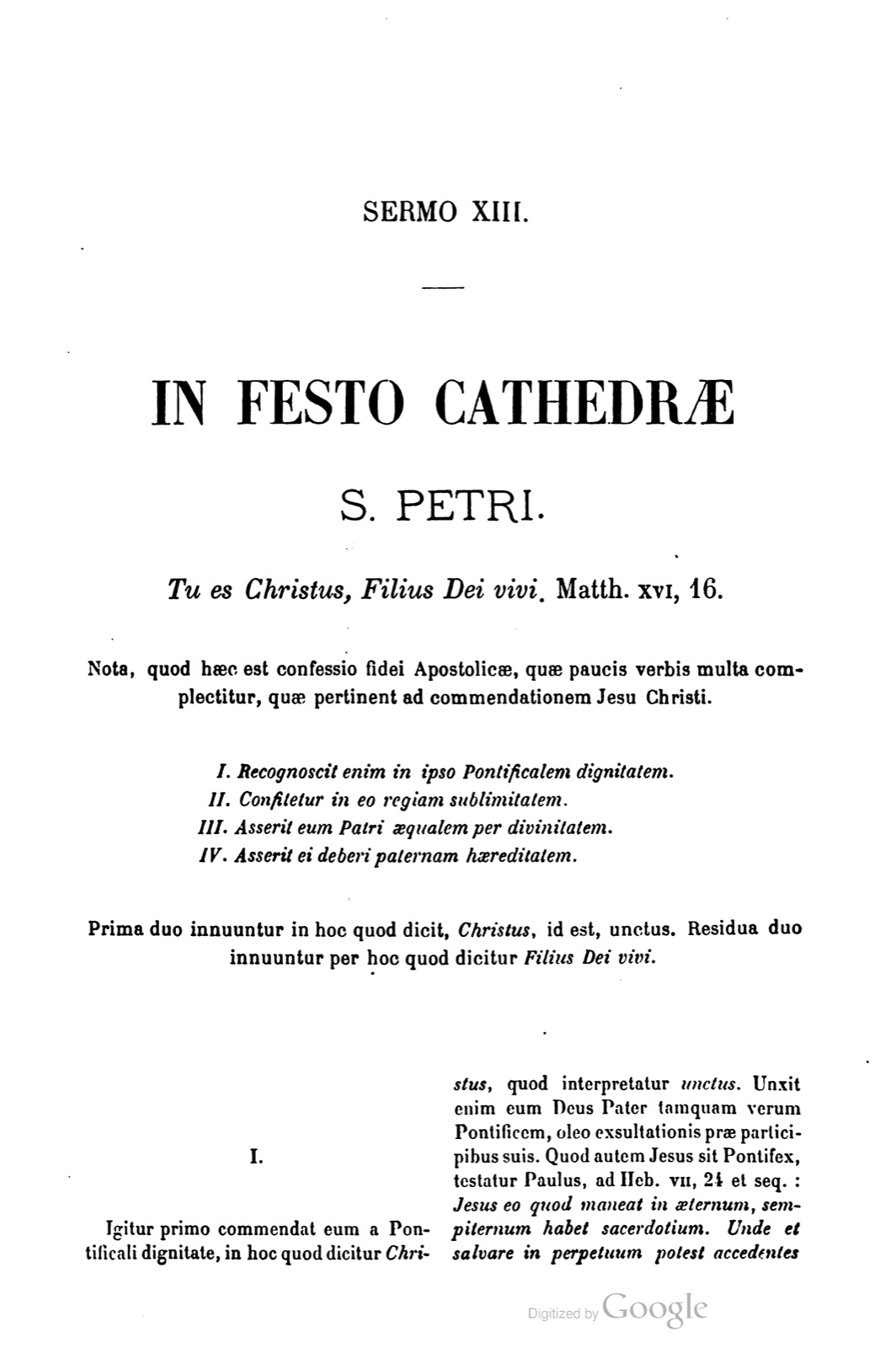
SERMO XIII.
IN FESTO CATHEDRÆ S. PETRI.
Tu es Christus, Filius Dei vivi. Matth. XVI, 16.
Nota, quod hæc est confessio fidei Apostolicæ, quæ paucis verbis multa complectitur, quæ pertinent ad commendationem Jesu Christi.
I. Recognoscit enim in ipso Pontificalem dignitatem. II. Confitetur in eo regiam sublimitatem. III. Asserit eum Patri æqualem per divinitatem. IV. Asserit ei deberi paternam hæreditatem.
Prima duo innuuntur in hoc quod dicit, Christus, id est, unctus. Residua duo innuuntur per hoc quod dicitur Filius Dei vivi.
I.
Igitur primo commendat eum a Pontificali dignitate, in hoc quod dicitur Christus, quod interpretatur unctus. Unxit enim eum Deus Pater tamquam verum Pontificem, oleo exsultationis præ participibus suis. Quod autem Jesus sit Pontifex, testatur Paulus, ad Heb. VII, 24 et seq.: Jesus eo quod maneat in æternum, sempiternum habet sacerdotium. Unde et salvare in perpetuum potest accedentes per semetipsum ad Deum: semper vivens ad interpellandum pro nobis. Talis enim decebat ut nobis esset Pontifex, sanctus, innocens, impollutus, segregatus a peccatoribus. Sanctus in mundi hujus conversatione: sancte enim conversatus fuit in mundo. Innocens in Passione: innocenter enim passus fuit. Impollutus in limbi confractione: quia enim impollutus fuit, destruxit mortis imperium. Segregatus a peccatoribus in gloriosa Resurrectione, et excelsior cælis factus in admirabili Ascensione.
1. Iste est Pontifex, qui calicem Passionis pro nobis bibit. Matth. XXVI, 42: Pater mi, si non potest hic calix transire nisi bibam illum, fiat voluntas tua.
SERMON XIII.
ON THE FEAST OF THE CHAIR OF SAINT PETER.
You are Christ, the Son of the living God. Matthew 16:16.
Note that this is the confession of Apostolic faith, which in few words embraces many things that pertain to the commendation of Jesus Christ.
I. For it recognizes in him Pontifical dignity. II. It confesses in him royal sublimity. III. It asserts that he is equal to the Father through divinity. IV. It asserts that the paternal inheritance is owed to him.
The first two are suggested in this which he says: Christ, that is, anointed. The remaining two are suggested through this which is said: Son of the living God.
I.
Therefore first he commends him from Pontifical dignity, in this which is said: Christ, which is interpreted anointed. For God the Father anointed him as a true High Priest, with the oil of exultation before his partakers. But that Jesus is High Priest, Paul testifies, at Hebrews 7:24 and following: Jesus, because he remains forever, has an everlasting priesthood. Hence also he can save forever those who approach God through himself, always living to intercede for us. For it was fitting that such a High Priest should be ours: holy, innocent, undefiled, separated from sinners. Holy in the conversation of this world, for he lived holily in the world. Innocent in the Passion, for he suffered innocently. Undefiled in the breaking of limbo, because since he was undefiled, he destroyed the dominion of death. Separated from sinners in the glorious Resurrection, and made higher than the heavens in the wonderful Ascension.
1. This is the High Priest who drank the chalice of the Passion for us. Matthew 26:42: My Father, if this chalice cannot pass unless I drink it, your will be done.
2. Hic est Pontifex, qui eumdem calicem suis fidelibus porrigit. Matth. XX, 22: Potestis bibere calicem, quem ego bibiturus sum? Quasi dicat: Nisi biberitis mecum calicem Passionis, non bibetis calicem consolationis.
3. Hic est Pontifex, qui claves ligandi atque solvendi Pontificibus et Sacerdotibus concessit. Matt. XVI, 19: Tibi dabo claves regni cælorum. Et quodcumque ligaveris super terram, erit ligatum et in cælis. Unde justa sententia excommunicationis vehementer est timenda. Excommunicatio enim separat, excludit, infirmat, tradit iniquo: separat a Deo, excludit a suffragiis Ecclesiæ, infirmat hominem ad resistendum vitiosis tentationibus, tradit iniquo, id est, diabolo et tortoribus infernalibus.
II.
Secundo commendat eum a regia dignitate, per hoc quod dicitur Christus, id est, unctus: quia reges etiam inunguntur. Et certe iste per illum pulchrum et rubicundum David expressus fuit, qui in regem inunctus fuit. Unde legitur in I Reg. XVI, 12 et 13: Erat David rufus, et pulcher adspectu, decoraque facie... Tulit ergo Samuel cornu olei, et unxit eum in medio fratrum ejus: et directus est Spiritus Domini a die illa in David, et deinceps. Per David ergo Christus, et per Samuelem Deus Pater intelligitur. Iste est rex, qui hominibus regni sui, hoc est, filiis gratiæ leges edidit et proposuit castitatis, æquitatis, et pietatis.
1. De lege castitatis, Matth. VI, 27, 28: Audistis, quia dictum est antiquis: Non mæchaberis. Ego autem dico vobis: quia omnis, qui viderit mulierem ad concupiscendum eam, jam mæchatus est eam in corde suo.
2. This is the High Priest who extends the same chalice to his faithful. Matthew 20:22: Can you drink the chalice which I am about to drink? As if he were saying: Unless you drink with me the chalice of the Passion, you will not drink the chalice of consolation.
3. This is the High Priest who granted to Pontiffs and Priests the keys of binding and loosing. Matthew 16:19: I will give to you the keys of the kingdom of heaven. And whatever you bind upon earth will be bound also in heaven. Hence the just sentence of excommunication is to be feared vehemently. For excommunication separates, excludes, weakens, hands over to the wicked one: it separates from God, excludes from the suffrages of the Church, weakens a man for resisting vicious temptations, hands him over to the wicked one, that is, to the devil and infernal torturers.
II.
Secondly he commends him from royal dignity, through this which is said: Christ, that is, anointed, because kings also are anointed. And certainly this one was expressed through that beautiful and ruddy David, who was anointed as king. Hence it is read in 1 Kings 16:12 and 13: David was red-haired and beautiful in sight, and comely of face... Therefore Samuel took the horn of oil and anointed him in the midst of his brothers, and the Spirit of the Lord was directed into David from that day and thereafter. Therefore by David Christ is understood, and by Samuel God the Father. This is the king who issued and proposed to the men of his kingdom, that is, to the sons of grace, laws of chastity, equity, and piety.
1. Concerning the law of chastity, Matthew 6:27, 28: You have heard that it was said to the ancients: You shall not commit adultery. But I say to you that everyone who has looked at a woman in order to desire her has already committed adultery with her in his heart.
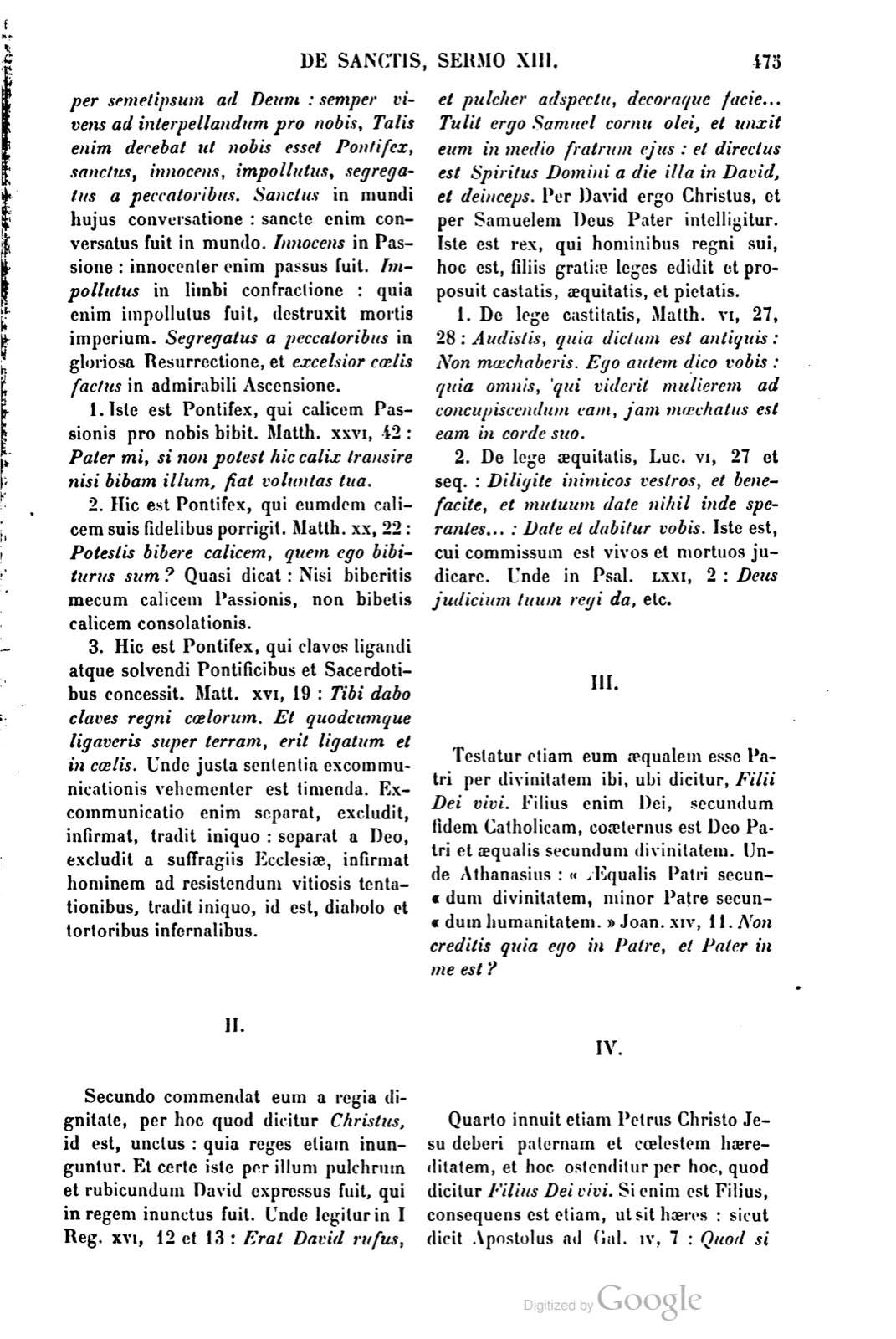
2. De lege æquitatis, Luc. VI, 27 et seq.: Diligite inimicos vestros, et benefacite, et mutuum date nihil inde sperantes...: Date et dabitur vobis. Iste est, cui commissum est vivos et mortuos judicare. Unde in Psal. LXXI, 2: Deus judicium tuum regi da, etc.
III.
Testatur etiam eum æqualem esse Patri per divinitatem ibi, ubi dicitur, Filii Dei vivi. Filius enim Dei, secundum fidem Catholicam, coæternus est Deo Patri et æqualis secundum divinitatem. Unde Athanasius: « Æqualis Patri secundum divinitatem, minor Patre secundum humanitatem. » Joan. XIV, 11. Non creditis quia ego in Patre, et Pater in me est?
IV.
Quarto innuit etiam Petrus Christo Jesu deberi paternam et cœlestem hæreditatem, et hoc ostenditur per hoc, quod dicitur Filius Dei vivi. Si enim est Filius, consequens est etiam, ut sit hæres: sicut dicit Apostolus ad Gal. IV, 7: Quod si filius: et hæres per Deum, subauditur, jure. Et nota, quod Jesus, qui est filius Dei, per unionem nos cohæredes suos fecit, qui sumus filii per adoptionem. Unde ad Rom. VIII, 16 et 17: Ipse Spiritus testimonium reddit spiritui nostro, quod sumus filii Dei. Si autem filii, et hæredes: hæredes quidem Dei, cohæredes autem Christi.
Hæreditas autem ista consistit in tribus: in vitæ perpetuitate, in divitiarum ubertate, et in gloriæ subtilitate. Unde Proverb. III, 16: Longitudo dierum in dextera ejus, et in sinistra illius divitiæ, et gloria.
Rogamus ergo Pontificem istum, et Regem, ut in regno Patris sui nos suos faciat cohæredes. Quod nobis præstare dignetur, etc.
2. Concerning the law of equity, Luke 6:27 and following: Love your enemies, and do good, and give loans, hoping nothing from it... Give, and it will be given to you. This is he to whom it has been committed to judge the living and the dead. Hence in Psalm 71:2: O God, give your judgment to the king, etc.
III.
He also testifies that he is equal to the Father through divinity there where it is said: Son of the living God. For the Son of God, according to the Catholic faith, is coeternal with God the Father and equal according to divinity. Hence Athanasius: "Equal to the Father according to divinity, less than the Father according to humanity." John 14:11: Do you not believe that I am in the Father and the Father is in me?
IV.
Fourthly Peter also suggests that the paternal and heavenly inheritance is owed to Christ Jesus, and this is shown through this, that he is called Son of the living God. For if he is Son, it follows also that he is heir, as the Apostle says at Galatians 4:7: But if a son, also an heir through God; supply, by right. And note that Jesus, who is Son of God, through union made us his coheirs, we who are sons through adoption. Hence at Romans 8:16 and 17: The Spirit himself gives testimony to our spirit that we are sons of God. But if sons, also heirs: heirs indeed of God, but coheirs of Christ.
But that inheritance consists in three things: in perpetuity of life, in abundance of riches, and in subtlety of glory. Hence Proverbs 3:16: Length of days is in her right hand, and in her left are riches and glory.
Therefore we ask that High Priest and King that in the kingdom of his Father he may make us his coheirs. May he deign to grant this to us, etc.

If a page does not appear, its photograph has not been uploaded yet.