Volume 13 · pp. 455–460
Sermon IX. On the Conversion of Blessed Paul, Conclusion
A marker with ≈ is an approximate page boundary, placed by measure of the text; the page photographs remain the authority. In the paired views, clicking a page marker brings that page into view.
Hoc lapide se Beatus Paulus ostendit ornatum, dure increpans Galatas, qui judaizare volebant, III, 1: O insensati Galatæ, quis vos fascinavit non obedire veritati, ante quorum oculos Jesus Christus præscriptus est, in vobis crucifixus? Quemdam etiam magum, qui Barieu sive Elymas vocabatur, quia proconsulem Sergium Paulum apud Paphum existentem, a fide quærebat avertere, dure corripuit, ita dicens, Act. XIII, 10 et 11: O plene omni dolo, et omni fallacia, fili diaboli, inimice omnis justitiæ, non desinis subvertere vias Domini rectas. Et nunc ecce manus Domini super te, et eris cæcus, non videns solem usque ad tempus. Et confestim cecidit in eum caligo, et tenebræ, et circuiens quærebat qui ei manum daret.
Ipse etiam scribit Prælatis, ut corripiant inquietos, ita dicens II ad Timoth. IV, 2: Prædica verbum, insta opportune, importune: argue, obsecra, increpa in omni patientia, et doctrina. Item, in epistola ad Titum, I, 10, 11, 13: Sunt multi inobedientes, vaniloqui, et seductores..., quos oportet redargui: qui universas domos subvertunt, docentes quæ non oportet, turpis lucri gratia... Quam ob causam increpa illos dure.
11. Undecimus lapis in hoc electionis vase, fuit Achates, per quem fortis obedientia denotatur. Achates enim nigrum habet colorem, et quibusdam candidis ramis cingitur. Ita etiam verus obediens niger, id est, despectus est in oculis suis, et candidis circulis præceptorum se cingi permittit. Multum etiam Achates prodest contra venenum, et maxime viperæ. Sic etiam vera obedientia contra incentivum, sive inflammativum venenum superbiæ hominem forti defensione tuetur. Habet etiam aquila prædictum lapidem in nido suo, ad custodiendum pullos suos. Ita etiam per veram obedientiam pullos operum nostrorum a morsu infernalis serpentis tueri debemus. Contra verum enim obedientem nihil prævalet inimicus.
Gemma igitur fortis obedientiæ statim in primo instanti suæ conversionis ornatus fuit Paulus. Unde et ait ad Jesum: Domine, quid me vis facere 1? Quasi dicat: Paratus sum tibi in omnibus quæcumque jusseris obedire. S. Bernardus: « O verbum breve, sed plenum, sed vivum, sed efficax, sed dignum omni acceptione. Quam pauci inveniuntur in hac perfectæ obedientiæ forma, qui suam ita abjecerint voluntatem, ut non quod ipsi, sed quid Dominus velit, omni hora requirant! »
Beatus etiam Paulus omnibus insinuans, ait ad Phil. II, 8, quod humiliavit semetipsum Jesus Christus, factus obediens usque ad mortem, mortem autem crucis. Quemlibet monet, ut obediat Evangelio Jesu Christi. Unde ait II ad Thess. I, 8, 9 et 10: In flamma ignis dans Jesus vindictam iis... qui non obediunt Evangelio Domini nostri Jesu Christi. Qui pænas dabunt in interitu æternas a facie Domini, et a gloria virtutis ejus: cum venerit glorificari in Sanctis suis, et admirabilis fieri in omnibus qui crediderunt. Uxores etiam ut maritis, filios ut parentibus, servos ut Dominis obediant, adhortatur, et ait ad Colos. III, 18: Mulieres subditæ estote viris, sicut oportet, in Domino. Glossa, « non contra Dominum. » Filii obedite parentibus vestris per omnia: hoc enim placitum est in Domino... Servi obedite per omnia dominis carnalibus, non ad oculum servientes, quasi hominibus placentes, sed in simplicitate cordis, timentes Deum... Scientes quod a Domino accipietis retributionem hæreditatis 2. Quid etiam e converso viri uxoribus, parentes filiis, et domini servis teneantur exhibere, declarat ad Coloss. III, 19 et 21: Viri diligite uxores vestras, et nolite amari esse ad illas... Patres, nolite ad indignationem provocare filios vestros. Ibid. IV, 1: Domini, quod justum est et æquum, servis præstate: scientes quod et vos Dominum habetis in cælo.
Blessed Paul showed himself adorned with this stone, harshly rebuking the Galatians, who wished to Judaize, chapter 3:1: O senseless Galatians, who has bewitched you not to obey the truth, before whose eyes Jesus Christ has been set forth, crucified among you? He also harshly corrected a certain magician, who was called Barieu or Elymas, because he was seeking to turn the proconsul Sergius Paulus, who was at Paphos, away from the faith, saying thus, Acts 13:10 and 11: O full of all deceit and all fallacy, son of the devil, enemy of all justice, you do not cease to overturn the right ways of the Lord. And now behold the hand of the Lord is upon you, and you will be blind, not seeing the sun for a time. And immediately there fell upon him mist and darkness, and going about he sought someone who would give him a hand.
He himself also writes to Prelates that they should correct the restless, saying thus in 2 Timothy 4:2: Preach the word; insist opportunely and importunely: argue, beseech, rebuke in all patience and doctrine. Likewise, in the epistle to Titus 1:10, 11, 13: There are many disobedient, vain-talkers and seducers..., whom it is necessary to rebuke, who overturn whole houses, teaching what they ought not, for the sake of foul gain... For which cause rebuke them sharply.
11. The eleventh stone in this vessel of election was Agate, by which strong obedience is denoted. For Agate has a black color, and is girded with certain white branches. So also the truly obedient one is black, that is, despised in his own eyes, and permits himself to be girded by the white circles of precepts. Agate also is of much use against poison, and especially against that of a viper. So also true obedience protects a man with strong defense against the inciting or inflammatory poison of pride. The eagle also has the aforesaid stone in its nest, for guarding its young. So also through true obedience we ought to guard the young of our works from the bite of the infernal serpent. For against one truly obedient the enemy prevails in nothing.
Therefore Paul was adorned immediately in the first instant of his conversion with the gem of strong obedience. Hence he also said to Jesus: Lord, what do you wish me to do 1? As if he were saying: I am ready to obey you in all things whatever you command. Saint Bernard: "O word brief, but full, but living, but effective, but worthy of all acceptance. How few are found in this form of perfect obedience, who have so cast away their own will that not what they themselves wish, but what the Lord wishes, they seek at every hour!"
Blessed Paul also, indicating this to all, says at Philippians 2:8 that Jesus Christ humbled himself, made obedient even unto death, even the death of the cross. He admonishes each person to obey the Gospel of Jesus Christ. Hence he says, 2 Thessalonians 1:8, 9 and 10: Jesus giving vengeance in the flame of fire to those... who do not obey the Gospel of our Lord Jesus Christ. They will pay eternal penalties in destruction from the face of the Lord and from the glory of his power, when he will have come to be glorified in his Saints and to be made wonderful in all who have believed. He also exhorts wives to obey husbands, children parents, servants masters, and says at Colossians 3:18: Women, be subject to your husbands, as is fitting, in the Lord. Gloss: "not against the Lord." Children, obey your parents in all things, for this is pleasing in the Lord... Servants, obey in all things your bodily masters, not serving to the eye, as pleasing men, but in simplicity of heart, fearing God... Knowing that from the Lord you will receive the recompense of inheritance 2. What, conversely, husbands are bound to show to wives, parents to children, and masters to servants, he declares at Colossians 3:19 and 21: Husbands, love your wives, and do not be bitter toward them... Fathers, do not provoke your children to indignation. In the same place 4:1: Masters, give to servants what is just and fair, knowing that you also have a Lord in heaven.
12. Duodecimus lapis quo vas istud erat ornatum, fuit Onychinus, per quem læta perseverantia datur intelligi. Onychinus enim permixtum in se habet colorem, ad modum unguis humani. Quia igitur unguis extremitas est corporis, non immerito per Onychinum finalis perseverantia figuratur. Onychinus etiam, sicut legitur, collo suspensus, vel digito portatus, tollit tristitiam. Sic etiam qui læte perseveraverit in bono, numquam per pusillanimitatis tristitiam molestatur.
Quod autem Paulus gemma perseverantiæ fuerit adornatus, ostendit ad Philip. III, 13 et 14, ubi dicit: Quæ retro sunt obliviscens, ad ea vero, quæ sunt priora, extendens meipsum, ad destinatum persequor, ad bravium supernæ vocationis Dei in Christo Jesu. Persequitur, id est, perseveranter sequitur. Hinc etiam loquitur, II ad Timoth. IV, 7 et 8: Bonum certamen certavi, cursum consummavi, fidem servavi. In reliquo reposita est mihi corona justitiæ, quam reddet mihi Dominus in illa die justus judex.
Ipse etiam ad lætam perseverantiam nos invitat, ad Heb. XII, 3 et 7: Recogitate eum, qui talem sustinuit a peccatoribus adversum semetipsum contradictionem... In disciplina perseverate. Tamquam filiis offert vobis se Deus.
III. Vas istud commendatur ab amplitudine et profunditate. Mirabiliter enim amplum erat et profundum per largam et altam charitatem, qua salutem omnium desiderans, ad omnes homines sese extendit. Unde ait, II ad Corinth. VI, 11: Os nostrum patet ad vos, o Corinthii, cor nostrum dilatatum est. Item ait, II ad Corinth. XII, 14 et 15: Non quæro quæ vestra sunt, sed vos... Ego autem libentissime impendam, et superimpendar ipse pro animabus vestris. Item ait, ad Philip. I, 8: Testis mihi est Deus, quomodo cupiam omnes vos in visceribus Jesu Christi. Item, I ad Thessal. II, 7 et 8: Tamquam si nutrix foveat filios suos. Ita desiderantes vos, cupide volebamus tradere vobis non solum Evangelium Dei, sed etiam animas nostras: quoniam charissimi nobis facti estis.
Ipse etiam monet nos, ut per veram charitatem dilatemur ad invicem. Propter quod ait, II ad Cor. VI, 13: Tamquam filiis dico: dilatamini et vos. Item, ad Rom. XIII, 8: Nemini quidquam debeatis: nisi ut invicem diligatis.
IV. Vas istud dignum est commendari a jugi puritate. Numquam enim Beatus Paulus per luxuriam fuit inquinatus, sed virginitatis integritatem continuo servavit illibatam. Unde et in testimonium virginitatis ipsius, dum decollaretur, lac prius quam sanguis exiit de collo ejus. Quia igitur virgo fuit, optavit et consuluit, ut omnes tales essent, qualis ipse fuit. Unde dicit I ad Cor. VII, 7: Volo omnes vos esse sicut meipsum. Glossa « scilicet continentes. » Item, in eodem capitulo: De virginibus præceptum Domini non habeo, consilium autem do 3, Glossa, « a sancto Spiritu mihi inspiratum. » Super locum istum dicit Augustinus: « Supergreditur virginitas conditionem humanæ naturæ, per quam homines Angelis assimilantur: major tamen victoria virginum est quam Angelorum. Angeli enim sine carne vivunt, virgines vero in carne triumphant. »
Quia ergo Beatus Paulus vas mundum erat et sanctum, omnes ad sanctificationem invitat et munditiam, I ad Thessalon. IV, 3 et seq.: Hæc est voluntas Dei, sanctificatio vestra: ut abstineatis vos a fornicatione: ut sciat unusquisque vestrum vas suum possidere in sanctificatione, et honore: non in passione desiderii, sicut et Gentes, quæ ignorant Deum... Non enim vocavit nos Deus in immunditiam, sed in sanctificationem.
12. The twelfth stone with which that vessel was adorned was Onyx, by which joyful perseverance is given to be understood. For Onyx has a mixed color in itself, after the manner of a human nail. Therefore because the nail is the extremity of the body, not undeservedly final perseverance is figured by Onyx. Onyx also, as is read, hung from the neck or carried on the finger, takes away sadness. So also one who has joyfully persevered in good is never troubled by the sadness of faint-heartedness.
But that Paul was adorned with the gem of perseverance, he shows at Philippians 3:13 and 14, where he says: Forgetting the things that are behind, but stretching myself out toward those things that are before, I pursue toward the destination, toward the prize of the supernal calling of God in Christ Jesus. He pursues, that is, he follows perseveringly. Hence he also speaks, 2 Timothy 4:7 and 8: I have fought the good fight, I have completed the course, I have kept the faith. For the rest there has been laid up for me the crown of justice, which the Lord, the just judge, will render to me on that day.
He himself also invites us to joyful perseverance, at Hebrews 12:3 and 7: Think again upon him who sustained such contradiction from sinners against himself... Persevere in discipline. God offers himself to you as to sons.
III. That vessel is commended from breadth and depth. For it was wonderfully broad and deep through large and high charity, by which, desiring the salvation of all, he extended himself to all men. Hence he says, 2 Corinthians 6:11: Our mouth is open to you, O Corinthians; our heart has been enlarged. Likewise he says, 2 Corinthians 12:14 and 15: I do not seek the things that are yours, but you... But I myself will most gladly spend and be spent over and above for your souls. Likewise he says, Philippians 1:8: God is my witness, how I long for all of you in the bowels of Jesus Christ. Likewise, 1 Thessalonians 2:7 and 8: As if a nurse should cherish her own sons. So, desiring you, we eagerly wished to hand over to you not only the Gospel of God, but even our souls, because you had been made most dear to us.
He himself also admonishes us to be enlarged toward one another through true charity. On account of which he says, 2 Corinthians 6:13: I speak as to sons: be enlarged also yourselves. Likewise, Romans 13:8: Owe nothing to anyone, except that you love one another.
IV. That vessel is worthy to be commended from constant purity. For Blessed Paul was never stained through lust, but continuously preserved the integrity of virginity inviolate. Hence also, as a testimony of his virginity, when he was beheaded, milk came out from his neck before blood. Therefore because he was a virgin, he wished and counseled that all should be such as he himself was. Hence he says, 1 Corinthians 7:7: I wish all of you to be as myself. Gloss: "namely continent." Likewise, in the same chapter: Concerning virgins I do not have a commandment of the Lord, but I give counsel 3, Gloss: "inspired to me by the Holy Spirit." On this place Augustine says: "Virginity passes beyond the condition of human nature, through which men are assimilated to Angels: yet the victory of virgins is greater than that of Angels. For Angels live without flesh, but virgins triumph in flesh."
Therefore because Blessed Paul was a clean and holy vessel, he invites all to sanctification and cleanness, 1 Thessalonians 4:3 and following: This is the will of God, your sanctification: that you abstain from fornication; that each one of you know how to possess his own vessel in sanctification and honor, not in the passion of desire, as also the Gentiles who do not know God... For God has not called us into uncleanness, but into sanctification.
V. Vas istud commendatur a solida firmitate. Valde enim solidum fuit et firmum, quod nec flagellis, nec virgis, nec lapidibus, nec aquarum concussionibus, sed nec aliquibus aliis violentis confringi poterat instrumentis. Legitur enim II ad Corinth. XI, quod a Judæis quinque vicibus flagellatus fuit, ita ut qualibet vice quadragenas percussiones acceperit, una minus, quæ quasi pro misericordia subtracta fuit ei. Ter etiam a Gentilibus virgis cæsus fuit, semel lapidatus fuit, ter naufragium pertulit. Præter hæc multos labores et ærumnas, multas etiam vigilias, multam famem et sitim, multa jejunia, multum frigus et pluviam, nuditatem sæpe sustinuit, multasque alias tribulationes: et tamen per impatientiam confringi non potuit. Unde ait II ad Corinth. XI, 24 et seq.: A Judæis quinquies, quadragenas, una minus, accepi. Ter virgis cæsus sum, semel lapidatus sum, ter naufragium feci, Glossa, « id est, pertuli: » nocte et die in profundo maris fui..., in labore et ærumna, in vigiliis multis, in fame et siti, in jejuniis multis, in frigore et nuditate. Hæc omnia sustinere poterat a Domino confortatus. Unde ait ad Phil. IV, 13: Omnia possum in eo qui me confortat.
Ipse etiam invitat nos ad patientiam tribulationum, sic dicens II ad Corinth. VI, 4 et 5: In omnibus exhibeamus nosmetipsos sicut Dei ministros in multa patientia. In quibus autem patientes esse debeamus, statim subdit: In tribulationibus, in necessitatibus, in angustiis, in plagis, in carceribus, in seditionibus, in laboribus, in vigiliis, in jejuniis. In omnibus præmissis patientia est nobis necessaria, de qua ait Apostolus ad Heb. X, 36: Patientia vobis necessaria est: ut voluntatem Dei facientes, reportetis promissionem.
VI. Commendatur vas istud honoris a multiplici utilitate. Et nota, quod olim erant quatuor genera vasorum, quæ utilitati Deo in tabernaculo ministrantium deserviebant. Et hæc vasa erant de auro purissimo. De istis vasis dicit Dominus ad Moysen, Exod. XXV, 29: Parabis et acetabula, ac phialas, thuribula, et cyathos, in quibus offerenda sunt libamina, ex auro purissimo. Nota etiam, quod secundum quosdam in acetabulis acetum, in phialis vinum, in thuribulis thus, in cyathis vero oleum solebat offerri. Horum ergo quatuor vasorum similitudinem gerit Apostolus Paulus. Erat enim acetabulum per pænitentiæ persuasionem, erat phiala per tristium exhilarationem, erat thuribulum per orationum profusionem: fuit nihilominus cyathus per supercælestium contemplationem.
1. Primo igitur erat acetabulum, per pænitentiæ persuasionem. Sicut enim acetum, quod secundum quosdam in acetabulis offerebatur, mordax est, et acutum: ita etiam pænitentia mordax est, et omnium præteritarum delectationum punitivum. Hanc Paulus persuasit omnibus criminosis. Unde ait Act. XVII, 30 et 31: Annuntiat Deus hominibus ut omnes ubique pænitentiam agant, eo quod statuit diem, in quo judicaturus est orbem in æquitate. Item, ait Paulus ad Agrippam, Act. XXVI, 19 et 20: Rex Agrippa, non fui incredulus cœlesti visioni: sed his, qui sunt Damasci primum, et Jerosolymis, et in omni regione Judææ, et Gentibus annuntiabam, ut pænitentiam agerent, et converterentur ad Deum, digna pænitentiæ opera facientes. Et nota, quod tam pio zelo peccatores invitavit ad pœnitentiam, ut etiam luctum fecerit super tales qui pœnitere nolebant. Unde ait II ad Cor. XII, 20 et 21: Timeo, ne forte cum venero, non quales volo, inveniam vos...: et lugeam multos ex iis, qui ante peccaverunt, et non egerunt pænitentiam super immunditia, et fornicatione, et impudicitia, quam gesserunt.
V. That vessel is commended from solid firmness. For it was very solid and firm, since it could not be broken by scourges, nor rods, nor stones, nor the batterings of waters, nor even by any other violent instruments. For it is read in 2 Corinthians 11 that he was scourged five times by the Jews, so that each time he received forty blows, less one, which was taken away from him as if for mercy. He was also beaten with rods three times by the Gentiles, was stoned once, suffered shipwreck three times. Besides these things he often sustained many labors and hardships, many vigils also, much hunger and thirst, many fasts, much cold and rain, nakedness, and many other tribulations; and yet he could not be broken through impatience. Hence he says, 2 Corinthians 11:24 and following: From the Jews five times I received forty blows, less one. Three times I was beaten with rods, once I was stoned, three times I made shipwreck, Gloss, "that is, I suffered it": night and day I was in the depth of the sea..., in labor and hardship, in many vigils, in hunger and thirst, in many fasts, in cold and nakedness. He could sustain all these things, strengthened by the Lord. Hence he says at Philippians 4:13: I can do all things in him who strengthens me.
He himself also invites us to the patience of tribulations, saying thus in 2 Corinthians 6:4 and 5: In all things let us exhibit ourselves as ministers of God in much patience. But in what things we ought to be patient, he immediately adds: In tribulations, in necessities, in anxieties, in blows, in prisons, in seditions, in labors, in vigils, in fasts. In all the aforesaid things patience is necessary for us, concerning which the Apostle says at Hebrews 10:36: Patience is necessary for you, so that, doing the will of God, you may carry back the promise.
VI. That vessel of honor is commended from manifold usefulness. And note that formerly there were four kinds of vessels which served the usefulness of those ministering to God in the tabernacle. And these vessels were of purest gold. Of these vessels the Lord says to Moses, Exodus 25:29: You shall prepare both little bowls, and vials, thuribles, and cups, in which libations are to be offered, from purest gold. Note also that according to some, vinegar used to be offered in the little bowls, wine in the vials, incense in the thuribles, but oil in the cups. Therefore the Apostle Paul bears the likeness of these four vessels. For he was a little bowl through persuasion to penance; he was a vial through the cheering of the sad; he was a thurible through the pouring forth of prayers; nevertheless he was a cup through the contemplation of super-heavenly things.
1. Therefore first he was a little bowl through persuasion to penance. For just as vinegar, which according to some was offered in little bowls, is biting and sharp, so also penance is biting and punitive of all past delights. Paul persuaded all criminals to this. Hence he says, Acts 17:30 and 31: God announces to men that all everywhere should do penance, because he has established a day on which he is going to judge the world in equity. Likewise Paul says to Agrippa, Acts 26:19 and 20: King Agrippa, I was not unbelieving toward the heavenly vision; but to those who are at Damascus first, and at Jerusalem, and in every region of Judea, and to the Gentiles, I announced that they should do penance and be converted to God, doing works worthy of penance. And note that with so pious a zeal he invited sinners to penance that he even made mourning over such persons who did not wish to repent. Hence he says, 2 Corinthians 12:20 and 21: I fear lest perhaps, when I come, I may find you not such as I wish... and I may mourn many of those who sinned before and did not do penance over uncleanness, and fornication, and shamelessness, which they practiced.
2. Secundo Beatus Paulus fuit ut phiala, per tristium exhilarationem. Sicut enim vinum, quod lætificat cor hominis, in phialis offerri consuevit: ita etiam Paulus tristes exhilaravit, invitans eos ad gaudium. Unde ait ad Phil. IV, 4: Gaudete in Domino semper: iterum dico gaudete. Quasi diceret: Gaudete, quia vos a præsenti miseria liberavit. Gaudete etiam, quia vos in cælis honore et gloria coronabit. Item, ait II ad Corinth. XIII, 11: De cætero, fratres, gaudete, perfecti estote, exhortamini, idem sapite, pacem habete, et Deus pacis et dilectionis erit vobiscum. Item, I ad Thess. V, 16, 17 et 18: Semper gaudete. Sine intermissione orate. In omnibus gratias agite: hæc est enim voluntas Dei in Christo Jesu, in omnibus vobis.
3. Tertio fuit thuribulum, per orationum profusionem. Sicut enim per thus, quod in thuribulis offerebatur, Dominus placabatur, et ideo per thus devota oratio figuratur: ita etiam Beatus Paulus pro his quos converterat, devotas orationes effudit ad Dominum. Unde ait II ad Corinth. XIII, 7: Oramus Deum ut nihil mali faciatis. Item, ait ad Philip. I, 9, 10 et 11: Oro ut charitas vestra magis ac magis abundet in scientia, et in omni sensu: ut probetis potiora, ut sitis sinceri, et sine offensa in diem Christi, repleti fructu justitiæ per Jesum Christum, in gloriam et laudem Dei. Item, II ad Thess. I, 11 et 12: Oramus semper pro vobis: ut dignetur vos vocatione sua Deus noster, et impleat omnem voluntatem bonitatis suæ, et opus fidei in virtute, ut clarificetur nomen Domini nostri Jesu Christi in vobis. In præcedentibus tribus auctoritatibus tria bona notari possunt, in quibus pro subditis suis orat Apostolus. In prima enim auctoritate orat, ut nihil mali faciant. In secunda orat, ut in charitate et operibus charitatis proficiant. In tertia orat, ut ad æternam claritatem ad quam vocati sunt, perveniant.
Iste etiam nobile thuribulum e converso petit orari pro se, ad Rom. XV, 30 et seq.: Obsecro vos fratres per Dominum nostrum Jesum Christum, et per charitatem sancti Spiritus, ut adjuvetis me in orationibus vestris pro me ad Deum, ut liberer ab infidelibus, qui sunt in Judæa, et obsequii mei oblatio accepta fiat in Jerusalem Sanctis, ut veniam ad vos in gaudio per voluntatem Dei ut refrigerer vobiscum. Amen. Item, II ad Thess. III, 1 et 2: De cætero fratres orate pro nobis, ut sermo Dei currat, et clarificetur, sicut et apud vos: et ut liberemur ab importunis, et malis hominibus. Ecce quod dat Apostolus hoc exemplum Prælatis, ut desiderent et petant orationes subditorum suorum. Quomodo vero orare debeamus, declarat I ad Cor. XIV, 15, ubi ait: Orabo spiritu, orabo et mente. Debet igitur non tantum ore, vel voce, sed spiritu, et mente, orare, qui vere et efficaciter vult orare.
4. Quarto fuit cyathus, per supercælestium contemplationem. Sicut enim oleum, quod in cyathis offerri solebat, aliis liquoribus superfertur: ita et Paulus contemptis inferioribus, mente et contemplatione in cœlestibus ferebatur. Unde ait ad Philip. III, 20: Nostra conversatio in cælis est. Item, II ad Cor. V, 13 et 14: Sive mente excedimus, Deo: sive sobrii sumus, vobis. Charitas enim Christi urget nos. Glossa: « Excedens mente Apostolus omnem humanam fragilitatem, omnem sæculi temporalitatem, omnia quæcumque nascendo et occidendo vanescunt, et transeunt, habitabat corde in quadam ineffabili contemplatione, ubi audivit ineffabilia verba quæ non licet homini loqui. » Ipse etiam hortatur nos, ut spretis vanitatibus hujus mundi superna quæramus. Unde ait ad Colos. III, 1 et 2: Si consurrexistis cum Christo: quæ sursum sunt quærite, ubi Christus est in dextera Dei sedens: quæ sursum sunt sapite, non quæ super terram.
2. Secondly Blessed Paul was as a vial through the cheering of the sad. For just as wine, which gladdens the heart of man, was accustomed to be offered in vials, so also Paul cheered the sad, inviting them to joy. Hence he says at Philippians 4:4: Rejoice in the Lord always; again I say, rejoice. As if he were saying: Rejoice because he has freed you from present misery. Rejoice also because in heaven he will crown you with honor and glory. Likewise he says, 2 Corinthians 13:11: For the rest, brothers, rejoice, be perfect, be exhorted, be of one mind, have peace, and the God of peace and love will be with you. Likewise, 1 Thessalonians 5:16, 17 and 18: Always rejoice. Pray without interruption. In all things give thanks: for this is the will of God in Christ Jesus in all of you.
3. Thirdly he was a thurible through the pouring forth of prayers. For just as through incense, which was offered in thuribles, the Lord was placated, and therefore through incense devout prayer is figured, so also Blessed Paul poured forth devout prayers to the Lord for those whom he had converted. Hence he says, 2 Corinthians 13:7: We pray God that you do nothing evil. Likewise he says at Philippians 1:9, 10 and 11: I pray that your charity may abound more and more in knowledge and in all perception, so that you may prove the better things, that you may be sincere and without offense unto the day of Christ, filled with the fruit of justice through Jesus Christ, unto the glory and praise of God. Likewise, 2 Thessalonians 1:11 and 12: We pray always for you, that our God may deem you worthy of his calling, and may fulfill every will of his goodness, and the work of faith in power, so that the name of our Lord Jesus Christ may be glorified in you. In the preceding three authorities three good things can be noted, in which the Apostle prays for his subjects. For in the first authority he prays that they may do nothing evil. In the second he prays that they may make progress in charity and in the works of charity. In the third he prays that they may come to the eternal brightness to which they have been called.
This noble thurible also, conversely, asks prayer to be made for himself, at Romans 15:30 and following: I beseech you, brothers, through our Lord Jesus Christ and through the charity of the Holy Spirit, that you help me in your prayers for me to God, that I may be freed from unbelievers who are in Judea, and that the offering of my service may be made acceptable to the Saints in Jerusalem, that I may come to you in joy through the will of God, so that I may be refreshed with you. Amen. Likewise, 2 Thessalonians 3:1 and 2: For the rest, brothers, pray for us, that the word of God may run and be glorified, as also among you, and that we may be freed from troublesome and evil men. Behold, the Apostle gives this example to Prelates, that they should desire and ask for the prayers of their subjects. But how we ought to pray, he declares in 1 Corinthians 14:15, where he says: I will pray with the spirit; I will pray also with the mind. Therefore one ought to pray not only with mouth or voice, but with spirit and mind, if he truly and effectively wishes to pray.
4. Fourthly he was a cup through the contemplation of super-heavenly things. For just as oil, which was accustomed to be offered in cups, is borne above other liquids, so also Paul, having despised lower things, was borne in mind and contemplation among heavenly things. Hence he says at Philippians 3:20: Our conversation is in heaven. Likewise, 2 Corinthians 5:13 and 14: Whether we go beyond in mind, it is for God; or whether we are sober, it is for you. For the charity of Christ presses us. Gloss: "The Apostle, going beyond in mind every human frailty, every temporality of the age, all things whatsoever that vanish and pass away by being born and by dying, dwelt in heart in a certain ineffable contemplation, where he heard ineffable words which it is not permitted to a man to speak." He himself also exhorts us that, despising the vanities of this world, we seek things above. Hence he says at Colossians 3:1 and 2: If you have risen together with Christ, seek the things that are above, where Christ is sitting at the right hand of God; savor the things that are above, not the things that are upon the earth.
Item nota, quod in domo Dei magna, adhuc sunt quatuor alia vasorum genera. Sunt enim vasa parvulorum, musicorum, castrorum, et medicorum: quibus omnibus Beatus Paulus comparari potest. Hinc est, quod dicitur Isa. XXII, 23 et 24: Figam Eliacim servum meum paxillum in loco fideli... Et suspendent super eum omnem gloriam domus patris ejus, vasorum diversa genera, omne vas parvulum a vasis craterarum usque ad omne vas musicorum. Eliacim interpretatur Deus meus frater eorum, et signat Dei Filium, qui licet per creationem esset Deus noster, per carnis tamen assumptionem factus est frater noster, quem tamquam paxillum Deus Pater erexit in Ecclesia, ut super eum omnia vasa Ecclesiæ, id est, omnes electi suspendantur in gloria.
1. Fuit itaque Beatus Paulus vas parvulorum, id est, crater tornatilis aureus, quo parvuli, id est, simplices lactarentur. Propinavit enim eis lac humanitatis Jesu Christi. Unde ait I ad Cor. III, 1 et 2: Tamquam parvulis in Christo, lac vobis potum dedi, non escam: nondum enim poteratis: sed nec nunc quidem potestis. Quasi diceret: Quia utpote parvuli nondum mel divinitatis poteratis attingere, propterea vobis lac humanitatis, per quod crescatis in salutem, provide propinavi. Verum cum proponitur hominibus humanitas Salvatoris nostri, numquam debet ejus Passio subticeri. Propter hoc legitur Exod. XXIV, 8, quod Moyses vitulinum sanguinem misit in crateris, ipsumque respersit in populum, et ait: Hic est sanguis fæderis quod pepegit Dominus vobiscum. Sic etiam Paulus sanguinem Christi respersit in nos, dicens ad Heb. IX, 13 et 14: Si sanguis hircorum, et taurorum, et cinis vitulæ aspersus inquinatos sanctificat ad emundationem carnis: quanto magis sanguis Christi, qui per Spiritum sanctum semetipsum obtulit immaculatum Deo, emundabit conscientiam nostram ab operibus mortuis, ad serviendum Deo viventi? Beatus etiam Paulus monet fortiores, ut infirmis tamquam parvulis condescendant, eosque benigne suscipiant. Unde ait ad Rom. XIV, 1: Infirmum in fide assumite, non in disceptationibus cogitationum. Item, I ad Thess. V, 14: Rogamus vos fratres, suscipite infirmos.
2. Fuit etiam vas musicorum, utpote quædam dulcis cithara, vel figella, qua convivantium aures delectarentur. Intulit enim auribus nostris delectabile canticum de supernis, ita canens I ad Cor. II, 9 et 10: Oculus non vidit, nec auris audivit, nec in cor hominis ascendit, quæ præparavit Deus iis, qui diligunt illum: nobis autem revelavit Deus per Spiritum suum: Spiritus enim omnia scrutatur, etiam profunda Dei. Item, canit ad Rom. VIII, 18: Non sunt condignæ passiones hujus temporis ad futuram gloriam, quæ revelabitur in nobis.
3. Fuit etiam Beatus Paulus vas castrorum in excelsis, sicut dicitur Eccli. Fuit enim quasi tuba argentea, cujus clangore castra Dei munirentur. Unde etiam Paulus os tubæ interpretatur. Igitur certam vocem dans hæc tuba, monet nos ut a somno peccati surgamus, et induti armis lucis præparemur ad bellum. Hinc est, quod clangit ad Rom. XIII, 11 et 12: Hora est jam nos de somno surgere... Abjiciamus ergo opera tenebrarum, et induamur arma lucis. Quæ vero sint arma lucis, ostendit ad Ephes. VI, 11 et seq., ubi ait: Induite vos armaturam Dei ut possitis stare... State ergo succincti lumbos vestros in veritate, et induti loricam justitiæ, et calceati pedes in præparationem Evangelii pacis: in omnibus sumentes scutum fidei, in quo possitis omnia tela nequissimi ignea exstinguere: et galeam salutis assumite: et gladium Spiritus, (quod est verbum Dei).
Likewise note that in the great house of God there are still four other kinds of vessels. For there are vessels of little ones, of musicians, of camps, and of physicians, to all of which Blessed Paul can be compared. Hence it is said in Isaiah 22:23 and 24: I will fasten Eliakim my servant as a peg in a faithful place... And they will hang upon him all the glory of the house of his father, diverse kinds of vessels, every little vessel from vessels of bowls even to every vessel of musicians. Eliakim is interpreted my God is their brother, and signifies the Son of God, who, although through creation he was our God, nevertheless through the assumption of flesh was made our brother; God the Father set him up in the Church as a peg, so that upon him all the vessels of the Church, that is, all the elect, may be hung in glory.
1. Therefore Blessed Paul was a vessel of little ones, that is, a turned golden bowl, by which the little ones, that is, the simple, might be fed with milk. For he poured out for them the milk of the humanity of Jesus Christ. Hence he says, 1 Corinthians 3:1 and 2: As to little ones in Christ, I gave you milk to drink, not food: for you were not yet able; but indeed even now you are not able. As if he were saying: Because, as little ones, you were not yet able to reach the honey of divinity, therefore I providently poured out for you the milk of humanity, through which you may grow into salvation. But when the humanity of our Savior is set forth for men, his Passion must never be passed over in silence. On account of this it is read in Exodus 24:8 that Moses put the blood of calves in bowls, sprinkled it upon the people, and said: This is the blood of the covenant which the Lord has struck with you. So also Paul sprinkled the blood of Christ upon us, saying at Hebrews 9:13 and 14: If the blood of goats and bulls and the ashes of a heifer sprinkled sanctifies the defiled unto the cleansing of the flesh, how much more will the blood of Christ, who through the Holy Spirit offered himself immaculate to God, cleanse our conscience from dead works, for serving the living God? Blessed Paul also admonishes the stronger to condescend to the weak as to little ones, and kindly to receive them. Hence he says at Romans 14:1: Receive the weak in faith, not in disputes of thoughts. Likewise, 1 Thessalonians 5:14: We ask you, brothers, receive the weak.
2. He was also a vessel of musicians, as a certain sweet cithara or fiddle, by which the ears of those dining might be delighted. For he brought to our ears a delightful song about things above, singing thus, 1 Corinthians 2:9 and 10: Eye has not seen, nor ear heard, nor has it ascended into the heart of man, what things God has prepared for those who love him; but God has revealed them to us through his Spirit, for the Spirit searches all things, even the deep things of God. Likewise, he sings at Romans 8:18: The sufferings of this time are not worthy in comparison with the future glory which will be revealed in us.
3. Blessed Paul was also a vessel of camps on high, as is said in Ecclesiasticus. For he was as a silver trumpet, by whose clangor the camps of God were fortified. Hence also Paul is interpreted mouth of a trumpet. Therefore this trumpet, giving a certain sound, admonishes us to rise from the sleep of sin and, dressed in the arms of light, to be prepared for war. Hence it is that he sounds at Romans 13:11 and 12: Now it is the hour for us to rise from sleep... Therefore let us cast away the works of darkness and put on the arms of light. But what the arms of light are, he shows at Ephesians 6:11 and following, where he says: Put on the armor of God, so that you may be able to stand... Stand therefore, having girded your loins in truth, and dressed in the breastplate of justice, and having shod your feet in the preparation of the Gospel of peace; in all things taking the shield of faith, in which you may be able to extinguish all the fiery darts of the most wicked one; and take the helmet of salvation and the sword of the Spirit, which is the word of God.
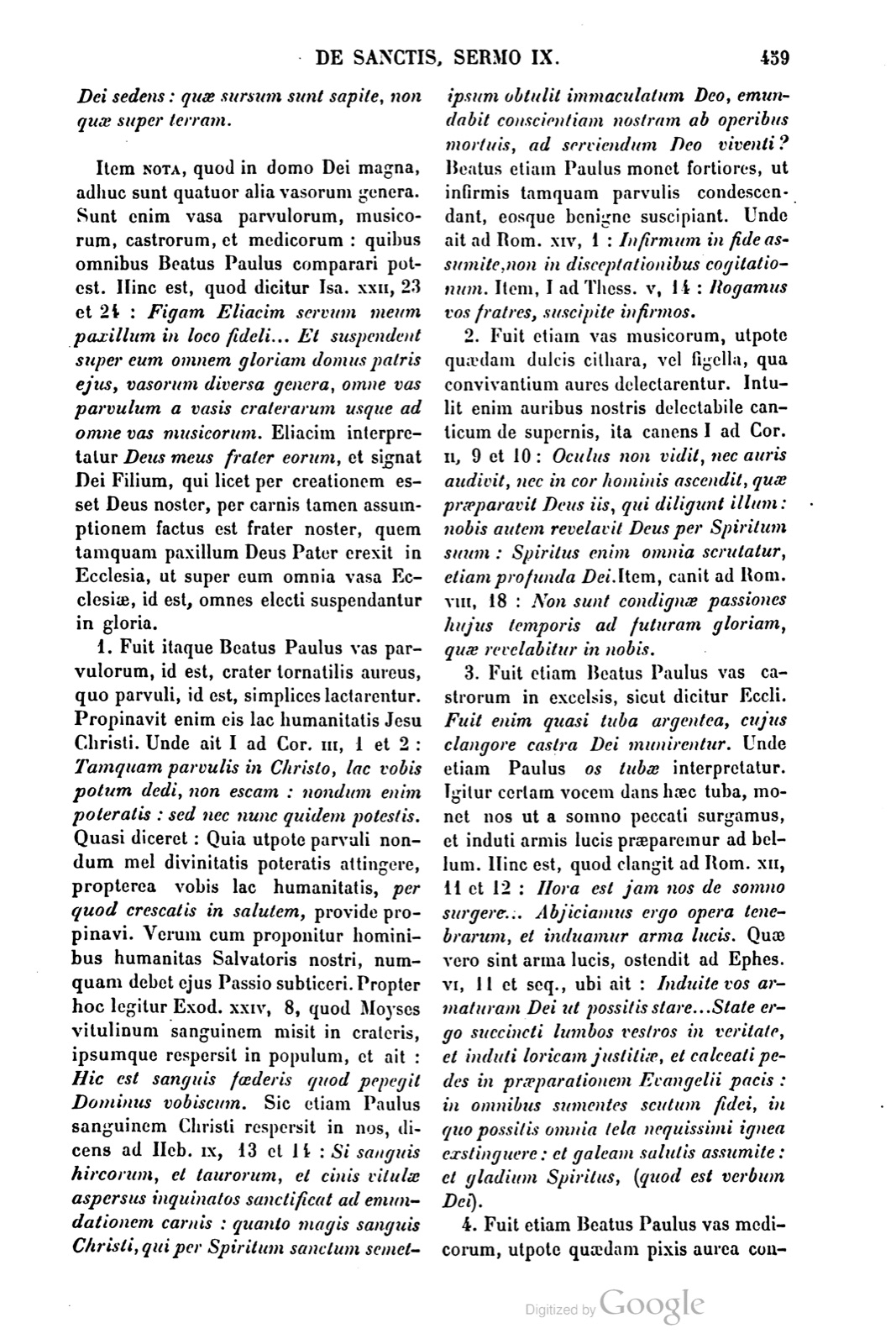
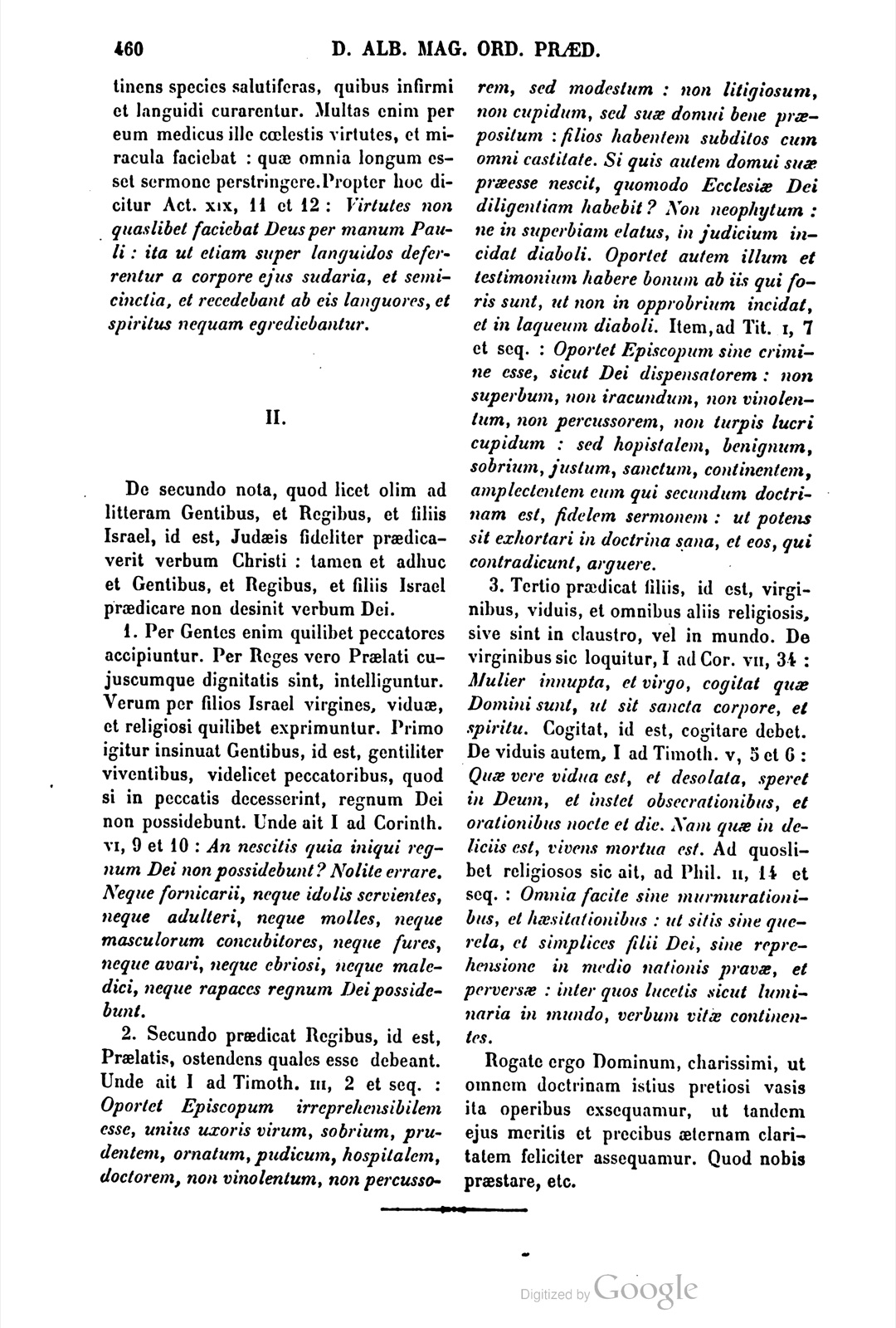
4. Fuit etiam Beatus Paulus vas medicorum, utpote quædam pixis aurea continens species salutiferas, quibus infirmi et languidi curarentur. Multas enim per eum medicus ille cœlestis virtutes, et miracula faciebat: quæ omnia longum esset sermone perstringere. Propter hoc dicitur Act. XIX, 11 et 12: Virtutes non quaslibet faciebat Deus per manum Pauli: ita ut etiam super languidos deferrentur a corpore ejus sudaria, et semicinctia, et recedebant ab eis languores, et spiritus nequam egrediebantur.
II.
De secundo nota, quod licet olim ad litteram Gentibus, et Regibus, et filiis Israel, id est, Judæis fideliter prædicaverit verbum Christi: tamen et adhuc et Gentibus, et Regibus, et filiis Israel prædicare non desinit verbum Dei.
1. Per Gentes enim quilibet peccatores accipiuntur. Per Reges vero Prælati cujuscumque dignitatis sint, intelliguntur. Verum per filios Israel virgines, viduæ, et religiosi quilibet exprimuntur. Primo igitur insinuat Gentibus, id est, gentiliter viventibus, videlicet peccatoribus, quod si in peccatis decesserint, regnum Dei non possidebunt. Unde ait I ad Corinth. VI, 9 et 10: An nescitis quia iniqui regnum Dei non possidebunt? Nolite errare. Neque fornicarii, neque idolis servientes, neque adulteri, neque molles, neque masculorum concubitores, neque fures, neque avari, neque ebriosi, neque maledici, neque rapaces regnum Dei possidebunt.
2. Secundo prædicat Regibus, id est, Prælatis, ostendens quales esse debeant. Unde ait I ad Timoth. III, 2 et seq.: Oportet Episcopum irreprehensibilem esse, unius uxoris virum, sobrium, prudentem, ornatum, pudicum, hospitalem, doctorem, non vinolentum, non percussorem, sed modestum: non litigiosum, non cupidum, sed suæ domui bene præpositum: filios habentem subditos cum omni castitate. Si quis autem domui suæ præesse nescit, quomodo Ecclesiæ Dei diligentiam habebit? Non neophytum: ne in superbiam elatus, in judicium incidat diaboli. Oportet autem illum et testimonium habere bonum ab iis qui foris sunt, ut non in opprobrium incidat, et in laqueum diaboli. Item, ad Tit. I, 7 et seq.: Oportet Episcopum sine crimine esse, sicut Dei dispensatorem: non superbum, non iracundum, non vinolentum, non percussorem, non turpis lucri cupidum: sed hospitalem, benignum, sobrium, justum, sanctum, continentem, amplectentem eum qui secundum doctrinam est, fidelem sermonem: ut potens sit exhortari in doctrina sana, et eos, qui contradicunt, arguere.
3. Tertio prædicat filiis, id est, virginibus, viduis, et omnibus aliis religiosis, sive sint in claustro, vel in mundo. De virginibus sic loquitur, I ad Cor. VII, 34: Mulier innupta, et virgo, cogitat quæ Domini sunt, ut sit sancta corpore, et spiritu. Cogitat, id est, cogitare debet. De viduis autem, I ad Timoth. V, 5 et 6: Quæ vere vidua est, et desolata, speret in Deum, et instet obsecrationibus, et orationibus nocte et die. Nam quæ in deliciis est, vivens mortua est. Ad quoslibet religiosos sic ait, ad Phil. II, 14 et seq.: Omnia facite sine murmurationibus, et hæsitationibus: ut sitis sine querela, et simplices filii Dei, sine reprehensione in medio nationis pravæ, et perversæ: inter quos lucetis sicut luminaria in mundo, verbum vitæ continentes.
Rogate ergo Dominum, charissimi, ut omnem doctrinam istius pretiosi vasis ita operibus exsequamur, ut tandem ejus meritis et precibus æternam claritatem feliciter assequamur. Quod nobis præstare, etc.
4. Blessed Paul was also a vessel of physicians, as a certain golden box containing health-bringing spices, by which the sick and weak might be cured. For that heavenly physician was doing many powers and miracles through him; it would be long to touch briefly on all these in speech. On account of this it is said in Acts 19:11 and 12: God was doing no ordinary powers by the hand of Paul, so that even upon the weak there were brought from his body handkerchiefs and aprons, and the illnesses withdrew from them, and wicked spirits went out.
II.
On the second, note that although formerly, according to the letter, he preached the word of Christ faithfully to Gentiles, and Kings, and sons of Israel, that is, to Jews, nevertheless even now he does not cease to preach the word of God both to Gentiles, and Kings, and sons of Israel.
1. For by Gentiles any sinners are taken. But by Kings Prelates are understood, of whatever dignity they may be. But by the sons of Israel virgins, widows, and any religious are expressed. Therefore first he intimates to Gentiles, that is, to those living gentile-wise, namely to sinners, that if they have died in sins, they will not possess the kingdom of God. Hence he says, 1 Corinthians 6:9 and 10: Do you not know that the unjust will not possess the kingdom of God? Do not err. Neither fornicators, nor those serving idols, nor adulterers, nor the soft, nor those who lie with males, nor thieves, nor the avaricious, nor drunkards, nor evil-speakers, nor the rapacious will possess the kingdom of God.
2. Secondly he preaches to Kings, that is, to Prelates, showing what sort they ought to be. Hence he says, 1 Timothy 3:2 and following: It is necessary for a Bishop to be irreprehensible, a man of one wife, sober, prudent, adorned, chaste, hospitable, a teacher, not given to wine, not a striker, but modest; not litigious, not covetous, but well set over his own house, having children subject with all chastity. But if someone does not know how to be over his own house, how will he have diligence of the Church of God? Not a neophyte, lest, lifted up into pride, he fall into the judgment of the devil. But it is also necessary for him to have good testimony from those who are outside, so that he may not fall into disgrace and into the snare of the devil. Likewise, at Titus 1:7 and following: It is necessary for a Bishop to be without crime, as a dispenser of God: not proud, not wrathful, not given to wine, not a striker, not greedy of foul gain, but hospitable, kind, sober, just, holy, continent, embracing the faithful word which is according to doctrine, so that he may be able to exhort in sound doctrine and to argue against those who contradict.
3. Thirdly he preaches to sons, that is, to virgins, widows, and all other religious, whether they are in the cloister or in the world. Concerning virgins he speaks thus, 1 Corinthians 7:34: The unmarried woman and the virgin think upon the things that are of the Lord, that she may be holy in body and spirit. She thinks, that is, she ought to think. But concerning widows, 1 Timothy 5:5 and 6: She who is truly a widow and desolate, let her hope in God and be instant in beseechings and prayers night and day. For she who is in delights, living, is dead. To any religious he says thus, Philippians 2:14 and following: Do all things without murmurings and hesitations, so that you may be without complaint and simple sons of God, without rebuke in the midst of a crooked and perverse nation, among whom you shine like lights in the world, holding the word of life.
Therefore pray to the Lord, dearest ones, that we may so pursue the whole doctrine of that precious vessel by works, that at last by his merits and prayers we may happily attain eternal brightness. May he grant this to us, etc.
If a page does not appear, its photograph has not been uploaded yet.