Volume 13 · pp. 449–454
Sermon IX. On the Conversion of Blessed Paul, Opening
A marker with ≈ is an approximate page boundary, placed by measure of the text; the page photographs remain the authority. In the paired views, clicking a page marker brings that page into view.
SERMO IX.
IN CONVERSIONE B. PAULI.
Vas electionis est mihi iste, ut portet nomen meum coram gentibus, et regibus, et filiis Israel. Act. IX, 15.
Duo principaliter sunt hic notanda:
I. Quare Beatus Paulus a Domino vas electionis appellatur? II. Quid per Gentes, et Reges, ac filios Israel figuretur?
I.
De primo nota, quod Beatus Paulus ideo vas electionis appellatur a Domino, quia valde eligibilis, et commendabilis est, propter sex causas.
I. Commendatur enim a materiæ dignitate. II. Ab ornatus nobilitate. III. A capaci profunditate. IV. A jugi puritate. V. A solida firmitate. VI. A multiplici utilitate.
I. Igitur Beatus Paulus vas electionis appellatur propter materiæ dignitatem. Et certe aurum omne metallum dignitate præcellit. Erat autem vas aureum. Unde legitur Eccli. L, 1 et 10: Simon sacerdos magnus..., quasi vas auri solidum, ornatum omni lapide pretioso. Simon interpretatur obediens, et optime signat Beatum Paulum, qui in primo instanti visitationis suæ factus est obediens Jesu Christo. Unde cum jaceret prostratus in terra, dixit ad Dominum: Domine, quid me vis facere 1? Glossa: « Indica voluntatem tuam, et ego obediam. »
Convenienter etiam Sacerdos magnus appellatur, quia mox ut visitatus fuit a Domino, non pecus aliquod extrinsecus Christo obtulit, sed semetipsum. Per totum quippe triduum conversionis suæ neque manducavit, neque bibit, sed oravit. Corpus itaque suum Domino obtulit, a cibis et potibus abstinendo: animam vero suam Christo immolavit, in orationibus persistendo. Hinc est, quod legitur Act. IX, 9 et 11: Erat tribus diebus non videns, et non manducavit, neque bibit. Dominus etiam ait ad Ananiam: Surge et vade in vicum, qui vocatur Rectus: et quære in domo Judæ Saulum nomine Tarsensem: ecce enim orat.
Igitur Beatus Paulus obediens Sacerdos Domini erat, quasi vas auri solidum. Qui enim prius fuerat quasi ferreus, id est, crudelis et impius, postea divina operatione mutatus in virum alterum, factus est quasi aureus, id est, mitis et bonus. Aurum enim temperantius et nobilius est omni metallo, et propterea designat mansuetudinem et bonitatem, quæ connaturalis est Deo. Natura enim Dei est bonitas: Dei enim proprium est misereri semper et parcere.
Quod autem Paulus ferreus fuit, id est, crudelis et impius, ostenditur in Act. IX, 13 et 14, ubi Ananias dicit ad Dominum: Domine, audivi a multis de viro hoc, quanta mala fecerit sanctis tuis in Jerusalem: et hic habet potestatem a principibus Sacerdotum alligandi omnes qui invocant nomen tuum. Quod autem mutatus fuerit in aurum, id est, effectus fuerit mitis et bonus, per hoc evidenter patet, quod Ananias ait ad eum: Saule frater, Dominus misit me Jesus, qui apparuit tibi in via, qua veniebas, ut videas, et implearis Spiritu sancto 2. Per hoc quod frater appellatur, et implendus dicitur Spiritu sancto, manifeste probatur quod jam erat mitis et bonus, utpote frater repletus Spiritu sancto: Spiritui enim sancto aurea bonitas et benignitas attribuitur, sicut dicitur ad Gal. V, 22.
Aureus igitur erat Apostolus Paulus per mitem bonitatem, unde dicitur II ad Cor. VIII, 21: Providemus bona non solum coram Deo, sed etiam coram omnibus hominibus. Ipse etiam invitat nos ad hoc, ut boni simus, ad Rom. XII, 9 et 17: Odientes malum, adhærentes bono...: providentes bona non tantum coram Deo, sed etiam coram omnibus hominibus. Providentes, id est, provide agentes. In quo vero præcipua bonitas consistat, ostendit ibidem 3, ita dicens: Benedicite persequentibus vos: benedicite et nolite maledicere... Si esurierit inimicus tuus, ciba illum: si sitit, potum da illi. Nota, bis dicit: Benedicite. Quasi dicat: Benedicite corde, et benedicite ore. Ecce, in quo præcipua bonitas consistit, ut videlicet inimicis nostris corde et ore benedicamus, ipsisque cibum et potum, dum indigent, præbeamus et demus.
SERMON IX.
ON THE CONVERSION OF BLESSED PAUL.
He is a vessel of election for me, that he may carry my name before gentiles, and kings, and the sons of Israel. Acts 9:15.
Two things chiefly are to be noted here:
I. Why Blessed Paul is called by the Lord a vessel of election? II. What is figured by Gentiles, and Kings, and the sons of Israel?
I.
On the first, note that Blessed Paul is called a vessel of election by the Lord for this reason, because he is very choice-worthy and commendable for six causes.
I. For he is commended from the dignity of the material. II. From the nobility of adornment. III. From capacious depth. IV. From constant purity. V. From solid firmness. VI. From manifold usefulness.
I. Therefore Blessed Paul is called a vessel of election because of the dignity of the material. And certainly gold surpasses every metal in dignity. But he was a golden vessel. Hence it is read in Ecclesiasticus 50:1 and 10: Simon the great priest..., as a solid vessel of gold, adorned with every precious stone. Simon is interpreted obedient, and very well signifies Blessed Paul, who in the first instant of his visitation was made obedient to Jesus Christ. Hence when he was lying prostrate on the earth, he said to the Lord: Lord, what do you wish me to do 1? The Gloss: "Indicate your will, and I shall obey."
The great Priest is also fittingly applied to him, because as soon as he was visited by the Lord, he offered to Christ not some beast outside himself, but his very self. For during the whole three days of his conversion he neither ate nor drank, but prayed. Therefore he offered his body to the Lord by abstaining from foods and drinks; but he sacrificed his soul to Christ by persisting in prayers. Hence it is read, Acts 9:9 and 11: He was three days not seeing, and he did not eat nor drink. The Lord also said to Ananias: Arise and go into the street which is called Straight, and seek in the house of Judas Saul by name, of Tarsus: for behold, he prays.
Therefore Blessed Paul was the obedient Priest of the Lord, as a solid vessel of gold. For he who before had been as iron, that is, cruel and impious, afterward, changed by divine operation into another man, was made as golden, that is, meek and good. For gold is more tempered and nobler than every metal, and for this reason it designates meekness and goodness, which is connatural to God. For the nature of God is goodness: for it is God's own proper thing always to have mercy and to spare.
But that Paul was iron, that is, cruel and impious, is shown in Acts 9:13 and 14, where Ananias says to the Lord: Lord, I have heard from many of this man, how many evils he has done to your saints in Jerusalem: and here he has power from the chief priests to bind all who invoke your name. But that he was changed into gold, that is, was made meek and good, is plainly evident through this, that Ananias says to him: Saul, brother, the Lord Jesus has sent me, who appeared to you on the road by which you were coming, so that you may see and be filled with the Holy Spirit 2. Through this, that he is called brother and is said to be about to be filled with the Holy Spirit, it is manifestly proved that he was already meek and good, as a brother filled with the Holy Spirit: for golden goodness and kindness are attributed to the Holy Spirit, as is said at Galatians 5:22.
Therefore the Apostle Paul was golden through meek goodness, whence it is said in 2 Corinthians 8:21: We provide good things not only before God, but also before all men. He himself also invites us to this, that we may be good, at Romans 12:9 and 17: Hating evil, adhering to good... providing good things not only before God, but also before all men. Providing, that is, acting providently. But in what chief goodness consists, he shows in the same place 3, saying thus: Bless those who persecute you: bless and do not curse... If your enemy is hungry, feed him; if he thirsts, give him drink. Note, he says twice: Bless. As if he were saying: Bless in heart, and bless in mouth. Behold in what chief goodness consists, namely that we bless our enemies in heart and mouth, and provide and give to them food and drink when they are in need.
II. Vas istud commendatur ab ornatus nobilitate. Ornatum enim erat omni lapide pretioso. Igitur ut de multis aliis pretiosis lapidibus taceamus, ornatus erat ad minus bis seno lapide pretioso, quibus etiam olim in lege rationale Summi Pontificis exstitit adornatum, sicut legitur Exod. XXXVIII, 17 et seq. Primus igitur lapis erat Jaspis. Secundus, Sapphirus. Tertius, Sardius. Quartus, Topazius. Quintus, Carbunculus. Sextus, Chrysolithus. Septimus, Smaragdus. Octavus, Amethystus. Nonus, Ligurius. Decimus, Beryllus. Undecimus, Achates. Duodecimus, Onychinus. Per Jaspidem notatur fidei fortitudo. Per Sapphirum spei celsitudo. Per Sardium memoria Dominicæ passionis. Per Topazion conformitas bonæ conservationis. Per Carbunculum claritas sapientiæ. Per Chrysolithum veritas cordis et linguæ. Per Smaragdum virens humilitas. Per Amethystum honorabilis sobrietas. Per Ligurium dulcis consolatio. Per Beryllum ardens increpatio. Per Achatem fortis obedientia. Per Onychinum læta perseverantia.
1. Primus igitur lapis pretiosus quo ornatum fuit hoc vas electionis, erat Jaspis, per quem intelligitur fidei fortitudo. Legitur enim de Jaspide, quod hominem efficit tutum timore deposito: omnibus etiam maleficiis, et incantationibus resistit. Sic et fideles credentes in Christum non pereunt, sed vitam æternam habebunt. Fides etiam est quasi quoddam nobile scutum, quod omnia tela nequissimi hostis exstinguit, sicut dicitur ad Ephes. VI, 16.
Fide igitur Sanctus Paulus erat ornatus: unde ait ad Galat. II, 16 et 20: Scientes, quod non justificatur homo..., nisi per fidem Jesu Christi... Quod autem nunc vivo in carne, in fide vivo Filii Dei, qui dilexit me, et tradidit semetipsum pro me.
Ipse etiam hortatur nos, ut contra diabolum fortiter stemus in fide. Propter quod ait I ad Corinth. XVI, 13 et 14: Vigilate, state in fide, viriliter agite, et confortamini in Domino: omnia vestra in charitate fiant. Ait etiam ad Hebr. XI, 6: Sine fide impossibile est placere Deo. Et quia impossibile est, quod aliquis placeat Deo sine fide, propterea scribit, II ad Corinth. XIII, 5: Si estis in fide, ipsi vos probate.
2. Secundus lapis attinens ad ornatum vasis istius, erat Sapphirus, per quem notatur spei celsitudo. Sicut enim Sapphirus colorem cælo similem habet, et sicut in ipso quædam stella rutilat, per quam virtus ejus dignoscitur: præterea Sapphirus membra hominis vegetat, et interiorem ardorem refrigerat: ita etiam spes ea quæ sursum sunt in cælo desiderat, et quodam dulci et lucido affectu cor illustrat: spes etiam membra debilia ad laborandum alleviat, et omnem intrinsecum ardorem tribulationum refrigerat.
II. That vessel is commended from the nobility of adornment. For it was adorned with every precious stone. Therefore, so that we may be silent about many other precious stones, it was adorned with at least twice six precious stones, with which also once in the law the rational of the High Priest existed adorned, as is read in Exodus 38:17 and following. Therefore the first stone was Jasper. The second, Sapphire. The third, Sardius. The fourth, Topaz. The fifth, Carbuncle. The sixth, Chrysolite. The seventh, Emerald. The eighth, Amethyst. The ninth, Ligure. The tenth, Beryl. The eleventh, Agate. The twelfth, Onyx. By Jasper the strength of faith is noted. By Sapphire the height of hope. By Sardius the memory of the Lord's Passion. By Topazion conformity of good preservation. By Carbuncle the brightness of wisdom. By Chrysolite truth of heart and tongue. By Emerald green humility. By Amethyst honorable sobriety. By Ligure sweet consolation. By Beryl burning rebuke. By Agate strong obedience. By Onyx joyful perseverance.
1. Therefore the first precious stone with which this vessel of election was adorned was Jasper, by which strength of faith is understood. For it is read of Jasper that it makes a man safe, fear having been put away; it also resists all evil arts and incantations. So also the faithful who believe in Christ do not perish, but will have eternal life. Faith is also as a certain noble shield, which extinguishes all the darts of the most wicked enemy, as is said at Ephesians 6:16.
Therefore Saint Paul was adorned with faith: hence he says to the Galatians 2:16 and 20: Knowing that man is not justified..., except through the faith of Jesus Christ... But that I now live in the flesh, I live in the faith of the Son of God, who loved me and handed himself over for me.
He also exhorts us, that we should stand strongly in faith against the devil. On account of which he says, 1 Corinthians 16:13 and 14: Watch, stand in faith, act manfully, and be strengthened in the Lord: let all your things be done in charity. He also says at Hebrews 11:6: Without faith it is impossible to please God. And because it is impossible that anyone please God without faith, therefore he writes, 2 Corinthians 13:5: If you are in the faith, prove yourselves.
2. The second stone belonging to the adornment of that vessel was Sapphire, by which the height of hope is noted. For just as Sapphire has a color similar to heaven, and just as in it a certain star shines red, through which its power is known; besides this, Sapphire enlivens the limbs of a man and cools interior heat: so also hope desires those things which are above in heaven, and illustrates the heart with a certain sweet and bright affection; hope also lightens weak limbs for labor, and cools every inward heat of tribulations.
Quod autem Beatus Paulus gemma spei fuerit adornatus, testatur ad Rom. V, 2: Gloriamur, inquit, in spe gloriæ filiorum Dei. Item ait, I ad Corinth. XV, 19: Si in hac vita tantum in Christo sperantes sumus, miserabiliores sumus omnibus hominibus. Item ait, I ad Timoth. VI, 17: Divitibus hujus sæculi præcipe non sublime sapere, neque sperare in incerto divitiarum, sed in Deo vivo, qui præstat nobis omnia abunde ad fruendum.
3. Tertius lapis in ornatu vasis istius, erat Sardius, per quem exprimitur memoria Dominicæ passionis. Sardius enim rubeum colorem habet: ita in passione rubeus factus est Dominus noster Jesus Christus. Unde ascendente eo in cœlum, quidam Angeli occurrentes ei dixerunt, ut ait Isa. LXIII, 2 et 3: Quare rubrum est vestimentum tuum, et vestimenta tua sicut calcantium in torculari? Quibus respondit Dominus: Torcular calcavi solus. Ibi dicit Glossa: « Crucem, et omnia tormenta passus sum, in quibus quasi prælo sum pressus, ita ut etiam sanguis funderetur. » Præterea in præsentiam Sardii, non potest nocere onyx: qui lapis, ut dicitur, lites multiplicat, et homines promovet ad rixas: ita etiam passio Domini ad memoriam efficaciter reducta, omnes lites dissolvit, et homines compescit a rixis: Dominus enim in passione quasi agnus mansuetus, coram tondente se obmutuit, et non aperuit os suum 4.
Quod autem Beatus Paulus memor, imo imitator semper fuerit Dominicæ passionis, insinuat ad Galat. II, 19 et 20: Christo confixus sum cruci. Vivo autem, jam non ego: vivit vero in me Christus. Item, ad Galat. VI, 14 et 17: Mihi autem absit gloriari, nisi in cruce Domini nostri Jesu Christi: per quem mihi mundus crucifixus est, et ego mundo... Ego enim stigmata Domini Jesu in corpore meo porto.
Hortatur etiam nos, ut cum Christo, et pro Christo patiamur. Unde ait ad Philip. I, 29: Quia vobis donatum est pro Christo, ut non solum in eum credatis, sed ut etiam pro illo patiamini. Dicit etiam ad Philip.: Hoc sentite in vobis, quod et in Christo Jesu..., qui humiliavit semetipsum, factus obediens usque ad mortem, mortem autem crucis 5.
4. Quartus lapis pretiosus in ornamento hujus vasis erat Topazius, per quem signatur conformitas bonæ conservationis. Topazius enim, ut dicit Glossa super Exod. « lapis est pretiosissimus, et est omnium colorum, et maxime aurei: » unde Topazius dicitur, quasi topadion, id est, omnium colorum. Dicitur etiam multum valere fluxum sanguinis patientibus.
Ita etiam Beatus Paulus conformitate bonæ vitæ omnibus se conformavit, ut omnes lucrifaceret, eosque ab immunditia sanguinei fluxus, id est, criminum liberaret. Unde ait, I ad Corinth. IX, 19, 20 et 22: Cum liber essem ex omnibus, omnium me servum feci, ut plures lucrifacerem. Et factus sum Judæis tamquam Judæus, ut Judæos lucrarer... Factus sum infirmis infirmus, ut infirmos lucrifacerem. Omnibus omnia factus sum, ut omnes facerem salvos.
But that Blessed Paul was adorned with the gem of hope, he testifies at Romans 5:2: We glory, he says, in the hope of the glory of the sons of God. Likewise he says, 1 Corinthians 15:19: If in this life only we are hoping in Christ, we are more miserable than all men. Likewise he says, 1 Timothy 6:17: Command the rich of this age not to be high-minded, nor to hope in the uncertainty of riches, but in the living God, who grants us all things abundantly for enjoyment.
3. The third stone in the adornment of that vessel was Sardius, by which the memory of the Lord's Passion is expressed. For Sardius has a red color: so in the Passion our Lord Jesus Christ was made red. Hence when he was ascending into heaven, certain Angels meeting him said to him, as Isaiah 63:2 and 3 says: Why is your garment red, and your garments like those of men treading in a winepress? To whom the Lord answered: I have trodden the winepress alone. There the Gloss says: "I suffered the Cross and all torments, in which I was pressed as in a press, so that even blood was poured out." Besides, in the presence of Sardius, onyx cannot do harm: that stone, as is said, multiplies quarrels and advances men toward disputes. So also the Passion of the Lord, effectively brought back to memory, dissolves all quarrels and restrains men from disputes: for the Lord in the Passion, like a meek lamb, was silent before the one shearing him, and did not open his mouth 4.
But that Blessed Paul was always mindful, indeed an imitator, of the Lord's Passion, he indicates at Galatians 2:19 and 20: I am fixed with Christ to the cross. But I live, now not I: truly Christ lives in me. Likewise, at Galatians 6:14 and 17: But far be it from me to glory, except in the cross of our Lord Jesus Christ, through whom the world has been crucified to me and I to the world... For I bear the marks of the Lord Jesus in my body.
He also exhorts us to suffer with Christ and for Christ. Hence he says at Philippians 1:29: Because it has been given to you for Christ, that you should not only believe in him, but also suffer for him. He also says to the Philippians: Feel this in yourselves, which was also in Christ Jesus..., who humbled himself, made obedient even unto death, even the death of the cross 5.
4. The fourth precious stone in the ornament of this vessel was Topaz, by which conformity of good preservation is signified. For Topaz, as the Gloss says on Exodus, "is a most precious stone, and is of all colors, and especially of golden color"; hence Topaz is called as if topadion, that is, of all colors. It is also said to be of much value to those suffering a flow of blood.
So also Blessed Paul by conformity of good life conformed himself to all, so that he might gain all and free them from the uncleanness of the bloody flow, that is, of crimes. Hence he says, 1 Corinthians 9:19, 20 and 22: Since I was free from all, I made myself the servant of all, that I might gain more. And I became to the Jews as a Jew, that I might gain the Jews... I became weak to the weak, that I might gain the weak. I became all things to all, that I might make all saved.
Ipse etiam monet nos, ut imitatione sui cuilibet homini per bonam conservationem nos conformemus: ait enim I ad Corinth. X, 32 et 33: Sine offensione estote Judæis, et Gentibus, et Ecclesiæ Dei. Sicut et ego per omnia omnibus placeo, non quærens quod mihi utile est, sed quod multis, ut salvi fiant. Glossa: « Hoc est omnibus per omnia placere, sine scandalo, cuique agere ad profectum aliorum, ut et illis, et huic sit utile. »
5. Quintus lapis quo vas istud egregium fuit ornatum, erat Carbunculus, per quem claritas sapientiæ figuratur. Sicut enim Carbunculus lucet in tenebris, et res circa se existentes illustrat; ita et Beatus Paulus per sapientiam sibi divinitus inspiratam, hujus mundi tenebras illustravit. Unde et cantatur de eo: « O gloriosum lumen omnium Ecclesiarum, sole splendidius, o vere Apostolicum sidus Altissimi S. Paulus, qui Ecclesiæ solem splendidum te Gentibus infundit. » Legitur etiam in Collecta: « Deus, qui universum mundum Beati Pauli Apostoli prædicatione docuisti. »
Quod autem mirabili sapientia fuerit insignitus, testatur de seipso, I ad Cor. II, 6 et 7: Sapientiam loquimur inter perfectos: sapientiam vero non hujus sæculi, neque principum hujus sæculi, qui destruuntur: sed loquimur Dei sapientiam. Sapientiam vero suam Paulus desuper acceperat, unde dicit ad Gal. I, 11 et 12: Notum vobis facio, fratres, Evangelium, quod evangelizatum est a me, quia non est secundum hominem: neque enim ego ab homine accepi illud, neque didici, sed per revelationem Jesu Christi.
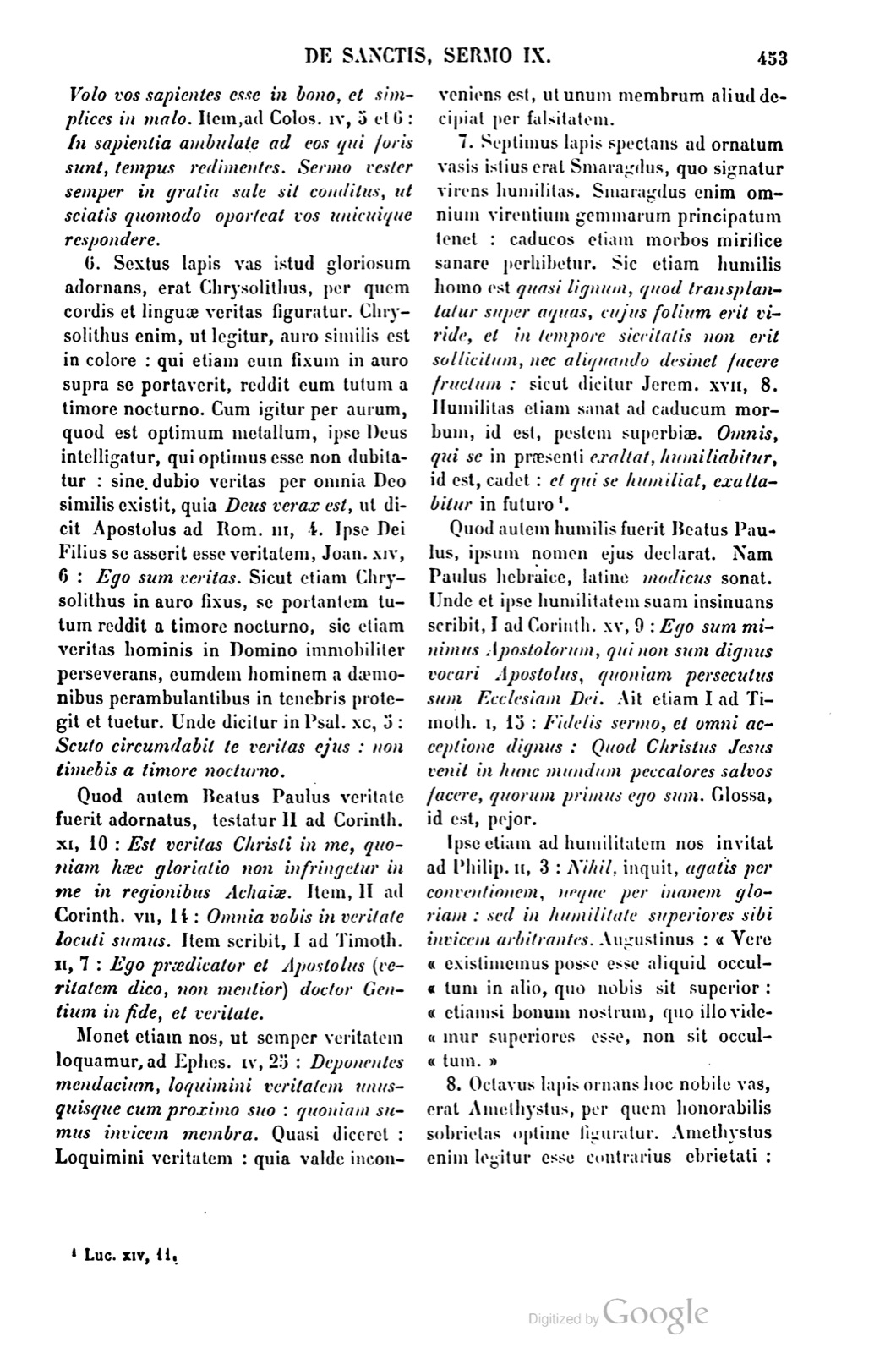
Ipse etiam invitat nos, ut sapientiam carnis fugientes prudentiam spiritus imitemur. Unde ait ad Rom. VIII, 5 et seq.: Qui secundum carnem sunt, quæ carnis sunt, sapiunt: qui vero secundum Spiritum sunt, quæ sunt Spiritus, sentiunt. Nam prudentia carnis, mors est: prudentia autem Spiritus, vita et pax. Quoniam sapientia carnis inimica est Deo... Qui in carne sunt, Deo placere non possunt. Ait etiam ad Roman. XVI, 19: Volo vos sapientes esse in bono, et simplices in malo. Item, ad Colos. IV, 5 et 6: In sapientia ambulate ad eos qui foris sunt, tempus redimentes. Sermo vester semper in gratia sale sit conditus, ut sciatis quomodo oporteat vos unicuique respondere.
6. Sextus lapis vas istud gloriosum adornans, erat Chrysolithus, per quem cordis et linguæ veritas figuratur. Chrysolithus enim, ut legitur, auro similis est in colore: qui etiam eum fixum in auro supra se portaverit, reddit eum tutum a timore nocturno. Cum igitur per aurum, quod est optimum metallum, ipse Deus intelligatur, qui optimus esse non dubitatur: sine dubio veritas per omnia Deo similis existit, quia Deus verax est, ut dicit Apostolus ad Rom. III, 4. Ipse Dei Filius se asserit esse veritatem, Joan. XIV, 6: Ego sum veritas. Sicut etiam Chrysolithus in auro fixus, se portantem tutum reddit a timore nocturno, sic etiam veritas hominis in Domino immobiliter perseverans, eumdem hominem a dæmonibus perambulantibus in tenebris protegit et tuetur. Unde dicitur in Psal. XC, 5: Scuto circumdabit te veritas ejus: non timebis a timore nocturno.
He himself also admonishes us that, in imitation of himself, we should conform ourselves to any man through good preservation: for he says, 1 Corinthians 10:32 and 33: Be without offense to Jews, and Gentiles, and the Church of God. As I also please all men in all things, not seeking what is useful to me, but what is useful to many, that they may be saved. Gloss: "This is to please all through all things without scandal, to do something for each one for the advancement of others, so that it may be useful both to them and to this one."
5. The fifth stone with which that excellent vessel was adorned was Carbuncle, by which brightness of wisdom is figured. For just as Carbuncle shines in darkness and illuminates the things existing around itself, so also Blessed Paul, through wisdom divinely inspired into him, illuminated the darkness of this world. Hence also it is sung of him: "O glorious light of all Churches, more splendid than the sun, O truly Apostolic star of the Most High, Saint Paul, who pours the splendid sun of the Church among the Gentiles." It is also read in the Collect: "O God, who taught the whole world by the preaching of Blessed Paul the Apostle."
But that he was marked with marvelous wisdom, he testifies about himself, 1 Corinthians 2:6 and 7: We speak wisdom among the perfect: but wisdom not of this age, nor of the princes of this age, who are destroyed; but we speak the wisdom of God. But Paul had received his wisdom from above, whence he says at Galatians 1:11 and 12: I make known to you, brothers, the Gospel which was evangelized by me, that it is not according to man: for neither did I receive it from man, nor did I learn it, but through the revelation of Jesus Christ.
He also invites us, fleeing the wisdom of the flesh, to imitate the prudence of the spirit. Hence he says at Romans 8:5 and following: Those who are according to the flesh savor the things that are of the flesh; but those who are according to the Spirit feel the things that are of the Spirit. For the prudence of the flesh is death; but the prudence of the Spirit is life and peace. Because the wisdom of the flesh is hostile to God... Those who are in the flesh cannot please God. He also says at Romans 16:19: I wish you to be wise in good and simple in evil. Likewise, at Colossians 4:5 and 6: Walk in wisdom toward those who are outside, redeeming the time. Let your speech always be in grace, seasoned with salt, so that you may know how you ought to answer each one.
6. The sixth stone adorning that glorious vessel was Chrysolite, by which truth of heart and tongue is figured. For Chrysolite, as is read, is similar to gold in color; whoever carries it fixed in gold upon himself, it renders him safe from nightly fear. Since therefore by gold, which is the best metal, God himself is understood, who is not doubted to be best: without doubt truth through all things exists similar to God, because God is true, as the Apostle says at Romans 3:4. The Son of God himself asserts himself to be the truth, John 14:6: I am truth. As also Chrysolite fixed in gold renders the one carrying it safe from nightly fear, so also the truth of a man persevering immovably in the Lord protects and guards that same man from demons walking about in darkness. Hence it is said in Psalm 90:5: His truth will surround you with a shield: you will not fear from nightly fear.
Quod autem Beatus Paulus veritate fuerit adornatus, testatur II ad Corinth. XI, 10: Est veritas Christi in me, quoniam hæc gloriatio non infringetur in me in regionibus Achaiæ. Item, II ad Corinth. VII, 14: Omnia vobis in veritate locuti sumus. Item scribit, I ad Timoth. II, 7: Ego prædicator et Apostolus (veritatem dico, non mentior) doctor Gentium in fide, et veritate.
Monet etiam nos, ut semper veritatem loquamur, ad Ephes. IV, 25: Deponentes mendacium, loquimini veritatem unusquisque cum proximo suo: quoniam sumus invicem membra. Quasi diceret: Loquimini veritatem: quia valde inconveniens est, ut unum membrum aliud decipiat per falsitatem.
7. Septimus lapis spectans ad ornatum vasis istius erat Smaragdus, quo signatur virens humilitas. Smaragdus enim omnium virentium gemmarum principatum tenet: caducos etiam morbos mirifice sanare perhibetur. Sic etiam humilis homo est quasi lignum, quod transplantatur super aquas, cujus folium erit viride, et in tempore siccitatis non erit sollicitum, nec aliquando desinet facere fructum: sicut dicitur Jerem. XVII, 8. Humilitas etiam sanat ad caducum morbum, id est, pestem superbiæ. Omnis, qui se in præsenti exaltat, humiliabitur, id est, cadet: et qui se humiliat, exaltabitur in futuro 6.
Quod autem humilis fuerit Beatus Paulus, ipsum nomen ejus declarat. Nam Paulus hebraice, latine modicus sonat. Unde et ipse humilitatem suam insinuans scribit, I ad Corinth. XV, 9: Ego sum minimus Apostolorum, qui non sum dignus vocari Apostolus, quoniam persecutus sum Ecclesiam Dei. Ait etiam I ad Timoth. I, 15: Fidelis sermo, et omni acceptione dignus: Quod Christus Jesus venit in hunc mundum peccatores salvos facere, quorum primus ego sum. Glossa, id est, pejor.
Ipse etiam ad humilitatem nos invitat ad Philip. II, 3: Nihil, inquit, agatis per contentionem, neque per inanem gloriam: sed in humilitate superiores sibi invicem arbitrantes. Augustinus: « Vere existimemus posse esse aliquid occultum in alio, quo nobis sit superior: etiamsi bonum nostrum, quo illo videmur superiores esse, non sit occultum. »
8. Octavus lapis ornans hoc nobile vas, erat Amethystus, per quem honorabilis sobrietas optime figuratur. Amethystus enim legitur esse contrarius ebrietati: præterea de facili sculpi potest. Sic etiam sobrietas ebrietatem elidit. Sobrius etiam homo adhuc aptus est, ut sculpturam recipiat, id est, doctrinam.
Quod autem Paulus sobrietate fuerit ornatus, ostendit II ad Thimoth. I, 7: Dedit nobis Deus spiritum sobrietatis. Ait etiam in Actib. XXVI, 25: Veritatis et sobrietatis verba loquor. Admonet etiam nos ut sobrii simus, I ad Thess. V, 6, 7 et 8: Non dormiamus sicut et cæteri, sed vigilemus, et sobrii simus. Qui enim dormiunt, nocte dormiunt: et qui ebrii sunt, nocte ebrii sunt. Nos autem, qui diei sumus, sobrii simus. Ait etiam I ad Cor. V, 11: Qui ebriosus est...: cum ejusmodi nec cibum sumite. Vel I ad Cor. VI, 10: Ebriosi regnum Dei non possidebunt.
But that Blessed Paul was adorned with truth, he testifies in 2 Corinthians 11:10: The truth of Christ is in me, because this glorying will not be broken in me in the regions of Achaia. Likewise, 2 Corinthians 7:14: We have spoken all things to you in truth. Likewise he writes, 1 Timothy 2:7: I am a preacher and Apostle (I speak the truth, I do not lie), a teacher of the Gentiles in faith and truth.
He also admonishes us that we should always speak truth, at Ephesians 4:25: Putting away lying, speak truth each one with his neighbor, because we are members one of another. As if he were saying: Speak truth, because it is very unfitting that one member deceive another through falsehood.
7. The seventh stone pertaining to the adornment of that vessel was Emerald, by which green humility is signified. For Emerald holds the chief place of all green gems; it is also reported to heal falling sicknesses wonderfully. So also a humble man is like a tree which is transplanted over waters, whose leaf will be green, and in time of drought it will not be anxious, nor will it ever cease to make fruit, as is said in Jeremiah 17:8. Humility also heals against the falling sickness, that is, the plague of pride. Everyone who exalts himself in the present will be humbled, that is, will fall; and he who humbles himself will be exalted in the future 6.
But that Blessed Paul was humble, his very name declares. For Paulus in Hebrew sounds in Latin as small. Hence he himself, indicating his humility, writes, 1 Corinthians 15:9: I am the least of the Apostles, who am not worthy to be called an Apostle, because I persecuted the Church of God. He also says, 1 Timothy 1:15: A faithful saying and worthy of all acceptance: That Christ Jesus came into this world to make sinners saved, of whom I am first. Gloss, that is, worse.
He also invites us to humility at Philippians 2:3: Do nothing, he says, through contention, nor through vain glory: but in humility judging one another superior to yourselves. Augustine: "Let us truly think that there can be something hidden in another, by which he may be superior to us: even if our good, by which we seem to be superior to him, is not hidden."
8. The eighth stone adorning this noble vessel was Amethyst, by which honorable sobriety is very well figured. For Amethyst is read to be contrary to drunkenness; besides, it can easily be carved. So also sobriety strikes down drunkenness. The sober man is also still apt to receive carving, that is, teaching.
But that Paul was adorned with sobriety, 2 Timothy 1:7 shows: God gave us a spirit of sobriety. He also says in Acts 26:25: I speak words of truth and sobriety. He also admonishes us that we be sober, 1 Thessalonians 5:6, 7 and 8: Let us not sleep as the rest do, but let us watch and be sober. For those who sleep, sleep at night; and those who are drunk, are drunk at night. But we, who are of the day, let us be sober. He also says, 1 Corinthians 5:11: He who is drunk... with such a one do not even take food. Or 1 Corinthians 6:10: The drunkards will not possess the kingdom of God.
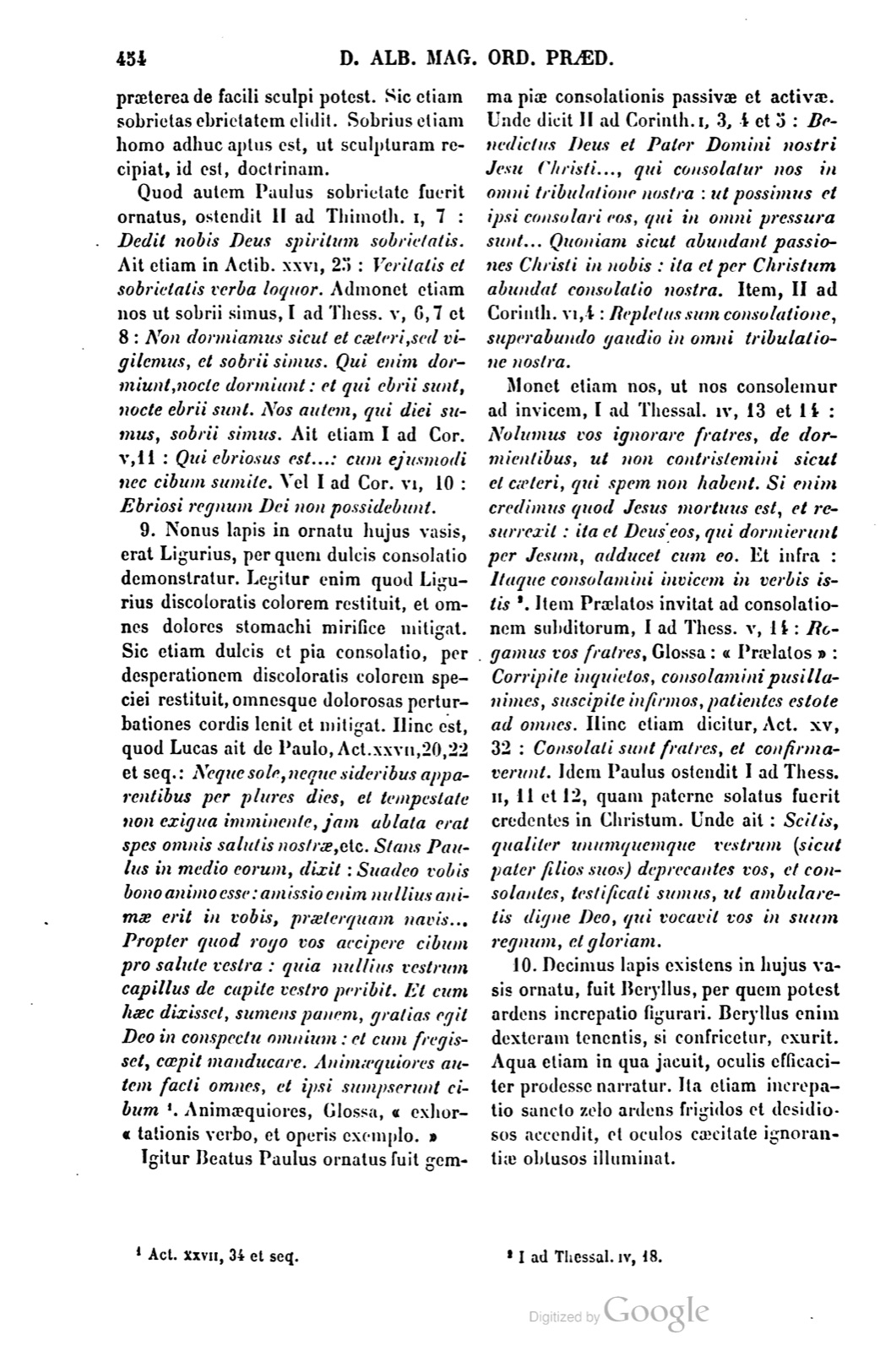
9. Nonus lapis in ornatu hujus vasis, erat Ligurius, per quem dulcis consolatio demonstratur. Legitur enim quod Ligurius discoloratis colorem restituit, et omnes dolores stomachi mirifice mitigat. Sic etiam dulcis et pia consolatio, per desperationem discoloratis colorem speciei restituit, omnesque dolorosas perturbationes cordis lenit et mitigat. Hinc est, quod Lucas ait de Paulo, Act. XXVII, 20, 22 et seq.: Neque sole, neque sideribus apparentibus per plures dies, et tempestate non exigua imminente, jam ablata erat spes omnis salutis nostræ, etc. Stans Paulus in medio eorum, dixit: Suadeo vobis bono animo esse: amissio enim nullius animæ erit in vobis, præterquam navis... Propter quod rogo vos accipere cibum pro salute vestra: quia nullius vestrum capillus de capite vestro peribit. Et cum hæc dixisset, sumens panem, gratias egit Deo in conspectu omnium: et cum fregisset, cœpit manducare. Animæquiores autem facti omnes, et ipsi sumpserunt cibum 7. Animæquiores, Glossa, « exhortationis verbo, et operis exemplo. »
Igitur Beatus Paulus ornatus fuit gemma piæ consolationis passivæ et activæ. Unde dicit II ad Corinth. I, 3, 4 et 5: Benedictus Deus et Pater Domini nostri Jesu Christi..., qui consolatur nos in omni tribulatione nostra: ut possimus et ipsi consolari eos, qui in omni pressura sunt... Quoniam sicut abundant passiones Christi in nobis: ita et per Christum abundat consolatio nostra. Item, II ad Corinth. VI, 4: Repletus sum consolatione, superabundo gaudio in omni tribulatione nostra.
Monet etiam nos, ut nos consolemur ad invicem, I ad Thessal. IV, 13 et 14: Nolumus vos ignorare fratres, de dormientibus, ut non contristemini sicut et cæteri, qui spem non habent. Si enim credimus quod Jesus mortuus est, et resurrexit: ita et Deus eos, qui dormierunt per Jesum, adducet cum eo. Et infra: Itaque consolamini invicem in verbis istis 8. Item Prælatos invitat ad consolationem subditorum, I ad Thess. V, 14: Rogamus vos fratres, Glossa: « Prælatos »: Corripite inquietos, consolamini pusillanimes, suscipite infirmos, patientes estote ad omnes. Hinc etiam dicitur, Act. XV, 32: Consolati sunt fratres, et confirmaverunt. Idem Paulus ostendit I ad Thess. II, 11 et 12, quam paterne solatus fuerit credentes in Christum. Unde ait: Scitis, qualiter unumquemque vestrum (sicut pater filios suos) deprecantes vos, et consolantes, testificati sumus, ut ambularetis digne Deo, qui vocavit vos in suum regnum, et gloriam.
10. Decimus lapis existens in hujus vasis ornatu, fuit Beryllus, per quem potest ardens increpatio figurari. Beryllus enim dexteram tenentis, si confricetur, exurit. Aqua etiam in qua jacuit, oculis efficaciter prodesse narratur. Ita etiam increpatio sancto zelo ardens frigidos et desidiosos accendit, et oculos cæcitate ignorantiæ obtusos illuminat.
9. The ninth stone in the adornment of this vessel was Ligure, by which sweet consolation is demonstrated. For it is read that Ligure restores color to the discolored and wonderfully mitigates all pains of the stomach. So also sweet and pious consolation restores the color of beauty to those discolored through despair, and softens and mitigates all painful disturbances of the heart. Hence it is that Luke says of Paul, Acts 27:20, 22 and following: With neither sun nor stars appearing for many days, and no slight tempest threatening, every hope of our salvation had already been taken away, etc. Paul, standing in their midst, said: I advise you to be of good courage: for there will be loss of no one's soul among you, except of the ship... On account of which I ask you to take food for your health: because a hair of the head of none of you will perish. And when he had said these things, taking bread, he gave thanks to God in the sight of all; and when he had broken it, he began to eat. But all, having become more composed, also took food 7. More composed, Gloss, "by the word of exhortation and by the example of the work."
Therefore Blessed Paul was adorned with the gem of pious consolation, passive and active. Hence he says, 2 Corinthians 1:3, 4 and 5: Blessed be the God and Father of our Lord Jesus Christ..., who consoles us in all our tribulation, so that we ourselves also may be able to console those who are in every distress... Since as the sufferings of Christ abound in us, so also through Christ our consolation abounds. Likewise, 2 Corinthians 6:4: I have been filled with consolation; I abound exceedingly with joy in all our tribulation.
He also admonishes us that we console one another, 1 Thessalonians 4:13 and 14: We do not wish you to be ignorant, brothers, concerning those who sleep, so that you may not be saddened like the rest who do not have hope. For if we believe that Jesus died and rose again, so also God will bring with him those who have slept through Jesus. And below: Therefore console one another in these words 8. Likewise he invites Prelates to the consolation of subjects, 1 Thessalonians 5:14: We ask you, brothers, Gloss: "Prelates": Rebuke the restless, console the faint-hearted, receive the weak, be patient toward all. Hence also it is said, Acts 15:32: They consoled the brothers and confirmed them. The same Paul shows in 1 Thessalonians 2:11 and 12 how paternally he consoled those believing in Christ. Hence he says: You know how each one of you (as a father his own sons), begging you and consoling you, we testified that you should walk worthily of God, who has called you into his kingdom and glory.
10. The tenth stone existing in the adornment of this vessel was Beryl, by which burning rebuke can be figured. For Beryl burns the right hand of the one holding it, if it is rubbed. The water also in which it has lain is narrated to help the eyes effectively. So also rebuke burning with holy zeal kindles the cold and sluggish, and illuminates eyes dulled by the blindness of ignorance.
Notes
- Acts 9:6. (Act. IX, 6.) ↩
- Acts 9:17. (Act. IX, 17.) ↩
- At Romans 12:14 and 20. (Ad Rom. XII, 14 et 20.) ↩
- Compare Isaiah 53:7. (Cf. Isa. LIII, 7.) ↩
- At Philippians 2:5 and 8. (Ad Philip. II, 5 et 8.) ↩
- Luke 14:11. (Luc. XIV, 11.) ↩
- Acts 27:34 and following. (Act. XXVII, 34 et seq.) ↩
- 1 Thessalonians 4:18. (I ad Thessal. IV, 18.) ↩
If a page does not appear, its photograph has not been uploaded yet.