Volume 13 · pp. 461–465
Sermon X. On the Purification of the Blessed Virgin Mary
A marker with ≈ is an approximate page boundary, placed by measure of the text; the page photographs remain the authority. In the paired views, clicking a page marker brings that page into view.
SERMO X.
IN PURIFICATIONE BEATÆ MARIÆ VIRG.
Tulerunt Jesum in Jerusalem, ut sisterent eum Domino. Luc. II, 22.
Quatuor hic prima facie notare potes:
I. Qui tulerint? II. Quem tulerint? III. Quo tulerint? IV. Propter quid tulerint?
Qui? Joseph et Maria. Quem? Puerum Jesum. Quo? In Jerusalem. Propter quid? ut sisterent eum Domino. Glossa, id est, « offerrent, et consecrarent. »
I.
Et nota, quod sicut Joseph et Maria tulerunt puerum Jesum in Jerusalem, ut offerrent eum Domino; sic et nos moraliter facere debemus.
Primo debemus spiritualiter esse Joseph et Maria: ut videlicet corpore quasi Joseph, anima vero Maria simus. Sicut enim Joseph Mariam conjugem suam non polluit, sed quasi fidelis custos, ei servivit: ita etiam corpus non debet animam quæ conjuncta est ei, polluere, sed potius ipsi fideli custodia deservire.
Hinc est, quod Dominus loquitur Levit. XI, 43 et 44: Nolite contaminare animas vestras. Ego enim sum Dominus Deus vester: sancti estote, quia ego sanctus sum. Ne polluatis animas vestras.
Et nota, quod non incongrue per Joseph qui interpretatur appositio, corpus intelligitur, quod de die in diem tendit ad hunc finem, ut in sepulcro mortuorum ossibus apponatur. Hinc est, quod legitur Gen. XXXV, 28 et 29: Completi sunt dies Isaac centum octoginta annorum. Consumptusque ætate mortuus est: et appositus est populo suo. Legitur etiam Gen. XLIX, 32: Finitis Jacob mandatis quibus filios instruebat, collegit pedes suos super lectulum, et obiit: appositusque est ad populum suum. Convenienter etiam per Mariam quæ illuminans interpretatur, pura anima figuratur. Per animam siquidem corpus illuminatur. Nam post abscessum animæ a corpore, corpus cinereum jacet et pallidum; unde absentia ejus probat, quid præsentia conferebat.
II.
Secundo, debemus ferre puerum Jesum. Ad hoc monet nos Apost. I ad Cor. VI, 20: Empti estis pretio magno. Glorificate, et portate Deum in corpore vestro. Ille in anima portat Dominum, qui ei servit ex toto intellectu, et ex tota voluntate, omnique memoria. Anima enim ad hoc se dare debet, ut bonum intelligat: bonum vero quod intelligit, velle debet: id etiam bonum quod vult, semper debet habere in memoria. Ille etiam in corpore suo portat Christum, qui omnia membra corporis, videlicet oculos, aures, os, linguam, dorsum, ventrem, et utrumque latus, manus, et pedes exhibet, et extendit in obsequio Jesu Christi. Unde dicit Apostolus ad Rom. VI, 19: Sicut exhibuistis membra vestra servire immunditiæ, et iniquitati ad iniquitatem, ita nunc exhibete membra vestra servire justitiæ in sanctificationem.
Et nota, quod dignum est ut portemus Christum, propter sex causas. Prima causa est, quia ipse pro nobis tulit dolores verberum, et flagellorum. Unde dicit Isa. LIII, 4: Vere languores nostros ipse tulit, et dolores nostros ipse portavit. Secunda causa est, quia ipse portavit pro nobis spineam coronam, qua acriter pungebatur. Unde dicitur Joan. XIX, 2 et 3: Milites plectentes coronam de spinis, imposuerunt capiti ejus... Exivit ergo Jesus portans coronam spineam. Tertia causa est, quia ipse pro nobis tulit crucis patibulum. Unde dicitur Joan. XIX, 17 et 18: Bajulans sibi crucem Jesus, exivit in eum, qui dicitur Calvariæ locum... ubi eum crucifixerunt. Quarta causa est, quia ipse peccata nostra, id est, pœnam peccatorum pertulit in ligno crucis. Unde dicitur I Petr. II, 24: Qui peccata nostra ipse pertulit in corpore super lignum: ut peccatis mortui, justitiæ vivamus. Pertulit, id est, perseveranter tulit. Quinta causa est, quia nos ab utero matris usque ad canos portat in peccatis nostris. Unde dicit in Isa. XLVI, 3 et 4: Audite me..., qui portamini a meo utero... Usque ad senectam ego ipse, et usque ad canos ego portabo: ego feci, et ego feram: ego portabo, et salvabo. Uterus Domini est misericordia ejus, in qua peccatores usque ad senectam et senium longanimiter portat, dissimulans peccata hominum propter pænitentiam. Sexta causa est, quia si eum portaverimus modo, facit nos tandem portari ab Angelis in sinum Abrahæ. Unde dicitur Luc. XVI, 22: Factum est ut moreretur mendicus, et portaretur ab Angelis in sinum Abrahæ. Septima causa est, quia non solum in sinum ad requiem, sed ad ubera portabimur ad refectionem. Unde dicit Isa. LXVI, 12 et 13: Ad ubera portabimini, et super genua blandientur vobis. Quomodo si cui mater blandiatur, ita ego consolabor vos, et in Jerusalem consolabimini.
SERMON X.
ON THE PURIFICATION OF THE BLESSED VIRGIN MARY.
They carried Jesus into Jerusalem, that they might present him to the Lord. Luke 2:22.
Here at first sight you can note four things:
I. Who carried? II. Whom they carried? III. To what place they carried? IV. On account of what they carried?
Who? Joseph and Mary. Whom? The boy Jesus. To what place? Into Jerusalem. On account of what? that they might present him to the Lord. Gloss, that is, "offer and consecrate."
I.
And note that just as Joseph and Mary carried the boy Jesus into Jerusalem, that they might offer him to the Lord, so also we ought to do morally.
First we ought spiritually to be Joseph and Mary: namely, so that in body we may be as Joseph, but in soul Mary. For just as Joseph did not pollute Mary his wife, but, as a faithful guardian, served her, so also the body ought not to pollute the soul which is joined to it, but rather to serve it with faithful guardianship.
Hence it is that the Lord speaks, Leviticus 11:43 and 44: Do not contaminate your souls. For I am the Lord your God: be holy, because I am holy. Do not pollute your souls.
And note that not unfittingly by Joseph, who is interpreted addition, the body is understood, which from day to day tends toward this end, that in the sepulcher it may be added to the bones of the dead. Hence it is read in Genesis 35:28 and 29: The days of Isaac were completed, one hundred eighty years. And consumed by age, he died and was added to his people. It is also read in Genesis 49:32: When Jacob's commands by which he was instructing his sons had been finished, he gathered his feet upon the little bed and died, and was added to his people. Fittingly also by Mary, who is interpreted illuminating, the pure soul is figured. For by the soul the body is illuminated. For after the departure of the soul from the body, the body lies ashen and pale; hence its absence proves what its presence used to confer.
II.
Secondly, we ought to bear the boy Jesus. To this the Apostle admonishes us, 1 Corinthians 6:20: You have been bought with a great price. Glorify and carry God in your body. He carries the Lord in his soul who serves him from his whole intellect, and from his whole will, and with all memory. For the soul ought to give itself to this, that it understand good; but the good that it understands, it ought to will; that good also which it wills, it ought always to have in memory. He also carries Christ in his body who presents and stretches out all the members of the body, namely eyes, ears, mouth, tongue, back, belly, and each side, hands and feet, in the service of Jesus Christ. Hence the Apostle says at Romans 6:19: As you presented your members to serve uncleanness and iniquity unto iniquity, so now present your members to serve justice unto sanctification.
And note that it is worthy that we carry Christ for six causes. The first cause is because he bore for us the pains of blows and scourges. Hence Isaiah 53:4 says: Truly he bore our weaknesses and he carried our pains. The second cause is because he carried for us the thorny crown, by which he was sharply pierced. Hence it is said in John 19:2 and 3: The soldiers, weaving a crown of thorns, placed it on his head... Therefore Jesus went out carrying the thorny crown. The third cause is because he bore for us the gibbet of the cross. Hence it is said in John 19:17 and 18: Jesus, carrying the cross for himself, went out to the place which is called Calvary... where they crucified him. The fourth cause is because he himself bore our sins, that is, the penalty of sins, on the wood of the cross. Hence it is said in 1 Peter 2:24: He himself bore our sins in his body upon the wood, so that, dead to sins, we may live to justice. He bore, that is, he bore perseveringly. The fifth cause is because from the womb of the mother even to white hairs he carries us in our sins. Hence he says in Isaiah 46:3 and 4: Hear me..., you who are carried from my womb... Even unto old age I myself, and even unto white hairs I will carry: I have made, and I will bear; I will carry and I will save. The womb of the Lord is his mercy, in which he long-sufferingly carries sinners even to old age and senescence, overlooking the sins of men for the sake of penance. The sixth cause is because if we carry him now, at last he makes us be carried by Angels into the bosom of Abraham. Hence it is said in Luke 16:22: It happened that the beggar died and was carried by Angels into the bosom of Abraham. The seventh cause is because we will be carried not only into the bosom for rest, but to the breasts for refreshment. Hence Isaiah 66:12 and 13 says: You will be carried to the breasts, and upon the knees they will caress you. As if a mother should caress someone, so I will console you, and in Jerusalem you will be consoled.
III.
Tertio, non debemus Jesum ad tempus portare, et postea a nobis eum rejicere, sicut multi faciunt, qui forsitan per susceptionem pœnitentiæ ipsum in Quadragesima portare incipiunt; sed statim ipso sancto die Paschæ, vel in crastino eum a se rejiciunt, comessationibus, ebrietatibus, ludis prohibitis et lascivis, nec non et luxuriis vacantes, sicut prius facere consueverunt. Portandus itaque est Jesus perseveranter, donec perveniatur in Jerusalem, per quam superna patria figuratur. Jerusalem quippe visio pacis interpretatur. Et vere in illa cœlesti superna patria vera pax videtur et est. Unde dicitur in Psal. CXLVII, 12 et 14: Lauda Jerusalem Dominum..., qui posuit fines tuos pacem. Hinc etiam Tob. XIII, 11 et 18: Jerusalem civitas Dei..., beati omnes qui diligunt te, et qui gaudent super pace tua.
IV.
Quarto, debemus puerum Jesum in Jerusalem offerre Deo Patri. Illam enim supernam Jerusalem, etsi nondum adhuc corpore possumus, quotidie tamen mente, et corde ingredi debemus, ut Deo Patri puerum Jesum offeramus. Tunc autem puerum Jesum Deo Patri offerimus, cum simpliciter petimus, ut misereatur nostri propter omnia quæ pro nobis sustinuit puer Jesus, videlicet propter nativitatem ejus, et circumcisionem; propter paupertatem, vigilias, lacrymas, et labores ejus: propter colaphos, alapas, et irrisiones, quas pro nobis sustinuit; propter sputa, quæ in facie suscepit, propter flagella quæ pertulit, propter spineam coronam quam in capite portavit, propter sæva vulnera quæ pro nobis in cruce passus fuit, et propter multa alia quæ pro nobis fecit, vel sustinuit dulcissimus Jesus. Unde Ecclesia omnes orationes suas sic concludit: « Per Dominum nostrum Jesum Christum Filium tuum. » Hinc est etiam, quod ait Apostolus ad Heb. XIII, 15: Per ipsum offeramus hostiam laudis semper Deo, id est, fructum labiorum confitentium nomini ejus. Hostia laudis est hostia laudabilis. Hæc autem hostia non tantum debet esse oratio, sed et fructus eorum qui Domino labiis confitentur.
III.
Thirdly, we ought not to carry Jesus for a time and afterward cast him away from us, as many do, who perhaps by the reception of penance begin to carry him in Lent; but immediately on the holy day of Easter itself, or on the next day, cast him away from themselves, giving themselves to feasts, drunkenness, forbidden and lascivious games, and also to lusts, as they had previously been accustomed to do. Therefore Jesus must be carried perseveringly, until one comes to Jerusalem, by which the supernal fatherland is figured. For Jerusalem is interpreted vision of peace. And truly in that heavenly supernal fatherland true peace is seen and exists. Hence it is said in Psalm 147:12 and 14: Praise the Lord, Jerusalem..., who has placed peace as your borders. Hence also Tobit 13:11 and 18: Jerusalem, city of God..., blessed are all who love you and who rejoice over your peace.
IV.
Fourthly, we ought to offer the boy Jesus in Jerusalem to God the Father. For that supernal Jerusalem, even if we are not yet able to enter it with the body, nevertheless daily we ought to enter it with mind and heart, so that we may offer the boy Jesus to God the Father. But then we offer the boy Jesus to God the Father when we simply ask that he have mercy on us on account of all things which the boy Jesus sustained for us, namely on account of his nativity and circumcision; on account of his poverty, vigils, tears, and labors; on account of the blows with fists, slaps, and mockeries which he sustained for us; on account of the spittings which he received in his face; on account of the scourges which he bore; on account of the thorny crown which he carried on his head; on account of the savage wounds which he suffered for us on the cross; and on account of many other things which most sweet Jesus did or sustained for us. Hence the Church concludes all her prayers thus: "Through our Lord Jesus Christ your Son." Hence it also is that the Apostle says at Hebrews 13:15: Through him let us offer always to God the sacrifice of praise, that is, the fruit of lips confessing his name. The sacrifice of praise is a praiseworthy sacrifice. But this sacrifice ought not only to be prayer, but also the fruit of those who confess the Lord with lips.
Et nota, quod Beata Maria Virgo non solum obtulit puerum suum Jesum, sed et obtulit cum eo talem oblationem quam paupercula puerpera secundum legem Moysi consuevit offerre, cujus videlicet manus præ paupertate agnum non poterat invenire. Hæc autem oblatio erat vel duo turtures, vel duo pulli columbæ, sicut legitur Levit. XII, 8. Ponamus ergo pro mysterio, quod obtulerit unum pullum columbæ, et unum turturem. In his duabus avibus, ut de multis earum proprietatibus taceamus, quatuor notantur, quæ optime conveniunt Beatæ Dei genitrici Mariæ. In columba quippe notatur prudens simplicitas, et prolis fœcunditas: in turture vero notatur perpetua continentia, et lenitatis patientia.
1. In columba igitur notatur prudens simplicitas. Prudentia ejus in hoc perpenditur, quod vitat insidias accipitris. Unde libenter nidificat in talibus locis, ad quæ accipiter accessum habere non potest. Simplicitas ejus in hoc attenditur, quod non curat de immundis cadaveribus: tantum puro grano vescitur, illoque contenta est. Sic etiam Beata Virgo prudens columba fuit, quæ cavens insidias infernalis accipitris, in Nazareth habitavit. Nazareth enim flos, vel sanctitas interpretatur. Et certe in flore sanctitatis commorantem diabolus nulla persuasione poterat attingere. Simplicitatem etiam suam commendabilem in hoc ostendit, quod omni transitoria delectatione contempta, solum illud cœleste granum elegit, quod erat in sinu Dei Patris, per quod ipsa etiam impleta fuit omni bono. Unde et Angelus dixit ad illam: Ave gratia plena 1.
And note that the Blessed Virgin Mary not only offered her boy Jesus, but also offered with him such an oblation as a poor little woman in childbirth was accustomed to offer according to the law of Moses, whose hand, namely because of poverty, could not find a lamb. But this oblation was either two turtledoves or two young pigeons, as is read in Leviticus 12:8. Therefore let us suppose for the mystery that she offered one young pigeon and one turtledove. In these two birds, so that we may be silent about many of their properties, four things are noted which fit the Blessed Mary, Mother of God, very well. For in the dove prudent simplicity and fruitfulness of offspring are noted; but in the turtledove perpetual continence and patience of gentleness are noted.
1. Therefore in the dove prudent simplicity is noted. Its prudence is observed in this, that it avoids the snares of the hawk. Hence it gladly nests in such places to which the hawk cannot have access. Its simplicity is considered in this, that it does not care for unclean carcasses; it feeds only on pure grain and is content with that. So also the Blessed Virgin was a prudent dove, who, avoiding the snares of the infernal hawk, dwelt in Nazareth. For Nazareth is interpreted flower or holiness. And certainly the devil could touch by no persuasion one dwelling in the flower of holiness. She also showed her commendable simplicity in this, that, with every transitory delight despised, she chose only that heavenly grain which was in the bosom of God the Father, through which she herself also was filled with every good. Hence also the Angel said to her: Hail, full of grace 1.
2. In columba etiam notatur prolis fœcunditas. Unde dicit Aristoteles in libris de Animalibus: « Colombæ ovant omni tempore, et faciunt pullos: cum fuerit locus suæ mansionis calidus, et fuerit cibus earum paratus. » Item, dicitur in sexto de Animalibus: « Columbæ ovant decies in anno, et aliquando cubant undecies, et aliquando duodecies, ut in Ægypto. » Igitur a fœcunditate prolis commendatur Virgo beata: quia illum nobis genuit, qui melior est omnibus his qui umquam nati fuerunt, vel adhuc nascentur in terris. Unde bene potest ei adaptari verbum illud, quod dicunt mulieres de Noemi in libro Ruth, IV, 15: De nuru tua natus est, quæ te diligit: et multo tibi melior est, quam si septem haberes filios. In veritate natus est Beatæ Virgini non de nuru sua, sed et de seipsa talis filius, de quo multo melius est ei, quam si mille filios genuisset, et illi omnes essent Imperatores.
3. In turture etiam notatur perpetua continentia. Unde dicit Aristoteles in octavo libro de Animalibus: « Fæmina turturum non associatur alicui mari, nisi uni solum: et nullo modo accipiunt alium masculum post. » Sic etiam Beata Virgo non solum post mortem sancti Joseph, sed etiam ante mortem suam semper casta permansit. Licet enim viro fuerit desponsata, numquam tamen in contumeliam virginitatis ab eo fuit attacta.
4. In turture etiam notatur lenis patientia. Unde dicit Aristoteles in libro decimo quarto de Animalibus: « In turture non invenitur fel. » Felle igitur, quod amarum est et iracundiæ excitativum, prorsus caruit Beata Virgo. Omnes enim tribulationes suas, et adversitates hujus mundi in multa patientia sustinuit, et lenitate.
Nos etiam ad imitationem Beatæ Mariæ cum puero Jesu columbam offerre debemus, et turturem.
1. Columbam offerimus, si prudenter simplices sumus, et prole fœcundi. Ad prudentiam columbinam invitat nos Dominus, Jerem. XLVIII, 28: Estote quasi columba nidificans in summo ore foraminis. Quasi dicat: Nidificate sicut prudentes columbæ in foramine lateris mei. Item, ait Cant. II, 13 et 14: Veni: columba mea, in foraminibus petræ, in caverna maceriæ. Glossa dicit, quod « petra est Christus, foramina vero petræ sunt illa quatuor vulnera manuum ejus ac pedum. » Caverna vero maceriæ est vulnus lateris ejus, in quibus ab insidiis accipitris nidificare oportet columbam Christi. Simplicitatem etiam columbæ imitari debemus: ut sicut illa in cibum eligit purum granum, sic et nos Deum eligamus, qui est illud granum frumenti, quod cadens in terram, id est, Beatam Virginem in Annuntiatione, mortuum fuit in Passione, et multum fructum attulit in Resurrectione et in Ascensione. Hoc granum elegerat ille qui dicit in Psal. LXXII, 25: Quid enim mihi est in cælo? et a te quid volui super terram?
2. In the dove fruitfulness of offspring is also noted. Hence Aristotle says in the books On Animals: "Doves lay eggs at every time and make young, when the place of their dwelling has been warm and their food has been prepared." Likewise, it is said in the sixth book On Animals: "Doves lay eggs ten times in a year, and sometimes brood eleven times, and sometimes twelve times, as in Egypt." Therefore the blessed Virgin is commended from fruitfulness of offspring, because she bore for us him who is better than all those who ever were born, or still will be born on earth. Hence well can be adapted to her that word which the women say about Naomi in the book of Ruth 4:15: He has been born from your daughter-in-law, who loves you, and he is much better for you than if you had seven sons. In truth such a son was born to the Blessed Virgin not from her daughter-in-law, but also from herself, concerning whom it is much better for her than if she had begotten a thousand sons and all those were Emperors.
3. In the turtledove perpetual continence is also noted. Hence Aristotle says in the eighth book On Animals: "The female of turtledoves is not associated with any male except one alone; and in no way do they receive another male afterward." So also the Blessed Virgin not only after the death of Saint Joseph, but also before her own death, always remained chaste. For although she had been betrothed to a man, nevertheless she was never touched by him to the dishonor of virginity.
4. In the turtledove gentle patience is also noted. Hence Aristotle says in the fourteenth book On Animals: "In the turtledove gall is not found." Therefore the Blessed Virgin was wholly without gall, which is bitter and provocative of wrath. For she sustained all her tribulations and adversities of this world in much patience and gentleness.
We also, in imitation of Blessed Mary, ought to offer a dove and a turtledove with the boy Jesus.
1. We offer a dove if we are prudently simple and fruitful in offspring. The Lord invites us to dovelike prudence, Jeremiah 48:28: Be like a dove nesting in the highest mouth of a hole. As if he were saying: Nest like prudent doves in the hole of my side. Likewise, he says, Canticles 2:13 and 14: Come, my dove, in the holes of the rock, in the hollow of the wall. The Gloss says that "the rock is Christ, but the holes of the rock are those four wounds of his hands and feet." But the hollow of the wall is the wound of his side, in which the dove of Christ ought to nest away from the snares of the hawk. We ought also to imitate the simplicity of the dove, so that just as it chooses pure grain for food, so also we may choose God, who is that grain of wheat which, falling into the earth, that is, into the Blessed Virgin at the Annunciation, was dead in the Passion, and brought forth much fruit in the Resurrection and Ascension. He had chosen this grain who says in Psalm 72:25: For what is there for me in heaven? and apart from you what have I wished upon earth?
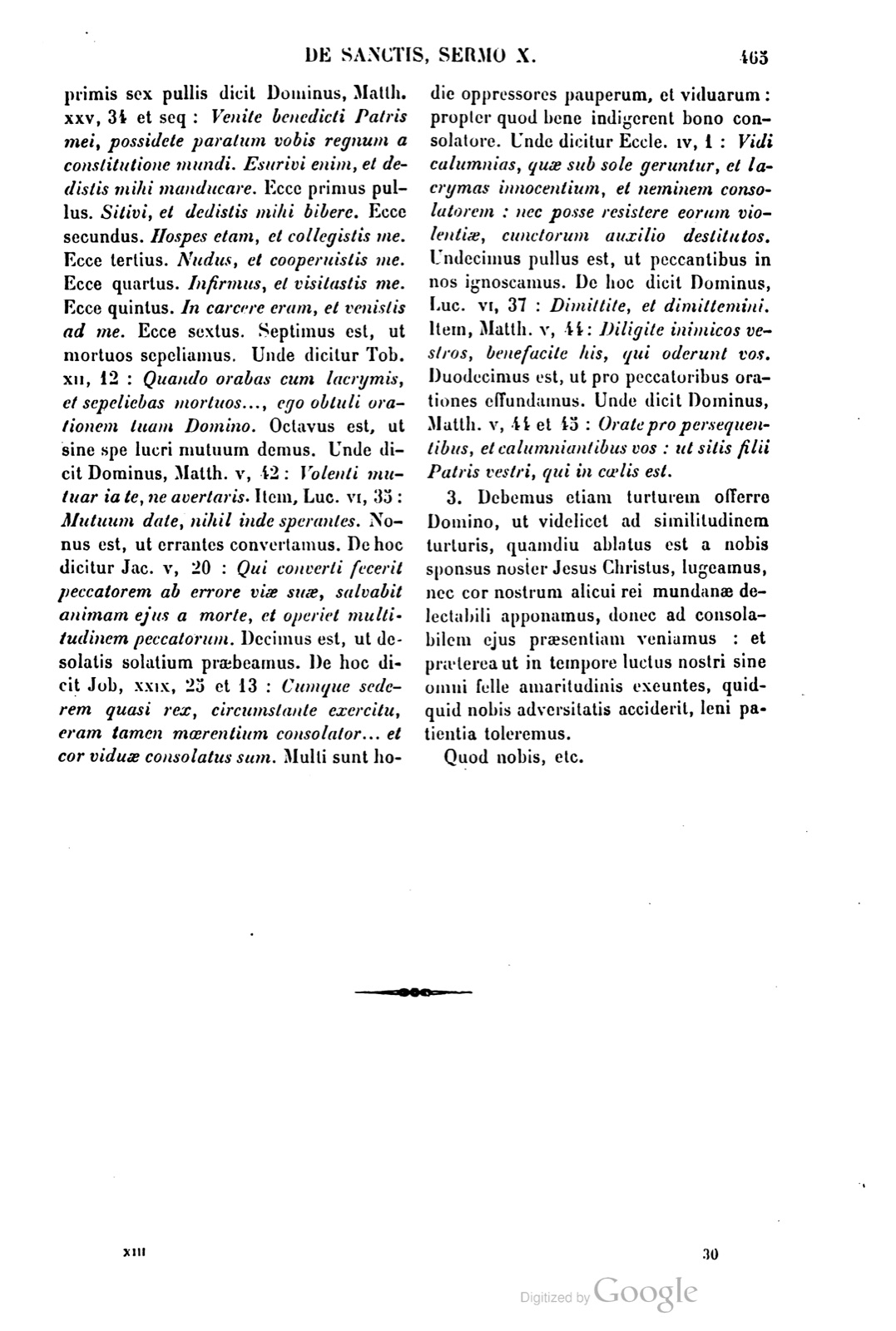
2. Sicut columba fœcunda est in prole, sic et nos debemus esse imitatores generosæ columbæ, ut singulis annis duodecim pullos bonorum operum Domino proferamus. Hi autem duodecim pulli sunt duodecim opera misericordiæ. De primis sex pullis dicit Dominus, Matth. XXV, 34 et seq.: Venite benedicti Patris mei, possidete paratum vobis regnum a constitutione mundi. Esurivi enim, et dedistis mihi manducare. Ecce primus pullus. Sitivi, et dedistis mihi bibere. Ecce secundus. Hospes eram, et collegistis me. Ecce tertius. Nudus, et cooperuistis me. Ecce quartus. Infirmus, et visitastis me. Ecce quintus. In carcere eram, et venistis ad me. Ecce sextus. Septimus est, ut mortuos sepeliamus. Unde dicitur Tob. XII, 12: Quando orabas cum lacrymis, et sepeliebas mortuos..., ego obtuli orationem tuam Domino. Octavus est, ut sine spe lucri mutuum demus. Unde dicit Dominus, Matth. V, 42: Volenti mutuari a te, ne avertaris. Item, Luc. VI, 35: Mutuum date, nihil inde sperantes. Nonus est, ut errantes convertamus. De hoc dicitur Jac. V, 20: Qui converti fecerit peccatorem ab errore viæ suæ, salvabit animam ejus a morte, et operiet multitudinem peccatorum. Decimus est, ut desolatis solatium præbeamus. De hoc dicit Job, XXIX, 25 et 13: Cumque sederem quasi rex, circumstante exercitu, eram tamen mærentium consolator... et cor viduæ consolatus sum. Multi sunt hodie oppressores pauperum, et viduarum: propter quod bene indigerent bono consolatore. Unde dicitur Eccle. IV, 1: Vidi calumnias, quæ sub sole geruntur, et lacrymas innocentium, et neminem consolatorem: nec posse resistere eorum violentiæ, cunctorum auxilio destitutos. Undecimus pullus est, ut peccantibus in nos ignoscamus. De hoc dicit Dominus, Luc. VI, 37: Dimittite, et dimittemini. Item, Matth. V, 44: Diligite inimicos vestros, benefacite his, qui oderunt vos. Duodecimus est, ut pro peccatoribus orationes effundamus. Unde dicit Dominus, Matth. V, 44 et 45: Orate pro persequentibus, et calumniantibus vos: ut sitis filii Patris vestri, qui in cælis est.
3. Debemus etiam turturem offerre Domino, ut videlicet ad similitudinem turturis, quamdiu ablatus est a nobis sponsus noster Jesus Christus, lugeamus, nec cor nostrum alicui rei mundanæ delectabili apponamus, donec ad consolabilem ejus præsentiam veniamus: et præterea ut in tempore luctus nostri sine omni felle amaritudinis exeuntes, quidquid nobis adversitatis acciderit, leni patientia toleremus.
Quod nobis, etc.
2. Just as the dove is fruitful in offspring, so also we ought to be imitators of the generous dove, so that in individual years we may bring forth twelve young of good works to the Lord. But these twelve young are the twelve works of mercy. Concerning the first six young the Lord says, Matthew 25:34 and following: Come, blessed of my Father, possess the kingdom prepared for you from the foundation of the world. For I was hungry, and you gave me to eat. Behold the first young. I thirsted, and you gave me to drink. Behold the second. I was a guest, and you gathered me in. Behold the third. Naked, and you covered me. Behold the fourth. Sick, and you visited me. Behold the fifth. I was in prison, and you came to me. Behold the sixth. The seventh is that we bury the dead. Hence it is said in Tobit 12:12: When you were praying with tears and burying the dead..., I offered your prayer to the Lord. The eighth is that we give a loan without hope of gain. Hence the Lord says, Matthew 5:42: Do not turn away from one wishing to borrow from you. Likewise, Luke 6:35: Give a loan, hoping nothing from it. The ninth is that we convert those who are erring. Concerning this it is said in James 5:20: He who has caused a sinner to be converted from the error of his way will save his soul from death and will cover a multitude of sins. The tenth is that we provide consolation to the desolate. Concerning this Job says, 29:25 and 13: And when I sat as a king, with the army standing around, nevertheless I was a consoler of those mourning... and I consoled the heart of the widow. Many today are oppressors of the poor and of widows; on account of which they would well need a good consoler. Hence it is said in Ecclesiastes 4:1: I saw the calumnies that are carried on under the sun, and the tears of the innocent, and no consoler; nor that they were able to resist their violence, being destitute of everyone's help. The eleventh young is that we forgive those sinning against us. Concerning this the Lord says, Luke 6:37: Forgive, and you will be forgiven. Likewise, Matthew 5:44: Love your enemies, do good to those who hate you. The twelfth is that we pour forth prayers for sinners. Hence the Lord says, Matthew 5:44 and 45: Pray for those persecuting and calumniating you, so that you may be sons of your Father who is in heaven.
3. We ought also to offer a turtledove to the Lord, namely so that in the likeness of the turtledove, as long as our bridegroom Jesus Christ has been taken away from us, we may mourn and not set our heart upon any delightful worldly thing, until we come to his consoling presence; and besides this so that, going forth in the time of our mourning without any gall of bitterness, whatever adversity happens to us, we may tolerate it with gentle patience.
May he grant this to us, etc.
Notes
- Luke 2:28. (Luc. II, 28.) ↩
If a page does not appear, its photograph has not been uploaded yet.