Works › Sermons on the Most Holy Sacrament of the Eucharist
Volume 13 · pp. 798–799
A Very Useful Little Note for Doctrine
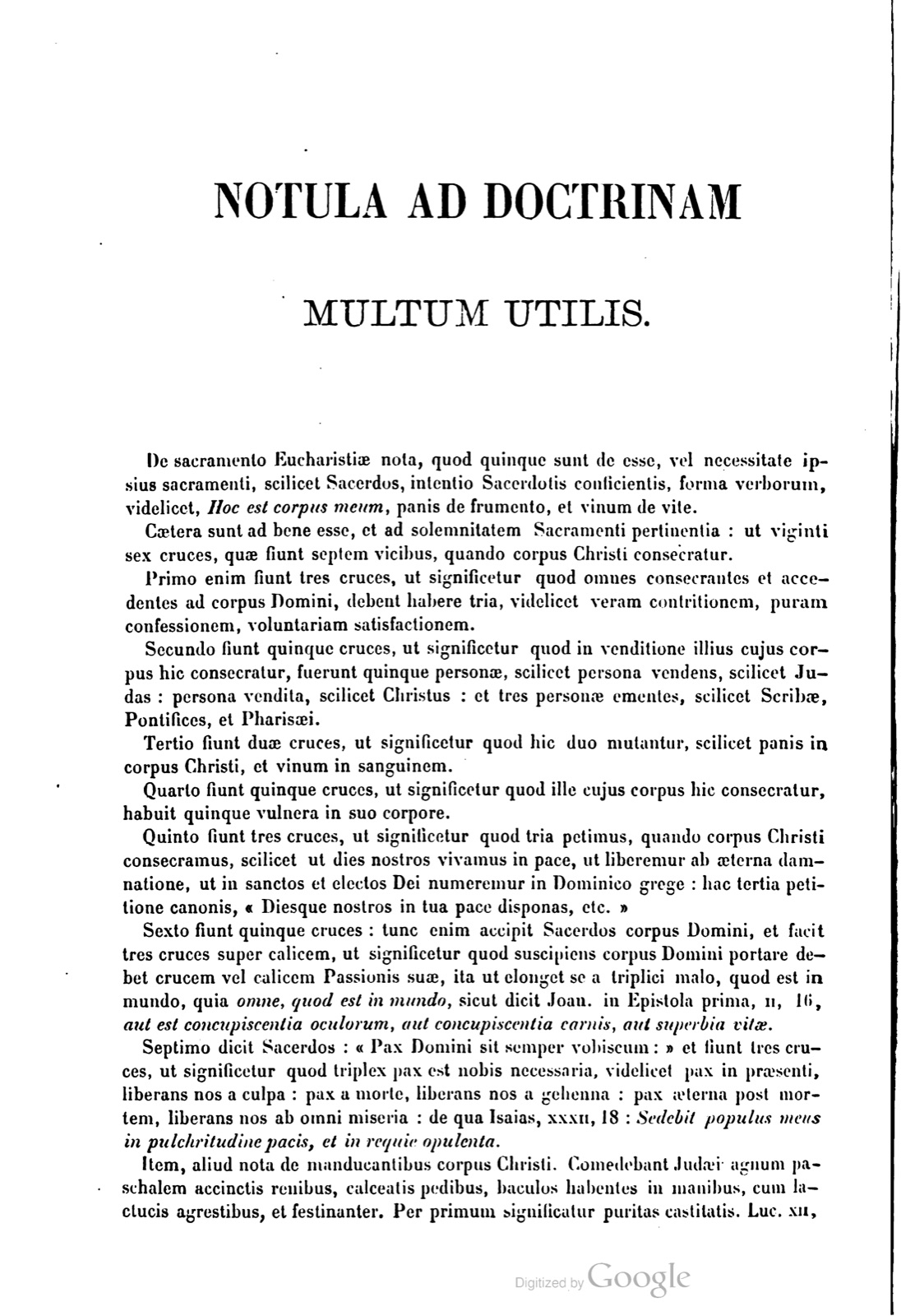
### NOTULA AD DOCTRINAM MULTUM UTILIS
De sacramento Eucharistiae nota, quod quinque sunt de esse, vel necessitate ipsius sacramenti, scilicet Sacerdos, intentio Sacerdotis conficientis, forma verborum, videlicet, Hoc est corpus meum, panis de frumento, et vinum de vite.
Caetera sunt ad bene esse, et ad solemnitatem Sacramenti pertinentia: ut viginti sex cruces, quae fiunt septem vicibus, quando corpus Christi consecratur.
Primo enim fiunt tres cruces, ut significetur quod omnes consecrantes et accedentes ad corpus Domini, debent habere tria, videlicet veram contritionem, puram confessionem, voluntariam satisfactionem.
Secundo fiunt quinque cruces, ut significetur quod in venditione illius cujus corpus hic consecratur, fuerunt quinque personae, scilicet persona vendens, scilicet Judas: persona vendita, scilicet Christus: et tres personae ementes, scilicet Scribae, Pontifices, et Pharisaei.
Tertio fiunt duae cruces, ut significetur quod hic duo mutantur, scilicet panis in corpus Christi, et vinum in sanguinem.
Quarto fiunt quinque cruces, ut significetur quod ille cujus corpus hic consecratur, habuit quinque vulnera in suo corpore.
Quinto fiunt tres cruces, ut significetur quod tria petimus, quando corpus Christi consecramus, scilicet ut dies nostros vivamus in pace, ut liberemur ab aeterna damnatione, ut in sanctos et electos Dei numeremur in Dominico grege: hac tertia petitione canonis, "Diesque nostros in tua pace disponas, etc."
Sexto fiunt quinque cruces: tunc enim accipit Sacerdos corpus Domini, et facit tres cruces super calicem, ut significetur quod suscipiens corpus Domini portare debet crucem vel calicem Passionis suae, ita ut elonget se a triplici malo, quod est in mundo, quia omne, quod est in mundo, sicut dicit Joan. in Epistola prima, ii, 16, aut est concupiscentia oculorum, aut concupiscentia carnis, aut superbia vitae.
Septimo dicit Sacerdos: "Pax Domini sit semper vobiscum:" et fiunt tres cruces, ut significetur quod triplex pax est nobis necessaria, videlicet pax in praesenti, liberans nos a culpa: pax a morte, liberans nos a gehenna: pax aeterna post mortem, liberans nos ab omni miseria: de qua Isaias, xxxii, 18: Sedebit populus meus in pulchritudine pacis, et in requie opulenta.
Item, aliud nota de manducantibus corpus Christi. Comedebant Judaei agnum paschalem accinctis renibus, calceatis pedibus, baculos habentes in manibus, cum lactucis agrestibus, et festinanter. Per primum significatur puritas castitatis. Luc. xii,
### A Very Useful Little Note for Doctrine
Concerning the sacrament of the Eucharist, note that five things are of the being, or necessity, of the sacrament itself, namely the Priest, the intention of the Priest confecting it, the form of the words, namely, This is my body, bread from wheat, and wine from the vine.
The other things pertain to well-being and to the solemnity of the Sacrament, such as the twenty-six crosses which are made at seven times when the body of Christ is consecrated.
For first three crosses are made, so that it may be signified that all who consecrate and approach the body of the Lord ought to have three things, namely true contrition, pure confession, voluntary satisfaction.
Secondly, five crosses are made, so that it may be signified that in the sale of him whose body is consecrated here, there were five persons, namely the person selling, namely Judas; the person sold, namely Christ; and the three persons buying, namely Scribes, Pontiffs, and Pharisees.
Thirdly, two crosses are made, so that it may be signified that two things are changed here, namely bread into the body of Christ, and wine into blood.
Fourthly, five crosses are made, so that it may be signified that he whose body is consecrated here had five wounds in his body.
Fifthly, three crosses are made, so that it may be signified that we ask for three things when we consecrate the body of Christ, namely that we may live our days in peace, that we may be freed from eternal damnation, that we may be numbered among the saints and elect of God in the Lord's flock, by this third petition of the canon: "And dispose our days in your peace, etc."
Sixthly, five crosses are made; for then the Priest receives the body of the Lord and makes three crosses over the chalice, so that it may be signified that one receiving the body of the Lord ought to carry the cross or chalice of his Passion, so that he distances himself from the threefold evil which is in the world, because everything that is in the world, as John says in the first Epistle, 2:16, either is concupiscence of the eyes, or concupiscence of the flesh, or pride of life.
Seventhly, the Priest says: "May the peace of the Lord be always with you," and three crosses are made, so that it may be signified that a threefold peace is necessary for us, namely peace in the present, freeing us from fault; peace at death, freeing us from Gehenna; eternal peace after death, freeing us from every misery. Concerning this Isaiah 32:18 says: My people will sit in the beauty of peace and in abundant rest.
Likewise, note another thing concerning those eating the body of Christ. The Jews ate the paschal lamb with loins girded, feet shod, staffs in hands, with wild lettuces, and hastily. Through the first is signified purity of chastity. Luke 12,
### NOTULA AD DOCTRINAM MULTUM UTILIS (continuatio et finis)
35: Sint lumbi vestri praecincti. Per secundum, affectus devotionis. Cant. vii, 1: Quam pulchri sunt gressus tui, in calceamentis, filia Principis. Per tertium, memoria Dominicae Passionis. Gen. xxxii, 10: In baculo meo transivi Jordanem istum. Per quartum, amaritudo contritionis. Psal. lxxix, 6: Cibasti nos pane lacrymarum. Per quintum, promptitudo voluntatis. Proverb. xxii, 29: Vidisti virum velocem in opere suo? Coram regibus stabit, etc.
Concludendo finaliter sciendum est, quod sacrosanctum corpus Domini nostri Jesu Christi sumi debet in memoriam Passionis, propitiationis, seu reconciliationis, dilectionis, et unionis, etc.
FINIS.
### A Very Useful Little Note for Doctrine (Continuation and End)
35: Let your loins be girded. Through the second is signified the affection of devotion. Song of Songs 7:1: How beautiful are your steps in shoes, daughter of the Prince. Through the third, the memory of the Lord's Passion. Genesis 32:10: With my staff I crossed this Jordan. Through the fourth, bitterness of contrition. Psalm 79:6: You fed us with the bread of tears. Through the fifth, promptness of will. Proverbs 22:29: Have you seen a man swift in his work? He will stand before kings, etc.
In concluding finally, one must know that the sacrosanct body of our Lord Jesus Christ ought to be received in memory of the Passion, of propitiation or reconciliation, of love, and of union, etc.
END.

If a page does not appear, its photograph has not been uploaded yet.