Works › Sermons on the Most Holy Sacrament of the Eucharist
Volume 13 · pp. 794–797
Sermon XXXII. On the Threefold Drink of Christ's Blood
A marker with ≈ is an approximate page boundary, placed by measure of the text; the page photographs remain the authority. In the paired views, clicking a page marker brings that page into view.
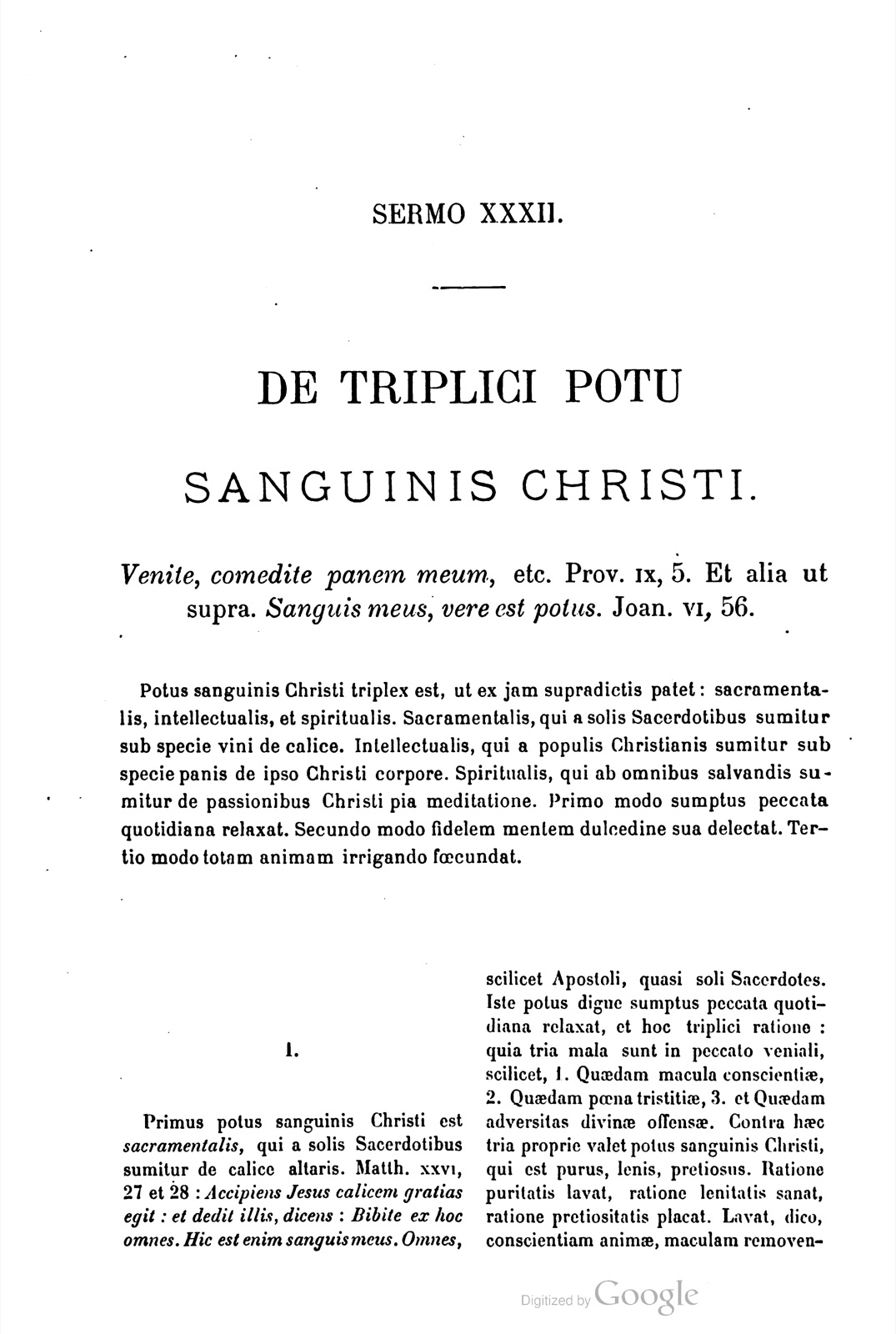
### Sermo XXXII
### De triplici potu sanguinis Christi
Venite, comedite panem meum, etc. Prov. ix, 5. Et alia ut supra. Sanguis meus, vere est potus. Joan. vi, 56.
Potus sanguinis Christi triplex est, ut ex jam supradictis patet: sacramentalis, intellectualis, et spiritualis. Sacramentalis, qui a solis Sacerdotibus sumitur sub specie vini de calice. Intellectualis, qui a populis Christianis sumitur sub specie panis de ipso Christi corpore. Spiritualis, qui ab omnibus salvandis sumitur de passionibus Christi pia meditatione. Primo modo sumptus peccata quotidiana relaxat. Secundo modo fidelem mentem dulcedine sua delectat. Tertio modo totam animam irrigando foecundat.
I.
Primus potus sanguinis Christi est sacramentalis, qui a solis Sacerdotibus sumitur de calice altaris. Matth. xxvi, 27 et 28: Accipiens Jesus calicem gratias egit: et dedit illis, dicens: Bibite ex hoc omnes. Hic est enim sanguis meus. Omnes, scilicet Apostoli, quasi soli Sacerdotes. Iste potus digne sumptus peccata quotidiana relaxat, et hoc triplici ratione: quia tria mala sunt in peccato veniali, scilicet, 1. Quaedam macula conscientiae, 2. Quaedam poena tristitiae, 3. et Quaedam adversitas divinae offensae. Contra haec tria proprie valet potus sanguinis Christi, qui est purus, lenis, pretiosus. Ratione puritatis lavat, ratione lenitatis sanat, ratione pretiositatis placat. Lavat, dico, conscientiam animae, maculam removendo: sanat poenam tristitiae, corda fidelium consolando: placat offensam divinae justitiae, pro nobis interpellando.
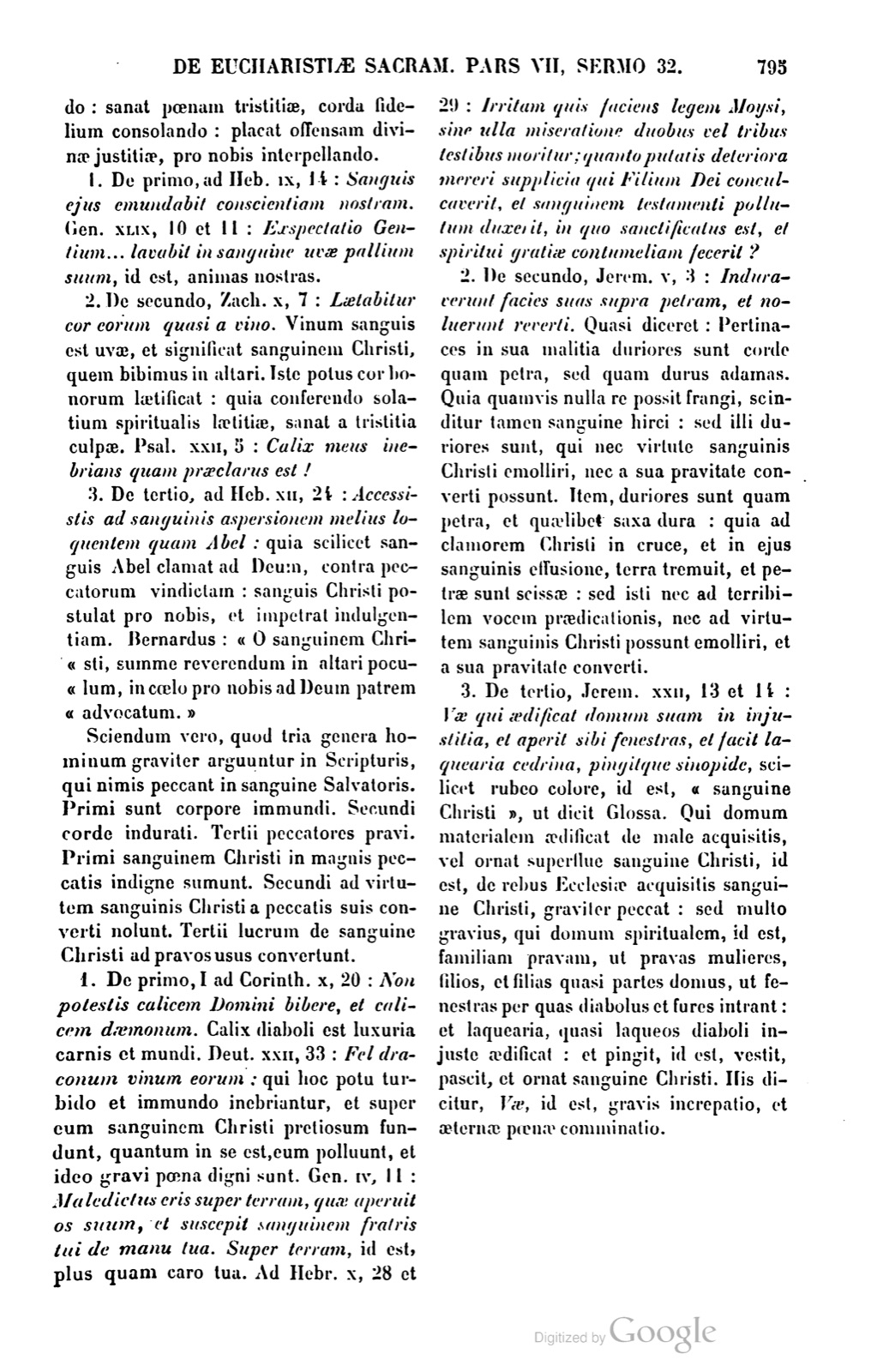
1. De primo, ad Heb. ix, 14: Sanguis ejus emundabit conscientiam nostram. Gen. xlix, 10 et 11: Exspectatio Gentium... lavabit in sanguine uvae pallium suum, id est, animas nostras.
2. De secundo, Zach. x, 7: Laetabitur cor eorum quasi a vino. Vinum sanguis est uvae, et significat sanguinem Christi, quem bibimus in altari. Iste potus cor bonorum laetificat: quia conferendo solatium spiritualis laetitiae, sanat a tristitia culpae. Psal. xxii, 5: Calix meus inebrians quam praeclarus est!
3. De tertio, ad Heb. xii, 24: Accessistis ad sanguinis aspersionem melius loquentem quam Abel: quia scilicet sanguis Abel clamat ad Deum, contra peccatorum vindictam: sanguis Christi postulat pro nobis, et impetrat indulgentiam. Bernardus: "O sanguinem Christi, summe reverendum in altari poculum, in caelo pro nobis ad Deum patrem advocatum."
Sciendum vero, quod tria genera hominum graviter arguuntur in Scripturis, qui nimis peccant in sanguine Salvatoris. Primi sunt corpore immundi. Secundi corde indurati. Tertii peccatores pravi. Primi sanguinem Christi in magnis peccatis indigne sumunt. Secundi ad virtutem sanguinis Christi a peccatis suis converti nolunt. Tertii lucrum de sanguine Christi ad pravos usus convertunt.
1. De primo, I ad Corinth. x, 20: Non potestis calicem Domini bibere, et calicem daemonum. Calix diaboli est luxuria carnis et mundi. Deut. xxxii, 33: Fel draconum vinum eorum: qui hoc potu turbido et immundo inebriantur, et super eum sanguinem Christi pretiosum fundunt, quantum in se est, eum polluunt, et ideo gravi poena digni sunt. Gen. iv, 11: Maledictus eris super terram, quae aperuit os suum, et suscepit sanguinem fratris tui de manu tua. Super terram, id est, plus quam caro tua. Ad Hebr. x, 28 et 29: Irritam quis faciens legem Moysi, sine ulla miseratione duobus vel tribus testibus moritur; quanto putatis deteriora mereri supplicia qui Filium Dei conculcaverit, et sanguinem testamenti pollutum duxerit, in quo sanctificatus est, et spiritui gratiae contumeliam fecerit?
### Sermon XXXII
### On the Threefold Drink of Christ's Blood
Come, eat my bread, etc. Proverbs 9:5. And the other texts as above. My blood is truly drink. John 6:56.
The drink of Christ's blood is threefold, as is clear from the things already said above: sacramental, intellectual, and spiritual. Sacramental is that which is received by Priests alone from the chalice under the species of wine. Intellectual is that which is received by Christian peoples under the species of bread from Christ's very body. Spiritual is that which is received by all who are to be saved from the passions of Christ by pious meditation. Received in the first way, it relaxes daily sins. In the second way it delights the faithful mind by its sweetness. In the third way, by irrigating the whole soul, it makes it fruitful.
I.
The first drink of Christ's blood is sacramental, which is received by Priests alone from the chalice of the altar. Matthew 26:27 and 28: Jesus, taking the chalice, gave thanks, and gave it to them, saying: Drink from this, all of you. For this is my blood. All, namely the Apostles, as if Priests alone. This drink, worthily received, relaxes daily sins, and this for a threefold reason: because there are three evils in venial sin, namely, 1. a certain stain of conscience, 2. a certain penalty of sadness, 3. and a certain adversity of divine offense. Against these three the drink of Christ's blood properly has power, which is pure, gentle, precious. By reason of purity it washes; by reason of gentleness it heals; by reason of preciousness it placates. It washes, I say, the conscience of the soul by removing stain; it heals the penalty of sadness by consoling the hearts of the faithful; it placates the offense of divine justice by interceding for us.
1. Concerning the first, Hebrews 9:14: His blood will cleanse our conscience. Genesis 49:10 and 11: The expectation of the Nations... will wash his cloak in the blood of the grape, that is, our souls.
2. Concerning the second, Zechariah 10:7: Their heart will rejoice as from wine. Wine is the blood of the grape and signifies the blood of Christ, which we drink on the altar. This drink gladdens the heart of good persons, because by conferring the solace of spiritual gladness, it heals from the sadness of fault. Psalm 22:5: My intoxicating chalice, how splendid it is!
3. Concerning the third, Hebrews 12:24: You have come to the sprinkling of blood speaking better than Abel, because namely the blood of Abel cries to God for vengeance against sinners; the blood of Christ asks for us and obtains indulgence. Bernard says: "O blood of Christ, cup most highly to be revered on the altar, in heaven our advocate before God the Father."
But one must know that three kinds of men are gravely accused in the Scriptures, who sin too much in the blood of the Savior. The first are unclean in body. The second are hardened in heart. The third are depraved sinners. The first unworthily receive the blood of Christ in great sins. The second do not wish to be converted from their sins by the power of Christ's blood. The third convert the profit from Christ's blood to depraved uses.
1. Concerning the first, 1 Corinthians 10:20: You cannot drink the chalice of the Lord and the chalice of demons. The chalice of the devil is the luxury of the flesh and of the world. Deuteronomy 32:33: The gall of dragons is their wine. Those who are made drunk by this turbid and unclean drink, and pour the precious blood of Christ upon it, so far as it is in them, pollute it, and therefore are worthy of grave punishment. Genesis 4:11: You will be cursed upon the earth, which opened its mouth and received your brother's blood from your hand. Upon the earth, that is, more than your flesh. Hebrews 10:28 and 29: Anyone making void the law of Moses dies without any mercy on the testimony of two or three witnesses; how much worse punishments do you think he deserves who has trampled the Son of God, and counted the blood of the testament polluted, in which he was sanctified, and has done insult to the Spirit of grace?
2. De secundo, Jerem. v, 3: Induraverunt facies suas supra petram, et noluerunt reverti. Quasi diceret: Pertinaces in sua malitia duriores sunt corde quam petra, sed quam durus adamas. Quia quamvis nulla re possit frangi, scinditur tamen sanguine hirci: sed illi duriores sunt, qui nec virtute sanguinis Christi emolliri, nec a sua pravitate converti possunt. Item, duriores sunt quam petra, et quaelibet saxa dura: quia ad clamorem Christi in cruce, et in ejus sanguinis effusione, terra tremuit, et petrae sunt scissae: sed isti nec ad terribilem vocem praedicationis, nec ad virtutem sanguinis Christi possunt emolliri, et a sua pravitate converti.
3. De tertio, Jerem. xxi, 13 et 14: Vae qui aedificat domum suam in injustitia, et aperit sibi fenestras, et facit laquearia cedrina, pingitque sinopide, scilicet rubeo colore, id est, "sanguine Christi", ut dicit Glossa. Qui domum materialem aedificat de male acquisitis, vel ornat superflue sanguine Christi, id est, de rebus Ecclesiae acquisitis sanguine Christi, graviter peccat: sed multo gravius, qui domum spiritualem, id est, familiam pravam, ut pravas mulieres, filios, et filias quasi partes domus, ut fenestras per quas diabolus et fures intrant: et laquearia, quasi laqueos diaboli injuste aedificat: et pingit, id est, vestit, pascit, et ornat sanguine Christi. His dicitur, Vae, id est, gravis increpatio, et aeternae poenae comminatio.
II.
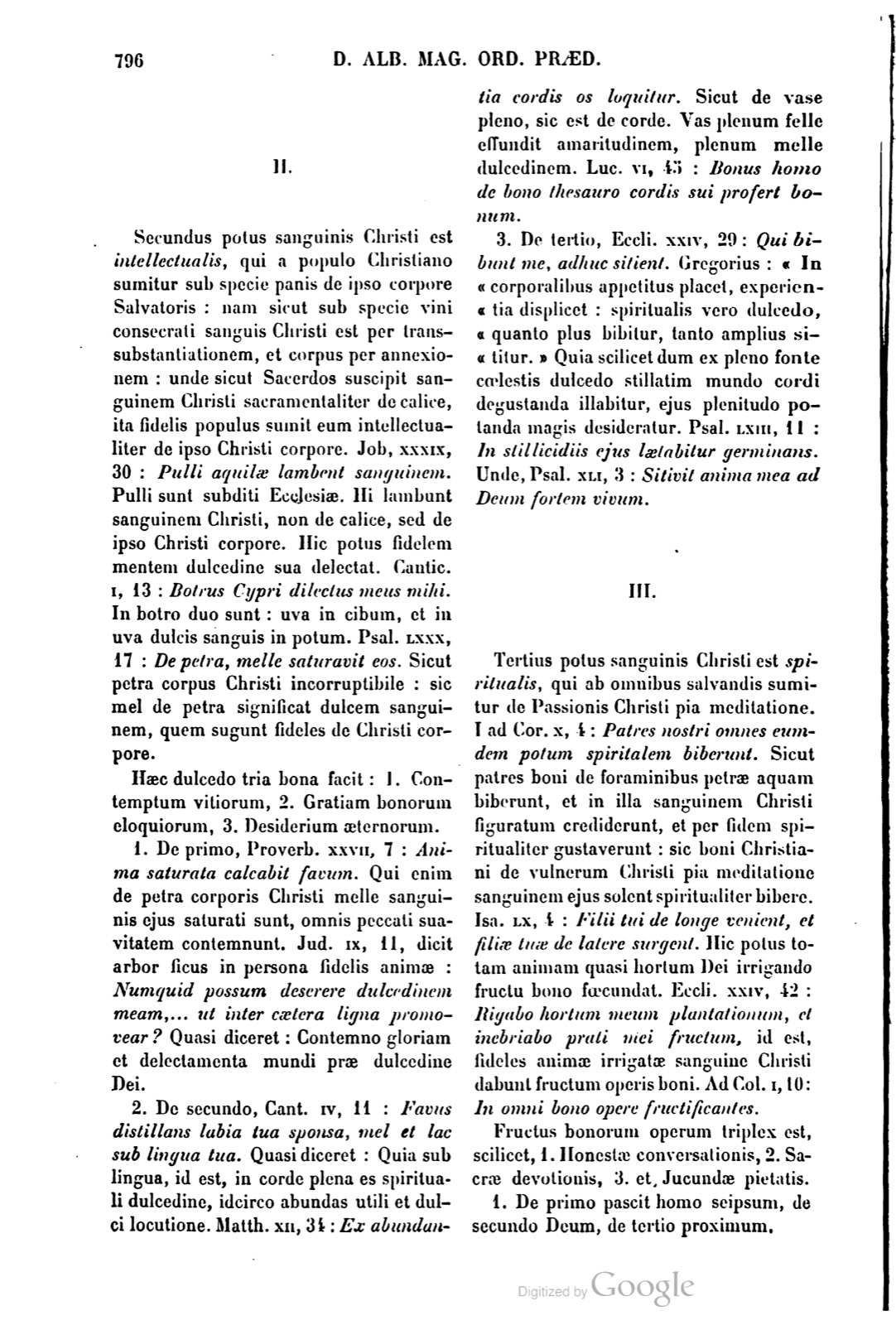
Secundus potus sanguinis Christi est intellectualis, qui a populo Christiano sumitur sub specie panis de ipso corpore Salvatoris: nam sicut sub specie vini consecrati sanguis Christi est per transsubstantiationem, et corpus per annexionem: unde sicut Sacerdos suscipit sanguinem Christi sacramentaliter de calice, ita fidelis populus sumit eum intellectualiter de ipso Christi corpore. Job, xxxix, 30: Pulli aquilae lambent sanguinem. Pulli sunt subditi Ecclesiae. Hi lambunt sanguinem Christi, non de calice, sed de ipso Christi corpore. Hic potus fidelem mentem dulcedine sua delectat. Cantic. i, 13: Botrus Cypri dilectus meus mihi. In botro duo sunt: uva in cibum, et in uva dulcis sanguis in potum. Psal. lxxx, 17: De petra, melle saturavit eos. Sicut petra corpus Christi incorruptibile: sic mel de petra significat dulcem sanguinem, quem sugunt fideles de Christi corpore.
2. Concerning the second, Jeremiah 5:3: They hardened their faces beyond rock, and they were unwilling to return. As if he were saying: Those stubborn in their malice are harder in heart than rock, but than hard diamond. Because although it can be broken by no thing, nevertheless it is split by the blood of a goat; but those persons are harder, who can neither be softened by the power of Christ's blood nor converted from their depravity. Likewise, they are harder than rock and than any hard stones, because at Christ's cry on the cross and at the pouring out of his blood, the earth trembled and the rocks were split; but those persons can be softened neither by the terrifying voice of preaching nor by the power of Christ's blood, nor converted from their depravity.
3. Concerning the third, Jeremiah 21:13 and 14: Woe to him who builds his house in injustice and opens windows for himself and makes cedar ceilings and paints with sinopis, namely with red color, that is, "with the blood of Christ," as the Gloss says. He who builds a material house from things badly acquired, or adorns it superfluously with the blood of Christ, that is, from the things of the Church acquired by the blood of Christ, sins gravely; but much more gravely does he sin who builds a spiritual house, that is, a depraved household, such as depraved women, sons, and daughters as parts of the house, as windows through which the devil and thieves enter, and ceilings, as snares of the devil, unjustly, and paints, that is, clothes, feeds, and adorns it with the blood of Christ. To these it is said, Woe, that is, grave rebuke and threat of eternal punishment.
II.
The second drink of Christ's blood is intellectual, which is received by the Christian people under the species of bread from the very body of the Savior. For just as under the species of consecrated wine the blood of Christ is there through transubstantiation, and the body through annexation, hence just as the Priest receives the blood of Christ sacramentally from the chalice, so the faithful people receive it intellectually from Christ's very body. Job 39:30: The young of the eagle will lick blood. The young are the subjects of the Church. These lick the blood of Christ, not from the chalice, but from Christ's very body. This drink delights the faithful mind with its sweetness. Song of Songs 1:13: A cluster of Cyprus is my beloved to me. In the cluster there are two things: the grape as food, and in the grape sweet blood as drink. Psalm 80:17: From the rock he filled them with honey. As the rock is the incorruptible body of Christ, so honey from the rock signifies the sweet blood which the faithful suck from Christ's body.
Haec dulcedo tria bona facit: 1. Contemptum vitiorum, 2. Gratiam bonorum eloquiorum, 3. Desiderium aeternorum.
1. De primo, Proverb. xxvii, 7: Anima saturata calcabit favum. Qui enim de petra corporis Christi melle sanguinis ejus saturati sunt, omnis peccati suavitatem contemnunt. Jud. ix, 11, dicit arbor ficus in persona fidelis animae: Numquid possum deserere dulcedinem meam, ... ut inter caetera ligna promovear? Quasi diceret: Contemno gloriam et delectamenta mundi prae dulcedine Dei.
2. De secundo, Cant. iv, 11: Favus distillans labia tua sponsa, mel et lac sub lingua tua. Quasi diceret: Quia sub lingua, id est, in corde plena es spirituali dulcedine, idcirco abundas utili et dulci locutione. Matth. xii, 34: Ex abundantia cordis os loquitur. Sicut de vase pleno, sic est de corde. Vas plenum felle effundit amaritudinem, plenum melle dulcedinem. Luc. vi, 43: Bonus homo de bono thesauro cordis sui profert bonum.
3. De tertio, Eccli. xxiv, 29: Qui bibunt me, adhuc sitient. Gregorius: "In corporalibus appetitus placet, experientia displicet: spiritualis vero dulcedo, quanto plus bibitur, tanto amplius sititur." Quia scilicet dum ex pleno fonte caelestis dulcedo stillatim mundo cordi degustanda illabitur, ejus plenitudo potanda magis desideratur. Psal. lxiii, 11: In stillicidiis ejus laetabitur germinans. Unde, Psal. xli, 3: Sitivit anima mea ad Deum fortem vivum.
III.
Tertius potus sanguinis Christi est spiritualis, qui ab omnibus salvandis sumitur de Passionis Christi pia meditatione. I ad Cor. x, 4: Patres nostri omnes eumdem potum spiritalem biberunt. Sicut patres boni de foraminibus petrae aquam biberunt, et in illa sanguinem Christi figuratum crediderunt, et per fidem spiritualiter gustaverunt: sic boni Christiani de vulnerum Christi pia meditatione sanguinem ejus solent spiritualiter bibere. Isa. lx, 4: Filii tui de longe venient, et filiae tuae de latere surgent. Hic potus totam animam quasi hortum Dei irrigando fructu bono foecundat. Eccli. xxiv, 42: Rigabo hortum meum plantationum, et inebriabo prati mei fructum, id est, fideles animae irrigatae sanguine Christi dabunt fructum operis boni. Ad Col. i, 10: In omni bono opere fructificantes.
Fructus bonorum operum triplex est, scilicet, 1. Honestae conversationis, 2. Sacrae devotionis, 3. et, Jucundae pietatis. 1. De primo pascit homo seipsum, de secundo Deum, de tertio proximum.
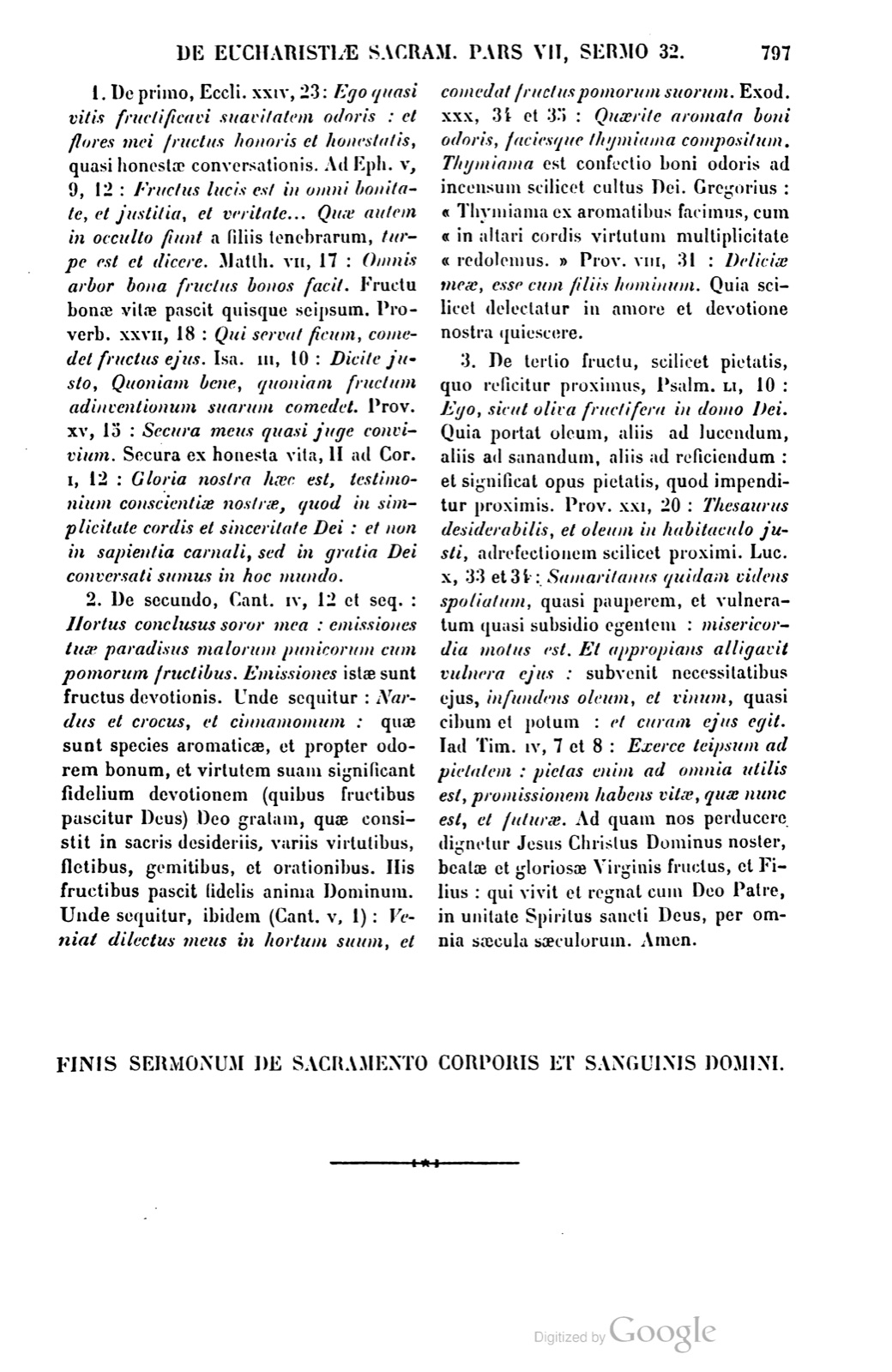
1. De primo, Eccli. xxiv, 23: Ego quasi vitis fructificavi suavitatem odoris: et flores mei fructus honoris et honestatis, quasi honestae conversationis. Ad Eph. v, 9, 12: Fructus lucis est in omni bonitate, et justitia, et veritate... Quae autem in occulto fiunt a filiis tenebrarum, turpe est et dicere. Matth. vii, 17: Omnis arbor bona fructus bonos facit. Fructu bonae vitae pascit quisque seipsum. Proverb. xxvii, 18: Qui servat ficum, comedet fructus ejus. Isa. iii, 10: Dicite justo, Quoniam bene, quoniam fructum adinventionum suarum comedet. Prov. xv, 15: Secura meus quasi juge convivium. Secura ex honesta vita, II ad Cor. i, 12: Gloria nostra haec est, testimonium conscientiae nostrae, quod in simplicitate cordis et sinceritate Dei: et non in sapientia carnali, sed in gratia Dei conversati sumus in hoc mundo.
This sweetness makes three goods: 1. contempt of vices, 2. grace of good utterances, 3. desire of eternal things.
1. Concerning the first, Proverbs 27:7: A sated soul will tread down the honeycomb. For those who have been sated from the rock of Christ's body with the honey of his blood despise the sweetness of every sin. Judges 9:11, the fig tree says in the person of the faithful soul: Can I abandon my sweetness, ... so that I may be promoted among the other trees? As if it were saying: I despise the glory and delights of the world in comparison with the sweetness of God.
2. Concerning the second, Song of Songs 4:11: A dripping honeycomb are your lips, bride; honey and milk are under your tongue. As if he were saying: Because under your tongue, that is, in your heart, you are full of spiritual sweetness, therefore you abound in useful and sweet speech. Matthew 12:34: From the abundance of the heart the mouth speaks. As it is with a full vessel, so it is with the heart. A vessel full of gall pours out bitterness; one full of honey pours out sweetness. Luke 6:43: A good man brings forth good from the good treasure of his heart.
3. Concerning the third, Ecclesiasticus 24:29: Those who drink me will still thirst. Gregory says: "In bodily things appetite pleases, experience displeases; but spiritual sweetness, the more it is drunk, the more it is thirsted for." Because namely, while heavenly sweetness from the full fountain slips drop by drop into a clean heart to be tasted, its fullness to be drunk is desired more. Psalm 63:11: The sprouting thing will rejoice in its drops. Hence Psalm 41:3: My soul has thirsted for the strong living God.
III.
The third drink of Christ's blood is spiritual, which is received by all who are to be saved from pious meditation on Christ's Passion. 1 Corinthians 10:4: All our fathers drank the same spiritual drink. As the good fathers drank water from the openings of the rock, and in that water believed the blood of Christ to be figured, and spiritually tasted it through faith, so good Christians are accustomed spiritually to drink his blood from pious meditation on Christ's wounds. Isaiah 60:4: Your sons will come from afar, and your daughters will rise from your side. This drink, by irrigating the whole soul as a garden of God, makes it fruitful with good fruit. Ecclesiasticus 24:42: I will water my garden of plantings, and I will make the fruit of my meadow drunk, that is, faithful souls irrigated by Christ's blood will give fruit of good work. Colossians 1:10: Bearing fruit in every good work.
The fruit of good works is threefold, namely: 1. of upright conduct, 2. of sacred devotion, 3. and of pleasant piety. 1. Concerning the first a man feeds himself, concerning the second God, concerning the third his neighbor.
1. Concerning the first, Ecclesiasticus 24:23: I, like a vine, have borne fruit the sweetness of odor, and my flowers are the fruit of honor and uprightness, as of upright conduct. Ephesians 5:9, 12: The fruit of light is in all goodness and justice and truth... But the things which are done in secret by the sons of darkness, it is shameful even to speak. Matthew 7:17: Every good tree makes good fruits. By the fruit of a good life each person feeds himself. Proverbs 27:18: He who keeps the fig tree will eat its fruit. Isaiah 3:10: Say to the just man: Because it is well, because he will eat the fruit of his discoveries. Proverbs 15:15: A secure mind is like a continual banquet. Secure from an upright life, 2 Corinthians 1:12: This is our glory, the testimony of our conscience, that in simplicity of heart and sincerity of God, and not in carnal wisdom, but in the grace of God, we have conducted ourselves in this world.
2. De secundo, Cant. iv, 12 et seq.: Hortus conclusus soror mea: emissiones tuae paradisus malorum punicorum cum pomorum fructibus. Emissiones istae sunt fructus devotionis. Unde sequitur: Nardus et crocus, et cinnamomum: quae sunt species aromaticae, et propter odorem bonum, et virtutem suam significant fidelium devotionem (quibus fructibus pascitur Deus) Deo gratam, quae consistit in sacris desideriis, variis virtutibus, fletibus, gemitibus, et orationibus. His fructibus pascit fidelis anima Dominum. Unde sequitur, ibidem (Cant. v, 1): Veniat dilectus meus in hortum suum, et comedat fructus pomorum suorum. Exod. xxx, 34 et 35: Quaerite aromata boni odoris, faciesque thymiama compositum. Thymiama est confectio boni odoris ad incensum scilicet cultus Dei. Gregorius: "Thymiama ex aromatibus facimus, cum in altari cordis virtutum multiplicitate redolemus." Prov. viii, 31: Deliciae meae, esse cum filiis hominum. Quia scilicet delectatur in amore et devotione nostra quiescere.
3. De tertio fructu, scilicet pietatis, quo reficitur proximus, Psalm. li, 10: Ego, sicut oliva fructifera in domo Dei. Quia portat oleum, aliis ad lucendum, aliis ad sanandum, aliis ad reficiendum: et significat opus pietatis, quod impenditur proximis. Prov. xxi, 20: Thesaurus desiderabilis, et oleum in habitaculo justi, ad refectionem scilicet proximi. Luc. x, 33 et 34: Samaritanus quidam videns spoliatum, quasi pauperem, et vulneratum quasi subsidio egentem: misericordia motus est. Et appropians alligavit vulnera ejus: subvenit necessitatibus ejus, infundens oleum, et vinum, quasi cibum et potum: et curam ejus egit. I ad Tim. iv, 7 et 8: Exerce teipsum ad pietatem: pietas enim ad omnia utilis est, promissionem habens vitae, quae nunc est, et futurae. Ad quam nos perducere dignetur Jesus Christus Dominus noster, beatae et gloriosae Virginis fructus, et Filius: qui vivit et regnat cum Deo Patre, in unitate Spiritus sancti Deus, per omnia saecula saeculorum. Amen.
FINIS SERMONUM DE SACRAMENTO CORPORIS ET SANGUINIS DOMINI.
2. Concerning the second, Song of Songs 4:12 and following: A garden enclosed is my sister; your sendings forth are a paradise of pomegranates with the fruits of apples. Those sendings forth are fruits of devotion. Hence it follows: Nard and crocus and cinnamon, which are aromatic spices and, on account of good odor and their power, signify the devotion of the faithful, pleasing to God (by which fruits God is fed), which consists in sacred desires, varied virtues, tears, groans, and prayers. With these fruits the faithful soul feeds the Lord. Hence it follows in the same place (Song of Songs 5:1): Let my beloved come into his garden and eat the fruits of his apples. Exodus 30:34 and 35: Seek spices of good odor, and make composed incense. Incense is a confection of good odor for incense, namely of the worship of God. Gregory says: "We make incense from spices when on the altar of the heart we are fragrant with a multiplicity of virtues." Proverbs 8:31: My delights are to be with the children of men, because namely he is delighted to rest in our love and devotion.
3. Concerning the third fruit, namely of piety, by which one's neighbor is refreshed, Psalm 51:10: I, like a fruitful olive tree in the house of God. Because it bears oil, for some for giving light, for others for healing, for others for refreshing, and it signifies the work of piety which is bestowed upon neighbors. Proverbs 21:20: Desirable treasure and oil are in the dwelling of the just man, namely for the refreshment of the neighbor. Luke 10:33 and 34: A certain Samaritan, seeing the plundered man, as poor, and wounded as needing aid, was moved by mercy. And coming near, he bound up his wounds; he came to his needs, pouring in oil and wine, as food and drink, and took care of him. 1 Timothy 4:7 and 8: Exercise yourself unto piety, for piety is useful unto all things, having promise of the life which now is and of the future life. To which may Jesus Christ our Lord, fruit and Son of the blessed and glorious Virgin, deign to lead us; who lives and reigns with God the Father, God in the unity of the Holy Spirit, through all ages of ages. Amen.
END OF THE SERMONS ON THE SACRAMENT OF THE BODY AND BLOOD OF THE LORD.
If a page does not appear, its photograph has not been uploaded yet.