Works › Sermons on the Most Holy Sacrament of the Eucharist
Volume 13 · pp. 775–778
Part VII. On the Threefold Consideration of the Blood of Christ. Sermon XXVII
A marker with ≈ is an approximate page boundary, placed by measure of the text; the page photographs remain the authority. In the paired views, clicking a page marker brings that page into view.
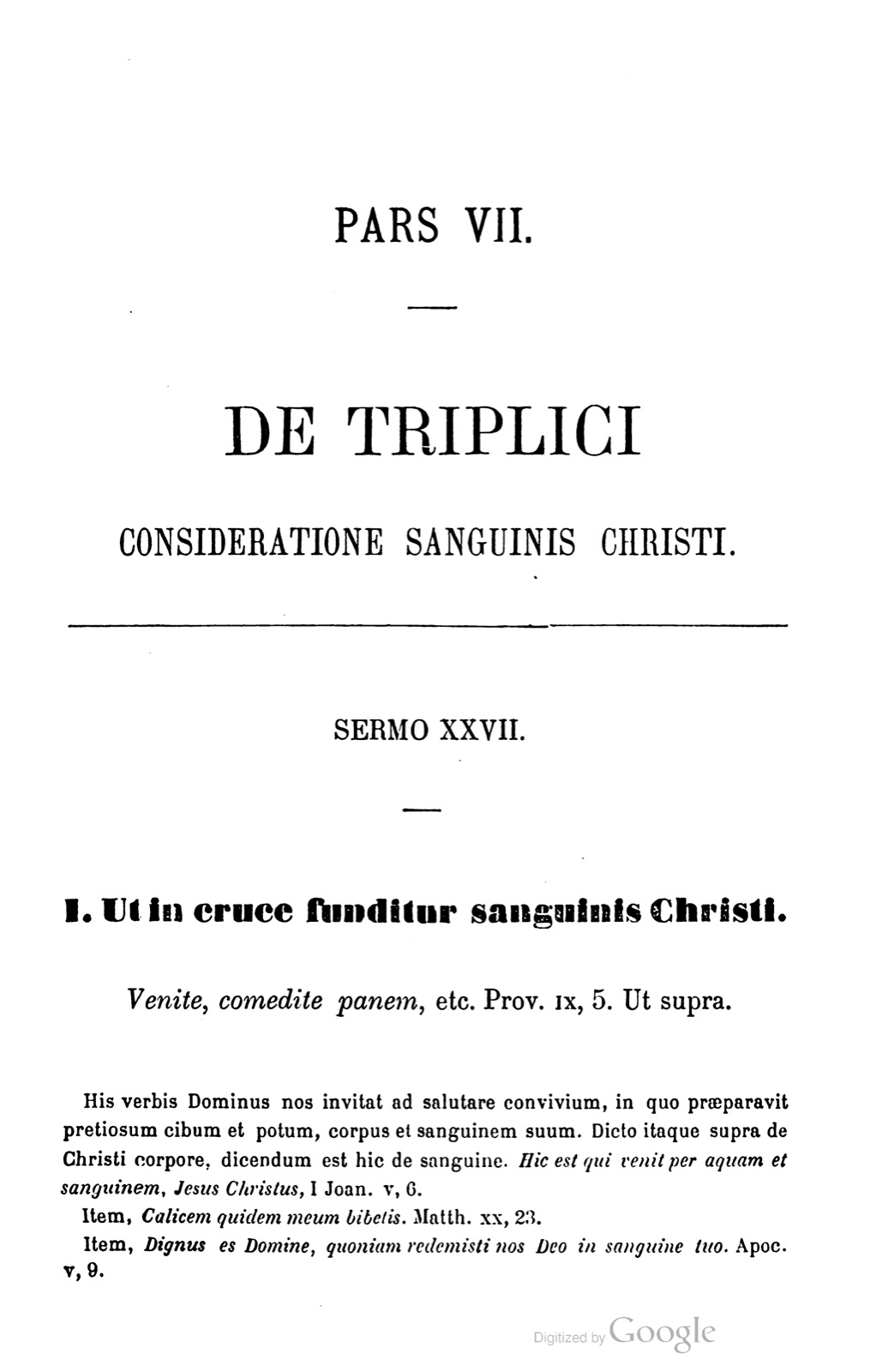
### Pars VII
### De triplici consideratione sanguinis Christi
### Sermo XXVII
### I. Ut in cruce funditur sanguinis Christi
Venite, comedite panem, etc. Prov. ix, 5. Ut supra.
His verbis Dominus nos invitat ad salutare convivium, in quo praeparavit pretiosum cibum et potum, corpus et sanguinem suum. Dicto itaque supra de Christi corpore, dicendum est hic de sanguine. Hic est qui venit per aquam et sanguinem, Jesus Christus, I Joan. v, 6.
Item, Calicem quidem meum bibetis. Matth. xx, 23.
Item, Dignus es Domine, quoniam redemisti nos Deo in sanguine tuo. Apoc. v, 9.
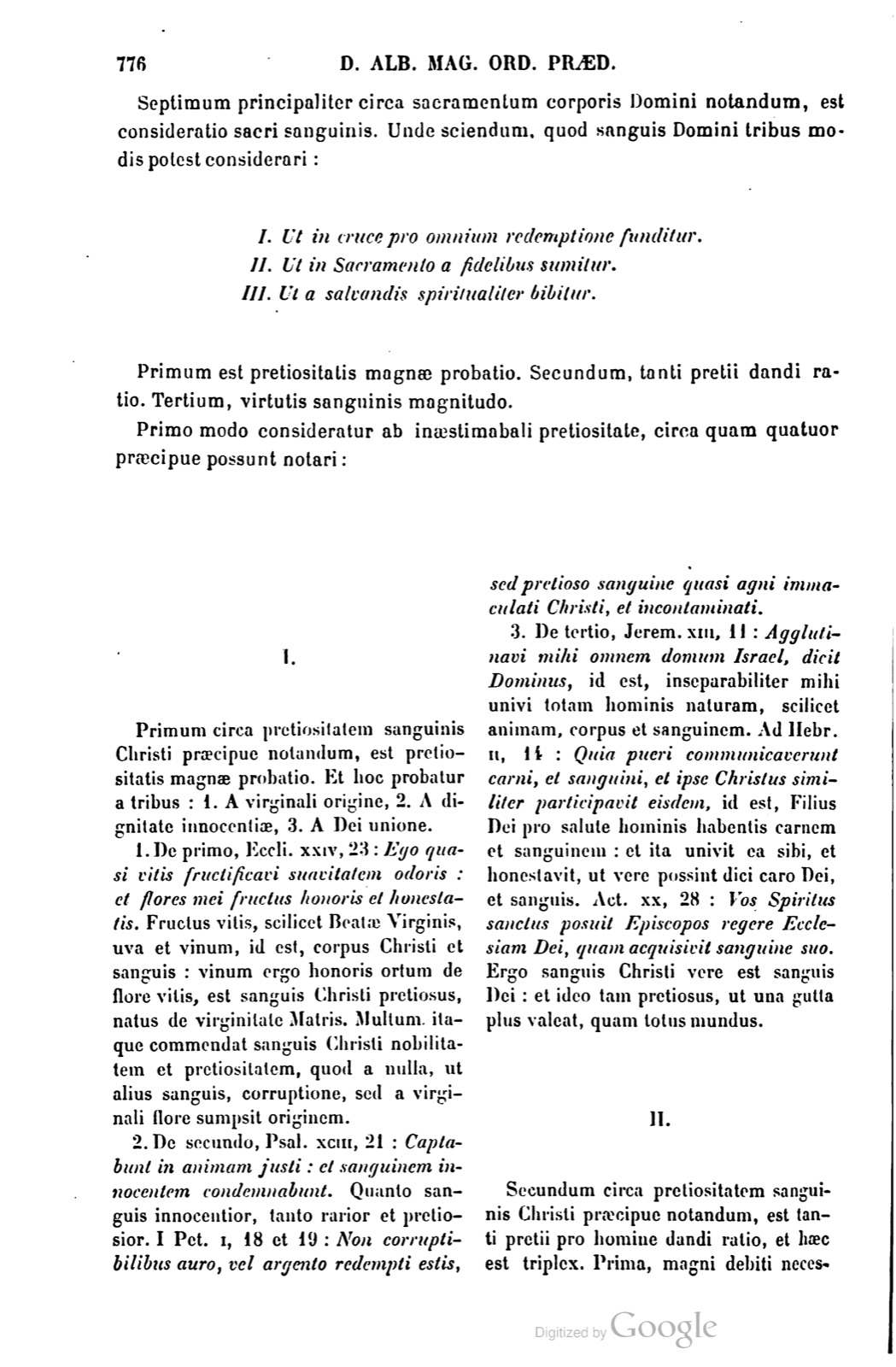
Septimum principaliter circa sacramentum corporis Domini notandum, est consideratio sacri sanguinis. Unde sciendum, quod sanguis Domini tribus modis potest considerari:
I. Ut in cruce pro omnium redemptione funditur.
II. Ut in Sacramento a fidelibus sumitur.
III. Ut a salvandis spiritualiter bibitur.
Primum est pretiositatis magnae probatio. Secundum, tanti pretii dandi ratio. Tertium, virtutis sanguinis magnitudo.
Primo modo consideratur ab inaestimabili pretiositate, circa quam quatuor praecipue possunt notari:
I.
Primum circa pretiositatem sanguinis Christi praecipue notandum, est pretiositatis magnae probatio. Et hoc probatur a tribus: 1. A virginali origine, 2. A dignitate innocentiae, 3. A Dei unione.
1. De primo, Eccli. xxiv, 23: Ego quasi vitis fructificavi suavitatem odoris: et flores mei fructus honoris et honestatis. Fructus vitis, scilicet Beatae Virginis, uva et vinum, id est, corpus Christi et sanguis: vinum ergo honoris ortum de flore vitis, est sanguis Christi pretiosus, natus de virginitate Matris. Multum itaque commendat sanguis Christi nobilitatem et pretiositatem, quod a nulla, ut alius sanguis, corruptione, sed a virginali flore sumpsit originem.
2. De secundo, Psal. xciii, 21: Captabunt in animam justi: et sanguinem innocentem condemnabunt. Quanto sanguis innocentior, tanto rarior et pretiosior. I Pet. i, 18 et 19: Non corruptibilibus auro, vel argento redempti estis, sed pretioso sanguine quasi agni immaculati Christi, et incontaminati.
3. De tertio, Jerem. xiii, 11: Agglutinavi mihi omnem domum Israel, dicit Dominus, id est, inseparabiliter mihi univi totam hominis naturam, scilicet animam, corpus et sanguinem. Ad Hebr. ii, 14: Quia pueri communicaverunt carni, et sanguini, et ipse Christus similiter participavit eisdem, id est, Filius Dei pro salute hominis habentis carnem et sanguinem: et ita univit ea sibi, et honestavit, ut vere possint dici caro Dei, et sanguis. Act. xx, 28: Vos Spiritus sanctus posuit Episcopos regere Ecclesiam Dei, quam acquisivit sanguine suo. Ergo sanguis Christi vere est sanguis Dei: et ideo tam pretiosus, ut una gutta plus valeat, quam totus mundus.
### Part VII
### On the Threefold Consideration of the Blood of Christ
### Sermon XXVII
### I. As the Blood of Christ Is Poured Out on the Cross
Come, eat bread, etc. Proverbs 9:5. As above.
By these words the Lord invites us to the saving banquet, in which he prepared precious food and drink, his body and blood. Therefore, after speaking above about the body of Christ, one must speak here about the blood. This is he who came through water and blood, Jesus Christ, 1 John 5:6.
Likewise: You shall indeed drink my chalice. Matthew 20:23.
Likewise: You are worthy, O Lord, because you redeemed us to God in your blood. Apocalypse 5:9.
The seventh thing principally to be noted concerning the sacrament of the Lord's body is the consideration of the sacred blood. Hence one must know that the blood of the Lord can be considered in three ways:
I. As it is poured out on the cross for the redemption of all.
II. As it is received in the Sacrament by the faithful.
III. As it is spiritually drunk by those to be saved.
The first is the proof of great preciousness. The second is the reason for giving so great a price. The third is the magnitude of the power of the blood.
In the first way it is considered from its inestimable preciousness, concerning which four things especially can be noted:
I.
The first thing especially to be noted concerning the preciousness of the blood of Christ is the proof of great preciousness. And this is proved from three things: 1. from its virginal origin, 2. from the dignity of innocence, 3. from union with God.
1. Concerning the first, Ecclesiasticus 24:23: I, like a vine, have borne fruit the sweetness of odor, and my flowers are the fruit of honor and uprightness. The fruit of the vine, namely of the Blessed Virgin, is the grape and wine, that is, the body of Christ and the blood; therefore the wine of honor arisen from the flower of the vine is the precious blood of Christ, born from the virginity of the Mother. Therefore it greatly commends the nobility and preciousness of Christ's blood, that it took origin not from any corruption, as other blood does, but from a virginal flower.
2. Concerning the second, Psalm 93:21: They will hunt for the soul of the just man, and they will condemn innocent blood. The more innocent blood is, the rarer and more precious it is. 1 Peter 1:18 and 19: You have been redeemed not with corruptible gold or silver, but with the precious blood as of the immaculate and undefiled lamb, Christ.
3. Concerning the third, Jeremiah 13:11: I glued to myself the whole house of Israel, says the Lord, that is, I inseparably united to myself the whole nature of man, namely soul, body, and blood. Hebrews 2:14: Because the children communicated in flesh and blood, Christ himself likewise participated in the same things, that is, the Son of God did so for the salvation of man having flesh and blood; and so he united these things to himself and honored them, so that they can truly be called the flesh of God and the blood. Acts 20:28: The Holy Spirit placed you as Bishops to rule the Church of God, which he acquired with his own blood. Therefore the blood of Christ truly is the blood of God, and therefore so precious that one drop is worth more than the whole world.
II.
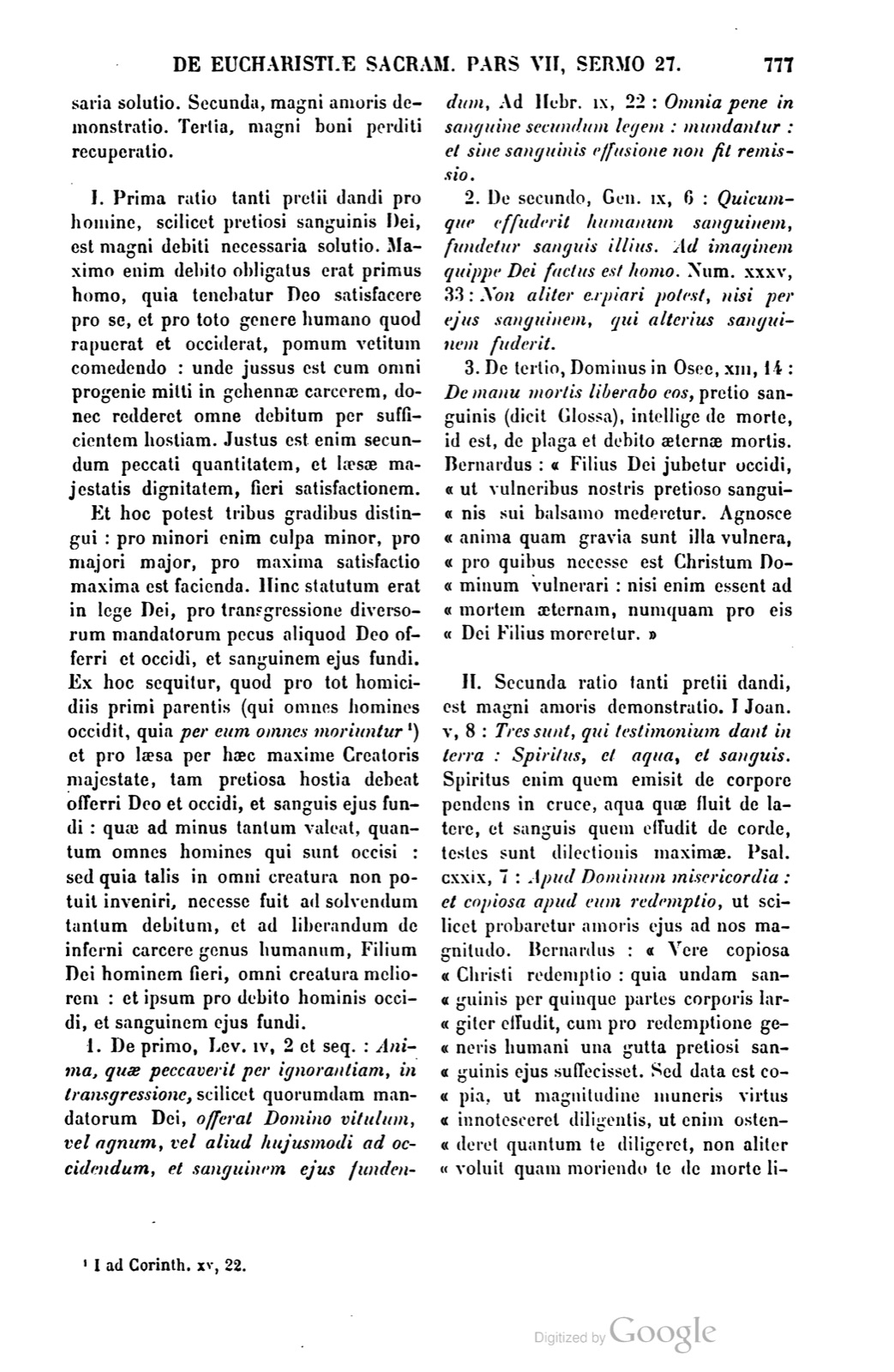
Secundum circa pretiositatem sanguinis Christi praecipue notandum, est tanti pretii pro homine dandi ratio, et haec est triplex. Prima, magni debiti necessaria solutio. Secunda, magni amoris demonstratio. Tertia, magni boni perditi recuperatio.
I. Prima ratio tanti pretii dandi pro homine, scilicet pretiosi sanguinis Dei, est magni debiti necessaria solutio. Maximo enim debito obligatus erat primus homo, quia tenebatur Deo satisfacere pro se, et pro toto genere humano quod rapuerat et occiderat, pomum vetitum comedendo: unde jussus est cum omni progenie mitti in gehennae carcerem, donec redderet omne debitum per sufficientem hostiam. Justus est enim secundum peccati quantitatem, et laesae majestatis dignitatem, fieri satisfactionem.
Et hoc potest tribus gradibus distingui: pro minori enim culpa minor, pro majori major, pro maxima satisfactio maxima est facienda. Hinc statutum erat in lege Dei, pro transgressione diversorum mandatorum pecus aliquod Deo offerri et occidi, et sanguinem ejus fundi. Ex hoc sequitur, quod pro tot homicidiis primi parentis (qui omnes homines occidit, quia per eum omnes moriuntur1) et pro laesa per haec maxime Creatoris majestate, tam pretiosa hostia debeat offerri Deo et occidi, et sanguis ejus fundi: quae ad minus tantum valeat, quantum omnes homines qui sunt occisi: sed quia talis in omni creatura non potuit inveniri, necesse fuit ad solvendum tantum debitum, et ad liberandum de inferni carcere genus humanum, Filium Dei hominem fieri, omni creatura meliorem: et ipsum pro debito hominis occidi, et sanguinem ejus fundi.
1. De primo, Lev. iv, 2 et seq.: Anima, quae peccaverit per ignorantiam, in transgressione, scilicet quorumdam mandatorum Dei, offerat Domino vitulum, vel agnum, vel aliud hujusmodi ad occidendum, et sanguinem ejus fundendum, Ad Hebr. ix, 22: Omnia pene in sanguine secundum legem mundantur: et sine sanguinis effusione non fit remissio.
II.
The second thing especially to be noted concerning the preciousness of Christ's blood is the reason for giving so great a price for man, and this is threefold: first, the necessary payment of a great debt; second, the demonstration of great love; third, the recovery of a great lost good.
I. The first reason for giving so great a price for man, namely the precious blood of God, is the necessary payment of a great debt. For the first man was bound by the greatest debt, because he was held to satisfy God for himself and for the whole human race, which he had snatched away and killed by eating the forbidden fruit; hence he was ordered, with all his progeny, to be sent into the prison of Gehenna until he should pay every debt through a sufficient victim. For it is just that satisfaction be made according to the quantity of sin and the dignity of the majesty injured.
And this can be distinguished in three degrees: for a lesser fault a lesser satisfaction, for a greater one a greater, and for the greatest, the greatest satisfaction must be made. Hence it had been established in the law of God that for the transgression of diverse commandments some animal should be offered to God and killed, and its blood poured out. From this it follows that for the many homicides of the first parent, who killed all men because through him all die1, and for the majesty of the Creator injured most greatly through these things, so precious a victim had to be offered to God and killed, and its blood poured out, which should be worth at least as much as all the men who were killed. But because such a one could not be found in all creation, it was necessary, for paying so great a debt and for freeing the human race from the prison of hell, that the Son of God become man, better than every creature, and that he be killed for man's debt and his blood be poured out.
1. Concerning the first, Leviticus 4:2 and following: A soul which shall sin through ignorance, namely in transgression of certain commandments of God, shall offer to the Lord a calf or lamb or another such thing to be killed and its blood poured out. Hebrews 9:22: Almost all things according to the law are cleansed in blood, and without the pouring out of blood remission is not made.
2. De secundo, Gen. ix, 6: Quicumque effuderit humanum sanguinem, fundetur sanguis illius. Ad imaginem quippe Dei factus est homo. Num. xxxv, 33: Non aliter expiari potest, nisi per ejus sanguinem, qui alterius sanguinem fuderit.
3. De tertio, Dominus in Osee, xiii, 14: De manu mortis liberabo eos, pretio sanguinis (dicit Glossa), intellige de morte, id est, de plaga et debito aeternae mortis. Bernardus: "Filius Dei jubetur occidi, ut vulneribus nostris pretioso sanguinis sui balsamo mederetur. Agnosce anima quam gravia sunt illa vulnera, pro quibus necesse est Christum Dominum vulnerari: nisi enim essent ad mortem aeternam, numquam pro eis Dei Filius moreretur."
II. Secunda ratio tanti pretii dandi, est magni amoris demonstratio. I Joan. v, 8: Tres sunt, qui testimonium dant in terra: Spiritus, et aqua, et sanguis. Spiritus enim quem emisit de corpore pendens in cruce, aqua quae fluit de latere, et sanguis quem effudit de corde, testes sunt dilectionis maximae. Psal. cxxix, 7: Apud Dominum misericordia: et copiosa apud eum redemptio, ut scilicet probaretur amoris ejus ad nos magnitudo. Bernardus: "Vere copiosa Christi redemptio: quia undam sanguinis per quinque partes corporis largiter effudit, cum pro redemptione generis humani una gutta pretiosi sanguinis ejus suffecisset. Sed data est copia, ut magnitudine muneris virtus innotesceret diligentis, ut enim ostenderet quantum te diligeret, non aliter voluit quam moriendo te de morte liberare." Augustinus: "O anima pretiosa, non auro redempta, vel opibus, sed agni immaculati sanguine: attende quantum valeas, quid pro te datum sit cogita, noli teipsam tradere in perditionem pro qua Christus suum pretiosum effudit sanguinem."
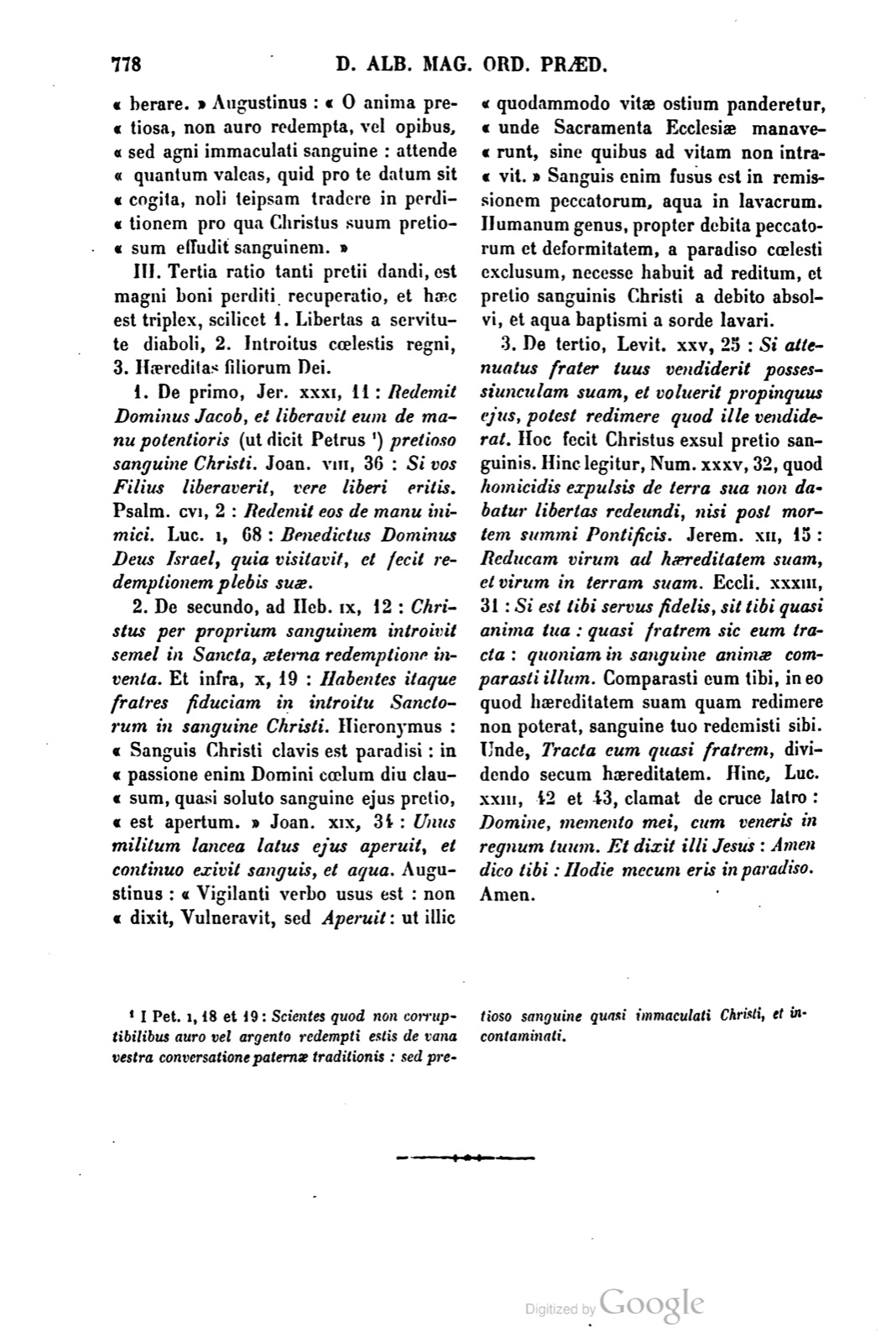
III. Tertia ratio tanti pretii dandi, est magni boni perditi recuperatio, et haec est triplex, scilicet 1. Libertas a servitute diaboli, 2. Introitus caelestis regni, 3. Haereditas filiorum Dei.
1. De primo, Jer. xxxi, 11: Redemit Dominus Jacob, et liberavit eum de manu potentioris (ut dicit Petrus1) pretioso sanguine Christi. Joan. viii, 36: Si vos Filius liberaverit, vere liberi eritis. Psalm. cvi, 2: Redemit eos de manu inimici. Luc. i, 68: Benedictus Dominus Deus Israel, quia visitavit, et fecit redemptionem plebis suae.
2. Concerning the second, Genesis 9:6: Whoever shall pour out human blood, his blood shall be poured out. For man was made to the image of God. Numbers 35:33: It cannot be expiated otherwise except by the blood of him who poured out another's blood.
3. Concerning the third, the Lord in Hosea 13:14: I will free them from the hand of death, at the price of blood, says the Gloss; understand from death, that is, from the plague and debt of eternal death. Bernard says: "The Son of God is ordered to be killed, so that by the precious balm of his blood he might heal our wounds. Recognize, O soul, how grave are those wounds for which it is necessary that Christ the Lord be wounded; for unless they were unto eternal death, the Son of God would never have died for them."
II. The second reason for giving so great a price is the demonstration of great love. 1 John 5:8: There are three who give testimony on earth: the Spirit, and water, and blood. For the Spirit which he sent forth from his body while hanging on the cross, the water which flowed from his side, and the blood which he poured out from his heart, are witnesses of the greatest love. Psalm 129:7: With the Lord there is mercy, and with him plentiful redemption, namely so that the greatness of his love for us might be proved. Bernard says: "Truly plentiful is the redemption of Christ, because he poured out a wave of blood abundantly through the five parts of his body, although one drop of his precious blood would have sufficed for the redemption of the human race. But abundance was given so that by the greatness of the gift the power of the one loving might become known; for to show how much he loved you, he willed to free you from death in no other way than by dying." Augustine says: "O precious soul, redeemed not by gold or by riches, but by the blood of the immaculate lamb: consider how much you are worth, think what was given for you, do not hand yourself over into perdition, for whom Christ poured out his precious blood."
III. The third reason for giving so great a price is the recovery of a great lost good, and this is threefold, namely: 1. freedom from servitude to the devil, 2. entrance of the heavenly kingdom, 3. the inheritance of the sons of God.
1. Concerning the first, Jeremiah 31:11: The Lord redeemed Jacob and freed him from the hand of one more powerful, as Peter says1, by the precious blood of Christ. John 8:36: If the Son has freed you, you will be truly free. Psalm 106:2: He redeemed them from the hand of the enemy. Luke 1:68: Blessed is the Lord God of Israel, because he visited and made redemption of his people.
2. De secundo, ad Heb. ix, 12: Christus per proprium sanguinem introivit semel in Sancta, aeterna redemptione inventa. Et infra, x, 19: Habentes itaque fratres fiduciam in introitu Sanctorum in sanguine Christi. Hieronymus: "Sanguis Christi clavis est paradisi: in passione enim Domini caelum diu clausum, quasi soluto sanguine ejus pretio, est apertum." Joan. xix, 34: Unus militum lancea latus ejus aperuit, et continuo exivit sanguis, et aqua. Augustinus: "Vigilanti verbo usus est: non dixit, Vulneravit, sed Aperuit: ut illic quodammodo vitae ostium panderetur, unde Sacramenta Ecclesiae manaverunt, sine quibus ad vitam non intravit." Sanguis enim fusus est in remissionem peccatorum, aqua in lavacrum. Humanum genus, propter debita peccatorum et deformitatem, a paradiso caelesti exclusum, necesse habuit ad reditum, et pretio sanguinis Christi a debito absolvi, et aqua baptismi a sorde lavari.
3. De tertio, Levit. xxv, 25: Si attenuatus frater tuus vendiderit possessiunculam suam, et voluerit propinquus ejus, potest redimere quod ille vendiderat. Hoc fecit Christus exsul pretio sanguinis. Hinc legitur, Num. xxxv, 32, quod homicidis expulsis de terra sua non dabatur libertas redeundi, nisi post mortem summi Pontificis. Jerem. xii, 15: Reducam virum ad haereditatem suam, et virum in terram suam. Eccli. xxxiii, 31: Si est tibi servus fidelis, sit tibi quasi anima tua: quasi fratrem sic eum tracta: quoniam in sanguine animae comparasti illum. Comparasti eum tibi, in eo quod haereditatem suam quam redimere non poterat, sanguine tuo redemisti sibi. Unde, Tracta eum quasi fratrem, dividendo secum haereditatem. Hinc, Luc. xxiii, 42 et 43, clamat de cruce latro: Domine, memento mei, cum veneris in regnum tuum. Et dixit illi Jesus: Amen dico tibi: Hodie mecum eris in paradiso. Amen.
### Footnotes
1 I Pet. i, 18 et 19: Scientes quod non corruptibilibus auro vel argento redempti estis de vana vestra conversatione paternae traditionis: sed pretioso sanguine quasi immaculati Christi, et incontaminati.
2. Concerning the second, Hebrews 9:12: Christ entered once into the Holy Places through his own blood, eternal redemption having been found. And below, 10:19: Therefore, brothers, having confidence in the entrance of the Holy Places in the blood of Christ. Jerome says: "The blood of Christ is the key of paradise; for in the Passion of the Lord heaven, long closed, was opened as if the price of his blood had been paid." John 19:34: One of the soldiers opened his side with a lance, and immediately blood and water came out. Augustine says: "He used a watchful word: he did not say 'wounded,' but 'opened,' so that there in a certain way the door of life might be opened, whence the Sacraments of the Church flowed, without which one does not enter into life." For the blood was poured out for the remission of sins, the water for washing. The human race, excluded from heavenly paradise because of the debts of sins and deformity, had need, for return, both to be absolved from debt by the price of Christ's blood and to be washed from stain by the water of baptism.
3. Concerning the third, Leviticus 25:25: If your brother, made poor, sells his little possession, and his kinsman wishes, he can redeem what that one had sold. Christ, the exile, did this at the price of blood. Hence it is read in Numbers 35:32 that to homicides expelled from their land there was not given freedom of returning except after the death of the high priest. Jeremiah 12:15: I will lead the man back to his inheritance and the man into his land. Ecclesiasticus 33:31: If you have a faithful servant, let him be to you like your soul; treat him as a brother, because with the blood of your soul you have acquired him. You have acquired him to yourself in this, that by your blood you redeemed for him his inheritance which he could not redeem. Hence, Treat him as a brother, by dividing the inheritance with him. Hence in Luke 23:42 and 43, the thief cries from the cross: Lord, remember me when you come into your kingdom. And Jesus said to him: Amen I say to you: Today you will be with me in paradise. Amen.
### Footnotes
1 1 Peter 1:18 and 19: Knowing that you were redeemed not with corruptible gold or silver from your vain conduct of paternal tradition, but with the precious blood as of the immaculate and undefiled Christ.
Notes
- 1 Peter 1:18 and 19: Knowing that you were redeemed not with corruptible gold or silver from your vain conduct of paternal tradition, but with the precious blood as of the immaculate and undefiled Christ. (I Pet. i, 18 et 19: Scientes quod non corruptibilibus auro vel argento redempti estis de vana vestra conversatione paternae traditionis: sed pretioso sanguine quasi immaculati Christi, et incontaminati.) ↩
If a page does not appear, its photograph has not been uploaded yet.