Works › Sermons on the Most Holy Sacrament of the Eucharist
Volume 13 · pp. 772–774
Sermon XXVI. On Effects Taken from Three Other Names of the Body of Christ
A marker with ≈ is an approximate page boundary, placed by measure of the text; the page photographs remain the authority. In the paired views, clicking a page marker brings that page into view.
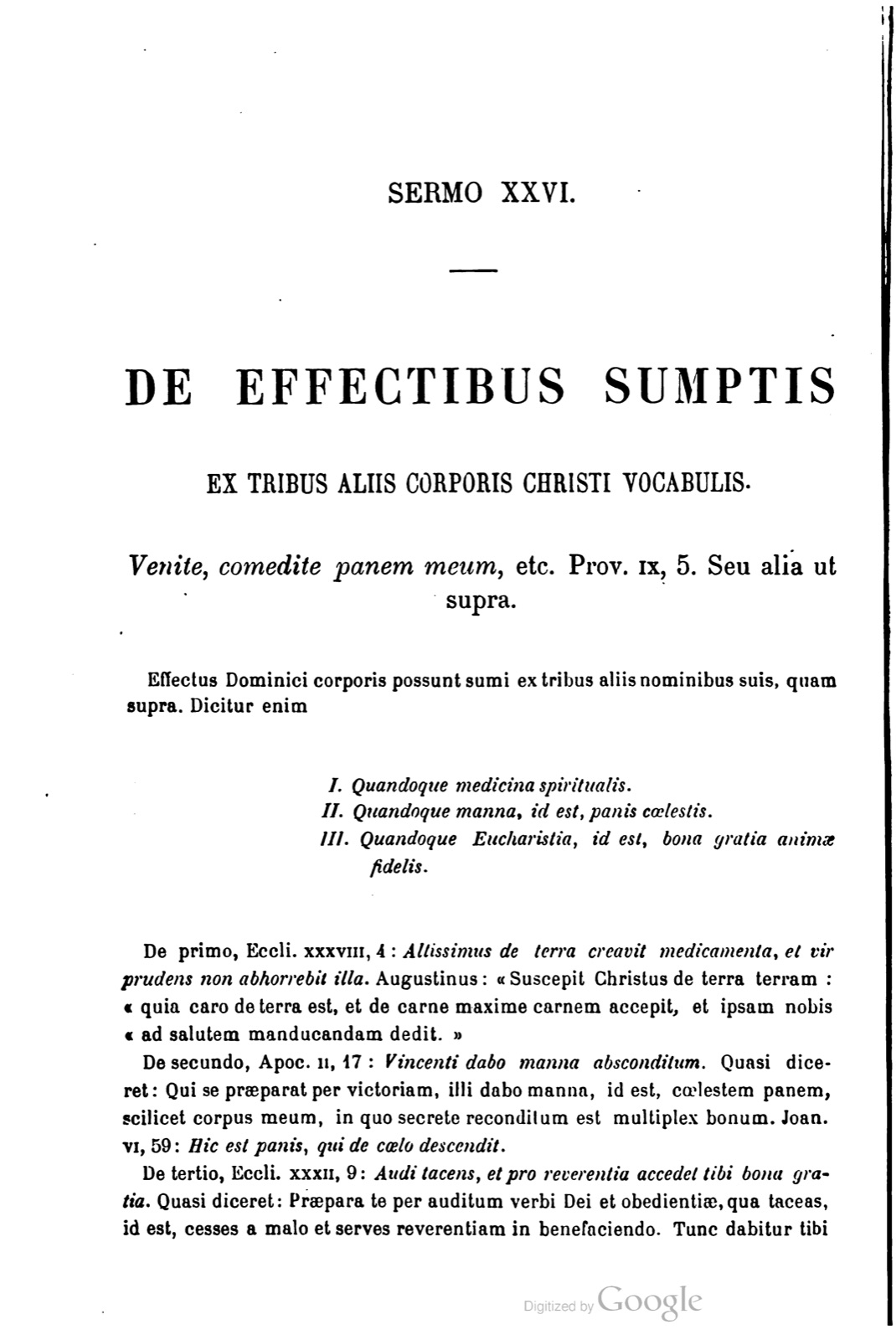
### Sermo XXVI
### De effectibus sumptis ex tribus aliis corporis Christi vocabulis
Venite, comedite panem meum, etc. Prov. ix, 5. Seu alia ut supra.
Effectus Dominici corporis possunt sumi ex tribus aliis nominibus suis, quam supra. Dicitur enim
I. Quandoque medicina spiritualis.
II. Quandoque manna, id est, panis caelestis.
III. Quandoque Eucharistia, id est, bona gratia animae fidelis.
De primo, Eccli. xxxviii, 4: Altissimus de terra creavit medicamenta, et vir prudens non abhorrebit illa. Augustinus: "Suscepit Christus de terra terram: quia caro de terra est, et de carne maxime carnem accepit, et ipsam nobis ad salutem manducandam dedit."
De secundo, Apoc. ii, 17: Vincenti dabo manna absconditum. Quasi diceret: Qui se praeparat per victoriam, illi dabo manna, id est, caelestem panem, scilicet corpus meum, in quo secrete reconditum est multiplex bonum. Joan. vi, 59: Hic est panis, qui de caelo descendit.
De tertio, Eccli. xxxii, 9: Audi tacens, et pro reverentia accedet tibi bona gratia. Quasi diceret: Praepara te per auditum verbi Dei et obedientiae, qua taceas, id est, cesses a malo et serves reverentiam in benefaciendo. Tunc dabitur tibi bona gratia, quae graece dicitur Eucharistia (Εὐχαριστία)1, id est, corpus Christi. Magister Sententiarum: "Sacramentum altaris excellenter dicitur Eucharistia, id est, bona gratia, quia in eo non solum est augmentum virtutum et gratiae: sed ille totus ibi sumitur, qui est fons et origo totius gratiae."
I.
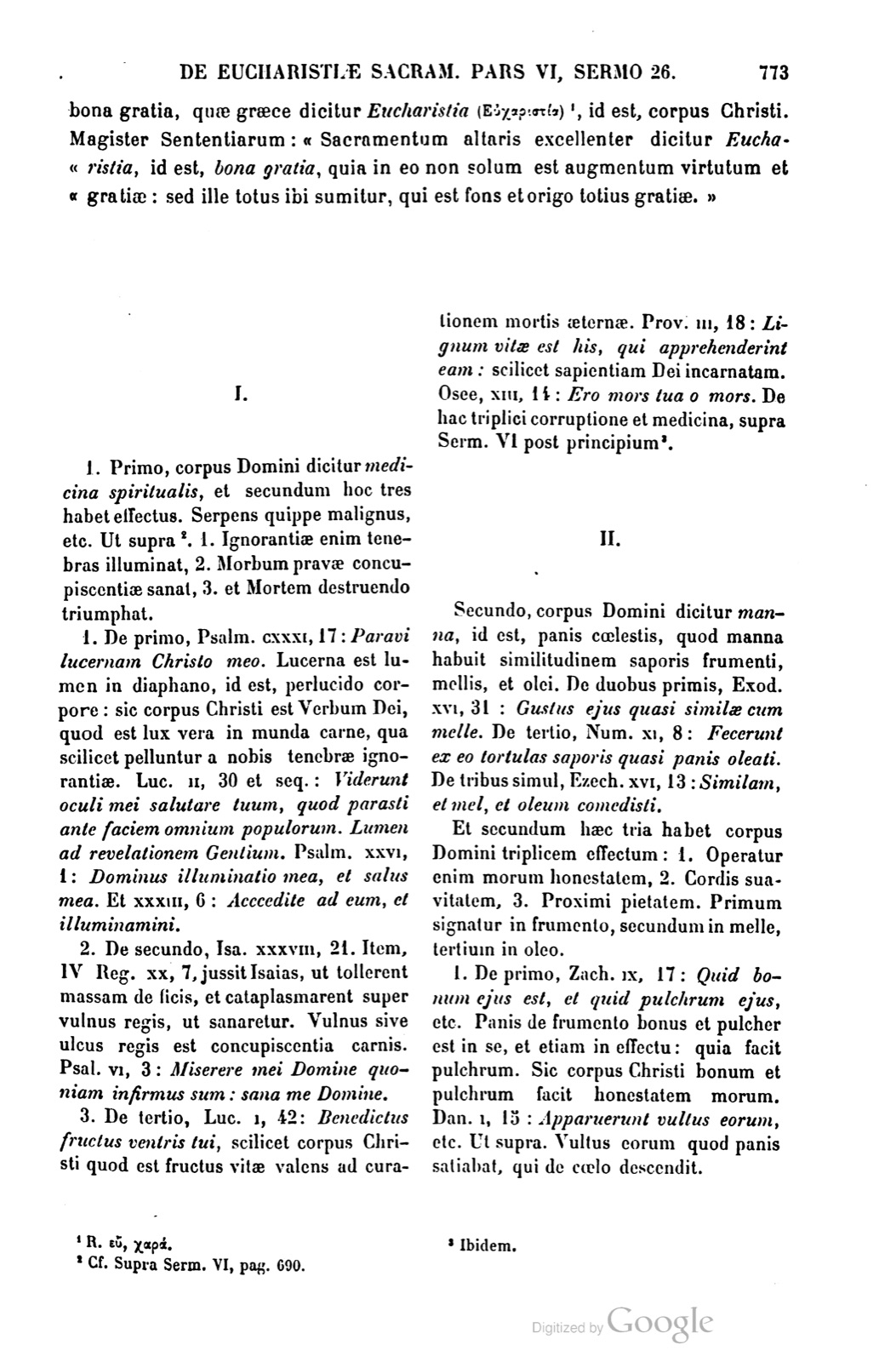
1. Primo, corpus Domini dicitur medicina spiritualis, et secundum hoc tres habet effectus. Serpens quippe malignus, etc. Ut supra2. 1. Ignorantiae enim tenebras illuminat, 2. Morbum pravae concupiscentiae sanat, 3. et Mortem destruendo triumphat.
1. De primo, Psalm. cxxxi, 17: Paravi lucernam Christo meo. Lucerna est lumen in diaphano, id est, perlucido corpore: sic corpus Christi est Verbum Dei, quod est lux vera in munda carne, qua scilicet pelluntur a nobis tenebrae ignorantiae. Luc. ii, 30 et seq. Viderunt oculi mei salutare tuum, quod parasti ante faciem omnium populorum. Lumen ad revelationem Gentium. Psalm. xxvi, 1: Dominus illuminatio mea, et salus mea. Et xxxiii, 6: Accedite ad eum, et illuminamini.
### Sermon XXVI
### On Effects Taken from Three Other Names of the Body of Christ
Come, eat my bread, etc. Proverbs 9:5. Or other texts as above.
The effects of the Lord's body can be taken from three other names of his, than above. For it is called:
I. Sometimes spiritual medicine.
II. Sometimes manna, that is, heavenly bread.
III. Sometimes Eucharist, that is, the good grace of a faithful soul.
Concerning the first, Ecclesiasticus 38:4: The Most High created medicines from the earth, and a prudent man will not abhor them. Augustine says: "Christ took earth from earth, because flesh is from the earth, and from flesh especially he received flesh, and he gave it to us to be eaten for salvation."
Concerning the second, Apocalypse 2:17: To the one conquering I will give the hidden manna. As if he were saying: To the one who prepares himself through victory, to him I will give manna, that is, heavenly bread, namely my body, in which manifold good is secretly stored away. John 6:59: This is the bread which descended from heaven.
Concerning the third, Ecclesiasticus 32:9: Hear in silence, and because of reverence good grace will come to you. As if he were saying: Prepare yourself through hearing the word of God and of obedience, by which you may be silent, that is, cease from evil and preserve reverence in doing good. Then good grace will be given to you, which in Greek is called Eucharistia (Εὐχαριστία)1, that is, the body of Christ. The Master of the Sentences says: "The sacrament of the altar is excellently called Eucharistia, that is, good grace, because in it there is not only an increase of virtues and grace, but that whole one is received there, who is the fount and origin of all grace."
I.
1. First, the body of the Lord is called spiritual medicine, and according to this it has three effects. For the malignant serpent, etc. As above2. 1. For it illuminates the darknesses of ignorance, 2. heals the disease of depraved concupiscence, 3. and triumphs by destroying death.
1. Concerning the first, Psalm 131:17: I have prepared a lamp for my Christ. A lamp is light in a diaphanous, that is, translucent body; so the body of Christ is the Word of God, which is the true light in clean flesh, by which namely the darknesses of ignorance are driven away from us. Luke 2:30 and following: My eyes have seen your salvation, which you have prepared before the face of all peoples, a light for revelation of the Gentiles. Psalm 26:1: The Lord is my illumination and my salvation. And 33:6: Approach him and be illuminated.
2. De secundo, Isa. xxxviii, 21. Item, IV Reg. xx, 7, jussit Isaias, ut tollerent massam de ficis, et cataplasmarent super vulnus regis, ut sanaretur. Vulnus sive ulcus regis est concupiscentia carnis. Psal. vi, 3: Miserere mei Domine quoniam infirmus sum: sana me Domine.
3. De tertio, Luc. i, 42: Benedictus fructus ventris tui, scilicet corpus Christi quod est fructus vitae valens ad curationem mortis aeternae. Prov. iii, 18: Lignum vitae est his, qui apprehenderint eam: scilicet sapientiam Dei incarnatam. Osee, xiii, 14: Ero mors tua o mors. De hac triplici corruptione et medicina, supra Serm. VI post principium3.
II.
Secundo, corpus Domini dicitur manna, id est, panis caelestis, quod manna habuit similitudinem saporis frumenti, mellis, et olei. De duobus primis, Exod. xvi, 31: Gustus ejus quasi similae cum melle. De tertio, Num. xi, 8: Fecerunt ex eo tortulas saporis quasi panis oleati. De tribus simul, Ezech. xvi, 13: Similam, et mel, et oleum comedisti.
Et secundum haec tria habet corpus Domini triplicem effectum: 1. Operatur enim morum honestatem, 2. Cordis suavitatem, 3. Proximi pietatem. Primum signatur in frumento, secundum in melle, tertium in oleo.
1. De primo, Zach. ix, 17: Quid bonum ejus est, et quid pulchrum ejus, etc. Panis de frumento bonus et pulcher est in se, et etiam in effectu: quia facit pulchrum. Sic corpus Christi bonum et pulchrum facit honestatem morum. Dan. i, 15: Apparuerunt vultus eorum, etc. Ut supra. Vultus eorum quod panis satiabat, qui de caelo descendit.
2. De secundo, Prov. xxiv, 13: Comede, fili mi, mel, quia bonum est. Sap. xvi, 20: Paratum de caelo panem praestitisti, etc.
3. De tertio, Job, xxix, 2 et seq. Quis mihi tribuat, ut sim secundum dies, quando secreto Deus erat in tabernaculo meo, et petra fundebat mihi rivos olei? id est, gratiam pietatis ad bonum proximi. Prov. xxi, 20: Thesaurus desiderabilis, et oleum in habitaculo justi. IV Reg. iv, 5, 7: Offerebant vasa, et mulier infundebat oleum.... Et ait Eliseus, Vende oleum, et redde creditori tuo: tu autem, et filii tui, vivite de reliquo. Ecce, oleum in opus pietatis proximum reficit, debita solvit, nos ipsos pascit. Primum intelligitur in eo quod fundebat oleum in vasa proximorum, secundum in eo quod reddidit per oleum debita creditori, tertium in eo quod ipsa et filii de oleo vixerunt.
2. Concerning the second, Isaiah 38:21. Likewise, 4 Kings 20:7: Isaiah ordered that they should take a mass of figs and plaster it upon the wound of the king, so that he might be healed. The wound or ulcer of the king is the concupiscence of the flesh. Psalm 6:3: Have mercy on me, O Lord, because I am weak; heal me, O Lord.
3. Concerning the third, Luke 1:42: Blessed is the fruit of your womb, namely the body of Christ, which is the fruit of life availing for the cure of eternal death. Proverbs 3:18: It is a tree of life to those who have grasped it, namely the incarnate wisdom of God. Hosea 13:14: I will be your death, O death. Concerning this threefold corruption and medicine, above in Sermon VI after the beginning3.
II.
Secondly, the body of the Lord is called manna, that is, heavenly bread, because manna had the likeness of the taste of wheat, honey, and oil. Concerning the first two, Exodus 16:31: Its taste was like fine flour with honey. Concerning the third, Numbers 11:8: They made from it cakes with a taste like oiled bread. Concerning the three together, Ezekiel 16:13: You ate fine flour and honey and oil.
And according to these three things the body of the Lord has a threefold effect: 1. for it works honesty of morals, 2. sweetness of heart, 3. piety toward neighbor. The first is signified in wheat, the second in honey, the third in oil.
1. Concerning the first, Zechariah 9:17: What is his good thing, and what is his beautiful thing, etc. Bread from wheat is good and beautiful in itself and also in effect, because it makes beautiful. Thus the body of Christ, good and beautiful, makes honesty of morals. Daniel 1:15: Their faces appeared, etc. As above. Their faces, because the bread satisfied them, which descended from heaven.
2. Concerning the second, Proverbs 24:13: Eat honey, my son, because it is good. Wisdom 16:20: You supplied bread prepared from heaven, etc.
3. Concerning the third, Job 29:2 and following: Who will grant me that I may be according to the days when God was secretly in my tabernacle, and the rock poured out for me streams of oil? That is, the grace of piety toward the good of neighbor. Proverbs 21:20: Desirable treasure and oil are in the dwelling of the just. 4 Kings 4:5, 7: They offered vessels, and the woman poured in oil.... And Elisha said, Sell the oil and pay your creditor; but you and your sons, live from the rest. Behold, oil refreshes the neighbor unto the work of piety, pays debts, and feeds ourselves. The first is understood in that she poured oil into the vessels of neighbors, the second in that she paid debts to the creditor through the oil, the third in that she herself and her sons lived from the oil.
III.
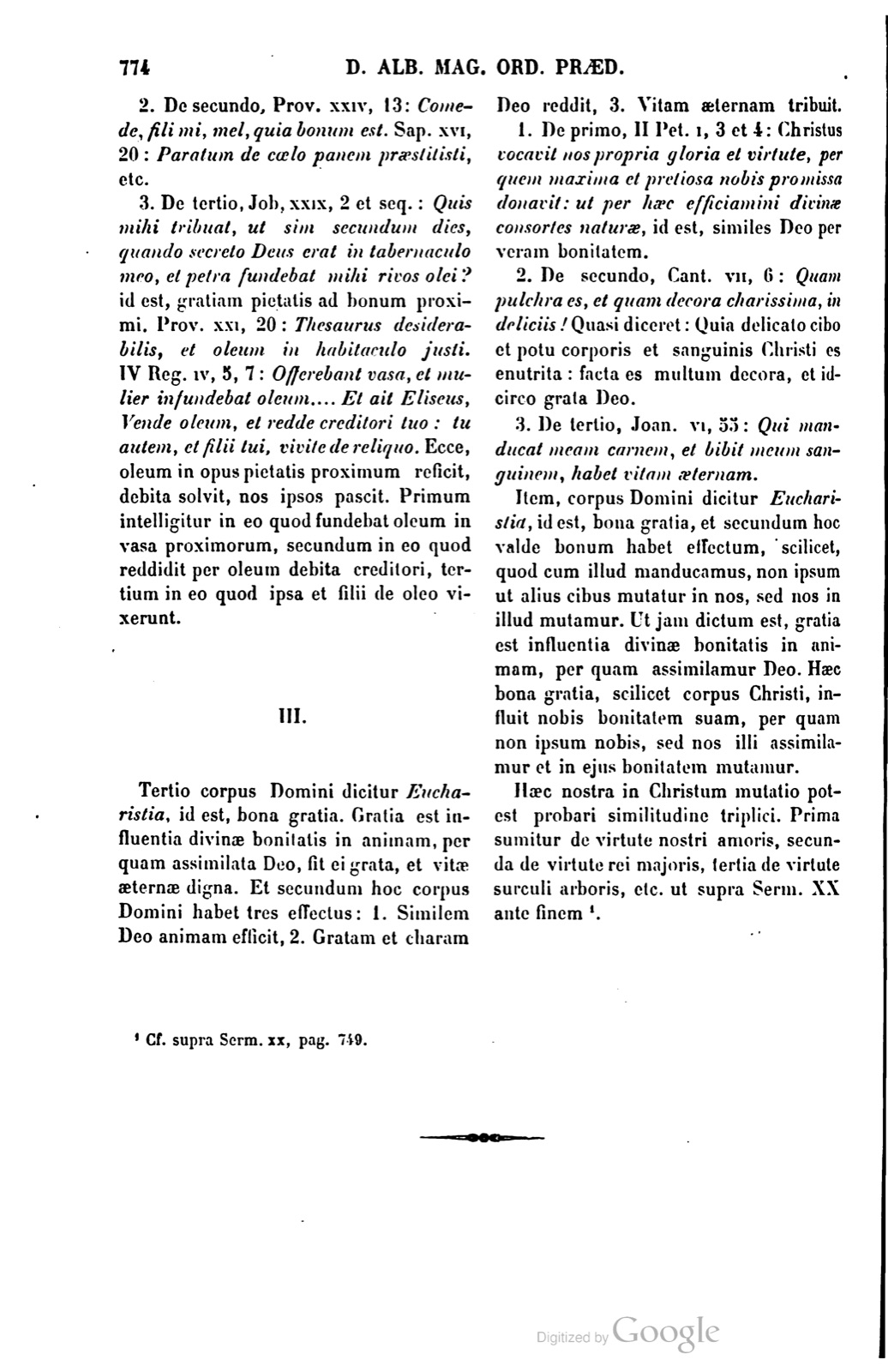
Tertio corpus Domini dicitur Eucharistia, id est, bona gratia. Gratia est influentia divinae bonitatis in animam, per quam assimilata Deo, fit ei grata, et vitae aeternae digna. Et secundum hoc corpus Domini habet tres effectus: 1. Similem Deo animam efficit, 2. Gratam et charam Deo reddit, 3. Vitam aeternam tribuit.
1. De primo, II Pet. i, 3 et 4: Christus vocavit nos propria gloria et virtute, per quem maxima et pretiosa nobis promissa donavit: ut per haec efficiamini divinae consortes naturae, id est, similes Deo per veram bonitatem.
2. De secundo, Cant. vii, 6: Quam pulchra es, et quam decora charissima, in deliciis! Quasi diceret: Quia delicato cibo et potu corporis et sanguinis Christi es enutrita: facta es multum decora, et idcirco grata Deo.
3. De tertio, Joan. vi, 55: Qui manducat meam carnem, et bibit meum sanguinem, habet vitam aeternam.
Item, corpus Domini dicitur Eucharistia, id est, bona gratia, et secundum hoc valde bonum habet effectum, scilicet, quod cum illud manducamus, non ipsum ut alius cibus mutatur in nos, sed nos in illud mutamur. Ut jam dictum est, gratia est influentia divinae bonitatis in animam, per quam assimilamur Deo. Haec bona gratia, scilicet corpus Christi, influit nobis bonitatem suam, per quam non ipsum nobis, sed nos illi assimilamur et in ejus bonitatem mutamur.
Haec nostra in Christum mutatio potest probari similitudine triplici. Prima sumitur de virtute nostri amoris, secunda de virtute rei majoris, tertia de virtute surculi arboris, etc. ut supra Serm. XX ante finem4.
### Footnotes
1 R. εὖ, χαρά.
2 Cf. Supra Serm. VI, pag. 690.
3 Ibidem.
4 Cf. supra Serm. xx, pag. 749.
III.
Thirdly, the body of the Lord is called Eucharistia, that is, good grace. Grace is an inflowing of divine goodness into the soul, through which, being assimilated to God, it becomes pleasing to him and worthy of eternal life. And according to this the body of the Lord has three effects: 1. it makes the soul like God, 2. it renders it pleasing and dear to God, 3. it grants eternal life.
1. Concerning the first, 2 Peter 1:3 and 4: Christ called us by his own glory and power, through whom he gave us the greatest and precious promises, so that through these you may be made sharers in the divine nature, that is, like God through true goodness.
2. Concerning the second, Song of Songs 7:6: How beautiful you are, and how comely, dearest one, in delights! As if he were saying: Because you have been nourished with the delicate food and drink of the body and blood of Christ, you have been made very comely, and therefore pleasing to God.
3. Concerning the third, John 6:55: He who eats my flesh and drinks my blood has eternal life.
Likewise, the body of the Lord is called Eucharistia, that is, good grace, and according to this it has a very good effect, namely, that when we eat it, it is not changed into us as another food is, but we are changed into it. As has already been said, grace is an inflowing of divine goodness into the soul, through which we are assimilated to God. This good grace, namely the body of Christ, pours its goodness into us, through which it is not assimilated to us, but we are assimilated to it and changed into its goodness.
This change of ours into Christ can be proved by a threefold likeness. The first is taken from the power of our love, the second from the power of a greater thing, the third from the power of the shoot of a tree, etc., as above in Sermon XX before the end4.
### Footnotes
1 R. εὖ, χαρά.
2 Compare above, Sermon VI, p. 690.
3 In the same place.
4 Compare above, Sermon XX, p. 749.
If a page does not appear, its photograph has not been uploaded yet.