Works › Sermons on the Most Holy Sacrament of the Eucharist
Volume 13 · pp. 703–706
Sermon IX. On the Form of Donation by Which It Is Given under the Species of Bread
A marker with ≈ is an approximate page boundary, placed by measure of the text; the page photographs remain the authority. In the paired views, clicking a page marker brings that page into view.
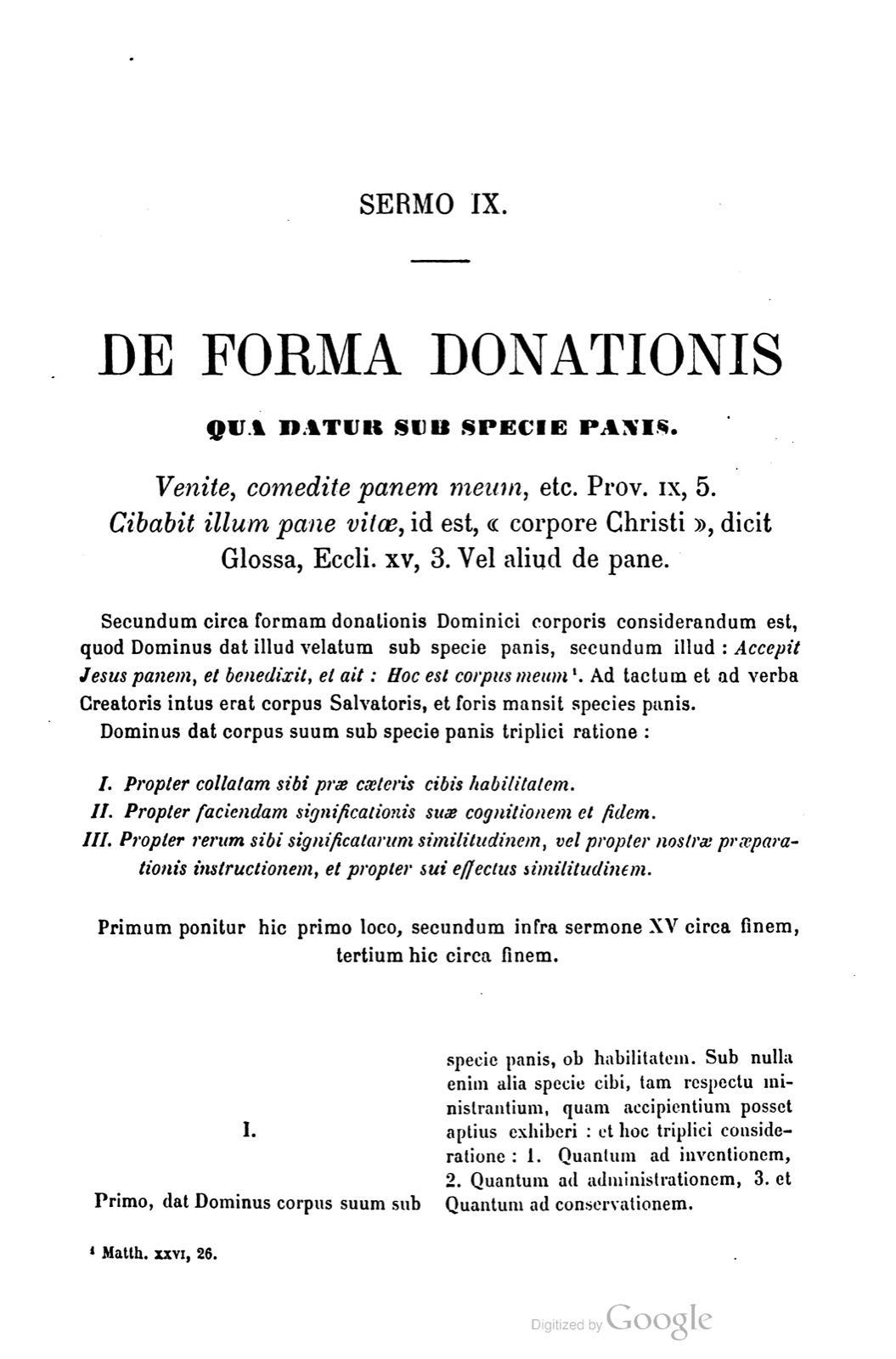
### Sermo IX
### De forma donationis qua datur sub specie panis
Venite, comedite panem meum, etc. Prov. ix, 5.
Cibabit illum pane vitae, id est, « corpore Christi », dicit Glossa, Eccli. xv, 3. Vel aliud de pane.
Secundum circa formam donationis Dominici corporis considerandum est, quod Dominus dat illud velatum sub specie panis, secundum illud: Accepit Jesus panem, et benedixit, et ait: Hoc est corpus meum1. Ad tactum et ad verba Creatoris intus erat corpus Salvatoris, et foris mansit species panis.
Dominus dat corpus suum sub specie panis triplici ratione:
I. Propter collatam sibi prae caeteris cibis habilitatem.
II. Propter faciendam significationis suae cognitionem et fidem.
III. Propter rerum sibi significatarum similitudinem, vel propter nostrae praeparationis instructionem, et propter sui effectus similitudinem.
Primum ponitur hic primo loco, secundum infra sermone XV circa finem, tertium hic circa finem.
I.
Primo, dat Dominus corpus suum sub specie panis, ob habilitatem. Sub nulla enim alia specie cibi, tam respectu ministrantium, quam accipientium posset aptius exhiberi: et hoc triplici consideratione: 1. Quantum ad inventionem, 2. Quantum ad administrationem, 3. et Quantum ad conservationem.
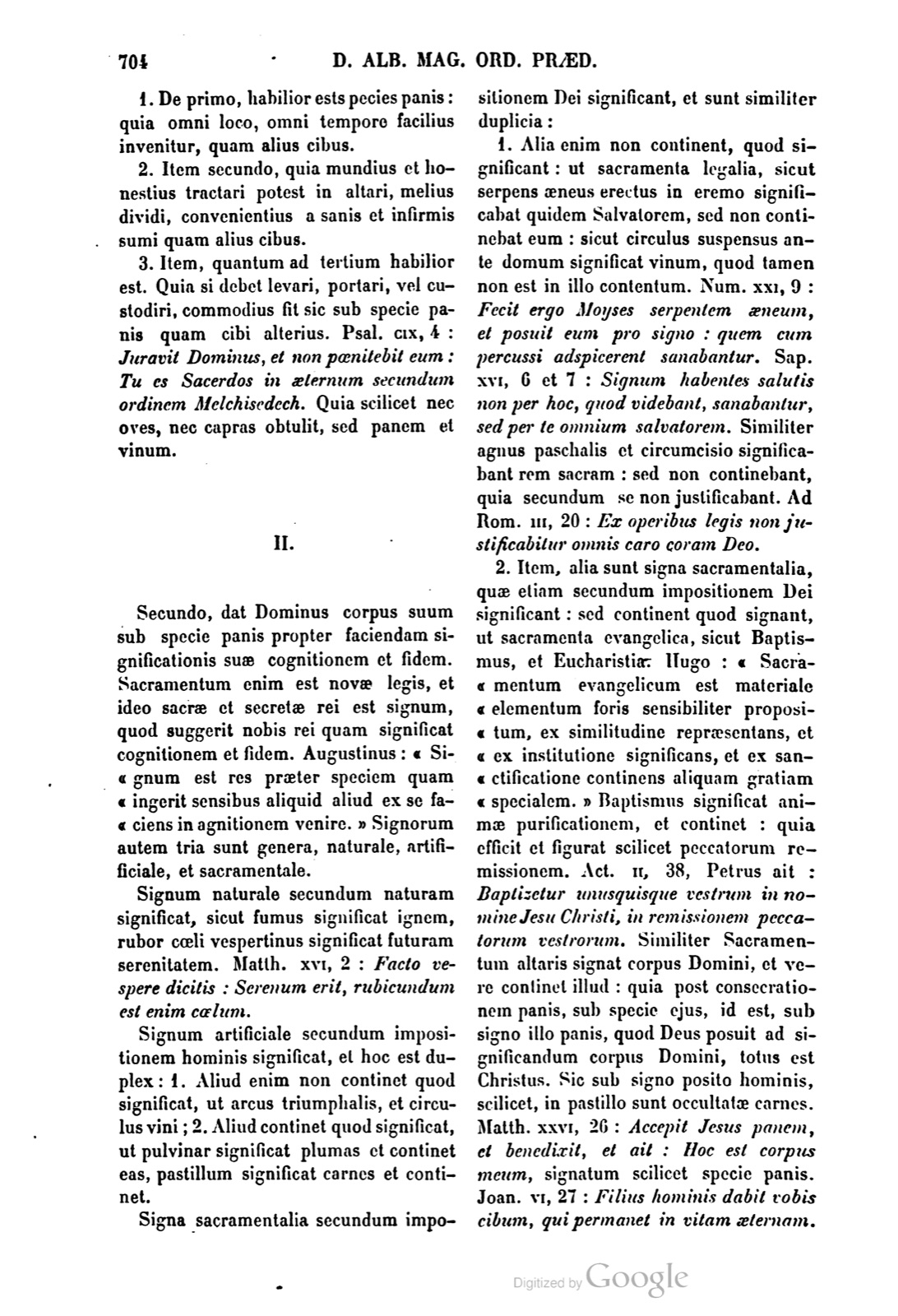
1. De primo, habilior est species panis: quia omni loco, omni tempore facilius invenitur, quam alius cibus.
2. Item secundo, quia mundius et honestius tractari potest in altari, melius dividi, convenientius a sanis et infirmis sumi quam alius cibus.
3. Item, quantum ad tertium habilior est. Quia si debet levari, portari, vel custodiri, commodius fit sic sub specie panis quam cibi alterius. Psal. cix, 4: Juravit Dominus, et non paenitebit eum: Tu es Sacerdos in aeternum secundum ordinem Melchisedech. Quia scilicet nec oves, nec capras obtulit, sed panem et vinum.
II.
Secundo, dat Dominus corpus suum sub specie panis propter faciendam significationis suae cognitionem et fidem. Sacramentum enim est novae legis, et ideo sacrae et secretae rei est signum, quod suggerit nobis rei quam significat cognitionem et fidem. Augustinus: « Signum est res praeter speciem quam ingerit sensibus aliquid aliud ex se faciens in agnitionem venire. » Signorum autem tria sunt genera, naturale, artificiale, et sacramentale.
### Sermon IX
### On the Form of Donation by Which It Is Given under the Species of Bread
Come, eat my bread, etc. Proverbs 9:5.
He will feed him with the bread of life, that is, "with the body of Christ," says the Gloss, Ecclesiasticus 15:3. Or another text concerning bread.
The second thing to be considered concerning the form of donation of the Lord's body is that the Lord gives it veiled under the species of bread, according to that saying: Jesus took bread, and blessed it, and said: This is my body1. At the touch and at the words of the Creator, within was the body of the Savior, and without the species of bread remained.
The Lord gives his body under the species of bread for a threefold reason:
I. On account of the fitness conferred upon it before the other foods.
II. On account of producing the knowledge and faith of its signification.
III. On account of the likeness of the things signified by it, or on account of the instruction of our preparation, and on account of the likeness of its effect.
The first is placed here in the first place, the second below around the end of Sermon XV, the third here around the end.
I.
First, the Lord gives his body under the species of bread on account of fitness. For under no other species of food, both with respect to those ministering and to those receiving, could it be more fittingly exhibited; and this by a threefold consideration: 1. As to finding it, 2. As to administering it, 3. and As to preserving it.
1. Concerning the first, the species of bread is fitter, because in every place and at every time it is found more easily than another food.
2. Likewise secondly, because it can be handled on the altar more cleanly and honorably, divided better, and consumed more conveniently by the healthy and the sick than another food.
3. Likewise, as to the third, it is fitter. For if it must be lifted, carried, or kept, this is done more conveniently thus under the species of bread than of another food. Psalm 109:4: The Lord has sworn, and it will not repent him: You are a Priest forever according to the order of Melchisedech. Because, namely, he offered neither sheep nor goats, but bread and wine.
II.
Secondly, the Lord gives his body under the species of bread on account of producing the knowledge and faith of its signification. For it is a sacrament of the new law, and therefore it is a sign of a sacred and secret thing, which suggests to us the knowledge and faith of the thing which it signifies. Augustine says: "A sign is a thing which, besides the species which it impresses upon the senses, causes something else from itself to come into recognition." But signs are of three kinds: natural, artificial, and sacramental.
Signum naturale secundum naturam significat, sicut fumus significat ignem, rubor coeli vespertinus significat futuram serenitatem. Matth. xvi, 2: Facto vespere dicitis: Serenum erit, rubicundum est enim coelum.
Signum artificiale secundum impositionem hominis significat, et hoc est duplex: 1. Aliud enim non continet quod significat, ut arcus triumphalis, et circulus vini; 2. Aliud continet quod significat, ut pulvinar significat plumas et continet eas, pastillum significat carnes et continet.
Signa sacramentalia secundum impositionem Dei significant, et sunt similiter duplicia:
1. Alia enim non continent, quod significant: ut sacramenta legalia, sicut serpens aeneus erectus in eremo significabat quidem Salvatorem, sed non continebat eum: sicut circulus suspensus ante domum significat vinum, quod tamen non est in illo contentum. Num. xxi, 9: Fecit ergo Moyses serpentem aeneum, et posuit eum pro signo: quem cum percussi adspicerent sanabantur. Sap. xvi, 6 et 7: Signum habentes salutis non per hoc, quod videbant, sanabantur, sed per te omnium salvatorem. Similiter agnus paschalis et circumcisio significabant rem sacram: sed non continebant, quia secundum se non justificabant. Ad Rom. iii, 20: Ex operibus legis non justificabitur omnis caro coram Deo.
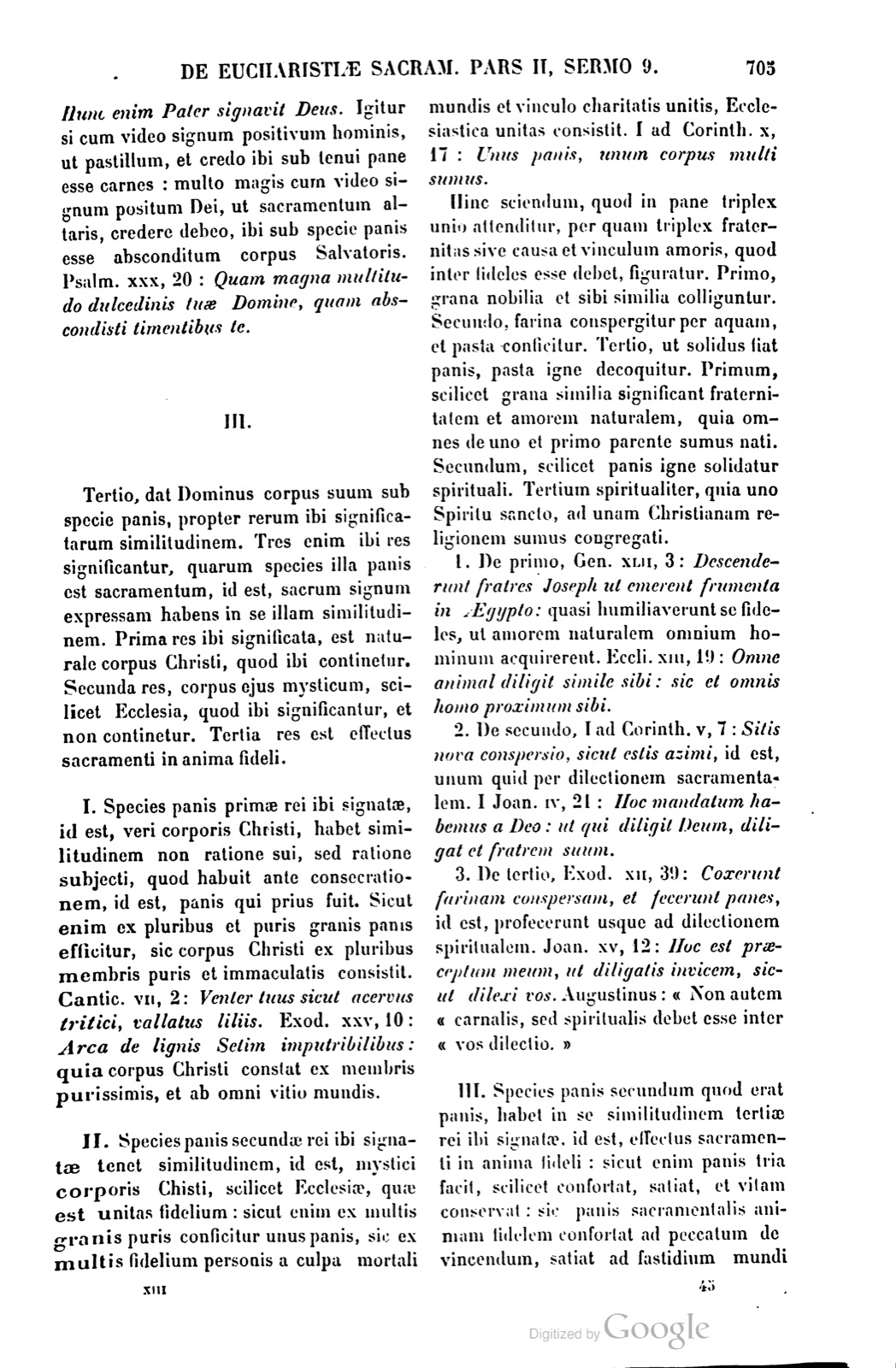
2. Item, alia sunt signa sacramentalia, quae etiam secundum impositionem Dei significant: sed continent quod signant, ut sacramenta evangelica, sicut Baptismus, et Eucharistia. Hugo: « Sacramentum evangelicum est materiale elementum foris sensibiliter propositum, ex similitudine repraesentans, et ex institutione significans, et ex sanctificatione continens aliquam gratiam specialem. » Baptismus significat animae purificationem, et continet: quia efficit et figurat scilicet peccatorum remissionem. Act. ii, 38, Petrus ait: Baptizetur unusquisque vestrum in nomine Jesu Christi, in remissionem peccatorum vestrorum. Similiter Sacramentum altaris signat corpus Domini, et vere continet illud: quia post consecrationem panis, sub specie ejus, id est, sub signo illo panis, quod Deus posuit ad significandum corpus Domini, totus est Christus. Sic sub signo posito hominis, scilicet, in pastillo sunt occultatae carnes. Matth. xxvi, 26: Accepit Jesus panem, et benedixit, et ait: Hoc est corpus meum, signatum scilicet specie panis. Joan. vi, 27: Filius hominis dabit vobis cibum, qui permanet in vitam aeternam. Hunc enim Pater signavit Deus. Igitur si cum video signum positivum hominis, ut pastillum, et credo ibi sub tenui pane esse carnes: multo magis cum video signum positum Dei, ut sacramentum altaris, credere debeo, ibi sub specie panis esse absconditum corpus Salvatoris. Psalm. xxx, 20: Quam magna multitudo dulcedinis tuae Domine, quam abscondisti timentibus te.
A natural sign signifies according to nature, as smoke signifies fire; the redness of the evening sky signifies future serenity. Matthew 16:2: When evening has come you say: It will be serene, for the sky is red.
An artificial sign signifies according to the imposition of man, and this is twofold: 1. For one does not contain what it signifies, as a triumphal arch and the circle of wine; 2. Another contains what it signifies, as a cushion signifies feathers and contains them, and a pastry signifies meats and contains them.
Sacramental signs signify according to the imposition of God, and are similarly twofold:
1. For some do not contain what they signify, as the legal sacraments: as the bronze serpent raised up in the desert indeed signified the Savior, but did not contain him; as a circle hung before a house signifies wine, which nevertheless is not contained in it. Numbers 21:9: Therefore Moses made a bronze serpent and set it up for a sign; when those who had been struck looked at it, they were healed. Wisdom 16:6 and 7: Having a sign of salvation, they were healed not through that which they saw, but through you, the Savior of all. Similarly the paschal lamb and circumcision signified a sacred thing, but did not contain it, because according to themselves they did not justify. Romans 3:20: From the works of the law no flesh will be justified before God.
2. Likewise, there are other sacramental signs, which also signify according to the imposition of God, but contain what they signify, as the evangelical sacraments, such as Baptism and the Eucharist. Hugh says: "An evangelical sacrament is a material element outwardly and sensibly proposed, representing from likeness, signifying from institution, and containing from sanctification some special grace." Baptism signifies purification of the soul and contains it, because it effects and figures, namely, the remission of sins. Acts 2:38, Peter says: Let each one of you be baptized in the name of Jesus Christ, unto the remission of your sins. Similarly the Sacrament of the altar signifies the body of the Lord and truly contains it, because after the consecration of the bread, under its species, that is, under that sign of bread which God established to signify the body of the Lord, the whole Christ is present. Thus under a sign established by man, namely in a pastry, meats are hidden. Matthew 26:26: Jesus took bread, and blessed it, and said: This is my body, signed, namely, by the species of bread. John 6:27: The Son of man will give you food which remains unto eternal life. For God the Father has signed him. Therefore if, when I see a positive sign of man, such as a pastry, I believe that meats are there under thin bread, much more when I see a sign established by God, such as the sacrament of the altar, ought I to believe that there, under the species of bread, the body of the Savior is hidden. Psalm 30:20: How great is the multitude of your sweetness, O Lord, which you have hidden for those who fear you.
III.
Tertio, dat Dominus corpus suum sub specie panis, propter rerum ibi significatarum similitudinem. Tres enim ibi res significantur, quarum species illa panis est sacramentum, id est, sacrum signum expressam habens in se illam similitudinem. Prima res ibi significata, est naturale corpus Christi, quod ibi continetur. Secunda res, corpus ejus mysticum, scilicet Ecclesia, quod ibi significatur, et non continetur. Tertia res est effectus sacramenti in anima fideli.
I. Species panis primae rei ibi signatae, id est, veri corporis Christi, habet similitudinem non ratione sui, sed ratione subjecti, quod habuit ante consecrationem, id est, panis qui prius fuit. Sicut enim ex pluribus et puris granis panis efficitur, sic corpus Christi ex pluribus membris puris et immaculatis consistit. Cantic. vii, 2: Venter tuus sicut acervus tritici, vallatus liliis. Exod. xxv, 10: Arca de lignis Setim imputribilibus: quia corpus Christi constat ex membris purissimis, et ab omni vitio mundis.
II. Species panis secundae rei ibi signatae tenet similitudinem, id est, mystici corporis Christi, scilicet Ecclesiae, quae est unitas fidelium: sicut enim ex multis granis puris conficitur unus panis, sic ex multis fidelium personis a culpa mortali mundis et vinculo charitatis unitis, Ecclesiastica unitas consistit. I ad Corinth. x, 17: Unus panis, unum corpus multi sumus.
Hinc sciendum, quod in pane triplex unio attenditur, per quam triplex fraternitas sive causa et vinculum amoris, quod inter fideles esse debet, figuratur. Primo, grana nobilia et sibi similia colliguntur. Secundo, farina conspergitur per aquam, et pasta conficitur. Tertio, ut solidus fiat panis, pasta igne decoquitur. Primum, scilicet grana similia significant fraternitatem et amorem naturalem, quia omnes de uno et primo parente sumus nati. Secundum, scilicet panis igne solidatur spirituali. Tertium spiritualiter, quia uno Spiritu sancto, ad unam Christianam religionem sumus congregati.
III.
Thirdly, the Lord gives his body under the species of bread on account of the likeness of the things signified there. For three things are signified there, of which that species of bread is a sacrament, that is, a sacred sign having expressly in itself that likeness. The first thing signified there is the natural body of Christ, which is contained there. The second thing is his mystical body, namely the Church, which is signified there and is not contained. The third thing is the effect of the sacrament in the faithful soul.
I. The species of bread has the likeness of the first thing signified there, that is, of the true body of Christ, not by reason of itself, but by reason of the subject which it had before consecration, that is, the bread which previously existed. For just as bread is made from many pure grains, so the body of Christ consists of many pure and immaculate members. Song of Songs 7:2: Your belly is like a heap of wheat, set about with lilies. Exodus 25:10: An ark of incorruptible setim wood, because the body of Christ consists of most pure members and members clean from every vice.
II. The species of bread bears the likeness of the second thing signified there, that is, of the mystical body of Christ, namely of the Church, which is the unity of the faithful: for just as one bread is made from many pure grains, so ecclesiastical unity consists of many persons of the faithful who are clean from mortal fault and united by the bond of charity. 1 Corinthians 10:17: We who are many are one bread, one body.
Hence it must be known that in bread a threefold union is attended to, through which a threefold fraternity or cause and bond of love, which ought to exist among the faithful, is figured. First, noble grains similar to one another are collected. Secondly, the flour is sprinkled together by water, and dough is made. Thirdly, so that the bread may become solid, the dough is cooked by fire. The first, namely similar grains, signifies natural fraternity and love, because we are all born from one and first parent. The second, namely bread is solidified by spiritual fire. The third spiritually, because by one Holy Spirit we have been gathered to one Christian religion.
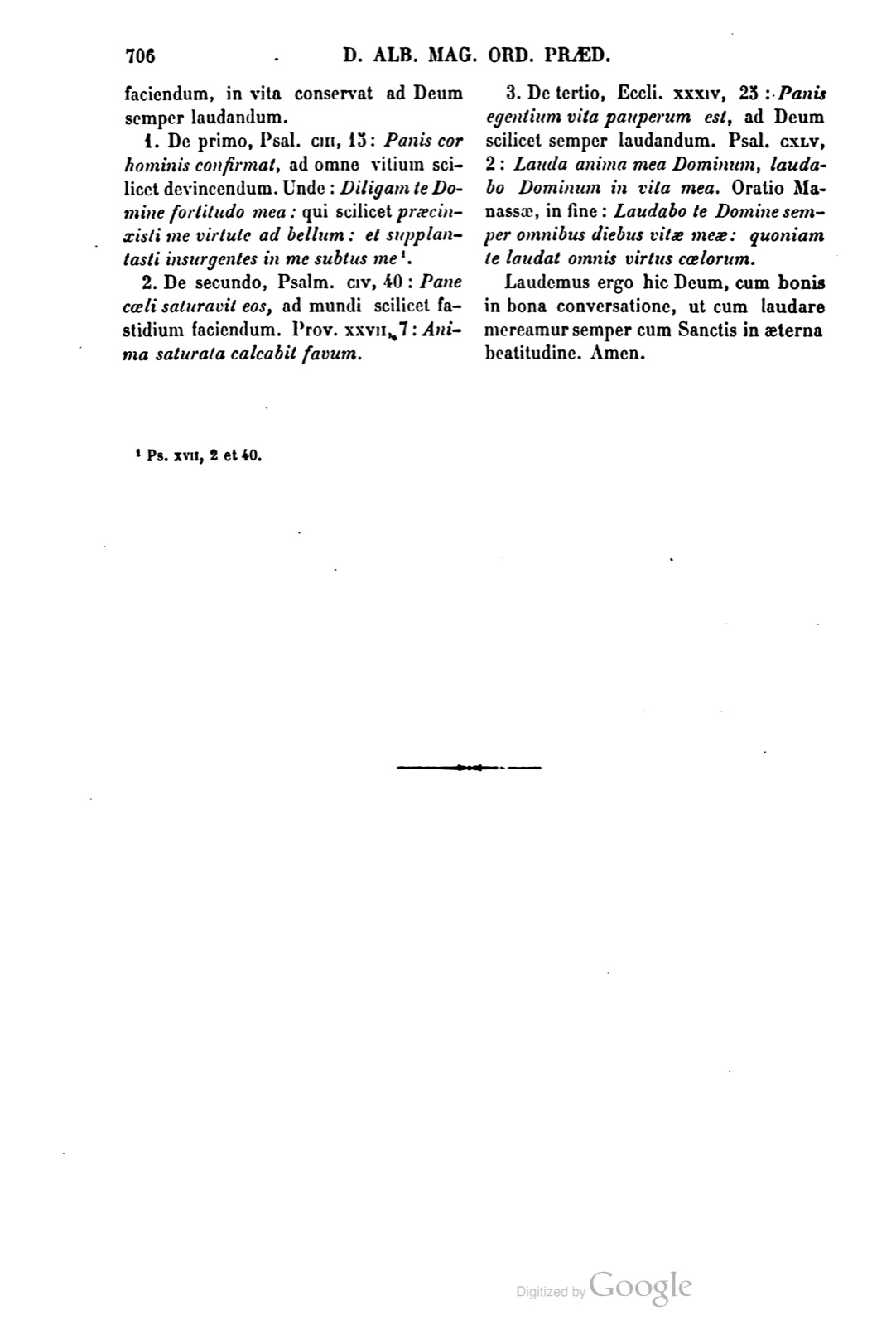
1. De primo, Gen. xlii, 3: Descenderunt fratres Joseph ut emerent frumenta in Aegypto: quasi humiliaverunt se fideles, ut amorem naturalem omnium hominum acquirerent. Eccli. xiii, 19: Omne animal diligit simile sibi: sic et omnis homo proximum sibi.
2. De secundo, I ad Corinth. v, 7: Sitis nova conspersio, sicut estis azimi, id est, unum quid per dilectionem sacramentalem. I Joan. iv, 21: Hoc mandatum habemus a Deo: ut qui diligit Deum, diligat et fratrem suum.
3. De tertio, Exod. xii, 39: Coxerunt farinam conspersam, et fecerunt panes, id est, profecerunt usque ad dilectionem spiritualem. Joan. xv, 12: Hoc est praeceptum meum, ut diligatis invicem, sicut dilexi vos. Augustinus: « Non autem carnalis, sed spiritualis debet esse inter vos dilectio. »
III. Species panis secundum quod erat panis, habet in se similitudinem tertiae rei ibi signatae, id est, effectus sacramenti in anima fideli: sicut enim panis tria facit, scilicet confortat, satiat, et vitam conservat: sic panis sacramentalis animam fidelem confortat ad peccatum devincendum, satiat ad fastidium mundi faciendum, in vita conservat ad Deum semper laudandum.
1. De primo, Psal. ciii, 15: Panis cor hominis confirmat, ad omne vitium scilicet devincendum. Unde: Diligam te Domine fortitudo mea: qui scilicet praecinxisti me virtute ad bellum: et supplantasti insurgentes in me subtus me2.
2. De secundo, Psalm. civ, 40: Pane coeli saturavit eos, ad mundi scilicet fastidium faciendum. Prov. xxvii, 7: Anima saturata calcabit favum.
3. De tertio, Eccli. xxxiv, 23: Panis egentium vita pauperum est, ad Deum scilicet semper laudandum. Psal. cxlv, 2: Lauda anima mea Dominum, laudabo Dominum in vita mea. Oratio Manassae, in fine: Laudabo te Domine semper omnibus diebus vitae meae: quoniam te laudat omnis virtus coelorum.
Laudemus ergo hic Deum, cum bonis in bona conversatione, ut cum laudare mereamur semper cum Sanctis in aeterna beatitudine. Amen.
1. Concerning the first, Genesis 42:3: The brothers of Joseph went down to buy grain in Egypt, as if the faithful humbled themselves so that they might acquire the natural love of all men. Ecclesiasticus 13:19: Every animal loves what is like itself; so also every man loves his neighbor.
2. Concerning the second, 1 Corinthians 5:7: Be a new sprinkling-together, as you are unleavened, that is, one thing through sacramental love. 1 John 4:21: We have this commandment from God: that he who loves God should love also his brother.
3. Concerning the third, Exodus 12:39: They cooked the sprinkled flour and made loaves, that is, they advanced even to spiritual love. John 15:12: This is my commandment, that you love one another, as I have loved you. Augustine says: "But the love among you ought not to be carnal, but spiritual."
III. The species of bread, according as it was bread, has in itself the likeness of the third thing signified there, that is, of the effect of the sacrament in the faithful soul: for just as bread does three things, namely it strengthens, satisfies, and preserves life, so the sacramental bread strengthens the faithful soul for conquering sin, satisfies it for creating disgust for the world, and preserves it in life for always praising God.
1. Concerning the first, Psalm 103:15: Bread strengthens the heart of man, namely for conquering every vice. Hence: I will love you, O Lord my strength: you, namely, have girded me with strength for war, and you have supplanted those rising against me beneath me2.
2. Concerning the second, Psalm 104:40: He satisfied them with the bread of heaven, namely for creating disgust for the world. Proverbs 27:7: The satisfied soul will tread upon the honeycomb.
3. Concerning the third, Ecclesiasticus 34:23: The bread of the needy is the life of the poor, namely for always praising God. Psalm 145:2: Praise the Lord, O my soul; I will praise the Lord in my life. The Prayer of Manasseh, at the end: I will praise you, O Lord, always, all the days of my life, because every power of the heavens praises you.
Therefore let us praise God here, with the good in good conduct, so that with them we may merit to praise him always with the Saints in eternal beatitude. Amen.
If a page does not appear, its photograph has not been uploaded yet.