Volume 2 · pp. 520–522
Book VIII of the Topics, Treatise III, Chapters I-III.
A marker with ≈ is an approximate page boundary, placed by measure of the text; the page photographs remain the authority. In the paired views, clicking a page marker brings that page into view.
TRACTATUS III.
QUALITER DIALECTICA EST AD EXERCITANDUM.
CAPUT I.
De documentis ad exercitationem pertinentibus, et formalibus, et rationalibus.
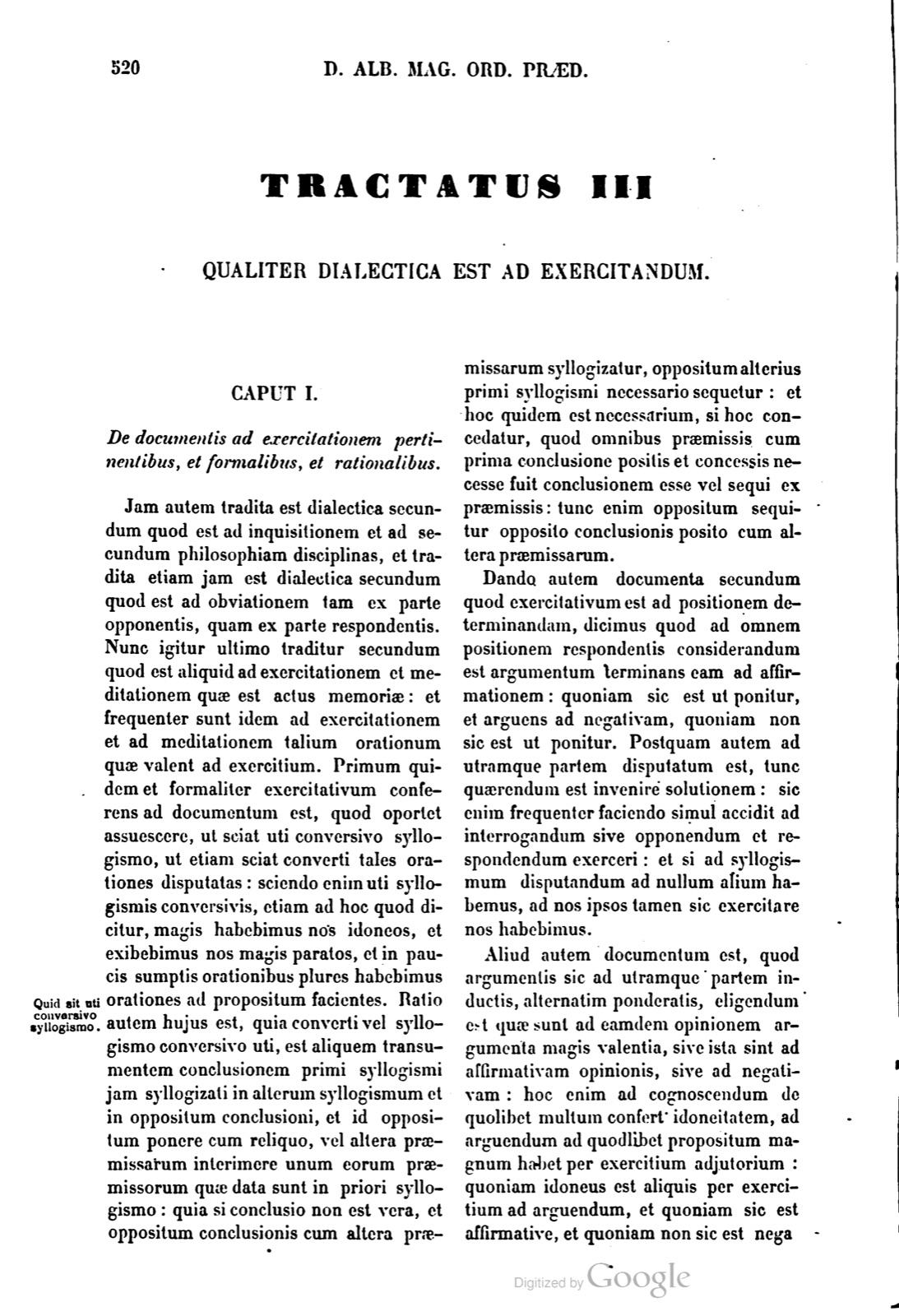
Jam autem tradita est dialectica secundum quod est ad inquisitionem et ad secundum philosophiam disciplinas, et tradita etiam jam est dialectica secundum quod est ad obviationem tam ex parte opponentis, quam ex parte respondentis. Nunc igitur ultimo traditur secundum quod est aliquid ad exercitationem et meditationem quae est actus memoriae: et frequenter sunt idem ad exercitationem et ad meditationem talium orationum quae valent ad exercitium. Primum quidem et formaliter exercitativum conferens ad documentum est, quod oportet assuescere, ut sciat uti conversivo syllogismo, ut etiam sciat converti tales orationes disputatas: sciendo enim uti syllogismis conversivis, etiam ad hoc quod dicitur, magis habebimus nos idoneos, et exibebimus nos magis paratos, et in paucis sumptis orationibus plures habebimus orationes ad propositum facientes. Ratio autem hujus est, quia converti vel syllogismo conversivo uti, est aliquem transumentem conclusionem primi syllogismi jam syllogizati in alterum syllogismum et in oppositum conclusioni, et id oppositum ponere cum reliquo, vel altera praemissarum interimere unum eorum praemissorum quae data sunt in priori syllogismo: quia si conclusio non est vera, et oppositum conclusionis cum altera praemissarum syllogizatur, oppositum alterius primi syllogismi necessario sequetur: et hoc quidem est necessarium, si hoc concedatur, quod omnibus praemissis cum prima conclusione positis et concessis necesse fuit conclusionem esse vel sequi ex praemissis: tunc enim oppositum sequitur opposito conclusionis posito cum altera praemissarum.
Dando autem documenta secundum quod exercitativum est ad positionem determinandam, dicimus quod ad omnem positionem respondentis considerandum est argumentum terminans eam ad affirmationem: quoniam sic est ut ponitur, et arguens ad negativam, quoniam non sic est ut ponitur. Postquam autem ad utramque partem disputatum est, tunc quaerendum est invenire solutionem: sic enim frequenter faciendo simul accidit ad interrogandum sive opponendum et respondendum exerceri: et si ad syllogismum disputandum ad nullum alium habemus, ad nos ipsos tamen sic exercitare nos habebimus.
Aliud autem documentum est, quod argumentis sic ad utramque partem inductis, alternatim ponderatis, eligendum est quae sunt ad eamdem opinionem argumenta magis valentia, sive ista sint ad affirmativam opinionis, sive ad negativam: hoc enim ad cognoscendum de quolibet multum confert idoneitatem, ad arguendum ad quodlibet propositum magnum habet per exercitium adjutorium: quoniam idoneus est aliquis per exercitium ad arguendum, et quoniam sic est affirmative, et quoniam non sic est negative. Nam ex talibus documentis accidit observationem, et facultatem ex observatis accidit fieri: et etiam habet adjutorium ad cognoscendum de quolibet secundum philosophiam speculative prudentiam, hoc est, providentiam, ut in quolibet provideatur quid verum et quid falsum sit: et posse inspicere in singulis quae utrinque (hoc est, ad utramque partem contradictionis) de unoquoque accidit dicere ex hypothesi (hoc est, suppositione) hoc est, ex talibus propositionibus quae supponuntur ut eis utamur tanquam principiis: hoc enim ad haec quae dicta sunt, non parvum est instrumentum: ex isto enim reliquum est et relictum et causatum, nos ratione eligere alterum contradictorum, quodcumque est id quod est verum. Oportet autem ad hujus electionem aliquem esse boni ingenii secundum virtutem naturae rationalis: esse autem boni ingenii est posse ex ingenio eligere verum in quolibet, et fugere falsum: quia qui nati sunt bene, hoc est, quibus bene innatum est, hoc possunt bene facere: quia ingenium dicitur intus genitus, et hic est qui subtiles habet spiritus et expeditas animales operationes, et bonam rationem collativam: nam qui amant verum tanquam naturae suae applicabile, et qui odio habent falsum quod profertur tanquam naturae suae inimicum, facile discernunt per artem juvantem naturam optimum in omnibus.
TREATISE III.
IN WHAT WAY DIALECTIC IS FOR EXERCISING.
CHAPTER I.
On teachings pertaining to exercise, both formal and rational.
Now dialectic has been handed down according as it is for inquiry and for disciplines according to philosophy, and dialectic has also now been handed down according as it is for obviation, both from the side of the opponent and from the side of the respondent. Therefore now, lastly, it is handed down according as it is something for exercise and meditation, which is an act of memory; and the same things are frequently for exercise and for meditation of such speeches as avail for exercise. The first teaching, formal and contributive to exercise, is that one must become accustomed so that he knows how to use a conversive syllogism, so that he also knows how such disputed speeches are converted. For by knowing how to use conversive syllogisms, we shall also have ourselves more suitable for that which is said, and we shall present ourselves as more prepared, and from speeches taken in few things we shall have several speeches making for the proposed thing. But the reason of this is that to be converted, or to use a conversive syllogism, is that someone, transferring the conclusion of the first syllogism already syllogized into another syllogism and into the opposite to the conclusion, posits that opposite with the remaining premise, or with the other of the premises, to take away one of those premises which were given in the prior syllogism. For if the conclusion is not true and the opposite of the conclusion is syllogized with one of the premises, the opposite of the other premise of the first syllogism will necessarily follow; and this indeed is necessary if this is conceded, that when all the premises with the first conclusion have been posited and conceded, it was necessary that the conclusion be or follow from the premises: for then the opposite follows when the opposite of the conclusion has been posited with the other premise.
But in giving teachings according as the exercitative is for determining a position, we say that for every position of the respondent one must consider the argument terminating it to affirmation, that it is so as it is posited, and arguing to negation, that it is not so as it is posited. But after disputation has been made toward each part, then one must seek to find the solution: for by doing this frequently, it happens at once that one is exercised in interrogating or opposing and responding; and if we have no one else for disputing by syllogism, nevertheless we shall have ourselves to exercise ourselves in this way.
But another teaching is that, when arguments have thus been introduced to each part and weighed alternately, one must choose which arguments to the same opinion are more strong, whether those are toward the affirmative of the opinion or toward the negative. For this contributes much suitability for knowing concerning anything, and has a great help through exercise for arguing to any proposed thing: because someone is suitable through exercise for arguing both that it is thus affirmatively and that it is not thus negatively. For from such teachings observation happens, and the faculty happens to be made from things observed; and it also has a help for knowing concerning anything according to philosophy speculative prudence, that is, foresight, so that in anything there may be foreseen what is true and what is false; and to be able to inspect in individual things what happens to be said on both sides, that is, toward each part of the contradiction, concerning each thing from hypothesis, that is, supposition, that is, from such propositions as are supposed so that we may use them as principles. For this is no small instrument for those things which have been said: from this, then, what remains and is left and caused is for us to choose by reason one of the contradictories, whichever it is that is true. But for this choice someone must be of good natural ability according to the power of rational nature. To be of good natural ability is to be able from native capacity to choose the true in anything and flee the false, because those who are well born, that is, those to whom this is well inborn, can do this well; because natural ability is said as “inwardly born,” and this is the one who has subtle spirits, ready animal operations, and a good collative reason. For those who love the true as applicable to their nature, and who hate the false which is brought forward as hostile to their nature, easily discern the best in all things through art helping nature.
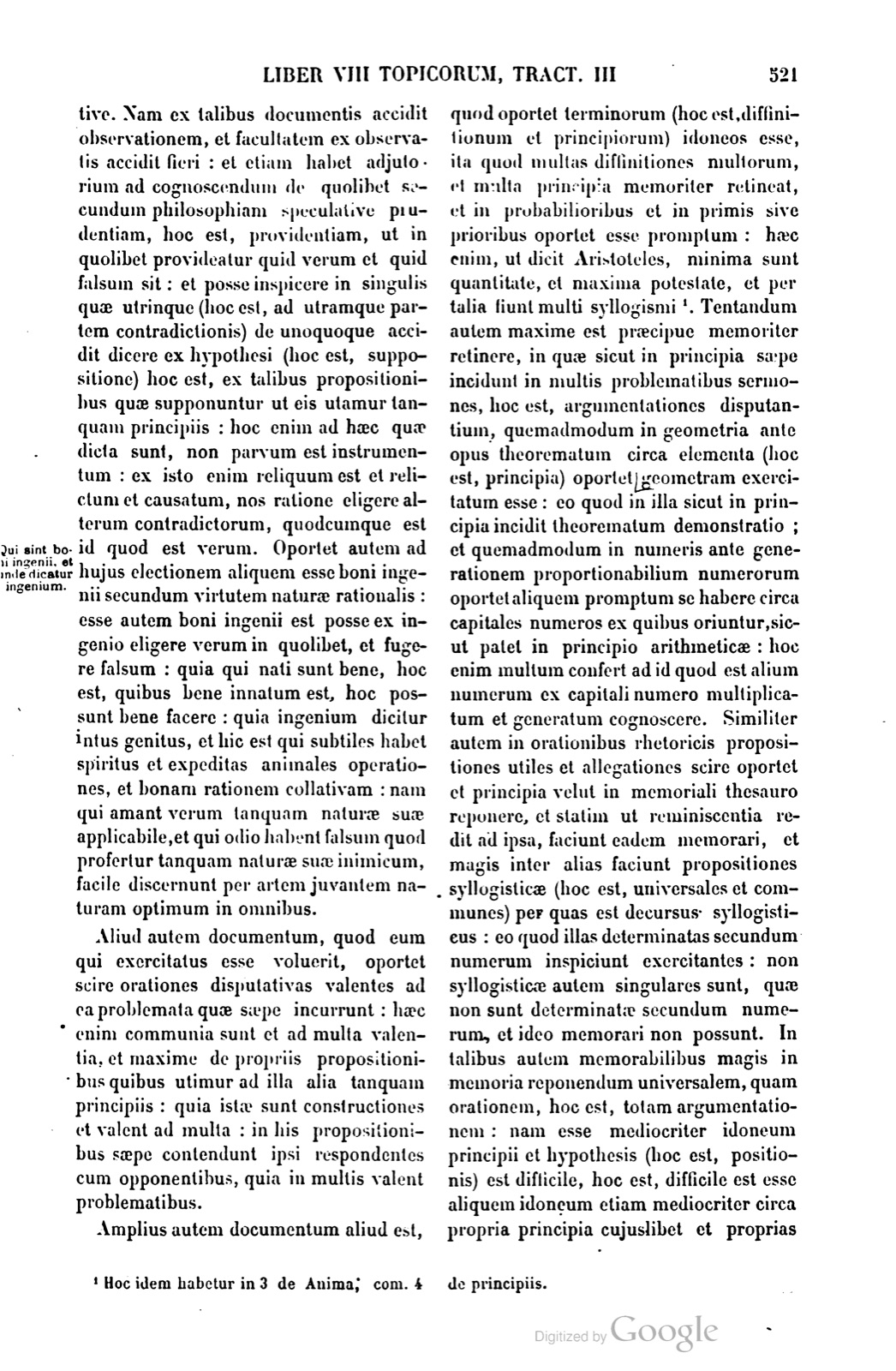
Aliud autem documentum, quod eum qui exercitatus esse voluerit, oportet scire orationes disputativas valentes ad ea problemata quae saepe incurrunt: haec enim communia sunt et ad multa valentia, et maxime de propriis propositionibus quibus utimur ad illa alia tanquam principiis: quia istae sunt constructiones et valent ad multa: in his propositionibus saepe contendunt ipsi respondentes cum opponentibus, quia in multis valent problematibus.
Amplius autem documentum aliud est, quod oportet terminorum (hoc est, diffinitionum et principiorum) idoneos esse, ita quod multas diffinitiones multorum, et multa principia memoriter retineat, et in probabilioribus et in primis sive prioribus oportet esse promptum: haec enim, ut dicit Aristoteles, minima sunt quantitate, et maxima potestate, et per talia fiunt multi syllogismi.1 Tentandum autem maxime est praecipue memoriter retinere, in quae sicut in principia saepe incidunt in multis problematibus sermones, hoc est, argumentationes disputantium, quemadmodum in geometria ante opus theorematum circa elementa (hoc est, principia) oportet geometram exercitatum esse: eo quod in illa sicut in principia incidit theorematum demonstratio; et quemadmodum in numeris ante generationem proportionabilium numerorum oportet aliquem promptum se habere circa capitales numeros ex quibus oriuntur, sicut patet in principio arithmeticae: hoc enim multum confert ad id quod est alium numerum ex capitali numero multiplicatum et generatum cognoscere. Similiter autem in orationibus rhetoricis propositiones utiles et allegationes scire oportet et principia velut in memoriali thesauro reponere, et statim ut reminiscentia redit ad ipsa, faciunt eadem memorari, et magis inter alias faciunt propositiones syllogisticae (hoc est, universales et communes) per quas est decursus syllogisticus: eo quod illas determinatas secundum numerum inspiciunt exercitantes: non syllogisticae autem singulares sunt, quae non sunt determinatae secundum numerum, et ideo memorari non possunt. In talibus autem memorabilibus magis in memoria reponendum universalem, quam orationem, hoc est, totam argumentationem: nam esse mediocriter idoneum principii et hypothesis (hoc est, positionis) est difficile, hoc est, difficile est esse aliquem idoneum etiam mediocriter circa propria principia cujuslibet et proprias propositiones: et ideo communes memoriter sunt retinendae.
CAPUT II.
Circa quas orationes maxime exercitandum.
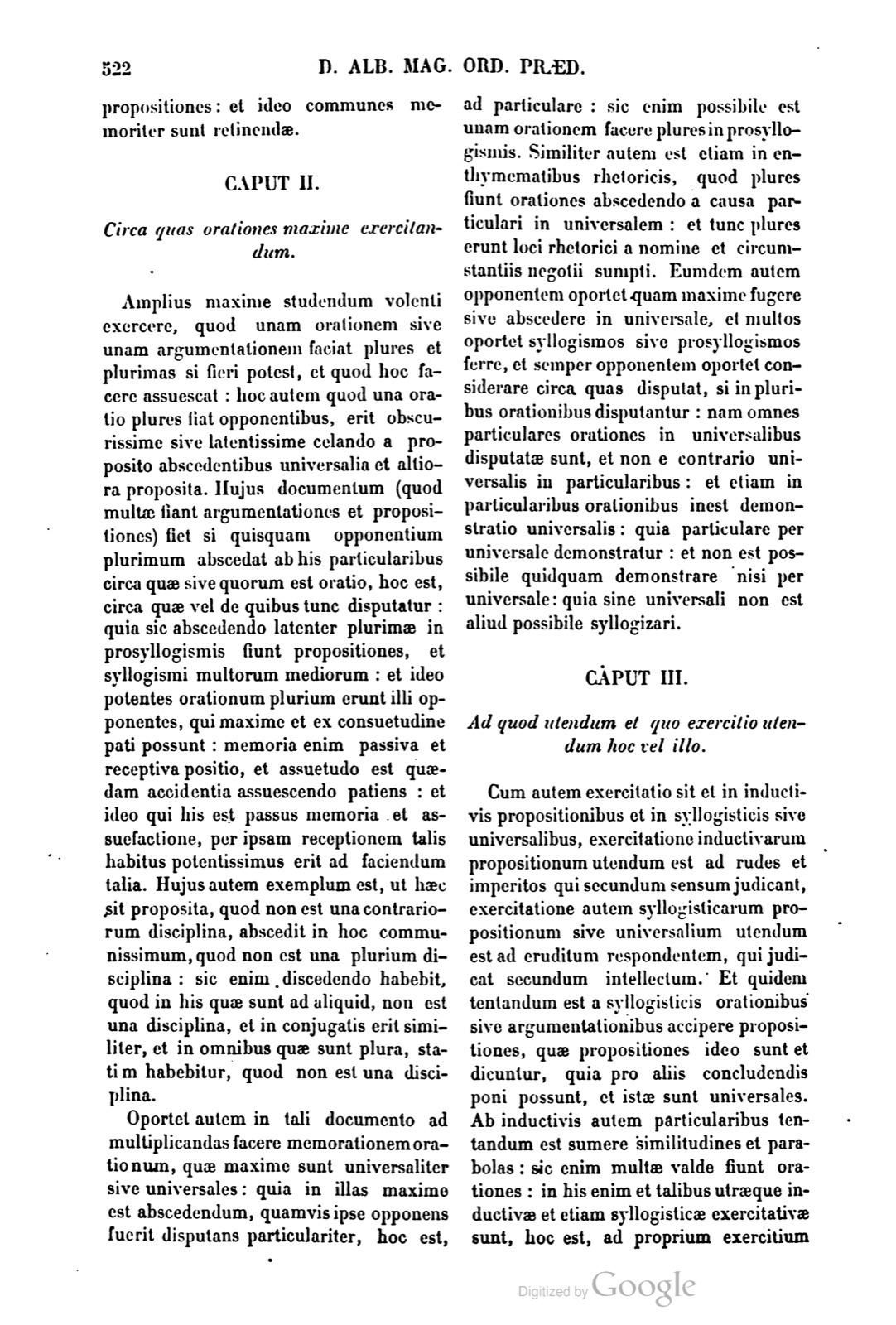
Amplius maxime studendum volenti exercere, quod unam orationem sive unam argumentationem faciat plures et plurimas si fieri potest, et quod hoc facere assuescat: hoc autem quod una oratio plures fiat opponentibus, erit obscurissime sive latentissime celando a proposito abscedentibus universalia et altiora proposita. Hujus documentum (quod multae fiant argumentationes et propositiones) fiet si quisquam opponentium plurimum abscedat ab his particularibus circa quae sive quorum est oratio, hoc est, circa quae vel de quibus tunc disputatur: quia sic abscedendo latenter plurimae in prosyllogismis fiunt propositiones, et syllogismi multorum mediorum: et ideo potentes orationum plurium erunt illi opponentes, qui maxime et ex consuetudine pati possunt: memoria enim passiva et receptiva positio, et assuetudo est quaedam accidentia assuescendo patiens: et ideo qui his est passus memoria et assuefactione, per ipsam receptionem talis habitus potentissimus erit ad faciendum talia. Hujus autem exemplum est, ut haec sit proposita, quod non est una contrariorum disciplina, abscedit in hoc communissimum, quod non est una plurium disciplina: sic enim discedendo habebit, quod in his quae sunt ad aliquid, non est una disciplina, et in conjugatis erit similiter, et in omnibus quae sunt plura, statim habebitur, quod non est una disciplina.
But another teaching is that the one who wishes to be exercised must know disputative speeches availing for those problems which often occur; for these are common and availing for many things, and especially concerning proper propositions which we use for those other things as principles, because these are constructions and avail for many things. In these propositions the respondents themselves often contend with opponents, because they avail in many problems.
Further, another teaching is that one must be suitable in terms, that is, definitions and principles, so that he retains by memory many definitions of many things and many principles, and in the more probable and in the first or prior things he must be prompt: for these, as Aristotle says, are smallest in quantity and greatest in power, and through such things many syllogisms are made.1 But one must try especially to retain chiefly in memory those things into which speeches, that is, argumentations of disputants, often fall as into principles in many problems; just as in geometry, before the work of theorems about elements, that is, principles, the geometer must be exercised, because into those, as into principles, the demonstration of theorems falls; and as in numbers, before the generation of proportionable numbers, someone must have himself prompt about the principal numbers from which they arise, as is clear in the beginning of arithmetic; for this contributes much to knowing another number multiplied from a principal number and generated. Likewise in rhetorical speeches one must know useful propositions and allegations, and store principles in a memorial treasury, as it were; and immediately when remembrance returns to them, they make the same things be remembered, and syllogistic propositions, that is, universal and common ones, do this more than others, through which there is syllogistic passage, because those exercising inspect them as determined according to number. But singular propositions are not syllogistic, since they are not determined according to number, and therefore cannot be remembered. But in such memorable things, the universal is more to be stored in memory than the speech, that is, the whole argumentation; for to be moderately suitable concerning principle and hypothesis, that is, position, is difficult, that is, it is difficult for someone to be even moderately suitable concerning the proper principles of each thing and the proper propositions. And therefore common things must be retained by memory.
CHAPTER II.
About which speeches one must especially be exercised.
Further, one who wishes to exercise must especially study to make one speech or one argumentation into several and very many, if it can be done, and to become accustomed to doing this. But that one speech becomes several for opponents will be done most obscurely or most latently by hiding universals and higher proposed things while departing from the proposed thing. The teaching for this, that many argumentations and propositions be made, will happen if some one of the opponents departs very much from those particulars about which, or of which, the speech is, that is, about which or concerning which he then disputes; because by thus departing, very many propositions are made latently in prosyllogisms, and syllogisms of many middles; and therefore those opponents will be powerful in many speeches who most of all and from custom can suffer them. For memory is a passive and receptive position, and habituation is a certain undergoing of accidents by becoming accustomed; and therefore he who has been affected by these things, by memory and habituation, through the very reception of such a habit will be most powerful for making such things. But the example of this is that this be proposed, that there is not one discipline of contraries; one departs into this most common thing, that there is not one discipline of several things. For by thus departing he will have that in those things which are relatives there is not one discipline, and in conjugates it will be similar, and in all things which are several, immediately it will be held that there is not one discipline.
Oportet autem in tali documento ad multiplicandas facere memorationem orationum, quae maxime sunt universaliter sive universales: quia in illas maxime est abscedendum, quamvis ipse opponens fuerit disputans particulariter, hoc est, ad particulare: sic enim possibile est unam orationem facere plures in prosyllogismis. Similiter autem est etiam in enthymematibus rhetoricis, quod plures fiunt orationes abscedendo a causa particulari in universalem: et tunc plures erunt loci rhetorici a nomine et circumstantiis negotii sumpti. Eumdem autem opponentem oportet quam maxime fugere sive abscedere in universale, et multos oportet syllogismos sive prosyllogismos ferre, et semper opponentem oportet considerare circa quas disputat, si in pluribus orationibus disputantur: nam omnes particulares orationes in universalibus disputatae sunt, et non e contrario universalis in particularibus: et etiam in particularibus orationibus inest demonstratio universalis: quia particulare per universale demonstratur: et non est possibile quidquam demonstrare nisi per universale: quia sine universali non est aliud possibile syllogizari.
CAPUT III.
Ad quod utendum et quo exercitio utendum hoc vel illo.
Cum autem exercitatio sit et in inductivis propositionibus et in syllogisticis sive universalibus, exercitatione inductivarum propositionum utendum est ad rudes et imperitos qui secundum sensum judicant, exercitatione autem syllogisticarum propositionum sive universalium utendum est ad eruditum respondentem, qui judicat secundum intellectum. Et quidem tentandum est a syllogisticis orationibus sive argumentationibus accipere propositiones, quae propositiones ideo sunt et dicuntur, quia pro aliis concludendis poni possunt, et istae sunt universales. Ab inductivis autem particularibus tentandum est sumere similitudines et parabolas: sic enim multae valde fiunt orationes: in his enim et talibus utraeque inductivae et etiam syllogisticae exercitativae sunt, hoc est, ad proprium exercitium
But in such a teaching for multiplying, one must make remembrance of speeches which are especially universal or are universals, because into these one must especially depart, although the opponent himself had been disputing particularly, that is, toward a particular. For thus it is possible to make one speech into several in prosyllogisms. Likewise it is also in rhetorical enthymemes, that several speeches are made by departing from a particular cause into a universal; and then there will be several rhetorical places taken from the name and the circumstances of the business. But the same opponent must as much as possible flee or depart into the universal, and must bring many syllogisms or prosyllogisms; and the opponent must always consider about what things he disputes, if they are disputed in several speeches: for all particular speeches are disputed in universals, and not conversely the universal in particulars. And even in particular speeches there is universal demonstration, because the particular is demonstrated through the universal; and it is not possible to demonstrate anything except through the universal, because without a universal it is not possible that anything else be syllogized.
CHAPTER III.
For what one should use this exercise, and by which exercise one should use this or that.
But since exercise is both in inductive propositions and in syllogistic or universal ones, the exercise of inductive propositions must be used toward rude and inexperienced persons who judge according to sense; but the exercise of syllogistic or universal propositions must be used toward an educated respondent who judges according to intellect. And indeed one must try to accept propositions from syllogistic speeches or argumentations, which are propositions for this reason and are so called, because they can be posited for concluding other things, and these are universal. But from inductive particulars one must try to take likenesses and parables; for thus very many speeches are made: for in these and such things both inductive and also syllogistic speeches are exercitative, that is, for proper exercise
Notes
- This same thing is found in book 3 On the Soul; compare book 4 On Principles. (Hoc idem habetur in 3 de Anima; com. 4 de principiis.) ↩
If a page does not appear, its photograph has not been uploaded yet.