Volume 2 · pp. 523–524
Book VIII of the Topics, Treatise III, Chapter III.
A marker with ≈ is an approximate page boundary, placed by measure of the text; the page photographs remain the authority. In the paired views, clicking a page marker brings that page into view.
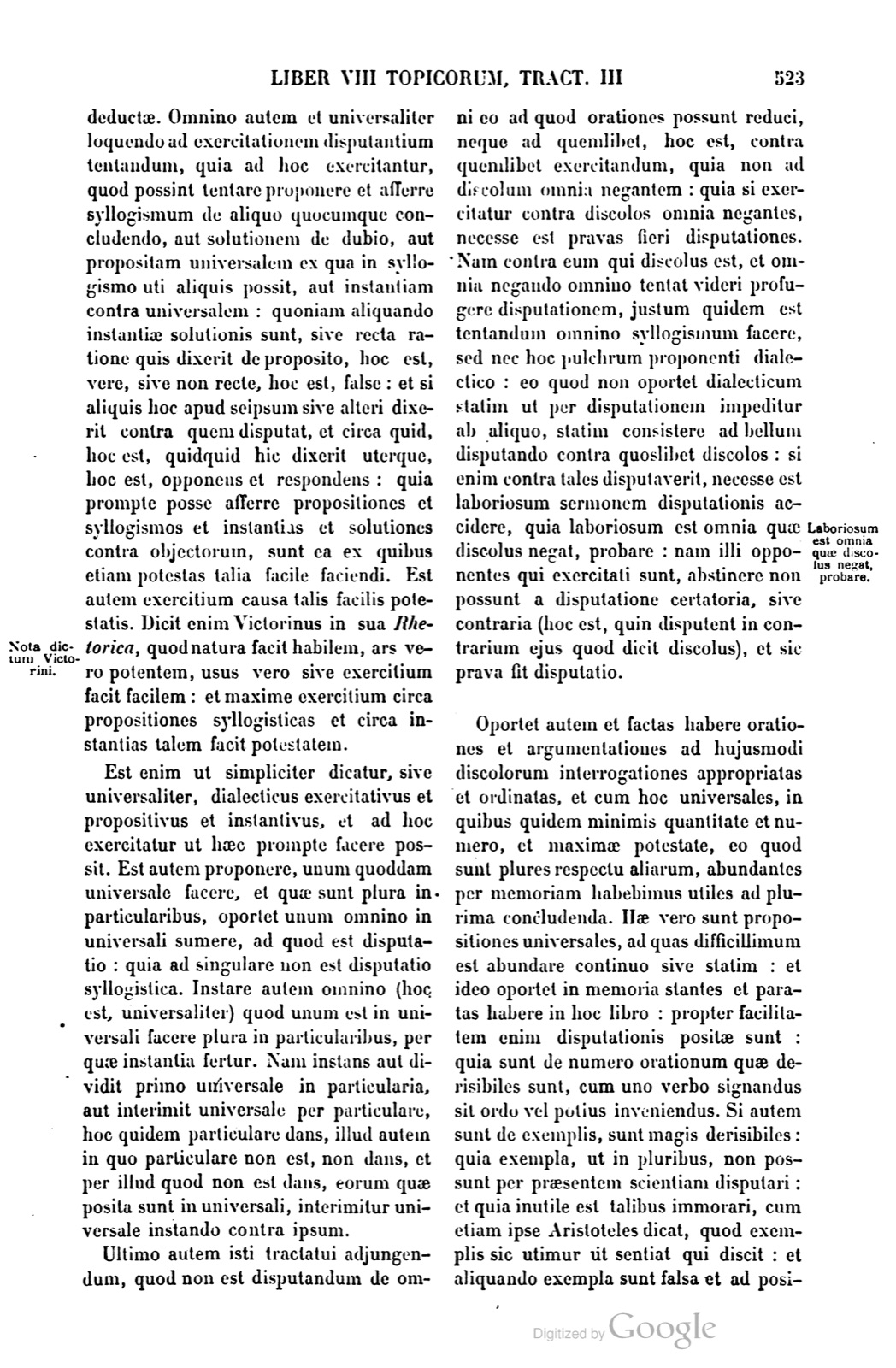
deductae. Omnino autem et universaliter loquendo ad exercitationem disputantium tentandum, quia ad hoc exercitantur, quod possint tentare proponere et afferre syllogismum de aliquo quocumque concludendo, aut solutionem de dubio, aut propositam universalem ex qua in syllogismo uti aliquis possit, aut instantiam contra universalem: quoniam aliquando instantiae solutionis sunt, sive recta ratione quis dixerit de proposito, hoc est, vere, sive non recte, hoc est, false: et si aliquis hoc apud seipsum sive alteri dixerit contra quem disputat, et circa quid, hoc est, quidquid hic dixerit uterque, hoc est, opponens et respondens: quia prompte posse afferre propositiones et syllogismos et instantias et solutiones contra objectorum, sunt ea ex quibus etiam potestas talia facile faciendi. Est autem exercitium causa talis facilis potestatis. Dicit enim Victorinus in sua Rhetorica, quod natura facit habilem, ars vero potentem, usus vero sive exercitium facit facilem: et maxime exercitium circa propositiones syllogisticas et circa instantias talem facit potestatem.
Est enim ut simpliciter dicatur, sive universaliter, dialecticus exercitativus et propositivus et instantivus, et ad hoc exercitatur ut haec prompte facere possit. Est autem proponere, unum quoddam universale facere, et quae sunt plura in particularibus, oportet unum omnino in universali sumere, ad quod est disputatio: quia ad singulare non est disputatio syllogistica. Instare autem omnino (hoc est, universaliter) quod unum est in universali facere plura in particularibus, per quae instantia fertur. Nam instans aut dividit primo universale in particularia, aut interimit universale per particulare, hoc quidem particulare dans, illud autem in quo particulare non est, non dans, et per illud quod non est dans, eorum quae posita sunt in universali, interimitur universale instando contra ipsum.
Ultimo autem isti tractatui adjungendum, quod non est disputandum de omni eo ad quod orationes possunt reduci, neque ad quemlibet, hoc est, contra quemlibet exercitandum, quia non ad discolum omnia negantem: quia si exercitatur contra discolos omnia negantes, necesse est pravas fieri disputationes. Nam contra eum qui discolus est, et omnia negando omnino tentat videri profugere disputationem, justum quidem est tentandum omnino syllogismum facere, sed nec hoc pulchrum proponenti dialectico: eo quod non oportet dialecticum statim ut per disputationem impeditur ab aliquo, statim consistere ad bellum disputando contra quoslibet discolos: si enim contra tales disputaverit, necesse est laboriosum sermonem disputationis accidere, quia laboriosum est omnia quae discolus negat, probare: nam illi opponentes qui exercitati sunt, abstinere non possunt a disputatione certatoria, sive contraria (hoc est, quin disputent in contrarium ejus quod dicit discolus), et sic prava fit disputatio.
having been brought down. Altogether, however, and speaking universally, for the exercise of disputants one must try, because they are exercised for this, that they may be able to try to propose and bring forward a syllogism concerning something, whatever it may be, to be concluded, or a solution concerning a doubtful matter, or a proposed universal from which someone can use it in a syllogism, or an instance against a universal: since sometimes instances are solutions, whether someone has spoken by right reason concerning the proposed thing, that is, truly, or not rightly, that is, falsely; and if someone has said this before himself or to another against whom he disputes, and concerning what, that is, whatever each one here has said, that is, the opponent and the respondent: because to be able promptly to bring forward propositions and syllogisms and instances and solutions against objections are those things from which there is also the power of doing such things easily. Exercise, however, is the cause of such easy power. For Victorinus says in his Rhetoric that nature makes one apt, but art powerful, and use or exercise makes one easy; and especially exercise concerning syllogistic propositions and concerning instances makes such power.
For, as it may be said simply or universally, the dialectician is exercitative and propositional and instancing, and he is exercised for this, that he may be able to do these things promptly. To propose, however, is to make some one universal, and the things which are many in particulars must altogether be taken as one in the universal, toward which there is disputation: because there is no syllogistic disputation toward the singular. But to make an instance altogether, that is, universally, is to make that which is one in the universal many in particulars, through which the instance is brought. For the one bringing an instance either first divides the universal into particulars, or takes away the universal through a particular, giving this particular indeed, but not giving that in which the particular is not, and through that which he does not give, of those things which have been posited in the universal, the universal is taken away by instancing against it.
Finally, this must be joined to this treatise, that one must not dispute about everything to which speeches can be reduced, nor with anyone whatever, that is, one must not be exercised against anyone whatever, because not against the troublesome man denying all things: because if one is exercised against troublesome men denying all things, it is necessary that depraved disputations be made. For against him who is troublesome, and by denying all things altogether tries to seem to flee disputation, it is indeed just that one try altogether to make a syllogism, but neither is this fine for the dialectical proposer: because it is not fitting for the dialectician, as soon as he is impeded in disputation by someone, immediately to stand for war by disputing against troublesome men of any sort; for if he has disputed against such persons, it is necessary that a laborious discourse of disputation happen, because it is laborious to prove all things which the troublesome man denies; for those opponents who have been exercised cannot abstain from contentious disputation, or contrary disputation (that is, from disputing into the contrary of that which the troublesome man says), and thus the disputation becomes depraved.
Oportet autem et factas habere orationes et argumentationes ad hujusmodi discolorum interrogationes appropriatas et ordinatas, et cum hoc universales, in quibus quidem minimis quantitate et numero, et maximae potestate, eo quod sunt plures respectu aliarum, abundantes per memoriam habebimus utiles ad plurima concludenda. Illae vero sunt propositiones universales, ad quas difficillimum est abundare continuo sive statim: et ideo oportet in memoria stantes et paratas habere in hoc libro: propter facilitatem enim disputationis positae sunt: quia sunt de numero orationum quae derisibiles sunt, cum uno verbo signandus sit ordo vel potius inveniendus. Si autem sunt de exemplis, sunt magis derisibiles: quia exempla, ut in pluribus, non possunt per praesentem scientiam disputari: et quia inutile est talibus immorari, cum etiam ipse Aristoteles dicat, quod exemplis sic utimur ut sentiat qui discit: et aliquando exempla sunt falsa et ad positionem aliorum supposita: et cum multum disputantur, illi qui determinant, dicunt finem: et ideo de talibus non curamus.
But one must also have speeches and argumentations already made, appropriated and ordered for the interrogations of troublesome men of this sort, and with this universal ones, in which indeed, being least in quantity and number and greatest in power, because they are more with respect to others, we shall have through memory abundant things useful for concluding very many things. But those are universal propositions, with respect to which it is most difficult to abound continuously or immediately: and therefore one must have them standing and prepared in memory in this book: for they have been posited for the facility of disputation, because they are of the number of speeches which are laughable, when the order must be signified or rather found with one word. But if they are from examples, they are more laughable: because examples, as in most cases, cannot be disputed through the present science; and because it is useless to linger over such things, since Aristotle himself also says that we use examples in this way, so that he who learns may perceive: and sometimes examples are false and supposed toward the position of others; and when they are disputed much, those who determine say the end: and therefore we do not care about such things.

If a page does not appear, its photograph has not been uploaded yet.