Volume 2 · pp. 517–519
Book VIII of the Topics, Treatise II, Chapters VIII-X.
A marker with ≈ is an approximate page boundary, placed by measure of the text; the page photographs remain the authority. In the paired views, clicking a page marker brings that page into view.
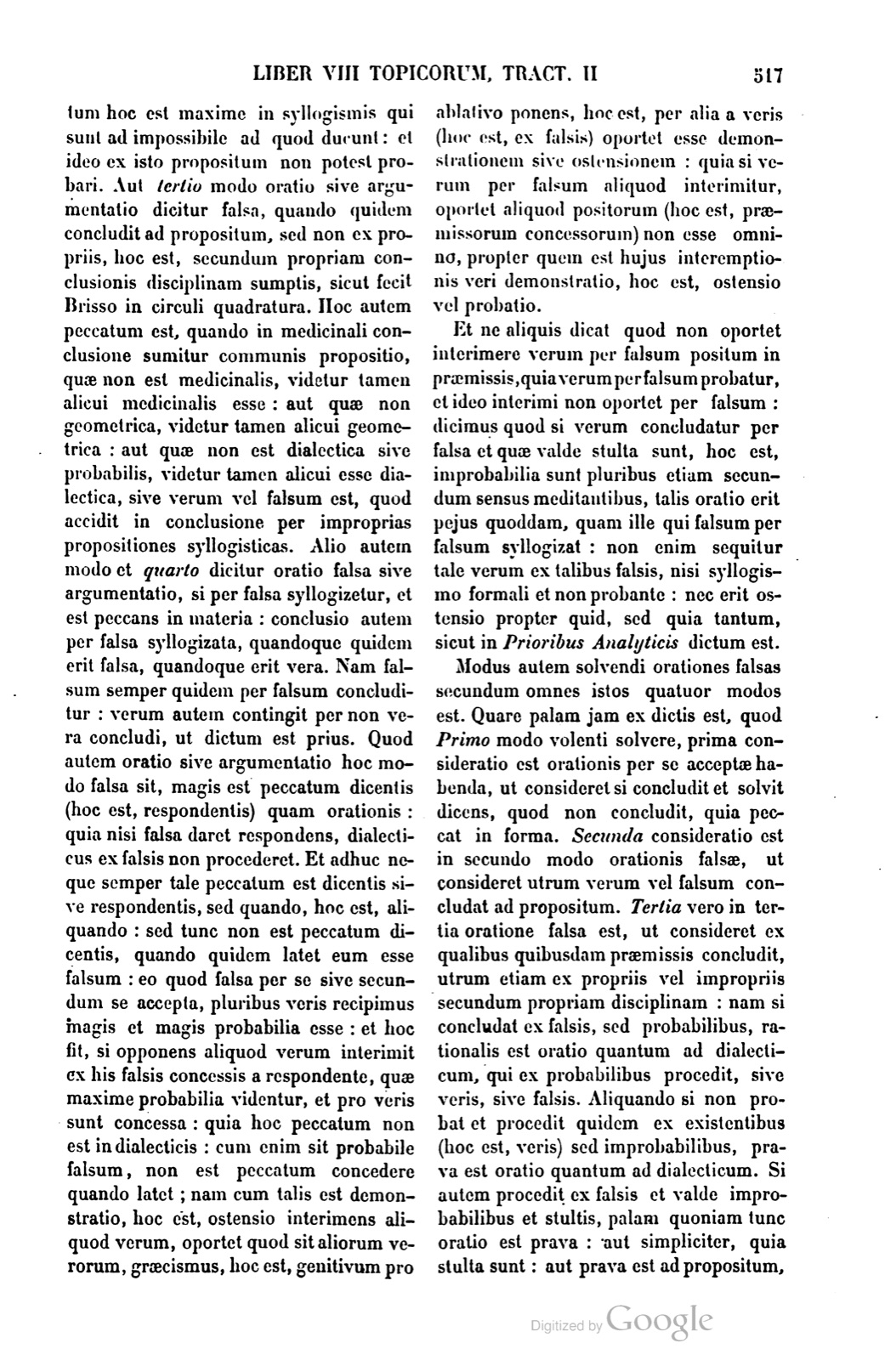
Aut tertio modo oratio sive argumentatio dicitur falsa, quando quidem concludit ad propositum, sed non ex propriis, hoc est, secundum propriam conclusionis disciplinam sumptis, sicut fecit Brisso in circuli quadratura. Hoc autem peccatum est, quando in medicinali conclusione sumitur communis propositio, quae non est medicinalis, videtur tamen alicui medicinalis esse: aut quae non geometrica, videtur tamen alicui geometrica: aut quae non est dialectica sive probabilis, videtur tamen alicui esse dialectica, sive verum vel falsum est, quod accidit in conclusione per improprias propositiones syllogisticas. Alio autem modo et quarto dicitur oratio falsa sive argumentatio, si per falsa syllogizetur, et est peccans in materia: conclusio autem per falsa syllogizata, quandoque quidem erit falsa, quandoque erit vera. Nam falsum semper quidem per falsum concluditur: verum autem contingit per non vera concludi, ut dictum est prius. Quod autem oratio sive argumentatio hoc modo falsa sit, magis est peccatum dicentis (hoc est, respondentis) quam orationis: quia nisi falsa daret respondens, dialecticus ex falsis non procederet. Et adhuc neque semper tale peccatum est dicentis sive respondentis, sed quando, hoc est, aliquando: sed tunc non est peccatum dicentis, quando quidem latet eum esse falsum: eo quod falsa per se sive secundum se accepta, pluribus veris recipimus magis et magis probabilia esse: et hoc fit, si opponens aliquod verum interimit ex his falsis concessis a respondente, quae maxime probabilia videntur, et pro veris sunt concessa: quia hoc peccatum non est in dialecticis: cum enim sit probabile falsum, non est peccatum concedere quando latet; nam cum talis est demonstratio, hoc est, ostensio interimens aliquod verum, oportet quod sit aliorum verorum, graecismus, hoc est, genitivum pro ablativo ponens, hoc est, per alia a veris (hoc est, ex falsis) oportet esse demonstrationem sive ostensionem: quia si verum per falsum aliquod interimitur, oportet aliquod positorum (hoc est, praemissorum concessorum) non esse omnino, propter quem est hujus interemptionis veri demonstratio, hoc est, ostensio vel probatio.
Et ne aliquis dicat quod non oportet interimere verum per falsum positum in praemissis, quia verum per falsum probatur, et ideo interimi non oportet per falsum: dicimus quod si verum concludatur per falsa et quae valde stulta sunt, hoc est, improbabilia sunt pluribus etiam secundum sensus meditantibus, talis oratio erit pejus quoddam, quam ille qui falsum per falsum syllogizat: non enim sequitur tale verum ex talibus falsis, nisi syllogismo formali et non probante: nec erit ostensio propter quid, sed quia tantum, sicut in Prioribus Analyticis dictum est.
Modus autem solvendi orationes falsas secundum omnes istos quatuor modos est. Quare palam jam ex dictis est, quod primo modo volenti solvere, prima consideratio est orationis per se acceptae habenda, ut consideret si concludit et solvit dicens, quod non concludit, quia peccat in forma. Secunda consideratio est in secundo modo orationis falsae, ut consideret utrum verum vel falsum concludat ad propositum. Tertia vero in tertia oratione falsa est, ut consideret ex qualibus quibusdam praemissis concludit, utrum etiam ex propriis vel impropriis secundum propriam disciplinam: nam si concludat ex falsis, sed probabilibus, rationalis est oratio quantum ad dialecticum, qui ex probabilibus procedit, sive veris, sive falsis. Aliquando si non probat et procedit quidem ex existentibus (hoc est, veris) sed improbabilibus, prava est oratio quantum ad dialecticum. Si autem procedit ex falsis et valde improbabilibus et stultis, palam quoniam tunc oratio est prava: aut simpliciter, quia stulta sunt: aut prava est ad propositum, quia nihil probat, cum consequentia in talibus causam non habeant.
Or in a third way a speech or argumentation is called false when it indeed concludes toward the proposed thing, but not from proper things, that is, from things taken according to the proper discipline of the conclusion, as Brisso did in the quadrature of the circle. But this fault exists when, in a medical conclusion, a common proposition is taken which is not medical, yet seems medical to someone; or when one which is not geometrical nevertheless seems geometrical to someone; or when one which is not dialectical or probable nevertheless seems to someone to be dialectical, whether what happens in the conclusion through improper syllogistic propositions is true or false. But in another and fourth way a speech or argumentation is called false if it is syllogized through false things, and it errs in matter. Now a conclusion syllogized through false things will sometimes indeed be false, and sometimes true. For the false is always indeed concluded through the false; but the true can happen to be concluded through things not true, as was said before. But that a speech or argumentation is false in this way is more the fault of the one saying, that is, of the respondent, than of the speech, because unless the respondent gave false things, the dialectician would not proceed from false things. And still, such a fault is not always of the one saying or respondent, but when, that is, sometimes; but then it is not the fault of the one saying when it is hidden from him that it is false, because false things accepted through themselves or according to themselves we receive as more and more probable than several true things. And this happens if the opponent takes away some true thing from these false things conceded by the respondent, which seem especially probable and have been conceded as true; because this is not a fault in dialectical matters. For since the false is probable, it is not a fault to concede when it is hidden; for when such is a demonstration, that is, an ostension taking away some true thing, it must be of other true things, a Graecism, that is, putting the genitive for the ablative, that is, through other things from true things, that is, from false things, there must be a demonstration or ostension, because if a true thing is taken away through some false thing, some one of the posited things, that is, of the conceded premises, must not be altogether, because of which there is demonstration, that is, ostension or proof, of this taking-away of the true.
And lest someone say that one ought not take away the true through a false thing posited in the premises, because the true is proved through the false and therefore ought not be taken away through the false, we say that if the true is concluded through false things, and through things which are very foolish, that is, improbable to many even considering according to the senses, such a speech will be a certain worse thing than one which syllogizes the false through the false. For such a true thing does not follow from such false things except by a formal syllogism and one not proving; nor will it be an ostension on account of why, but only that, as was said in the Prior Analytics.
But the mode of solving false speeches according to all those four modes is this. Wherefore it is now plain from what has been said that, for one wishing to solve in the first mode, the first consideration of the speech accepted through itself must be had, so that he may consider whether it concludes, and he solves by saying that it does not conclude because it errs in form. The second consideration is in the second mode of false speech, so that he considers whether it concludes true or false toward the proposed thing. But the third in the third false speech is that he consider from what sort of premises it concludes, whether also from proper or improper things according to the proper discipline; for if it concludes from false but probable things, the speech is rational as to the dialectician, who proceeds from probable things, whether true or false. Sometimes, if it does not prove and indeed proceeds from existing things, that is, true things, but improbable ones, the speech is bad as to the dialectician. But if it proceeds from false and very improbable and foolish things, it is plain that then the speech is bad: either simply, because they are foolish, or bad toward the proposed thing, because it proves nothing, since consequences in such things do not have a cause.
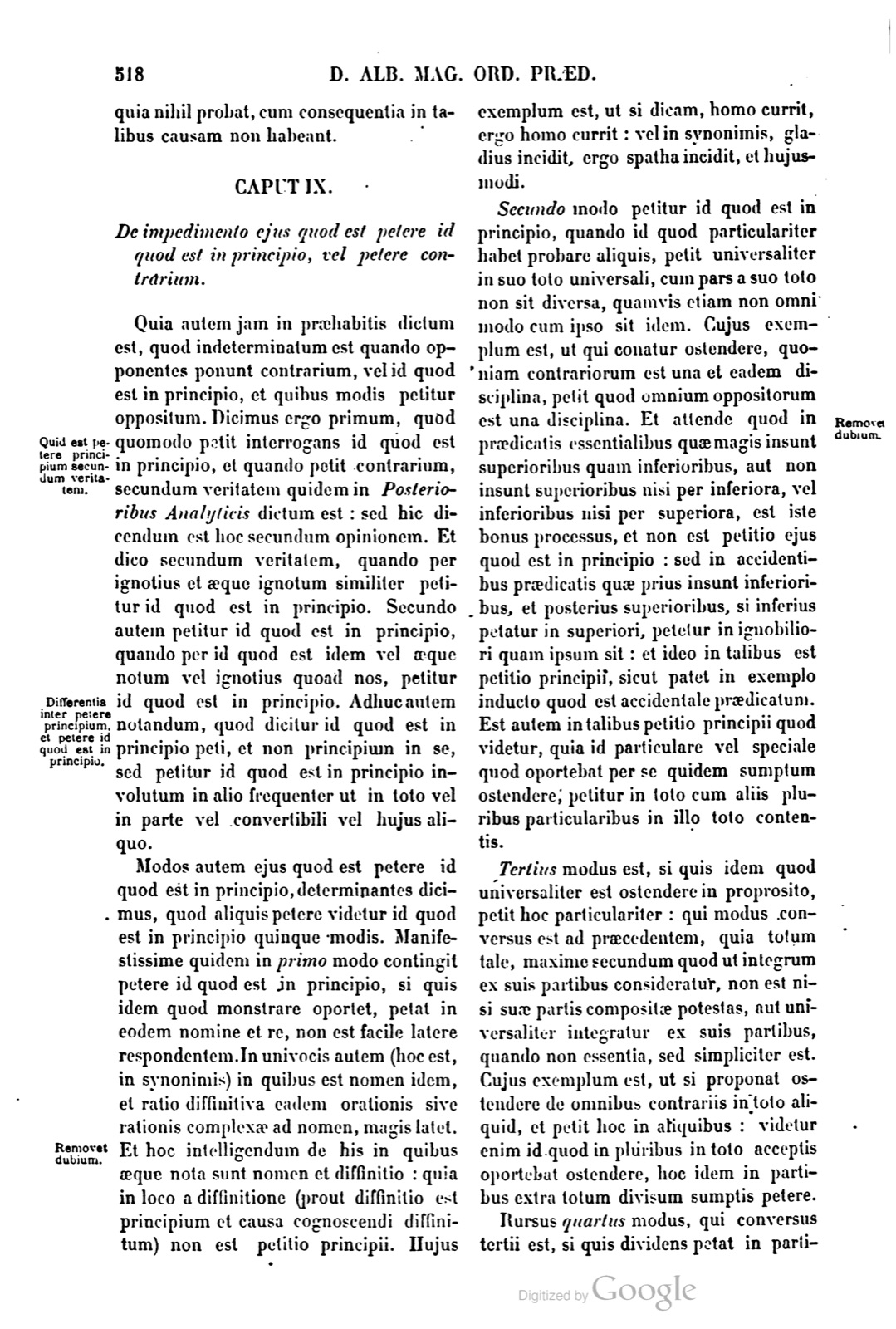
CAPUT IX.
De impedimento ejus quod est petere id quod est in principio, vel petere contrarium.
Quia autem jam in praehabitis dictum est, quod indeterminatum est quando opponentes ponunt contrarium, vel id quod est in principio, et quibus modis petitur oppositum. Dicimus ergo primum, quod quomodo petit interrogans id quod est in principio, et quando petit contrarium, secundum veritatem quidem in Posterioribus Analyticis dictum est: sed hic dicendum est hoc secundum opinionem. Et dico secundum veritatem, quando per ignotius et aeque ignotum similiter petitur id quod est in principio. Secundo autem petitur id quod est in principio, quando per id quod est idem vel aeque notum vel ignotius quoad nos, petitur id quod est in principio. Adhuc autem notandum, quod dicitur id quod est in principio peti, et non principium in se, sed petitur id quod est in principio involutum in alio frequenter ut in toto vel in parte vel convertibili vel hujus aliquo.
Modos autem ejus quod est petere id quod est in principio, determinantes dicimus, quod aliquis petere videtur id quod est in principio quinque modis. Manifestissime quidem in primo modo contingit petere id quod est in principio, si quis idem quod monstrare oportet, petat in eodem nomine et re, non est facile latere respondentem. In univocis autem (hoc est, in synonymis) in quibus est nomen idem, et ratio diffinitiva eadem orationis sive rationis complexae ad nomen, magis latet. Et hoc intelligendum de his in quibus aeque nota sunt nomen et diffinitio: quia in loco a diffinitione (prout diffinitio est principium et causa cognoscendi diffinitum) non est petitio principii. Hujus exemplum est, ut si dicam, homo currit, ergo homo currit: vel in synonymis, gladius incidit, ergo spatha incidit, et hujusmodi.
Secundo modo petitur id quod est in principio, quando id quod particulariter habet probare aliquis, petit universaliter in suo toto universali, cum pars a suo toto non sit diversa, quamvis etiam non omni modo cum ipso sit idem. Cujus exemplum est, ut qui conatur ostendere, quoniam contrariorum est una et eadem disciplina, petit quod omnium oppositorum est una disciplina. Et attende quod in praedicatis essentialibus quae magis insunt superioribus quam inferioribus, aut non insunt superioribus nisi per inferiora, vel inferioribus nisi per superiora, est iste bonus processus, et non est petitio ejus quod est in principio: sed in accidentibus praedicatis quae prius insunt inferioribus, et posterius superioribus, si inferius petatur in superiori, petetur in ignobiliori quam ipsum sit: et ideo in talibus est petitio principii, sicut patet in exemplo inducto quod est accidentale praedicatum. Est autem in talibus petitio principii quod videtur, quia id particulare vel speciale quod oportebat per se quidem sumptum ostendere, petitur in toto cum aliis pluribus particularibus in illo toto contentis.
Tertius modus est, si quis idem quod universaliter est ostendere in proposito, petit hoc particulariter: qui modus conversus est ad praecedentem, quia totum tale, maxime secundum quod ut integrum ex suis partibus consideratur, non est nisi suae partis compositae potestas, aut universaliter integratur ex suis partibus, quando non essentia, sed simpliciter est. Cujus exemplum est, ut si proponat ostendere de omnibus contrariis in toto aliquid, et petit hoc in aliquibus: videtur enim id quod in pluribus in toto acceptis oportebat ostendere, hoc idem in partibus extra totum divisum sumptis petere.
CHAPTER IX.
On the impediment which is to beg that which is in the principle, or to beg the contrary.
But because it has already been said in the preceding things that it is indeterminate when opponents posit the contrary or that which is in the principle, and in what ways the opposite is begged, therefore we say first how the questioner begs that which is in the principle, and when he begs the contrary; indeed according to truth this has been said in the Posterior Analytics, but here this must be said according to opinion. And I say according to truth, when through what is more unknown and equally unknown that which is in the principle is similarly begged. But secondly, that which is in the principle is begged when through that which is the same, or equally known, or more unknown to us, that which is in the principle is begged. Still further it must be noted that one is said to beg that which is in the principle, and not the principle in itself; rather what is in the principle, frequently wrapped up in another as in a whole or in a part or in a convertible or something of this kind, is begged.
But determining the modes of that which is to beg what is in the principle, we say that someone seems to beg what is in the principle in five ways. In the first way, it happens most manifestly to beg what is in the principle if someone begs, in the same name and thing, the same thing which must be shown; it is not easy for this to escape the respondent. But in univocal things, that is, in synonyms, in which the name is the same and the definitive account of the speech or complex account with respect to the name is the same, it is more hidden. And this must be understood of those things in which the name and the definition are equally known, because in the place from definition, insofar as definition is the principle and cause of knowing the defined thing, there is no begging of the principle. The example of this is if I say, a man runs, therefore a man runs; or in synonyms, a sword cuts, therefore a blade cuts, and things of this sort.
In the second way, that which is in the principle is begged when what someone has to prove particularly he begs universally in its universal whole, since a part is not diverse from its whole, although it is also not in every way the same as it. The example of this is someone who tries to show that there is one and the same discipline of contraries, and begs that there is one discipline of all opposites. And attend that in essential predicates, which belong more to superiors than to inferiors, or do not belong to superiors except through inferiors, or to inferiors except through superiors, this is a good process and is not begging that which is in the principle. But in accidental predicates which belong first to inferiors and afterwards to superiors, if the inferior is begged in the superior, it will be begged in something less noble than it is; and therefore in such things there is begging of the principle, as is clear in the example introduced, which is an accidental predicate. But in such things there is begging of the principle which seems so because that particular or special thing which ought to have been shown taken through itself is begged in the whole with many other particulars contained in that whole.
The third mode is if someone begs particularly the same thing which is to be shown universally in the proposed thing; this mode is the converse of the preceding one, because such a whole, especially according as it is considered as an integral thing from its parts, is only the power of its composed part, or is integrated universally from its parts, when it is not essence, but is simply. The example of this is if someone proposes to show something concerning all contraries in the whole, and begs this in certain ones; for he seems to beg the very same thing in parts taken as divided outside the whole which ought to have been shown in several things taken in the whole.
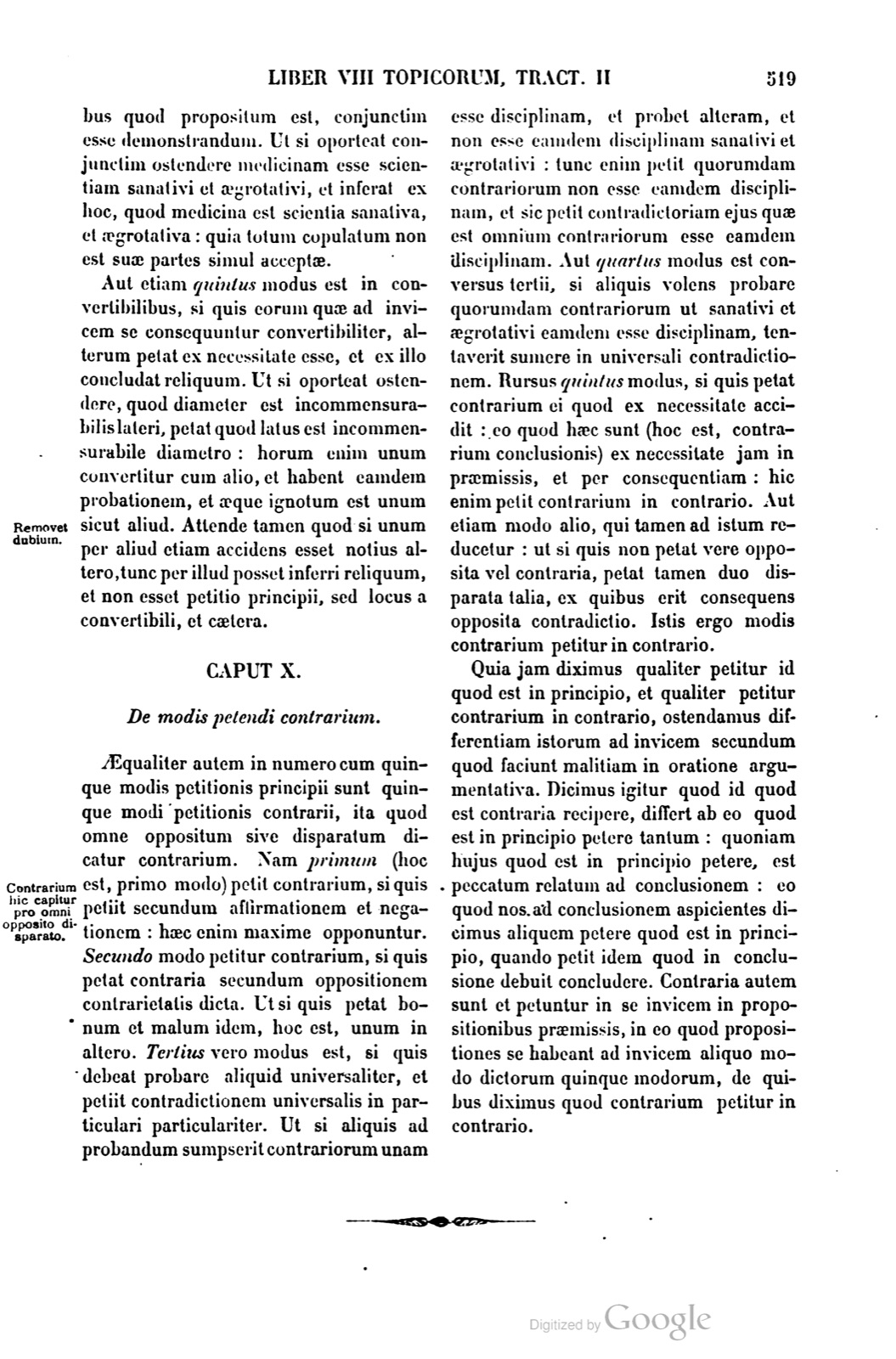
Rursus quartus modus, qui conversus tertii est, si quis dividens petat in partibus quod propositum est, conjunctim esse demonstrandum. Ut si oporteat conjunctim ostendere medicinam esse scientiam sanativi et aegrotativi, et inferat ex hoc, quod medicina est scientia sanativa, et aegrotativa: quia totum copulatum non est suae partes simul acceptae.
Aut etiam quintus modus est in convertibilibus, si quis eorum quae ad invicem se consequuntur convertibiliter, alterum petat ex necessitate esse, et ex illo concludat reliquum. Ut si oporteat ostendere, quod diameter est incommensurabilis lateri, petat quod latus est incommensurabile diametro: horum enim unum convertitur cum alio, et habent eamdem probationem, et aeque ignotum est unum sicut aliud. Attende tamen quod si unum per aliud etiam accidens esset notius altero, tunc per illud posset inferri reliquum, et non esset petitio principii, sed locus a convertibili, et caetera.
CAPUT X.
De modis petendi contrarium.
Aequaliter autem in numero cum quinque modis petitionis principii sunt quinque modi petitionis contrarii, ita quod omne oppositum sive disparatum dicatur contrarium. Nam primum (hoc est, primo modo) petit contrarium, si quis petiit secundum affirmationem et negationem: haec enim maxime opponuntur. Secundo modo petitur contrarium, si quis petat contraria secundum oppositionem contrarietatis dicta. Ut si quis petat bonum et malum idem, hoc est, unum in altero. Tertius vero modus est, si quis debeat probare aliquid universaliter, et petiit contradictionem universalis in particulari particulariter. Ut si aliquis ad probandum sumpserit contrariorum unam esse disciplinam, et probet alteram, et non esse eamdem disciplinam sanativi et aegrotativi: tunc enim petit quorumdam contrariorum non esse eamdem disciplinam, et sic petit contradictoriam ejus quae est omnium contrariorum esse eamdem disciplinam. Aut quartus modus est conversus tertii, si aliquis volens probare quorumdam contrariorum ut sanativi et aegrotativi eamdem esse disciplinam, tentaverit sumere in universali contradictionem. Rursus quintus modus, si quis petat contrarium ei quod ex necessitate accidit: eo quod haec sunt (hoc est, contrarium conclusionis) ex necessitate jam in praemissis, et per consequentiam hic enim petit contrarium in contrario. Aut etiam modo alio, qui tamen ad istum reducetur: ut si quis non petat vere opposita vel contraria, petat tamen duo disparata talia, ex quibus erit consequens opposita contradictio. Istis ergo modis contrarium petitur in contrario.
Quia jam diximus qualiter petitur id quod est in principio, et qualiter petitur contrarium in contrario, ostendamus differentiam istorum ad invicem secundum quod faciunt malitiam in oratione argumentative. Dicimus igitur quod id quod est contraria recipere, differt ab eo quod est in principio petere tantum: quoniam hujus quod est in principio petere, est peccatum relatum ad conclusionem: eo quod nos ad conclusionem aspicientes dicimus aliquem petere quod est in principio, quando petit idem quod in conclusione debuit concludere. Contraria autem sunt et petuntur in se invicem in propositionibus praemissis, in eo quod propositiones se habeant ad invicem aliquo modo dictorum quinque modorum, de quibus diximus quod contrarium petitur in contrario.
Again, the fourth mode, which is the converse of the third, is if someone, dividing, begs in parts what was proposed to be demonstrated conjointly. As if one had to show conjointly that medicine is the science of the healthful and the disease-producing, and from this infers that medicine is healthful science and disease-producing science; for the coupled whole is not its parts accepted together.
Or also the fifth mode is in convertibles, if someone begs one of those things which follow one another convertibly to be by necessity, and from that concludes the remaining one. As if it were necessary to show that the diameter is incommensurable to the side, he begs that the side is incommensurable to the diameter; for one of these is converted with the other, and they have the same proof, and one is equally unknown as the other. Attend, however, that if one were also by accident more known than the other through the other, then through it the remaining one could be inferred, and it would not be begging of the principle, but the place from the convertible, and so on.
CHAPTER X.
On the modes of begging the contrary.
Now equal in number with the five modes of begging the principle are the five modes of begging the contrary, so that every opposite or disparate thing is called a contrary. For first, that is, in the first mode, someone begs the contrary if he has begged according to affirmation and negation; for these are most of all opposed. In the second mode the contrary is begged if someone begs contraries stated according to the opposition of contrariety. As if someone begs good and evil as the same, that is, one in the other. But the third mode is if someone ought to prove something universally and has begged the contradiction of the universal in particular particularly. As if someone, for proving that there is one discipline of contraries, had assumed that there is one discipline of contraries, and proves another thing, namely that there is not the same discipline of the healthful and the disease-producing; for then he begs that there is not the same discipline of certain contraries, and thus begs the contradictory of that which is that there is the same discipline of all contraries. Or the fourth mode is the converse of the third, if someone wishing to prove that there is the same discipline of certain contraries, as of the healthful and the disease-producing, has tried to take the contradiction universally. Again, the fifth mode is if someone begs the contrary of what happens by necessity, because these, that is, the contrary of the conclusion, are already in the premises by necessity, and by consequence here he begs the contrary in the contrary. Or also in another mode, which nevertheless will be reduced to this one, as if someone does not beg things truly opposed or contrary, yet begs two disparate things such that from them an opposite contradiction will be consequent. Therefore in these modes the contrary is begged in the contrary.
Since we have now said how that which is in the principle is begged, and how the contrary is begged in the contrary, let us show the difference of these from one another according as they make badness in argumentative speech. Therefore we say that receiving contraries differs only from begging what is in the principle, because the fault of begging what is in the principle is referred to the conclusion; because, looking to the conclusion, we say that someone begs what is in the principle when he begs the same thing which he ought to have concluded in the conclusion. But contraries exist and are begged in one another in the premises, in that the propositions are related to one another in some one of the five stated modes concerning which we have said that the contrary is begged in the contrary.
If a page does not appear, its photograph has not been uploaded yet.