Volume 2 · pp. 514–517
Book VIII of the Topics, Treatise II, Chapters VI-VIII.
A marker with ≈ is an approximate page boundary, placed by measure of the text; the page photographs remain the authority. In the paired views, clicking a page marker brings that page into view.
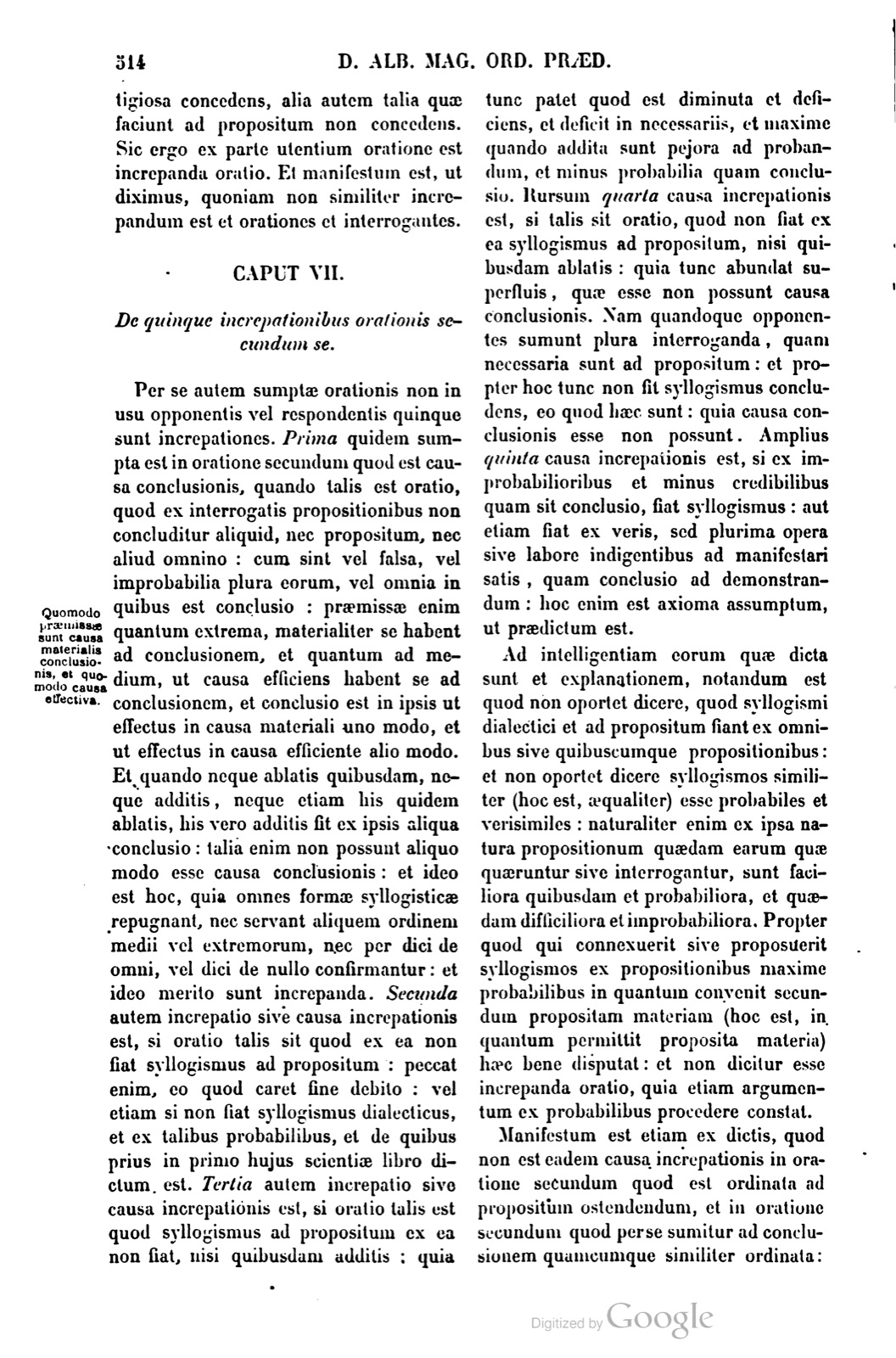
Quoniam autem indefinitum est sive incertum et indeterminatum, quando contraria opponenti vel respondenti, et quando ea quae sunt in principio sunt inconvenientia, ad intentum propositum faciunt vel proponunt homines disputantes ad invicem opponens et respondens: plurimi etiam ea prius sunt renuentes et negantes, postea concedunt et ponunt haec, ut saepe fit in probabilibus: et hoc fit ideo, quia respondentes plerumque subaudiunt ad perversum intellectum audita, referendo ea quae interrogantes interrogant a principio, et ex hoc necesse est pravas fieri disputationes. Et causa hujus est ille qui respondet, haec quidem litigiosa concedens, alia autem talia quae faciunt ad propositum non concedens. Sic ergo ex parte utentium oratione est increpanda oratio. Et manifestum est, ut diximus, quoniam non similiter increpandum est et orationes et interrogantes.
CAPUT VII.
De quinque increpationibus orationis secundum se.
Per se autem sumptae orationis non in usu opponentis vel respondentis quinque sunt increpationes. Prima quidem sumpta est in oratione secundum quod est causa conclusionis, quando talis est oratio, quod ex interrogatis propositionibus non concluditur aliquid, nec propositum, nec aliud omnino: cum sint vel falsa, vel improbabilia plura eorum, vel omnia in quibus est conclusio: praemissae enim quantum extrema, materialiter se habent ad conclusionem, et quantum ad medium, ut causa efficiens habent se ad conclusionem, et conclusio est in ipsis ut effectus in causa materiali uno modo, et ut effectus in causa efficiente alio modo. Et quando neque ablatis quibusdam, neque additis, neque etiam his quidem ablatis, his vero additis fit ex ipsis aliqua conclusio: talia enim non possunt aliquo modo esse causa conclusionis: et ideo est hoc, quia omnes formae syllogisticae repugnant, nec servant aliquem ordinem medii vel extremorum, nec per dici de omni, vel dici de nullo confirmantur: et ideo merito sunt increpanda.
Secunda autem increpatio sive causa increpationis est, si oratio talis sit quod ex ea non fiat syllogismus ad propositum: peccat enim, eo quod caret fine debito: vel etiam si non fiat syllogismus dialecticus, et ex talibus probabilibus, et de quibus prius in primo hujus scientiae libro dictum est. Tertia autem increpatio sive causa increpationis est, si oratio talis est quod syllogismus ad propositum ex ea non fiat, nisi quibusdam additis: quia tunc patet quod est diminuta et deficiens, et deficit in necessariis, et maxime quando addita sunt pejora ad probandum, et minus probabilia quam conclusio. Rursum quarta causa increpationis est, si talis sit oratio, quod non fiat ex ea syllogismus ad propositum, nisi quibusdam ablatis: quia tunc abundat superfluis, quae esse non possunt causa conclusionis. Nam quandoque opponentes sumunt plura interroganda, quam necessaria sunt ad propositum: et propter hoc tunc non fit syllogismus concludens, eo quod haec sunt: quia causa conclusionis esse non possunt. Amplius quinta causa increpationis est, si ex improbabilioribus et minus credibilibus quam sit conclusio, fiat syllogismus: aut etiam fiat ex veris, sed plurima opera sive labore indigentibus ad manifestari satis, quam conclusio ad demonstrandum: hoc enim est axioma assumptum, ut praedictum est.
But because it is indefinite or uncertain and indeterminate when contrary things to the opponent or respondent, and when those things which are in the principle, are unsuitable and make for the intended proposed thing or are proposed by people disputing with one another, the opponent and the respondent; very many also first refuse and deny them, and afterwards concede and posit these, as often happens in probable matters; and this happens because respondents for the most part understand the things heard toward a perverse understanding, referring the things which the questioners interrogate from the beginning, and from this disputations must become bad. And the cause of this is the one who responds, conceding these contentious things, but not conceding other such things which make for the proposed thing. Thus therefore the speech is rebukable from the side of those using the speech. And it is manifest, as we have said, that speeches and questioners are not to be rebuked in the same way.
CHAPTER VII.
On the five rebukes of a speech according to itself.
But of a speech taken through itself, not in the use of the opponent or respondent, there are five rebukes. The first indeed is taken in the speech according as it is the cause of the conclusion, when the speech is such that from the propositions interrogated nothing is concluded, neither the proposed thing nor anything else at all, since several of those in which the conclusion consists, or all, are either false or improbable. For the premises, as to the extremes, stand materially toward the conclusion, and as to the middle they stand as an efficient cause toward the conclusion; and the conclusion is in them as an effect in a material cause in one way, and as an effect in an efficient cause in another way. And when, neither by certain things removed, nor by things added, nor even by these removed and those added, some conclusion is made from them, such things cannot in any way be the cause of a conclusion; and this is so because all syllogistic forms are repugnant, and they preserve no order of middle or extremes, nor are they confirmed through being said of every or through being said of none; and therefore they are deservedly to be rebuked.
But the second rebuke or cause of rebuke is if the speech is such that from it no syllogism is made toward the proposed thing; for it errs because it lacks the due end; or also if a dialectical syllogism is not made from such probable things as those concerning which it was said before in the first book of this science. But the third rebuke or cause of rebuke is if the speech is such that a syllogism toward the proposed thing is not made from it unless certain things are added, because then it is clear that it is diminished and deficient, and fails in necessary things, and especially when the things added for proving are worse and less probable than the conclusion. Again, the fourth cause of rebuke is if the speech is such that from it a syllogism toward the proposed thing is not made unless certain things are removed, because then it abounds in superfluous things which cannot be the cause of the conclusion. For sometimes opponents take more things to be interrogated than are necessary for the proposed thing; and on account of this, then a concluding syllogism is not made, since these things are such that they cannot be the cause of the conclusion. Further, the fifth cause of rebuke is if a syllogism is made from things more improbable and less credible than the conclusion is; or also if it is made from true things, but from those needing more work or labor in order to be sufficiently manifested than the conclusion needs in order to be demonstrated. For this is the axiom assumed, as was said before.
Ad intelligentiam eorum quae dicta sunt et explanationem, notandum est quod non oportet dicere, quod syllogismi dialectici et ad propositum fiant ex omnibus sive quibuscumque propositionibus: et non oportet dicere syllogismos similiter (hoc est, aequaliter) esse probabiles et verisimiles: naturaliter enim ex ipsa natura propositionum quaedam earum quae quaeruntur sive interrogantur, sunt faciliora quibusdam et probabiliora, et quaedam difficiliora et improbabiliora. Propter quod qui connexuerit sive proposuerit syllogismos ex propositionibus maxime probabilibus in quantum convenit secundum propositam materiam (hoc est, in quantum permittit proposita materia) haec bene disputat: et non dicitur esse increpanda oratio, quia etiam argumentum ex probabilibus procedere constat.
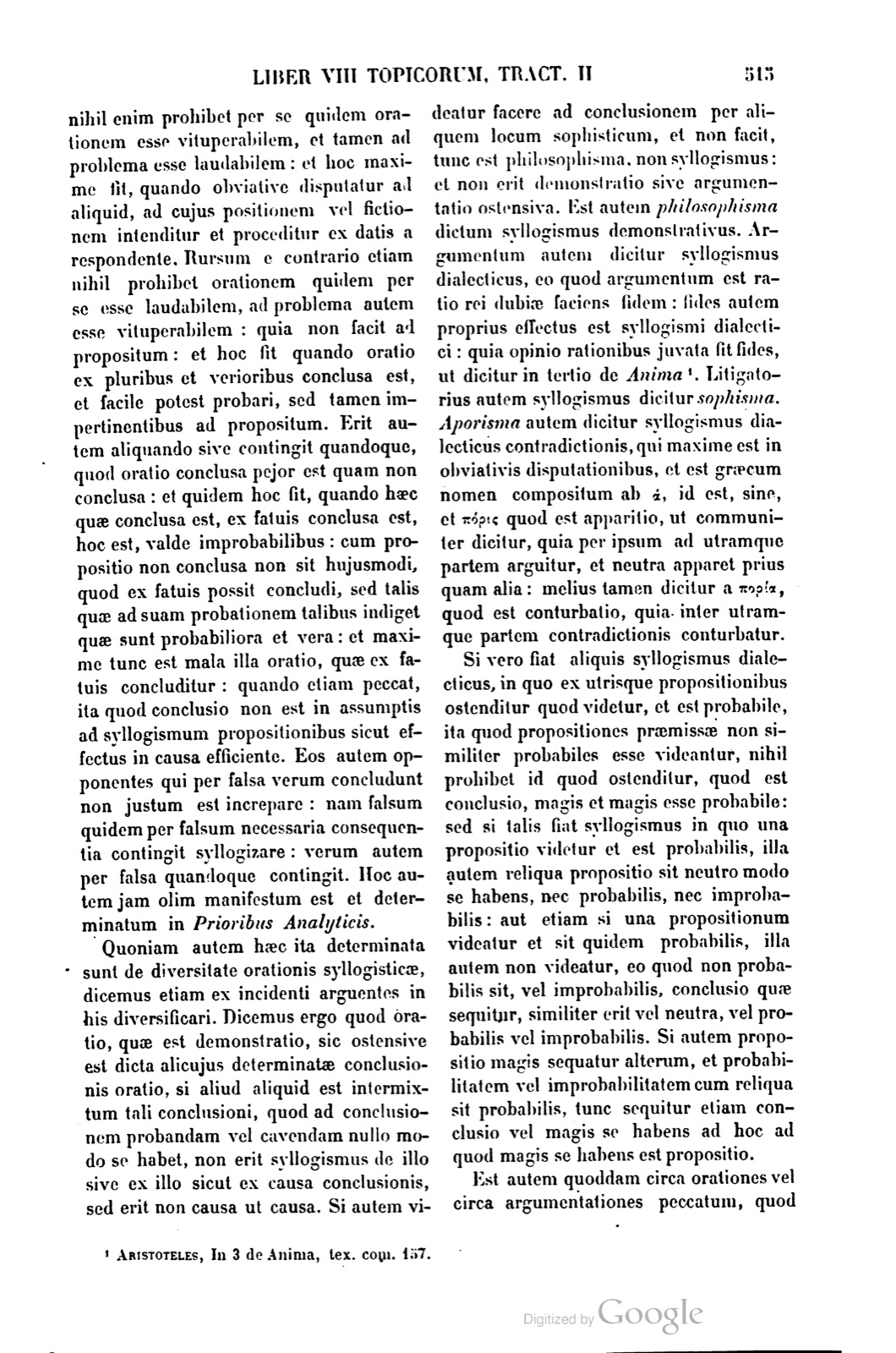
Manifestum est etiam ex dictis, quod non est eadem causa increpationis in oratione secundum quod est ordinata ad propositum ostendendum, et in oratione secundum quod per se sumitur ad conclusionem quamcumque similiter ordinata: nihil enim prohibet per se quidem orationem esse vituperabilem, et tamen ad problema esse laudabilem: et hoc maxime fit, quando obviative disputatur ad aliquid, ad cujus positionem vel fictionem intenditur et proceditur ex datis a respondente. Rursum e contrario etiam nihil prohibet orationem quidem per se esse laudabilem, ad problema autem esse vituperabilem: quia non facit ad propositum: et hoc fit quando oratio ex pluribus et verioribus conclusa est, et facile potest probari, sed tamen impertinentibus ad propositum. Erit autem aliquando sive contingit quandoque, quod oratio conclusa pejor est quam non conclusa: et quidem hoc fit, quando haec quae conclusa est, ex fatuis conclusa est, et hoc est, valde improbabilibus: cum propositio non conclusa non sit hujusmodi, quod ex fatuis possit concludi, sed talis quae ad suam probationem talibus indiget quae sunt probabiliora et vera: et maxime tunc est mala illa oratio, quae ex fatuis concluditur: quando etiam peccat, ita quod conclusio non est in assumptis ad syllogismum propositionibus sicut effectus in causa efficiente. Eos autem opponentes qui per falsa verum concludunt non justum est increpare: nam falsum quidem per falsum necessaria consequentia contingit syllogizare: verum autem per falsa quandoque contingit. Hoc autem jam olim manifestum est et determinatum in Prioribus Analyticis.
Quoniam autem haec ita determinata sunt de diversitate orationis syllogisticae, dicemus etiam ex incidenti arguentes in his diversificari. Dicemus ergo quod oratio, quae est demonstratio, sic ostensive est dicta alicujus determinatae conclusionis oratio, si aliud aliquid est intermixtum tali conclusioni, quod ad conclusionem probandam vel cavendam nullo modo se habet, non erit syllogismus de illo sive ex illo sicut ex causa conclusionis, sed erit non causa ut causa. Si autem videatur facere ad conclusionem per aliquem locum sophisticum, et non facit, tunc est philosophisma, non syllogismus: et non erit demonstratio sive argumentatio ostensiva. Est autem philosophisma dictum syllogismus demonstrativus. Argumentum autem dicitur syllogismus dialecticus, eo quod argumentum est ratio rei dubiae faciens fidem: fides autem proprius effectus est syllogismi dialectici: quia opinio rationibus juvata fit fides, ut dicitur in tertio de Anima.1 Litigatorius autem syllogismus dicitur sophisma. Aporisma autem dicitur syllogismus dialecticus contradictionis, qui maxime est in obviativis disputationibus, et est graecum nomen compositum ab a, id est, sine, et πόρις quod est apparitio, ut communiter dicitur, quia per ipsum ad utramque partem arguitur, et neutra apparet prius quam alia: melius tamen dicitur a πορία, quod est conturbatio, quia inter utramque partem contradictionis conturbatur.
For understanding and explanation of the things which have been said, it must be noted that one ought not say that dialectical syllogisms, even toward the proposed thing, are made from all or any propositions whatever; and one ought not say that syllogisms are similarly, that is, equally, probable and likely. For naturally, from the very nature of propositions, certain of those which are sought or interrogated are easier and more probable than others, and certain are more difficult and more improbable. On account of which, he who has connected or proposed syllogisms from propositions as probable as possible according as agrees with the proposed matter, that is, insofar as the proposed matter permits, disputes well in these things; and the speech is not said to be rebukable, because it is also clear that an argument proceeds from probable things.
It is also manifest from what has been said that the cause of rebuke is not the same in a speech according as it is ordered to showing the proposed thing, and in a speech according as it is taken through itself and ordered similarly to any conclusion whatever. For nothing prevents a speech from being blameworthy through itself and nevertheless praiseworthy for the problem; and this happens especially when one disputes obviatively toward something, toward whose position or fiction the speech is intended and proceeds from the things given by the respondent. Again, on the contrary, nothing prevents a speech from being praiseworthy through itself but blameworthy for the problem, because it does not make for the proposed thing; and this happens when a speech is concluded from more and truer things and can easily be proved, but nevertheless by things impertinent to the proposed thing. But sometimes it will be, or sometimes it happens, that a concluded speech is worse than one not concluded; and this indeed happens when what is concluded is concluded from foolish things, that is, from very improbable things, while the proposition not concluded is not of such a sort that it could be concluded from foolish things, but is one which, for its proof, needs such things as are more probable and true. And especially then that speech is bad which is concluded from foolish things, when it also errs so that the conclusion is not in the propositions assumed for the syllogism as an effect in an efficient cause. But it is not just to rebuke those opponents who conclude the true through false things; for indeed the false can be syllogized through the false by necessary consequence, but sometimes the true can happen through false things. And this has long since been made manifest and determined in the Prior Analytics.
But since these things have thus been determined concerning the diversity of syllogistic speech, we shall also say incidentally that those arguing are diversified in these things. Therefore we say that a speech which is demonstration is thus called ostensively the speech of some determinate conclusion; if something else is intermixed with such a conclusion which in no way relates to proving or avoiding the conclusion, it will not be a syllogism concerning that or from that as from a cause of the conclusion, but it will be a non-cause as a cause. But if it seems to make for the conclusion through some sophistical place and does not, then it is a philosophism, not a syllogism, and it will not be a demonstration or ostensive argumentation. But a philosophism is called a demonstrative syllogism. An argument, however, is called a dialectical syllogism, because an argument is a reason of a doubtful thing making faith; and faith is the proper effect of a dialectical syllogism, because opinion helped by reasons becomes faith, as is said in the third book On the Soul.1 But a contentious syllogism is called a sophism. But an aporism is called a dialectical syllogism of contradiction, which is especially in obviative disputations, and is a Greek name composed from a, that is, without, and πόρις, which is appearance, as is commonly said, because through it one argues to each part and neither appears before the other; nevertheless it is better said from πορία, which is disturbance, because one is disturbed between each part of the contradiction.
Si vero fiat aliquis syllogismus dialecticus, in quo ex utrisque propositionibus ostenditur quod videtur, et est probabile, ita quod propositiones praemissae non similiter probabiles esse videantur, nihil prohibet id quod ostenditur, quod est conclusio, magis et magis esse probabile: sed si talis fiat syllogismus in quo una propositio videtur et est probabilis, illa autem reliqua propositio sit neutro modo se habens, nec probabilis, nec improbabilis: aut etiam si una propositionum videatur et sit quidem probabilis, illa autem non videatur, eo quod non probabilis sit, vel improbabilis, conclusio quae sequitur, similiter erit vel neutra, vel probabilis vel improbabilis. Si autem propositio magis sequatur alterum, et probabilitatem vel improbabilitatem cum reliqua sit probabilis, tunc sequitur etiam conclusio vel magis se habens ad hoc ad quod magis se habens est propositio.
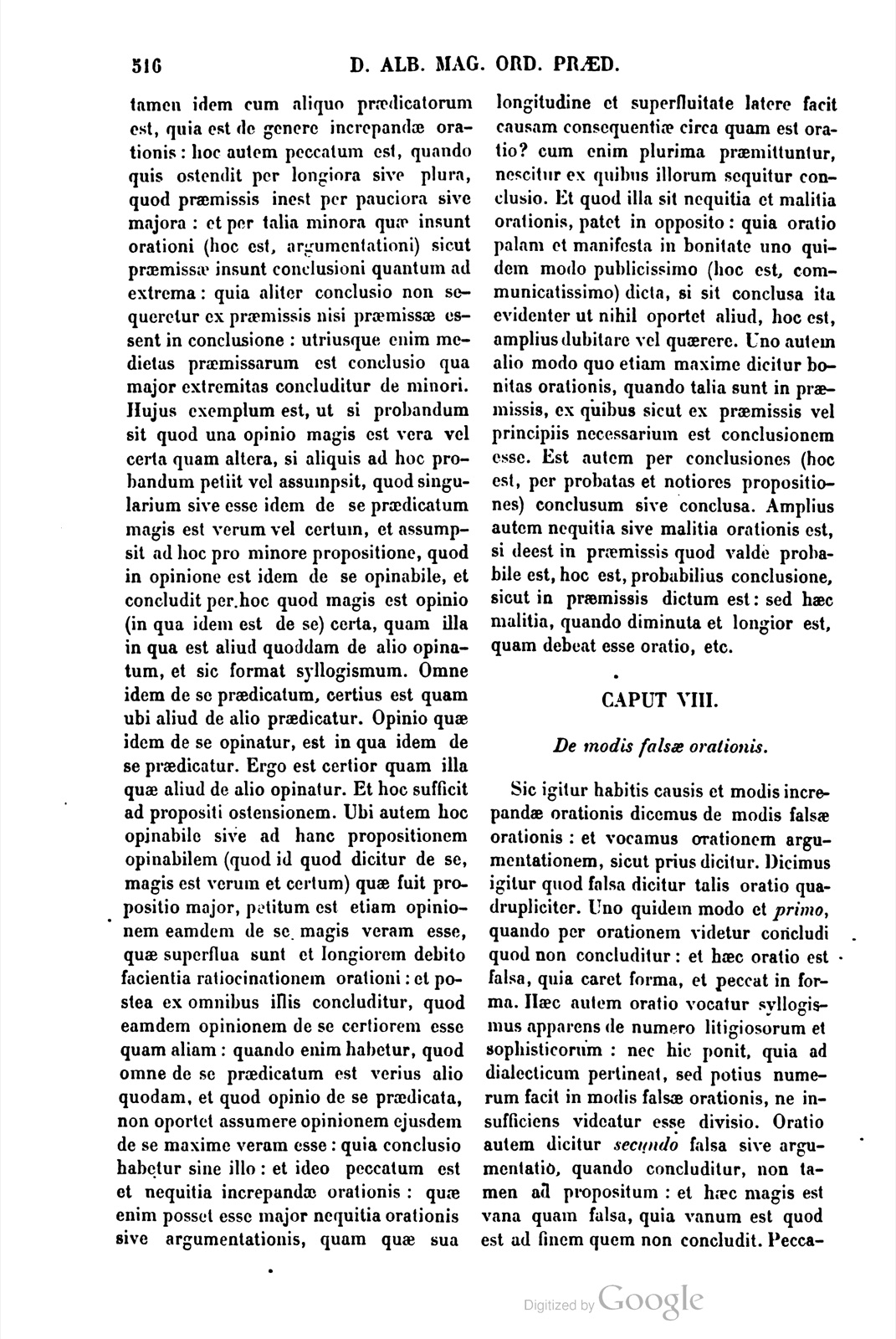
Est autem quoddam circa orationes vel circa argumentationes peccatum, quod tamen idem cum aliquo praedicatorum est, quia est de genere increpandae orationis: hoc autem peccatum est, quando quis ostendit per longiora sive plura, quod praemissis inest per pauciora sive majora: et per talia minora quae insunt orationi (hoc est, argumentationi) sicut praemissae insunt conclusioni quantum ad extrema: quia aliter conclusio non sequeretur ex praemissis nisi praemissae essent in conclusione: utriusque enim medietas praemissarum est conclusio qua major extremitas concluditur de minori. Hujus exemplum est, ut si probandum sit quod una opinio magis est vera vel certa quam altera, si aliquis ad hoc probandum petiit vel assumpsit, quod singularium sive esse idem de se praedicatum magis est verum vel certum, et assumpsit ad hoc pro minore propositione, quod in opinione est idem de se opinabile, et concludit per hoc quod magis est opinio (in qua idem est de se) certa, quam illa in qua est aliud quoddam de alio opinatum, et sic format syllogismum. Omne idem de se praedicatum, certius est quam ubi aliud de alio praedicatur. Opinio quae idem de se opinatur, est in qua idem de se praedicatur. Ergo est certior quam illa quae aliud de alio opinatur. Et hoc sufficit ad propositi ostensionem. Ubi autem hoc opinabile sive ad hanc propositionem opinabilem (quod id quod dicitur de se, magis est verum et certum) quae fuit propositio major, petitum est etiam opinionem eamdem de se magis veram esse, quae superflua sunt et longiorem debito facientia ratiocinationem orationi: et postea ex omnibus illis concluditur, quod eamdem opinionem de se certiorem esse quam aliam: quando enim habetur, quod omne de se praedicatum est verius alio quodam, et quod opinio de se praedicata, non oportet assumere opinionem ejusdem de se maxime veram esse: quia conclusio habetur sine illo: et ideo peccatum est et nequitia increpandae orationis: quae enim posset esse major nequitia orationis sive argumentationis, quam quae sua longitudine et superfluitate latere facit causam consequentiae circa quam est oratio? cum enim plurima praemittuntur, nescitur ex quibus illorum sequitur conclusio. Et quod illa sit nequitia et malitia orationis, patet in opposito: quia oratio palam et manifesta in bonitate uno quidem modo publicissimo (hoc est, communicatissimo) dicta, si sit conclusa ita evidenter ut nihil oportet aliud, hoc est, amplius dubitare vel quaerere. Uno autem alio modo quo etiam maxime dicitur bonitas orationis, quando talia sunt in praemissis, ex quibus sicut ex praemissis vel principiis necessarium est conclusionem esse. Est autem per conclusiones (hoc est, per probatas et notiores propositiones) conclusum sive conclusa. Amplius autem nequitia sive malitia orationis est, si deest in praemissis quod valde probabile est, hoc est, probabilius conclusione, sicut in praemissis dictum est: sed haec malitia, quando diminuta et longior est, quam debeat esse oratio, etc.
But if some dialectical syllogism is made in which, from both propositions, that which seems so and is probable is shown, so that the premises do not seem similarly probable, nothing prevents that which is shown, which is the conclusion, from being more and more probable. But if such a syllogism is made in which one proposition seems and is probable, but that remaining proposition stands in neither mode, neither probable nor improbable; or also if one of the propositions seems and is indeed probable, but the other does not seem so, because it is not probable, or is improbable, the conclusion which follows will similarly be either neutral, or probable, or improbable. But if the proposition follows one of the two more, and with the remaining proposition there is probability or improbability, then the conclusion also follows, having itself more toward that toward which the proposition is more disposed.
But there is a certain fault about speeches or argumentations, which nevertheless is the same as some one of the predicates, because it is of the genus of a rebukable speech. This fault is when someone shows through longer or more things what belongs through fewer or greater things to the premises; and through such lesser things which belong to the speech, that is, the argumentation, just as premises belong to the conclusion as to the extremes, because otherwise the conclusion would not follow from the premises unless the premises were in the conclusion. For the middle position of both premises is the conclusion by which the greater extreme is concluded of the lesser. The example of this is if it has to be proved that one opinion is more true or certain than another, and someone, for proving this, has sought or assumed that, among singular things, or being the same predicated of itself, is more true or certain, and for this has assumed as the minor proposition that in opinion there is the same opinable thing of itself, and through this concludes that the opinion in which the same thing is of itself is more certain than that in which something else is opined of another, and thus forms the syllogism. Everything the same predicated of itself is more certain than where another is predicated of another. The opinion which opines the same of itself is that in which the same is predicated of itself. Therefore it is more certain than that which opines another of another. And this suffices for showing the proposed thing. But where this opinable thing, or for this probable proposition, that what is said of itself is more true and certain, which was the major proposition, it has also been sought that the same opinion of itself is more true, these are superfluous things and make the ratiocination longer than due for the speech; and afterwards from all those things it is concluded that the same opinion of itself is more certain than another. For when it is held that everything predicated of itself is truer than some other thing, and that opinion is predicated of itself, one need not assume that the opinion of the same thing concerning itself is maximally true, because the conclusion is held without that; and therefore it is a fault and badness of a rebukable speech. For what greater badness of a speech or argumentation could there be than one which by its length and superfluity makes hidden the cause of the consequence about which the speech is? For when very many things are premised, it is not known from which of them the conclusion follows. And that this is badness and malice of speech is clear in the opposite: because a speech is plain and manifest in goodness in one most public way, that is, most common way, if it is concluded so evidently that nothing else, that is, nothing further, needs to be doubted or asked. But in another way also in which the goodness of speech is especially spoken of, it is when such things are in the premises from which, as from premises or principles, it is necessary that the conclusion be. But it has been concluded, or the things have been concluded, through conclusions, that is, through proved and better known propositions. Further, badness or malice of speech exists if there is lacking in the premises what is very probable, that is, more probable than the conclusion, as was said in the premises; but this malice exists when the speech is diminished and longer than it ought to be, and so on.
CAPUT VIII.
De modis falsae orationis.
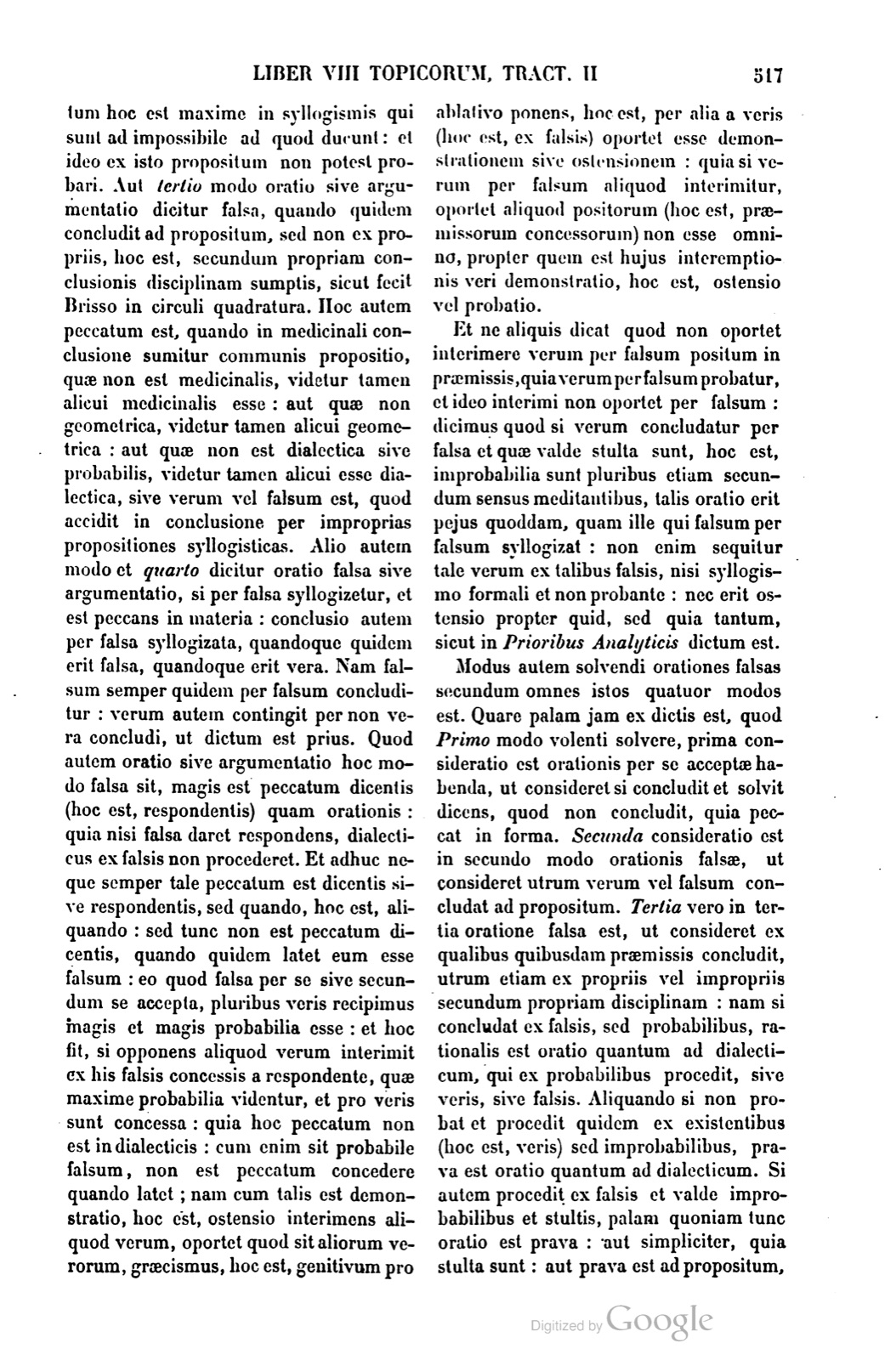
Sic igitur habitis causis et modis increpandae orationis dicemus de modis falsae orationis: et vocamus orationem argumentationem, sicut prius dicitur. Dicimus igitur quod falsa dicitur talis oratio quadrupliciter. Uno quidem modo et primo, quando per orationem videtur concludi quod non concluditur: et haec oratio est falsa, quia caret forma, et peccat in forma. Haec autem oratio vocatur syllogismus apparens de numero litigiosorum et sophisticorum: nec hic ponit, quia ad dialecticum pertineat, sed potius numerum facit in modis falsae orationis, ne insufficiens videatur esse divisio. Oratio autem dicitur secundo falsa sive argumentatio, quando concluditur, non tamen ad propositum: et haec magis est vana quam falsa, quia vanum est quod est ad finem quem non concludit. Peccatum hoc est maxime in syllogismis qui sunt ad impossibile ad quod ducunt: et ideo ex isto propositum non potest probari.
CHAPTER VIII.
On the modes of false speech.
Therefore, with the causes and modes of rebukable speech thus held, we shall speak of the modes of false speech; and we call speech argumentation, as was said before. Therefore we say that such a speech is called false in four ways. In one way and first, when through the speech there seems to be concluded what is not concluded; and this speech is false, because it lacks form and errs in form. But this speech is called an apparent syllogism from the number of contentious and sophistical syllogisms; and he does not set it down here because it pertains to the dialectician, but rather makes up the number in the modes of false speech, lest the division seem insufficient. But a speech or argumentation is called false in a second way when something is concluded, but not toward the proposed thing; and this is more vain than false, because vain is what is toward an end which it does not conclude. This fault is especially in syllogisms which are to the impossible to which they lead; and therefore from this the proposed thing cannot be proved.
Notes
- Aristotle, On the Soul, book 3, text-commentary 157. (Aristoteles, In 3 de Anima, tex. com. 157.) ↩
If a page does not appear, its photograph has not been uploaded yet.