Volume 2 · pp. 511–513
Book VIII of the Topics, Treatise II, Chapters IV-VI.
A marker with ≈ is an approximate page boundary, placed by measure of the text; the page photographs remain the authority. In the paired views, clicking a page marker brings that page into view.
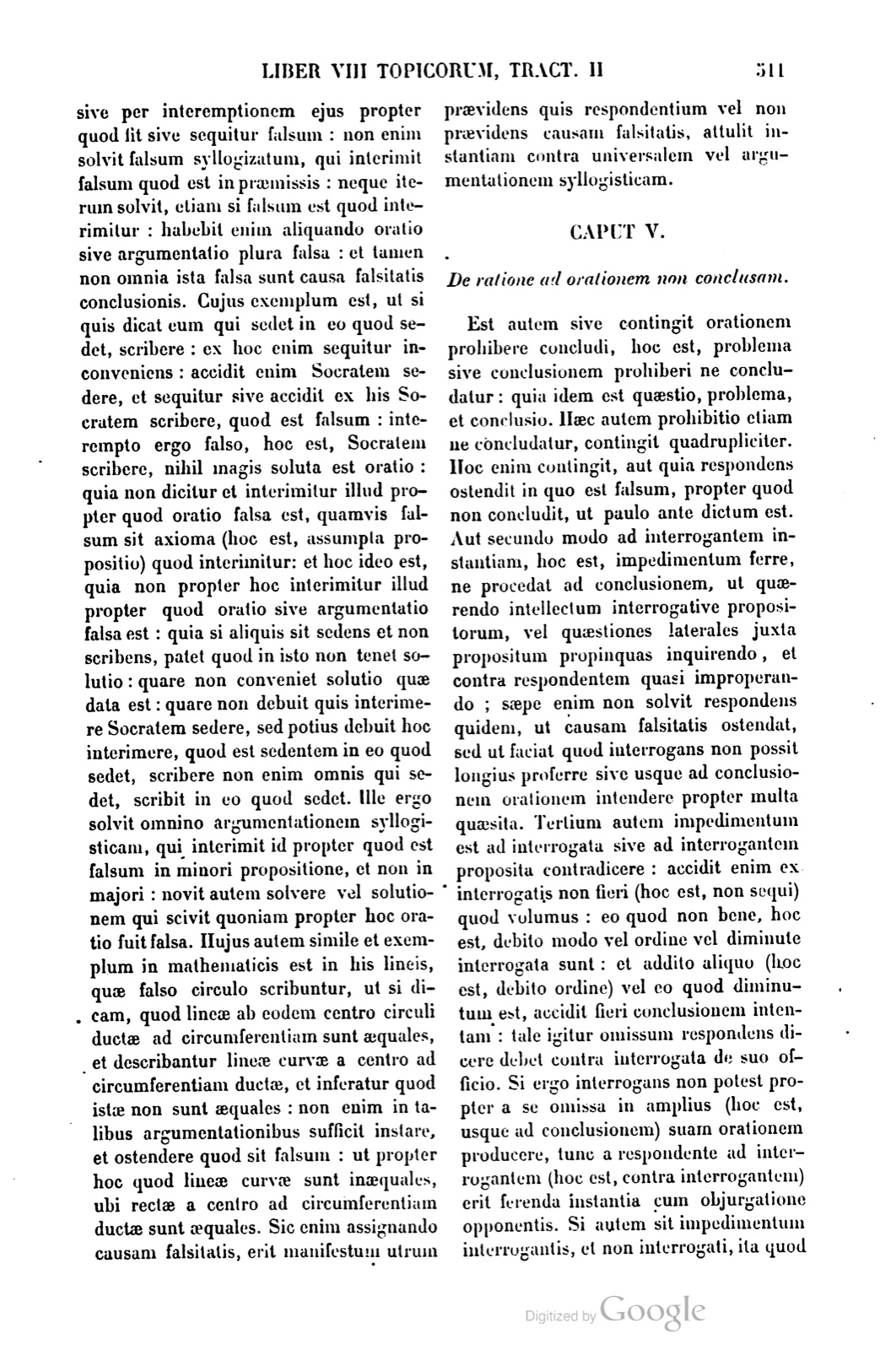
sive per interemptionem ejus propter quod fit sive sequitur falsum: non enim solvit falsum syllogizatum, qui interimit falsum quod est in praemissis: neque iterum solvit, etiam si falsum est quod interimitur: habebit enim aliquando oratio sive argumentatio plura falsa: et tamen non omnia ista falsa sunt causa falsitatis conclusionis. Cujus exemplum est, ut si quis dicat eum qui sedet in eo quod sedet, scribere: ex hoc enim sequitur inconveniens: accidit enim Socratem sedere, et sequitur sive accidit ex his Socratem scribere, quod est falsum: interempto ergo falso, hoc est, Socratem scribere, nihil magis soluta est oratio: quia non dicitur et interimitur illud propter quod oratio falsa est, quamvis falsum sit axioma (hoc est, assumpta propositio) quod interimitur: et hoc ideo est, quia non propter hoc interimitur illud propter quod oratio sive argumentatio falsa est: quia si aliquis sit sedens et non scribens, patet quod in isto non tenet solutio: quare non conveniet solutio quae data est: quare non debuit quis interimere Socratem sedere, sed potius debuit hoc interimere, quod est sedentem in eo quod sedet, scribere non enim omnis qui sedet, scribit in eo quod sedet. Ille ergo solvit omnino argumentationem syllogisticam, qui interimit id propter quod est falsum in minori propositione, et non in majori: novit autem solvere vel solutionem qui scivit quoniam propter hoc oratio fuit falsa. Hujus autem simile et exemplum in mathematicis est in his lineis, quae falso circulo scribuntur, ut si dicam, quod lineae ab eodem centro circuli ductae ad circumferentiam sunt aequales, et describantur lineae curvae a centro ad circumferentiam ductae, et inferatur quod istae non sunt aequales: non enim in talibus argumentationibus sufficit instare, et ostendere quod sit falsum: ut propter hoc quod lineae curvae sunt inaequales, ubi rectae a centro ad circumferentiam ductae sunt aequales. Sic enim assignando causam falsitatis, erit manifestum utrum praevidens quis respondentium vel non praevidens causam falsitatis, attulit instantiam contra universalem vel argumentationem syllogisticam.
CAPUT V.
De ratione ad orationem non conclusam.
Est autem sive contingit orationem prohibere concludi, hoc est, problema sive conclusionem prohiberi ne concludatur: quia idem est quaestio, problema, et conclusio. Haec autem prohibitio etiam ne concludatur, contingit quadrupliciter. Hoc enim contingit, aut quia respondens ostendit in quo est falsum, propter quod non concludit, ut paulo ante dictum est. Aut secundo modo ad interrogantem instantiam, hoc est, impedimentum ferre, ne procedat ad conclusionem, ut quaerendo intellectum interrogative propositorum, vel quaestiones laterales juxta propositum propinquas inquirendo, et contra respondentem quasi improperando; saepe enim non solvit respondens quidem, ut causam falsitatis ostendat, sed ut faciat quod interrogans non possit longius proferre sive usque ad conclusionem orationem intendere propter multa quaesita. Tertium autem impedimentum est ad interrogata sive ad interrogantem proposita contradicere: accidit enim ex interrogatis non fieri (hoc est, non sequi) quod volumus: eo quod non bene, hoc est, debito modo vel ordine vel diminute interrogata sunt: et addito aliquo (hoc est, debito ordine) vel eo quod diminutum est, accidit fieri conclusionem intentam: tale igitur omissum respondens dicere debet contra interrogata de suo officio. Si ergo interrogans non potest propter a se omissa in amplius (hoc est, usque ad conclusionem) suam orationem producere, tunc a respondente ad interrogantem (hoc est, contra interrogantem) erit ferenda instantia cum objurgatione opponentis. Si autem sit impedimentum interrogantis, et non interrogati, ita quod interrogans potest quidem procedere ad conclusionem: tunc respondentis est quaerere instantiam ad interrogata, ut ex ista parte impediat conclusionem, ne aliud propter eam pati videatur. Quarta autem et pessima (quae maxime affligit opponentem) instantia est, quae est ad tempus: prolixius quidem enim respondentes, talibus orationibus instant, ad quae disputare pluris est temporis quam sit praesentis exercitationis, quae est circa principale propositum: et hoc est, quod ante dictum est difficultatis majoris assumptio: et his modis impeditur operans obviative disputans, ne deveniat ad conclusionem intentam.
or through the taking-away of that because of which the false is made or follows; for he who takes away the false which is in the premises does not solve the false thing syllogized, nor again does he solve it even if what is taken away is false. For sometimes a speech or argumentation will have several false things, and nevertheless not all those false things are the cause of the falsity of the conclusion. The example of this is if someone says that one who sits, insofar as he sits, writes; for from this an unsuitable thing follows: for it happens that Socrates sits, and from these things it follows or happens that Socrates writes, which is false. Therefore, when the false has been taken away, that is, “Socrates writes,” the speech is no more solved, because that because of which the speech is false is not stated and taken away, although the axiom, that is, the assumed proposition, which is taken away is false. And this is so because that because of which the speech or argumentation is false is not taken away on account of this: because if someone is sitting and not writing, it is clear that the solution does not hold in this case. Wherefore the solution which was given will not be suitable; wherefore one ought not to have taken away “Socrates sits,” but rather ought to have taken away this, namely that one sitting, insofar as he sits, writes, for not everyone who sits writes insofar as he sits. Therefore he wholly solves the syllogistic argumentation who takes away that because of which it is false in the minor proposition and not in the major. But he knows how to solve, or knows the solution, who has known why the speech was false. A likeness and example of this in mathematics is in those lines which are described falsely with a circle: as if I should say that lines drawn from the same center of a circle to the circumference are equal, and curved lines drawn from the center to the circumference are described, and it is inferred that these are not equal. For in such argumentations it is not sufficient to object and to show that it is false because curved lines are unequal, where straight lines drawn from the center to the circumference are equal. For thus, by assigning the cause of falsity, it will be manifest whether some one of the respondents, foreseeing or not foreseeing the cause of falsity, has brought an instance against the universal or against the syllogistic argumentation.
CHAPTER V.
On reasoning toward a speech not concluded.
Now a speech can be, or happens to be, prohibited from being concluded, that is, a problem or conclusion can be prohibited lest it be concluded, because question, problem, and conclusion are the same. But this prohibition that it not be concluded also happens in four ways. For this happens either because the respondent shows in what the false consists, on account of which it does not conclude, as was said a little before. Or in a second way, by bringing an instance, that is, an impediment, to the questioner, lest he proceed to the conclusion, as by seeking the meaning of the things proposed interrogatively, or by inquiring into lateral questions near the proposed thing, and as if by reproaching the respondent. For often the respondent does not indeed solve in order to show the cause of falsity, but so that he makes the questioner unable to carry the speech further or direct it all the way to the conclusion because of the many things asked. But the third impediment is to contradict the things interrogated or the things proposed to the questioner: for it happens that what we wish is not made, that is, does not follow, from the interrogated things, because they have been interrogated not well, that is, not in the due mode or order, or deficiently; and when something is added, that is, in due order, or when that which was deficient is added, it happens that the intended conclusion is made. Therefore such an omitted thing the respondent ought to state against the interrogated things from his office. Therefore if the questioner cannot, because of things omitted by himself, produce his speech further, that is, up to the conclusion, then an instance with rebuke of the opponent will have to be brought by the respondent to the questioner, that is, against the questioner. But if the impediment belongs to the questioner and not to the thing interrogated, so that the questioner can indeed proceed to the conclusion, then it belongs to the respondent to seek an instance to the things interrogated, so that from this side he may impede the conclusion, lest he seem to suffer something else on account of it. But the fourth and worst instance, which most afflicts the opponent, is the one which is for time: for respondents object with more prolix speeches, toward which disputing belongs to more time than belongs to the present exercise, which concerns the principal proposed thing; and this is what was said before, the assumption of greater difficulty. And by these modes the one working and disputing obviatively is impeded, lest he arrive at the intended conclusion.
Epilogaliter ergo dicendo, sicut dictum est prius, instantiae fiunt quatuor modis. Comparando autem istas instantias ad invicem, dicimus quod inter istas instantias sive impedimenta non est solutio orationis non concludentis, nisi prima tantum, ut in antehabito capitulo determinatum est. Reliquae vero tres dictae instantiae non solutiones sed prohibitiones et impedimenta quaedam sunt conclusionum ne fiant contra respondentem, qui prohibere debet ne aliud ab opponente pati videatur.
CAPUT VI.
De increpatione orationis ex parte utentis ea in generali ex parte orationis in generali, etc.
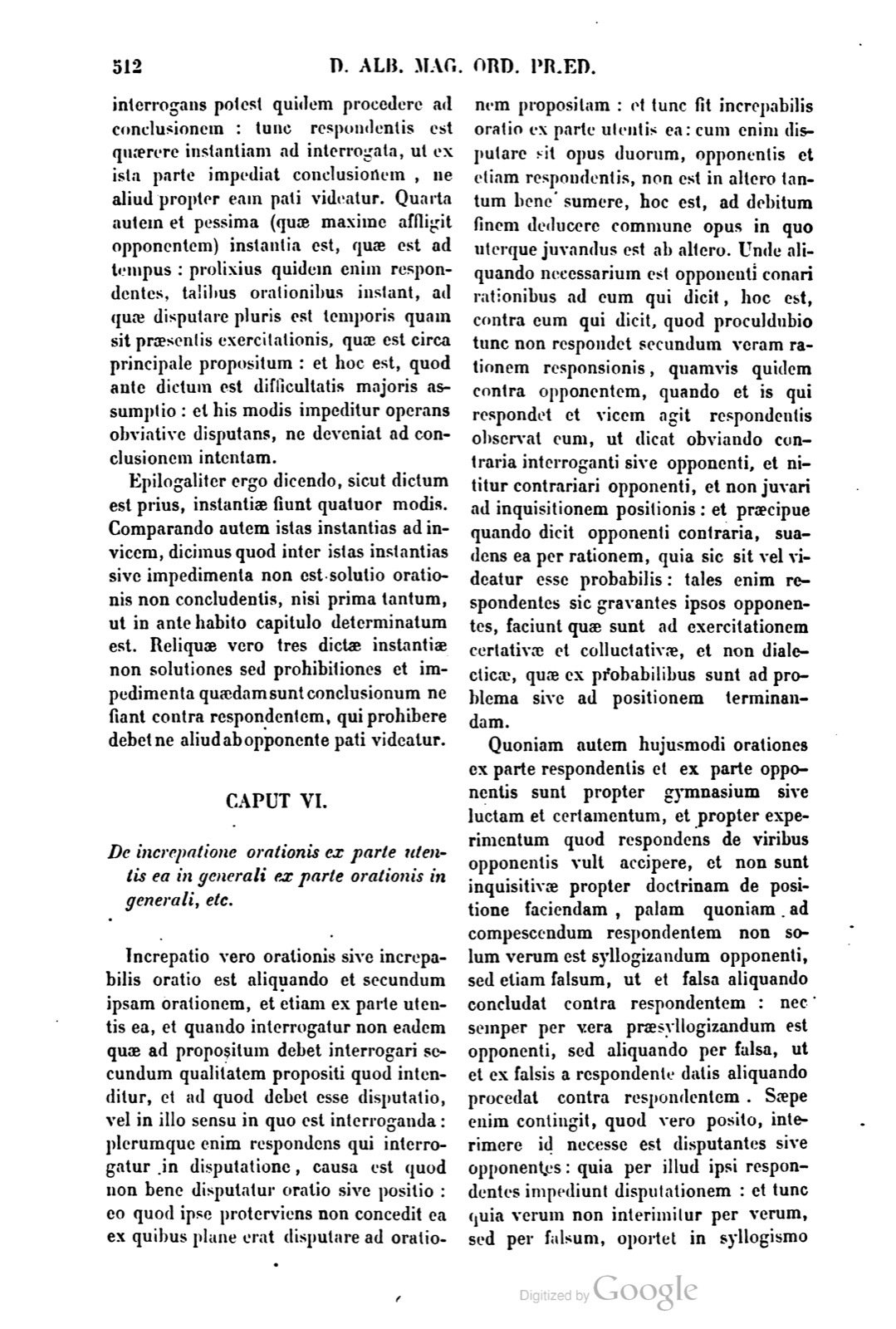
Increpatio vero orationis sive increpabilis oratio est aliquando et secundum ipsam orationem, et etiam ex parte utentis ea, et quando interrogatur non eadem quae ad propositum debet interrogari secundum qualitatem propositi quod intenditur, et ad quod debet esse disputatio, vel in illo sensu in quo est interroganda: plerumque enim respondens qui interrogatur in disputatione, causa est quod non bene disputatur oratio sive positio: eo quod ipse proterviens non concedit ea ex quibus plane erat disputare ad orationem propositam: et tunc fit increpabilis oratio ex parte utentis ea: cum enim disputare sit opus duorum, opponentis et etiam respondentis, non est in altero tantum bene sumere, hoc est, ad debitum finem deducere commune opus in quo uterque juvandus est ab altero. Unde aliquando necessarium est opponenti conari rationibus ad eum qui dicit, hoc est, contra eum qui dicit, quod proculdubio tunc non respondet secundum veram rationem responsionis, quamvis quidem contra opponentem, quando et is qui respondet et vicem agit respondentis observat cum, ut dicat obviando contraria interroganti sive opponenti, et nititur contrariari opponenti, et non juvari ad inquisitionem positionis: et praecipue quando dicit opponenti contraria, suadens ea per rationem, quia sic sit vel videatur esse probabilis: tales enim respondentes sic gravantes ipsos opponentes, faciunt quae sunt ad exercitationem certative et colluctative, et non dialecticae, quae ex probabilibus sunt ad problema sive ad positionem terminandam.
Quoniam autem hujusmodi orationes ex parte respondentis et ex parte opponentis sunt propter gymnasium sive luctam et certamentum, et propter experimentum quod respondens de viribus opponentis vult accipere, et non sunt inquisitivae propter doctrinam de positione faciendam, palam quoniam ad compescendum respondentem non solum verum est syllogizandum opponenti, sed etiam falsum, ut et falsa aliquando concludat contra respondentem: nec semper per vera praesyllogizandum est opponenti, sed aliquando per falsa, ut et ex falsis a respondente datis aliquando procedat contra respondentem. Saepe enim contingit, quod vero posito, interimere id necesse est disputantes sive opponentes: quia per illud ipsi respondentes impediunt disputationem: et tunc quia verum non interimitur per verum, sed per falsum, oportet in syllogismo protendere et proponere falsa.1 Quoniam et falso posito, non potest hoc interimi, nisi per falsa deducendo ad inconveniens, oportet etiam tunc protendere falsa: nihil enim prohibet in probabilibus alicui respondentium aliquando videri ea quae non sunt (hoc est, quae falsa sunt) magis quam videantur ea quae sunt vera. Sicut quod sol sit monopedalis, magis alicui videtur, quam quod sit major habitatione: propter quod argumentatione facta ex falsis, quae illi responderi videntur, magis erit suasus ut compescatur quam sit adjutus.
Therefore, by way of recapitulation, as was said before, instances are made in four ways. But by comparing these instances with one another, we say that among these instances or impediments there is no solution of a speech not concluding, except only the first, as was determined in the preceding chapter. But the remaining three stated instances are not solutions, but certain prohibitions and impediments of conclusions, lest they be made against the respondent, who ought to prohibit lest he seem to suffer something else from the opponent.
CHAPTER VI.
On rebuke of a speech from the side of the one using it, in general, and from the side of the speech in general, and so on.
But rebuke of a speech, or a rebukable speech, is sometimes both according to the speech itself and also from the side of the one using it, and when the same things are not interrogated which ought to be interrogated toward the proposed thing according to the quality of the proposed thing which is intended and toward which the disputation ought to be, or in that sense in which it must be interrogated. For very often the respondent who is interrogated in disputation is the cause that the speech or position is not well disputed, because he, acting perversely, does not concede those things from which one could plainly dispute toward the proposed speech; and then the speech becomes rebukable from the side of the one using it. For since disputing is the work of two, of the opponent and also of the respondent, it does not belong to one alone to take well, that is, to lead to the due end, the common work in which each must be helped by the other. Whence sometimes it is necessary for the opponent to strive with reasons toward him who says, that is, against him who says, that without doubt he then does not respond according to the true account of response, although indeed against the opponent, when both he who responds and performs the office of respondent observes this, so that by obviating he may say contrary things to the questioner or opponent, and strives to oppose the opponent and not to be helped toward the inquiry of the position; and especially when he says contrary things to the opponent, persuading them by reason because thus it is or seems to be probable. For such respondents, weighing down the opponents themselves in this way, do the things which belong to exercise contesting and wrestling, and not to dialectic, which proceeds from probable things for determining a problem or position.
But since speeches of this sort on the side of the respondent and on the side of the opponent are for training or wrestling and contest, and for the experiment which the respondent wishes to receive concerning the powers of the opponent, and are not inquisitive for making doctrine concerning the position, it is plain that for restraining the respondent the opponent must syllogize not only the true but also the false, so that he may sometimes conclude false things against the respondent; nor must the opponent always pre-syllogize through true things, but sometimes through false things, so that sometimes he may proceed against the respondent from false things given by the respondent. For often it happens that, when a true thing has been posited, the disputants or opponents must take it away, because through it the respondents themselves impede the disputation; and then, because the true is not taken away by the true but by the false, in the syllogism false things must be extended and proposed.1 Since also when a false thing has been posited, this cannot be taken away except by leading through false things to an unsuitable result, then also false things must be extended: for nothing prevents those things which are not, that is, which are false, from sometimes seeming to some of the respondents in probable matters more than the things which are true seem. For example, that the sun is one foot across seems more to someone than that it is larger than a dwelling; on account of which, when an argumentation has been made from false things which seem to be answered to him, he will be more persuaded so that he is restrained than helped.
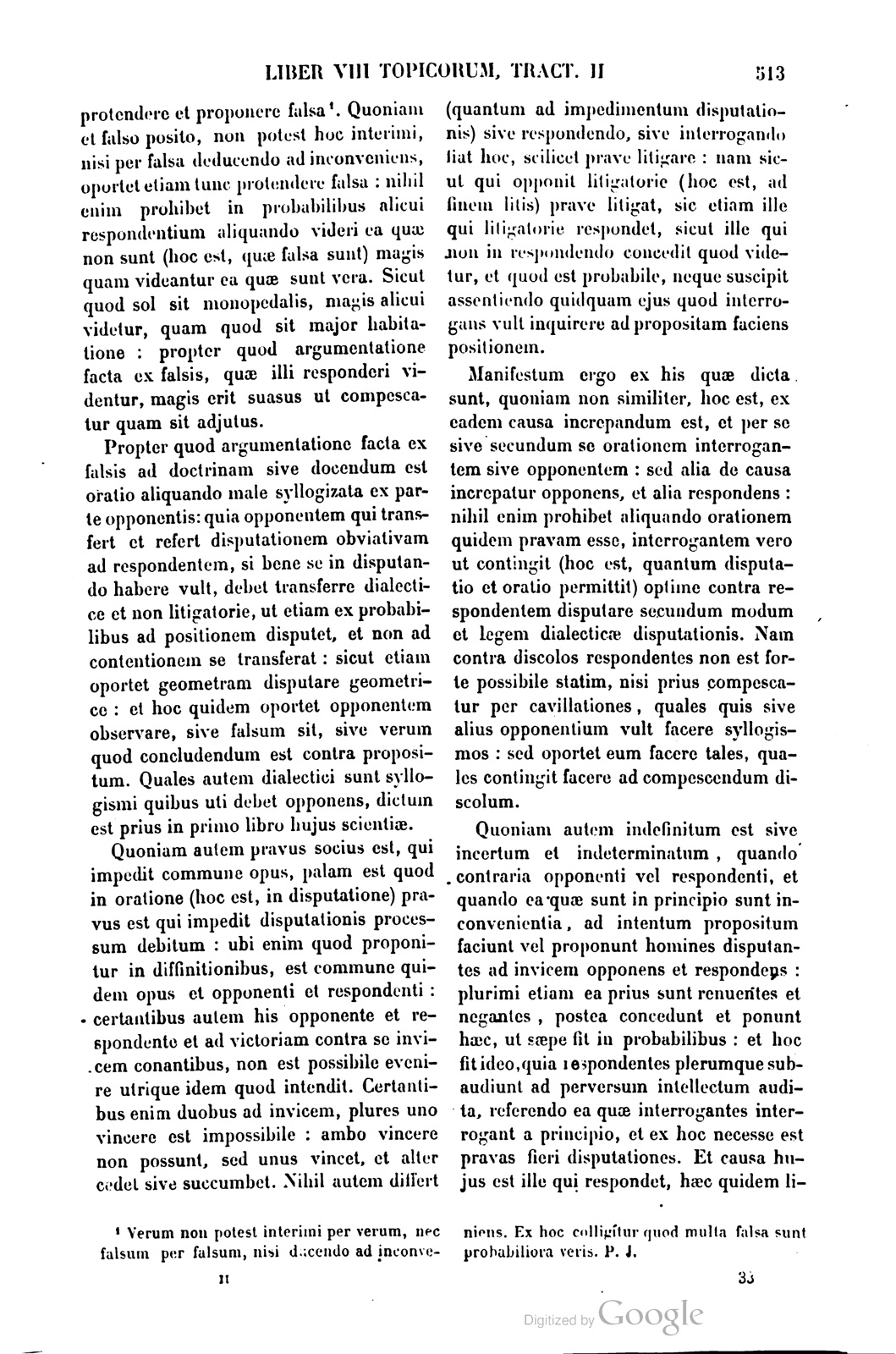
Propter quod argumentatione facta ex falsis ad doctrinam sive docendum est oratio aliquando male syllogizata ex parte opponentis: quia opponentem qui transfert et refert disputationem obviativam ad respondentem, si bene se in disputando habere vult, debet transferre dialectice et non litigatorie, ut etiam ex probabilibus ad positionem disputet, et non ad contentionem se transferat: sicut etiam oportet geometram disputare geometrice: et hoc quidem oportet opponentem observare, sive falsum sit, sive verum quod concludendum est contra propositum. Quales autem dialectici sunt syllogismi quibus uti debet opponens, dictum est prius in primo libro hujus scientiae.
Quoniam autem pravus socius est, qui impedit commune opus, palam est quod in oratione (hoc est, in disputatione) pravus est qui impedit disputationis processum debitum: ubi enim quod proponitur in diffinitionibus, est commune quidem opus et opponenti et respondenti: certantibus autem his opponente et respondente et ad victoriam contra se invicem conantibus, non est possibile evenire utrique idem quod intendit. Certantibus enim duobus ad invicem, plures uno vincere est impossibile: ambo vincere non possunt, sed unus vincet, et alter cedet sive succumbet. Nihil autem differt (quantum ad impedimentum disputationis) sive respondendo, sive interrogando fiat hoc, scilicet prave litigare: nam sicut qui opponit litigatorie (hoc est, ad finem litis) prave litigat, sic etiam ille qui litigatorie respondet, sicut ille qui non in respondendo concedit quod videtur, et quod est probabile, neque suscipit assentiendo quidquam ejus quod interrogans vult inquirere ad propositam faciens positionem.
Manifestum ergo ex his quae dicta sunt, quoniam non similiter, hoc est, ex eadem causa increpandum est, et per se sive secundum se orationem interrogantem sive opponentem: sed alia de causa increpatur opponens, et alia respondens: nihil enim prohibet aliquando orationem quidem pravam esse, interrogantem vero ut contingit (hoc est, quantum disputatio et oratio permittit) optime contra respondentem disputare secundum modum et legem dialecticae disputationis. Nam contra discolos respondentes non est forte possibile statim, nisi prius compescatur per cavillationes, quales quis sive alius opponentium vult facere syllogismos: sed oportet eum facere tales, quales contingit facere ad compescendum discolum.
On account of this, when argumentation has been made from false things for doctrine or teaching, the speech is sometimes badly syllogized from the side of the opponent, because the opponent who transfers and refers obviative disputation to the respondent, if he wishes to conduct himself well in disputing, ought to transfer dialectically and not contentiously, so that he also disputes from probable things toward the position, and does not transfer himself to contention; just as the geometer also ought to dispute geometrically. And this the opponent indeed ought to observe, whether what is to be concluded against the proposed thing is false or true. But what sort of dialectical syllogisms the opponent ought to use was said before in the first book of this science.
But since he is a bad companion who impedes the common work, it is plain that in a speech, that is, in disputation, he is bad who impedes the due progress of disputation. For where what is proposed in definitions is a common work both to the opponent and to the respondent, but with these, the opponent and respondent, contending and striving against each other for victory, it is not possible for the same thing which each intends to happen to both. For when two contend against each other, it is impossible for more than one to win: both cannot win, but one will win, and the other will yield or succumb. But it makes no difference, with respect to the impediment of disputation, whether this, namely to litigate badly, is done by responding or by interrogating. For just as one who opposes litigiously, that is, for the end of strife, litigates badly, so also does he who responds litigiously, as the one who in responding does not concede what seems so and what is probable, nor by assenting receives anything of that which the questioner, making the proposed position, wishes to inquire into.
Therefore from these things which have been said it is manifest that not similarly, that is, not from the same cause, must both the speech in itself or according to itself, and the questioner or opponent, be rebuked; rather the opponent is rebuked for one cause, and the respondent for another. For nothing prevents the speech indeed from sometimes being bad, while the questioner, as it happens, that is, insofar as the disputation and speech permit, disputes very well against the respondent according to the mode and law of dialectical disputation. For against difficult respondents perhaps it is not possible immediately unless he is first restrained through cavillations, such as someone or another of the opponents wishes to make syllogisms; but he must make such as it happens to make for restraining the difficult one.
Notes
- The true cannot be taken away by the true, nor the false by the false, except by leading to an unsuitable result. From this it is gathered that many false things are more probable than true things. P. J. (Verum non potest interimi per verum, nec falsum per falsum, nisi ducendo ad inconveniens. Ex hoc colligitur quod multa falsa sunt probabiliora veris. P. J.) ↩
If a page does not appear, its photograph has not been uploaded yet.