Volume 2 · pp. 508–510
Book VIII of the Topics, Treatise II, Chapters III-IV.
A marker with ≈ is an approximate page boundary, placed by measure of the text; the page photographs remain the authority. In the paired views, clicking a page marker brings that page into view.
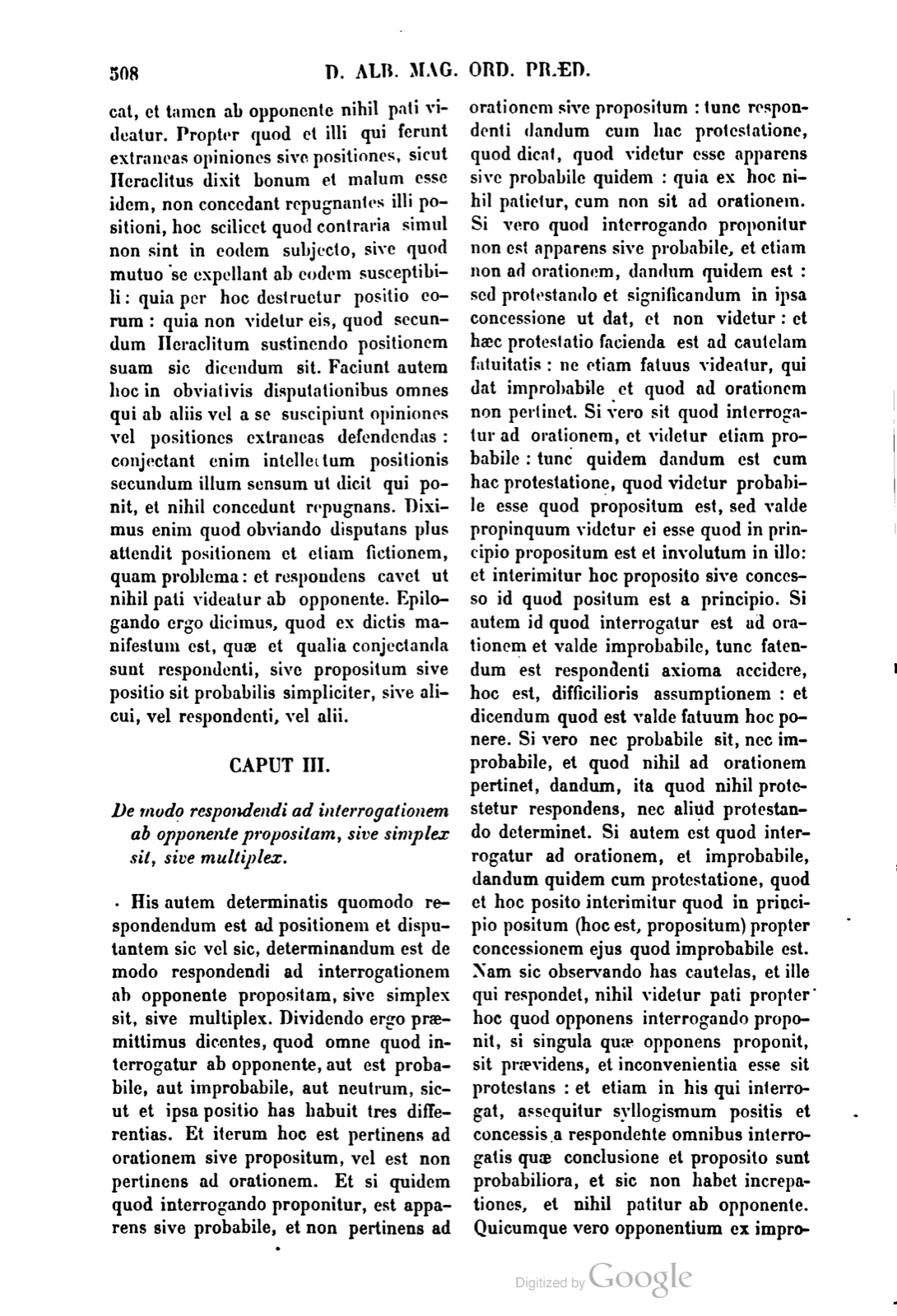
CAPUT III.
De modo respondendi ad interrogationem ab opponente propositam, sive simplex sit, sive multiplex.
His autem determinatis quomodo respondendum est ad positionem et disputantem sic vel sic, determinandum est de modo respondendi ad interrogationem ab opponente propositam, sive simplex sit, sive multiplex. Dividendo ergo praemittimus dicentes, quod omne quod interrogatur ab opponente, aut est probabile, aut improbabile, aut neutrum, sicut et ipsa positio has habuit tres differentias. Et iterum hoc est pertinens ad orationem sive propositum, vel est non pertinens ad orationem. Et si quidem quod interrogando proponitur, est apparens sive probabile, et non pertinens ad orationem sive propositum: tunc respondenti dandum cum hac protestatione, quod dicat, quod videtur esse apparens sive probabile quidem: quia ex hoc nihil patietur, cum non sit ad orationem. Si vero quod interrogando proponitur non est apparens sive probabile, et etiam non ad orationem, dandum quidem est: sed protestando et significandum in ipsa concessione ut dat, et non videtur: et haec protestatio facienda est ad cautelam fatuitatis: ne etiam fatuus videatur, qui dat improbabile et quod ad orationem non pertinet. Si vero sit quod interrogatur ad orationem, et videtur etiam probabile: tunc quidem dandum est cum hac protestatione, quod videtur probabile esse quod propositum est, sed valde propinquum videtur ei esse quod in principio propositum est et involutum in illo: et interimitur hoc proposito sive concesso id quod positum est a principio. Si autem id quod interrogatur est ad orationem et valde improbabile, tunc fatendum est respondenti axioma accidere, hoc est, difficilioris assumptionem: et dicendum quod est valde fatuum hoc ponere. Si vero nec probabile sit, nec improbabile, et quod nihil ad orationem pertinet, dandum, ita quod nihil protestetur respondens, nec aliud protestando determinet. Si autem est quod interrogatur ad orationem, et improbabile, dandum quidem cum protestatione, quod et hoc posito interimitur quod in principio positum (hoc est, propositum) propter concessionem ejus quod improbabile est. Nam sic observando has cautelas, et ille qui respondet, nihil videtur pati propter hoc quod opponens interrogando proponit, si singula quae opponens proponit, sit praevidens, et inconvenientia esse sit protestans: et etiam in his qui interrogat, assequitur syllogismum positis et concessis a respondente omnibus interrogatis quae conclusione et proposito sunt probabiliora, et sic non habet increpationes, et nihil patitur ab opponente. Quicumque vero opponentium ex improbabilibus quam conclusio, sic conantur syllogizare, palam est quoniam non bene syllogizant, et propter hoc sic et talia interrogantibus sive proponentibus non est concedendum a respondente quod interrogant.
Similiter autem respondendo cautelae observandae sunt in his quae obscure (hoc est, multipliciter) dicta interrogantur: his obviativa disputatione a respondente obviandum est caute, ut nihil pati videatur. Quoniam autem in talibus concessum est respondenti, quod non intelligitur obscurum et multiplex, dicere a principio ad opponentem, quod non intelligit id quod proponit: et iterum conceditur respondenti aliquo propositorum multipliciter, quod non est necessarium, quod ipse illud vel simpliciter confiteatur vel simpliciter neget. Palam ergo quod nisi primum propositum planum sit et simplex, non est pigritandum dicere respondenti se non intelligere: et hoc ideo faciendum est, quia saepe obviat difficile aliquid respondentibus, ex hoc quod dant et concedunt ea simpliciter quae non sunt vera, cum proponuntur ab interrogantibus. Si autem a principio notum quidem sit respondenti, quod interrogatum multipliciter dicitur, considerandum si ipsum multiplex in omnibus quidem sensibus verum vel falsum sit: tunc simpliciter dandum, vel simpliciter negandum ac si simplex sit.1 Si vero in aliquo sensu quidem sit falsum, et in aliquo verum, significandum est et protestandum a respondente, quoniam hoc multipliciter dicitur, et propter aliud quidem (hoc est, in uno sensu) est falsum, et aliud, hoc est, in alio sensu, est verum. Et hoc debet facere in principio antequam opponens procedat ad conclusionem. Si enim posterius jam facta conclusione dividat ipsum multiplex, incertum est utrum ipse respondens hoc dubium quod est in multiplici, a principio perspexerit: et sic minorabitur coram opponente. Si autem respondens non praeviderit dubium quod est ex multiplici, et concesserit ipsum, et postea viderit quod multiplex est, obviando dicere debet opponenti, quoniam non dedi sive concessi interrogatum ad hoc (hoc est, ad hunc sensum) inspiciens in quo tu concludis: sed concessi illud ad alterum eorum sensuum quos habet in se multiplex: nam pluribus existentibus sensibus quae sub eodem aequivoco nomine vel sub eadem oratione amphibologica, facilis est dubitatio. Si vero planum sit et simplex quod interrogando proponitur, respondendum est plane, aut sic, aut non, concedendo simpliciter, aut negando simpliciter.
CHAPTER III.
On the mode of responding to an interrogation proposed by the opponent, whether it is simple or multiple.
But once these things have been determined, namely how one must respond to a position and to one disputing in this or that way, it must be determined concerning the mode of responding to an interrogation proposed by the opponent, whether it is simple or multiple. Therefore by dividing we premise, saying that everything which is interrogated by the opponent is either probable, or improbable, or neutral, just as the position itself had these three differences. And again, this is pertinent to the speech or proposed thing, or it is not pertinent to the speech. And if indeed what is proposed by interrogating is apparent or probable, and is not pertinent to the speech or proposed thing, then it must be given by the respondent with this protestation, that he say that it indeed seems to be apparent or probable, because from this he will suffer nothing, since it is not toward the speech. But if what is proposed by interrogating is not apparent or probable, and also is not toward the speech, it must indeed be given, but with protestation, and it must be signified in the very concession that he gives it, and it does not seem so; and this protestation must be made as a precaution against foolishness, lest he also seem foolish who gives what is improbable and what does not pertain to the speech. But if what is interrogated is toward the speech, and also seems probable, then indeed it must be given with this protestation, that what has been proposed seems to be probable, but seems to be very near to that which was proposed in the beginning and wrapped up in it; and when this has been proposed or conceded, that which was posited in the beginning is taken away. But if that which is interrogated is toward the speech and very improbable, then the respondent must confess that an axiom occurs, that is, the assumption of the more difficult; and it must be said that to posit this is very foolish. But if it is neither probable nor improbable, and what pertains in no way to the speech, it must be given, so that the respondent protests nothing, nor determines anything else by protesting. But if what is interrogated is toward the speech and improbable, it must indeed be given with protestation that, when this also has been posited, what was posited in the beginning, that is, proposed, is destroyed on account of the concession of that which is improbable. For by observing these precautions in this way, both the one who responds seems to suffer nothing because of this which the opponent proposes by interrogating, if he foresees each thing which the opponent proposes and protests that they are unsuitable; and also in the case of him who interrogates, he obtains a syllogism when all the interrogated things which are more probable than the conclusion and the proposed thing have been posited and conceded by the respondent, and thus he does not have rebukes and suffers nothing from the opponent. But whichever opponents in this way try to syllogize from things more improbable than the conclusion, it is plain that they do not syllogize well; and on account of this, to those interrogating or proposing thus and such things, what they interrogate must not be conceded by the respondent.
Likewise, in responding, precautions must be observed in those things which are interrogated obscurely, that is, multiply: against these, in obviative disputation, the respondent must obviate carefully, so that he seems to suffer nothing. But since in such cases it is granted to the respondent, when what is obscure and multiple is not understood, to say to the opponent from the beginning that he does not understand what he proposes; and again it is conceded to the respondent, when some one of the proposed things is multiple, that it is not necessary that he himself either simply confess it or simply deny it. Therefore it is plain that unless the first proposed thing is plain and simple, the respondent must not be slow to say that he does not understand; and this must be done because often something difficult meets respondents from this, that they give and concede simply things which are not true, when they are proposed by questioners. But if from the beginning it is known to the respondent that the thing interrogated is said in many ways, one must consider whether the multiple itself is true or false in all senses: then it must be simply given or simply denied as if it were simple.1 But if in one sense indeed it is false and in another true, it must be signified and protested by the respondent that this is said in many ways, and on account of one thing, that is, in one sense, it is false, and in another, that is, in another sense, it is true. And he must do this at the beginning before the opponent proceeds to the conclusion. For if later, when the conclusion has already been made, he divides the multiple itself, it is uncertain whether the respondent himself perceived from the beginning this doubt which is in the multiple; and thus he will be lessened before the opponent. But if the respondent did not foresee the doubt which is from the multiple, and conceded it, and afterwards sees that it is multiple, in obviating he must say to the opponent: I did not give or concede the thing interrogated looking to this, that is, to this sense, in which you conclude, but I conceded it according to the other of those senses which the multiple has in itself. For with several senses existing under the same equivocal name or under the same amphibological speech, doubt is easy. But if what is proposed by interrogating is plain and simple, one must respond plainly, either thus or not, by conceding simply or denying simply.
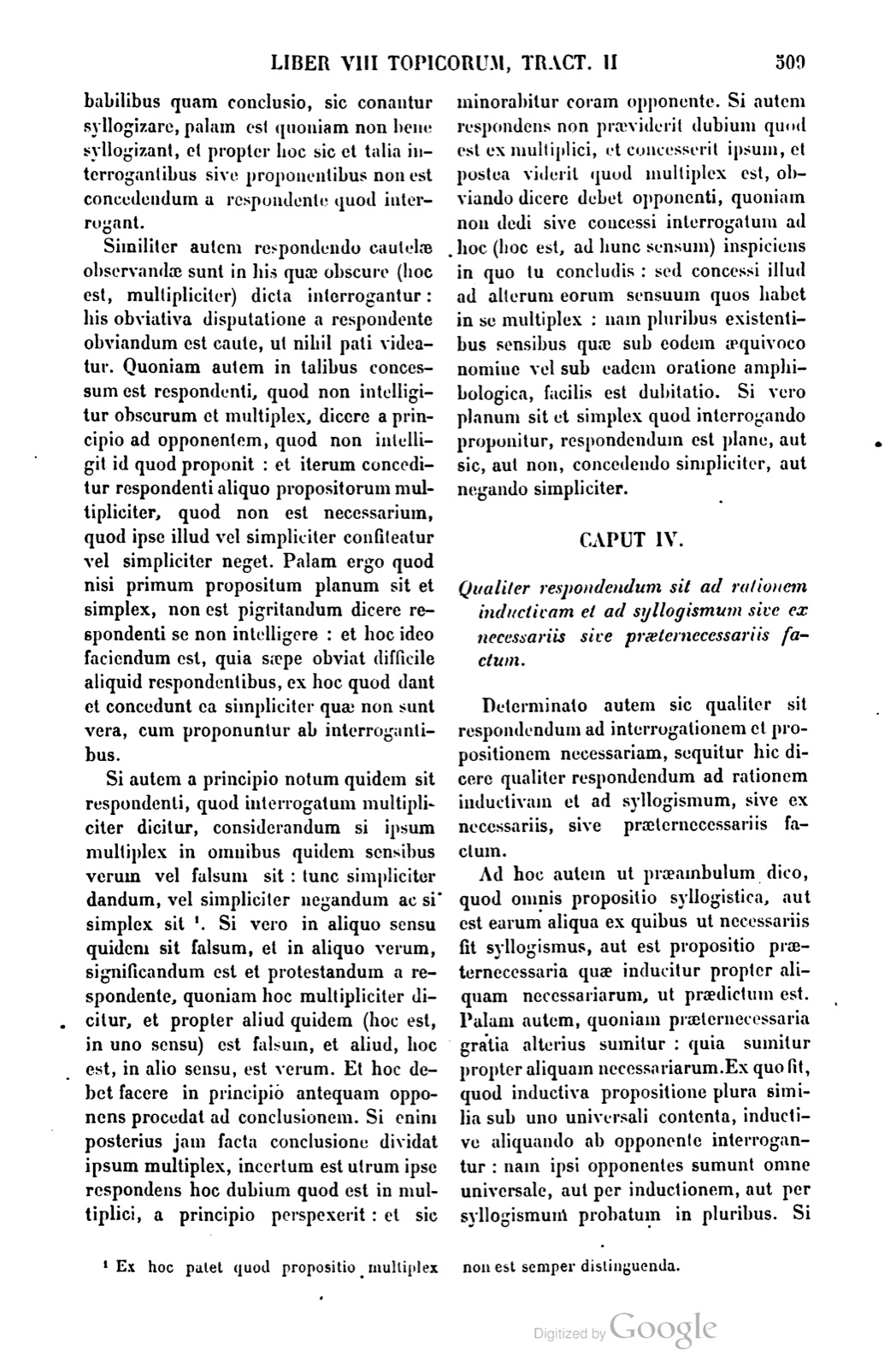
CAPUT IV.
Qualiter respondendum sit ad rationem inductivam et ad syllogismum sive ex necessariis sive praeternecessariis factum.
Determinato autem sic qualiter sit respondendum ad interrogationem et propositionem necessariam, sequitur hic dicere qualiter respondendum ad rationem inductivam et ad syllogismum, sive ex necessariis, sive praeternecessariis factum.
Ad hoc autem ut praeambulum dico, quod omnis propositio syllogistica, aut est earum aliqua ex quibus ut necessariis fit syllogismus, aut est propositio praeternecessaria quae inducitur propter aliquam necessariarum, ut praedictum est. Palam autem, quoniam praeternecessaria gratia alterius sumitur: quia sumitur propter aliquam necessariarum. Ex quo fit, quod inductiva propositione plura similia sub uno universali contenta, inductive aliquando ab opponente interrogantur: nam ipsi opponentes sumunt omne universale, aut per inductionem, aut per syllogismum probatum in pluribus. Si ergo inductione sumere velit universale, omnia singularia ponenda sunt et concedenda a respondente, dummodo sint vera et probabilia: ad universale autem sive contra universale tendandum est instantiam ferre per aliquod singulare non prius inductum ab opponente, et inducta prius ab opponente concessit respondens: et si per aliquod illorum instantiam ferret, sibi contradicere videretur. Nam sine instantia, vel quae sit, vel quae videatur prohibere orationem, cavendum est a respondente ne protervire videatur. Patet ergo quod quando in multis singularibus apparuit sic esse ut dicitur, et non dederit sive concesserit respondens universale, cum non habeat instantiam quam proferre possit, tunc manifestum est quod protervit.
CHAPTER IV.
In what way one must respond to an inductive reasoning and to a syllogism made either from necessary or from preter-necessary things.
But once it has thus been determined how one must respond to an interrogation and a necessary proposition, it follows here to say how one must respond to inductive reasoning and to a syllogism, whether made from necessary things or from preter-necessary things.
But for this, as a preamble, I say that every syllogistic proposition is either one of those from which, as necessary things, a syllogism is made, or it is a preter-necessary proposition which is introduced on account of some one of the necessary propositions, as has been said before. But it is plain that a preter-necessary proposition is taken for the sake of another, because it is taken on account of some necessary proposition. From this it happens that, with an inductive proposition, several similar things contained under one universal are sometimes interrogated inductively by the opponent: for opponents themselves take every universal either through induction or through syllogism proved in many cases. Therefore if he wishes to take the universal by induction, all the singulars must be posited and conceded by the respondent, provided that they are true and probable; but toward the universal or against the universal one must strive to bring an instance through some singular not previously introduced by the opponent, since the respondent has conceded the things previously introduced by the opponent; and if he brought an instance through any of those, he would seem to contradict himself. For without an instance, whether one which is or one which seems to prohibit the speech, the respondent must beware lest he seem perverse. Therefore it is clear that when it has appeared in many singulars to be so as is said, and the respondent has not given or conceded the universal, although he does not have an instance which he can bring forward, then it is manifest that he acts perversely.
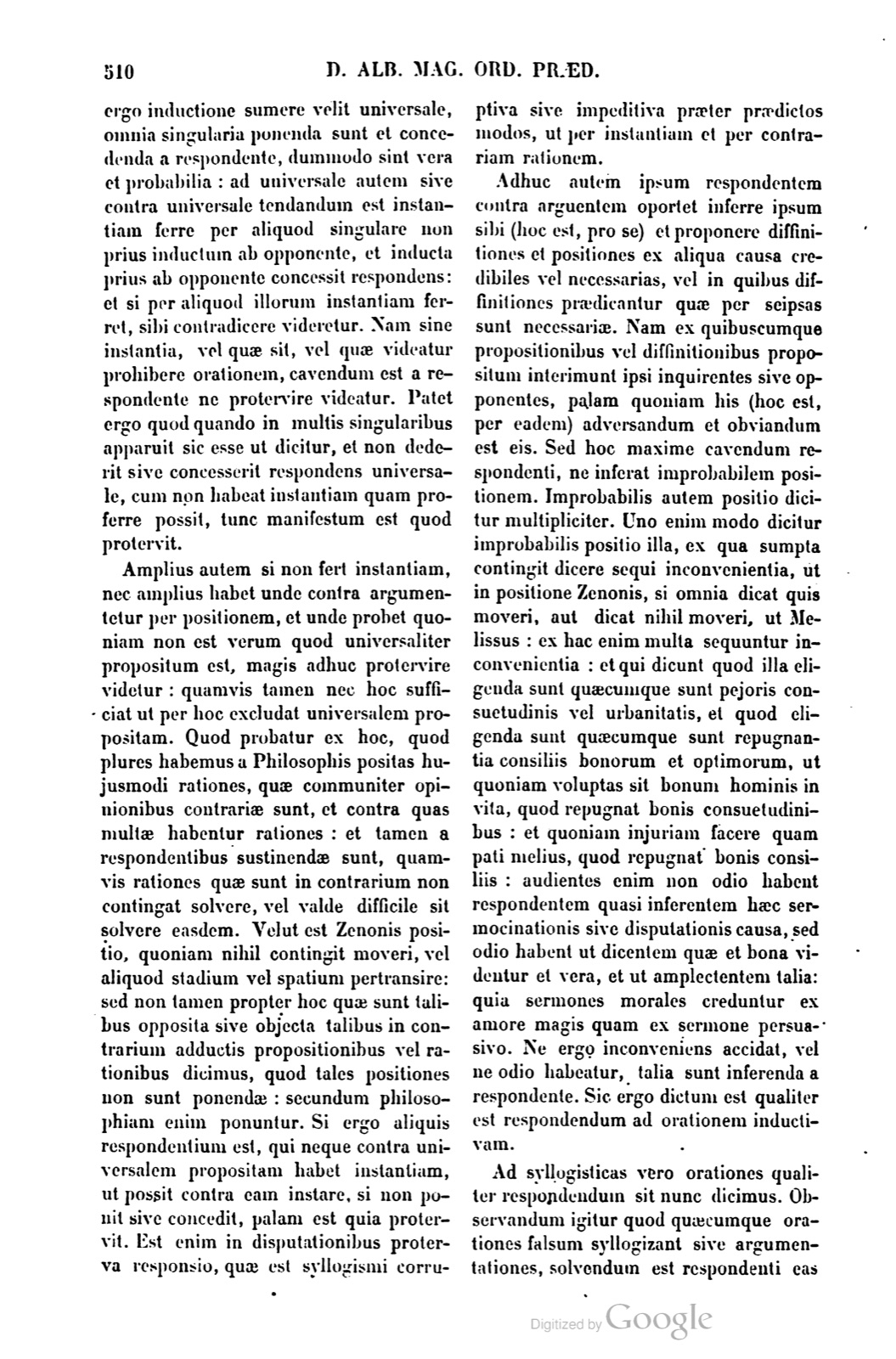
Amplius autem si non fert instantiam, nec amplius habet unde contra argumentetur per positionem, et unde probet quoniam non est verum quod universaliter propositum est, magis adhuc protervire videtur: quamvis tamen nec hoc sufficiat ut per hoc excludat universalem propositam. Quod probatur ex hoc, quod plures habemus a Philosophis positas hujusmodi rationes, quae communiter opinionibus contrariae sunt, et contra quas multae habentur rationes: et tamen a respondentibus sustinendae sunt, quamvis rationes quae sunt in contrarium non contingat solvere, vel valde difficile sit solvere easdem. Velut est Zenonis positio, quoniam nihil contingit moveri, vel aliquod stadium vel spatium pertransire: sed non tamen propter hoc quae sunt talibus opposita sive objecta talibus in contrarium adductis propositionibus vel rationibus dicimus, quod tales positiones non sunt ponendae: secundum philosophiam enim ponuntur. Si ergo aliquis respondentium est, qui neque contra universalem propositam habet instantiam, ut possit contra eam instare, si non ponit sive concedit, palam est quia protervit. Est enim in disputationibus proterva responsio, quae est syllogismi corruptiva sive impeditiva praeter praedictos modos, ut per instantiam et per contrariam rationem.
Adhuc autem ipsum respondentem contra arguentem oportet inferre ipsum sibi (hoc est, pro se) et proponere diffinitiones et positiones ex aliqua causa credibiles vel necessarias, vel in quibus diffinitiones praedicantur quae per seipsas sunt necessariae. Nam ex quibuscumque propositionibus vel diffinitionibus propositum interimunt ipsi inquirentes sive opponentes, palam quoniam his (hoc est, per eadem) adversandum et obviandum est eis. Sed hoc maxime cavendum respondenti, ne inferat improbabilem positionem. Improbabilis autem positio dicitur multipliciter. Uno enim modo dicitur improbabilis positio illa, ex qua sumpta contingit dicere sequi inconvenientia, ut in positione Zenonis, si omnia dicat quis moveri, aut dicat nihil moveri, ut Melissus: ex hac enim multa sequuntur inconvenientia: et qui dicunt quod illa eligenda sunt quaecumque sunt pejoris consuetudinis vel urbanitatis, et quod eligenda sunt quaecumque sunt repugnantia consiliis bonorum et optimorum, ut quoniam voluptas sit bonum hominis in vita, quod repugnat bonis consuetudinibus: et quoniam injuriam facere quam pati melius, quod repugnat bonis consiliis: audientes enim non odio habent respondentem quasi inferentem haec sermocinationis sive disputationis causa, sed odio habent ut dicentem quae et bona videntur et vera, et ut amplectentem talia: quia sermones morales creduntur ex amore magis quam ex sermone persuasivo. Ne ergo inconveniens accidat, vel ne odio habeatur, talia sunt inferenda a respondente. Sic ergo dictum est qualiter est respondendum ad orationem inductivam.
Ad syllogisticas vero orationes qualiter respondendum sit nunc dicimus. Observandum igitur quod quaecumque orationes falsum syllogizant sive argumentationes, solvendum est respondenti eas
Further, if he does not bring an instance, nor further has whence he may argue against it through the position, and whence he may prove that what has been proposed universally is not true, he seems still more perverse; although nevertheless not even this suffices so that through this he may exclude the proposed universal. This is proved from this, that we have many arguments of this sort posited by the Philosophers, which are commonly contrary to opinions, and against which many arguments are had; and yet they must be sustained by respondents, although it does not happen to solve the arguments which are to the contrary, or it is very difficult to solve the same. Such is the position of Zeno, that nothing happens to be moved, or to pass across some stadium or space; but nevertheless on account of this we do not say that those things which are opposed to such positions, or objected against such things by propositions or arguments brought to the contrary, are positions which must not be posited: for they are posited according to philosophy. Therefore if some respondent is one who neither has an instance against the proposed universal, so that he can make an instance against it, if he does not posit or concede, it is plain that he acts perversely. For in disputations a perverse response is one which is corruptive or impeditive of the syllogism beyond the aforesaid modes, as through instance and through contrary reasoning.
Furthermore, against the one arguing the respondent himself must infer it to himself, that is, for himself, and propose definitions and positions credible or necessary from some cause, or in which definitions are predicated which are necessary through themselves. For from whatever propositions or definitions the inquirers or opponents themselves take away the proposed thing, it is plain that by these, that is, through the same things, one must resist and obviate them. But this must especially be guarded against by the respondent, lest he introduce an improbable position. Now an improbable position is said in many ways. For in one way that is called an improbable position from which, once it is taken, it happens to say that unsuitable things follow, as in Zeno's position if someone says that all things are moved, or says that nothing is moved, as Melissus says: for from this many unsuitable things follow. And those who say that whatever things belong to worse custom or urbanity are to be chosen, and that whatever things are repugnant to the counsels of good and best people are to be chosen, as that pleasure is the good of man in life, which is repugnant to good customs, and that doing injury is better than suffering it, which is repugnant to good counsels: for hearers do not hate the respondent as one introducing these things for the sake of discourse or disputation, but they hate him as one saying things which also seem good and true, and as one embracing such things; because moral speeches are believed from love more than from persuasive speech. Therefore lest an unsuitable thing happen, or lest he be hated, such things must be introduced by the respondent. Thus therefore it has been said how one must respond to inductive speech.
But how one must respond to syllogistic speeches we now say. Therefore it must be observed that whatever speeches or argumentations syllogize the false, the respondent must solve them
Notes
- From this it is clear that a multiple proposition is not always to be distinguished. (Ex hoc patet quod propositio multiplex non est semper distinguenda.) ↩
If a page does not appear, its photograph has not been uploaded yet.