Volume 2 · pp. 502–504
Book VIII of the Topics, Treatise I, Chapter VI.
A marker with ≈ is an approximate page boundary, placed by measure of the text; the page photographs remain the authority. In the paired views, clicking a page marker brings that page into view.
CAPUT VI.
Qualiter probentur orationes per priora et posteriora, et qualiter oportet opponentem et interrogare et ordinare ea quae interrogat.
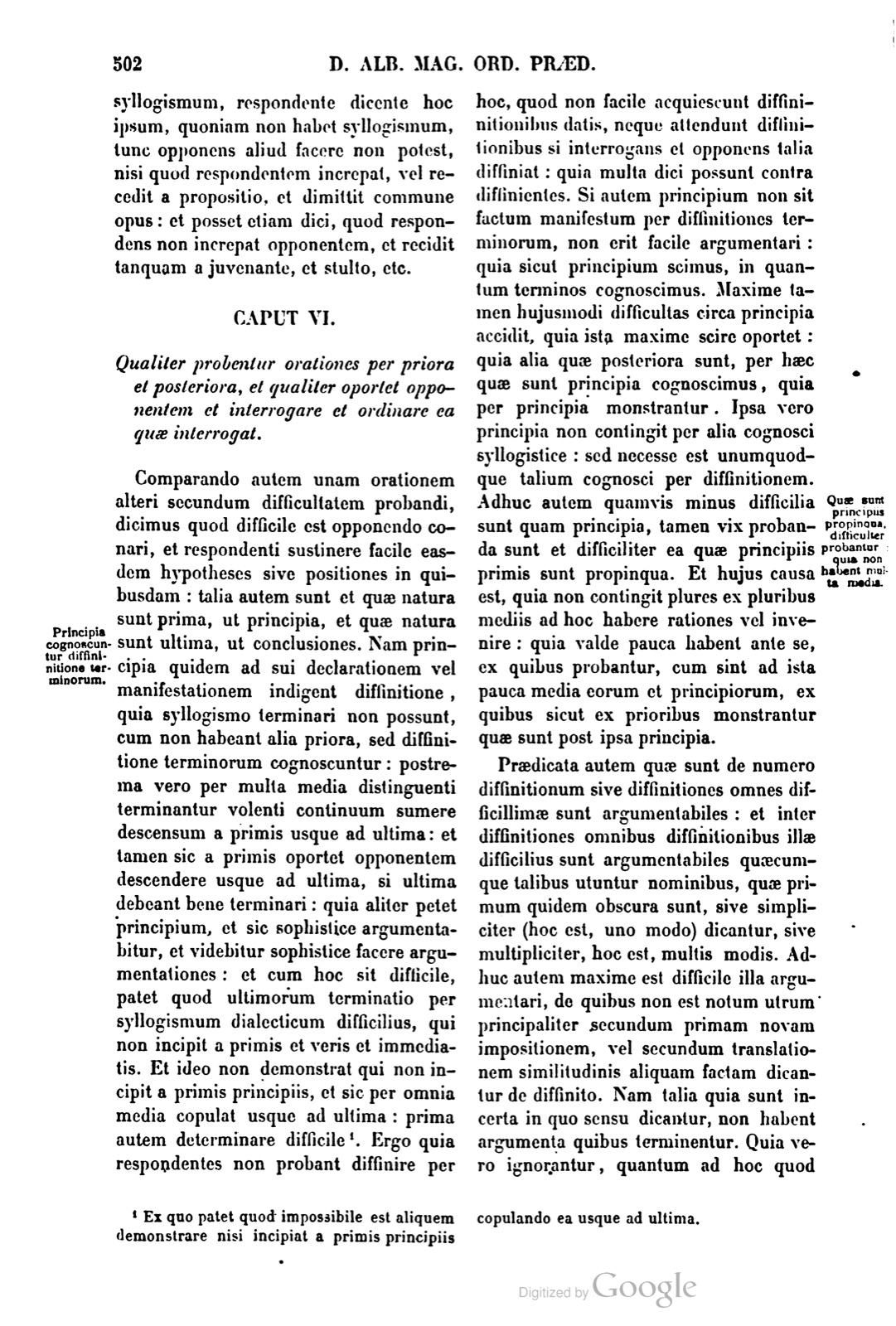
Comparando autem unam orationem alteri secundum difficultatem probandi, dicimus quod difficile est opponendo conari, et respondenti sustinere facile easdem hypotheses sive positiones in quibusdam: talia autem sunt et quae natura sunt prima, ut principia, et quae natura sunt ultima, ut conclusiones. Nam principia quidem ad sui declarationem vel manifestationem indigent diffinitione, quia syllogismo terminari non possunt, cum non habeant alia priora, sed diffinitione terminorum cognoscuntur: postrema vero per multa media distinguenti terminantur volenti continuum sumere descensum a primis usque ad ultima: et tamen sic a primis oportet opponentem descendere usque ad ultima, si ultima debeant bene terminari: quia aliter petet principium, et sic sophistice argumentabitur, et videbitur sophistice facere argumentationes: et cum hoc sit difficile, patet quod ultimorum terminatio per syllogismum dialecticum difficilius, qui non incipit a primis et veris et immediatis. Et ideo non demonstrat qui non incipit a primis principiis, et sic per omnia media copulat usque ad ultima: prima autem determinare difficile.1
Ergo quia respondentes non probant diffinire per hoc, quod non facile acquiescunt diffinitionibus datis, neque attendunt diffinitionibus si interrogans et opponens talia diffiniat: quia multa dici possunt contra diffinientes. Si autem principium non sit factum manifestum per diffinitiones terminorum, non erit facile argumentari: quia sicut principium scimus, in quantum terminos cognoscimus. Maxime tamen hujusmodi difficultas circa principia accidit, quia ista maxime scire oportet: quia alia quae posteriora sunt, per haec quae sunt principia cognoscimus, quia per principia monstrantur. Ipsa vero principia non contingit per alia cognosci syllogistice: sed necesse est unumquodque talium cognosci per diffinitionem.
Adhuc autem quamvis minus difficilia sunt quam principia, tamen vix probanda sunt et difficiliter ea quae principiis primis sunt propinqua. Et hujus causa est, quia non contingit plures ex pluribus mediis ad hoc habere rationes vel invenire: quia valde pauca habent ante se, ex quibus probantur, cum sint ad ista pauca media eorum et principiorum, ex quibus sicut ex prioribus monstrantur quae sunt post ipsa principia.
Praedicata autem quae sunt de numero diffinitionum sive diffinitiones omnes difficillimae sunt argumentabiles: et inter diffinitiones omnibus diffinitionibus illae difficilius sunt argumentabiles quaecumque talibus utuntur nominibus, quae primum quidem obscura sunt, sive simpliciter (hoc est, uno modo) dicantur, sive multipliciter, hoc est, multis modis. Adhuc autem maxime est difficile illa argumentari, de quibus non est notum utrum principaliter secundum primam novam impositionem, vel secundum translationem similitudinis aliquam factam dicantur de diffinito. Nam talia quia sunt incerta in quo sensu dicantur, non habent argumenta quibus terminentur. Quia vero ignorantur, quantum ad hoc quod ignorantur, si propter hoc talia sunt quod secundum translationem dicuntur, non habent increpationem.
CHAPTER VI.
In what way speeches are proved through prior and posterior things, and in what way the opponent ought both to interrogate and to order the things which he interrogates.
But by comparing one speech to another according to the difficulty of proving, we say that it is difficult by opposing to attempt, and easy for the respondent to sustain, the same hypotheses or positions in certain cases: and such are both those things which by nature are first, as principles, and those things which by nature are last, as conclusions. For principles indeed need definition for their own declaration or manifestation, because they cannot be terminated by syllogism, since they do not have other prior things, but are known by the definition of terms; but the last things are terminated through many middles for one distinguishing and wishing to take a continuous descent from the first things down to the last. And nevertheless the opponent must in this way descend from first things down to last things, if last things ought to be well terminated: because otherwise he will beg the principle, and thus will argue sophistically, and will seem sophistically to make argumentations. And since this is difficult, it is clear that the termination of last things through a dialectical syllogism is more difficult, one which does not begin from first and true and immediate things. And therefore he does not demonstrate who does not begin from first principles, and thus connect through all the middles down to the last things; but to determine first things is difficult.1
Therefore, because respondents do not approve defining through this, that they do not easily acquiesce in definitions given, nor attend to definitions if the questioner and opponent defines such things, because many things can be said against those defining. But if the principle has not been made manifest through definitions of terms, it will not be easy to argue, because we know the principle insofar as we know the terms. Yet this sort of difficulty occurs especially concerning principles, because those things must especially be known: because we know other things which are posterior through these which are principles, since they are shown through principles. But the principles themselves cannot be known syllogistically through other things: rather each one of such things must be known through definition.
Further, although those things which are near to first principles are less difficult than principles, nevertheless they are scarcely provable and are proved with difficulty. And the cause of this is that for this one cannot have or find several reasons from several middles, because they have very few things before them from which they are proved, since there are few middles of these things and of principles, from which, as from prior things, those things which are after the principles themselves are shown.
But the predicates which are of the number of definitions, or all definitions, are most difficult to argue about; and among definitions, more difficult to argue about than all definitions are whichever ones use such names as first are obscure, whether they are said simply, that is, in one way, or multiply, that is, in many ways. Further, it is especially difficult to argue about those concerning which it is not known whether they are said of the defined thing principally according to a first new imposition, or according to some transference of likeness that has been made. For such things, because they are uncertain in what sense they are said, do not have arguments by which they may be terminated. But because they are unknown with respect to this, that they are unknown, if they are such for this reason that they are said according to transference, they do not have rebuke.
Prout autem difficile est ad probandum omnino et universaliter omnis propositio (quae difficilis est ad probandum aliquid) vel diffinitione arbitranda est indigere, vel est eorum quae multipliciter dicuntur: et propter hoc est, quod difficilis est ad probandum: vel est eorum quae secundum translationem dicuntur: vel quia non longe est a principiis: aut etiam quia non est nobis manifestum secundum quem dictorum modorum est dictum quod praestat dubitationem. Nam cum nobis efficitur manifestus modus, secundum quem dubitationem faciebat, tunc palam efficitur, quoniam aut diffinire oportebat si sit manifestum principium, aut dividere si sit manifestandum per partes, aut oporteret medias propositiones invenire per quas probaretur, quia incertum erat: nam per haec quae sunt dubia, probantur ultima.
Adhuc autem in propositionibus pluribus primis (quando non bene assignatur diffinitio) non est facile conari ad disputandum de ipsis: sicut est exemplariter videre, si quaeratur de hac propositione, utrum unum uni contrarium est, vel plura: diffinitis autem contrariis secundum modum quo debent diffiniri, ut quod contraria sunt quae sub eodem genere maxime distant, facile est videre utrum contingat plura eidem esse contraria: quia cum maxime distent, et quod per superabundantiam dicitur, non conveniat nisi uni, non convenit eidem plura esse contraria. Eodem autem modo est in aliis quae indigent diffinitione.
Videntur autem in disciplinis quaedam ob diffinitionis defectionem obscuritatem generare, sicut patet in exemplo mathematico, ut si dicatur, linea (quae juxta latus secat planum) similiter dividit superficiem et locum, hoc est, secundum divisionem lateris inferioris et superioris aequalem dividit in duo media aequalia, et planum, id est, superficiem, et etiam locum secundum spatium quod est inter lineas: et hoc videre poteris in figura in margine sic. Diffinitione autem dicta, scilicet quid sit dividi juxta latus in duo aequalia, statim manifestum est quod dicitur: eo quod eamdem ablationem sive divisionem habent loca et lineae: quia loca sive spatia lineis continentur, et secundum divisionem linearum dividuntur. Est enim diffinitio ejus rationis sive proportionis, secundum quod etiam proportio divisionis spatii sive loci quod interjacet lineis. In elementis autem sive principiis simpliciter primis, postquam diffinitiones terminorum positae sunt, facillimum est ostendere.
Ut positis quibusdam terminorum diffinitionibus, ut quid est linea, et quid circulus, quid punctum, et hujusmodi, facillime ostendimus prima theoremata, ut patet in primo Euclidis: eo quod non est multa sive per multa media ad unumquodque primorum argumentari: sed per ipsas suorum terminorum probantur diffinitiones, sicut patet per probationem primi Euclidis, quae est, quod super datam lineam triangulum aequilaterum convenit collocare: quod probatur per solam diffinitionem circuli. Si autem ista prima non probantur per tales positas principiorum diffinitiones, difficillime probabuntur: non enim tunc probabuntur nisi experimento: fortasse autem via syllogistica, et omnino impossibile est probare ea. Similiter autem his quae dicta sunt, et in his quae sunt circa orationes, hoc est, dialecticas orationes se habet: et istae ex diversis et primis et mediis et ultimis proponuntur: et oportet non latere opponentem, quoniam difficile est argumentabilis propositio, quae passa aliquid eorum trium quae dicta sunt de primis et mediis et extremis.
But insofar as every proposition is difficult to prove altogether and universally, a proposition which is difficult for proving something must be judged either to need definition, or to be one of those things which are said multiply, and on account of this it is difficult to prove; or it is one of those things which are said according to transference; or because it is not far from principles; or also because it is not manifest to us according to which of the stated modes what provides doubt has been said. For when the mode according to which it was making doubt becomes manifest to us, then it becomes plain that either it had to be defined, if the principle is manifest, or divided, if it must be manifested through parts, or it was necessary to find middle propositions through which it would be proved, because it was uncertain: for through these things which are doubtful, the last things are proved.
Moreover, in several first propositions, when the definition is not well assigned, it is not easy to attempt disputing about them. As can be seen by example if one asks concerning this proposition, whether one thing is contrary to one thing, or several. But when contraries have been defined according to the mode by which they ought to be defined, as that contraries are the things which are most distant under the same genus, it is easy to see whether it happens that several things are contrary to the same thing: because, since they are most distant, and what is said by superabundance agrees only to one, it does not agree that several things are contrary to the same thing. And it is in the same way in other things which need definition.
But in the disciplines certain things seem to generate obscurity because of defect of definition, as is clear in a mathematical example: as if it is said that a line, which cuts a plane along the side, similarly divides the surface and the place, that is, according to the division of the lower and higher side it divides an equal thing into two equal middles, both the plane, that is, the surface, and also the place according to the space which is between the lines; and you will be able to see this in the figure in the margin. But when the definition has been stated, namely what it is to be divided along the side into two equal things, immediately what is said is manifest, because the places and the lines have the same taking-away or division, since places or spaces are contained by lines and are divided according to the division of lines. For the definition is of that account or proportion, according as there is also the proportion of division of the space or place which lies between the lines. But in elements or principles simply first, after the definitions of terms have been posited, it is easiest to show.
As, when certain definitions of terms have been posited, such as what a line is, and what a circle is, what a point is, and things of this sort, we most easily show the first theorems, as is clear in the first book of Euclid: because there is not much, or by many middles, to argue to each of the first things; but they are proved through the very definitions of their terms, as is clear through the proof of the first proposition of Euclid, which is that it is fitting to place an equilateral triangle on a given line; and this is proved through the definition of circle alone. But if those first things are not proved through such posited definitions of principles, they will be proved with greatest difficulty: for then they will not be proved except by experiment; but perhaps by the syllogistic way, and altogether it is impossible to prove them. Likewise it stands with these things which have been said also in those things which concern speeches, that is, dialectical speeches: and these are proposed from diverse things, and from first, middle, and last things; and it must not be hidden from the opponent that a proposition is difficult to argue about when it has undergone one of those three things which have been said concerning first, middle, and extreme things.
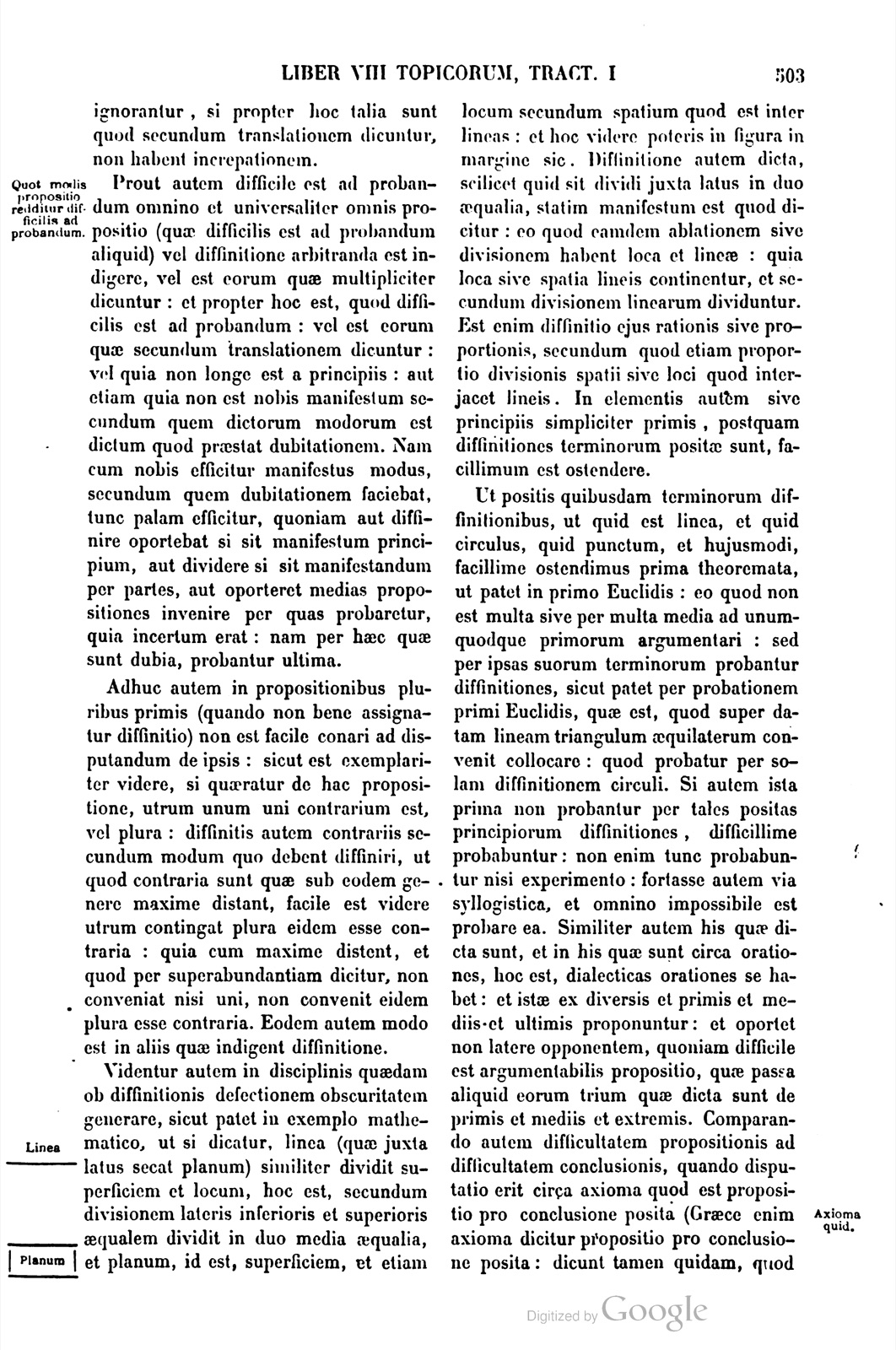
Comparando autem difficultatem propositionis ad difficultatem conclusionis, quando disputatio erit circa axioma quod est propositio pro conclusione posita (Graece enim axioma dicitur propositio pro conclusione posita: dicunt tamen quidam, quod axioma est propositio ad probandam alteram assumpta, quae difficilior est ad probandum quam illa ad cujus probationem assumitur: ponitur enim hic pro propositione affirmante syllogismum) cum ista difficilior sit ad probandum, quam principalis positio sive conclusio, major labor erit disputare ad illam, quam ad principalem positionem sive conclusionem: et quia ipsa est immediata, ad ipsam non est via argumentationis.
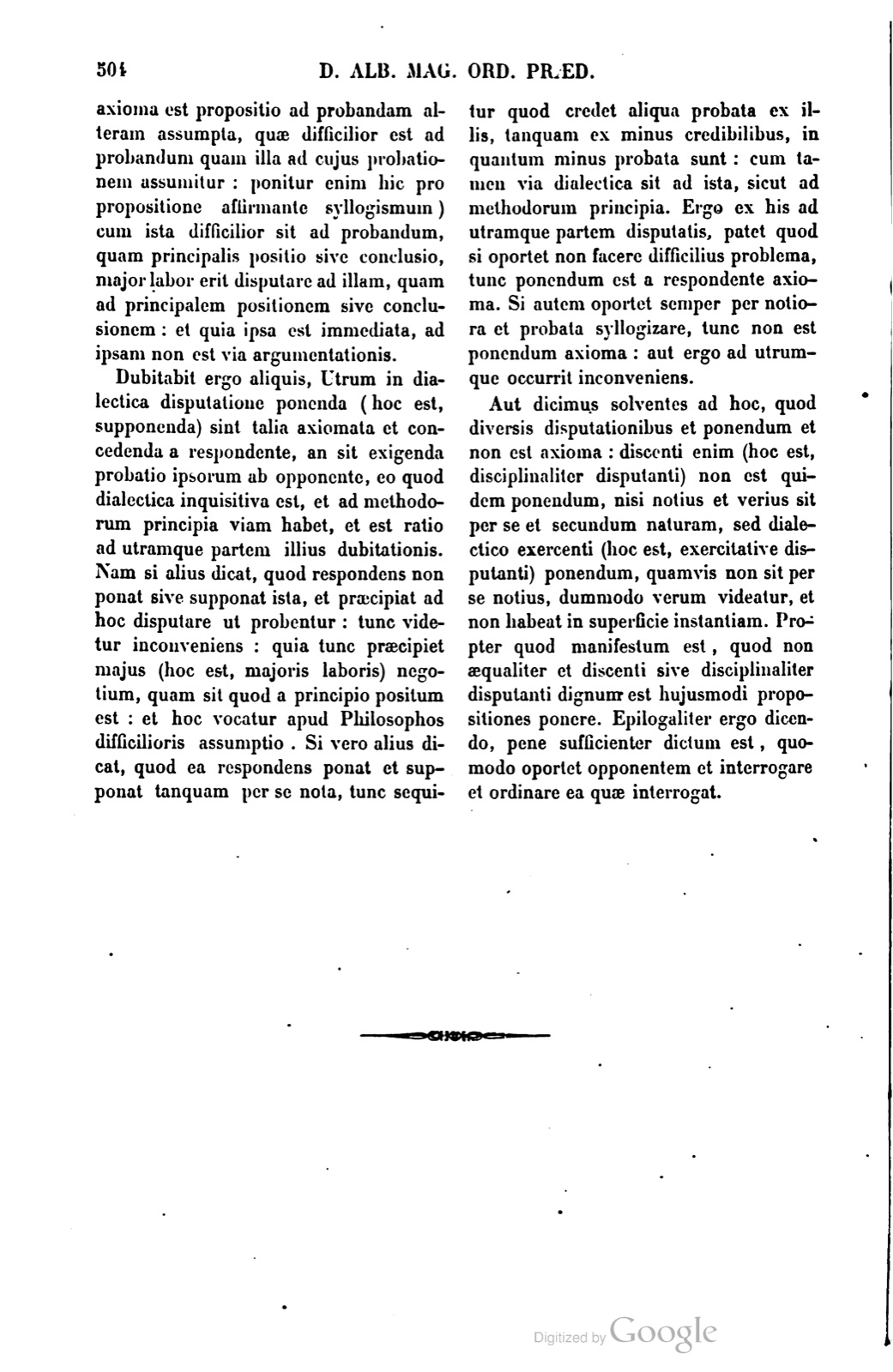
Dubitabit ergo aliquis, Utrum in dialectica disputatione ponenda (hoc est, supponenda) sint talia axiomata et concedenda a respondente, an sit exigenda probatio ipsorum ab opponente, eo quod dialectica inquisitiva est, et ad methodorum principia viam habet, et est ratio ad utramque partem illius dubitationis. Nam si alius dicat, quod respondens non ponat sive supponat ista, et praecipiat ad hoc disputare ut probentur: tunc videtur inconveniens: quia tunc praecipiet majus (hoc est, majoris laboris) negotium, quam sit quod a principio positum est: et hoc vocatur apud Philosophos difficilioris assumptio. Si vero alius dicat, quod ea respondens ponat et supponat tanquam per se nota, tunc sequitur quod credet aliqua probata ex illis, tanquam ex minus credibilibus, in quantum minus probata sunt: cum tamen via dialectica sit ad ista, sicut ad methodorum principia. Ergo ex his ad utramque partem disputatis, patet quod si oportet non facere difficilius problema, tunc ponendum est a respondente axioma. Si autem oportet semper per notiora et probata syllogizare, tunc non est ponendum axioma: aut ergo ad utrumque occurrit inconveniens.
Aut dicimus solventes ad hoc, quod diversis disputationibus et ponendum et non est axioma: discenti enim (hoc est, disciplinaliter disputanti) non est quidem ponendum, nisi notius et verius sit per se et secundum naturam, sed dialectico exercenti (hoc est, exercitative disputanti) ponendum, quamvis non sit per se notius, dummodo verum videatur, et non habeat in superficie instantiam. Propter quod manifestum est, quod non aequaliter et discenti sive disciplinaliter disputanti dignum est hujusmodi propositiones ponere. Epilogaliter ergo dicendo, pene sufficienter dictum est, quomodo oportet opponentem et interrogare et ordinare ea quae interrogat.
But by comparing the difficulty of the proposition to the difficulty of the conclusion, when the disputation will be about an axiom, which is a proposition posited in place of a conclusion (for in Greek axioma is called a proposition posited in place of a conclusion; nevertheless some say that an axiom is a proposition assumed for proving another, which is more difficult to prove than that for whose proof it is assumed; but here it is posited for a proposition affirming a syllogism), since this is more difficult to prove than the principal position or conclusion, there will be greater labor to dispute toward it than toward the principal position or conclusion; and because it is immediate, there is no way of argumentation to it.
Therefore someone will doubt whether in dialectical disputation such axioms are to be posited, that is, supposed, and conceded by the respondent, or whether proof of them is to be demanded from the opponent, because dialectic is inquisitive and has a way to the principles of the methods, and there is reason toward each part of that doubt. For if another says that the respondent should not posit or suppose these things, and commands disputing to this so that they may be proved, then an unsuitable thing seems to follow, because then he will prescribe a greater business, that is, one of greater labor, than that which was posited from the beginning: and this is called among the Philosophers the assumption of the more difficult. But if another says that the respondent should posit and suppose them as known through themselves, then it follows that he will believe certain things proved from them as from less credible things, insofar as they are less proved, although the dialectical way is toward these things as toward principles of the methods. Therefore from these things, disputed toward each part, it is clear that if one must not make the problem more difficult, then the axiom must be posited by the respondent. But if one must always syllogize through more known and proved things, then the axiom must not be posited: therefore an unsuitable thing occurs toward each part.
Or we say, solving this, that in diverse disputations an axiom both must be posited and must not be posited: for for the learner, that is, for one disputing disciplinarily, it must indeed not be posited unless it is more known and truer through itself and according to nature; but for the dialectician exercising, that is, disputing exercitatively, it must be posited, although it is not more known through itself, provided that it seems true and does not have an instance on the surface. On account of which it is manifest that it is not equally worthy for both the learner or one disputing disciplinarily to posit propositions of this sort. Therefore, by way of recapitulation, it has been said almost sufficiently how the opponent ought both to interrogate and to order the things which he interrogates.
Notes
- From this it is clear that it is impossible for someone to demonstrate unless he begins from first principles by connecting them down to the last things. (Ex quo patet quod impossibile est aliquem demonstrare nisi incipiat a primis principiis copulando ea usque ad ultima.) ↩
If a page does not appear, its photograph has not been uploaded yet.