Volume 2 · pp. 499–501
Book VIII of the Topics, Treatise I, Chapters IV-V.
A marker with ≈ is an approximate page boundary, placed by measure of the text; the page photographs remain the authority. In the paired views, clicking a page marker brings that page into view.
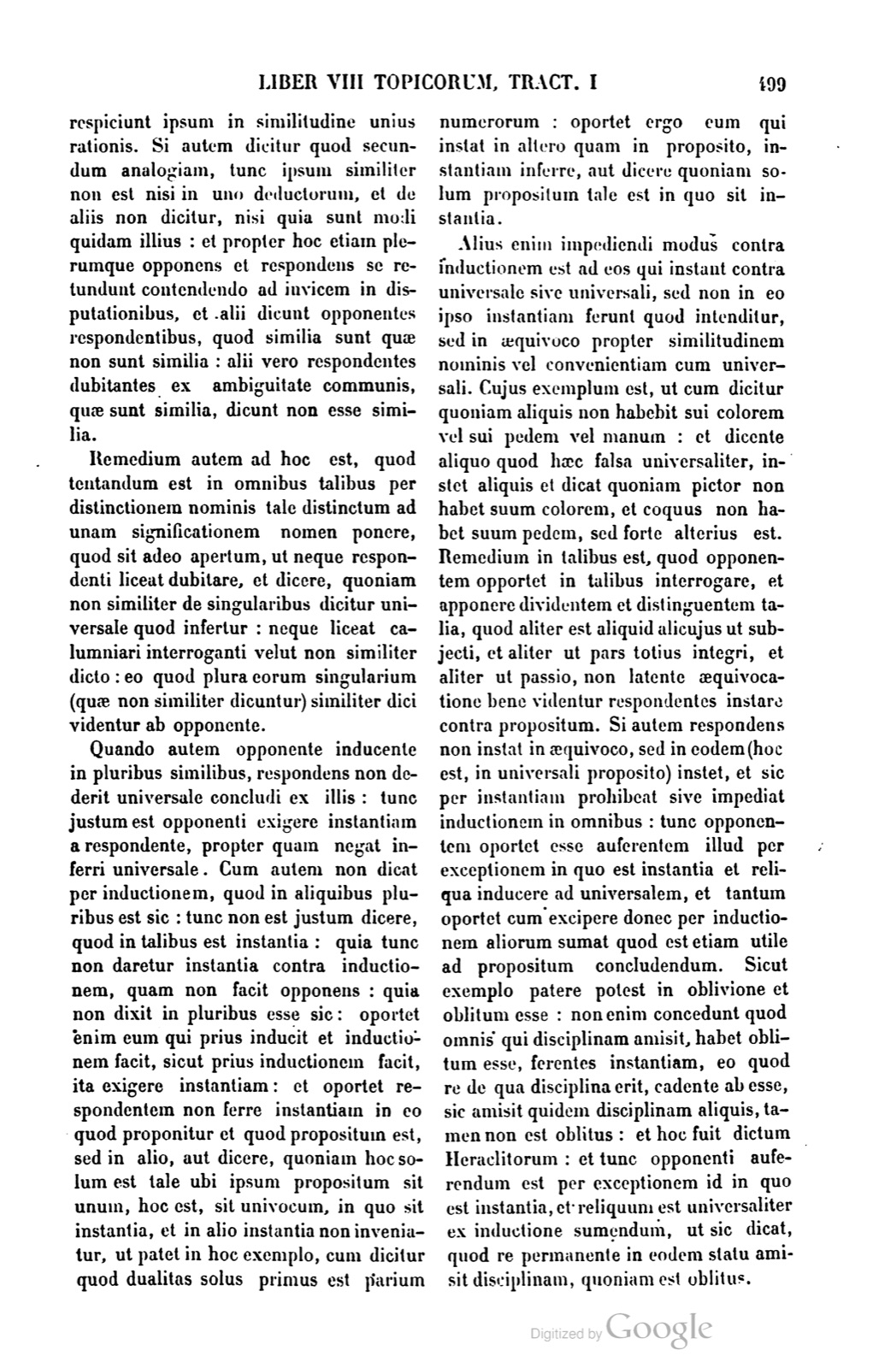
respiciunt ipsum in similitudine unius rationis. Si autem dicitur quod secundum analogiam, tunc ipsum similiter non est nisi in uno deductorum, et de aliis non dicitur, nisi quia sunt modi quidam illius: et propter hoc etiam plerumque opponens et respondens se retundunt contendendo ad invicem in disputationibus, et alii dicunt opponentes respondentibus, quod similia sunt quae non sunt similia: alii vero respondentes dubitantes ex ambiguitate communis, quae sunt similia, dicunt non esse similia.
Remedium autem ad hoc est, quod tentandum est in omnibus talibus per distinctionem nominis tale distinctum ad unam significationem nomen ponere, quod sit adeo apertum, ut neque respondenti liceat dubitare, et dicere, quoniam non similiter de singularibus dicitur universale quod infertur: neque liceat calumniari interroganti velut non similiter dicto: eo quod plura eorum singularium (quae non similiter dicuntur) similiter dici videntur ab opponente.
Quando autem opponente inducente in pluribus similibus, respondens non dederit universale concludi ex illis: tunc justum est opponenti exigere instantiam a respondente, propter quam negat inferri universale. Cum autem non dicat per inductionem, quod in aliquibus pluribus est sic: tunc non est justum dicere, quod in talibus est instantia: quia tunc non daretur instantia contra inductionem, quam non facit opponens: quia non dixit in pluribus esse sic: oportet enim eum qui prius inducit et inductionem facit, sicut prius inductionem facit, ita exigere instantiam: et oportet respondentem non ferre instantiam in eo quod proponitur et quod propositum est, sed in alio, aut dicere, quoniam hoc solum est tale ubi ipsum propositum sit unum, hoc est, sit univocum, in quo sit instantia, et in alio instantia non inveniatur, ut patet in hoc exemplo, cum dicitur quod dualitas solus primus est parium numerorum: oportet ergo eum qui instat in altero quam in proposito, instantiam inferre, aut dicere quoniam solum propositum tale est in quo sit instantia.
Alius enim impediendi modus contra inductionem est ad eos qui instant contra universale sive universali, sed non in eo ipso instantiam ferunt quod intenditur, sed in aequivoco propter similitudinem nominis vel convenientiam cum universali. Cujus exemplum est, ut cum dicitur quoniam aliquis non habebit sui colorem vel sui pedem vel manum: et dicente aliquo quod haec falsa universaliter, instet aliquis et dicat quoniam pictor non habet suum colorem, et coquus non habet suum pedem, sed forte alterius est. Remedium in talibus est, quod opponentem oportet in talibus interrogare, et apponere dividentem et distinguentem talia, quod aliter est aliquid alicujus ut subjecti, et aliter ut pars totius integri, et aliter ut passio, non latente aequivocatione bene videntur respondentes instare contra propositum. Si autem respondens non instat in aequivoco, sed in eodem (hoc est, in universali proposito) instet, et sic per instantiam prohibeat sive impediat inductionem in omnibus: tunc opponentem oportet esse auferentem illud per exceptionem in quo est instantia et reliqua inducere ad universalem, et tantum oportet eum excipere donec per inductionem aliorum sumat quod est etiam utile ad propositum concludendum. Sicut exemplo patere potest in oblivione et oblitum esse: non enim concedunt quod omnis qui disciplinam amisit, habet oblitum esse, ferentes instantiam, eo quod re de qua disciplina erit, cadente ab esse, sic amisit quidem disciplinam aliquis, tamen non est oblitus: et hoc fuit dictum Heraclitorum: et tunc opponenti auferendum est per exceptionem id in quo est instantia, et reliquum est universaliter ex inductione sumendum, ut sic dicat, quod re permanente in eodem statu amisit disciplinam, quoniam est oblitus.
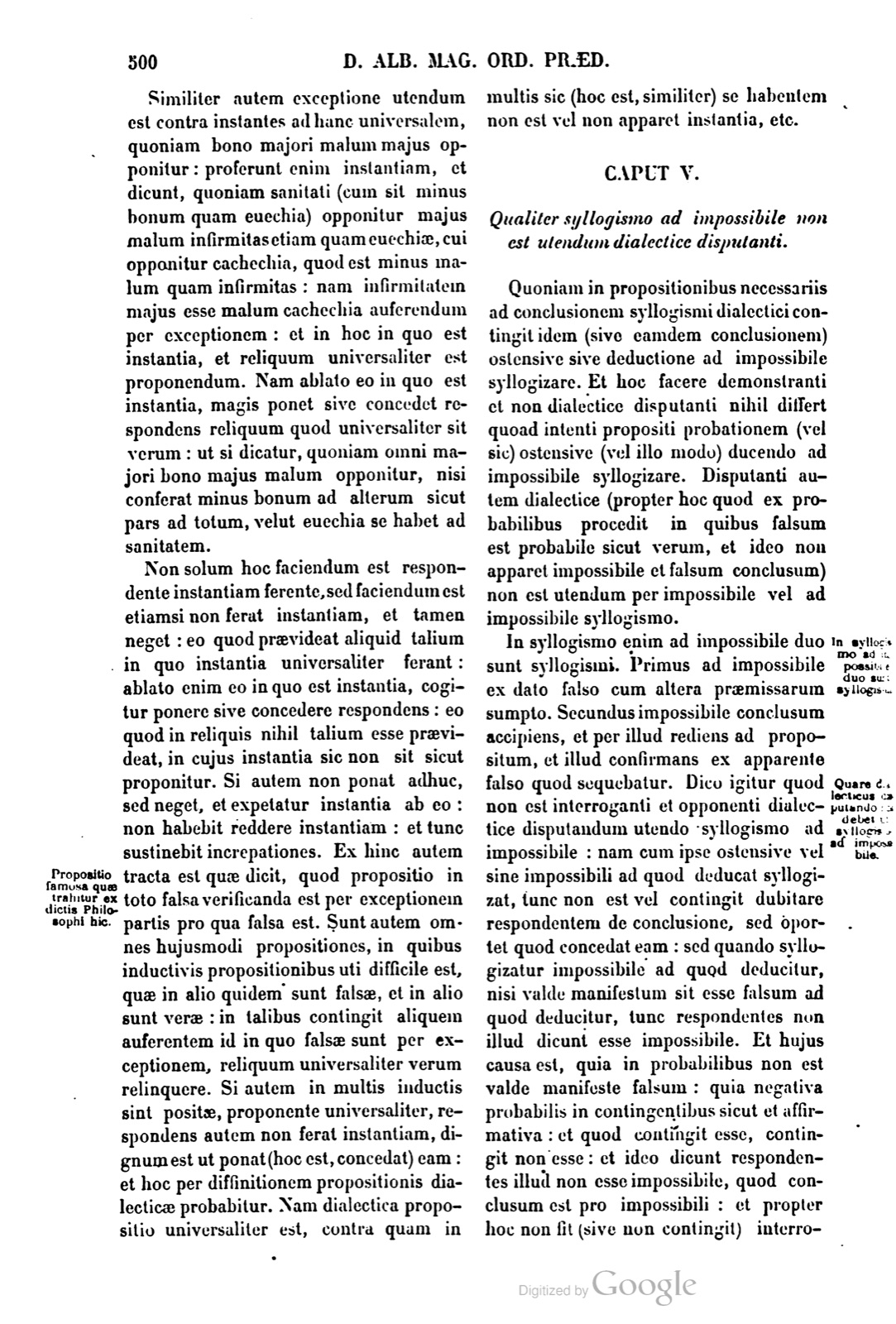
Similiter autem exceptione utendum est contra instantes ad hanc universalem, quoniam bono majori malum majus opponitur: proferunt enim instantiam, et dicunt, quoniam sanitati (cum sit minus bonum quam euechia) opponitur majus malum infirmitas etiam quam euechiae, cui opponitur cachechia, quod est minus malum quam infirmitas: nam infirmitatem majus esse malum cachechia auferendum per exceptionem: et in hoc in quo est instantia, et reliquum universaliter est proponendum. Nam ablato eo in quo est instantia, magis ponet sive concedet respondens reliquum quod universaliter sit verum: ut si dicatur, quoniam omni majori bono majus malum opponitur, nisi conferat minus bonum ad alterum sicut pars ad totum, velut euechia se habet ad sanitatem.
they regard it in the likeness of one account. But if it is said according to analogy, then it itself is not similarly except in one of the things deduced, and is not said of the others except because they are certain modes of that one: and on account of this also, very often the opponent and the respondent blunt themselves by contending with one another in disputations, and some opponents tell respondents that things are similar which are not similar; but other respondents, doubting from the ambiguity of the common term, say that things which are similar are not similar.
But the remedy for this is that in all such cases one must try, through distinction of the name, to posit the name, thus distinguished, to one signification, which is so open that neither may it be permitted to the respondent to doubt and say that the universal which is inferred is not said similarly of the singulars, nor may it be permitted to calumniate the questioner as though it had not been said similarly: because several of those singulars, which are not said similarly, seem to be said similarly by the opponent.
But when, with the opponent inducing in several similar things, the respondent has not granted that the universal be concluded from them, then it is just for the opponent to demand an instance from the respondent, on account of which he denies that the universal is inferred. But when he does not say through induction that in several things it is so, then it is not just to say that there is an instance in such things: because then an instance would not be given against an induction which the opponent does not make, since he did not say that it is so in several things. For the one who first induces and makes an induction, just as he first makes the induction, must also demand the instance; and the respondent must not bring an instance in that which is proposed and which is the proposed thing, but in another, or must say that this alone is such where the proposed thing itself is one, that is, univocal, in which there is an instance, and an instance is not found in another, as is clear in this example, when it is said that duality alone is the first of even numbers: therefore the one who makes an instance in another than in the proposed thing must bring an instance, or say that the proposed thing alone is such as that in which there is an instance.
For another mode of impeding against induction is toward those who make an instance against the universal or to the universal, but do not bring an instance in that very thing which is intended, but in an equivocal thing on account of likeness of name or agreement with the universal. An example of this is when it is said that someone will not have his own color or his own foot or hand; and when someone says that these things are false universally, someone makes an instance and says that a painter does not have his own color, and a cook does not have his own foot, but perhaps it belongs to another. The remedy in such cases is that the opponent must interrogate in such cases and add, dividing and distinguishing such things, that something is of someone in one way as of a subject, and in another way as a part of an integral whole, and in another way as a passion; when the equivocation is not hidden, the respondents seem well to make an instance against the proposed thing. But if the respondent does not make an instance in the equivocal, but makes an instance in the same thing, that is, in the proposed universal, and thus through an instance prohibits or impedes induction in all things, then the opponent must be one taking away, through exception, that in which the instance is, and must introduce the remaining things toward the universal, and he must except only so much until through induction of the others he takes what is also useful for concluding the proposed thing. As can be clear by example in forgetfulness and to have forgotten: for they do not concede that everyone who has lost a discipline has forgotten, bringing an instance because, when the thing about which the discipline will be has fallen from being, someone indeed has thus lost the discipline, yet has not forgotten; and this was said by the Heracliteans; and then the opponent must take away by exception that in which the instance is, and the remainder must be taken universally from induction, so that he may say thus: while the thing remains in the same state, he lost the discipline, because he forgot.
Likewise exception must be used against those making instances to this universal, that to a greater good a greater evil is opposed: for they bring forward an instance, and say that to health, since it is a lesser good than good bodily condition, there is opposed illness, a greater evil even than bad bodily condition, to which bad condition is opposed, which is a lesser evil than illness. For that illness is a greater evil than bad bodily condition must be taken away by exception; and in this in which there is an instance, and the rest must be proposed universally. For when that in which there is an instance has been removed, the respondent will more posit or concede the rest, that it is universally true: as if it is said that to every greater good a greater evil is opposed, unless it compares a lesser good to the other as part to whole, as good bodily condition stands to health.
Non solum hoc faciendum est respondente instantiam ferente, sed faciendum est etiamsi non ferat instantiam, et tamen neget: eo quod praevidet aliquid talium in quo instantia universaliter ferat: ablato enim eo in quo est instantia, cogitur ponere sive concedere respondens: eo quod in reliquis nihil talium esse praevidet, in cujus instantia sic non sit sicut proponitur. Si autem non ponat adhuc, sed neget, et expetatur instantia ab eo: non habebit reddere instantiam: et tunc sustinebit increpationes.
Ex hinc autem tracta est quae dicit, quod propositio in toto falsa verificanda est per exceptionem partis pro qua falsa est. Sunt autem omnes hujusmodi propositiones, in quibus inductivis propositionibus uti difficile est, quae in alio quidem sunt falsae, et in alio sunt verae: in talibus contingit aliquem auferentem id in quo falsae sunt per exceptionem, reliquum universaliter verum relinquere. Si autem in multis inductis sint positae, proponente universaliter, respondens autem non ferat instantiam, dignum est ut ponat (hoc est, concedat) eam: et hoc per diffinitionem propositionis dialecticae probabitur. Nam dialectica propositio universaliter est, contra quam in multis sic (hoc est, similiter) se habentem non est vel non apparet instantia, etc.
CAPUT V.
Qualiter syllogismo ad impossibile non est utendum dialectice disputanti.
Quoniam in propositionibus necessariis ad conclusionem syllogismi dialectici contingit idem (sive eamdem conclusionem) ostensive sive deductione ad impossibile syllogizare. Et hoc facere demonstranti et non dialectice disputanti nihil differt quoad intenti propositi probationem (vel sic) ostensive (vel illo modo) ducendo ad impossibile syllogizare. Disputanti autem dialectice (propter hoc quod ex probabilibus procedit in quibus falsum est probabile sicut verum, et ideo non apparet impossibile et falsum conclusum) non est utendum per impossibile vel ad impossibile syllogismo.
In syllogismo enim ad impossibile duo sunt syllogismi. Primus ad impossibile ex dato falso cum altera praemissarum sumpto. Secundus impossibile conclusum accipiens, et per illud rediens ad propositum, et illud confirmans ex apparente falso quod sequebatur.
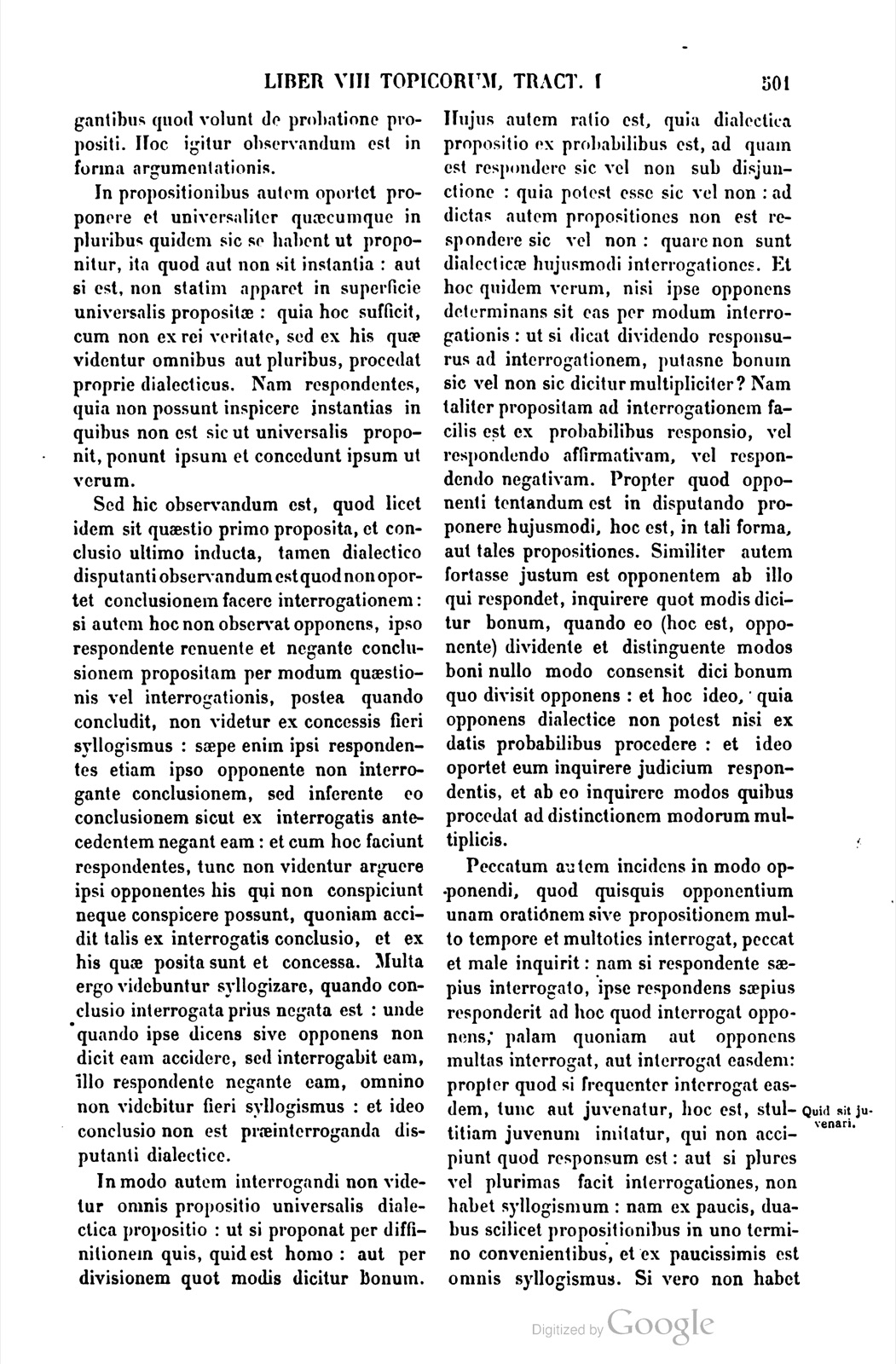
Dico igitur quod non est interroganti et opponenti dialectice disputandum utendo syllogismo ad impossibile: nam cum ipse ostensive vel sine impossibili ad quod deducat syllogizat, tunc non est vel contingit dubitare respondentem de conclusione, sed oportet quod concedat eam: sed quando syllogizatur impossibile ad quod deducitur, nisi valde manifestum sit esse falsum ad quod deducitur, tunc respondentes non illud dicunt esse impossibile. Et hujus causa est, quia in probabilibus non est valde manifeste falsum: quia negativa probabilis in contingentibus sicut et affirmativa: et quod contingit esse, contingit non esse: et ideo dicunt respondentes illud non esse impossibile, quod conclusum est pro impossibili: et propter hoc non fit (sive non contingit) interrogantibus quod volunt de probatione propositi. Hoc igitur observandum est in forma argumentationis.
In propositionibus autem oportet proponere et universaliter quaecumque in pluribus quidem sic se habent ut proponitur, ita quod aut non sit instantia: aut si est, non statim apparet in superficie universalis propositae: quia hoc sufficit, cum non ex rei veritate, sed ex his quae videntur omnibus aut pluribus, procedat proprie dialecticus. Nam respondentes, quia non possunt inspicere instantias in quibus non est sic ut universalis proponit, ponunt ipsum et concedunt ipsum ut verum.
This must be done not only when the respondent brings an instance, but it must be done also if he does not bring an instance and yet denies, because he foresees some such thing in which an instance would bear universally; for when that in which there is an instance has been removed, the respondent is compelled to posit or concede, because in the remaining things he foresees nothing such in whose instance it is not so as is proposed. But if he still does not posit, but denies, and an instance is sought from him, he will not have an instance to return; and then he will sustain rebukes.
From this, then, is drawn the proposition which says that a proposition false as a whole must be verified through exception of the part for which it is false. Now all propositions of this sort, in which it is difficult to use inductive propositions, are those which in one respect are false and in another are true: in such cases it happens that someone, by exception taking away that in which they are false, leaves the rest universally true. But if they have been posited in many introduced cases, with the proposer proposing universally, while the respondent does not bring an instance, it is worthy that he posit it, that is, concede it: and this will be proved through the definition of a dialectical proposition. For a dialectical proposition is universally one against which, when many things stand thus, that is, similarly, there is not, or there does not appear, an instance, and so on.
CHAPTER V.
In what way a syllogism to the impossible must not be used by one disputing dialectically.
Since in necessary propositions for the conclusion of a dialectical syllogism it happens that the same thing, or the same conclusion, is syllogized ostensively or by deduction to the impossible. And to do this differs nothing for one demonstrating and not disputing dialectically, with respect to the proof of the intended proposed thing: either to syllogize ostensively in this way, or in that way by leading to the impossible. But for one disputing dialectically, because he proceeds from probable things, in which the false is probable just as the true, and therefore the impossible and false conclusion does not appear, one must not use a syllogism through the impossible or to the impossible.
For in a syllogism to the impossible there are two syllogisms. The first is to the impossible from the given false thing taken with the other of the premises. The second accepts the impossible concluded, and through it returns to the proposed thing, and confirms it from the apparent false thing which followed.
Therefore I say that the one interrogating and opposing must not dispute dialectically by using a syllogism to the impossible: for when he syllogizes ostensively or without the impossible to which he leads, then the respondent cannot, or it does not happen that he can, doubt concerning the conclusion, but he must concede it. But when the impossible to which it is led is syllogized, unless that to which it is led is very manifestly false, then respondents do not say that it is impossible. And the cause of this is that in probable matters there is nothing very manifestly false, because a probable negative in contingent things is as probable as an affirmative, and what happens to be can happen not to be. And therefore respondents say that what has been concluded as impossible is not impossible; and on account of this, for those interrogating, what they want concerning proof of the proposed thing does not happen. Therefore this must be observed in the form of argumentation.
But in propositions one must propose universally whatever things in several cases stand as is proposed, so that either there is no instance, or, if there is, it does not immediately appear on the surface of the universal proposed: because this suffices, since the dialectician properly proceeds not from the truth of the thing, but from those things which seem so to all or to many. For respondents, because they cannot inspect the instances in which it is not so as the universal proposes, posit it and concede it as true.
Sed hic observandum est, quod licet idem sit quaestio primo proposita, et conclusio ultimo inducta, tamen dialectico disputanti observandum est quod non oportet conclusionem facere interrogationem: si autem hoc non observat opponens, ipso respondente renuente et negante conclusionem propositam per modum quaestionis vel interrogationis, postea quando concludit, non videtur ex concessis fieri syllogismus: saepe enim ipsi respondentes etiam ipso opponente non interrogante conclusionem, sed inferente eo conclusionem sicut ex interrogatis antecedentem negant eam: et cum hoc faciunt respondentes, tunc non videntur arguere ipsi opponentes his qui non conspiciunt neque conspicere possunt, quoniam accidit talis ex interrogatis conclusio, et ex his quae posita sunt et concessa. Multa ergo videbuntur syllogizare, quando conclusio interrogata prius negata est: unde quando ipse dicens sive opponens non dicit eam accidere, sed interrogabit eam, illo respondente negante eam, omnino non videbitur fieri syllogismus: et ideo conclusio non est praeinterroganda disputanti dialectice.
In modo autem interrogandi non videtur omnis propositio universalis dialectica propositio: ut si proponat per diffinitionem quis, quid est homo: aut per divisionem quot modis dicitur bonum. Hujus autem ratio est, quia dialectica propositio ex probabilibus est, ad quam est respondere sic vel non sub disjunctione: quia potest esse sic vel non: ad dictas autem propositiones non est respondere sic vel non: quare non sunt dialecticae hujusmodi interrogationes. Et hoc quidem verum, nisi ipse opponens determinans sit eas per modum interrogationis: ut si dicat dividendo responsurus ad interrogationem, putasne bonum sic vel non sic dicitur multipliciter? Nam taliter propositam ad interrogationem facilis est ex probabilibus responsio, vel respondendo affirmativam, vel respondendo negativam. Propter quod opponenti tentandum est in disputando proponere hujusmodi, hoc est, in tali forma, aut tales propositiones. Similiter autem fortasse justum est opponentem ab illo qui respondet, inquirere quot modis dicitur bonum, quando eo (hoc est, opponente) dividente et distinguente modos boni nullo modo consensit dici bonum quo divisit opponens: et hoc ideo, quia opponens dialectice non potest nisi ex datis probabilibus procedere: et ideo oportet eum inquirere judicium respondentis, et ab eo inquirere modos quibus procedat ad distinctionem modorum multiplicis.
Peccatum autem incidens in modo opponendi, quod quisquis opponentium unam orationem sive propositionem multo tempore et multoties interrogat, peccat et male inquirit: nam si respondente saepius interrogato, ipse respondens saepius responderit ad hoc quod interrogat opponens; palam quoniam aut opponens multas interrogat, aut interrogat easdem: propter quod si frequenter interrogat easdem, tunc aut juvenatur, hoc est, stultitiam juvenum imitatur, qui non accipiunt quod responsum est: aut si plures vel plurimas facit interrogationes, non habet syllogismum: nam ex paucis, duabus scilicet propositionibus in uno termino convenientibus, et ex paucissimis est omnis syllogismus. Si vero non habet syllogismum, respondente dicente hoc ipsum, quoniam non habet syllogismum, tunc opponens aliud facere non potest, nisi quod respondentem increpat, vel recedit a proposito, et dimittit commune opus: et posset etiam dici, quod respondens non increpat opponentem, et recidit tanquam a juvenante, et stulto, etc.
But here it must be observed that, although the question first proposed and the conclusion last introduced are the same, nevertheless it must be observed by the dialectical disputant that he ought not make the conclusion an interrogation. But if the opponent does not observe this, when the respondent himself refuses and denies the conclusion proposed by way of question or interrogation, afterwards, when he concludes, the syllogism does not seem to be made from things conceded. For often the respondents themselves, even when the opponent himself is not interrogating the conclusion but inferring the conclusion as from the things previously interrogated, deny it; and when the respondents do this, then the opponents themselves do not seem to argue to those who do not see nor are able to see that such a conclusion happens from the interrogated things and from those things which have been posited and conceded. Therefore they will seem to syllogize many things when the conclusion previously interrogated has been denied; whence when the speaker or opponent himself does not say that it happens, but will interrogate it, with that respondent denying it, it will in no way seem that a syllogism is made; and therefore the conclusion must not be pre-interrogated by one disputing dialectically.
But in the mode of interrogating, not every universal proposition seems to be a dialectical proposition, as if someone proposes by definition, what is man? or by division, in how many ways is good said? The reason of this is that a dialectical proposition is from probable things, to which there is answer “yes” or “no” under disjunction, because it can be so or not so; but to the stated propositions there is no answering yes or no: wherefore interrogations of this sort are not dialectical. And this indeed is true, unless the opponent himself is determining them by way of interrogation, as if, about to respond by dividing to the interrogation, he says: do you think good is said in this way or not in this way, in many ways? For to a proposition proposed in such a way for interrogation an answer is easy from probable things, either by responding with the affirmative or by responding with the negative. On account of which the opponent must attempt in disputing to propose things of this sort, that is, in such a form, or such propositions. Likewise perhaps it is just for the opponent to inquire from the one who responds in how many ways good is said, when, with him, that is, the opponent, dividing and distinguishing the modes of good, he has in no way consented that good is said in the way in which the opponent divided it; and this is so because the opponent cannot proceed dialectically except from probable things given: and therefore he must inquire into the judgment of the respondent, and from him inquire into the modes by which he may proceed to the distinction of the modes of the multiple.
But the fault occurring in the mode of opposing is that whoever of the opponents interrogates one speech or proposition for a long time and many times, sins and inquires badly. For if, when the respondent has been interrogated more often, the respondent himself has responded more often to that which the opponent interrogates, it is plain that either the opponent interrogates many things, or he interrogates the same things. Therefore if he frequently interrogates the same things, then either he acts youthfully, that is, imitates the foolishness of youths, who do not accept what has been answered; or, if he makes several or very many interrogations, he does not have a syllogism: for every syllogism is from few things, namely two propositions agreeing in one term, and from very few things. But if he does not have a syllogism, with the respondent saying this very thing, that he does not have a syllogism, then the opponent can do nothing else except rebuke the respondent, or withdraw from the proposed thing and dismiss the common work; and it could also be said that the respondent does not rebuke the opponent, and withdraws as from one acting youthfully and foolishly, and so on.
If a page does not appear, its photograph has not been uploaded yet.