Volume 2 · pp. 473–474
Tractate VII. Chapter I. On the integral whole from heterogeneous parts.
A marker with ≈ is an approximate page boundary, placed by measure of the text; the page photographs remain the authority. In the paired views, clicking a page marker brings that page into view.
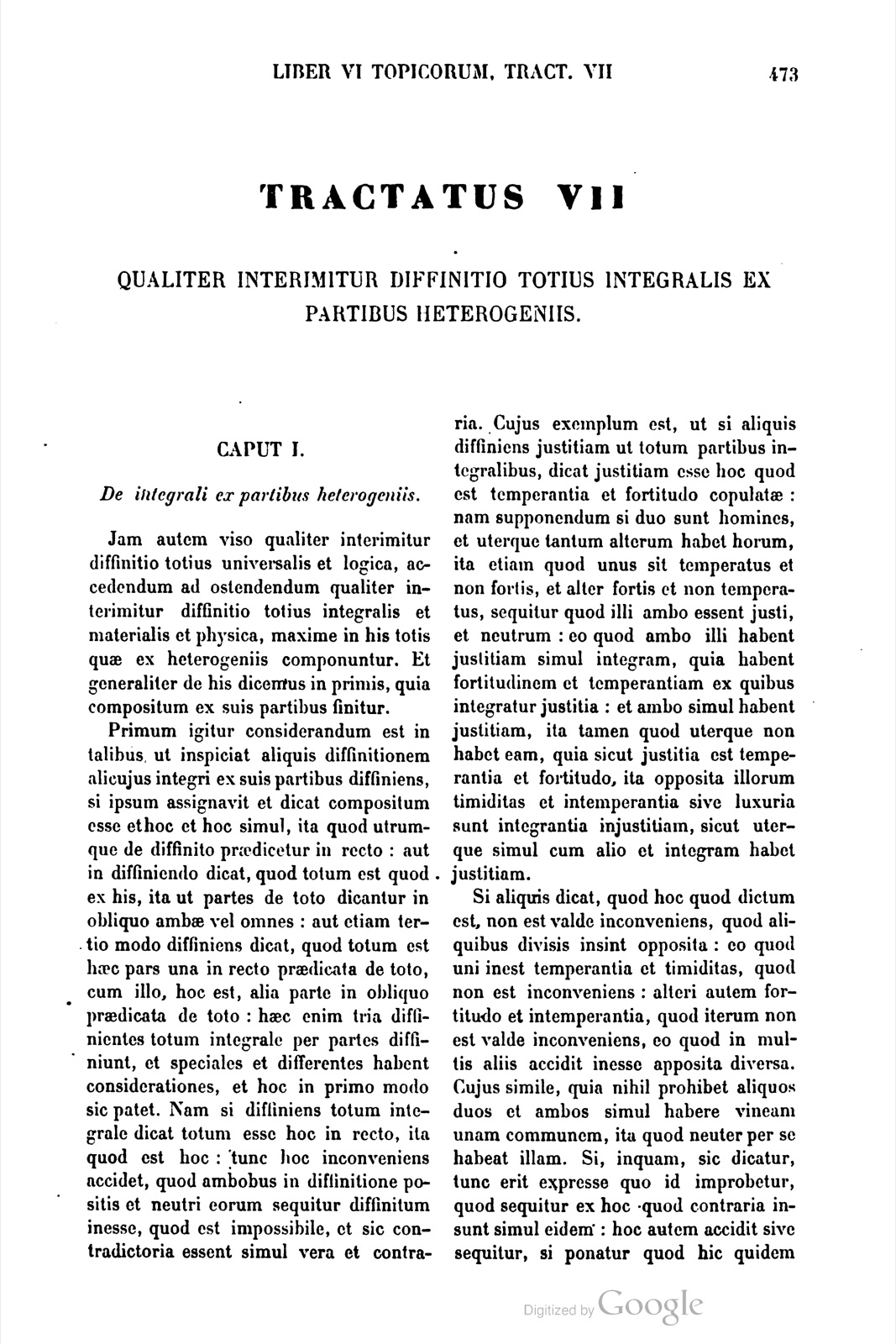
TRACTATUS VII. QUALITER INTERIMITUR DIFFINITIO TOTIUS INTEGRALIS EX PARTIBUS HETEROGENIIS.
CAPUT I. De integrali ex partibus heterogeniis.
Jam autem viso qualiter interimitur diffinitio totius universalis et logica, accedendum ad ostendendum qualiter interimitur diffinitio totius integralis et materialis et physica, maxime in his totis quae ex heterogeniis componuntur. Et generaliter de his dicemus in primis, quia compositum ex suis partibus finitur.
Primum igitur considerandum est in talibus, ut inspiciat aliquis diffinitionem alicujus integri ex suis partibus diffiniens, si ipsum assignavit et dicat compositum esse et hoc et hoc simul, ita quod utrumque de diffinito praedicetur in recto: aut in diffiniendo dicat, quod totum est quod ex his, ita ut partes de toto dicantur in obliquo ambae vel omnes: aut etiam tertio modo diffiniens dicat, quod totum est haec pars una in recto praedicata de toto, cum illo, hoc est, alia parte in obliquo praedicata de toto: haec enim tria diffinientes totum integrale per partes diffiniunt, et speciales et differentes habent considerationes, et hoc in primo modo sic patet. Nam si diffiniens totum integrale dicat totum esse hoc in recto, ita quod est hoc: tunc hoc inconveniens accidet, quod ambobus in diffinitione positis et neutri eorum sequitur diffinitum inesse, quod est impossibile, et sic contradictoria essent simul vera et contraria. Cujus exemplum est, ut si aliquis diffiniens justitiam ut totum partibus integralibus, dicat justitiam esse hoc quod est temperantia et fortitudo copulatae: nam supponendum si duo sunt homines, et uterque tantum alterum habet horum, ita etiam quod unus sit temperatus et non fortis, et alter fortis et non temperatus, sequitur quod illi ambo essent justi, et neutrum: eo quod ambo illi habent justitiam simul integram, quia habent fortitudinem et temperantiam ex quibus integratur justitia: et ambo simul habent justitiam, ita tamen quod uterque non habet eam, quia sicut justitia est temperantia et fortitudo, ita opposita illorum timiditas et intemperantia sive luxuria sunt integrantia injustitiam, sicut uterque simul cum alio et integram habet justitiam.
Si aliquis dicat, quod hoc quod dictum est, non est valde inconveniens, quod aliquibus divisis insint opposita: eo quod uni inest temperantia et timiditas, quod non est inconveniens: alteri autem fortitudo et intemperantia, quod iterum non est valde inconveniens, eo quod in multis aliis accidit inesse apposita diversa. Cujus simile, quia nihil prohibet aliquos duos et ambos simul habere vineam unam communem, ita quod neuter per se habeat illam. Si, inquam, sic dicatur, tunc erit expresse quo id improbetur, quod sequitur ex hoc quod contraria insunt simul eidem: hoc autem accidit sive sequitur, si ponatur quod hic quidem unus duorum suprapositorum habeat temperantiam cum debilitate, hoc est, cum timiditate: ille autem reliquus duorum habeat fortitudinem cum opposito temperantiae, quod est luxuria vel intemperantia: ambas enim istas habitudines dicimus justitiam et injustitiam integrando, quia sicut per temperantiam est justus, ita per timiditatem est injustus: ex quo datur quod si justitia est hoc et hoc copulative, quod tunc sequitur quod praedicatur de altero in recto, et eodem modo si injustitia est hoc et hoc, quod divisim praedicatur de ipsis: nam si justitia est temperantia et fortitudo, tunc injustitia est timiditas et luxuria sive intemperantia. Et sic dicendo accidet universaliter argumentari, quoniam idem sunt totum integrale et partes ejus sic acceptae: omnia enim per quae hoc potest argumentari, utilia sunt ad hoc quod nunc dictum est. Videtur enim iste qui sic diffinivit, confiteri quod partes toti sint eaedem: quia aliter non in recto praedicarentur de toto diffinito.
TRACTATE VII. HOW THE DEFINITION OF AN INTEGRAL WHOLE FROM HETEROGENEOUS PARTS IS DESTROYED.
CHAPTER I. On the integral whole from heterogeneous parts.
But now, having seen how the definition of a universal and logical whole is destroyed, one must proceed to showing how the definition of an integral and material and physical whole is destroyed, especially in those wholes which are composed from heterogeneous parts. And generally we shall speak of these first, because a composite is bounded by its parts.
Therefore first in such things one must consider, so that someone defining the definition of some integral from its parts may inspect whether he has assigned it and says that the composite is both this and this together, in such a way that each is predicated of the defined thing in the direct case; or in defining says that the whole is that which is from these, so that the parts are said of the whole obliquely, both or all; or even in a third way the one defining says that the whole is this one part predicated of the whole in the direct case, with that, that is, the other part predicated of the whole obliquely. For these three define an integral whole through parts, and they have special and different considerations; and this is clear in the first way as follows. For if one defining an integral whole says that the whole is this in the direct case, so that it is this, then this unsuitable consequence will happen: that, when both have been posited in the definition, and the defined thing follows neither of them as being present, which is impossible, contradictories and contraries would thus be true at the same time. An example is that if someone defining justice as a whole by integral parts says that justice is this, namely temperance and fortitude conjoined; for it must be supposed that if there are two men, and each has only one of these, so that one is temperate and not brave and the other brave and not temperate, it follows that both those men would be just, and neither: because those two together have integral justice, since they have fortitude and temperance from which justice is integrated, and the two together have justice, yet in such a way that neither has it, because as justice is temperance and fortitude, so their opposites, timidity and intemperance or luxury, integrate injustice, just as each together with the other has integral justice.
If someone says that what has been said is not very unsuitable, that opposites should be present in certain divided things, because temperance and timidity are in one, which is not unsuitable, while fortitude and intemperance are in the other, which again is not very unsuitable, because in many other cases it happens that diverse apposed things are present. A similar case is that nothing prevents two persons, and both together, from having one common vineyard, so that neither has it through himself. If, I say, it is stated in this way, then there will be expressly that by which it is disproved, because it follows from this that contraries are present at the same time in the same thing. But this happens or follows if it is posited that this one of the two mentioned above has temperance with weakness, that is, with timidity, while the remaining one of the two has fortitude with the opposite of temperance, which is luxury or intemperance. For we say that both of these dispositions integrate justice and injustice, because as one is just through temperance, so through timidity he is unjust; from which it is granted that if justice is this and this copulatively, then it follows that it is predicated of the other in the direct case, and in the same way, if injustice is this and this, that it is predicated divisively of them. For if justice is temperance and fortitude, then injustice is timidity and luxury or intemperance. And by speaking thus it will happen to argue universally that the integral whole and its parts taken in this way are the same; for all things through which this can be argued are useful for what has now been said. For one who defined in this way seems to confess that the parts are the same as the whole, because otherwise they would not be predicated in the direct case of the defined whole.
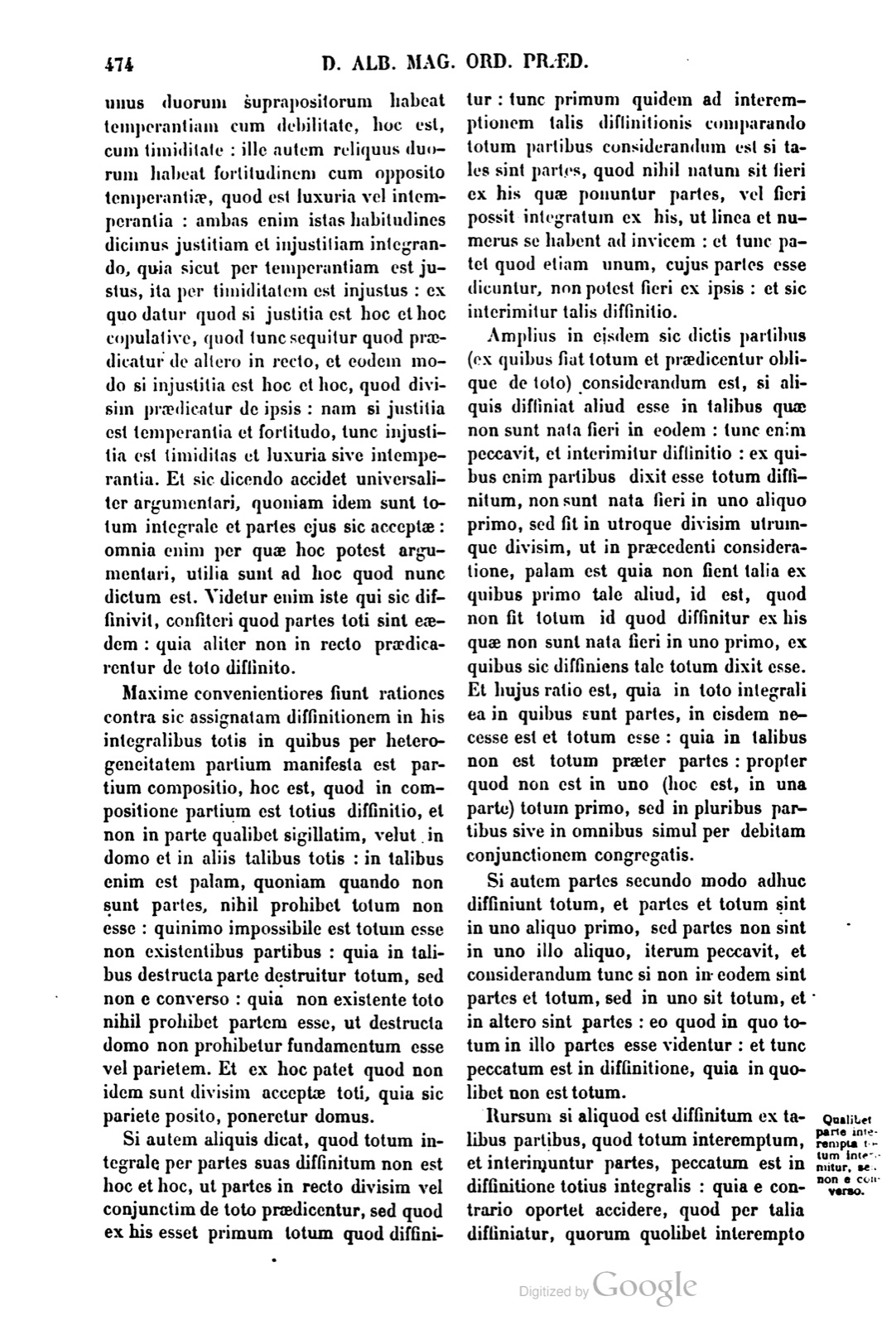
Maxime convenientiores fiunt rationes contra sic assignatam diffinitionem in his integralibus totis in quibus per heterogeneitatem partium manifesta est partium compositio, hoc est, quod in compositione partium est totius diffinitio, et non in parte qualibet sigillatim, velut in domo et in aliis talibus totis: in talibus enim est palam, quoniam quando non sunt partes, nihil prohibet totum non esse: quinimo impossibile est totum esse non existentibus partibus: quia in talibus destructa parte destruitur totum, sed non e converso: quia non existente toto nihil prohibet partem esse, ut destructa domo non prohibetur fundamentum esse vel parietem. Et ex hoc patet quod non idem sunt divisim acceptae toti, quia sic pariete posito, poneretur domus.
Si autem aliquis dicat, quod totum integrale per partes suas diffinitum non est hoc et hoc, ut partes in recto divisim vel conjunctim de toto praedicentur, sed quod ex his esset primum totum quod diffinitur: tunc primum quidem ad interemptionem talis diffinitionis comparando totum partibus considerandum est si tales sint partes, quod nihil natum sit fieri ex his quae ponuntur partes, vel fieri possit integratum ex his, ut linea et numerus se habent ad invicem: et tunc patet quod etiam unum, cujus partes esse dicuntur, non potest fieri ex ipsis: et sic interimitur talis diffinitio.
Amplius in eisdem sic dictis partibus (ex quibus fiat totum et praedicentur oblique de toto) considerandum est, si aliquis diffiniat aliud esse in talibus quae non sunt nata fieri in eodem: tunc enim peccavit, et interimitur diffinitio: ex quibus enim partibus dixit esse totum diffinitum, non sunt nata fieri in uno aliquo primo, sed fit in utroque divisim utrumque divisim, ut in praecedenti consideratione, palam est quia non fient talia ex quibus primo tale aliud, id est, quod non fit totum id quod diffinitur ex his quae non sunt nata fieri in uno primo, ex quibus sic diffiniens tale totum dixit esse. Et hujus ratio est, quia in toto integrali ea in quibus sunt partes, in eisdem necesse est et totum esse: quia in talibus non est totum praeter partes: propter quod non est in uno (hoc est, in una parte) totum primo, sed in pluribus partibus sive in omnibus simul per debitam conjunctionem congregatis.
Si autem partes secundo modo adhuc diffiniunt totum, et partes et totum sint in uno aliquo primo, sed partes non sint in uno illo aliquo, iterum peccavit, et considerandum tunc si non in eodem sint partes et totum, sed in uno sit totum, et in altero sint partes: eo quod in quo totum in illo partes esse videntur: et tunc peccatum est in diffinitione, quia in quolibet non est totum.
Rursum si aliquod est diffinitum ex talibus partibus, quod totum interemptum, et interimuntur partes, peccatum est in diffinitione totius integralis: quia e contrario oportet accidere, quod per talia diffiniatur, quorum quolibet interempto
Arguments against a definition assigned in this way become most suitable in those integral wholes in which, through the heterogeneity of parts, the composition of parts is manifest, that is, that the definition of the whole is in the composition of the parts and not in each part singly, as in a house and in other such wholes. For in such things it is plain that, when the parts do not exist, nothing prevents the whole from not existing; indeed it is impossible for the whole to exist when the parts do not exist, because in such things, when a part is destroyed, the whole is destroyed, but not conversely; because when the whole does not exist, nothing prevents a part from existing, as when a house has been destroyed the foundation or wall is not prevented from existing. And from this it is clear that the parts taken divisively are not the same as the whole, because if the wall were posited, the house would be posited in that way.
But if someone says that an integral whole defined through its parts is not this and this, so that the parts are predicated of the whole in the direct case divisively or conjointly, but that from these there would be the first whole which is defined, then, first indeed, for destroying such a definition by comparing the whole to the parts, one must consider whether the parts are such that nothing is born to come to be from these things which are posited as parts, or whether an integrated thing can come to be from them, as line and number stand to one another. And then it is clear that even one thing, whose parts they are said to be, cannot come to be from them; and thus such a definition is destroyed.
Furthermore, in the same parts so stated, from which a whole would come to be and which are predicated obliquely of the whole, one must consider, if someone defines something else as being in such parts which are not born to come to be in the same thing, for then he has erred and the definition is destroyed. For the parts from which he said the defined whole to be are not born to come to be in some one first thing, but each is made divisively in each, as in the preceding consideration; it is plain that such things will not come to be from which that other first thing comes to be, that is, that the whole which is defined does not come to be from those things which are not born to come to be in one first thing, from which the one defining in this way said such a whole to be. And the reason for this is that, in an integral whole, in the same things in which the parts are, the whole also must be; because in such things there is no whole apart from the parts. Therefore the whole is not first in one, that is, in one part, but in several parts, or in all together gathered through due conjunction.
But if parts in the second way still define the whole, and parts and whole are in some one first thing, but the parts are not in that one thing, again he has erred; and then one must consider whether the parts and whole are not in the same thing, but the whole is in one thing and the parts are in another, because in that in which the whole is, in that the parts seem to be. And then there is error in the definition, because the whole is not in any one part.
Again, if something is defined from such parts that, when the whole has been destroyed, the parts also are destroyed, there is error in the definition of the integral whole, because the contrary ought to happen: that it be defined through such things, when any one of which has been destroyed
If a page does not appear, its photograph has not been uploaded yet.