Volume 2 · pp. 468–472
Tractate VI. On the definition of complex things.
A marker with ≈ is an approximate page boundary, placed by measure of the text; the page photographs remain the authority. In the paired views, clicking a page marker brings that page into view.
TRACTATUS VI. DE DIFFINITIONE COMPLEXORUM.
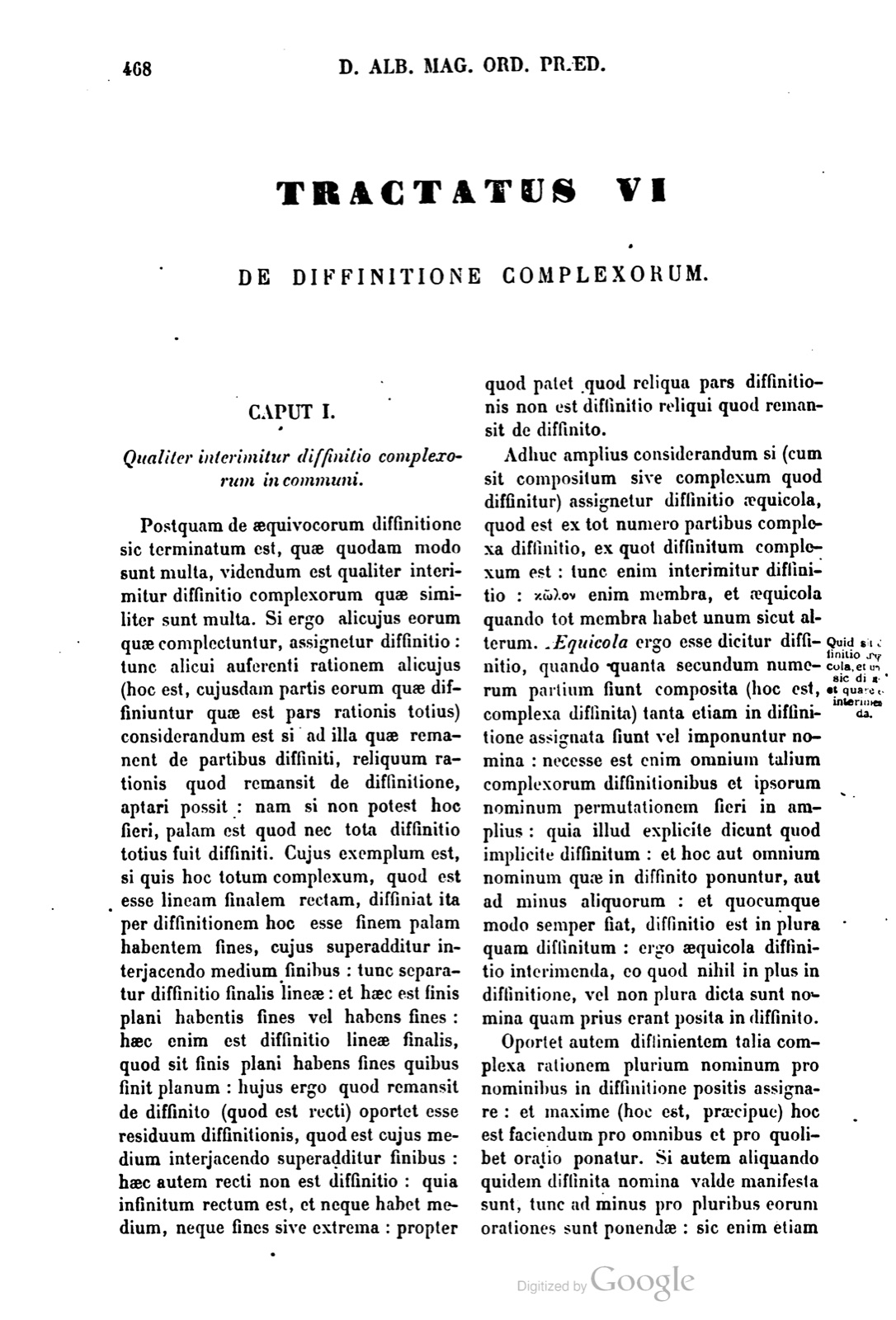
CAPUT I. Qualiter interimitur diffinitio complexorum in communi.
Postquam de aequivocorum diffinitione sic terminatum est, quae quodam modo sunt multa, videndum est qualiter interimitur diffinitio complexorum quae similiter sunt multa. Si ergo alicujus eorum quae complectuntur, assignetur diffinitio: tunc alicui auferenti rationem alicujus (hoc est, cujusdam partis eorum quae diffiniuntur quae est pars rationis totius) considerandum est si ad illa quae remanent de partibus diffiniti, reliquum rationis quod remansit de diffinitione, aptari possit: nam si non potest hoc fieri, palam est quod nec tota diffinitio totius fuit diffiniti. Cujus exemplum est, si quis hoc totum complexum, quod est esse lineam finalem rectam, diffiniat ita per diffinitionem hoc esse finem palam habentem fines, cujus superadditur interjacendo medium finibus: tunc separatur diffinitio finalis lineae: et haec est finis plani habentis fines vel habens fines: haec enim est diffinitio lineae finalis, quod sit finis plani habens fines quibus finit planum: hujus ergo quod remansit de diffinito (quod est recti) oportet esse residuum diffinitionis, quod est cujus medium interjacendo superadditur finibus: haec autem recti non est diffinitio: quia infinitum rectum est, et neque habet medium, neque fines sive extrema: propter quod patet quod reliqua pars diffinitionis non est diffinitio reliqui quod remansit de diffinito.
Adhuc amplius considerandum si (cum sit compositum sive complexum quod diffinitur) assignetur diffinitio aequicola, quod est ex tot numero partibus complexa diffinitio, ex quot diffinitum complexum est: tunc enim interimitur diffinitio: κῶλον enim membra, et aequicola quando tot membra habet unum sicut alterum. Aequicola ergo esse dicitur diffinitio, quando quanta secundum numerum partium fiunt composita (hoc est, complexa diffinita) tanta etiam in diffinitione assignata fiunt vel imponuntur nomina: necesse est enim omnium talium complexorum diffinitionibus et ipsorum nominum permutationem fieri in amplius: quia illud explicite dicunt quod implicite diffinitum: et hoc aut omnium nominum quae in diffinito ponuntur, aut ad minus aliquorum: et quocumque modo semper fiat, diffinitio est in plura quam diffinitum: ergo aequicola diffinitio interimenda, eo quod nihil in plus in diffinitione, vel non plura dicta sunt nomina quam prius erant posita in diffinito.
Oportet autem diffinientem talia complexa rationem plurium nominum pro nominibus in diffinitione positis assignare: et maxime (hoc est, praecipue) hoc est faciendum pro omnibus et pro quolibet oratio ponatur. Si autem aliquando quidem diffinita nomina valde manifesta sunt, tunc ad minus pro pluribus eorum orationes sunt ponendae: sic enim etiam fit in simplicibus, hoc est, in complexis. Unde si nomen in nomen et non in orationem transumat, non erit diffiniens. Ut si transumat pro tunica hoc nomen, vestem, licet vestis communius et notius sit tunica: tamen quia unicum nomen est, non est diffinitio.
TRACTATE VI. ON THE DEFINITION OF COMPLEX THINGS.
CHAPTER I. How the definition of complex things is destroyed in common.
After the definition of equivocal things has thus been completed, things which in some way are many, one must see how the definition of complex things, which similarly are many, is destroyed. Therefore if a definition is assigned of any of those things which are complex, then, for someone taking away the account of something, that is, of a certain part of those things which are defined, which is part of the account of the whole, one must consider whether the remaining account which remains from the definition can be fitted to those things which remain of the parts of the defined thing. For if this cannot be done, it is plain that not even the whole definition belonged to the whole defined thing. An example is if someone defines this whole complex, which is to be a final straight line, by definition in such a way that this is an end plainly having ends, to which a middle is superadded by lying between the ends; then the definition of final line is separated, and this is the end of a plane having ends or having ends. For this is the definition of final line, that it is the end of a plane having ends by which it terminates the plane. Therefore of this which remains of the defined thing, which is of straight, there must be the residue of the definition, which is that whose middle is superadded by lying between ends. But this is not the definition of straight, because an infinite straight thing exists and has neither middle nor ends or extremes; on account of which it is clear that the remaining part of the definition is not the definition of the remaining thing which remained from the defined thing.
Further, one must consider whether, when what is defined is a composite or complex thing, an equal-membered definition is assigned, which is a definition complex from as many parts in number as the complex defined thing is; for then the definition is destroyed. For κῶλον means members, and something is equal-membered when one thing has as many members as the other. Therefore a definition is said to be equal-membered when, as many things as are made composite according to the number of parts, that is, defined complexes, so many names also are made or imposed in the assigned definition. For in definitions of all such complexes there must be a permutation of the names themselves into something broader, because they state explicitly what the defined thing states implicitly; and this either for all the names which are placed in the defined thing, or at least for some of them. And in whatever way it always happens, the definition is in more things than the defined thing; therefore an equal-membered definition must be destroyed, because nothing broader is in the definition, or no more names have been stated than had first been posited in the defined thing.
But one defining such complex things must assign the account of several names in place of the names posited in the definition; and especially, that is, principally, this must be done for all, and an expression must be posited for each. But if sometimes the defined names are very manifest, then at least expressions must be posited for many of them; for thus it also happens in simple things, that is, in complex things. Hence if he transfers name into name and not into an expression, he will not be defining. Thus if he transfers this name garment in place of tunic, although garment is more common and better known than tunic, nevertheless, because it is a single name, it is not a definition.
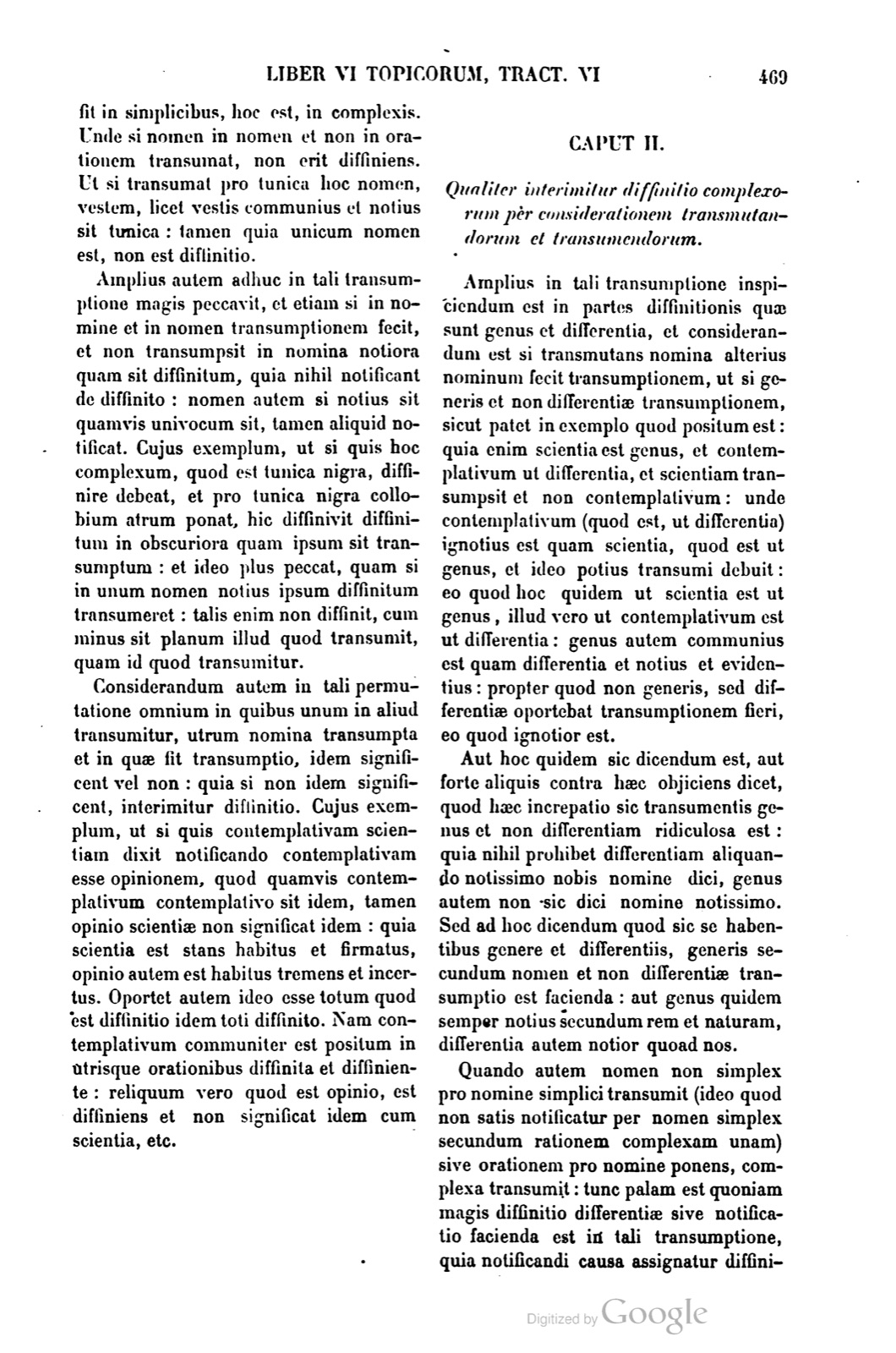
Amplius autem adhuc in tali transumptione magis peccavit, et etiam si in nomine et in nomen transumptionem fecit, et non transumpsit in nomina notiora quam sit diffinitum, quia nihil notificat de diffinito: nomen autem si notius sit quamvis univocum sit, tamen aliquid notificat. Cujus exemplum, ut si quis hoc complexum, quod est tunica nigra, diffinire debeat, et pro tunica nigra collobium atrum ponat, hic diffinivit diffinitum in obscuriora quam ipsum sit transumptum: et ideo plus peccat, quam si in unum nomen notius ipsum diffinitum transumeret: talis enim non diffinit, cum minus sit planum illud quod transumit, quam id quod transumitur.
Considerandum autem in tali permutatione omnium in quibus unum in aliud transumitur, utrum nomina transumpta et in quae fit transumptio, idem significent vel non: quia si non idem significant, interimitur diffinitio. Cujus exemplum, ut si quis contemplativam scientiam dixit notificando contemplativam esse opinionem, quod quamvis contemplativum contemplativo sit idem, tamen opinio scientiae non significat idem: quia scientia est stans habitus et firmatus, opinio autem est habitus tremens et incertus. Oportet autem ideo esse totum quod est diffinitio idem toti diffinito. Nam contemplativum communiter est positum in utrisque orationibus diffinita et diffiniente: reliquum vero quod est opinio, est diffiniens et non significat idem cum scientia, etc.
CAPUT II. Qualiter interimitur diffinitio complexorum per considerationem transmutandorum et transumendorum.
Amplius in tali transumptione inspiciendum est in partes diffinitionis quae sunt genus et differentia, et considerandum est si transmutans nomina alterius nominum fecit transumptionem, ut si generis et non differentiae transumptionem, sicut patet in exemplo quod positum est: quia enim scientia est genus, et contemplativum ut differentia, et scientiam transumpsit et non contemplativum: unde contemplativum (quod est, ut differentia) ignotius est quam scientia, quod est ut genus, et ideo potius transumi debuit: eo quod hoc quidem ut scientia est ut genus, illud vero ut contemplativum est ut differentia: genus autem communius est quam differentia et notius et evidentius: propter quod non generis, sed differentiae oportebat transumptionem fieri, eo quod ignotior est.
Aut hoc quidem sic dicendum est, aut forte aliquis contra haec objiciens dicet, quod haec increpatio sic transumentis genus et non differentiam ridiculosa est: quia nihil prohibet differentiam aliquando notissimo nobis nomine dici, genus autem non sic dici nomine notissimo. Sed ad hoc dicendum quod sic se habentibus genere et differentiis, generis secundum nomen et non differentiae transumptio est facienda: aut genus quidem semper notius secundum rem et naturam, differentia autem notior quoad nos.
Furthermore, in such transfer one has erred still more if he has also made a transfer in a name and into a name, and has not transferred into names better known than the defined thing, because it makes nothing known about the defined thing; but if the name is better known, even if it is univocal, nevertheless it makes something known. An example is that if someone has to define this complex, black tunic, and in place of black tunic posits dark cloak, he has here defined the defined thing into things more obscure than the transferred thing itself; and therefore he errs more than if he had transferred the defined thing itself into one name better known. For such a person does not define, since that which he transfers is less plain than that which is transferred.
But in such permutation of all things in which one thing is transferred into another, one must consider whether the names transferred and those into which the transfer is made signify the same thing or not; because if they do not signify the same thing, the definition is destroyed. An example is if someone, making known contemplative science, has said that contemplative is opinion. Although contemplative is the same as contemplative, nevertheless opinion does not signify the same as science, because science is a standing and firm habit, but opinion is a trembling and uncertain habit. Therefore the whole which is the definition must be the same as the whole defined thing. For contemplative is placed commonly in both expressions, the defined and the defining; but the remainder, which is opinion, is defining and does not signify the same as science, etc.
CHAPTER II. How the definition of complex things is destroyed through consideration of things to be transmuted and transferred.
Furthermore, in such transfer one must inspect the parts of definition, which are genus and difference, and must consider whether the one transmuting names has made a transfer of one of the names, as if of genus and not of difference, as is clear in the example which has been posited. For since science is genus and contemplative as difference, and he transferred science and not contemplative, hence contemplative, which is as difference, is more unknown than science, which is as genus, and therefore it ought rather to have been transferred; because this, namely science, is as genus, but that, namely contemplative, is as difference. But genus is more common than difference and better known and more evident; on account of which the transfer ought to have been made not of genus but of difference, because it is more unknown.
Either this must be said in this way, or perhaps someone objecting against these things will say that this rebuke of one thus transferring genus and not difference is ridiculous, because nothing prevents a difference from sometimes being said by a name very well known to us, while genus is not thus said by a name very well known. But to this it must be said that when genus and differences have themselves in this way, the transfer according to name must be made of genus and not of difference; or rather genus is always better known according to thing and nature, but difference is better known with respect to us.
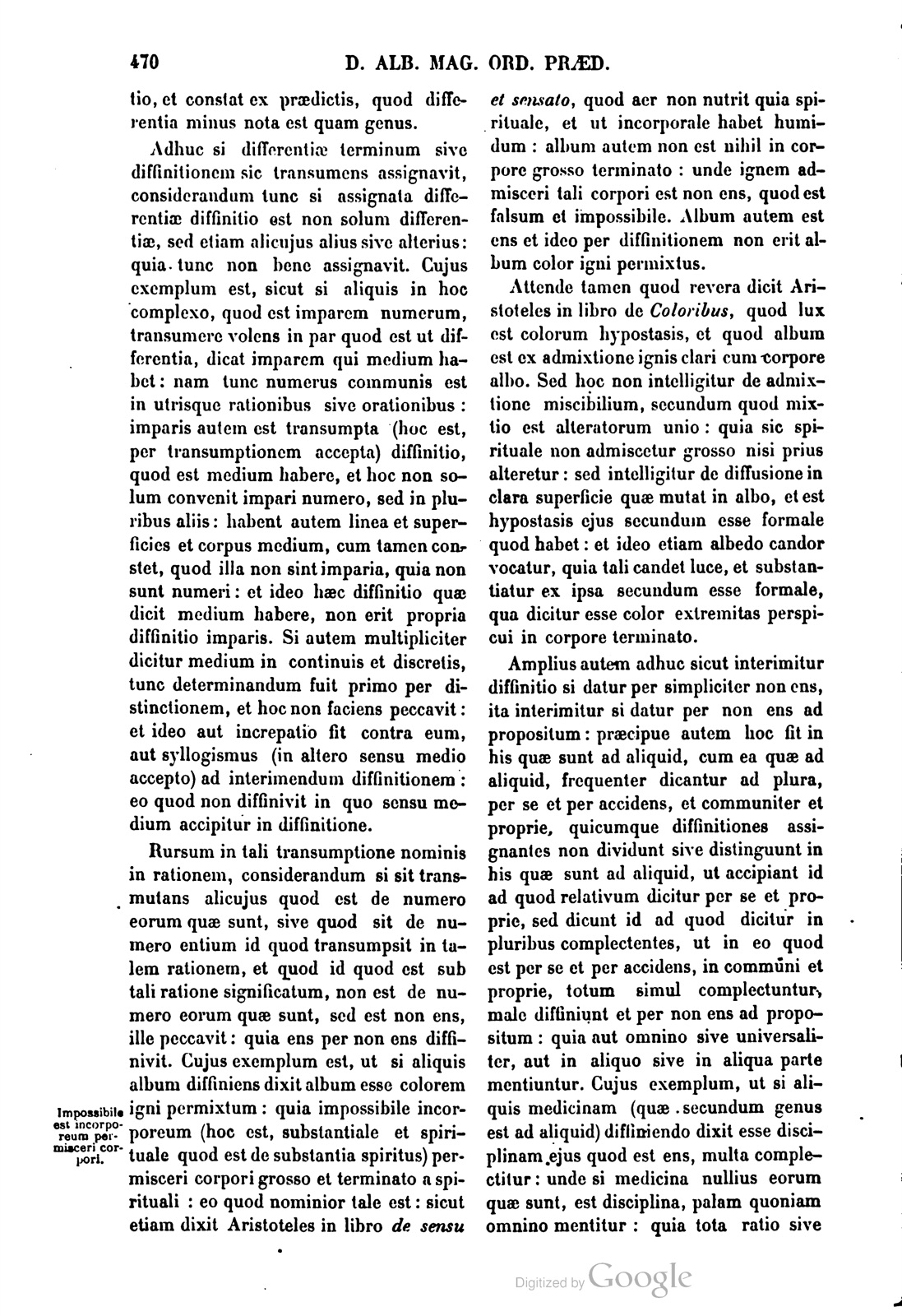
Quando autem nomen non simplex pro nomine simplici transumit (ideo quod non satis notificatur per nomen simplex secundum rationem complexam unam) sive orationem pro nomine ponens, complexa transumit: tunc palam est quoniam magis diffinitio differentiae sive notificatio facienda est in tali transumptione, quia notificandi causa assignatur diffinitio, et constat ex praedictis, quod differentia minus nota est quam genus.
Adhuc si differentiae terminum sive diffinitionem sic transumens assignavit, considerandum tunc si assignata differentiae diffinitio est non solum differentiae, sed etiam alicujus alius sive alterius: quia tunc non bene assignavit. Cujus exemplum est, sicut si aliquis in hoc complexo, quod est imparem numerum, transumere volens in par quod est ut differentia, dicat imparem qui medium habet: nam tunc numerus communis est in utrisque rationibus sive orationibus: imparis autem est transumpta (hoc est, per transumptionem accepta) diffinitio, quod est medium habere, et hoc non solum convenit impari numero, sed in pluribus aliis: habent autem linea et superficies et corpus medium, cum tamen constet, quod illa non sint imparia, quia non sunt numeri: et ideo haec diffinitio quae dicit medium habere, non erit propria diffinitio imparis. Si autem multipliciter dicitur medium in continuis et discretis, tunc determinandum fuit primo per distinctionem, et hoc non faciens peccavit: et ideo aut increpatio fit contra eum, aut syllogismus (in altero sensu medio accepto) ad interimendum diffinitionem: eo quod non diffinivit in quo sensu medium accipitur in diffinitione.
Rursum in tali transumptione nominis in rationem, considerandum si sit transmutans alicujus quod est de numero eorum quae sunt, sive quod sit de numero entium id quod transumpsit in talem rationem, et quod id quod est sub tali ratione significatum, non est de numero eorum quae sunt, sed est non ens, ille peccavit: quia ens per non ens diffinivit. Cujus exemplum est, ut si aliquis album diffiniens dixit album esse colorem igni permixtum: quia impossibile incorporeum (hoc est, substantiale et spirituale quod est de substantia spiritus) permisceri corpori grosso et terminato a spirituali: eo quod nominior tale est: sicut etiam dixit Aristoteles in libro de sensu et sensato, quod aer non nutrit quia spirituale, et ut incorporale habet humidum: album autem non est nihil in corpore grosso terminato: unde ignem admisceri tali corpori est non ens, quod est falsum et impossibile. Album autem est ens et ideo per diffinitionem non erit album color igni permixtus.
Attende tamen quod revera dicit Aristoteles in libro de Coloribus, quod lux est colorum hypostasis, et quod album est ex admixtione ignis clari cum corpore albo. Sed hoc non intelligitur de admixtione miscibilium, secundum quod mixtio est alteratorum unio: quia sic spirituale non admiscetur grosso nisi prius alteretur: sed intelligitur de diffusione in clara superficie quae mutat in albo, et est hypostasis ejus secundum esse formale quod habet: et ideo etiam albedo candor vocatur, quia tali candet luce, et substantiatur ex ipsa secundum esse formale, qua dicitur esse color extremitas perspicui in corpore terminato.
But when he transfers a non-simple name in place of a simple name, because it is not sufficiently made known by a simple name according to one complex account, or, placing an expression in place of a name, transfers complex things, then it is plain that the definition or making-known of the difference must be made more in such transfer, because definition is assigned for the sake of making known, and it is clear from what has been said before that difference is less known than genus.
Further, if one transferring in this way has assigned the term or definition of the difference, one must then consider whether the assigned definition of the difference belongs not only to the difference but also to some other or another thing; because then he has not assigned well. An example is as if someone, wishing to transfer in this complex which is odd number into even, which is as difference, should say that odd is what has a middle; for then common number is in both accounts or expressions, but the transferred definition of odd, that is, the definition received through transfer, is what has a middle, and this belongs not only to odd number but to several other things; for line and surface and body have a middle, although it is clear that those are not odd, because they are not numbers. And therefore this definition which says to have a middle will not be the proper definition of odd. But if middle is said in many ways in continuous and discrete things, then it should first have been determined through distinction; and one not doing this has erred. Therefore either a rebuke is made against him, or a syllogism, with middle taken in the other sense, for destroying the definition, because he did not define in what sense middle is taken in the definition.
Again, in such transfer of name into account, one must consider whether what he transferred into such an account belongs to the number of those things which are, or is of the number of beings, and whether that which is signified under such an account is not of the number of those things which are, but is non-being. Such a person has erred, because he has defined being through non-being. An example is if someone defining white has said that white is a color mixed with fire; because it is impossible for an incorporeal thing, that is, a substantial and spiritual thing which is of the substance of spirit, to be mixed with a gross body and one terminated by the spiritual, because such a thing is more name-like; as Aristotle also said in the book On Sense and the Sensible, that air does not nourish because it is spiritual, and as incorporeal it has moisture. But white is not nothing in a gross terminated body; hence for fire to be mixed with such a body is non-being, which is false and impossible. But white is being, and therefore by definition white will not be color mixed with fire.
Yet note that Aristotle truly says in the book On Colors that light is the hypostasis of colors, and that white is from the admixture of clear fire with a white body. But this is not understood of the admixture of mixable things, according as mixture is the union of altered things, because in this way the spiritual is not admixed to the gross unless it is first altered; rather, it is understood of diffusion in a clear surface which changes in white, and is its hypostasis according to the formal being which it has. And therefore whiteness is also called brightness, because it shines with such light, and is substantiated from it according to formal being, by which it is said to be color, the extremity of the transparent in a terminated body.
Amplius autem adhuc sicut interimitur diffinitio si datur per simpliciter non ens, ita interimitur si datur per non ens ad propositum: praecipue autem hoc fit in his quae sunt ad aliquid, cum ea quae ad aliquid, frequenter dicantur ad plura, per se et per accidens, et communiter et proprie, quicumque diffinitiones assignantes non dividunt sive distinguunt in his quae sunt ad aliquid, ut accipiant id ad quod relativum dicitur per se et proprie, sed dicunt id ad quod dicitur in pluribus complectentes, ut in eo quod est per se et per accidens, in communi et proprie, totum simul complectuntur, male diffiniunt et per non ens ad propositum: quia aut omnino sive universaliter, aut in aliquo sive in aliqua parte mentiuntur. Cujus exemplum, ut si aliquis medicinam (quae secundum genus est ad aliquid) diffiniendo dixit esse disciplinam ejus quod est ens, multa complectitur: unde si medicina nullius eorum quae sunt, est disciplina, palam quoniam omnino mentitur: quia tota ratio sive diffinitio falsa: dicitur enim in toto falsa, quia pro toto falsa, quia non continetur in eo ad quod assignatur, nihil enim entium est cujus ipsa sit disciplina. Si autem ostendatur quod medicina est alicujus entis disciplina et alicujus non, tunc ratio sive diffinitio in aliquo mentitur, et hoc est inconveniens, quia ratio entium debet vera esse: si enim per se est diffinitio et non secundum accidens, oportet quod sit de omni eo ad quod dicitur, quemadmodum etiam in aliis diffinitionibus se habet quae sunt ad aliquid, quas omnes oportet esse de omni, nam omne disciplinatum ad disciplinam dicitur in quantum disciplinatum est. Et similiter est etiam in aliis: et hoc ideo quia quae ad aliquid sunt, convertuntur, sive ad convertentiam dicuntur.
Amplius si forte aliquis dicat, quod quando dicitur medicina disciplina entis, haec est quaedam diffinitio, sed non assignatur ad id ad quod est per se, sed ad id ad quod est per accidens: et sic quod dicat, quod ratione diffinitionem assignavit: tunc sequitur inconveniens, quia sic singulum eorum quae ad aliquid dicuntur, non ad unum, sed ad plura dicitur, quae accidunt illi ad quod dicitur: nihil enim prohibet ens ad quod assignatur, et album et bonum esse et plura alia per accidens. Propter quod sequitur, quod qui medicinam ad quodlibet assignavit et recte assignavit, ut dicit adversarius, sequitur quod qui id quod est ad aliquid, ad id ad quod secundum accidens dicitur, assignavit, recte assignavit, quod falsum est, cum diffinitio dicat esse substantiale et per se.
Amplius autem aliud inconveniens sequitur, quia impossibile est hujus rationem esse propriam assignationem ejus quod est ad aliquid: planum enim est, quod non sola medicina est entis, sed plures de numero aliarum disciplinarum, ut geometria et arithmetica dicuntur esse ad esse sive ad ens: propter quod sequitur, quod unaquaeque illarum erit disciplina entis: non ergo medicina est proprium ad ens diffinitum: et sic diffinitio non convertitur.
Furthermore, just as definition is destroyed if it is given through what is simply non-being, so it is destroyed if it is given through non-being with respect to the proposal. But this happens especially in those things which are toward something, since those things which are toward something are frequently said toward several things, through themselves and by accident, commonly and properly. Whoever, in assigning definitions, do not divide or distinguish in those things which are toward something, so as to receive that toward which the relative is said through itself and properly, but state that toward which it is said while embracing many things, so that they include everything at once in that which is through itself and by accident, commonly and properly, define badly and through non-being with respect to the proposal, because either wholly or universally, or in something or in some part, they lie. An example is if someone, in defining medicine, which according to genus is toward something, has said that it is the discipline of that which is being; he embraces many things. Hence if medicine is the discipline of none of the things which are, it is plain that he lies wholly, because the whole account or definition is false. For it is said to be false in the whole, because false for the whole, since it is not contained in that toward which it is assigned; for there is no being of which it itself is the discipline. But if it is shown that medicine is the discipline of some being and not of some other, then the account or definition lies in something, and this is unsuitable, because the account of beings ought to be true. For if the definition is through itself and not according to accident, it must be of everything toward which it is said, just as it also has itself in other definitions which are toward something, all of which must be of every case; for every disciplined thing is said toward discipline insofar as it is disciplined. And similarly it is also in other cases, and this because things which are toward something are converted, or are said toward convertence.
Furthermore, if perhaps someone says that when medicine is called a discipline of being, this is a certain definition, but it is not assigned toward that toward which it is through itself, but toward that toward which it is by accident, and thus he says that he has assigned a definition by reason, then an unsuitable consequence follows: because in this way each of those things which are said toward something is said not toward one thing, but toward many, which happen to that toward which it is said. For nothing prevents the being toward which it is assigned from being also white and good and many other things by accident. Therefore it follows that one who assigned medicine to anything whatever, and assigned it rightly, as the adversary says, consequently one who assigned that which is toward something to that toward which it is said according to accident assigned it rightly; this is false, since definition states substantial and through-itself being.
Furthermore, another unsuitable consequence follows, because it is impossible for the account of this to be the proper assignment of that which is toward something. For it is plain that not medicine alone belongs to being, but several from the number of other disciplines, such as geometry and arithmetic, are said to be toward being or toward what is; on account of which it follows that each of those will be a discipline of being. Therefore medicine is not proper to being as defined, and so the definition is not converted.
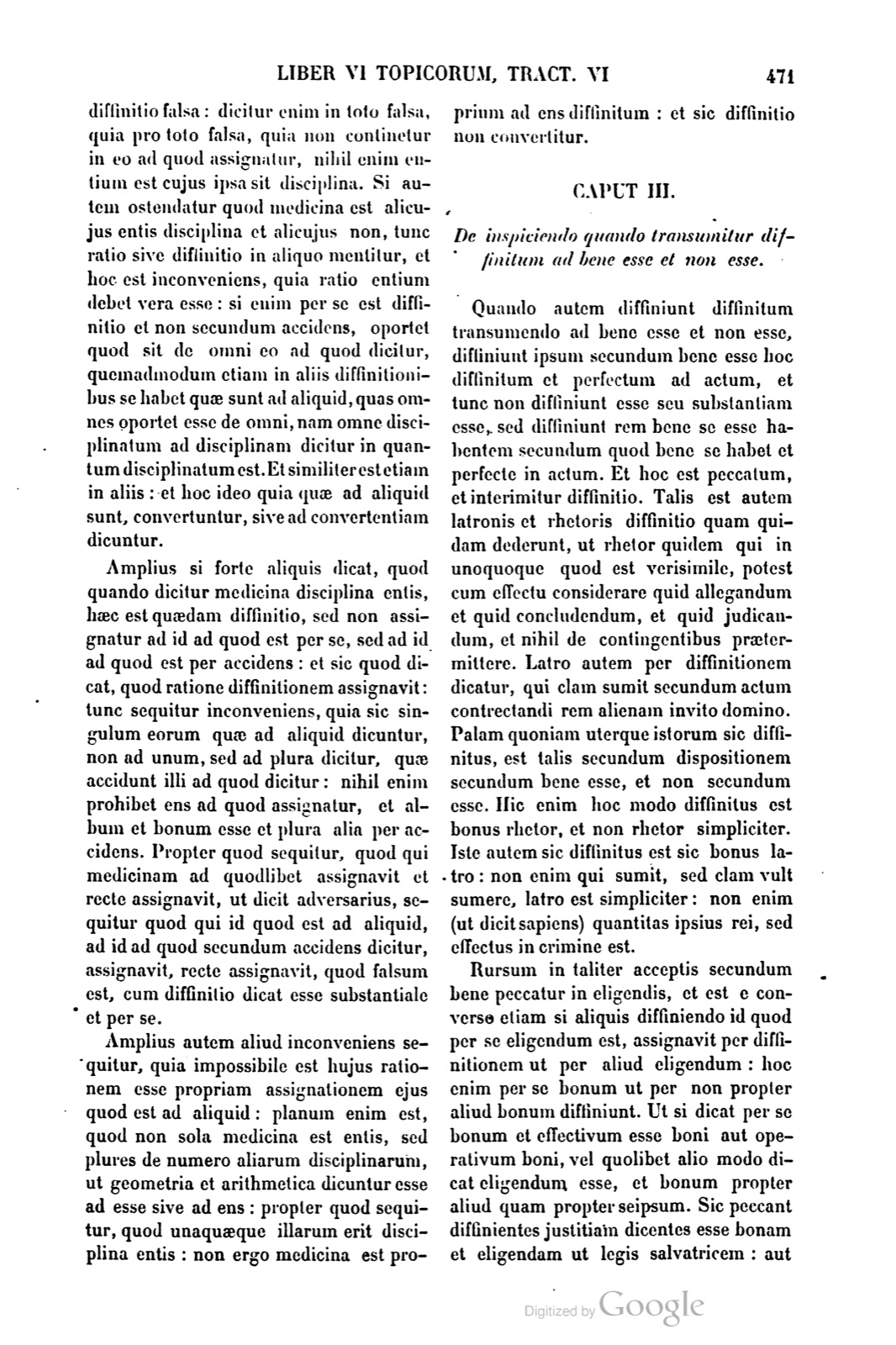
CAPUT III. De inspiciendo quando transumitur diffinitum ad bene esse et non esse.
Quando autem diffiniunt diffinitum transumendo ad bene esse et non esse, diffiniunt ipsum secundum bene esse hoc diffinitum et perfectum ad actum, et tunc non diffiniunt esse seu substantiam esse, sed diffiniunt rem bene se esse habentem secundum quod bene se habet et perfecte in actum. Et hoc est peccatum, et interimitur diffinitio. Talis est autem latronis et rhetoris diffinitio quam quidam dederunt, ut rhetor quidem qui in unoquoque quod est verisimile, potest cum effectu considerare quid allegandum et quid concludendum, et quid judicandum, et nihil de contingentibus praetermittere. Latro autem per diffinitionem dicatur, qui clam sumit secundum actum contrectandi rem alienam invito domino. Palam quoniam uterque istorum sic diffinitus, est talis secundum dispositionem secundum bene esse, et non secundum esse. Hic enim hoc modo diffinitus est bonus rhetor, et non rhetor simpliciter. Iste autem sic diffinitus est sic bonus latro: non enim qui sumit, sed clam vult sumere, latro est simpliciter: non enim (ut dicit sapiens) quantitas ipsius rei, sed effectus in crimine est.
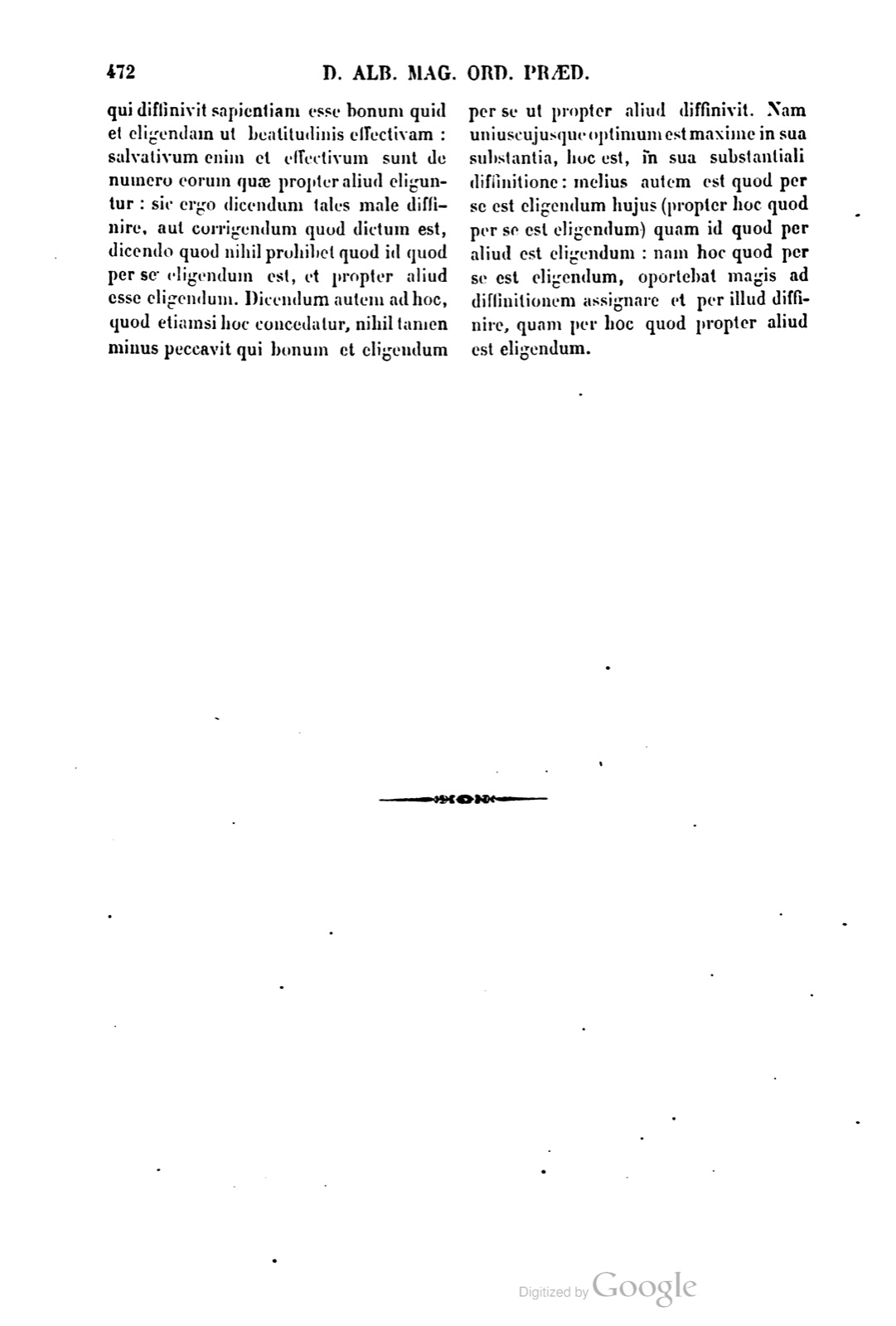
Rursum in taliter acceptis secundum bene peccatur in eligendis, et est e converso etiam si aliquis diffiniendo id quod per se eligendum est, assignavit per diffinitionem ut per aliud eligendum: hoc enim per se bonum ut per non propter aliud bonum diffiniunt. Ut si dicat per se bonum et effectivum esse boni aut operativum boni, vel quolibet alio modo dicat eligendum esse, et bonum propter aliud quam propter seipsum. Sic peccant diffinientes justitiam dicentes esse bonam et eligendam ut legis salvatricem: aut qui diffinivit sapientiam esse bonum quid et eligendam ut beatitudinis effectivam: salvativum enim et effectivum sunt de numero eorum quae propter aliud eliguntur: sic ergo dicendum tales male diffinire, aut corrigendum quod dictum est, dicendo quod nihil prohibet quod id quod per se eligendum est, et propter aliud esse eligendum. Dicendum autem ad hoc, quod etiamsi hoc concedatur, nihil tamen minus peccavit qui bonum et eligendum per se ut propter aliud diffinivit. Nam uniuscujusque optimum est maxime in sua substantia, hoc est, in sua substantiali diffinitione: melius autem est quod per se est eligendum hujus (propter hoc quod per se est eligendum) quam id quod per aliud est eligendum: nam hoc quod per se est eligendum, oportebat magis ad diffinitionem assignare et per illud diffinire, quam per hoc quod propter aliud est eligendum.
CHAPTER III. On inspecting when the defined thing is transferred to well-being and not to being.
But when they define a defined thing by transferring it to well-being and not being, they define it according to well-being, as this defined thing and as perfected to act; and then they do not define being or substantial being, but define the thing as having itself well according as it has itself well and perfectly in act. And this is an error, and the definition is destroyed. Such is the definition of thief and rhetor which certain persons have given: a rhetor, namely, as one who in each case of what is likely can consider effectively what must be alleged and what concluded and what judged, and omit nothing of the contingents; but a thief is said by definition to be one who secretly takes according to the act of handling another's thing against the owner's will. It is plain that each of these, thus defined, is such according to a disposition according to well-being, and not according to being. For one defined in this way is a good rhetor, and not a rhetor simply. But that one thus defined is in this way a good thief; for not one who takes, but one who secretly wills to take, is a thief simply; for, as the wise man says, not the quantity of the thing itself, but the effect in the crime is what matters.
Again, in things taken in such a way according to the good, error is committed in things to be chosen; and conversely also, if someone in defining that which is to be chosen through itself has assigned it by definition as to be chosen through something else. For they define this good through itself as good not for its own sake. Thus if he says that the through-itself good is also productive of good or operative of good, or says in any other way that it is choiceworthy and good on account of something other than itself. Thus those defining justice err when they say that it is good and to be chosen as preservative of law; or one who defined wisdom as something good and to be chosen as productive of beatitude; for preservative and productive are among the number of those things which are chosen on account of something else. Therefore such people must be said to define badly, or what has been said must be corrected by saying that nothing prevents that which is to be chosen through itself from also being to be chosen on account of another. But to this it must be said that, even if this is conceded, nevertheless he who defined the good and choiceworthy through itself as on account of something else erred no less. For the best thing of each thing is especially in its substance, that is, in its substantial definition; but what is to be chosen through itself is better in this respect, because it is to be chosen through itself, than what is to be chosen through another. For that which is to be chosen through itself ought rather to have been assigned to the definition and defined through it than through this, which is to be chosen on account of another.
If a page does not appear, its photograph has not been uploaded yet.