Volume 2 · pp. 475–478
Book VI, Tractate VII, Chapters I-III.
A marker with ≈ is an approximate page boundary, placed by measure of the text; the page photographs remain the authority. In the paired views, clicking a page marker brings that page into view.
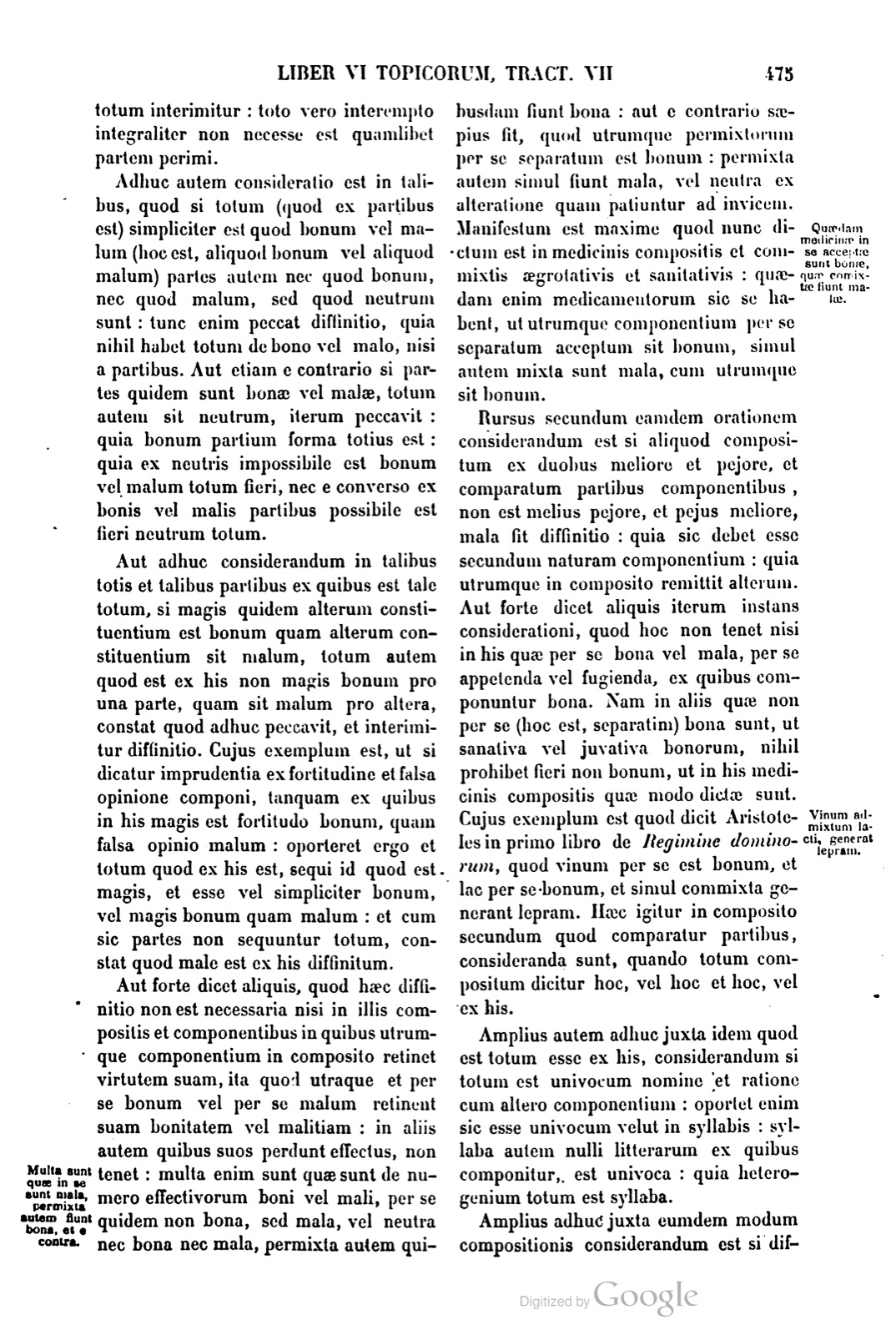
totum interimitur: toto vero interempto integraliter non necesse est quamlibet partem perimi.
Adhuc autem consideratio est in talibus, quod si totum (quod ex partibus est) simpliciter est quod bonum vel malum (hoc est, aliquod bonum vel aliquod malum) partes autem nec quod bonum, nec quod malum, sed quod neutrum sunt: tunc enim peccat diffinitio, quia nihil habet totum de bono vel malo, nisi a partibus. Aut etiam e contrario si partes quidem sunt bonae vel malae, totum autem sit neutrum, iterum peccavit: quia bonum partium forma totius est: quia ex neutris impossibile est bonum vel malum totum fieri, nec e converso ex bonis vel malis partibus possibile est fieri neutrum totum.
Aut adhuc considerandum in talibus totis et talibus partibus ex quibus est tale totum, si magis quidem alterum constituentium est bonum quam alterum constituentium sit malum, totum autem quod est ex his non magis bonum pro una parte, quam sit malum pro altera, constat quod adhuc peccavit, et interimitur diffinitio. Cujus exemplum est, ut si dicatur imprudentia ex fortitudine et falsa opinione componi, tanquam ex quibus in his magis est fortitudo bonum, quam falsa opinio malum: oporteret ergo et totum quod ex his est, sequi id quod est magis, et esse vel simpliciter bonum, vel magis bonum quam malum: et cum sic partes non sequuntur totum, constat quod male est ex his diffinitum.
Aut forte dicet aliquis, quod haec diffinitio non est necessaria nisi in illis compositis et componentibus in quibus utrumque componentium in composito retinet virtutem suam, ita quod utraque et per se bonum vel per se malum retinent suam bonitatem vel malitiam: in aliis autem quibus suos perdunt effectus, non tenet: multa enim sunt quae sunt de numero effectivorum boni vel mali, per se quidem non bona, sed mala, vel neutra nec bona nec mala, permixta autem quibusdam fiunt bona: aut e contrario saepius fit, quod utrumque permixtorum per se separatum est bonum: permixta autem simul fiunt mala, vel neutra ex alteratione quam patiuntur ad invicem. Manifestum est maxime quod nunc dictum est in medicinis compositis et commixtis aegrotativis et sanitativis: quaedam enim medicamentorum sic se habent, ut utrumque componentium per se separatum acceptum sit bonum, simul autem mixta sunt mala, cum utrumque sit bonum.
Rursus secundum eamdem orationem considerandum est si aliquod compositum ex duobus meliore et pejore, et comparatum partibus componentibus, non est melius pejore, et pejus meliore, mala fit diffinitio: quia sic debet esse secundum naturam componentium: quia utrumque in composito remittit alterum. Aut forte dicet aliquis iterum instans considerationi, quod hoc non tenet nisi in his quae per se bona vel mala, per se appetenda vel fugienda, ex quibus componuntur bona. Nam in aliis quae non per se (hoc est, separatim) bona sunt, ut sanativa vel juvativa bonorum, nihil prohibet fieri non bonum, ut in his medicinis compositis quae modo dictae sunt. Cujus exemplum est quod dicit Aristoteles in primo libro de Regimine dominorum, quod vinum per se est bonum, et lac per se bonum, et simul commixta generant lepram. Haec igitur in composito secundum quod comparatur partibus, consideranda sunt, quando totum compositum dicitur hoc, vel hoc et hoc, vel ex his.
Amplius autem adhuc juxta idem quod est totum esse ex his, considerandum si totum est univocum nomine et ratione cum altero componentium: oportet enim sic esse univocum velut in syllabis: syllaba autem nulli litterarum ex quibus componitur, est univoca: quia heterogenium totum est syllaba.
the whole is destroyed; but when the whole has been integrally destroyed, it is not necessary that each part perish.
Further, in such things the consideration is that if the whole, which is from parts, is simply something good or evil, that is, some good or some evil, while the parts are neither something good nor something evil but neutral, then the definition errs, because the whole has nothing of good or evil except from the parts. Or conversely, if the parts indeed are good or evil but the whole is neutral, again it has erred, because the good of the parts is the form of the whole; for from neutral things it is impossible for a good or evil whole to come to be, nor conversely is it possible from good or evil parts for a neutral whole to come to be.
One must also consider in such wholes and such parts from which such a whole exists whether one constituent is more good than the other constituent is evil, while the whole which is from them is not more good on the one side than evil on the other; it is clear that it has still erred, and the definition is destroyed. The example is if imprudence is said to be composed from fortitude and false opinion, as from things among which fortitude is more good than false opinion is evil; therefore the whole which is from these ought to follow that which is greater, and be either simply good or more good than evil. And since in this way the parts do not follow the whole, it is clear that it has been badly defined from these.
Or perhaps someone will say that this definition is necessary only in those composites and components in which each component retains its own power in the composite, so that each retains its own goodness or malice as good through itself or evil through itself; but in others in which they lose their own effects, it does not hold. For many things are from the number of effectives of good or evil, yet through themselves not good, but evil, or neutral, neither good nor evil, while when mixed with certain things they become good; or conversely it more often happens that each of the things mixed, separated through itself, is good, but when mixed together they become evil, or neutral, from the alteration which they undergo toward each other. What has now been said is most manifest in compounded and mixed medicines, sickness-making and health-making; for certain medicines stand so that each component taken separately through itself is good, but mixed together they are evil, although each is good.
Again, according to the same expression, one must consider whether some composite from two things, a better and a worse, when compared to its component parts, is not better than the worse and worse than the better; the definition becomes bad, because it ought to be so according to the nature of the components, since each remits the other in the composite. Or perhaps someone again pressing against the consideration will say that this holds only in those things which are good or evil through themselves, to be sought or fled through themselves, from which good things are composed. For in others which are not good through themselves, that is, separately, such as things health-making or helpful to goods, nothing prevents a not-good thing from being made, as in those compounded medicines which have just been mentioned. The example is what Aristotle says in the first book On the Governance of Masters, that wine through itself is good, and milk through itself is good, and mixed together they generate leprosy. Therefore these things must be considered in the composite according as it is compared to its parts, when the composite whole is called this, or this and this, or from these.
Furthermore, still according to the same point that the whole is from these, one must consider whether the whole is univocal in name and account with one of the components; for it must be univocal in this way, as in syllables, but a syllable is univocal with none of the letters from which it is composed, because the syllable is a heterogeneous whole.
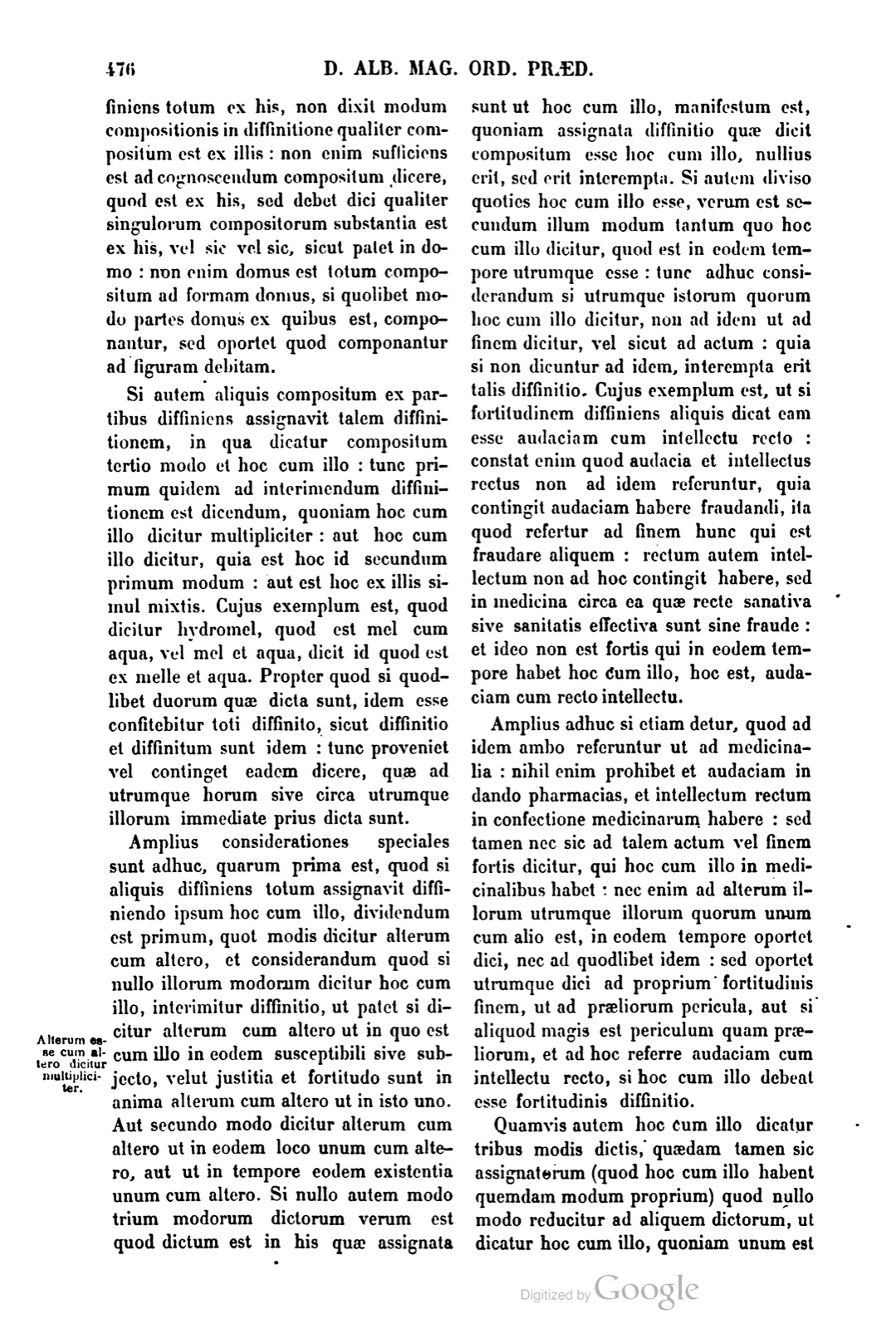
Amplius adhuc juxta eumdem modum compositionis considerandum est si diffiniens totum ex his, non dixit modum compositionis in diffinitione qualiter compositum est ex illis: non enim sufficiens est ad cognoscendum compositum dicere, quod est ex his, sed debet dici qualiter singulorum compositorum substantia est ex his, vel sic vel sic, sicut patet in domo: non enim domus est totum compositum ad formam domus, si quolibet modo partes domus ex quibus est, componantur, sed oportet quod componantur ad figuram debitam.
Si autem aliquis compositum ex partibus diffiniens assignavit talem diffinitionem, in qua dicatur compositum tertio modo et hoc cum illo: tunc primum quidem ad interimendum diffinitionem est dicendum, quoniam hoc cum illo dicitur multipliciter: aut hoc cum illo dicitur, quia est hoc id secundum primum modum: aut est hoc ex illis simul mixtis. Cujus exemplum est, quod dicitur hydromel, quod est mel cum aqua, vel mel et aqua, dicit id quod est ex melle et aqua. Propter quod si quodlibet duorum quae dicta sunt, idem esse confitebitur toti diffinito, sicut diffinitio et diffinitum sunt idem: tunc proveniet vel continget eadem dicere, quae ad utrumque horum sive circa utrumque illorum immediate prius dicta sunt.
Amplius considerationes speciales sunt adhuc, quarum prima est, quod si aliquis diffiniens totum assignavit diffiniendo ipsum hoc cum illo, dividendum est primum, quot modis dicitur alterum cum altero, et considerandum quod si nullo illorum modorum dicitur hoc cum illo, interimitur diffinitio, ut patet si dicitur alterum cum altero ut in quo est cum illo in eodem susceptibili sive subjecto, velut justitia et fortitudo sunt in anima alterum cum altero ut in isto uno. Aut secundo modo dicitur alterum cum altero ut in eodem loco unum cum altero, aut ut in tempore eodem existentia unum cum altero. Si nullo autem modo trium modorum dictorum verum est quod dictum est in his quae assignata sunt ut hoc cum illo, manifestum est, quoniam assignata diffinitio quae dicit compositum esse hoc cum illo, nullius erit, sed erit interempta. Si autem diviso quoties hoc cum illo esse, verum est secundum illum modum tantum quo hoc cum illo dicitur, quod est in eodem tempore utrumque esse: tunc adhuc considerandum si utrumque istorum quorum hoc cum illo dicitur, non ad idem ut ad finem dicitur, vel sicut ad actum: quia si non dicuntur ad idem, interempta erit talis diffinitio. Cujus exemplum est, ut si fortitudinem diffiniens aliquis dicat eam esse audaciam cum intellectu recto: constat enim quod audacia et intellectus rectus non ad idem referuntur, quia contingit audaciam habere fraudandi, ita quod refertur ad finem hunc qui est fraudare aliquem: rectum autem intellectum non ad hoc contingit habere, sed in medicina circa ea quae recte sanativa sive sanitatis effectiva sunt sine fraude: et ideo non est fortis qui in eodem tempore habet hoc cum illo, hoc est, audaciam cum recto intellectu.
Amplius adhuc si etiam detur, quod ad idem ambo referuntur ut ad medicinalia: nihil enim prohibet et audaciam in dando pharmacias, et intellectum rectum in confectione medicinarum habere: sed tamen nec sic ad talem actum vel finem fortis dicitur, qui hoc cum illo in medicinalibus habet: nec enim ad alterum illorum utrumque illorum quorum unum cum alio est, in eodem tempore oportet dici, nec ad quodlibet idem: sed oportet utrumque dici ad proprium fortitudinis finem, ut ad proeliorum pericula, aut si aliquod magis est periculum quam proeliorum, et ad hoc referre audaciam cum intellectu recto, si hoc cum illo debeat esse fortitudinis diffinitio.
Further, according to the same mode of composition one must consider whether the one defining the whole from these has not stated in the definition the mode of composition, how it is composed from those things. For to know the composite it is not sufficient to say that it is from these things, but it must be said how the substance of each composite is from these, either in this way or in that, as is clear in a house; for the house is not the whole composed to the form of house if the parts of the house from which it is are composed in just any way, but they must be composed to the due figure.
But if someone defining a composite from parts has assigned such a definition in which the composite is said in the third way, this with that, then first, for destroying the definition, it must be said that this with that is said in many ways: either this with that is said because this is that according to the first way, or because this is from those things mixed together. The example is what is called hydromel, which is honey with water, or honey and water; it says that which is from honey and water. Therefore if either of the two things stated is confessed to be the same as the whole defined thing, just as definition and defined thing are the same, then it will come about or happen that the same things are said which were immediately said before toward either of these or concerning either of them.
Furthermore, there are still special considerations. The first of them is that if someone defining a whole assigned it by defining it as this with that, one must first divide in how many ways one thing is said with another, and consider that if this with that is said in none of those ways, the definition is destroyed. This is clear if one thing is said with another as that in which it is with that in the same susceptible or subject, as justice and fortitude are in the soul, one with another in this one thing. Or in a second way one thing is said with another as one with another in the same place, or as one with another existing at the same time. But if what has been said is true in none of the three stated ways among those things which are assigned as this with that, it is manifest that the assigned definition which says the composite is this with that will belong to nothing, but will be destroyed. But if, after dividing the ways in which to be this with that is said, it is true only according to that mode by which this with that is said, namely that each exists at the same time, then one must still consider whether each of those of which this with that is said is not said toward the same thing as toward an end or as toward act. For if they are not said toward the same thing, such a definition will be destroyed. The example is if someone defining fortitude says that it is daring with right understanding. For it is clear that daring and right understanding are not referred to the same thing, because it happens that one has daring for deceiving, so that it is referred to this end, which is to deceive someone; but right understanding cannot be had for this, but in medicine concerning those things which are rightly health-making or effective of health without deception. And therefore he is not brave who at the same time has this with that, that is, daring with right understanding.
Furthermore, even if it is granted that both are referred to the same thing, as to medicinal things, for nothing prevents one from having daring in giving medicines and right understanding in preparing medicines, nevertheless not even in this way is he called brave with respect to such an act or end who has this with that in medicinal matters. For each of those of which one is with the other should not be said at the same time toward either one of them, nor toward just any same thing, but each must be said toward the proper end of fortitude, as toward the dangers of battles, or if some danger is greater than that of battles, and daring with right understanding must be referred to this if this with that ought to be the definition of fortitude.
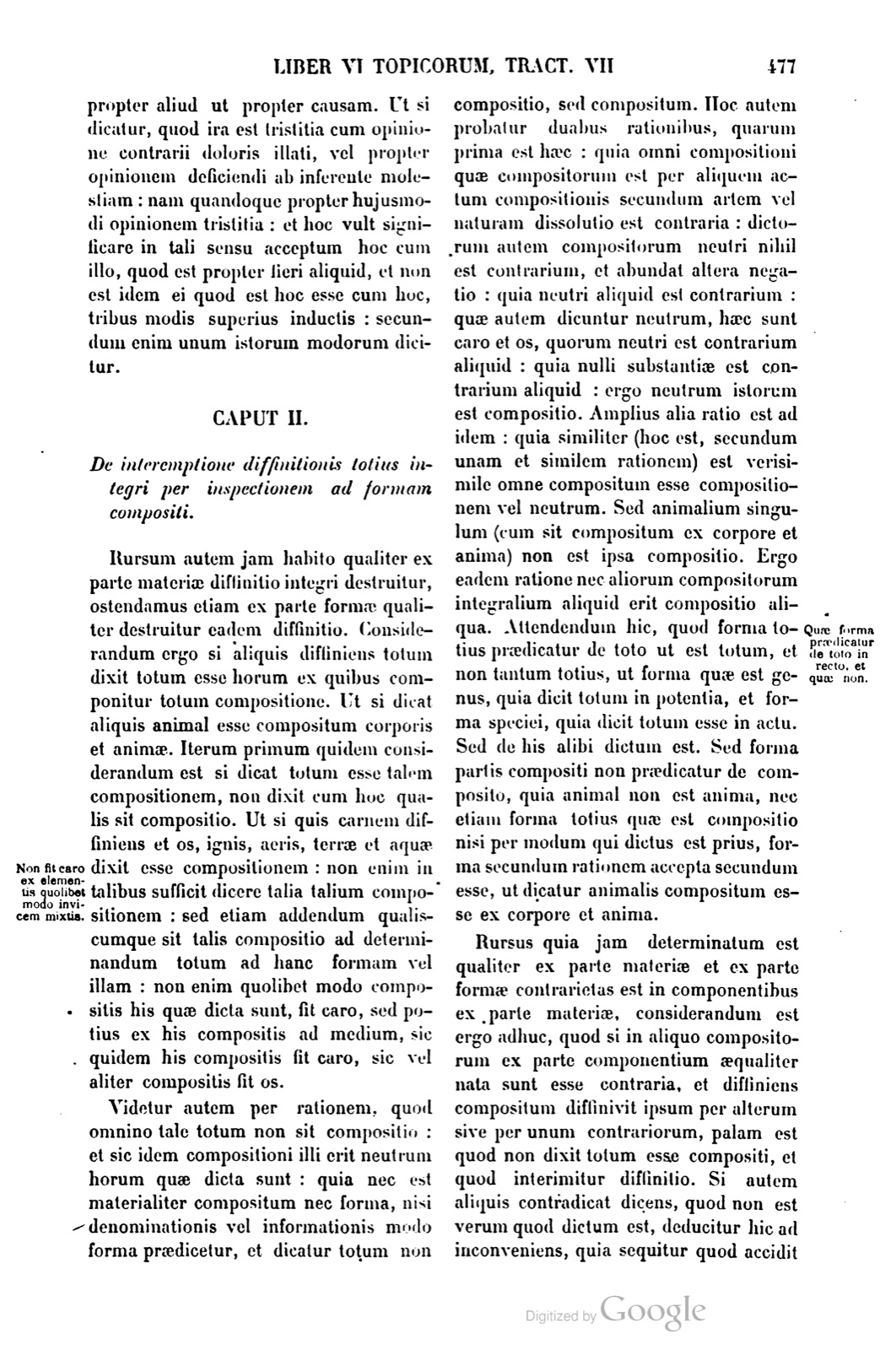
Quamvis autem hoc cum illo dicatur tribus modis dictis, quaedam tamen sic assignatorum (quod hoc cum illo habent quemdam modum proprium) quod nullo modo reducitur ad aliquem dictorum, ut dicatur hoc cum illo, quoniam unum est propter aliud ut propter causam. Ut si dicatur, quod ira est tristitia cum opinione contrarii doloris illati, vel propter opinionem deficiendi ab inferente molestiam: nam quandoque propter hujusmodi opinionem tristitia: et hoc vult significare in tali sensu acceptum hoc cum illo, quod est propter fieri aliquid, et non est idem ei quod est hoc esse cum hoc, tribus modis superius inductis: secundum enim unum istorum modorum dicitur.
CAPUT II. De interemptione diffinitionis totius integri per inspectionem ad formam compositi.
Rursum autem jam habito qualiter ex parte materiae diffinitio integri destruitur, ostendamus etiam ex parte formae qualiter destruitur eadem diffinitio. Considerandum ergo si aliquis diffiniens totum dixit totum esse horum ex quibus componitur totum compositione. Ut si dicat aliquis animal esse compositum corporis et animae. Iterum primum quidem considerandum est si dicat totum esse talem compositionem, non dixit cum hoc qualis sit compositio. Ut si quis carnem diffiniens et os, ignis, aeris, terrae et aquae dixit esse compositionem: non enim in talibus sufficit dicere talia talium compositionem: sed etiam addendum qualiscumque sit talis compositio ad determinandum totum ad hanc formam vel illam: non enim quolibet modo compositis his quae dicta sunt, fit caro, sed potius ex his compositis ad medium, sic quidem his compositis fit caro, sic vel aliter compositis fit os.
Videtur autem per rationem, quod omnino tale totum non sit compositio: et sic idem compositioni illi erit neutrum horum quae dicta sunt: quia nec est materialiter compositum nec forma, nisi denominationis vel informationis modo forma praedicetur, et dicatur totum non compositio, sed compositum. Hoc autem probatur duabus rationibus, quarum prima est haec: quia omni compositioni quae compositorum est per aliquem actum compositionis secundum artem vel naturam dissolutio est contraria: dictorum autem compositorum neutri nihil est contrarium, et abundat altera negatio: quia neutri aliquid est contrarium: quae autem dicuntur neutrum, haec sunt caro et os, quorum neutri est contrarium aliquid: quia nulli substantiae est contrarium aliquid: ergo neutrum istorum est compositio. Amplius alia ratio est ad idem: quia similiter (hoc est, secundum unam et similem rationem) est verisimile omne compositum esse compositionem vel neutrum. Sed animalium singulum (cum sit compositum ex corpore et anima) non est ipsa compositio. Ergo eadem ratione nec aliorum compositorum integralium aliquid erit compositio aliqua. Attendendum hic, quod forma totius praedicatur de toto ut est totum, et non tantum totius, ut forma quae est genus, quia dicit totum in potentia, et forma speciei, quia dicit totum esse in actu. Sed de his alibi dictum est. Sed forma partis compositi non praedicatur de composito, quia animal non est anima, nec etiam forma totius quae est compositio nisi per modum qui dictus est prius, forma secundum rationem accepta secundum esse, ut dicatur animalis compositum esse ex corpore et anima.
Rursus quia jam determinatum est qualiter ex parte materiae et ex parte formae contrarietas est in componentibus ex parte materiae, considerandum est ergo adhuc, quod si in aliquo compositorum ex parte componentium aequaliter nata sunt esse contraria, et diffiniens compositum diffinivit ipsum per alterum sive per unum contrariorum, palam est quod non dixit totum esse compositi, et interimitur diffinitio. Si autem aliquis contradicat dicens, quod non est verum quod dictum est, deducitur hic ad inconveniens, quia sequitur quod accidit plures ejusdem esse diffinitiones: quid enim magis diffinitur per hoc unum contrarium, quam per alterum: utraque enim contrariorum sive oppositorum nata sunt similiter fieri in composito ex contrariis: talis est enim animae diffinitio, quam quidam assignant, ut dicatur anima substantia esse disciplinae susceptibilis: nam similiter et aequaliter est ignorantiae susceptibilis sicut et disciplinae, et sic diffinibilis est per ignorantiam, sicut per disciplinam.
Although this with that is said in the three stated ways, nevertheless certain things thus assigned, which have a certain proper mode of this with that, are in no way reduced to any of the stated ways; for example, it is said this with that because one is on account of the other as on account of a cause. Thus if it is said that anger is sadness with the opinion of a contrary inflicted pain, or on account of the opinion of falling short by the one bringing trouble; for sometimes sadness exists on account of an opinion of this sort. And this with that, taken in such a sense, wishes to signify what is on account of something coming to be, and it is not the same as this being with this in the three ways introduced above, for it is said according to one of those modes.
CHAPTER II. On the destruction of the definition of an integral whole through inspection toward the form of the composite.
Again, now that it has been held how the definition of an integral thing is destroyed on the part of matter, let us also show how the same definition is destroyed on the part of form. Therefore one must consider whether someone defining a whole has said that the whole is of those things from which the whole is composed by composition. As if someone says that an animal is composed of body and soul. Again, first one must consider whether, if he says the whole is such a composition, he has not said with this what kind of composition it is. As if someone defining flesh and bone has said that they are a composition of fire, air, earth, and water. For in such things it is not enough to say that such things are a composition of such things, but it must also be added of what kind such a composition is for determining the whole to this form or that; for flesh does not come to be when those stated things are composed in just any way, but rather flesh comes to be from these composed to a mean, while bone comes to be when they are composed in this way or another.
But by reason it seems that such a whole is not composition at all; and so neither of those things which have been stated will be the same as that composition, because it is neither materially composed nor form, unless form is predicated by way of denomination or information and the whole is called not composition but composite. This is proved by two reasons, of which the first is this: to every composition which is of composites through some act of composition according to art or nature, dissolution is contrary; but to neither of the stated composites is anything contrary, and the other negation is redundant, because to neither is anything contrary. But those which are called neither are flesh and bone, to neither of which is anything contrary, because there is no contrary to any substance; therefore neither of these is a composition. Furthermore another reason for the same point is that similarly, that is, according to one and like account, it is likely that every composite is a composition or neither. But each animal, since it is composed from body and soul, is not the composition itself. Therefore by the same reason neither will any of the other integral composites be some composition. Here it must be noticed that the form of the whole is predicated of the whole as it is whole, and not only of the whole as a form which is genus, because it states the whole in potency, and the form of species, because it states the whole to be in act. But these things have been spoken of elsewhere. Yet the form of a part of the composite is not predicated of the composite, because animal is not soul; nor even is the form of the whole which is composition predicated except in the way stated before, form taken according to account according to being, so that the composite of animal is said to be from body and soul.
Again, because it has now been determined how, on the part of matter and on the part of form, contrariety is in components on the part of matter, one must therefore still consider that if, in some composite, on the part of the components, contraries are equally born to be, and the one defining the composite has defined it through one or another of the contraries, it is plain that he has not stated the whole being of the composite, and the definition is destroyed. But if someone contradicts, saying that what has been said is not true, he is led here to an unsuitable consequence, because it follows that there happen to be several definitions of the same thing. For why is it defined more through this one contrary than through the other? For each of the contraries or opposites is born similarly to come to be in a composite from contraries. Such is the definition of the soul which some assign, so that soul is said to be substance susceptible of discipline; for it is similarly and equally susceptible of ignorance as of discipline, and thus definable through ignorance as through discipline.
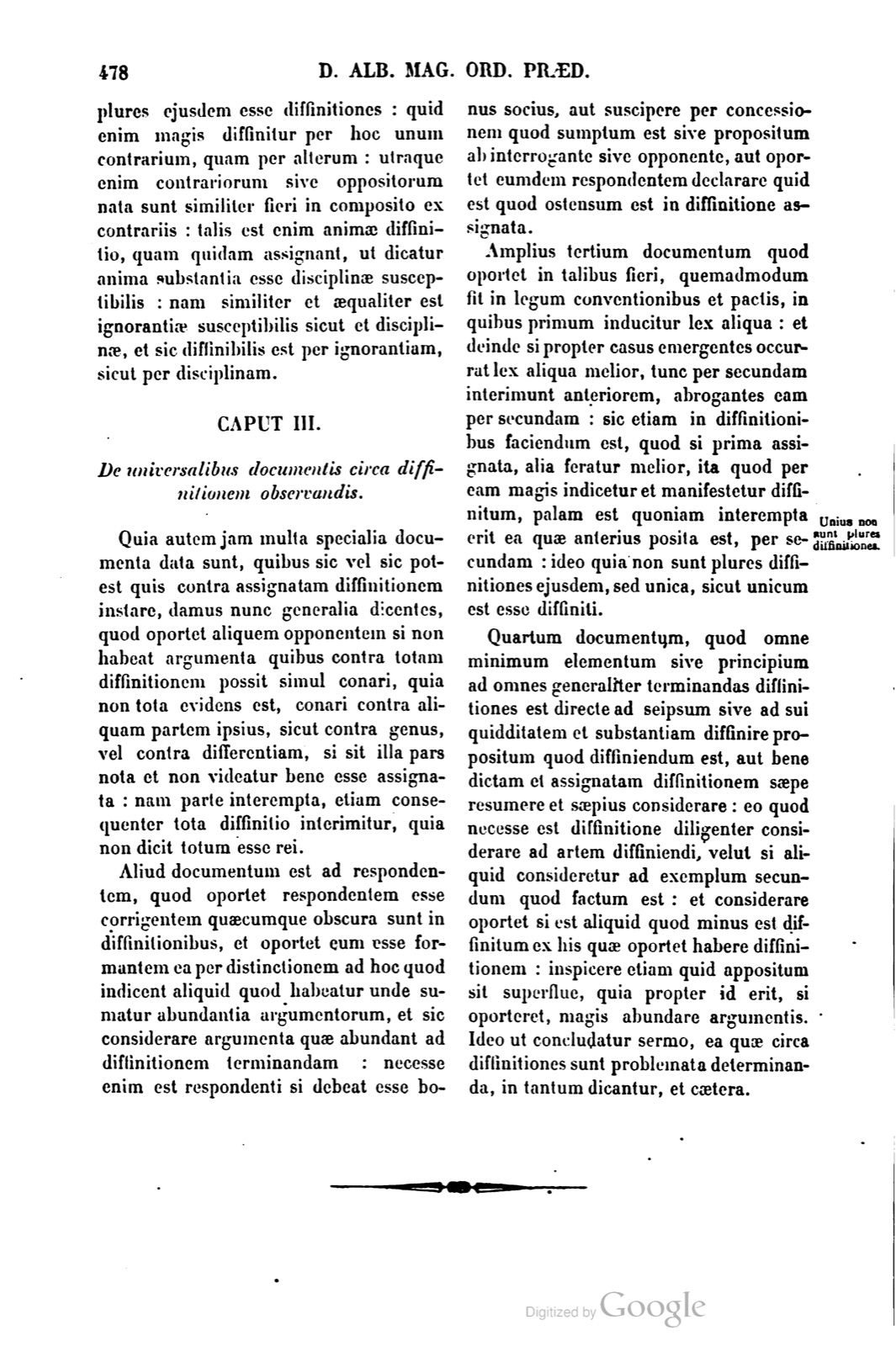
CAPUT III. De universalibus documentis circa diffinitionem observandis.
Quia autem jam multa specialia documenta data sunt, quibus sic vel sic potest quis contra assignatam diffinitionem instare, damus nunc generalia dicentes, quod oportet aliquem opponentem si non habeat argumenta quibus contra totam diffinitionem possit simul conari, quia non tota evidens est, conari contra aliquam partem ipsius, sicut contra genus, vel contra differentiam, si sit illa pars nota et non videatur bene esse assignata: nam parte interempta, etiam consequenter tota diffinitio interimitur, quia non dicit totum esse rei.
Aliud documentum est ad respondentem, quod oportet respondentem esse corrigentem quaecumque obscura sunt in diffinitionibus, et oportet eum esse formantem ea per distinctionem ad hoc quod indicent aliquid quod habeatur unde sumatur abundantia argumentorum, et sic considerare argumenta quae abundant ad diffinitionem terminandam: necesse enim est respondenti si debeat esse bonus socius, aut suscipere per concessionem quod sumptum est sive propositum ab interrogante sive opponente, aut oportet eumdem respondentem declarare quid est quod ostensum est in diffinitione assignata.
Amplius tertium documentum quod oportet in talibus fieri, quemadmodum fit in legum conventionibus et pactis, in quibus primum inducitur lex aliqua: et deinde si propter casus emergentes occurrat lex aliqua melior, tunc per secundam interimunt anteriorem, abrogantes eam per secundam: sic etiam in diffinitionibus faciendum est, quod si prima assignata, alia feratur melior, ita quod per eam magis indicetur et manifestetur diffinitum, palam est quoniam interempta erit ea quae anterius posita est, per secundam: ideo quia non sunt plures diffinitiones ejusdem, sed unica, sicut unicum est esse diffiniti.
Quartum documentum, quod omne minimum elementum sive principium ad omnes generaliter terminandas diffinitiones est directe ad seipsum sive ad sui quidditatem et substantiam diffinire propositum quod diffiniendum est, aut bene dictam et assignatam diffinitionem saepe resumere et saepius considerare: eo quod necesse est diffinitione diligenter considerare ad artem diffiniendi, velut si aliquid consideretur ad exemplum secundum quod factum est: et considerare oportet si est aliquid quod minus est diffinitum ex his quae oportet habere diffinitionem: inspicere etiam quid appositum sit superflue, quia propter id erit, si oporteret, magis abundare argumentis. Ideo ut concludatur sermo, ea quae circa diffinitiones sunt problemata determinanda, in tantum dicantur, et caetera.
CHAPTER III. On universal teachings to be observed concerning definition.
But because many special teachings have now been given, by which someone can in this or that way object against an assigned definition, we now give general teachings, saying that some opponent, if he does not have arguments by which he can at once try against the whole definition, because the whole is not evident, ought to try against some part of it, as against genus or against difference, if that part is known and does not seem to have been well assigned; for when a part has been destroyed, consequently the whole definition is also destroyed, because it does not state the whole being of the thing.
Another teaching is for the respondent: the respondent ought to correct whatever things are obscure in definitions, and ought to form them by distinction so that they indicate something from which an abundance of arguments may be taken, and so to consider the arguments which abound for terminating the definition. For the respondent, if he ought to be a good associate, must either receive by concession what has been taken or proposed by the questioner or opponent, or the same respondent must declare what it is that has been shown in the assigned definition.
Furthermore, a third teaching which must be done in such matters is like what happens in agreements and pacts of laws, in which first some law is introduced; and then, if because of emerging cases some better law occurs, then by the second they destroy the former, abrogating it by the second. Thus also in definitions it must be done: if a first one has been assigned, another better one is brought, so that through it the defined thing is more indicated and manifested, it is plain that the one posited earlier will be destroyed by the second, precisely because there are not several definitions of the same thing, but one, just as the being of the defined thing is one.
The fourth teaching is that every smallest element or principle, for terminating all definitions generally, is directly to define toward itself or toward its own quiddity and substance the proposed thing which must be defined, or often to resume and consider more often the definition well spoken and assigned; because it is necessary to consider definition diligently for the art of defining, as if something is considered according to the example as it was made. And one must consider whether there is anything that is less defined among those things which ought to have definition; one must also inspect what has been superfluously appended, because on account of that, if it were necessary, one will abound more in arguments. Therefore, so that the discourse may be concluded, let those things which concern problems about definitions to be determined be stated to this extent, and so on.
If a page does not appear, its photograph has not been uploaded yet.