Volume 2 · pp. 466–467
Tractate V. Sole chapter. How the definition of an equivocal term is destroyed.
A marker with ≈ is an approximate page boundary, placed by measure of the text; the page photographs remain the authority. In the paired views, clicking a page marker brings that page into view.
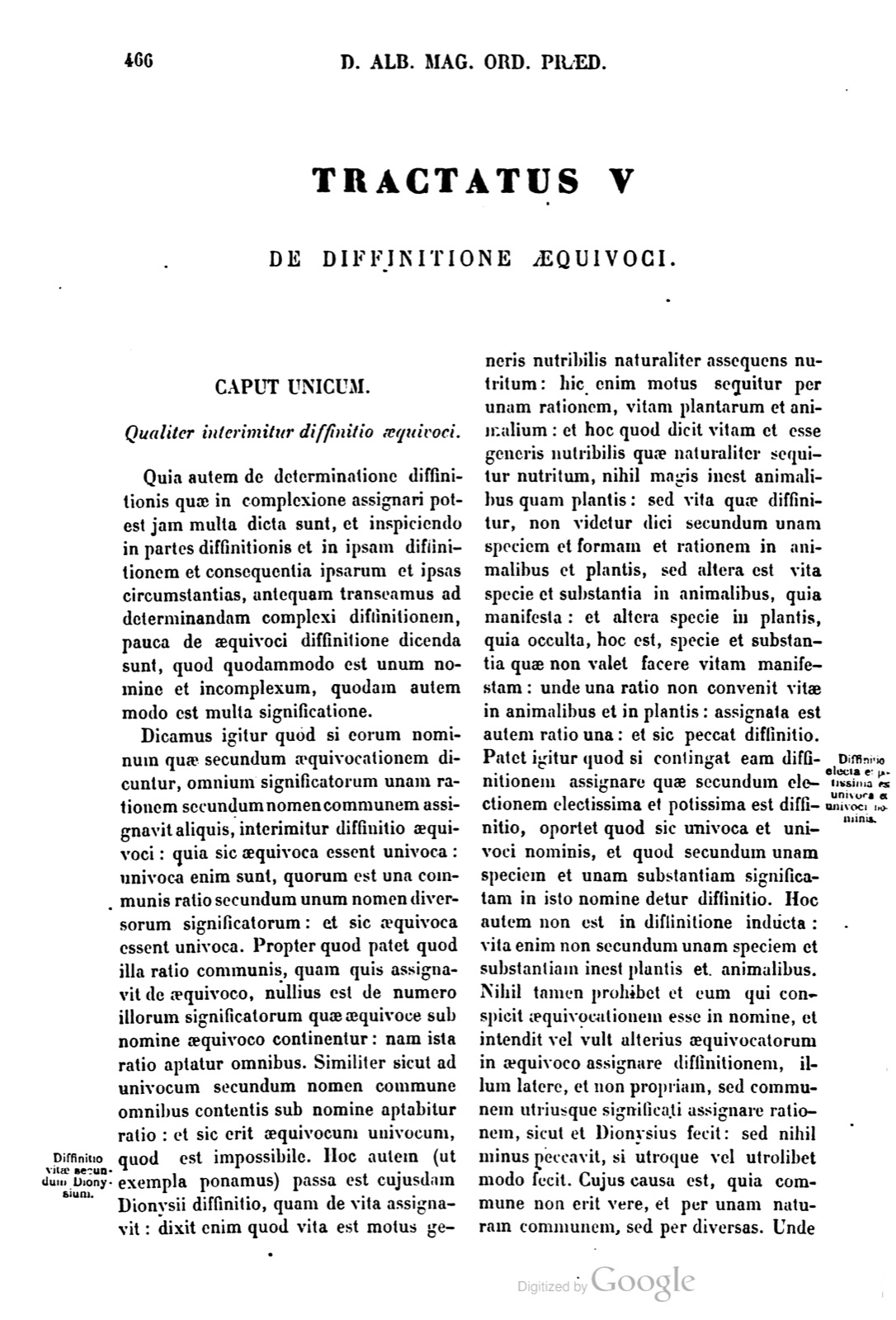
TRACTATUS V. DE DIFFINITIONE AEQUIVOCI.
CAPUT UNICUM. Qualiter interimitur diffinitio aequivoci.
Quia autem de determinatione diffinitionis quae in complexione assignari potest jam multa dicta sunt, et inspiciendo in partes diffinitionis et in ipsam diffinitionem et consequentia ipsarum et ipsas circumstantias, antequam transeamus ad determinandam complexi diffinitionem, pauca de aequivoci diffinitione dicenda sunt, quod quodammodo est unum nomine et incomplexum, quodam autem modo est multa significatione.
Dicamus igitur quod si eorum nominum quae secundum aequivocationem dicuntur, omnium significatorum unam rationem secundum nomen commune assignavit aliquis, interimitur diffinitio aequivoci: quia sic aequivoca essent univoca: univoca enim sunt, quorum est una communis ratio secundum unum nomen diversorum significatorum: et sic aequivoca essent univoca. Propter quod patet quod illa ratio communis, quam quis assignavit de aequivoco, nullius est de numero illorum significatorum quae aequivoce sub nomine aequivoco continentur: nam ista ratio aptatur omnibus. Similiter sicut ad univocum secundum nomen commune omnibus contentis sub nomine aptabitur ratio: et sic erit aequivocum univocum, quod est impossibile. Hoc autem (ut exempla ponamus) passa est cujusdam Dionysii diffinitio, quam de vita assignavit: dixit enim quod vita est motus generis nutribilis naturaliter assequens nutritum: hic enim motus sequitur per unam rationem, vitam plantarum et animalium: et hoc quod dicit vitam et esse generis nutribilis quae naturaliter sequitur nutritum, nihil magis inest animalibus quam plantis: sed vita quae diffinitur, non videtur dici secundum unam speciem et formam et rationem in animalibus et plantis, sed altera est vita specie et substantia in animalibus, quia manifesta: et altera specie in plantis, quia occulta, hoc est, specie et substantia quae non valet facere vitam manifestam: unde una ratio non convenit vitae in animalibus et in plantis: assignata est autem ratio una: et sic peccat diffinitio.
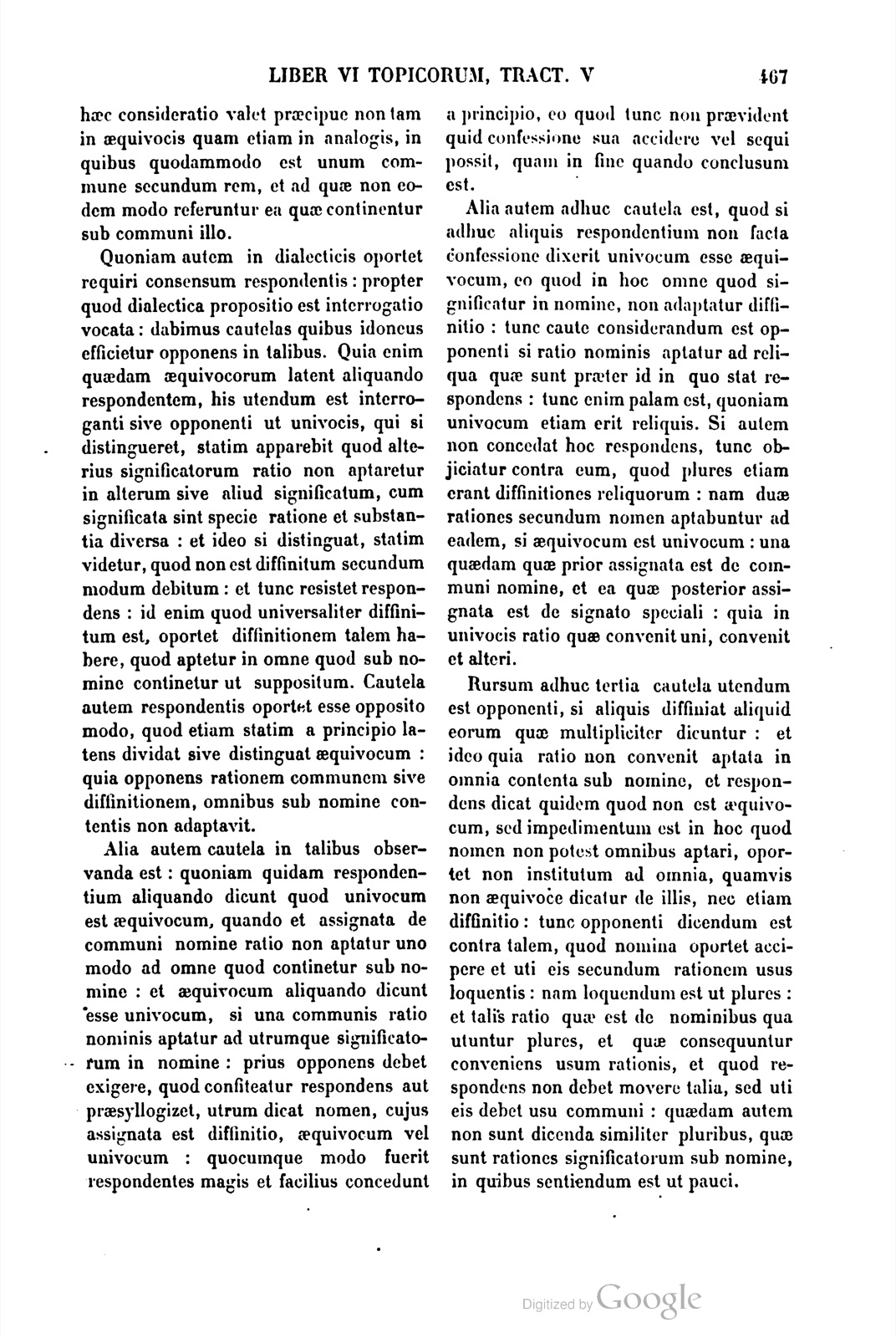
Patet igitur quod si contingat eam diffinitionem assignare quae secundum electionem electissima et potissima est diffinitio, oportet quod sic univoca et univoci nominis, et quod secundum unam speciem et unam substantiam significatam in isto nomine detur diffinitio. Hoc autem non est in diffinitione inducta: vita enim non secundum unam speciem et substantiam inest plantis et animalibus. Nihil tamen prohibet et eum qui conspicit aequivocationem esse in nomine, et intendit vel vult alterius aequivocatorum in aequivoco assignare diffinitionem, illum latere, et non propriam, sed communem utriusque significati assignare rationem, sicut et Dionysius fecit: sed nihil minus peccavit, si utroque vel utrolibet modo fecit. Cujus causa est, quia commune non erit vere, et per unam naturam communem, sed per diversas. Unde haec consideratio valet praecipue non tam in aequivocis quam etiam in analogis, in quibus quodammodo est unum commune secundum rem, et ad quae non eodem modo referuntur ea quae continentur sub communi illo.
Quoniam autem in dialecticis oportet requiri consensum respondentis: propter quod dialectica propositio est interrogatio vocata: dabimus cautelas quibus idoneus efficietur opponens in talibus. Quia enim quaedam aequivocorum latent aliquando respondentem, his utendum est interroganti sive opponenti ut univocis, qui si distingueret, statim apparebit quod alterius significatorum ratio non aptaretur in alterum sive aliud significatum, cum significata sint specie ratione et substantia diversa: et ideo si distinguat, statim videtur, quod non est diffinitum secundum modum debitum: et tunc resistet respondens: id enim quod universaliter diffinitum est, oportet diffinitionem talem habere, quod aptetur in omne quod sub nomine continetur ut suppositum. Cautela autem respondentis oportet esse opposito modo, quod etiam statim a principio latens dividat sive distinguat aequivocum: quia opponens rationem communem sive diffinitionem, omnibus sub nomine contentis non adaptavit.
TRACTATE V. ON THE DEFINITION OF AN EQUIVOCAL TERM.
SOLE CHAPTER. How the definition of an equivocal term is destroyed.
But because many things have now been said concerning the determination of definition which can be assigned in a complex expression, and by inspecting the parts of definition and the definition itself and their consequences and the circumstances themselves, before we pass on to determining the definition of a complex thing, a few things must be said about the definition of an equivocal term, which in one way is one by name and incomplex, but in another way is many in signification.
Therefore let us say that if someone has assigned one account according to the common name for all the signified things of those names which are said according to equivocation, the definition of the equivocal term is destroyed, because in this way equivocal things would be univocal; for univocal things are those of which there is one common account according to one name of diverse signified things, and so equivocal things would be univocal. On account of this it is clear that that common account which someone has assigned concerning an equivocal term belongs to none of the number of those signified things which are equivocally contained under the equivocal name; for that account is fitted to all. Similarly, as an account will be fitted to the univocal according to the common name for all things contained under the name, so the equivocal will be univocal, which is impossible. But this, to give examples, happened to the definition of a certain Dionysius which he assigned concerning life; for he said that life is the motion of the nutritive genus naturally following upon what is nourished. For this motion follows by one account the life of plants and animals; and this, that it states life and the being of the nutritive genus which naturally follows what is nourished, belongs no more to animals than to plants. But the life which is defined does not seem to be said according to one species and form and account in animals and plants, but one life is different in species and substance in animals because it is manifest, and another in species in plants because it is hidden, that is, a species and substance which is not able to make life manifest. Hence one account does not belong to life in animals and in plants; but one account has been assigned, and so the definition errs.
Therefore it is clear that if it happens to assign that definition which according to choice is the most choice and most powerful definition, it must be a definition of univocal things and of a univocal name in this way, and a definition must be given according to one species and one substance signified in that name. But this is not so in the definition introduced, for life is not in plants and animals according to one species and substance. Yet nothing prevents the one who observes equivocation to be in the name, and intends or wishes to assign the definition of one of the things equivocally named in the equivocal term, from being unaware of that and assigning not a proper account but a common account of both signified things, as Dionysius also did; but he erred no less if he did it in either or in both ways. The cause of this is that the common thing will not be truly through one common nature, but through diverse natures. Hence this consideration is valid especially not only in equivocal things but also in analogical things, in which there is in some way one common thing according to the thing, and those things which are contained under that common thing are not referred to it in the same way.
But because in dialectics the consent of the respondent must be sought, for which reason a dialectical proposition is called an interrogation, we shall give cautions by which the opponent will be made suitable in such matters. For because certain equivocal terms are sometimes hidden from the respondent, the questioner or opponent must use these as univocal terms; if he were to distinguish, it would immediately appear that the account of one of the signified things would not be fitted to the other or another signified thing, since the signified things are diverse in species, account, and substance. And therefore, if he distinguishes, it at once seems that the thing has not been defined according to the due mode, and then the respondent will resist; for that which has been universally defined must have such a definition that it is fitted to everything which is contained under the name as a supposit. But the caution of the respondent must be in the opposite mode: that at once from the beginning he divide or distinguish the hidden equivocal term, because the opponent has not adapted the common account or definition to all things contained under the name.
Alia autem cautela in talibus observanda est: quoniam quidam respondentium aliquando dicunt quod univocum est aequivocum, quando et assignata de communi nomine ratio non aptatur uno modo ad omne quod continetur sub nomine: et aequivocum aliquando dicunt esse univocum, si una communis ratio nominis aptatur ad utrumque significatorum in nomine: prius opponens debet exigere, quod confiteatur respondens aut praesyllogizet, utrum dicat nomen, cujus assignata est diffinitio, aequivocum vel univocum: quocumque modo fuerit respondentes magis et facilius concedunt a principio, eo quod tunc non praevident quid confessione sua accidere vel sequi possit, quam in fine quando conclusum est.
Alia autem adhuc cautela est, quod si adhuc aliquis respondentium non facta confessione dixerit univocum esse aequivocum, eo quod in hoc omne quod significatur in nomine, non adaptatur diffinitio: tunc caute considerandum est opponenti si ratio nominis aptatur ad reliqua quae sunt praeter id in quo stat respondens: tunc enim palam est, quoniam univocum etiam erit reliquis. Si autem non concedat hoc respondens, tunc objiciatur contra eum, quod plures etiam erant diffinitiones reliquorum: nam duae rationes secundum nomen aptabuntur ad eadem, si aequivocum est univocum: una quaedam quae prior assignata est de communi nomine, et ea quae posterior assignata est de signato speciali: quia in univocis ratio quae convenit uni, convenit et alteri.
Rursum adhuc tertia cautela utendum est opponenti, si aliquis diffiniat aliquid eorum quae multipliciter dicuntur: et ideo quia ratio non convenit aptata in omnia contenta sub nomine, et respondens dicat quidem quod non est aequivocum, sed impedimentum est in hoc quod nomen non potest omnibus aptari, oportet non institutum ad omnia, quamvis non aequivoce dicatur de illis, nec etiam diffinitio: tunc opponenti dicendum est contra talem, quod nomina oportet accipere et uti eis secundum rationem usus loquentis: nam loquendum est ut plures: et talis ratio quae est de nominibus qua utuntur plures, et quae consequuntur conveniens usum rationis, et quod respondens non debet movere talia, sed uti eis debet usu communi: quaedam autem non sunt dicenda similiter pluribus, quae sunt rationes significatorum sub nomine, in quibus sentiendum est ut pauci.
Another caution to be observed in such matters is that some respondents sometimes say that a univocal term is equivocal, when the account assigned from the common name is not fitted in one mode to everything that is contained under the name; and sometimes they say that an equivocal term is univocal if one common account of the name is fitted to both of the things signified in the name. The opponent should first require that the respondent confess, or should presyllogize, whether he says the name whose definition has been assigned is equivocal or univocal. In whatever way it may be, respondents concede more and more easily at the beginning, because then they do not foresee what can happen or follow from their confession, than at the end when it has been concluded.
Yet another caution is that if some respondent, without a confession having been made, has said that a univocal term is equivocal because in this case the definition is not adapted to everything signified in the name, then the opponent must cautiously consider whether the account of the name is fitted to the remaining things apart from that in which the respondent stands; for then it is plain that it will also be univocal for the others. But if the respondent does not concede this, then it should be objected against him that there were also several definitions of the remaining things; for two accounts according to the name will be fitted to the same things, if the equivocal term is univocal: one certain account which was assigned earlier from the common name, and that which was assigned later from the special signified thing, because in univocal things the account which belongs to one belongs also to the other.
Again, still a third caution must be used by the opponent if someone defines something of those things which are said in many ways. And therefore, because the account does not fit when adapted to all things contained under the name, and the respondent indeed says that it is not equivocal, but that the impediment is in this, that the name cannot be fitted to all, and it is necessary that it has not been instituted for all, although it is not said of them equivocally, nor is the definition. Then it must be said by the opponent against such a man that names must be received and used according to the account of the speaker's usage; for one must speak as the many do. And such an account, which is about the names which the many use, and which follows the fitting use of reason, is the sort where the respondent ought not to move such matters, but ought to use them by common usage. But certain things are not to be spoken similarly to the many, namely the accounts of things signified under the name, in which one must think as the few do.
If a page does not appear, its photograph has not been uploaded yet.