Volume 2 · pp. 463–465
Tractate IV. Sole chapter. How definition is destroyed by inspecting opposites which are toward something.
A marker with ≈ is an approximate page boundary, placed by measure of the text; the page photographs remain the authority. In the paired views, clicking a page marker brings that page into view.
TRACTATUS IV. QUALITER INTERIMITUR DIFFINITIO PER LOCOS EXTRINSECOS TAM IN OPPOSITIS SECUNDUM GENERA OPPOSITORUM, QUAM A SIMILIBUS VEL A CONJUGATIS SUMPTOS.
CAPUT UNICUM. Qualiter interimitur diffinitio inspiciendo in oppositis quae sunt ad aliquid.
Cum autem jam dictum sit qualiter diffinitio interimitur per locos intrinsecos, inspiciendo in ea quae sunt de essentia diffinitionis vel consequentia ad ista vel circumstantiae eorum: consequens est nunc ostendere qualiter interimitur per locos extrinsecos tam in oppositis secundum genera oppositorum, quam a similibus vel a conjugatis sumptos. Inter opposita autem prius est inspiciendum in relativis, quia plus habent de ente, cum utrumque sit ens actu. Dicimus igitur quod considerandum primo in oppositis quae ad aliquid sunt, si assignata diffinitione ejus quod est ad aliquid, genus positum in diffinitione est ad aliquid, utrum species etiam sit ad idem suo modo, hoc est, specialiter, sicut genus generaliter est: si autem non, interimitur diffinitio. Cujus exemplum est in relativis quae secundum dici relativa sunt, sicut et opinio est dicta ad opinatum, et quaedam sive specialis opinio ad quoddam sive speciale opinatum: et sicut multiplex dicitur ad submultiplex in genere, utrum quoddam speciale multiplex in specie dicta dicatur ad quoddam submultiplex: si enim non sic diffinitio assignatur vel genus in diffinitione, interimitur diffinitio.
Videndum autem est adhuc in relativis considerando (si diffinitio assignata dicetur esse pro opposito), si oppositi correlativi quod refertur ad illud sit opposita diffinitio. Verbi gratia, si dimidii diffinitio opposita est ei diffinitioni quae est duplicis. Verbi gratia, si duplex est per diffinitionem quod secundum aequalem partem dimidium superat, dimidium erit quod in aequali parte a duplo superatur. Illud autem (quantum ad secundo inductam considerationem) est etiam in contrariis. Nam et in illis contrariis contraria ratio erit sive diffinitio secundum unamquamque complexionem contrariorum: plures enim complexiones contrariorum in primo hujus scientiae libro determinatae sunt. Cujus exemplum est, ut si juvativum est per diffinitionem quod est boni effectivum, erit per contrarium nocivum secundum diffinitionem quod est mali effectivum: nam contraria in quantum contraria sunt et opposita, relationem habent ad invicem: alterum enim horum contrariorum necesse est contrarium esse ei quod ex principio dictum est: quia quodcumque horum ex principio assignetur, alterum erit ei contrarium: juvativum enim erit ad nocivum, et e converso: et bonum ad malum, et e converso. Si ergo neutrum contrarium est ei quod ex principio dictum est, palam est ex ipsa contrarietate ipsorum ad invicem: quia neuter neutro (quod in principio ponitur) convenit, vel erit diffinitio ejus quod posterius per contrarietatem ad id assignatur, si recte et secundum quidditatem diffinitio assignetur.
Inspiciendo autem specialiter in contraria dicimus, quod quaedam contraria accipiuntur sic, quod unum est ut privatio, alterum ut habitus: quidam autem accipiunt ambo ut habitus: et primo inspiciemus in ea quorum unum est privatio, et alterum ut habitus. Dicamus igitur quod contrariorum quaedam sunt contraria sic, quod unum dicitur privatione alterius, ut inaequalitas et aequalitas: quia aequalitas privatione aequalitatis videtur esse inaequalitas: inaequalia enim dicuntur quae non sunt aequalia, et sic mutuo se expellunt ab eodem susceptibili. Palam autem ex his quae saepe dicta sunt, si talia contraria debeant diffiniri, palam erit quod id quod secundum privationem dicitur, debet diffiniri per alterum: reliquum vero contrariorum quod dicitur secundum habitum, non oportet per id quod secundum privationem dicitur, diffiniri: quia privatio non est principium cognoscendi habitum, sed e converso: non enim contingit alterutrum talium contrariorum per alterutrum cognosci, sed per habitum cognoscitur privatio, et non habitus cognoscitur per privationem.
TRACTATE IV. HOW DEFINITION IS DESTROYED THROUGH EXTRINSIC PLACES, BOTH IN OPPOSITES ACCORDING TO THE GENERA OF OPPOSITES, AND TAKEN FROM SIMILARS OR FROM CONJUGATES.
SOLE CHAPTER. How definition is destroyed by inspecting opposites which are toward something.
But since it has now been said how definition is destroyed through intrinsic places, by inspecting those things which are of the essence of definition, or consequences upon these, or their circumstances, it remains now to show how it is destroyed through extrinsic places, both in opposites according to the genera of opposites, and places taken from similars or from conjugates. But among opposites one must first inspect relatives, because they have more of being, since each is being in act. Therefore we say that first, in opposites which are toward something, one must consider, once the definition of that which is toward something has been assigned, whether the genus placed in the definition is toward something, and whether the species also is toward the same thing in its own mode, that is, specially, as the genus is generally. But if not, the definition is destroyed. The example of this is in relatives which are relatives according to being said, as opinion also is said toward the thing opined, and some or special opinion toward some or special thing opined; and as multiple is said toward submultiple in genus, whether some special multiple stated in species is said toward some submultiple. For if the definition or genus in the definition is not assigned in this way, the definition is destroyed.
But one must also see, by considering in relatives, if the assigned definition is said to be for the opposite, whether the definition of the correlative opposite which is referred to it is the opposite definition. For example, whether the definition of half is opposite to that definition which is of double. For example, if double is by definition that which exceeds the half by an equal part, half will be that which is exceeded by the double in an equal part. But that, as regards the second consideration introduced, is also in contraries. For in those contraries too there will be a contrary account or definition according to each complexion of contraries; for several complexions of contraries have been determined in the first book of this science. The example is that, if the helpful is by definition what is productive of good, by the contrary the harmful will be by definition what is productive of evil; for contraries, insofar as they are contraries and opposites, have relation to one another. For one of these contraries must be contrary to what was stated from the beginning, because whichever of these is assigned from the beginning, the other will be contrary to it: for the helpful will be toward the harmful, and conversely; and good toward evil, and conversely. Therefore if neither contrary is contrary to that which was said from the beginning, it is plain from their very contrariety to one another, because neither agrees with the other, which is posited in the beginning, or it will be the definition of what is afterward assigned to it through contrariety, if the definition is assigned rightly and according to quiddity.
But by inspecting contraries specially we say that certain contraries are taken in such a way that one is as privation and the other as habit; but some take both as habits; and first we shall inspect those of which one is privation and the other as habit. Therefore let us say that certain contraries are contraries in such a way that one is said by privation of the other, as inequality and equality, because inequality seems to be equality by privation of equality; for unequal things are called those which are not equal, and so they mutually expel each other from the same susceptible. But it will be plain from those things which have often been said that, if such contraries ought to be defined, that which is said according to privation must be defined through the other; but the remaining contrary, which is said according to habit, need not be defined through that which is said according to privation, because privation is not the principle of knowing habit, but conversely. For it does not happen that either of such contraries is known through the other, but privation is known through habit, and habit is not known through privation.
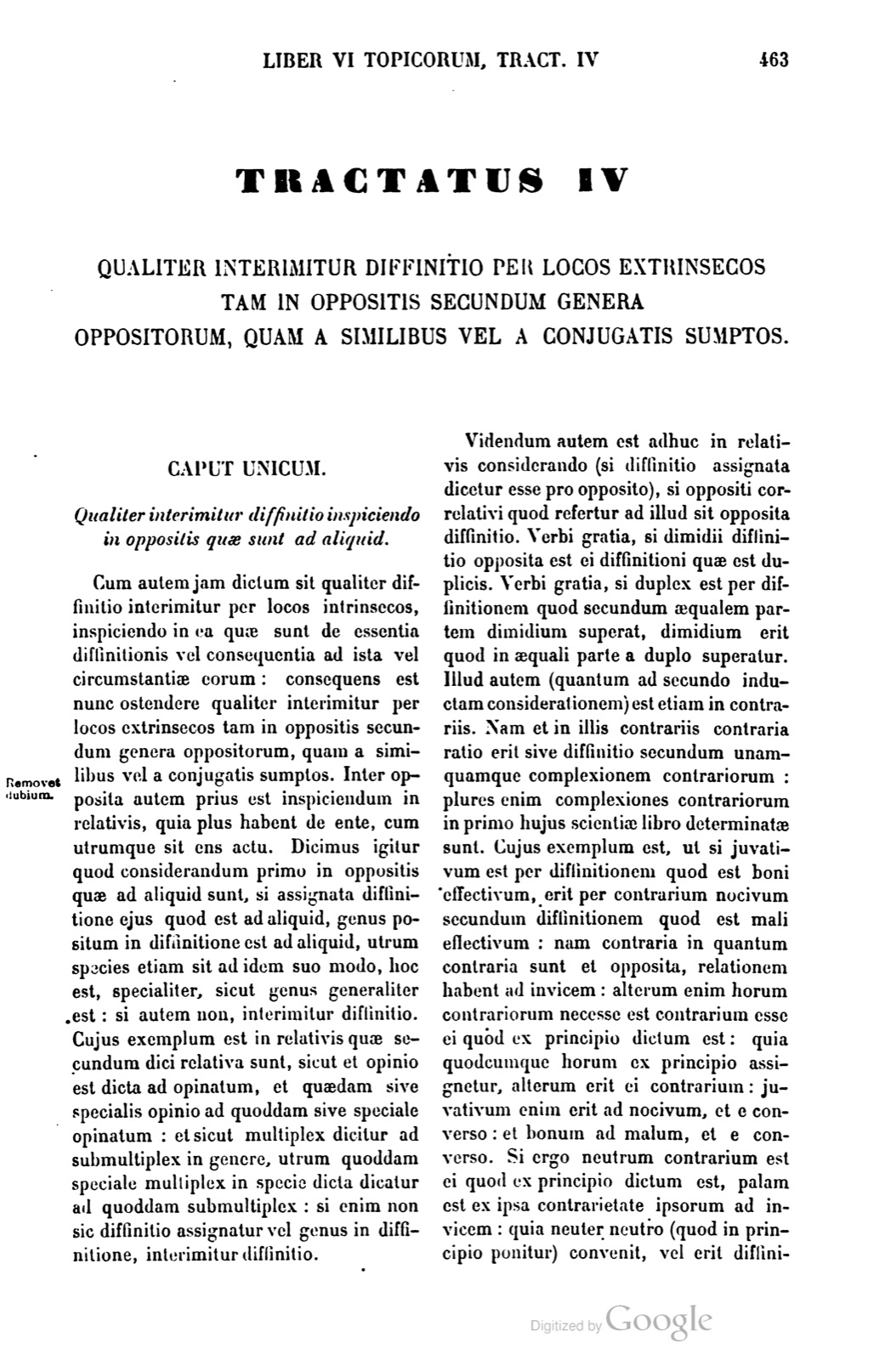
Et in contrariis considerandum est hujusmodi peccatum per quod interimitur diffinitio, ut si quis diffiniat aequalitatem dicendo quod aequalitas est per diffinitionem contrarium inaequalitati: nam per hoc quod sic diffinitur secundum privationem, dicitur habitus qui est aequalitas: et ideo interimitur diffinitio. Amplius aliud peccatum est, quia sic diffinientem necesse est in ipsa sua diffinitione uti eo quod diffinitur: et hoc est inconveniens. Hoc autem palam est si pro nomine in diffinitione posito accipiatur diffinitio nominis ejusdem. Nam quia inaequalitas nihil differt et privatio aequalitatis, cum unum sit diffinitio alterius, cum diffinitum inaequalitatis, et diffinitio ejus sit contrarium aequalitatis esse, erit aequalitas quae diffinitur, contrarium inaequalitatis esse: et erit idem ac si dicat, aequalitas est contrarium secundum privationem aequalitatis esse: et sic aequalitas cadit in diffinitione aequalitatis: propter quod sic diffiniens, eodem erit usus in diffinitione sui ipsius.
Si autem neutrum contrariorum secundum privationem dicitur, sed utrumque secundum habitum: assignetur autem ratio sive diffinitio: similiter autem unum per alterum, ut dicatur sic, bonum esse per diffinitionem quod est malo contrarium: tunc palam est, quoniam et malum per diffinitionem est quod est bono contrarium. Nam hoc modo contrariorum similiter assignanda est ratio, quod utrumque diffinitur in hoc quod est alteri contrarium: propter quod rursum sicut in aliis (quorum alterum secundum privationem dicitur) eodem contingit uti in diffinitione sui ipsius: et hoc ideo quia inest in mali ratione bonum, quando sic diffinitur, quod bonum est quod est malo contrarium: nihil autem differt malum ab eo quod est bono esse contrarium: et sic per diffinitionem bonum contrarium boni contrario: et sic eodem usus est in diffinitione sui ipsius, quia bonum in diffinitione boni est positum.
Amplius inspiciendo in privationem et habitum: privatio autem habet comparationem ad id in quo est, sicut in subjecto quod relinquit, et ad oppositum suum: et ideo oportet quod in diffinitione diffiniatur ad utrumque: ideo considerandum est, quod si ad oppositum (quod secundum privationem dicitur) aliquis diffiniens non assignavit cujus est privatio sicut habitus privatio, aut cujus est ut contrarii vel oppositi, ut quoniam est horum habituum privatio. Adhuc autem et si non additur in diffinitione in quo sicut in subjecto natum est fieri privationem illam, et etiam in quo natum fieri prima specie, peccavit, et interimitur diffinitio: vel simpliciter in quo natum est fieri talem privationem, hoc est, universaliter. Verbi gratia, ut si ignorantia dicens (hoc est, diffiniens) non dixit in diffinitione quod sit privatio scientiae, ex eo quod comparatur ad habitum per quem cognoscitur. Aut etiam si in diffinitione non addidit in quo est nata fieri privatio illa ut in subjecto simpliciter vel primo, eo quod per subjectum cognoscitur accidens. Ut si diffiniens ignorantiam non dixit, quoniam scientiae est privatio, et quod nata est fieri in homine et primum in rationali parte animae: nam si sic diffiniens, quodlibet illorum non facit, peccabit. Similiter autem et in corporalibus privationibus: nam si quodlibet illorum quae dicta sunt, non faciat, et quod non dicat in quo simpliciter vel in quo primo, peccabit, et interimitur diffinitio. Si enim dicat quid est caecitas, et non dicat caecitatem esse visus privationem in oculo: oportet enim bene assignantem diffinitionem privationis, et quid est quod privatum est, et in quo est sicut in simpliciter susceptivo, vel in primo susceptivo, et etiam dicere quid est quod privatum est per ipsam.
And in contraries an error of this sort must be considered, through which definition is destroyed: as if someone defines equality by saying that equality is by definition contrary to inequality. For by the fact that it is thus defined according to privation, the habit which is equality is stated; and therefore the definition is destroyed. Furthermore, there is another error, because one defining in this way must use in his very definition that which is defined; and this is unsuitable. But this is plain if the definition of the same name is taken in place of the name posited in the definition. For because inequality differs in no way from privation of equality, since one is the definition of the other, when the defined thing of inequality and its definition is to be contrary to the being of equality, equality, which is defined, will be contrary to the being of inequality; and it will be the same as if he said: equality is the contrary according to privation of the being of equality. And thus equality falls in the definition of equality; on account of which one defining in this way will have used the same thing in the definition of itself.
But if neither of the contraries is said according to privation, but each according to habit, and an account or definition is assigned, and likewise one through the other, so that it is said thus, that good is by definition what is contrary to evil, then it is plain that evil too by definition is what is contrary to good. For in this way the account of contraries must be assigned similarly, because each is defined in this, that it is contrary to the other; on account of which again, as in the others of which one is said according to privation, it happens to use the same thing in the definition of itself. And this is because good is present in the account of evil, when it is defined in this way, that good is what is contrary to evil; but evil differs in no way from that which is to be contrary to good. And so by definition good is contrary to the contrary of good; and thus he has used the same thing in the definition of itself, because good has been posited in the definition of good.
Furthermore, by inspecting privation and habit: privation has comparison to that in which it is, as in the subject which it leaves, and to its opposite; and therefore in definition it must be defined toward both. Therefore one must consider whether, toward the opposite, which is said according to privation, someone defining has not assigned of what it is the privation, as the privation of a habit, or of what it is as of a contrary or opposite, namely that it is the privation of these habits. Further, if there is not added in the definition in what, as in a subject, that privation is born to come to be, and also in what it is born to come to be according to first species, he has erred and the definition is destroyed; or simply, in what such a privation is born to come to be, that is, universally. For example, if one saying ignorance, that is, defining it, did not say in the definition that it is the privation of science, from the fact that it is compared to the habit through which it is known. Or again, if in the definition he has not added in what that privation is born to come to be as in a subject simply or first, because accident is known through subject. Thus if one defining ignorance did not say that it is privation of science, and that it is born to come to be in man and first in the rational part of the soul, if the one defining in this way does not make any one of those things, he will err. Likewise also in corporeal privations: for if he does not make any of those things which have been stated, and does not say in what simply or in what first, he will err, and the definition is destroyed. For if he says what blindness is and does not say that blindness is privation of sight in the eye, then one assigning the definition of privation well must state both what that which is deprived is, and in what it is as in the simply susceptible, or in the first susceptible, and also state what is deprived through it.
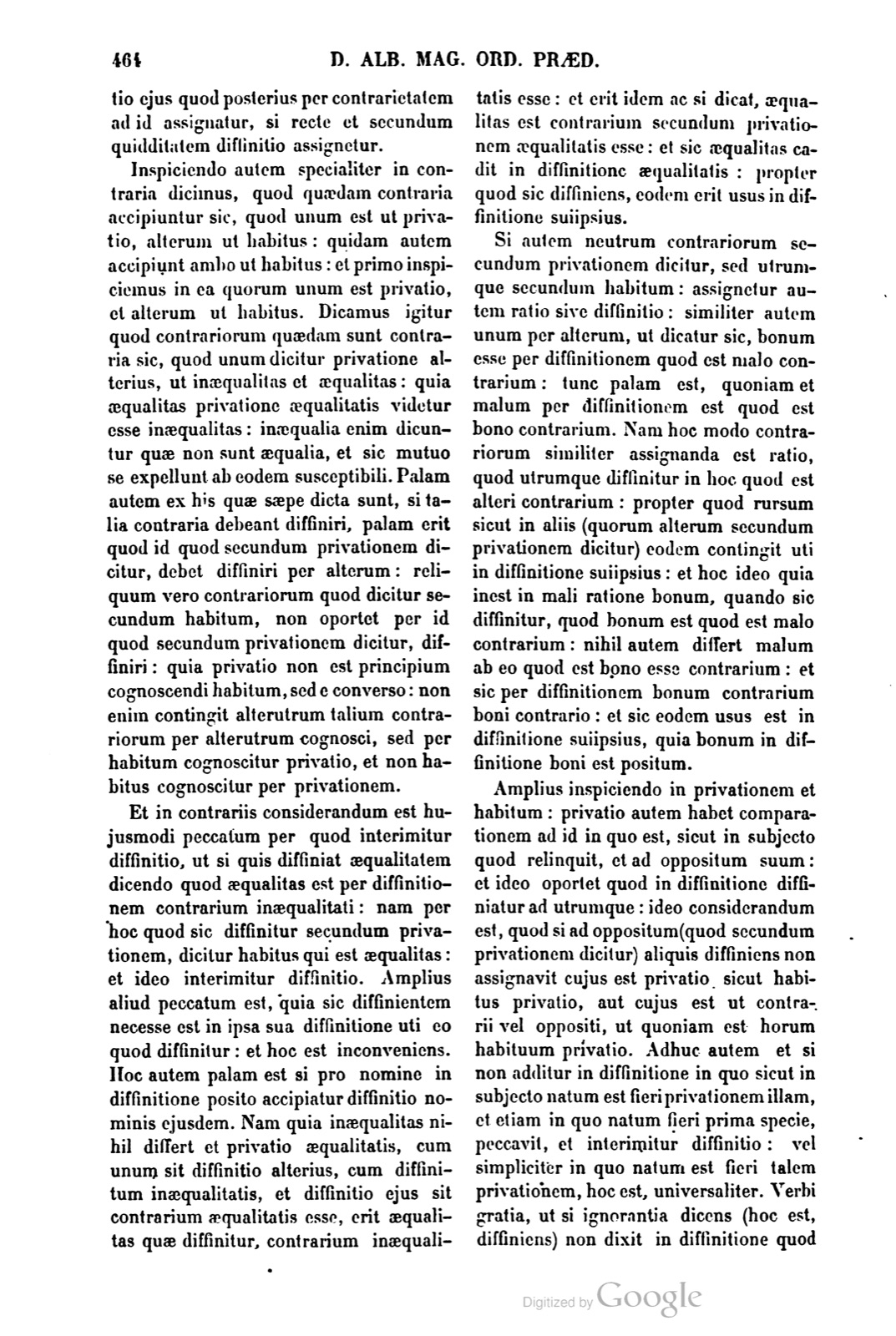
Adhuc considerandum praeter omnia quae dicta sunt, si aliquis id quod secundum privationem dictum est, non secundum privationem diffinivit, sed secundum negationem: tunc enim videtur esse hujusmodi sive simile peccatum his qui ignorantiam non secundum negationem puram, sed secundum privationem diffiniunt: nam secundum istos (sicut et verum est) quod negative non habet scientiam, non videbitur ignorare: quia privatio relinquit subjectum et aptitudinem, quod non facit negatio: unde quod negative non habet scientiam, non videbitur ignorare, sed magis videbitur ignorare quod aptitudinem habens ad sciendum, fallitur ex parte subjecti. Hujus signum est, quia nec inanimata nec pueros dicimus ignorare: quia non sunt susceptibiles scientiae: unde in talibus non potest diffiniri ignorantia secundum privationem scientiae quae relinquit subjectum et aptitudinem: et ideo in talibus diffinitionibus debet ponere habitum quem privat, et subjectum in quo est privatio: alias interimitur diffinitio.
Amplius autem considerandum si diffinitio assignata a conjugatis et casibus et similibus casibus inflexe assignatur: et si hoc fieri non potest, interimitur diffinitio. Ut si juvativum est effectivum sanitatis: tunc juvative esse est effective sanitatis esse, et juvans est faciens sanitatem.
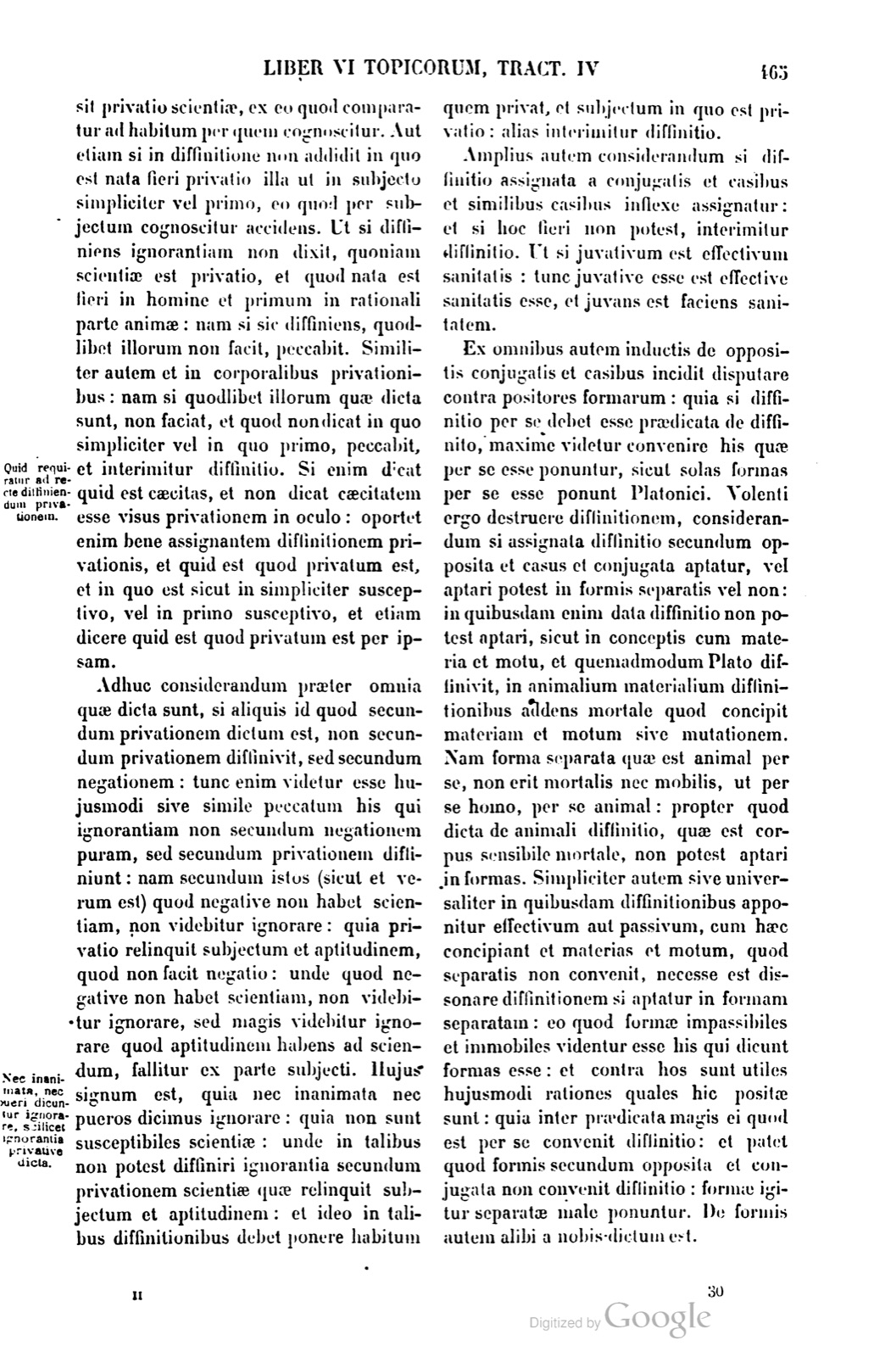
Ex omnibus autem inductis de oppositis conjugatis et casibus incidit disputare contra positores formarum: quia si diffinitio per se debet esse praedicata de diffinito, maxime videtur convenire his quae per se esse ponuntur, sicut solas formas per se esse ponunt Platonici. Volenti ergo destruere diffinitionem, considerandum si assignata diffinitio secundum opposita et casus et conjugata aptatur, vel aptari potest in formis separatis vel non: in quibusdam enim data diffinitio non potest aptari, sicut in conceptis cum materia et motu, et quemadmodum Plato diffinivit, in animalium materialium diffinitionibus addens mortale quod concipit materiam et motum sive mutationem. Nam forma separata quae est animal per se, non erit mortalis nec mobilis, ut per se homo, per se animal: propter quod dicta de animali diffinitio, quae est corpus sensibile mortale, non potest aptari in formas. Simpliciter autem sive universaliter in quibusdam diffinitionibus apponitur effectivum aut passivum, cum haec concipiant et materias et motum, quod separatis non convenit, necesse est dissonare diffinitionem si aptatur in formam separatam: eo quod formae impassibiles et immobiles videntur esse his qui dicunt formas esse: et contra hos sunt utiles hujusmodi rationes quales hic positae sunt: quia inter praedicata magis ei quod est per se convenit diffinitio: et patet quod formis secundum opposita et conjugata non convenit diffinitio: formae igitur separatae male ponuntur. De formis autem alibi a nobis dictum est.
Still further, beyond all things which have been said, one must consider whether someone has defined that which has been said according to privation not according to privation, but according to negation; for then there seems to be an error of this sort, or similar to those who define ignorance not according to pure negation, but according to privation. For according to them, as is also true, that which negatively does not have science will not seem to be ignorant, because privation leaves a subject and aptitude, which negation does not do. Hence that which negatively does not have science will not seem to be ignorant; rather that which, having aptitude for knowing, fails on the part of the subject will seem to be ignorant. The sign of this is that we say neither inanimate things nor children are ignorant, because they are not susceptible of science. Hence in such things ignorance cannot be defined according to privation of science, which leaves subject and aptitude; and therefore in such definitions one must place the habit which it deprives, and the subject in which the privation is; otherwise the definition is destroyed.
Furthermore, one must consider whether the assigned definition is assigned inflectedly from conjugates and cases and similar cases; and if this cannot be done, the definition is destroyed. As if the helpful is productive of health, then to be helpfully is to be productively of health, and the helper is one making health.
But from all the things introduced concerning opposites, conjugates, and cases, it happens to dispute against the posers of forms, because if definition through itself ought to be predicated of the defined thing, it seems most of all to belong to those things which are posited to be through themselves, just as the Platonists posit separate forms alone to be through themselves. Therefore for one wishing to destroy definition, one must consider whether the assigned definition according to opposites and cases and conjugates is fitted, or can be fitted, to separated forms or not. For in some cases the given definition cannot be fitted, as in things conceived with matter and motion, and as Plato defined, adding mortal in definitions of material animals, which conceives matter and motion or mutation. For the separated form which is animal through itself will not be mortal nor movable, as man through itself, animal through itself; on account of which the stated definition of animal, which is mortal sensible body, cannot be fitted to forms. But simply or universally in certain definitions something effective or passive is appended, since these conceive both matters and motion, which does not belong to separated things; the definition must disagree if it is fitted to separated form, because forms seem to be impassible and immobile to those who say that forms exist. And against them such arguments as are posited here are useful, because among predicates definition more belongs to that which is through itself; and it is clear that definition according to opposites and conjugates does not belong to forms; therefore separated forms are badly posited. But concerning forms we have spoken elsewhere.
If a page does not appear, its photograph has not been uploaded yet.