Volume 2 · pp. 461–462
Chapter IV. How the definition of that defined thing which is toward something is destroyed if it has not determined its qualities, quantity, where, or other differences.
A marker with ≈ is an approximate page boundary, placed by measure of the text; the page photographs remain the authority. In the paired views, clicking a page marker brings that page into view.
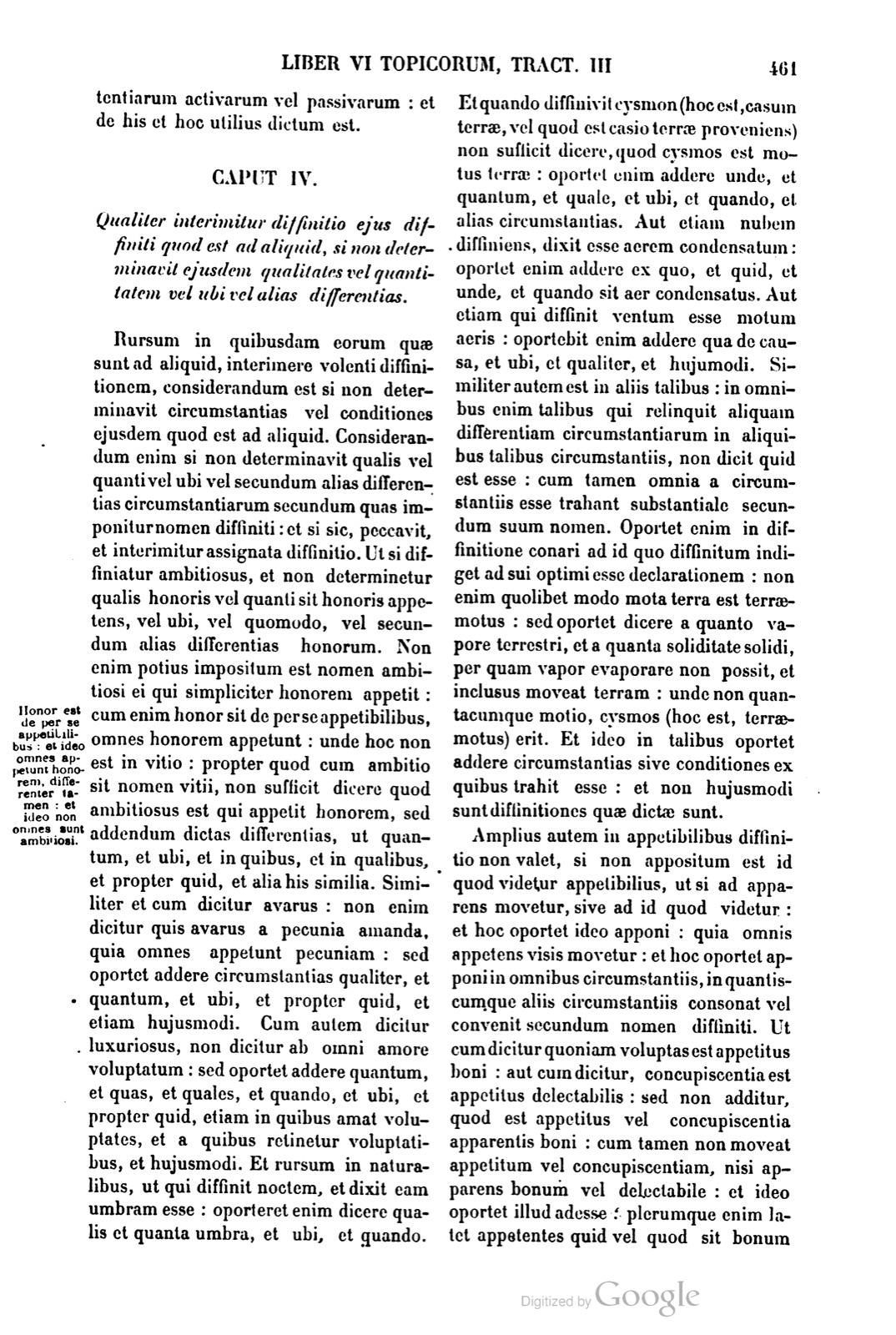
CAPUT IV. Qualiter interimitur diffinitio ejus diffiniti quod est ad aliquid, si non determinavit ejusdem qualitates vel quantitatem vel ubi vel alias differentias.
Rursum in quibusdam eorum quae sunt ad aliquid, interimere volenti diffinitionem, considerandum est si non determinavit circumstantias vel conditiones ejusdem quod est ad aliquid. Considerandum enim si non determinavit qualis vel quanti vel ubi vel secundum alias differentias circumstantiarum secundum quas imponitur nomen diffiniti: et si sic, peccavit, et interimitur assignata diffinitio. Ut si diffiniatur ambitiosus, et non determinetur qualis honoris vel quanti sit honoris appetens, vel ubi, vel quomodo, vel secundum alias differentias honorum. Non enim potius impositum est nomen ambitiosi ei qui simpliciter honorem appetit: cum enim honor sit de per se appetibilibus, omnes honorem appetunt: unde hoc non est in vitio: propter quod cum ambitio sit nomen vitii, non sufficit dicere quod ambitiosus est qui appetit honorem, sed addendum dictas differentias, ut quantum, et ubi, et in quibus, et in qualibus, et propter quid, et alia his similia. Similiter et cum dicitur avarus: non enim dicitur quis avarus a pecunia amanda, quia omnes appetunt pecuniam: sed oportet addere circumstantias qualiter, et quantum, et ubi, et propter quid, et etiam hujusmodi. Cum autem dicitur luxuriosus, non dicitur ab omni amore voluptatum: sed oportet addere quantum, et quas, et quales, et quando, et ubi, et propter quid, etiam in quibus amat voluptates, et a quibus retinetur voluptatibus, et hujusmodi. Et rursum in naturalibus, ut qui diffinit noctem, et dixit eam umbram esse: oporteret enim dicere qualis et quanta umbra, et ubi, et quando. Et quando diffinivit cysmon (hoc est, casum terrae, vel quod est casio terrae proveniens) non sufficit dicere, quod cysmos est motus terrae: oportet enim addere unde, et quantum, et quale, et ubi, et quando, et alias circumstantias. Aut etiam nubem diffiniens, dixit esse aerem condensatum: oportet enim addere ex quo, et quid, et unde, et quando sit aer condensatus. Aut etiam qui diffinit ventum esse motum aeris: oportebit enim addere qua de causa, et ubi, et qualiter, et hujusmodi. Similiter autem est in aliis talibus: in omnibus enim talibus qui relinquit aliquam differentiam circumstantiarum in aliquibus talibus circumstantiis, non dicit quid est esse: cum tamen omnia a circumstantiis esse trahant substantiale secundum suum nomen. Oportet enim in diffinitione conari ad id quo diffinitum indiget ad sui optimi esse declarationem: non enim quolibet modo mota terra est terrae-motus: sed oportet dicere a quanto vapore terrestri, et a quanta soliditate solidi, per quam vapor evaporare non possit, et inclusus moveat terram: unde non quantacumque motio, cysmos (hoc est, terrae-motus) erit. Et ideo in talibus oportet addere circumstantias sive conditiones ex quibus trahit esse: et non hujusmodi sunt diffinitiones quae dictae sunt.
Amplius autem in appetibilibus diffinitio non valet, si non appositum est id quod videtur appetibilius, ut si ad apparens movetur, sive ad id quod videtur: et hoc oportet ideo apponi: quia omnis appetens visis movetur: et hoc oportet apponi in omnibus circumstantiis, in quantiscumque aliis circumstantiis consonat vel convenit secundum nomen diffiniti. Ut cum dicitur quoniam voluptas est appetitus boni: aut cum dicitur, concupiscentia est appetitus delectabilis: sed non additur, quod est appetitus vel concupiscentia apparentis boni: cum tamen non moveat appetitum vel concupiscentiam, nisi apparens bonum vel delectabile: et ideo oportet illud adesse: plerumque enim latet appetentes quid vel quod sit bonum vel delectabile secundum veritatem, et moventur ad apparens. Propter quod non est necessarium bonum esse per se, cujus appetitus est voluptas: neque necesse est delectabile esse per se, cujus appetitus est concupiscentia: sed debet dici apparens bonum: hoc enim in eo quod apparet, facit voluptatem et concupiscentiam: unde sic per apparens bonum oportebat assignationem facere voluptatis et concupiscentiae, ut generaliter esset omnis voluptatis et concupiscentiae. Si enim aliquis diffiniens voluptatem et concupiscentiam, assignavit quod dictum est, ita quod apponat quod apparentis boni est voluptas, et apparentis delectabilis est concupiscentia: tunc adhuc qui vult interimere diffinitionem, debet ea quae assignat, in species separatas boni et delectabilis reducere: quia, sicut dixit Plato, sunt causae et formae istorum sensibilium: quia quod non est in causis, hoc non est in effectibus. Cum enim apparens non sit nisi apud nos, quibus in sensu apparet hoc esse bonum vel delectabile, et causetur ab eo cui apparet: cujus signum est, quod diversis diversa apparent delectabilia et bona: sequitur quod non forma separata sunt quae sunt causa alicujus apparentis boni vel delectabilis: quia apparens ut apparens est, causam et formam non habet extra eum cui apparet: species autem ad speciem videtur dici in omnibus difficilibus, sicut res ad rem, et ita se habere: quia omnium eorum quae sunt quidditatem facientia, sunt species quae sunt esse ejus quod est.
CHAPTER IV. How the definition of that defined thing which is toward something is destroyed if it has not determined its qualities, quantity, where, or other differences.
Again, in certain of those things which are toward something, for one wishing to destroy definition, one must consider whether he has not determined the circumstances or conditions of the same thing which is toward something. For one must consider whether he has not determined of what quality, or of what quantity, or where, or according to other differences of circumstances according to which the name of the defined thing is imposed; and if so, he has erred, and the assigned definition is destroyed. As if ambition is defined and it is not determined of what kind of honor, or of how much honor, it is appetitive, or where, or how, or according to other differences of honors. For the name ambitious is not rather imposed on him who simply seeks honor, since honor is among things appetible through themselves, and all seek honor; hence this is not in vice. Therefore, since ambition is the name of a vice, it is not enough to say that the ambitious person is one who seeks honor, but the stated differences must be added, such as how much, and where, and in which things, and in things of what kind, and for what reason, and other things similar to these. Likewise also when one is called avaricious, for someone is not called avaricious from money being loved, because all seek money; but it is necessary to add the circumstances: how, and how much, and where, and for what reason, and also things of this sort. And when one is called luxurious, he is not so called from every love of pleasures, but one must add how much, and which pleasures, and of what kind, and when, and where, and for what reason, also in which things he loves pleasures, and from which pleasures he is held back, and things of this sort. And again in natural things, as one who defines night and has said that it is shadow: for he ought to say what kind and how much shadow, and where, and when. And when he defined cysmon, that is, the fall of the earth, or what comes from the falling of the earth, it is not enough to say that cysmos is motion of the earth; for one must add whence, and how much, and of what kind, and where, and when, and other circumstances. Or again, defining cloud, he has said that it is condensed air; for he must add from what, and what, and whence, and when the air is condensed. Or again he who defines wind as being motion of air; for he must add from what cause, and where, and how, and things of this sort. Likewise it is also in other such cases. For in all such cases, one who leaves behind some difference of circumstances in some such circumstances does not state what being is, since nevertheless all such things draw substantial being from circumstances according to their name. For in definition one must strive toward that which the defined thing needs for the declaration of its best being. For not earth moved in just any way is earth-movement; rather, one must say from how much terrestrial vapor, and from how much solidity of the solid, through which the vapor cannot evaporate, and enclosed moves the earth; hence not any motion whatever will be cysmos, that is, earth-movement. And therefore in such things one must add the circumstances or conditions from which it draws being; and definitions of this sort are not those which have been stated.
Furthermore, in appetible things the definition is not valid if that which seems more appetible has not been appended, as if it is moved toward the apparent or toward that which seems so; and this must be appended for this reason, because every desiring thing is moved by things seen; and this must be appended in all circumstances, in whatever other circumstances it agrees or fits according to the name of the defined thing. As when it is said that pleasure is appetite of good, or when it is said that desire is appetite of the delectable, but it is not added that it is appetite or desire of apparent good; nevertheless nothing moves appetite or desire except apparent good or the delectable, and therefore that must be present. For mostly it is hidden from those seeking what or which thing is good or delectable according to truth, and they are moved toward the apparent. On account of this it is not necessary that the good, whose appetite is pleasure, be good through itself; nor is it necessary that the delectable, whose appetite is desire, be delectable through itself; but apparent good ought to be said. For this, in that it appears, makes pleasure and desire. Hence the assignment of pleasure and desire ought thus to be made through apparent good, so that it would belong generally to every pleasure and desire. For if someone defining pleasure and desire has assigned what has been said, so that he appends that pleasure belongs to apparent good and desire to apparent delectable, then still he who wishes to destroy the definition must reduce those things which he assigns into separate species of good and delectable, because, as Plato said, they are the causes and forms of these sensible things, since what is not in causes is not in effects. For since the apparent exists only with us, to whom in sense this appears to be good or delectable, and is caused by him to whom it appears, of which the sign is that diverse delectable and good things appear to diverse persons, it follows that those are not separate forms which are the cause of any apparent good or delectable; because the apparent as apparent has no cause and form outside him to whom it appears. But species seems to be said toward species in all difficult matters, just as thing toward thing, and so to have itself; because of all those things which make quiddity, there are species which are the being of that which is.
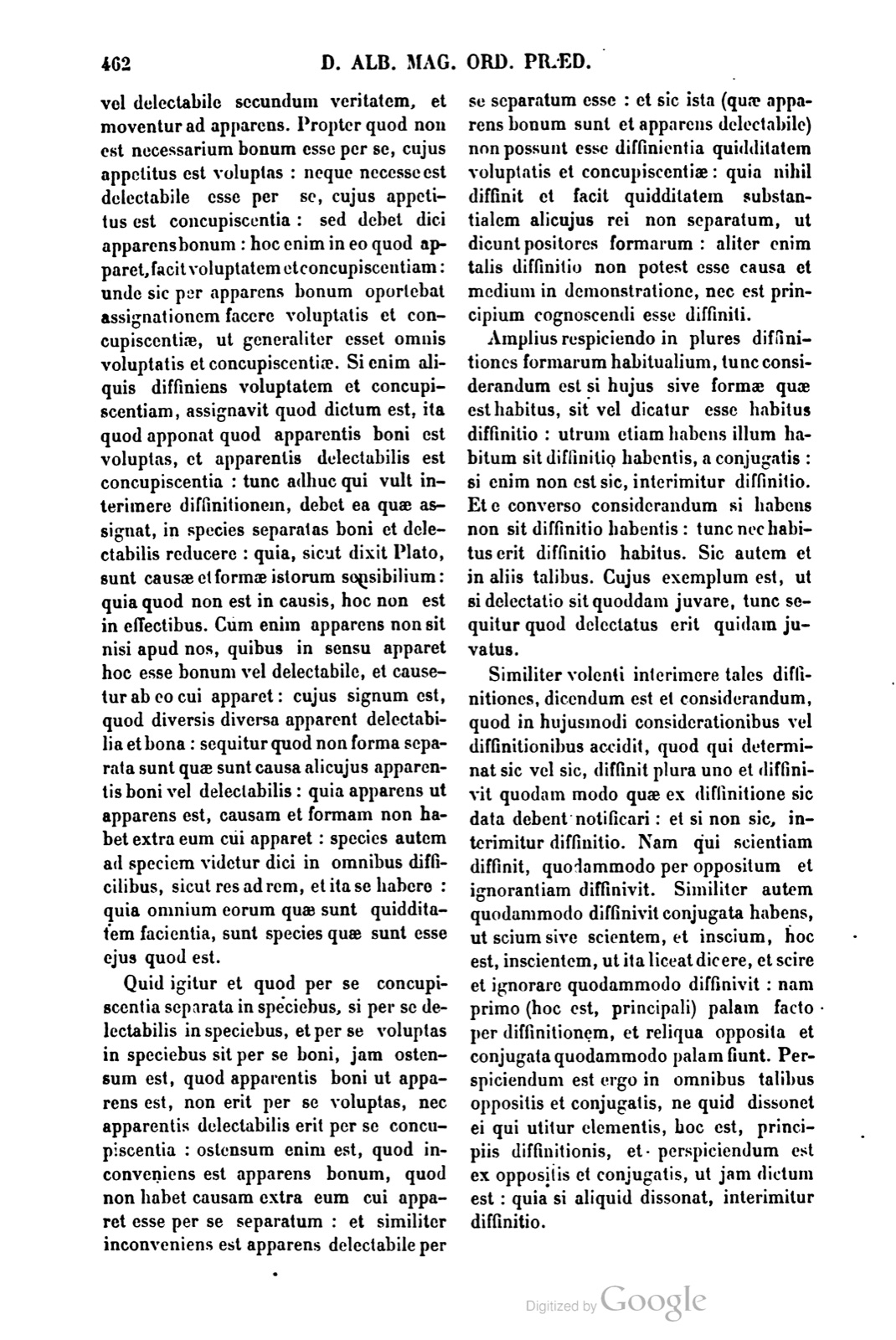
Quid igitur et quod per se concupiscentia separata in speciebus, si per se delectabilis in speciebus, et per se voluptas in speciebus sit per se boni, jam ostensum est, quod apparentis boni ut apparens est, non erit per se voluptas, nec apparentis delectabilis erit per se concupiscentia: ostensum enim est, quod inconveniens est apparens bonum, quod non habet causam extra eum cui apparet esse per se separatum: et similiter inconveniens est apparens delectabile per se separatum esse: et sic ista (quae apparens bonum sunt et apparens delectabile) non possunt esse diffinientia quidditatem voluptatis et concupiscentiae: quia nihil diffinit et facit quidditatem substantialem alicujus rei non separatum, ut dicunt positores formarum: aliter enim talis diffinitio non potest esse causa et medium in demonstratione, nec est principium cognoscendi esse diffiniti.
Amplius respiciendo in plures diffinitiones formarum habitualium, tunc considerandum est si hujus sive formae quae est habitus, sit vel dicatur esse habitus diffinitio: utrum etiam habens illum habitum sit diffinitio habentis, a conjugatis: si enim non est sic, interimitur diffinitio. Et e converso considerandum si habens non sit diffinitio habentis: tunc nec habitus erit diffinitio habitus. Sic autem et in aliis talibus. Cujus exemplum est, ut si delectatio sit quoddam juvare, tunc sequitur quod delectatus erit quidam juvatus.
Similiter volenti interimere tales diffinitiones, dicendum est et considerandum, quod in hujusmodi considerationibus vel diffinitionibus accidit, quod qui determinat sic vel sic, diffinit plura uno et diffinivit quodammodo quae ex diffinitione sic data debent notificari: et si non sic, interimitur diffinitio. Nam qui scientiam diffinit, quodammodo per oppositum et ignorantiam diffinivit. Similiter autem quodammodo diffinivit conjugata habens, ut scium sive scientem, et inscium, hoc est, inscientem, ut ita liceat dicere, et scire et ignorare quodammodo diffinivit: nam primo (hoc est, principali) palam facto per diffinitionem, et reliqua opposita et conjugata quodammodo palam fiunt. Perspiciendum est ergo in omnibus talibus oppositis et conjugatis, ne quid dissonet ei qui utitur elementis, hoc est, principiis diffinitionis, et perspiciendum est ex oppositis et conjugatis, ut jam dictum est: quia si aliquid dissonat, interimitur diffinitio.
Therefore what it is, and that there is desire through itself separated in species, if the delectable through itself is in species, and pleasure through itself is of good through itself in species, has now been shown: that of apparent good as apparent, there will not be pleasure through itself, nor of apparent delectable will there be desire through itself. For it has been shown that it is unsuitable for apparent good, which does not have a cause outside him to whom it appears, to be separated through itself; and likewise it is unsuitable for apparent delectable to be separated through itself. And so these things, which are apparent good and apparent delectable, cannot be things defining the quiddity of pleasure and desire, because nothing not separated defines and makes the substantial quiddity of any thing, as the posers of forms say; for otherwise such a definition cannot be a cause and middle in demonstration, nor is it a principle of knowing the being of the defined thing.
Furthermore, by looking into several definitions of habitual forms, then one must consider whether of this, or of a form which is a habit, there is, or is said to be, a definition of the habit; also whether the one having that habit is the definition of the one having it, from conjugates. For if it is not so, the definition is destroyed. And conversely one must consider whether the one having is not the definition of the one having; then neither will the habit be the definition of the habit. And thus also in other such cases. The example of this is that if delight is a certain helping, then it follows that the one delighted will be a certain one helped.
Likewise, for one wishing to destroy such definitions, it must be said and considered that in considerations or definitions of this sort it happens that one who determines thus or thus defines several things by one thing and in some way has defined those things which ought to be made known from the definition thus given; and if not so, the definition is destroyed. For one who defines science has in some way defined through the opposite and ignorance. Likewise he has in some way defined the conjugates, the one having, as the knowing or knower, and the unknowing, that is, the ignorant, if it is permitted to speak thus, and has in some way defined to know and to be ignorant; for when the first, that is, the principal, has been made plain through definition, the remaining opposites and conjugates also are in some way made plain. Therefore in all such opposites and conjugates one must examine lest anything disagree with the one who uses the elements, that is, the principles of definition; and one must examine from opposites and conjugates, as has now been said, because if anything disagrees, the definition is destroyed.
If a page does not appear, its photograph has not been uploaded yet.