Volume 2 · pp. 459–461
Chapter III. How definition is destroyed from comparison of the defined thing according as it is toward something.
A marker with ≈ is an approximate page boundary, placed by measure of the text; the page photographs remain the authority. In the paired views, clicking a page marker brings that page into view.
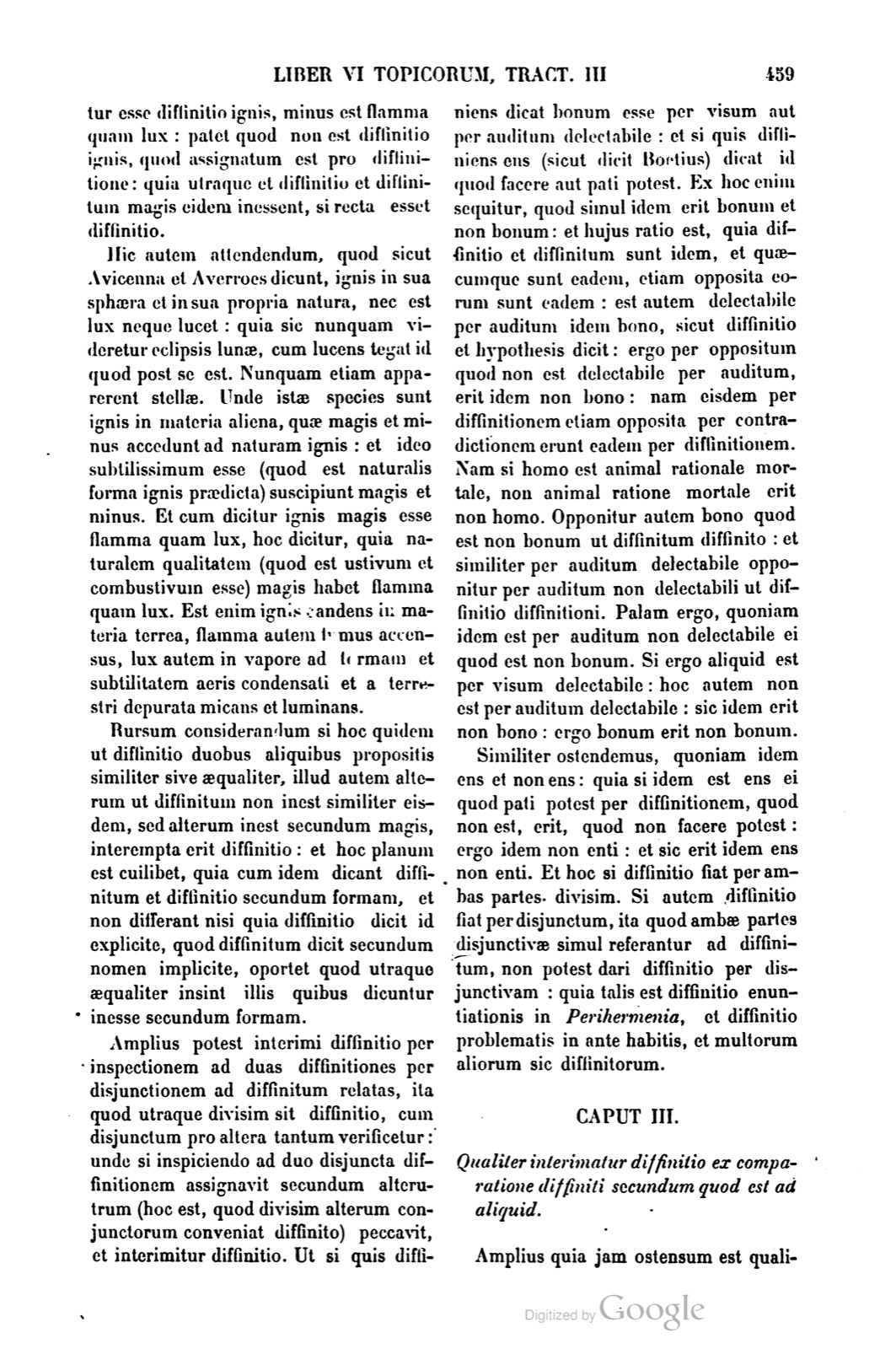
CAPUT III. Qualiter interimatur diffinitio ex comparatione diffiniti secundum quod est ad aliquid.
Amplius quia jam ostensum est qualiter interimitur diffinitio per defectum differentiae ad materiam contractae, ostendamus qualiter interimitur per defectum generis et simpliciter, et hoc sine circumstantiis. Dicamus ergo prius generali documento, quod in generibus et differentiis et aliis omnibus quae sunt et debent esse in diffinitione assignatis, eos qui interimere volunt diffinitionem, et pro nominibus generum vel differentiarum utuntur diffinitionibus nominum, ut melius videatur quod consonat et dissonat diffinito, oportet considerare si quid dissonat.
In speciali ergo considerandum si id quod diffinitur, est ad aliquid, aut per seipsum, aut secundum genus, ut grammaticam quae secundum genus est ad aliquid: tunc considerandum est si in diffinitione ejus quod est ad aliquid, non est dictum per differentiam et signatum quod est ad aliquid: et tunc interimitur diffinitio per defectum generis et differentiae quae debent esse in diffinitione. Cujus exemplum est, ut si quis scientiam (quae secundum dici est ad aliquid) diffiniens dicat, quod scientia est opinio rata: aut voluptatem diffiniens dicat, quod voluptas est appetitus sine tristitia. Nam ejus quod est ad aliquid substantia quae est esse ipsius, est quod ad alterum est: eo quod idem fuit unicuique eorum quae sunt ad aliquid esse et ad aliquid quodammodo se habere, ut in Praedicamentis dictum est: et ideo in diffinitione ponendum id ad quod est diffinitum: oportebat ergo diffiniendo scientiam dicere, quod scientia est opinio scibilis sive ejus quod est scibile: et oportebat diffiniendo voluptatem dicere, quod voluptas est appetitus boni vel boni delectabilis: quia ad haec sunt scientia et voluptas. Similiter et si grammaticam diffiniens aliquis dixit grammaticam esse scientiam litterarum, peccavit: eo quod oportebat in diffinitione relativi dicere et ipsum ad quod per se dicitur, aut ad quod dicitur secundum suum genus: haec enim oportet in diffinitione relativorum assignari.
CHAPTER III. How definition is destroyed from comparison of the defined thing according as it is toward something.
Furthermore, because it has now been shown how definition is destroyed through defect of difference contracted to matter, let us show how it is destroyed through defect of genus and simply, and this without circumstances. Therefore let us first say by a general teaching that in genera and differences and all other things which are and ought to be assigned in definition, those who wish to destroy definition, and who use definitions of names in place of the names of genera or differences, so that what agrees and disagrees with the defined thing may be better seen, must consider whether anything disagrees.
Therefore in particular one must consider whether that which is defined is toward something, either through itself or according to genus, as grammar, which according to genus is toward something; then one must consider whether in the definition of that which is toward something, it has not been said through difference and signified that it is toward something; and then definition is destroyed through defect of genus and difference which ought to be in the definition. The example of this is that if someone defining science, which according to being said is toward something, says that science is a fixed opinion; or defining pleasure says that pleasure is an appetite without sadness. For the substance of that which is toward something, which is its being, is that it is toward another, because for each of the things which are toward something, to be and to have itself somehow toward something is the same, as was said in the Categories. And therefore in the definition that toward which the defined thing is must be posited. Therefore in defining science one ought to say that science is an opinion of the knowable, or of that which is knowable; and in defining pleasure one ought to say that pleasure is an appetite of good or of delectable good, because science and pleasure are toward these things. Likewise, if someone defining grammar has said that grammar is the science of letters, he has erred, because in the definition of a relative one ought to state both the thing toward which it is said through itself and that toward which it is said according to its genus; for these things must be assigned in the definitions of relatives.
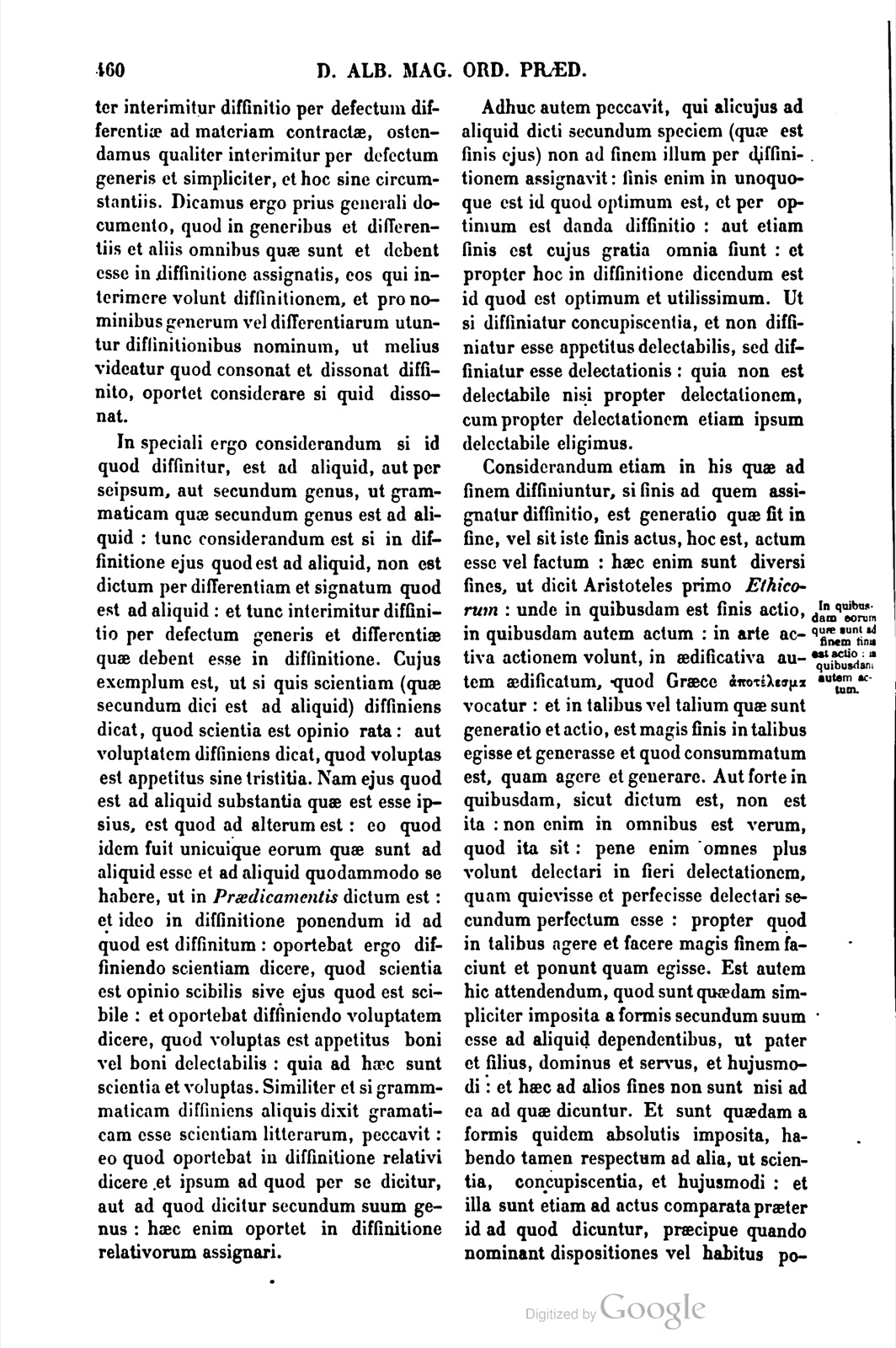
Adhuc autem peccavit, qui alicujus ad aliquid dicti secundum speciem (quae est finis ejus) non ad finem illum per diffinitionem assignavit: finis enim in unoquoque est id quod optimum est, et per optimum est danda diffinitio: aut etiam finis est cujus gratia omnia fiunt: et propter hoc in diffinitione dicendum est id quod est optimum et utilissimum. Ut si diffiniatur concupiscentia, et non diffiniatur esse appetitus delectabilis, sed diffiniatur esse delectationis: quia non est delectabile nisi propter delectationem, cum propter delectationem etiam ipsum delectabile eligimus.
Considerandum etiam in his quae ad finem diffiniuntur, si finis ad quem assignatur diffinitio, est generatio quae fit in fine, vel sit iste finis actus, hoc est, actum esse vel factum: haec enim sunt diversi fines, ut dicit Aristoteles primo Ethicorum: unde in quibusdam est finis actio, in quibusdam autem actum: in arte activa actionem volunt, in aedificativa autem aedificatum, quod Graece ἀποτέλεσμα vocatur: et in talibus vel talium quae sunt generatio et actio, est magis finis in talibus egisse et generasse et quod consummatum est, quam agere et generare. Aut forte in quibusdam, sicut dictum est, non est ita: non enim in omnibus est verum, quod ita sit: pene enim omnes plus volunt delectari in fieri delectationem, quam quievisse et perfecisse delectari secundum perfectum esse: propter quod in talibus agere et facere magis finem faciunt et ponunt quam egisse. Est autem hic attendendum, quod sunt quaedam simpliciter imposita a formis secundum suum esse ad aliquid dependentibus, ut pater et filius, dominus et servus, et hujusmodi: et haec ad alios fines non sunt nisi ad ea ad quae dicuntur. Et sunt quaedam a formis quidem absolutis imposita, habendo tamen respectum ad alia, ut scientia, concupiscentia, et hujusmodi: et illa sunt etiam ad actus comparata praeter id ad quod dicuntur, praecipue quando nominant dispositiones vel habitus potentiarum activarum vel passivarum: et de his et hoc utilius dictum est.
Further, he has erred who, for something said toward something according to species, which is its end, has not assigned it by definition toward that end; for in each thing the end is that which is best, and definition must be given through what is best. Or again, the end is that for the sake of which all things are done; and for this reason, in definition, that which is best and most useful must be stated. Thus if desire is defined and is not defined as being appetite of the delectable, but is defined as being of delight, this errs, because it is not delectable except on account of delight, since on account of delight we also choose the delectable itself.
One must also consider in those things which are defined toward an end whether the end toward which the definition is assigned is generation which comes to be in the end, or whether this end is act, that is, to be actual or made; for these are diverse ends, as Aristotle says in the first book of the Ethics. Hence in some things the end is action, but in others the thing acted: in active art they will action, but in building art the thing built, which in Greek is called ἀποτέλεσμα; and in such things, or of such things as generation and action, the end in such things is rather to have acted and generated, and what has been consummated, than to act and generate. Or perhaps in some things, as has been said, it is not so; for it is not true in all things that it is so. For almost all wish more to be delighted in the coming-to-be of delight than to have rested and perfected being delighted according to perfect being; on account of which in such things they make and posit acting and making more as the end than having acted. But here it must be noted that there are certain things imposed simply from forms dependent according to their being toward something, as father and son, master and servant, and things of this sort; and these are not toward other ends except toward those things toward which they are said. And there are certain things imposed from forms which are indeed absolute, yet have a respect toward other things, as science, desire, and things of this sort; and those are also compared to acts beyond that toward which they are said, especially when they name dispositions or habits of active or passive powers; and concerning these this also has been said more usefully.
If a page does not appear, its photograph has not been uploaded yet.