Volume 2 · pp. 458–459
Chapter II. How definition is destroyed from comparison of the definition to the defined thing according to more and less.
A marker with ≈ is an approximate page boundary, placed by measure of the text; the page photographs remain the authority. In the paired views, clicking a page marker brings that page into view.
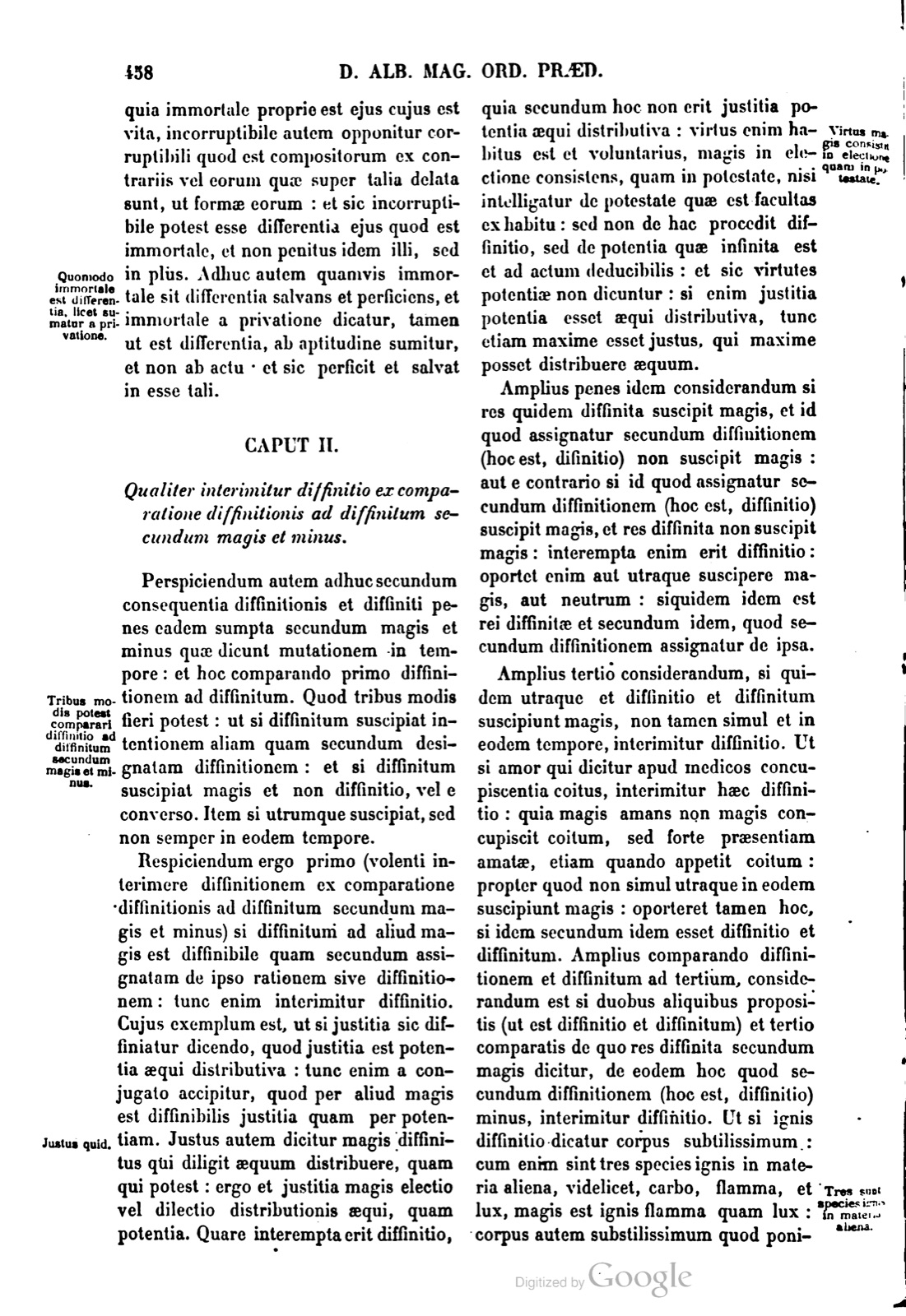
CAPUT II. Qualiter interimitur diffinitio ex comparatione diffinitionis ad diffinitum secundum magis et minus.
Perspiciendum autem adhuc secundum consequentia diffinitionis et diffiniti penes eadem sumpta secundum magis et minus quae dicunt mutationem in tempore: et hoc comparando primo diffinitionem ad diffinitum. Quod tribus modis fieri potest: ut si diffinitum suscipiat intentionem aliam quam secundum designatam diffinitionem: et si diffinitum suscipiat magis et non diffinitio, vel e converso. Item si utrumque suscipiat, sed non semper in eodem tempore.
Respiciendum ergo primo (volenti interimere diffinitionem ex comparatione diffinitionis ad diffinitum secundum magis et minus) si diffinitum ad aliud magis est diffinibile quam secundum assignatam de ipso rationem sive diffinitionem: tunc enim interimitur diffinitio. Cujus exemplum est, ut si justitia sic diffiniatur dicendo, quod justitia est potentia aequi distributiva: tunc enim a conjugato accipitur, quod per aliud magis est diffinibilis justitia quam per potentiam. Justus autem dicitur magis diffinitus qui diligit aequum distribuere, quam qui potest: ergo et justitia magis electio vel dilectio distributionis aequi, quam potentia. Quare interempta erit diffinitio, quia secundum hoc non erit justitia potentia aequi distributiva: virtus enim habitus est et voluntarius, magis in electione consistens, quam in potestate, nisi intelligatur de potestate quae est facultas ex habitu: sed non de hac procedit diffinitio, sed de potentia quae infinita est et ad actum deducibilis: et sic virtutes potentiae non dicuntur: si enim justitia potentia esset aequi distributiva, tunc etiam maxime esset justus, qui maxime posset distribuere aequum.
Amplius penes idem considerandum si res quidem diffinita suscipit magis, et id quod assignatur secundum diffinitionem (hoc est, diffinitio) non suscipit magis: aut e contrario si id quod assignatur secundum diffinitionem (hoc est, diffinitio) suscipit magis, et res diffinita non suscipit magis: interempta enim erit diffinitio: oportet enim aut utraque suscipere magis, aut neutrum: siquidem idem est rei diffinitae et secundum idem, quod secundum diffinitionem assignatur de ipsa.
Amplius tertio considerandum, si quidem utraque et diffinitio et diffinitum suscipiunt magis, non tamen simul et in eodem tempore, interimitur diffinitio. Ut si amor qui dicitur apud medicos concupiscentia coitus, interimitur haec diffinitio: quia magis amans non magis concupiscit coitum, sed forte praesentiam amatae, etiam quando appetit coitum: propter quod non simul utraque in eodem suscipiunt magis: oporteret tamen hoc, si idem secundum idem esset diffinitio et diffinitum. Amplius comparando diffinitionem et diffinitum ad tertium, considerandum est si duobus aliquibus propositis (ut est diffinitio et diffinitum) et tertio comparatis de quo res diffinita secundum magis dicitur, de eodem hoc quod secundum diffinitionem (hoc est, diffinitio) minus, interimitur diffinitio. Ut si ignis diffinitio dicatur corpus subtilissimum: cum enim sint tres species ignis in materia aliena, videlicet, carbo, flamma, et lux, magis est ignis flamma quam lux: corpus autem subtilissimum quod ponitur esse diffinitio ignis, minus est flamma quam lux: patet quod non est diffinitio ignis, quod assignatum est pro diffinitione: quia utraque et diffinitio et diffinitum magis eidem inessent, si recta esset diffinitio.
CHAPTER II. How definition is destroyed from comparison of the definition to the defined thing according to more and less.
But one must also examine, according to the consequences of definition and of the defined thing, those things taken with respect to the same matters according to more and less, which state change in time; and this by first comparing the definition to the defined thing. This can happen in three ways: if the defined thing receives another intention than according to the designated definition; and if the defined thing receives more, and the definition does not, or conversely; likewise if each receives more, but not always at the same time.
Therefore, first, one wishing to destroy definition from comparison of definition to the defined thing according to more and less must look whether the defined thing is more definable toward something else than according to the account or definition assigned concerning it; for then the definition is destroyed. The example of this is if justice is defined in this way by saying that justice is a power distributive of the equal; for then it is received from the conjugate that justice is more definable through something else than through power. But one is called just, as more defined, who loves to distribute the equal, than one who can; therefore justice too is more a choice or love of distribution of the equal than a power. Therefore the definition will have been destroyed, because according to this justice will not be a power distributive of the equal. For virtue is a habit and voluntary, consisting more in choice than in power, unless it is understood of power which is a faculty from habit; but the definition does not proceed concerning this, but concerning power which is indefinite and able to be led to act; and so virtues are not called powers. For if justice were a power distributive of the equal, then he also would be most just who could most distribute the equal.
Furthermore, with respect to the same thing one must consider whether the defined thing indeed receives more, and that which is assigned according to the definition, that is, the definition, does not receive more; or conversely, if that which is assigned according to the definition, that is, the definition, receives more, and the defined thing does not receive more; for the definition will have been destroyed. For either both must receive more, or neither, since that which is assigned concerning the defined thing according to the definition is the same as the defined thing and according to the same respect.
Furthermore, third, one must consider whether each, both definition and defined thing, receives more, but not at the same time and in the same thing; then definition is destroyed. Thus if love, which among physicians is called desire for intercourse, is defined so, this definition is destroyed, because one loving more does not desire intercourse more, but perhaps the presence of the beloved, even when he seeks intercourse. On account of this both do not together receive more in the same thing; nevertheless this would have to be so if definition and defined thing were the same according to the same respect. Furthermore, by comparing definition and defined thing to a third thing, one must consider whether, when two things are proposed, such as definition and defined thing, and compared to a third, concerning which the defined thing is said according to more, concerning the same thing that which is according to the definition, that is, the definition, is said less; then definition is destroyed. Thus if the definition of fire is said to be a most subtle body: since there are three species of fire in alien matter, namely coal, flame, and light, flame is more fire than light; but the most subtle body which is posited as the definition of fire is less flame than light. Therefore it is clear that what has been assigned as definition is not the definition of fire, because both the definition and the defined thing would belong more to the same thing if the definition were correct.
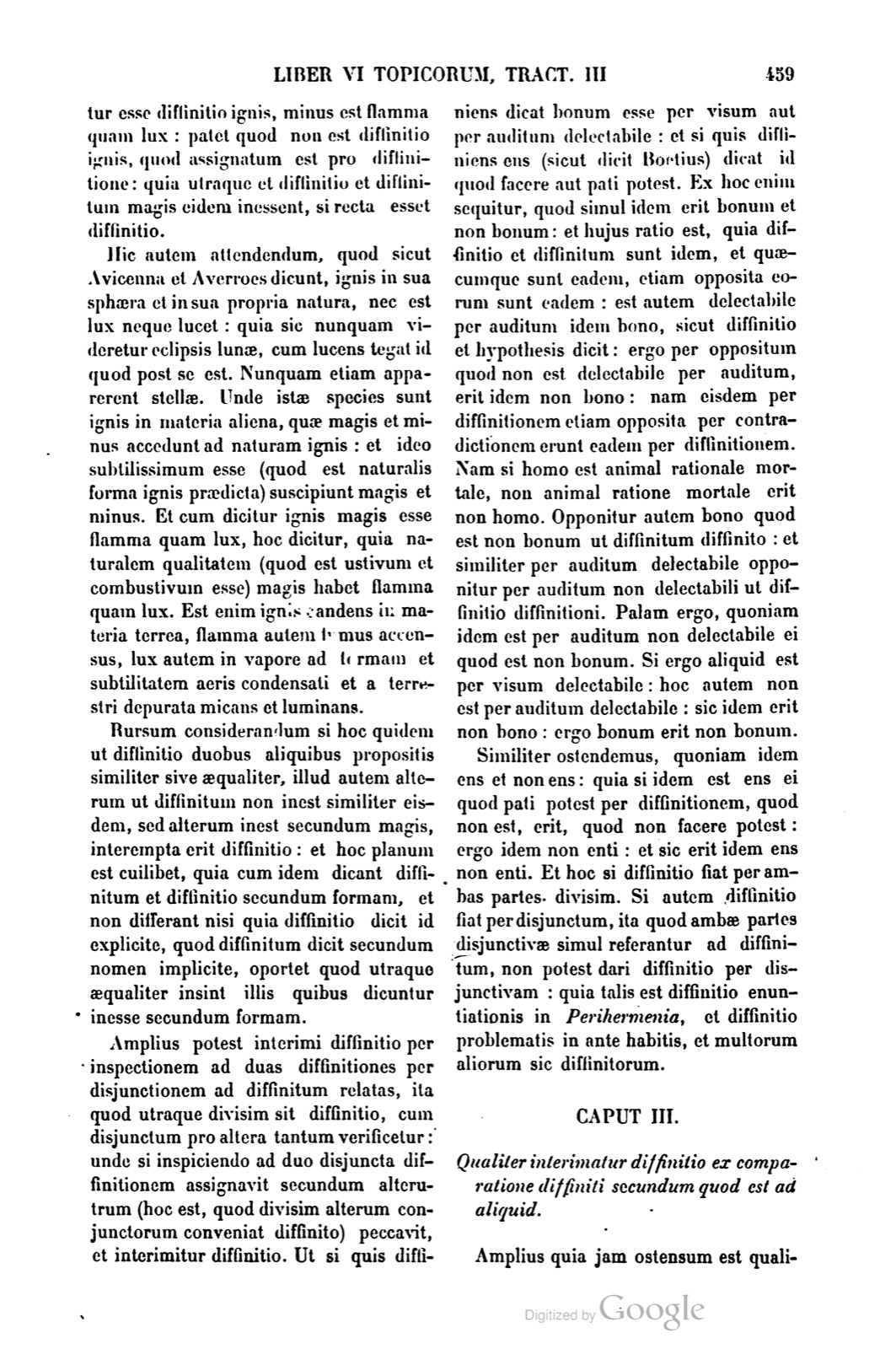
Hic autem attendendum, quod sicut Avicenna et Averroes dicunt, ignis in sua sphaera et in sua propria natura, nec est lux neque lucet: quia sic nunquam videretur eclipsis lunae, cum lucens tegat id quod post se est. Nunquam etiam apparerent stellae. Unde istae species sunt ignis in materia aliena, quae magis et minus accedunt ad naturam ignis: et ideo subtilissimum esse (quod est naturalis forma ignis praedicta) suscipiunt magis et minus. Et cum dicitur ignis magis esse flamma quam lux, hoc dicitur, quia naturalem qualitatem (quod est ustivum et combustivum esse) magis habet flamma quam lux. Est enim ignis candens in materia terrea, flamma autem ignis accensus, lux autem in vapore ad formam et subtilitatem aeris condensati et a terrestri depurata micans et luminans.
Rursum considerandum si hoc quidem ut diffinitio duobus aliquibus propositis similiter sive aequaliter, illud autem alterum ut diffinitum non inest similiter eisdem, sed alterum inest secundum magis, interempta erit diffinitio: et hoc planum est cuilibet, quia cum idem dicant diffinitum et diffinitio secundum formam, et non differant nisi quia diffinitio dicit id explicite, quod diffinitum dicit secundum nomen implicite, oportet quod utraque aequaliter insint illis quibus dicuntur inesse secundum formam.
Amplius potest interimi diffinitio per inspectionem ad duas diffinitiones per disjunctionem ad diffinitum relatas, ita quod utraque divisim sit diffinitio, cum disjunctum pro altera tantum verificetur: unde si inspiciendo ad duo disjuncta diffinitionem assignavit secundum alterutrum (hoc est, quod divisim alterum conjunctorum conveniat diffinito) peccavit, et interimitur diffinitio. Ut si quis diffiniens dicat bonum esse per visum aut per auditum delectabile: et si quis diffiniens ens (sicut dicit Boetius) dicat id quod facere aut pati potest. Ex hoc enim sequitur, quod simul idem erit bonum et non bonum: et hujus ratio est, quia diffinitio et diffinitum sunt idem, et quaecumque sunt eadem, etiam opposita eorum sunt eadem: est autem delectabile per auditum idem bono, sicut diffinitio et hypothesis dicit: ergo per oppositum quod non est delectabile per auditum, erit idem non bono: nam eisdem per diffinitionem etiam opposita per contradictionem erunt eadem per diffinitionem. Nam si homo est animal rationale mortale, non animal rationale mortale erit non homo. Opponitur autem bono quod est non bonum ut diffinitum diffinito: et similiter per auditum delectabile opponitur per auditum non delectabili ut diffinitio diffinitioni. Palam ergo, quoniam idem est per auditum non delectabile ei quod est non bonum. Si ergo aliquid est per visum delectabile: hoc autem non est per auditum delectabile: sic idem erit non bono: ergo bonum erit non bonum.
Similiter ostendemus, quoniam idem ens et non ens: quia si idem est ens ei quod pati potest per diffinitionem, quod non est, erit, quod non facere potest: ergo idem non enti: et sic erit idem ens non enti. Et hoc si diffinitio fiat per ambas partes divisim. Si autem diffinitio fiat per disjunctum, ita quod ambae partes disjunctivae simul referantur ad diffinitum, non potest dari diffinitio per disjunctivam: quia talis est diffinitio enuntiationis in Perihermenia, et diffinitio problematis in ante habitis, et multorum aliorum sic diffinitorum.
But here it must be noted that, as Avicenna and Averroes say, fire in its sphere and in its proper nature is neither light nor does it shine, because if it did, an eclipse of the moon would never be seen, since what shines covers what is behind it. Nor would the stars ever appear. Hence these species are fire in alien matter, which approach more and less to the nature of fire; and therefore they receive more and less the being-most-subtle, which is the aforesaid natural form of fire. And when fire is said to be flame more than light, this is said because flame has the natural quality, namely being able to burn and consume, more than light. For fire is glowing in earthy matter, but flame is kindled fire, and light is gleaming and illuminating in vapor condensed toward the form and subtlety of air and purified from what is earthy.
Again one must consider whether this, as definition, belongs similarly or equally to two proposed things, but that other, as defined thing, does not belong similarly to the same things, but one belongs according to more; then the definition will have been destroyed. And this is plain to anyone, because, since defined thing and definition state the same according to form and differ only because definition states explicitly what the defined thing states implicitly according to the name, both must be equally in those things in which they are said to be according to form.
Furthermore, definition can be destroyed through inspection toward two definitions related to the defined thing through disjunction, so that each separately is a definition, while the disjunct is verified only for one of the two. Hence, if by looking to two disjoined things someone has assigned the definition according to either one, that is, so that separately either of the conjoined things belongs to the defined thing, he has erred and the definition is destroyed. As if someone defining should say that the good is what is delightful through sight or through hearing; and if someone defining being, as Boethius says, should say that it is that which can act or suffer. For from this it follows that the same thing will be at once good and not good. And the reason for this is that definition and defined thing are the same, and whatever things are the same, their opposites also are the same. But what is delightful through hearing is the same as good, as the definition and hypothesis say; therefore, through the opposite, what is not delightful through hearing will be the same as not-good. For for the same things by definition, even opposites by contradiction will be the same by definition. For if man is rational mortal animal, non-rational-mortal-animal will be non-man. But not-good is opposed to good as defined thing to defined thing; and likewise delightful through hearing is opposed to not-delightful through hearing as definition to definition. Therefore it is plain that what is not delightful through hearing is the same as what is not good. Therefore if something is delightful through sight, but this is not delightful through hearing, thus the same thing will be not-good; therefore good will be not-good.
Similarly we shall show that the same thing is being and non-being, because if being is the same by definition as that which can suffer, that which cannot act will be what is not; therefore it is the same as non-being, and so the same thing will be being and non-being. And this follows if the definition is made through both parts separately. But if the definition is made through the disjunct so that both disjunctive parts are referred together to the defined thing, a definition cannot be given through a disjunctive expression, because such is the definition of an enunciation in the Perihermenias, and the definition of a problem in what has gone before, and of many other things defined in this way.
If a page does not appear, its photograph has not been uploaded yet.