Volume 2 · pp. 457–458
Tractate III. Chapter I. Whether the definition agrees with the defined thing according to all times, or whether it disagrees with something at some time.
A marker with ≈ is an approximate page boundary, placed by measure of the text; the page photographs remain the authority. In the paired views, clicking a page marker brings that page into view.
TRACTATUS III. QUALITER INTERIMITUR DIFFINITIO INSPICIENDO IN EA QUAE DIFFINITIONEM COMPARATAM AD DIFFINITUM CONSEQUUNTUR SECUNDUM IDENTITATEM.
CAPUT I. Si diffinitio diffinito secundum omnia tempora consonet, vel si alicui in aliquo tempore dissonet.
Sic autem terminata diffinitione vel problemate diffinitionis penes essentialia diffinitionis, determinandum idem problema penes ea quae diffinitionem comparatam ad diffinitum consequuntur secundum identitatem. Et primo quidem considerandum si diffinitio diffinito secundum omnia tempora consonet, vel si alicui in aliquo tempore dissonet: quia tunc interimitur diffinitio. Ut si aliquis diffinivit animal immortale, quod est nunc incorruptibile: nam nunc incorruptibile animal, ita quod haec dictio, nunc, determinet hoc quod est incorruptibile, nunc est immortale, et hoc modo nunc immortale nunc incorruptibile est. Sic ergo hoc modo interimitur diffinitio.
Aut forte dicendum, quod in exemplo inducto non est instantia vera quin possit esse diffinitio: hoc enim quod dicitur nunc incorruptibile esse, dubium est et multos sensus habere potest. Aut enim incorruptibile dicitur ab actu corruptionis, et dicitur nunc incorruptibile quod non nunc corrumpitur: et hoc modo non est diffinitio immortalis. Aut incorruptibile dicit privationem potentiae corruptionis, non simpliciter, sed ut sit sensus, quod incorruptibile dicitur, quoniam impossibile est corrumpi nunc: et sic iterum non est diffinitio immortalis. Aut incorruptibile dicit quidem privationem potentiae corruptionis simpliciter, et nunc tale sit dictum ipsum incorruptibile, hoc est, ut hujusmodi sit nunc quod nunquam corrumpi possit: et hoc modo potest esse diffinitio immortalis. Quando ergo dicimus, quod incorruptibile nunc est animal, non hoc dicimus assignando quoniam nunc tale animal quod non corrumpitur, sed ostendimus quoniam nunc tale sit, quod nunquam corrumpatur nec corrumpi possit: hoc autem idem est immortali et diffinitio ejusdem: propter quod non accidit nunc secundum hoc tempus praesens tantum id idem immortale esse: sed dicimus hic unum sic esse considerandum, si secundum omne tempus sequitur in his ubi accidat id quod secundum diffinitionem assignatur, sequi diffinitum et inesse nunc secundum hoc praesens tempus et praeteritum tempus, et non semper. Quod autem secundum nomen diffiniti ad quod aptatur diffinitio, accidit aliquando non inesse, non erit idem nunc et prius.
TRACTATE III. HOW DEFINITION IS DESTROYED BY INSPECTING THOSE THINGS WHICH FOLLOW UPON DEFINITION COMPARED TO THE DEFINED THING ACCORDING TO IDENTITY.
CHAPTER I. Whether the definition agrees with the defined thing according to all times, or whether it disagrees with something at some time.
But with definition, or the problem of definition, thus completed with respect to the essentials of definition, the same problem must be determined with respect to those things which follow upon definition compared to the defined thing according to identity. And first, one must consider whether the definition agrees with the defined thing according to all times, or whether it disagrees with something at some time, because then the definition is destroyed. As if someone defined immortal animal as that which is now incorruptible; for an animal now incorruptible, in such a way that this expression, now, determines that which is incorruptible, now is immortal, and in this way what is now immortal is now incorruptible. Therefore in this way the definition is destroyed.
Or perhaps it must be said that in the example introduced there is not a true instance preventing it from being a definition; for this which is called being now incorruptible is doubtful and can have many senses. For either incorruptible is said from the act of corruption, and that is called now incorruptible which is not now being corrupted, and in this way it is not the definition of immortal. Or incorruptible says a privation of the potency of corruption, not simply, but so that the sense is that it is called incorruptible because it is impossible to be corrupted now; and thus again it is not the definition of immortal. Or incorruptible indeed says the privation of the potency of corruption simply, and let incorruptible itself now be said as such, that is, so that this sort of thing is now what can never be corrupted; and in this way it can be the definition of immortal. Therefore when we say that incorruptible now is animal, we do not say this by assigning that it is now such an animal which is not corrupted, but we show that it is now such that it is never corrupted nor can be corrupted; and this is the same as immortal and the definition of the same. On account of this it does not happen that, according to this present time alone, the same thing is immortal now; but here we say that one thing must be considered in this way: whether according to every time, in these cases where what is assigned according to the definition happens, that thing follows the defined thing and is present now according to this present time and according to past time, and not always. But what according to the name of the defined thing to which the definition is fitted happens at some time not to be present, will not be the same now and before.
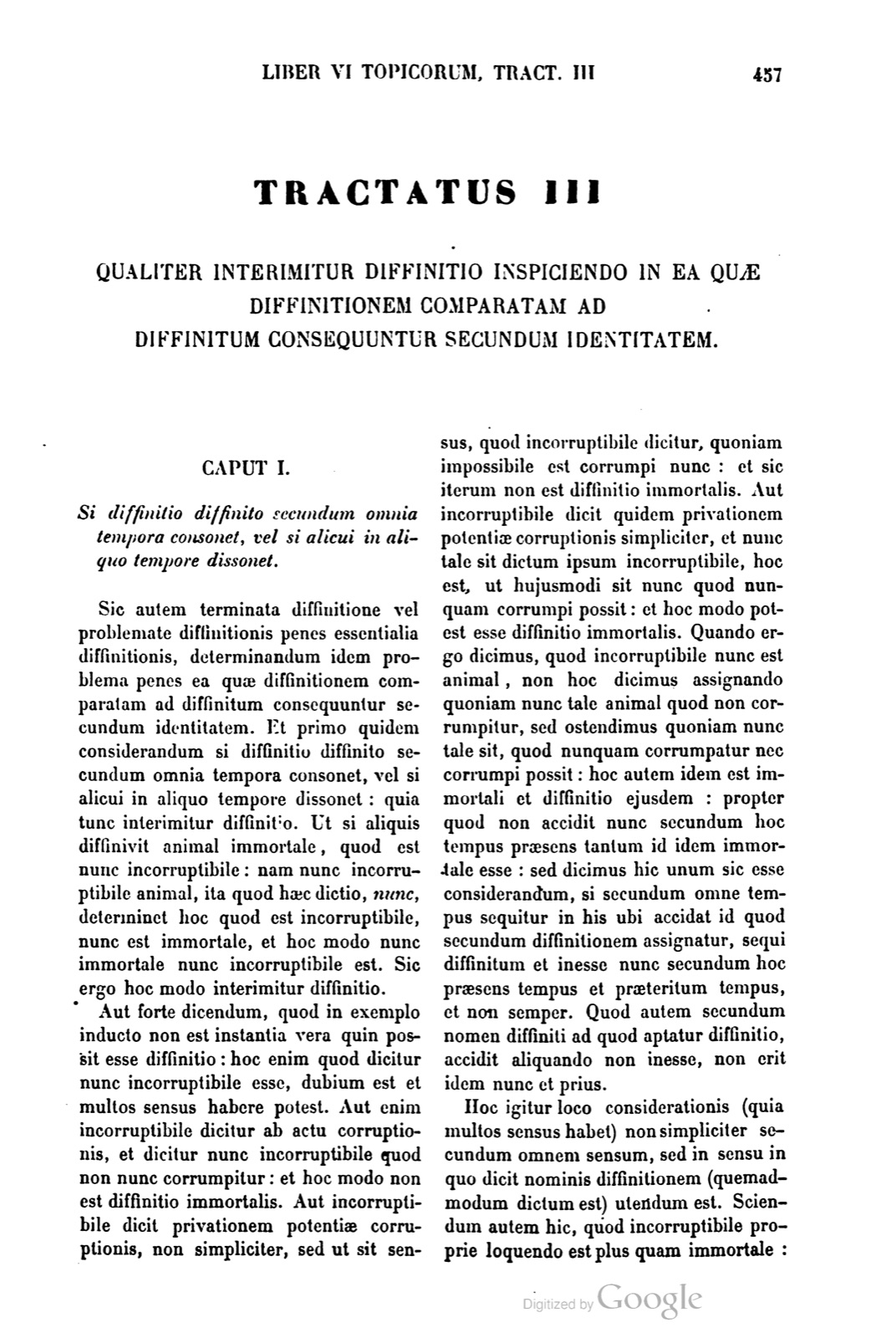
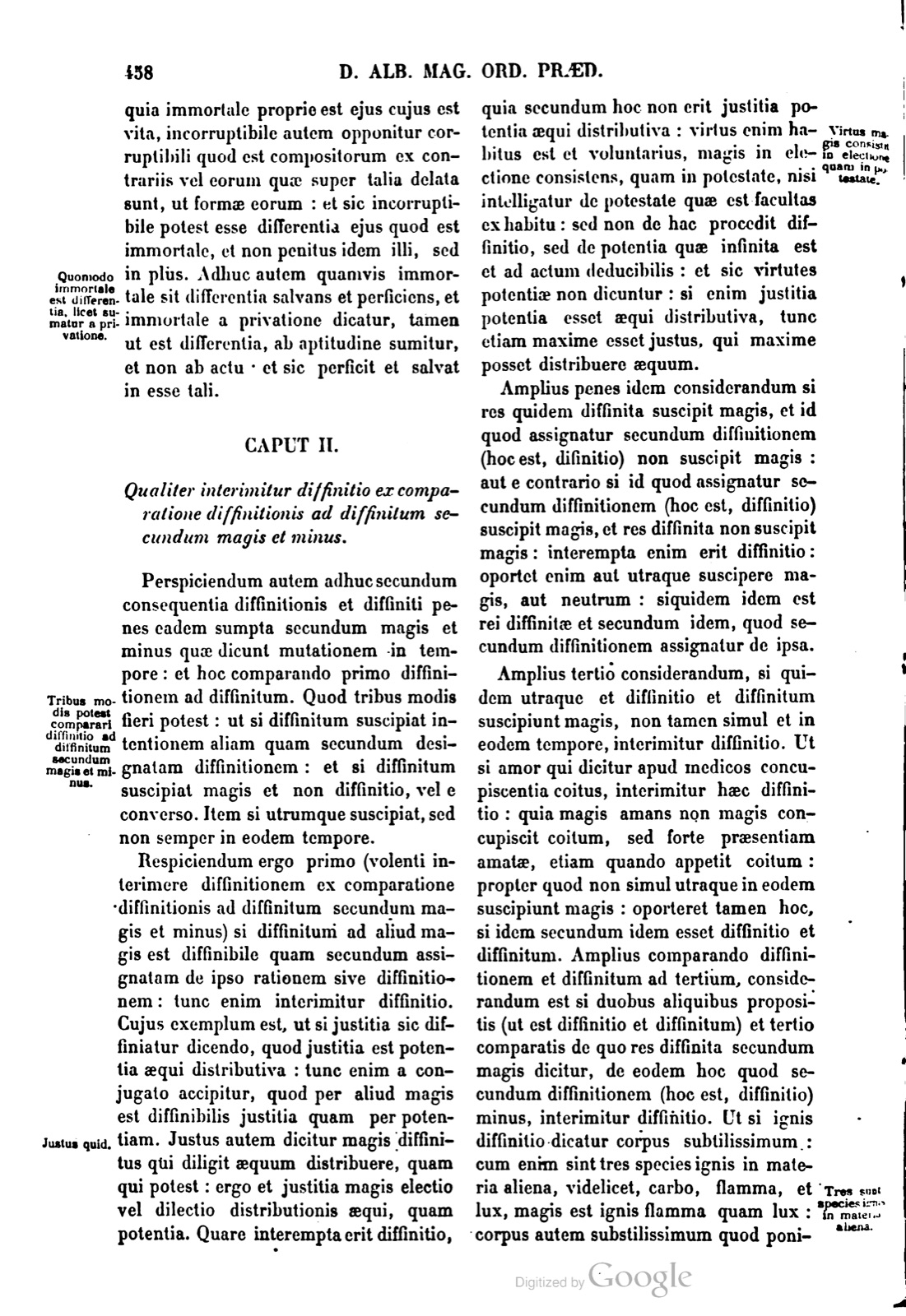
Hoc igitur loco considerationis (quia multos sensus habet) non simpliciter secundum omnem sensum, sed in sensu in quo dicit nominis diffinitionem (quemadmodum dictum est) utendum est. Sciendum autem hic, quod incorruptibile proprie loquendo est plus quam immortale: quia immortale proprie est ejus cujus est vita, incorruptibile autem opponitur corruptibili quod est compositorum ex contrariis vel eorum quae super talia delata sunt, ut formae eorum: et sic incorruptibile potest esse differentia ejus quod est immortale, et non penitus idem illi, sed in plus. Adhuc autem quamvis immortale sit differentia salvans et perficiens, et immortale a privatione dicatur, tamen ut est differentia, ab aptitudine sumitur, et non ab actu: et sic perficit et salvat in esse tali.
Therefore this place of consideration, because it has many senses, must be used not simply according to every sense, but in the sense in which it states the definition of the name, as has been said. But it must be known here that incorruptible, properly speaking, is broader than immortal, because immortal is properly of that whose life exists, whereas incorruptible is opposed to corruptible, which belongs to composites from contraries or to those things which are borne upon such things, such as their forms. And so incorruptible can be the difference of that which is immortal, and is not entirely the same as it, but broader. Further, although immortal is a difference saving and perfecting, and immortal is said from privation, nevertheless, as it is a difference, it is taken from aptitude and not from act; and so it perfects and preserves in such being.
If a page does not appear, its photograph has not been uploaded yet.