Volume 2 · pp. 451–456
Chapter VII. On inspection toward the difference taken absolutely and toward the contracted difference.
A marker with ≈ is an approximate page boundary, placed by measure of the text; the page photographs remain the authority. In the paired views, clicking a page marker brings that page into view.
animal, praedicaretur secundum unamquamque differentiam, ut quaelibet differentia participationis: tunc jure et multa animalia de specie praedicarentur. Et hujus causa est, quia differentia dividit genus, et multae differentiae in multa divident, et diversae divident in diversa: et sic numeraretur animal diversitate differentiarum ut participatum dividitur secundum participantia diversa: et sic tunc (quia una species habet plures differentias quae de specie praedicantur) multa animalia de eadem specie praedicarentur: quia quaelibet differentia infert genus quod ipsa participat.
Si autem quis objiciat, quando similiter a primo descenditur usque ad ultimum, multa genera praedicantur de uno. Non est simile: quia nullum eorum per quae descenditur per opposita, dividit genus: et ideo genus non numeratur in illis, sed est idem plus et minus coarctatum secundum quod plus est et minus descensus a primo.
Amplius ad idem alia ratio est: quia si genus de differentia praedicatur, et substantiali et essentiali praedicatione, non tamen talis praedicatio est superioris de inferiore secundum rectam lineam praedicabilium: quia si sic, sequitur quod differentiae omnes essent species vel individua: quia tali praedicatione non nisi de specie et individuo praedicatur genus: si quidem hoc certum est in his de quibus animal praedicatur: nam unumquodque animalium de quo animal genus praedicatur essentiali praedicatione, species est, aut individuum. Est autem hic attendendum, quod haec natura quae est genus, de hac natura quae est differentia nullo modo praedicatur, sed disparatae naturae sunt, quarum una est ut id quod est potentia et materiale quod est genus, et altera est sicut actus purus cujus nihil est id quod est subjectum et potentia: unde cum omne id quod praedicatur affirmative de aliquo, sui aliquid secundum esse habeat in eo de quo praedicatur, et genus secundum id quod est natura quaedam et subjectum et in potentia, sui nihil secundum esse habeat in differentia, eo quod est id quod est in subjectum in potentia existens, impossibile quod alterum de altero essentialiter praedicetur, sed sunt essentiae et naturae disparatae. Et hujus causas diversi diversas assignant: sed non alia causa est quam illa quam dicit Aristoteles et Philosophi, quod id quod est subjectum in potentia existens secundum rem, nunquam in idem cum forma et actu coincidit: sequeretur enim quod idem esset formans et formatum, et distinguibile et distinctum, et perficiens et perfectum: quae omnia sunt impossibilia et contra omnem intellectum. Ergo oportet dici quod quando genus de differentia vel differentia de genere praedicatur, vel quando species vel individuum de differentia, vel e converso praedicatur, quod differentia, secundum esse et concretionem quam habet ad suppositum quod informat, accipiatur: et sic dicitur quod animal est rationale, et rationale est animal: et quod homo est rationalis, et rationalis homo: et rationalis Socrates, et Socrates rationalis. Dicunt tamen quidam, quod cum dicitur, rationale est animal, vel e converso animal est rationale, quod duplex est locutio: ex eo quod hoc quod dico, rationale, potest stare formaliter: et sic falsa est locutio, quia sic rationalitas esset animal: vel potest stare pro supposito, et sic est vera. Et hoc est idem cum priore, sed dicit quod prior solum causam dicit eorum quae dicta sunt. Et ex his plane intelligitur quod hic dicitur.
Similiter adhuc inspiciendum in differentiam comparatam ad species, si species aut aliud inferius specie (sicut individuum, vel specialissimum quod subalterna specie continetur) praedicatur essentialiter et universaliter de differentia: hoc enim est impossibile: cujus prima ratio est, quia sic in amplius. Aliud inconveniens sequitur: quia sic accidit sive sequitur, quod species sit differentia: siquidem praedicabitur de differentia aliqua specierum, constat quod non accidentali praedicatione praedicatur, ut homo est albus: praedicabitur ergo essentialiter affirmative: constat ergo quod praedicata species aliquid sui habet in subjecto quod est differentia: constat autem quod cum non sit in specie nisi genus et differentia, quod alterum horum habet species in differentia: patet quod non genus: ergo differentiam: sequitur ergo quod species sit differentia, quod est inconveniens. Nam si praedicatur de differentia haec species, homo, palam quod sequitur, quod homo sit differentia: et sic interimitur differentia et diffinitio.
animal, it would be predicated according to each difference, as each difference is of participation; then with reason also many animals would be predicated of the species. And the cause of this is that difference divides genus, and many differences will divide into many things, and diverse differences will divide into diverse things; and so animal would be numbered by the diversity of differences, as what is participated is divided according to diverse participants; and so then, because one species has several differences which are predicated of the species, many animals would be predicated of the same species, because each difference implies the genus which it itself participates.
But if someone should object that, when descent is made similarly from the first down to the last, many genera are predicated of one thing, it is not similar, because none of those through which descent is made by opposites divides the genus; and therefore genus is not numbered in them, but is the same thing more and less narrowed according as there is more and less descent from the first.
Furthermore, there is another reason for the same point: because if genus is predicated of difference, and by substantial and essential predication, nevertheless such predication is not of a superior concerning an inferior according to the straight line of predicables; because if it were so, it follows that all differences would be species or individuals, because by such predication genus is predicated only of species and individual, if indeed this is certain in those things of which animal is predicated; for every animal of which animal as genus is predicated by essential predication is a species or an individual. But here it must be noticed that this nature which is genus is in no way predicated of this nature which is difference, but they are disparate natures, of which one is as that which is in potency and material, which is genus, and the other is as pure act, of which nothing is that which is subject and potency; whence since everything which is predicated affirmatively of something has something of itself according to being in that of which it is predicated, and genus according to that which it is, a certain nature and subject and in potency, has nothing of itself according to being in difference, because it is that which is in a subject existing in potency, it is impossible that one be predicated essentially of the other, but they are disparate essences and natures. And diverse people assign diverse causes of this, but there is no other cause than that which Aristotle and the philosophers state: that what is a subject existing in potency according to the thing never coincides into the same with form and act; for it would follow that the same thing would be forming and formed, distinguishable and distinguished, perfecting and perfected, all of which are impossible and contrary to every intellect. Therefore it must be said that when genus is predicated of difference or difference of genus, or when species or individual is predicated of difference, or conversely, difference is taken according to the being and concretion which it has toward the supposit which it informs; and thus it is said that animal is rational, and rational is animal, and that man is rational, and rational is man, and rational Socrates, and Socrates rational. Yet some say that when it is said, rational is animal, or conversely animal is rational, the expression is twofold: from the fact that what I say, rational, can stand formally, and thus the expression is false, because in that way rationality would be animal; or it can stand for the supposit, and thus it is true. And this is the same as the prior answer, but it says that the prior only states the cause of those things which have been said. And from these things what is said here is plainly understood.
Likewise one must still inspect difference compared to species, whether species or something else inferior to species, such as an individual, or a most special species contained under a subaltern species, is predicated essentially and universally of difference; for this is impossible. The first reason for this is that thus it would be broader. Another unsuitable consequence follows, because thus it happens or follows that species is difference; since it will be predicated of some difference of species, it is clear that it is not predicated by accidental predication, as man is white; therefore it will be predicated essentially and affirmatively. It is clear, therefore, that the predicated species has something of itself in the subject which is difference. But it is clear that, since there is nothing in species except genus and difference, the species has one of these in difference: plainly not genus; therefore difference. Therefore it follows that species is difference, which is unsuitable. For if this species, man, is predicated of difference, it plainly follows that man is difference; and so difference and definition are destroyed.
Rursum comparando differentiam ad speciem secundum prioritatem, considerandum est si non prior est differentia specie: sic enim interimitur differentia et diffinitio: eo quod genere posteriorem, specie autem priorem oportet esse differentiam.
Est autem objectio consueta quae in multis locis et hic et in secundo Posteriorum 1 et in aliis locis fieri consuevit, quod dicit Aristoteles, quod differentia in amplius praedicatur quam species: et in VII Primae philosophiae 2 dicit, quod differentia ultima specifica convertibilis est cum specie, et non est in amplius quam species ipsa: quae etiam esse videntur contraria et repugnantia. Sed ad hoc saepius a nobis in diversis libris est responsum, quod est quae secundum nomen et actum differentiae differentia est: et est quae dividit et differre facit in specie, quia alia non dividit: et si differre facit speciem ab aliis, hoc est ex consequenti: quia constituendo format: et sic per formam ab omnibus (quae ad illam formam disparata sunt) dividit. Et ideo differentia, secundum actum differentiae differentia existente, intelligitur quod quantum est de se, communior est quam species, de qua etiam supra in primo hujus scientiae libro dictum est, quod est generalis et cum genere collocanda: et in prima philosophia 3 in septimo innuit Aristoteles, quod omnes differentiae quae sunt ante ultimam, sunt ut genus, et pro genere ponuntur: quia in potentia sunt, non ut actus purus et stans et perfectus: sed illa quae est actus totus purus secundum se, est in actu formae constituentis et determinantis totam generis potentiam: et quod differre facit, non habet nisi ex consequenti: ideo non dividit inter se id cujus est differentia, hoc est, speciem, sicut facit differentia divisiva quae inter seipsam dividit genus cujus est differentia: sed ex consequenti dividit totam speciem integram ab aliis. Et de tali differentia nec hic fit sermo, nec etiam in secundo Posteriorum, sed in VII primae philosophiae, ubi agitur de veris principiis earum constituentibus eas in substantia et inesse: et sic solvuntur contraria. Alii autem aliter solvunt, de quorum dicto non curamus.
Adhuc volenti interimere considerandum est ad differentiam comparatam ad aliud genus quod non est diffiniti genus, quod non continet genus diffiniti, nec continetur ab eo sicut genera subalternatim posita: quia non videtur, quod diversi generis neque subalternati simul, nec subalternantis genus diffiniti sit eadem et substantialis differentia, sicut nec una species est talium generum ita ad invicem se habentium. Hoc autem probatur per deductionem ad impossibile: quia si detur quod non est sic, ut dictum est, accidet sive sequetur, quod una species erit in duobus generibus non continentibus se invicem, hoc est, non subalternatim positis. Cujus ratio est haec: generale est, quod quaelibet differentia secundum se accepta infert suum proprium genus in quo est, velut gressibile et bipes quae sunt differentiae animalis, inferunt animal si secundum se accipiantur. Similiter quaelibet differentia cum suo genere accepta constituit unam speciem, et unica differentia constituit unicam speciem: unica ergo differentia cum uno genere constituit unicam speciem, et eadem cum alio genere accepta constituit speciem, quia unica est duorum generum, ut dicit hypothesis: et verum est quod de quo praedicatur differentia, de eodem praedicatur et genus illius differentiae. Sint ergo genera A B, et unica differentia sit C, species autem constituta sit D: praedicatur autem C de D, ergo et A genus praedicatur de D: per eamdem rationem praedicabitur et B de D per differentiam quae est C; quia ista duorum generum est differentia: ergo differentia et species una est in duobus generibus, ut in A et B, quod est contra hoc quod in Praedicamentis dicitur, quod diversorum generum, et caetera.
Again, by comparing difference to species according to priority, one must consider whether difference is not prior to species; for in this way difference and definition are destroyed, because difference must be posterior to genus but prior to species.
But there is the customary objection which is wont to be made in many places, both here and in the second book of the Posterior Analytics 1 and in other places, that Aristotle says that difference is predicated more broadly than species; and in the seventh book of First Philosophy 2 he says that the final specific difference is convertible with species and is not broader than the species itself; and these also seem to be contrary and repugnant. But to this it has often been answered by us in diverse books that there is that which is a difference according to the name and act of difference, and there is that which divides and makes things differ in species, because the other does not divide; and if it makes a species differ from others, this is consequently, because by constituting it forms it, and thus by form it divides from all things which are disparate from that form. And therefore difference, according as it is difference by the act of difference, is understood to be, so far as it is of itself, more common than species; concerning which it was also said above in the first book of this science that it is general and to be placed with genus. And in First Philosophy 3, in the seventh book, Aristotle hints that all differences which are before the last are as genus and are put for genus, because they are in potency, not as pure act standing and perfect; but that which is wholly pure act according to itself is in the act of form constituting and determining the whole potency of genus. And that it makes differ, it has only consequently; therefore it does not divide among themselves that of which it is the difference, that is, the species, as divisive difference does, which divides among itself the genus of which it is the difference; but consequently it divides the whole integral species from others. And concerning such a difference neither is there discussion here, nor even in the second book of the Posterior Analytics, but in the seventh book of First Philosophy, where the true principles constituting them in substance and in-being are treated; and thus the contrary points are solved. But others solve it otherwise; we do not care about their statement.
Further, one wishing to destroy must consider difference compared to another genus which is not the genus of the defined thing, which does not contain the genus of the defined thing, nor is contained by it as genera placed subalternately; because it does not seem that a genus of diverse kind and not subalternated together, nor a subalternating genus of the defined thing, has the same and substantial difference, just as one species does not belong to genera of this sort which stand so to one another. This is proved by reduction to the impossible: because if it is granted that it is not so, as has been said, it will happen or follow that one species will be in two genera not containing each other, that is, not placed subalternately. The reason for this is the following: it is general that each difference, taken according to itself, implies its own proper genus in which it is, as walkable and two-footed, which are differences of animal, imply animal if they are taken according to themselves. Likewise each difference taken with its genus constitutes one species, and a single difference constitutes a single species; therefore one difference with one genus constitutes one species, and the same difference taken with another genus constitutes a species, because it is one difference of two genera, as the hypothesis says; and it is true that of whatever the difference is predicated, of the same thing the genus of that difference is also predicated. Let the genera be A and B, and let the one difference be C, and let the constituted species be D: but C is predicated of D, therefore also genus A is predicated of D; by the same reason B also will be predicated of D through the difference which is C, because that is the difference of two genera. Therefore difference and one species are in two genera, as in A and B, which is contrary to what is said in the Categories, that of diverse genera, and so on.
Hoc cum consilio (ut melius intelligatur) corrigendum est: quia quamvis sit generalis vera de differentia ultima constitutiva, tamen de aliis differentiis accepta indiget interemptione. Et quidem aut sic dicendum est ut posita est consideratio de ultima differentia, aut dicendum est quod impossibile est eamdem differentiam duorum generum esse non continentium se ad invicem, sive non subalternatim positorum: sed addendum quod duorum non subalternatim positorum quae ambo genera non supponuntur uni quod est commune genus ad utrumque: quia aliter consideratio habebit instantiam: nam gressibile animal et volatile animal genera sunt non subalternatim posita, et utriusque eorum est unica differentia quae est bipes: et ideo addendum est, quod nec utriusque generis sit genus unum, quod si unum sit genus utriusque generis existentis sub eodem communi genere ad utrumque: et tunc non habet instantiam: nam ambo quae dicta sunt genera quae sunt animal gressibile, et animal volatile, sunt sub uno communi utrique generi.
Palam autem pro secunda parte considerationis, quoniam et hoc habet instantiam: quia in talibus differentiis non necesse est differentiam universaliter proprium genus inferre: eo quod contingit eamdem differentiam duorum esse generum non continentium se invicem: non enim sequitur, est bipes, ergo est volatile: nec sequitur, est bipes, ergo est gressibile vel homo: sed alterum tantum horum generum sub distinctione ad reliquum inferre necesse est: et superiora haec omnia simul sub disjunctione conjuncta ex suis inferioribus differentiis inferuntur: sequitur enim, bipes, ergo gressibile vel volatile: et haec inferunt animal, commune genus quod ambo illa genera continet.
CAPUT VII. De inspectione ad differentiam absolute acceptam et ad differentiam contractam.
Videndum autem volenti interimere differentiam et diffinitionem, si in aliquo quod diffinitur, assignavit differentiam loco determinatam vel designatam: tunc enim interimitur differentia: quia differentia est de intrinsecis essentialibus: locus autem extrinsecus est, et non essentialis: non enim substantialiter videtur differre substantia una diffinita a substantia alia diffinita in eo quod ubi sive in loco. Propter quod etiam illi increpantur, qui in gressibili animali et volatili animali dividunt animal, dividentes animal in aquatile et terrestre: quod tamen Aristoteles facit in libro Animalium nono. Sed hi non increpandi sunt, quod ita dividunt velut gressibile et terrestre et aquatile ubi significet: cum haec sint differentiae quae penes ubi accipiuntur. Sed tamen in his haec consideratio correctione indiget: quia aut male dicunt penes ubi differentiam assignantes, aut in his quidem assignantes differentiam non recte increpantur, si intentionem ad hoc referunt, quod in naturali et essentiali aptitudine animalis est in aqua vel in terra esse: tunc enim differentia quae est aquatile vel terrestre, non significat in aliquo loco esse vel in ubi, ita quod ad hoc accipiatur differentia: sed significat quale quid est illud animal secundum naturam et differentiam substantialem. Quod ex hoc probatur, quia si aquatile secundum locum in sicco sit, si est avis aquatica ab aqua remota, adhuc per naturam est aquatile. Similiter autem et terrestre est terrestre, etsi in humido sit secundum locum, ut bubalus in aqua existens: et crocodillus cum est in humido non est aquatile, sed terrestre. Adhuc quamvis sic assignans penes locum differentiam non sit increpandus, attamen si aliquis aliquando secundum locum assignet differentiam, non ad intrinseca et essentialia respiciens, tunc palam est quod assignans peccans erit, et interimitur differentia. Si autem aliquis quaerat, quare respiciendo ad tempus non datur haec consideratio sicut respiciendo ad locum? Dicimus quod omnes tales quaestiones in hac materia quae ex probabilibus est, superfluae sunt: tamen dici potest quod locus magis convenit cum differentia quam tempus, quia locus est contentivus et salvativus sicut differentia: tempus autem est magis causa corruptionis per motum, qui facit distare a principio id quod movetur: et ideo magis aspiciendo ad locum, quam ad tempus ponitur consideratio. Et quamvis idem sit (quoad generans) motus ad locum et ad formam, eo quod tantum datur de loco, quantum de forma ipsi mobili: cum diversi motus sint localis et generationis, localis quidem in eo quod extrinsecus se habet ad rem, generatio autem in eo quod intrinsecus ad ipsam se habet: et ideo peccat penes locum differentiam assignans, et non peccat differentiam assignans penes generationem.
This must be corrected with counsel, so that it may be better understood: because although it is generally true of the final constitutive difference, nevertheless when taken of other differences it needs destruction. And indeed either the consideration must be stated in this way, as it is posed concerning the final difference, or it must be said that it is impossible for the same difference to belong to two genera not containing one another, or not placed subalternately, but it must be added: of two things not placed subalternately which both as genera are not put under one thing which is a common genus toward each. Otherwise the consideration will have an instance; for walkable animal and flying animal are genera not placed subalternately, and the one difference which is two-footed belongs to each of them. And therefore it must be added that there is not one genus of each genus, whereas if there is one genus of each genus existing under the same common genus toward each, then it has no instance; for both genera which have been stated, namely walkable animal and flying animal, are under one common genus for each genus.
But it is plain for the second part of the consideration that this too has an instance: because in such differences it is not necessary for difference universally to imply its proper genus, because it happens that the same difference belongs to two genera not containing one another. For it does not follow, it is two-footed, therefore it is flying; nor does it follow, it is two-footed, therefore it is walkable or a man; but it is necessary that only one of these genera imply the other under distinction. And all these superior things joined together under disjunction are implied from their inferior differences; for it follows, it is two-footed, therefore it is walkable or flying; and these imply animal, the common genus which contains both those genera.
CHAPTER VII. On inspection toward the difference taken absolutely and toward the contracted difference.
But one wishing to destroy difference and definition must see whether, in something which is defined, he has assigned a difference determined or designated by place; for then the difference is destroyed, because difference belongs to intrinsic essentials, whereas place is extrinsic and not essential. For one defined substance does not seem to differ substantially from another defined substance in that which is where, or in place. On account of this those are also rebuked who, in walkable animal and flying animal, divide animal by dividing animal into aquatic and terrestrial, which nevertheless Aristotle does in the ninth book On Animals. But these are not to be rebuked for dividing in such a way, as though walkable and terrestrial and aquatic signified where, since these are differences which are taken with respect to where. Yet nevertheless in these cases this consideration needs correction, because either they speak badly when assigning difference with respect to where, or in these cases, in assigning difference, they are not rightly rebuked, if they refer the intention to this: that in the natural and essential aptitude of the animal it is to be in water or on land. For then the difference which is aquatic or terrestrial does not signify being in some place or in where, so that difference is taken according to this, but signifies what sort of thing that animal is according to nature and substantial difference. This is proved from this, that if what is aquatic according to place is on dry land, if it is an aquatic bird removed from water, it is still aquatic by nature. Likewise the terrestrial is terrestrial even if it is in the wet according to place, as a buffalo existing in water; and a crocodile, when it is in the wet, is not aquatic but terrestrial. Further, although one assigning difference in this way with respect to place is not to be rebuked, nevertheless if someone at some time assigns difference according to place, not looking to intrinsic and essential things, then it is plain that the one assigning will be erring, and difference is destroyed. But if someone asks why this consideration is not given by looking to time as it is by looking to place, we say that all such questions in this matter, which is from probabilities, are superfluous. Yet it can be said that place agrees more with difference than time does, because place is containing and preserving, as difference is; but time is more a cause of corruption through motion, which makes what is moved stand away from its principle; and therefore the consideration is placed more by looking to place than to time. And although, with respect to the generator, motion to place and to form is the same, because as much is given of place as of form to the mobile thing, nevertheless, since the motions are diverse, namely local motion and generation, local motion indeed insofar as it stands extrinsically to the thing, but generation insofar as it stands intrinsically to it, therefore one assigning difference with respect to place errs, and one assigning difference with respect to generation does not err.
Rursum adhuc volenti interimere diffinitionem, inspiciendo ad differentiam ad materiam contractam, considerandum est si aliquis diffinitionem, ponens passionem esse assignavit. Passionem autem dicimus omne id quo secundum qualitatem actu patitur id quod alterando movetur: hoc enim modo Aspasius in libro de Passionibus passionem diffiniens dicit, quod passio est motus quo patiendo movetur quod continue alteratur: continue enim hoc recipit, cum passio a Graeco quod est pati, quod latine sonat recipere, dicatur. Omnis enim passio talis quae vere passio in passione vel passionabili qualitate existens, magis facta per motum, in mobili plus et plus accepta, abjicit a substantia: quia ipse motus alterativus (qui est forma passionis) magis et magis acceptus, dicitur abjicere a substantia: quia abjicit de substantia a contrario continue ex quo fit motus: etiam id quod dicitur abjicere a substantia, est idem quod abjicere a subjecto, quia subjectum substantia est quae movetur. Quare autem talis passio differentia non sit, ideo est quia differentia (cum de essentialibus sit) magis videtur salvare substantiam, et omne quod in substantia est, quam abjicere: quia non est secundum motum alterativum, sed potius amotio ipsius et finis motus.
Adhuc autem ad idem est, quod simpliciter impossibile est esse singulum eorum quae sunt si non est propria differentia: quia ista est forma substantialis ipsius: et ideo de ista nihil abjicitur, et ipsa nihil abjicit. Nam cum non est gressibile secundum aptitudinem (et si non sit secundum actum) non erit homo. Simpliciter autem sive universaliter dicendum secundum quae (hoc est, secundum quaecumque) alteratur habens ista ut passionem, nihil eorum est differentia illius. Omnia enim quae hujusmodi sunt, quod secundum ea alterantur subjecta habentia ea (cum magis fiunt secundum motum qui est forma) semper plus facta abjiciunt a substantia subjecta et habent contraria: quod non facit differentia quae est actus purus et simplex, et non procedit de minus in plus secundum sui substantiam. Propter quod si diffiniens per genus et differentiam (aliquam hujus passionem ut differentiam assignavit) peccavit: simpliciter enim nulla alterantur secundum plus et magis fieri per motum secundum differentias specificas.
Again, still for one wishing to destroy definition, by inspecting the difference contracted to matter, one must consider whether someone has assigned a definition by positing passion as being the difference. But by passion we mean everything by which, according to quality, that which is moved by being altered actually suffers; for in this way Aspasius, in the book On Passions, defining passion, says that passion is a motion by which, in suffering, what is continuously altered is moved; for it continuously receives this, since passion is said from the Greek for suffering, which in Latin sounds as receiving. For every such passion which is truly a passion existing in a passion or passible quality, made greater through motion, received more and more in a mobile thing, casts away from substance; because the alterative motion itself, which is the form of passion, received more and more, is said to cast away from substance, because it continuously casts away from the contrary substance from which the motion comes to be. Also what is called casting away from substance is the same as casting away from the subject, because the subject is the substance which is moved. But why such a passion is not a difference is because difference, since it belongs to essentials, seems rather to preserve substance and everything which is in substance than to cast away, because it is not according to alterative motion, but rather the removal of it and the end of motion.
Further, for the same point there is this: that it is simply impossible for each one of the things that are to exist if its proper difference does not exist, because that is its substantial form; and therefore nothing is cast away from it, and it casts away nothing. For when something is not walkable according to aptitude, even if it is not so according to act, it will not be a man. But simply or universally it must be said that according to whatever things one having these things is altered as to a passion, none of those things is its difference. For all things of this sort, according to which subjects having them are altered, when they become greater according to motion, which is form, always, when made greater, cast away more from the subject substance and have contraries; but difference, which is pure and simple act and does not proceed from less to more according to its substance, does not do this. Therefore, if one defining through genus and difference has assigned some passion of this sort as a difference, he has erred; for simply nothing is altered according to becoming more and greater by motion according to specific differences.
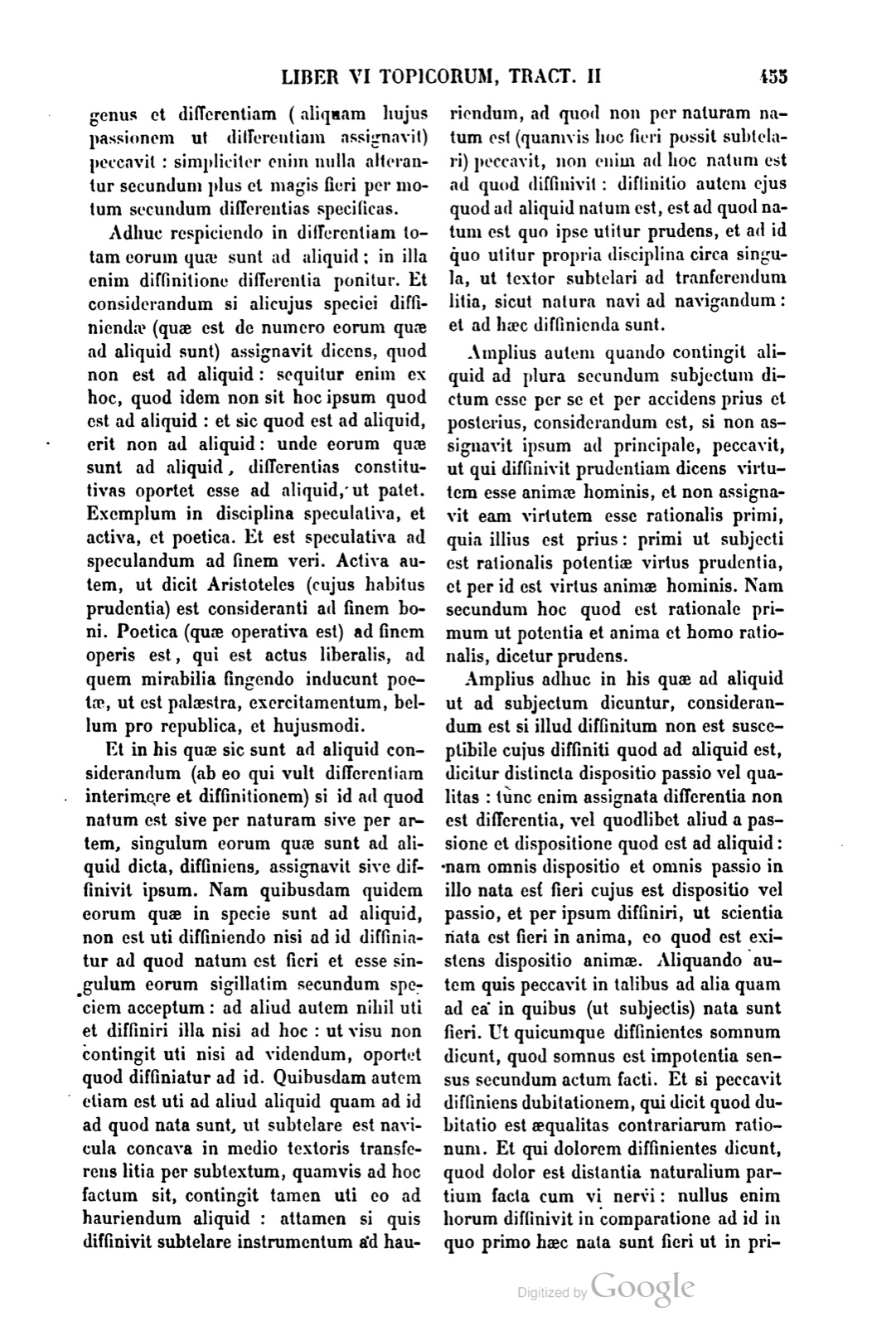
Adhuc respiciendo in differentiam totam eorum quae sunt ad aliquid; in illa enim diffinitione differentia ponitur. Et considerandum si alicujus speciei diffiniendae (quae est de numero eorum quae ad aliquid sunt) assignavit dicens, quod non est ad aliquid: sequitur enim ex hoc, quod idem non sit hoc ipsum quod est ad aliquid: et sic quod est ad aliquid, erit non ad aliquid: unde eorum quae sunt ad aliquid, differentias constitutivas oportet esse ad aliquid, ut patet. Exemplum in disciplina speculativa, et activa, et poetica. Et est speculativa ad speculandum ad finem veri. Activa autem, ut dicit Aristoteles (cujus habitus prudentia) est consideranti ad finem boni. Poetica (quae operativa est) ad finem operis est, qui est actus liberalis, ad quem mirabilia fingendo inducunt poetae, ut est palaestra, exercitamentum, bellum pro republica, et hujusmodi.
Et in his quae sic sunt ad aliquid considerandum (ab eo qui vult differentiam interimere et diffinitionem) si id ad quod natum est sive per naturam sive per artem, singulum eorum quae sunt ad aliquid dicta, diffiniens, assignavit sive diffinivit ipsum. Nam quibusdam quidem eorum quae in specie sunt ad aliquid, non est uti diffiniendo nisi ad id diffiniatur ad quod natum est fieri et esse singulum eorum sigillatim secundum speciem acceptum: ad aliud autem nihil uti et diffiniri illa nisi ad hoc: ut visu non contingit uti nisi ad videndum, oportet quod diffiniatur ad id. Quibusdam autem etiam est uti ad aliud aliquid quam ad id ad quod nata sunt, ut subtelare est navicula concava in medio textoris transferens litia per subtextum, quamvis ad hoc factum sit, contingit tamen uti eo ad hauriendum aliquid: attamen si quis diffinivit subtelare instrumentum ad hauriendum, ad quod non per naturam natum est (quamvis hoc fieri possit subtelari) peccavit, non enim ad hoc natum est ad quod diffinivit: diffinitio autem ejus quod ad aliquid natum est, est ad quod natum est quo ipse utitur prudens, et ad id quo utitur propria disciplina circa singula, ut textor subtelari ad transferendum litia, sicut natura navi ad navigandum: et ad haec diffinienda sunt.
Amplius autem quando contingit aliquid ad plura secundum subjectum dictum esse per se et per accidens prius et posterius, considerandum est, si non assignavit ipsum ad principale, peccavit, ut qui diffinivit prudentiam dicens virtutem esse animae hominis, et non assignavit eam virtutem esse rationalis primi, quia illius est prius: primi ut subjecti est rationalis potentiae virtus prudentia, et per id est virtus animae hominis. Nam secundum hoc quod est rationale primum ut potentia et anima et homo rationalis, dicetur prudens.
Amplius adhuc in his quae ad aliquid ut ad subjectum dicuntur, considerandum est si illud diffinitum non est susceptibile cujus diffiniti quod ad aliquid est, dicitur distincta dispositio passio vel qualitas: tunc enim assignata differentia non est differentia, vel quodlibet aliud a passione et dispositione quod est ad aliquid: nam omnis dispositio et omnis passio in illo nata est fieri cujus est dispositio vel passio, et per ipsum diffiniri, ut scientia nata est fieri in anima, eo quod est existens dispositio animae. Aliquando autem quis peccavit in talibus ad alia quam ad ea in quibus (ut subjectis) nata sunt fieri. Ut quicumque diffinientes somnum dicunt, quod somnus est impotentia sensus secundum actum facti. Et si peccavit diffiniens dubitationem, qui dicit quod dubitatio est aequalitas contrariarum rationum. Et qui dolorem diffinientes dicunt, quod dolor est distantia naturalium partium facta cum vi nervi: nullus enim horum diffinivit in comparatione ad id in quo primo haec nata sunt fieri ut in primo subjecto. Nam nec somnus secundum causam natus est primo fieri in sensu secundum actum facto, sed in organo sensuum, ut in organo sensus communis. Nec dubitatio nata est fieri in ratiocinationibus, sed in ratione sicut in primo subjecto. Nec dolor ut in primo subjecto in naturalibus partibus: si enim dolor concedatur adesse naturalibus partibus, cum etiam inanimata naturales partes habeant, sequitur etiam quod inanimata dolebunt, quia naturales habent partes. Talis autem et taliter peccans est etiam sanitatis diffinitio, si concedatur per diffinitionem esse sanitas medium sive medietas calidorum et frigidorum, quia multis inest inanimatis: sequitur enim quod necesse est sana esse quaecumque sunt mediocriter calida et frigida: eo quod singulorum medietas in illis eisdem est, quorum ut subjectorum est medietas: propter quod sequitur secundum hoc quod omnibus illis inest sanitas, quod falsum est, cum sanitas sit habitus animalis tantum.
Further, by looking to the whole difference of those things which are toward something, for in that definition difference is posited, one must consider whether, in defining some species which is from the number of things that are toward something, he has assigned it by saying that it is not toward something. For from this it follows that the same thing is not this very thing which is toward something; and so what is toward something will be not toward something. Hence the constitutive differences of those things which are toward something must be toward something, as is clear. An example is in speculative, active, and poetic discipline. Speculative discipline is for speculating toward the end of truth. But active discipline, as Aristotle says, whose habit is prudence, belongs to one considering toward the end of good. Poetic discipline, which is operative, is toward the end of a work, which is a liberal act, toward which poets lead by fashioning wonders, as are wrestling, exercise, war for the republic, and things of this sort.
And in those things which are thus toward something, one must consider, by the one who wishes to destroy difference and definition, whether, in defining, he has assigned or defined the thing itself toward that for which it is born either by nature or by art, each one of those things which are called toward something. For for certain of those things which are toward something in species, there is no use in defining except that it be defined toward that for which each of them is born to come to be and to be, taken singly according to species; but there is no use in defining those things toward something else except toward this. Thus it is not possible to use sight except for seeing; therefore it must be defined toward that. But certain things can also be used for something else than that for which they are born, as a shuttle is a little boat hollow in the middle of a weaver, carrying threads through the warp; although it has been made for this, nevertheless it happens that someone uses it for drawing up something. Yet if someone has defined a shuttle as an instrument for drawing up, for which it is not born by nature, although this can be done with a shuttle, he has erred; for it is not born for that for which he has defined it. But the definition of that which is born toward something is toward that for which it is born, with which the prudent man uses it, and toward that for which the proper discipline uses it concerning individual things, as the weaver uses the shuttle for carrying threads, as nature uses a ship for sailing; and they must be defined toward these things.
Furthermore, when it happens that something said toward several things according to subject is said through itself and by accident, prior and posterior, one must consider whether, if he has not assigned it to the principal thing, he has erred; as one who defined prudence, saying it to be a virtue of the soul of man, and did not assign it to be the virtue of the first rational thing, because it belongs to that prior thing. Prudence is a virtue of the rational power, of the first as subject, and through that it is a virtue of the soul of man. For according as the rational is first as power, and soul, and rational man, one will be called prudent.
Further, still in those things which are said toward something as toward a subject, one must consider whether that defined thing is not receptive of that of which, as a defined thing that is toward something, a distinct disposition, passion, or quality is said; for then the assigned difference is not a difference, nor is anything else apart from passion and disposition which is toward something. For every disposition and every passion is born to come to be in that whose disposition or passion it is, and to be defined through it, as science is born to come to be in the soul, because it is an existing disposition of the soul. But sometimes someone has erred in such matters toward things other than those in which, as subjects, they are born to come to be. Thus whoever, defining sleep, say that sleep is the impotence of sense made according to act; and if he has erred who defines doubt, who says that doubt is an equality of contrary reasons; and those who, defining pain, say that pain is the distance of natural parts made with the force of a nerve: none of these has defined in comparison to that in which these are first born to come to be as in a first subject. For sleep according to its cause is not born first to come to be in sense made according to act, but in the organ of the senses, as in the organ of common sense. Nor is doubt born to come to be in reasonings, but in reason as in its first subject. Nor is pain as in first subject in natural parts; for if pain is conceded to be present in natural parts, since even inanimate things have natural parts, it follows also that inanimate things will suffer pain, because they have natural parts. Such also, and erring in such a way, is the definition of health, if through definition health is conceded to be a mean or a middle of hot and cold things, because it belongs to many inanimate things; for it follows that whatever things are moderately hot and cold must be healthy, because the middle of individual things is in those same things whose middle it is as subjects; on account of which it follows, according to this, that health is in all those things, which is false, since health is a habit only of an animal.
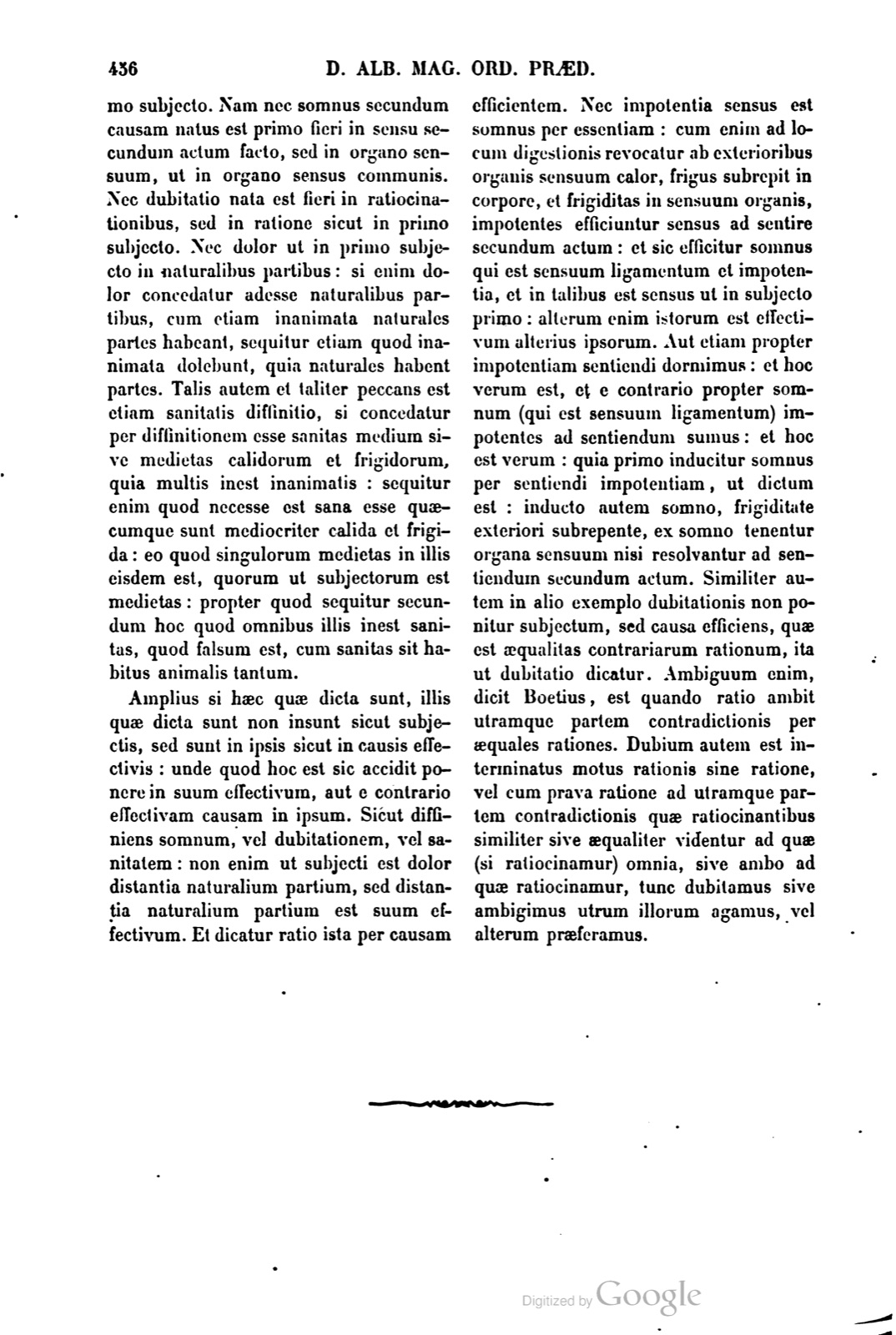
Amplius si haec quae dicta sunt, illis quae dicta sunt non insunt sicut subjectis, sed sunt in ipsis sicut in causis effectivis: unde quod hoc est sic accidit ponere in suum effectivum, aut e contrario effectivam causam in ipsum. Sicut diffiniens somnum, vel dubitationem, vel sanitatem: non enim ut subjecti est dolor distantia naturalium partium, sed distantia naturalium partium est suum effectivum. Et dicatur ratio ista per causam efficientem. Nec impotentia sensus est somnus per essentiam: cum enim ad locum digestionis revocatur ab exterioribus organis sensuum calor, frigus subrepit in corpore, et frigiditas in sensuum organis, impotentes efficiuntur sensus ad sentire secundum actum: et sic efficitur somnus qui est sensuum ligamentum et impotentia, et in talibus est sensus ut in subjecto primo: alterum enim istorum est effectivum alterius ipsorum. Aut etiam propter impotentiam sentiendi dormimus: et hoc verum est, et e contrario propter somnum (qui est sensuum ligamentum) impotentes ad sentiendum sumus: et hoc est verum: quia primo inducitur somnus per sentiendi impotentiam, ut dictum est: inducto autem somno, frigiditate exteriori subrepente, ex somno tenentur organa sensuum nisi resolvantur ad sentiendum secundum actum. Similiter autem in alio exemplo dubitationis non ponitur subjectum, sed causa efficiens, quae est aequalitas contrariarum rationum, ita ut dubitatio dicatur. Ambiguum enim, dicit Boetius, est quando ratio ambit utramque partem contradictionis per aequales rationes. Dubium autem est interminatus motus rationis sine ratione, vel cum prava ratione ad utramque partem contradictionis quae ratiocinantibus similiter sive aequaliter videntur ad quae (si ratiocinamur) omnia, sive ambo ad quae ratiocinamur, tunc dubitamus sive ambigimus utrum illorum agamus, vel alterum praeferamus.
Furthermore, if these things which have been said do not belong to those things which have been said as to subjects, but are in them as in effective causes, hence because this is so it happens to posit the thing in its own effective cause, or conversely the effective cause in it. This is like one defining sleep, or doubt, or health; for pain is not the distance of natural parts as of a subject, but the distance of natural parts is its effective cause. And let that account be stated through the efficient cause. Nor is impotence of sense sleep by essence; for when heat is recalled from the exterior organs of the senses to the place of digestion, cold slips into the body and coldness into the organs of the senses, and the senses are made impotent for sensing according to act, and thus sleep comes to be, which is the bond and impotence of the senses; and in such things sense is as in the first subject, for one of those is the effective cause of the other. Or again we sleep because of impotence of sensing, and this is true; and conversely, because of sleep, which is the bond of the senses, we are impotent for sensing, and this is true, because sleep is first induced through the impotence of sensing, as has been said; but once sleep has been induced, with exterior coldness slipping in, the organs of the senses are held by sleep unless they are released for sensing according to act. Likewise in the other example of doubt the subject is not posited, but the efficient cause, which is the equality of contrary reasons, so that it may be called doubt. For, Boethius says, the ambiguous is when reason goes around each part of a contradiction by equal reasons. But the doubtful is an unterminated motion of reason without reason, or with a depraved reason, toward each part of a contradiction, which things seem similarly or equally to those reasoning; when we reason toward all things, or toward both things toward which we reason, then we doubt or are uncertain which of those we should do, or which other we should prefer.
If a page does not appear, its photograph has not been uploaded yet.