Volume 2 · pp. 449–450
Chapter V. On inspection toward difference compared to those things which are in the predicamental line. Chapter VI, beginning.
A marker with ≈ is an approximate page boundary, placed by measure of the text; the page photographs remain the authority. In the paired views, clicking a page marker brings that page into view.
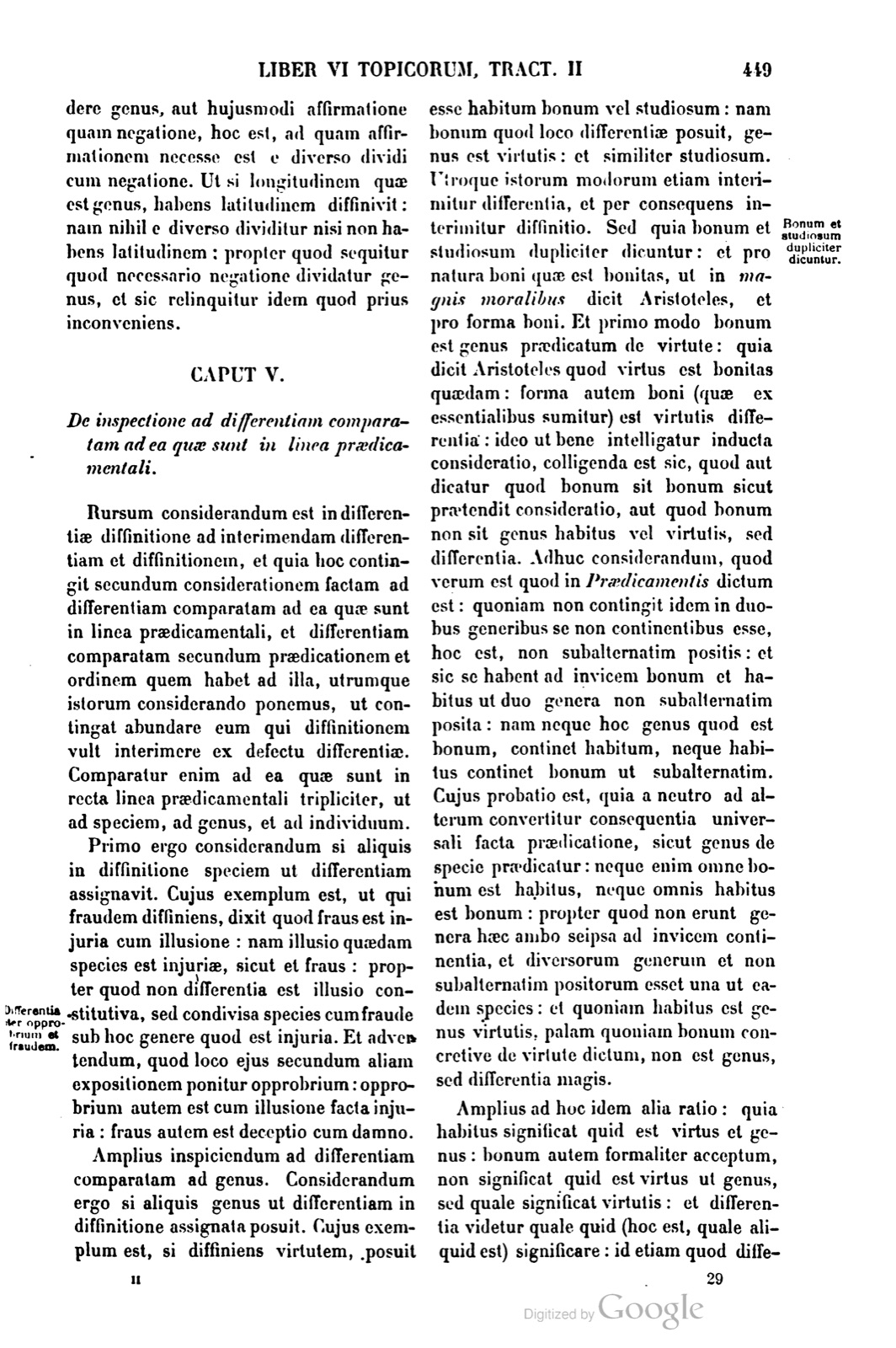
CAPUT V. De inspectione ad differentiam comparatam ad ea quae sunt in linea praedicamentali.
Rursum considerandum est in differentiae diffinitione ad interimendam differentiam et diffinitionem, et quia hoc contingit secundum considerationem factam ad differentiam comparatam ad ea quae sunt in linea praedicamentali, et differentiam comparatam secundum praedicationem et ordinem quem habet ad illa, utrumque istorum considerando ponemus, ut contingat abundare eum qui diffinitionem vult interimere ex defectu differentiae. Comparatur enim ad ea quae sunt in recta linea praedicamentali tripliciter, ut ad speciem, ad genus, et ad individuum.
Primo ergo considerandum si aliquis in diffinitione speciem ut differentiam assignavit. Cujus exemplum est, ut qui fraudem diffiniens, dixit quod fraus est injuria cum illusione: nam illusio quaedam species est injuriae, sicut et fraus: propter quod non differentia est illusio constitutiva, sed condivisa species cum fraude sub hoc genere quod est injuria. Et advertendum, quod loco ejus secundum aliam expositionem ponitur opprobrium: opprobrium autem est cum illusione facta injuria: fraus autem est deceptio cum damno.
Amplius inspiciendum ad differentiam comparatam ad genus. Considerandum ergo si aliquis genus ut differentiam in diffinitione assignata posuit. Cujus exemplum est, si diffiniens virtutem, posuit esse habitum bonum vel studiosum: nam bonum quod loco differentiae posuit, genus est virtutis: et similiter studiosum. Utroque istorum modorum etiam interimitur differentia, et per consequens interimitur diffinitio. Sed quia bonum et studiosum dupliciter dicuntur: et pro natura boni quae est bonitas, ut in Magnis Moralibus dicit Aristoteles, et pro forma boni. Et primo modo bonum est genus praedicatum de virtute: quia dicit Aristoteles quod virtus est bonitas quaedam: forma autem boni, quae ex essentialibus sumitur, est virtutis differentia: ideo ut bene intelligatur inducta consideratio, colligenda est sic, quod aut dicatur quod bonum sit bonum sicut praetendit consideratio, aut quod bonum non sit genus habitus vel virtutis, sed differentia. Adhuc considerandum, quod verum est quod in Praedicamentis dictum est: quoniam non contingit idem in duobus generibus se non continentibus esse, hoc est, non subalternatim positis: et sic se habent ad invicem bonum et habitus ut duo genera non subalternatim posita: nam neque hoc genus quod est bonum, continet habitum, neque habitus continet bonum ut subalternatim. Cujus probatio est, quia a neutro ad alterum convertitur consequentia universali facta praedicatione, sicut genus de specie praedicatur: neque enim omne bonum est habitus, neque omnis habitus est bonum: propter quod non erunt genera haec ambo seipsa ad invicem continentia, et diversorum generum et non subalternatim positorum esset una ut eadem species: et quoniam habitus est genus virtutis, palam quoniam bonum concretive de virtute dictum, non est genus, sed differentia magis.
Amplius ad hoc idem alia ratio: quia habitus significat quid est virtus et genus: bonum autem formaliter acceptum, non significat quid est virtus ut genus, sed quale significat virtutis: et differentia videtur quale quid, hoc est, quale aliquid est, significare: id etiam quod differentia informat, et hoc est suppositum speciei. Attendendum autem, quod virtus dupliciter consideratur: secundum relationem ad potentiam, cujus est ultimum et perfectio in bono, et sic consideratur virtus ut virtus ad alterum dicitur: et sic est in genere habitus, quia, ut dicit Avicenna, habitus est quo quis aliquid agit cum voluerit. Consideratur etiam secundum id quod est virtus: et secundum hoc quod supponit in nomine virtutis, et sic est in genere boni, et bene quidem sic considerata est virtus: et hoc modo dicit Aristoteles. Nihil prohibet idem esse in diversis generibus.
CHAPTER V. On inspection toward difference compared to those things which are in the predicamental line.
Again, one must consider, in the definition of difference for destroying difference and definition, that because this happens according to the consideration made toward difference compared to those things which are in the predicamental line, and toward difference compared according to predication and the order which it has toward them, we shall set down each of these by considering them, so that one who wishes to destroy definition from defect of difference may be able to abound. For difference is compared to those things which are in the straight predicamental line in three ways: to species, to genus, and to individual.
Therefore first one must consider whether someone in definition assigned species as difference. The example of this is one who, defining fraud, said that fraud is injury with mockery; for mockery is a certain species of injury, just as fraud also is. On account of this mockery is not a constitutive difference, but a species co-divided with fraud under this genus which is injury. And one should note that in its place, according to another exposition, reproach is posited; but reproach is injury made with mockery, while fraud is deception with loss.
Furthermore, one must inspect difference compared to genus. Therefore one must consider whether someone has posited genus as difference in the assigned definition. The example of this is if one defining virtue posited it to be a good or virtuous habit; for good, which he posited in place of difference, is the genus of virtue; and similarly virtuous. In each of these two ways difference is also destroyed, and consequently definition is destroyed. But because good and virtuous are said in two ways, both for the nature of good which is goodness, as Aristotle says in the Great Ethics, and for the form of good. And in the first way good is a genus predicated of virtue, because Aristotle says that virtue is a certain goodness; but the form of good, which is taken from essentials, is the difference of virtue. Therefore, so that the introduced consideration may be well understood, it must be gathered thus: either that good is said to be good as the consideration displays, or that good is not the genus of habit or virtue, but a difference. One must also consider that what was said in the Categories is true: that it does not happen that the same thing is in two genera not containing one another, that is, not posited subalternately. And good and habit have themselves toward each other in this way, as two genera not posited subalternately; for neither does this genus which is good contain habit, nor does habit contain good subalternately. The proof of this is that consequence is converted from neither to the other with universal predication made, as genus is predicated of species; for not every good is a habit, nor is every habit a good. Therefore these two will not be genera containing each other mutually, and of diverse genera not posited subalternately there would be one as the same species. And since habit is the genus of virtue, it is plain that good, said concretely of virtue, is not genus but rather difference.
Furthermore, there is another reason for this same thing: because habit signifies what virtue is and signifies genus; but good, accepted formally, does not signify what virtue is as genus, but signifies the quality of virtue. And difference seems to signify a qualified what, that is, what sort of something it is; also that which difference informs, and this is the supposit of the species. But it must be noted that virtue is considered in two ways: according to relation to the power, of which it is the ultimate and perfection in good, and thus virtue is considered as virtue is said toward another; and in this way it is in the genus of habit, because, as Avicenna says, a habit is that by which someone does something when he wishes. It is also considered according to that which is virtue, and according to that which it supposes in the name of virtue; and in this way it is in the genus of good, and virtue considered thus is indeed good, and Aristotle speaks in this way. Nothing prevents the same thing from being in diverse genera.
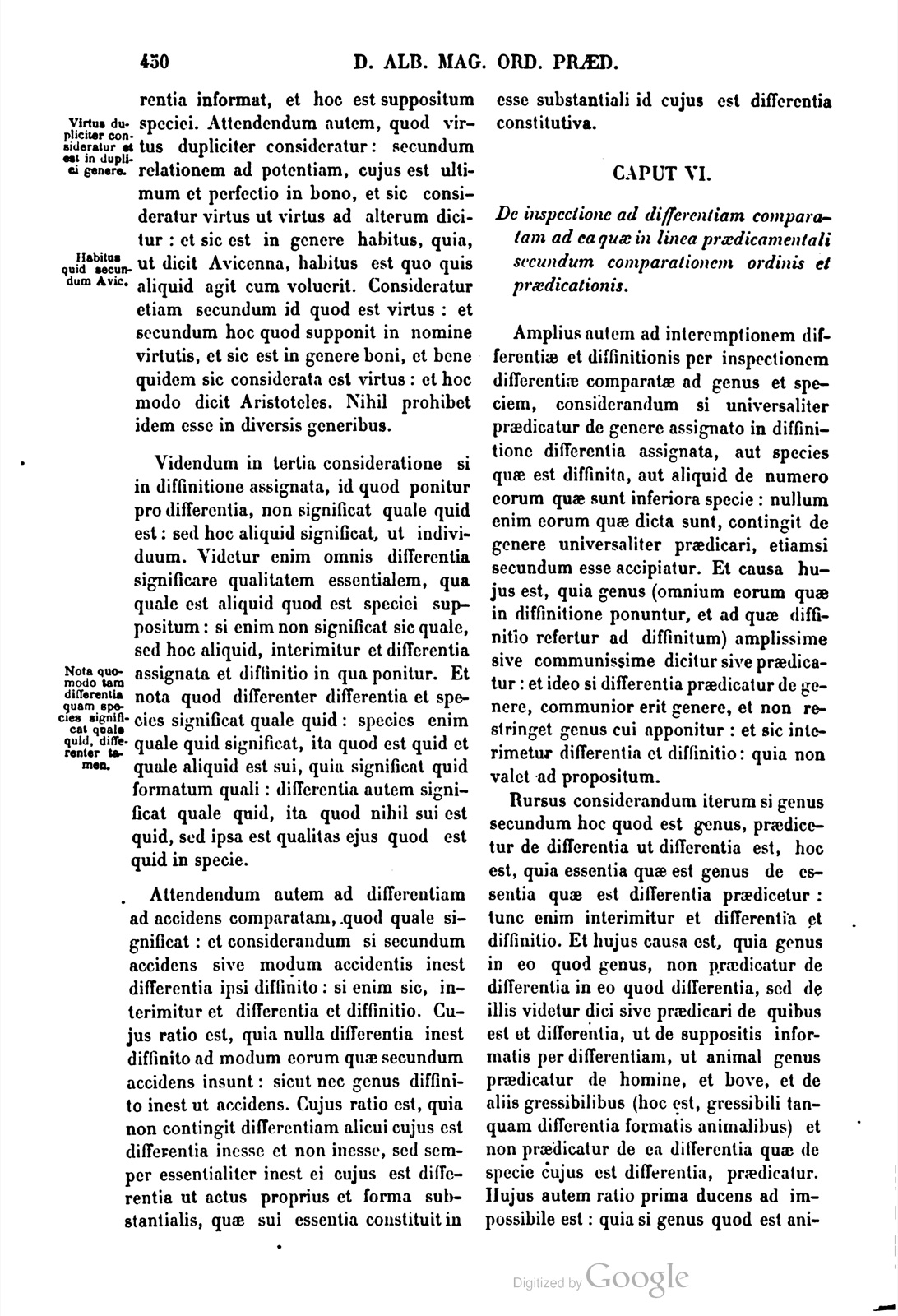
Videndum in tertia consideratione si in diffinitione assignata, id quod ponitur pro differentia, non significat quale quid est: sed hoc aliquid significat, ut individuum. Videtur enim omnis differentia significare qualitatem essentialem, qua quale est aliquid quod est speciei suppositum: si enim non significat sic quale, sed hoc aliquid, interimitur et differentia assignata et diffinitio in qua ponitur. Et nota quod differenter differentia et species significat quale quid: species enim quale quid significat, ita quod est quid et quale aliquid est sui, quia significat quid formatum quali: differentia autem significat quale quid, ita quod nihil sui est quid, sed ipsa est qualitas ejus quod est quid in specie.
Attendendum autem ad differentiam ad accidens comparatam, quod quale significat: et considerandum si secundum accidens sive modum accidentis inest differentia ipsi diffinito: si enim sic, interimitur et differentia et diffinitio. Cujus ratio est, quia nulla differentia inest diffinito ad modum eorum quae secundum accidens insunt: sicut nec genus diffinito inest ut accidens. Cujus ratio est, quia non contingit differentiam alicui cujus est differentia inesse et non inesse, sed semper essentialiter inest ei cujus est differentia ut actus proprius et forma substantialis, quae sui essentia constituit in esse substantiali id cujus est differentia constitutiva.
CAPUT VI. De inspectione ad differentiam comparatam ad ea quae in linea praedicamentali secundum comparationem ordinis et praedicationis.
Amplius autem ad interemptionem differentiae et diffinitionis per inspectionem differentiae comparatae ad genus et speciem, considerandum si universaliter praedicatur de genere assignato in diffinitione differentia assignata, aut species quae est diffinita, aut aliquid de numero eorum quae sunt inferiora specie: nullum enim eorum quae dicta sunt, contingit de genere universaliter praedicari, etiamsi secundum esse accipiatur. Et causa hujus est, quia genus, omnium eorum quae in diffinitione ponuntur, et ad quae diffinitio refertur ad diffinitum, amplissime sive communissime dicitur sive praedicatur: et ideo si differentia praedicatur de genere, communior erit genere, et non restringet genus cui apponitur: et sic interimitur differentia et diffinitio: quia non valet ad propositum.
Rursus considerandum iterum si genus secundum hoc quod est genus, praedicetur de differentia ut differentia est, hoc est, quia essentia quae est genus de essentia quae est differentia praedicetur: tunc enim interimitur et differentia et diffinitio. Et hujus causa est, quia genus in eo quod genus, non praedicatur de differentia in eo quod differentia, sed de illis videtur dici sive praedicari de quibus est et differentia, ut de suppositis informatis per differentiam, ut animal genus praedicatur de homine, et bove, et de aliis gressibilibus, hoc est, gressibili tanquam differentia formatis animalibus, et non praedicatur de ea differentia quae de specie cujus est differentia, praedicatur. Hujus autem ratio prima ducens ad impossibile est: quia si genus quod est ani-
In the third consideration one must see whether, in the assigned definition, that which is posited in place of difference does not signify what kind of what it is, but signifies this something, as an individual. For every difference seems to signify an essential quality by which something which is the supposit of the species is of such a sort. For if it does not signify such a quality in this way, but this something, both the assigned difference and the definition in which it is placed are destroyed. And note that difference and species signify a qualified what differently: for species signifies a qualified what in such a way that it is a what and something qualified of itself, because it signifies a what formed by a quale; but difference signifies a qualified what in such a way that none of itself is what, but it itself is the quality of that which is what in the species.
But one must attend to difference compared to accident, because it signifies quality; and one must consider whether the difference belongs to the defined thing according to accident or in the mode of an accident. For if so, both difference and definition are destroyed. The reason for this is that no difference belongs to the defined thing according to the mode of those things which belong according to accident, just as neither does genus belong to the defined thing as an accident. The reason for this is that it does not happen that a difference belongs and does not belong to something whose difference it is, but it always belongs essentially to that whose difference it is, as proper act and substantial form, which by its own essence constitutes in substantial being that of which it is the constitutive difference.
CHAPTER VI. On inspection toward difference compared to those things which are in the predicamental line according to comparison of order and predication.
Furthermore, for the destruction of difference and definition through inspection of difference compared to genus and species, one must consider whether the assigned difference is universally predicated of the genus assigned in the definition, or the species which is defined, or something from the number of those things which are inferior to the species. For none of the things that have been stated can be predicated universally of genus, even if it is taken according to being. And the cause of this is that genus, of all the things which are posited in the definition and to which the definition is referred toward the defined thing, is said or predicated most broadly or most commonly. And therefore if difference is predicated of genus, it will be more common than genus and will not restrict the genus to which it is appended; and so difference and definition are destroyed, because it does not avail for the proposal.
Again, one must consider once more whether genus, according to this that it is genus, is predicated of difference as it is difference, that is, whether the essence which is genus is predicated of the essence which is difference; for then both difference and definition are destroyed. And the cause of this is that genus, insofar as it is genus, is not predicated of difference insofar as it is difference, but seems to be said or predicated of those things of which the difference also is, as of supposits informed by difference, as animal the genus is predicated of man and ox and of other walkable things, that is, of animals formed by walkable as by a difference, and is not predicated of that difference which is predicated of the species whose difference it is. But the first reason for this, leading to the impossible, is this: because if the genus which is ani-
If a page does not appear, its photograph has not been uploaded yet.