Volume 2 · pp. 442–444
Chapter II. On inspecting the prior divisively, how definition is destroyed.
A marker with ≈ is an approximate page boundary, placed by measure of the text; the page photographs remain the authority. In the paired views, clicking a page marker brings that page into view.
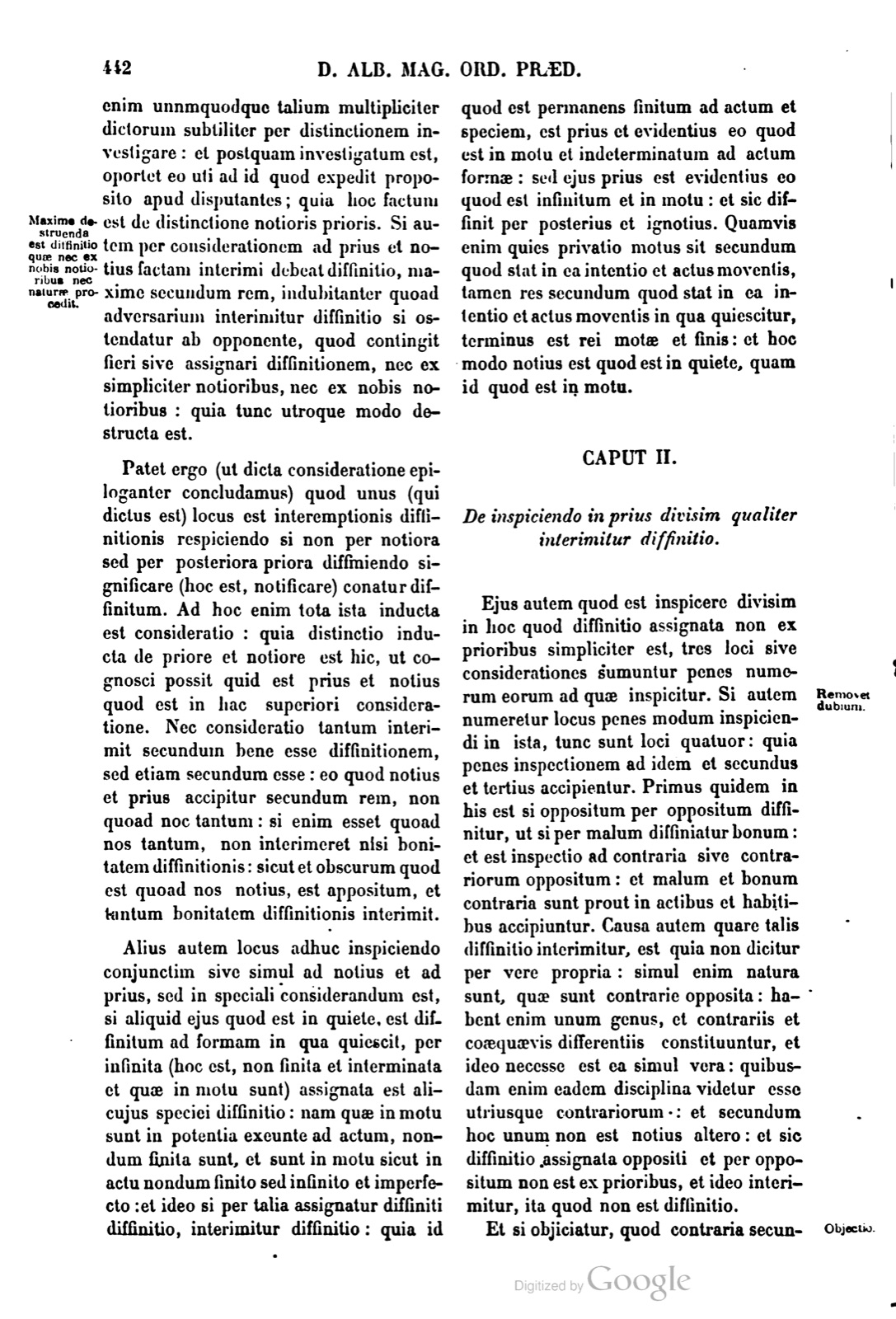
CAPUT II. De inspiciendo in prius divisim qualiter interimitur diffinitio.
Ejus autem quod est inspicere divisim in hoc quod diffinitio assignata non ex prioribus simpliciter est, tres loci sive considerationes sumuntur penes numerum eorum ad quae inspicitur. Si autem numeretur locus penes modum inspiciendi in ista, tunc sunt loci quatuor: quia penes inspectionem ad idem et secundus et tertius accipientur. Primus quidem in his est si oppositum per oppositum diffinitur, ut si per malum diffiniatur bonum: et est inspectio ad contraria sive contrariorum oppositum: et malum et bonum contraria sunt prout in actibus et habitibus accipiuntur. Causa autem quare talis diffinitio interimitur, est quia non dicitur per vere propria: simul enim natura sunt, quae sunt contrarie opposita: habent enim unum genus, et contrariis et coaequaevis differentiis constituuntur, et ideo necesse est ea simul vera: quibusdam enim eadem disciplina videtur esse utriusque contrariorum: et secundum hoc unum non est notius altero: et sic diffinitio assignata oppositi et per oppositum non est ex prioribus, et ideo interimitur, ita quod non est diffinitio.
Et si objiciatur, quod contraria secundum Aristotelem X primae philosophiae 1 reducuntur ad privationem et habitum. Privatio autem et habitus non sunt simul vera, sed habent se ut prius et posterius. Dicendum quod haec objectio provenit ex falso intellectu Philosophi in metaphysicis: non enim reducuntur ad privationem et habitum nisi secundum causam, et non secundum modum oppositionis qui accipitur in formis oppositis oppositorum: quia hoc est impossibile: et sic stat consideratio inducta.
Oportet autem non latere, quoniam in quibusdam oppositis quaedam opposita non est vel contingit aliter diffiniri, nisi unius ratio sit in ratione alterius, ut in relativis, ut duplum sine dimidio nondum diffinitur, quod est etiam relative oppositum: et ut universaliter dicatur quaecumque ad aliud sunt et dicuntur, et non secundum dici tantum sunt ad aliud: nam omnia quae per se ad aliud dicuntur et sunt relativa, hujus idem esse quod sunt ad illud sunt, et ipso nomine suo sic ad aliud dicuntur, quia sunt ad aliud se habere secundum esse quo diffiniuntur: quare non est possibile alterum sine altero per diffinitionem cognoscere: eo quod necessarium est in alterius diffinitione sumi alterum correlativum. Sed intelligendum subtiliter tunc, quando unum relativum ponitur in diffinitione alterius, non ponitur in diffinitione ut diffiniens: nec hoc modo unum relativorum est in alio ut diffiniens in diffinito, sed potius est in diffinitione alterius sicut id ad quod datur ejus diffinitio secundum id ad quod dicitur secundum esse relativi quod ad ipsum est, et ad hoc recipitur in diffinitione sicut terminus ad quem extrinsecus stat diffinitio: et hoc modo non stat inconveniens. Propter quod oportet cognoscere subtiliter naturas oppositorum, et omnibus hujusmodi quae assumuntur ad terminandum problema secundum hunc locum oportet uti in his quae sunt opposita prout ad propositum videbitur expedire.
CHAPTER II. On inspecting the prior divisively, how definition is destroyed.
But of that which is to inspect divisively with respect to this, that the assigned definition is not from things prior simply, three places or considerations are taken according to the number of those things toward which one inspects. But if the place is numbered according to the mode of inspecting in these matters, then there are four places, because according to inspection toward the same thing both the second and the third will be received. The first among these is if an opposite is defined through an opposite, as if good is defined through evil; and this is an inspection toward contraries, or toward the opposition of contraries; and evil and good are contraries insofar as they are received in acts and habits. But the cause why such a definition is destroyed is that it is not stated through things truly proper. For those things which are contrarily opposed are simultaneous in nature; for they have one genus and are constituted by contrary and coequal differences; and therefore it is necessary that they be true simultaneously. For to some people the same discipline seems to belong to each of two contraries; and according to this one is not better known than the other. And thus an assigned definition of an opposite and through an opposite is not from prior things, and therefore it is destroyed, so that it is not a definition.
And if it is objected that contraries according to Aristotle in the tenth book of first philosophy 1 are reduced to privation and habit, but privation and habit are not true simultaneously, but have themselves as prior and posterior, it must be said that this objection comes from a false understanding of the Philosopher in the Metaphysics. For they are not reduced to privation and habit except according to cause, and not according to the mode of opposition which is received in the opposed forms of opposites, because this is impossible; and so the introduced consideration stands.
But one must not be unaware that in certain opposites some opposed things are not, or cannot otherwise be, defined unless the account of one is in the account of the other, as in relatives; for example, double is not yet defined without half, which is also relatively opposed. And to speak universally, whatever things are and are said toward another, and are not toward another only according to being said, for all things which through themselves are said toward another and are relatives, this very being which they have is to be toward that thing, and by their very name they are thus said toward another, because they have themselves toward another according to the being by which they are defined. Therefore it is not possible to know one through definition without the other, because it is necessary that one correlative be taken in the definition of the other. But it must be subtly understood that then, when one relative is placed in the definition of the other, it is not placed in the definition as defining; nor in this way is one of the relatives in the other as defining in the defined thing, but rather it is in the definition of the other as that toward which its definition is given according to that toward which it is said according to the being of the relative which is toward it, and for this it is received in the definition as the terminus toward which the definition stands extrinsically; and in this way no unsuitability stands. On account of this one must subtly know the natures of opposites, and in all things of this sort which are assumed for terminating the problem according to this place one must use those things which are opposed as will seem expedient for the proposal.
Alius autem locus hujus considerationis est inspiciendo in natura prius, si et eodem usus est in diffinitione ei quod diffinitur: tunc enim non diffinitur per simpliciter priora: quia idem non est prius natura seipso: hoc enim aliquando factum in diffinitionibus latet, quando idem posuit, sed non sub eodem diffiniti nomine, sed ratione ipsius loco nominis posita. Ut si quis volens diffinire solem, dixit solem esse stellam albam quae de die apparet. Et hujus ratio est, quod idem in diffinitione sui ponit: quia die in diffinitione utendo, utitur etiam sole. Sed ad deprehendendum talia peccata, in diffinitionibus uti oportet sive accipere diffinitiones nominis, et loco nominis ponere diffinitiones. Ut quoniam dies si diffiniatur, est latio sive motus solis supra terram, palam quod qui lationem solis supra terram dixit in nomine diei, dixit etiam solem: propter quod solem diffiniendo utitur die.
Rursus tertius locus hujus considerationis est inspiciendo in prius natura, considerandum si eo utitur in diffinitione, quod e contrario dividitur cum diffinito: e contrario vero divisa coaequaeva sunt. Sicut qui diffinivit abundans quod est impar numerus, dicens quod abundans sive impar numerus est, quod unitate majus est vel excedit perfectum, hoc est, parem numerum: simul enim natura sunt quae e diverso ex eodem genere proximo dividuntur, hoc est, per coaequaevam divisionem accipiuntur. Abundans autem et perfectum ex eodem genere, quod est numerus, e diverso coaequaeve dividuntur: sunt enim ambo haec par et impar numeri, et species coaequaevae in hoc genere quod est numerus: et ideo unum illorum non est prius altero secundum naturam.
But another place of this consideration is by inspecting what is prior in nature, if one has used in the definition even the same thing as that which is defined; for then it is not defined through things prior simply, because the same thing is not prior in nature to itself. For this sometimes lies hidden when it has been done in definitions, when he has posited the same thing, but not under the same name of the defined thing, rather with the account of it posited in place of the name. Thus if someone, wishing to define the sun, said that the sun is a white star which appears by day. And the reason of this is that he places the same thing in its own definition, because by using day in the definition, he also uses the sun. But to detect such errors in definitions, one must use or take definitions of the name, and place definitions in place of the name. Thus, since day, if it is defined, is the bearing or motion of the sun above the earth, it is plain that one who stated the bearing of the sun above the earth in the name of day also stated the sun; on account of which in defining the sun he uses day.
Again, the third place of this consideration, by inspecting what is prior in nature, is that one must consider whether he uses in the definition that which is divided contrariwise with the defined thing; but things divided contrariwise are coequal. As one who defined an abundant number, which is an odd number, saying that the abundant or odd number is that which is greater by a unit or exceeds the perfect, that is, the even number; for those things which are divided from diverse sides from the same proximate genus are simultaneous in nature, that is, they are received through a coequal division. But abundant and perfect are coequally divided from the same genus, which is number, from diverse sides; for both these, even and odd, are numbers, and are coequal species in this genus which is number. And therefore one of them is not prior to the other according to nature.
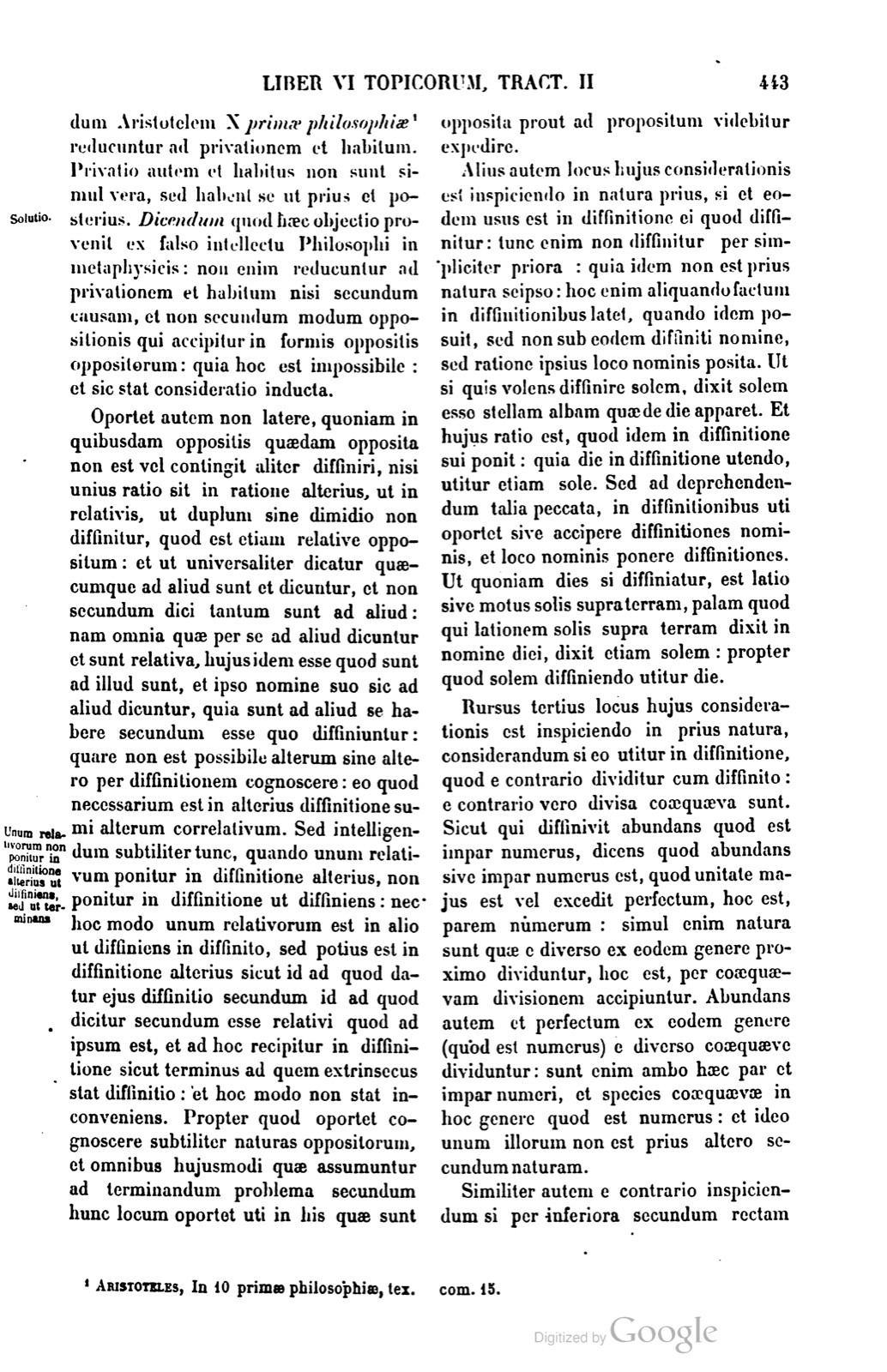
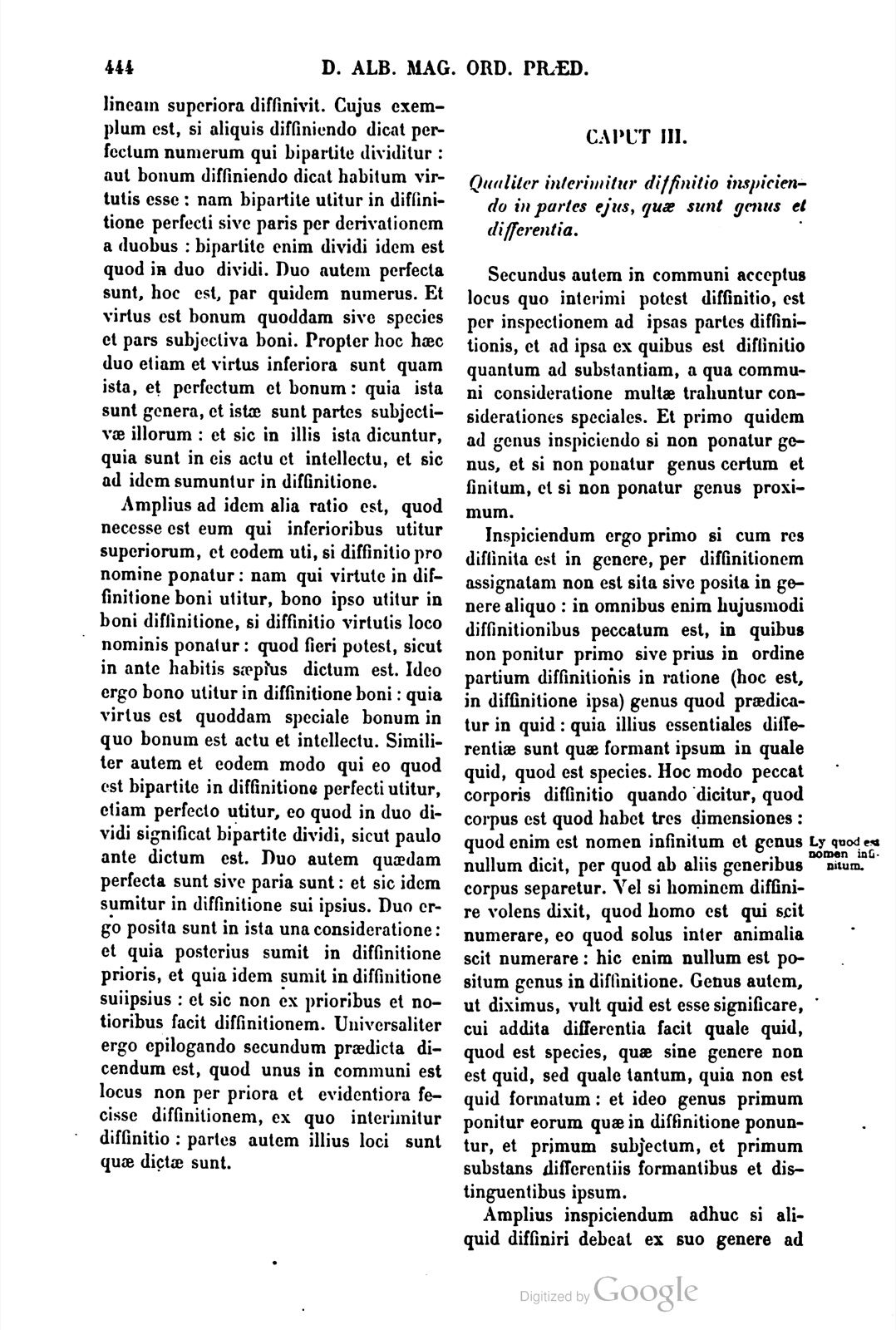
Similiter autem e contrario inspiciendum si per inferiora secundum rectam lineam superiora diffinivit. Cujus exemplum est, si aliquis diffiniendo dicat perfectum numerum qui bipartite dividitur: aut bonum diffiniendo dicat habitum virtutis esse: nam bipartite utitur in diffinitione perfecti sive paris per derivationem a duobus: bipartite enim dividi idem est quod in duo dividi. Duo autem perfecta sunt, hoc est, par quidem numerus. Et virtus est bonum quoddam sive species et pars subjectiva boni. Propter hoc haec duo etiam et virtus inferiora sunt quam ista, et perfectum et bonum: quia ista sunt genera, et istae sunt partes subjectivae illorum: et sic in illis ista dicuntur, quia sunt in eis actu et intellectu, et sic ad idem sumuntur in diffinitione.
Amplius ad idem alia ratio est, quod necesse est eum qui inferioribus utitur superiorum, et eodem uti, si diffinitio pro nomine ponatur: nam qui virtute in diffinitione boni utitur, bono ipso utitur in boni diffinitione, si diffinitio virtutis loco nominis ponatur: quod fieri potest, sicut in ante habitis saepius dictum est. Ideo ergo bono utitur in diffinitione boni: quia virtus est quoddam speciale bonum in quo bonum est actu et intellectu. Similiter autem et eodem modo qui eo quod est bipartite in diffinitione perfecti utitur, etiam perfecto utitur, eo quod in duo dividi significat bipartite dividi, sicut paulo ante dictum est. Duo autem quaedam perfecta sunt sive paria sunt: et sic idem sumitur in diffinitione sui ipsius. Duo ergo posita sunt in ista una consideratione: et quia posterius sumit in diffinitione prioris, et quia idem sumit in diffinitione sui ipsius: et sic non ex prioribus et notioribus facit diffinitionem. Universaliter ergo epilogando secundum praedicta dicendum est, quod unus in communi est locus non per priora et evidentiora fecisse diffinitionem, ex quo interimitur diffinitio: partes autem illius loci sunt quae dictae sunt.
Likewise, on the contrary, one must inspect whether he has defined superior things through inferior things according to a straight line. The example of this is if someone in defining should call a perfect number that which is divided bipartitely; or in defining good should say that it is the habit of virtue. For he uses bipartite in the definition of the perfect or even through derivation from two; for to be divided bipartitely is the same as to be divided into two. But two are certain perfect things, that is, even numbers. And virtue is a certain good, or a species and subjective part of good. On account of this these two also, and virtue, are inferior to those things, the perfect and the good, because those are genera, and these are their subjective parts; and so in those these are said, because they are in them in act and in understanding, and thus they are taken toward the same thing in the definition.
Furthermore, there is another reason for the same point, that one who uses the inferior things of superiors must also use the same thing if the definition is put in place of the name. For one who uses virtue in the definition of good uses good itself in the definition of good, if the definition of virtue is put in place of the name; this can be done, as has often been said in what went before. Therefore he uses good in the definition of good, because virtue is a certain special good in which good is in act and in understanding. Likewise, in the same way, one who uses what is bipartite in the definition of the perfect also uses the perfect, because to be divided into two signifies to be divided bipartitely, as was said a little before. But two are certain perfect or even things, and thus the same thing is taken in the definition of itself. Therefore two things are posited in this one consideration: both that he takes what is posterior in the definition of what is prior, and that he takes the same thing in the definition of itself; and so he does not make a definition from prior and better known things. Therefore, by concluding universally according to the aforesaid things, it must be said that one common place is to have made a definition not through prior and more evident things, from which definition is destroyed; but the parts of that place are those which have been stated.
Notes
- Aristotle, in the tenth book of First Philosophy, text, commentary 15. (Aristoteles, In 10 primae philosophiae, tex. com. 15.) ↩
If a page does not appear, its photograph has not been uploaded yet.