Volume 2 · pp. 439–442
Tractate II. Chapter I. If they do not define through what is better known and prior, by looking at these conjointly.
A marker with ≈ is an approximate page boundary, placed by measure of the text; the page photographs remain the authority. In the paired views, clicking a page marker brings that page into view.
TRACTATUS II. QUALITER INTERIMITUR DIFFINITIO INSPICIENDO IN CONDITIONES DIFFINITIONIS ET PARTIUM EJUS.
CAPUT I. Si non per notius diffiniunt et prius, conjunctim in haec aspiciendo.
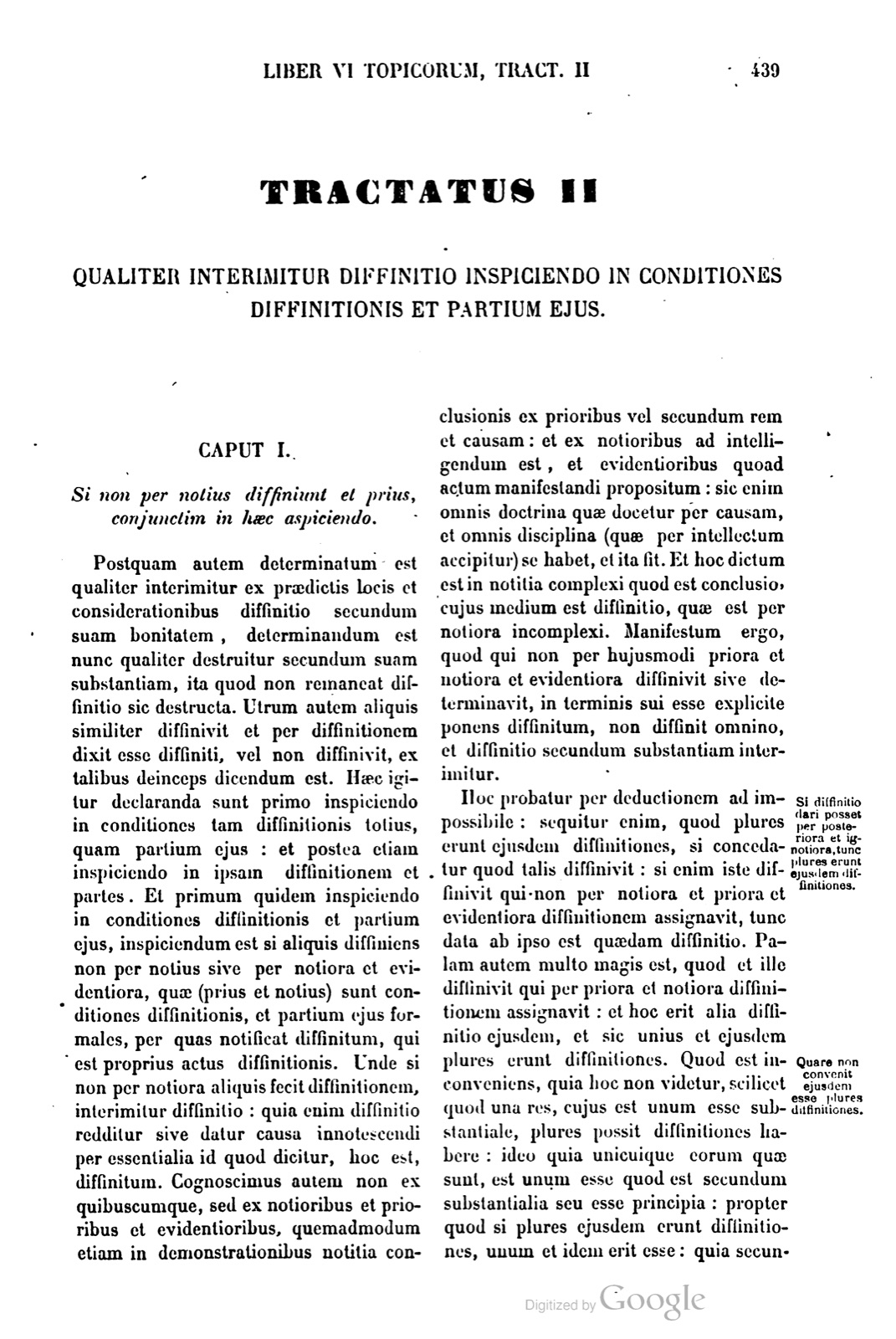
Postquam autem determinatum est qualiter interimitur ex praedictis locis et considerationibus diffinitio secundum suam bonitatem, determinandum est nunc qualiter destruitur secundum suam substantiam, ita quod non remaneat diffinitio sic destructa. Utrum autem aliquis similiter diffinivit et per diffinitionem dixit esse diffiniti, vel non diffinivit, ex talibus deinceps dicendum est. Haec igitur declaranda sunt primo inspiciendo in conditiones tam diffinitionis totius, quam partium ejus: et postea etiam inspiciendo in ipsam diffinitionem et partes. Et primum quidem inspiciendo in conditiones diffinitionis et partium ejus, inspiciendum est si aliquis diffiniens non per notius sive per notiora et evidentiora, quae, prius et notius, sunt conditiones diffinitionis, et partium ejus formales, per quas notificat diffinitum, qui est proprius actus diffinitionis. Unde si non per notiora aliquis fecit diffinitionem, interimitur diffinitio: quia enim diffinitio redditur sive datur causa innotescendi per essentialia id quod dicitur, hoc est, diffinitum. Cognoscimus autem non ex quibuscumque, sed ex notioribus et prioribus et evidentioribus, quemadmodum etiam in demonstrationibus notitia conclusionis ex prioribus vel secundum rem et causam: et ex notioribus ad intelligendum est, et evidentioribus quoad actum manifestandi propositum: sic enim omnis doctrina quae docetur per causam, et omnis disciplina, quae per intellectum accipitur, se habet, et ita fit. Et hoc dictum est in notitia complexi quod est conclusio, cujus medium est diffinitio, quae est per notiora incomplexi. Manifestum ergo, quod qui non per hujusmodi priora et notiora et evidentiora diffinivit sive determinavit, in terminis sui esse explicite ponens diffinitum, non diffinit omnino, et diffinitio secundum substantiam interimitur.
Hoc probatur per deductionem ad impossibile: sequitur enim, quod plures erunt ejusdem diffinitiones, si concedatur quod talis diffinivit: si enim iste diffinivit qui non per notiora et priora et evidentiora diffinitionem assignavit, tunc data ab ipso est quaedam diffinitio. Palam autem multo magis est, quod et ille diffinivit qui per priora et notiora diffinitionem assignavit: et hoc erit alia diffinitio ejusdem, et sic unius et ejusdem plures erunt diffinitiones. Quod est inconveniens, quia hoc non videtur, scilicet quod una res, cujus est unum esse substantiale, plures possit diffinitiones habere: ideo quia unicuique eorum quae sunt, est unum esse quod est secundum substantialia seu esse principia: propter quod si plures ejusdem erunt diffinitiones, unum et idem erit esse: quia secundum utramque diffinitionem significatur esse diffiniti: haec autem duo esse per duas diffinitiones significatas de diffinito in eodem esse non possunt, eo quod diffinitiones sunt diversae et per diversa assignatae: manifestum ergo quod non diffinivit, qui diffinitum non per priora et evidentiora determinavit. Sic igitur inspiciendo ad prius et notius conjunctim, patet quod destruitur diffinitio si non assignatur per priora et notiora.
Inspiciendo autem divisim adhuc etiam per prius et notius potest interimi diffinitio. Igitur ut hoc ostendatur, per non evidentiora fieri diffinitionem simpliciter dicitur, sicut et notius dicitur dupliciter. Unde non evidentius dupliciter est accipere: si enim per non notiora sit differentia, aut ex ignotioribus simpliciter et secundum naturam rei diffinitae, aut fit ex ignotioribus nobis sive quoad nos: utrumque enim istorum contingit et contingere potest, quod duobus istis modis ex ignotioribus assignatur diffinitio. Dicitur ergo simpliciter evidentius quod prius est simpliciter quoad naturam posteriorem secundum naturam, ut punctum prius est linea, eo quod est principium ejus secundum substantiam: et hoc eodem modo linea prior est superficie, et superficies prior soliditate sive corpore: quia lineae terminus essentialis et formalis est punctum, et superficiei linea, et corporis superficies: et sic prius est simpliciter punctum quam linea, et linea quam superficies, et superficies quam corpus, quemadmodum unitas est prius et principium omnis numeri. Similiter autem littera prior est quam syllaba, et syllaba quam dictio, et dictio quam oratio, et principium suo principiato, et simplex omne suo composito. Nobis esse notiora e contrario modo accidit: nobis enim notius est, quod maxime sub sensu cadit, quia per sensum primo notitiam accipimus. Unde solidum sive corpus nobis est notius quam superficies, et superficies quam linea, et linea quam punctum: quia maxime solidum cadit sub sensu: propter quod etiam plures, hoc est, non sapientes, hoc magis cognoscunt quam sua principia simplicia: nam haec quidem principiata quolibet modo et sensu et ratione cognoscuntur: illa autem quae sunt illorum principia et simplicia, non est apprehendere nisi subtili et abundanti intellectu qui fit per resolutionem principiati et compositi in principium et simplex.
TRACTATE II. HOW DEFINITION IS DESTROYED BY INSPECTING THE CONDITIONS OF DEFINITION AND OF ITS PARTS.
CHAPTER I. If they do not define through what is better known and prior, by looking at these conjointly.
But after it has been determined how definition is destroyed according to its goodness from the aforesaid places and considerations, it must now be determined how it is destroyed according to its substance, so that a definition thus destroyed does not remain. But whether someone has similarly defined and, through definition, has stated the being of the defined thing, or has not defined, must henceforth be stated from such things. Therefore these things must be declared first by inspecting the conditions both of the whole definition and of its parts, and afterward also by inspecting the definition itself and its parts. And first, by inspecting the conditions of definition and of its parts, one must inspect whether someone defining does not define through something better known, or through things better known and more evident, which, as prior and better known, are the formal conditions of definition and of its parts, through which it makes known the defined thing, which is the proper act of definition. Hence, if someone made a definition not through things better known, the definition is destroyed; for definition is rendered or given as the cause of making known through essentials that which is stated, that is, the defined thing. But we know not from just any things, but from better known and prior and more evident things, just as also in demonstrations the knowledge of the conclusion is from prior things either according to thing and cause, and from things better known for understanding, and from things more evident with respect to the act of manifesting what is proposed. For every doctrine which is taught through cause, and every discipline which is received through intellect, has itself in this way and so occurs. And this has been said in the knowledge of a complex thing, which is the conclusion whose middle is the definition, which is through the better known things of the incomplex. Therefore it is manifest that one who has not defined or determined through prior, better known, and more evident things of this sort, explicitly positing the defined thing in the terms of its being, does not define at all, and definition is destroyed according to substance.
This is proved by reduction to the impossible: for it follows that there will be several definitions of the same thing, if it is conceded that such a person has defined. For if this man defined who assigned a definition not through better known and prior and more evident things, then a certain definition has been given by him. But it is plainly much more the case that the one also defined who assigned a definition through prior and better known things; and this will be another definition of the same thing, and thus there will be several definitions of one and the same thing. This is unsuitable, because this does not seem possible, namely that one thing, of which there is one substantial being, could have several definitions; and this is because for each of the things that are, there is one being which is according to substantial things or principles of being. Therefore, if there will be several definitions of the same thing, one and the same being will exist, because according to each definition the being of the defined thing is signified; but these two beings signified by two definitions concerning the defined thing cannot be in the same being, because the definitions are diverse and assigned through diverse things. Therefore it is manifest that he has not defined who has not determined the defined thing through prior and more evident things. Thus, therefore, by looking conjointly at the prior and the better known, it is clear that definition is destroyed if it is not assigned through prior and better known things.
But by inspecting divisively, definition can still also be destroyed through the prior and the better known. Therefore, so that this may be shown, a definition is said to be made simply through things not more evident, just as the better known is said in two ways. Hence the not more evident must be taken in two ways: for if the difference is through things not better known, either it is from things more unknown simply and according to the nature of the defined thing, or it is made from things more unknown to us or with respect to us; and each of these happens and can happen, namely that in these two ways a definition is assigned from things more unknown. Therefore that is called more evident simply which is prior simply with respect to nature to what is posterior according to nature, as point is prior to line, because it is its principle according to substance; and in this same way line is prior to surface, and surface prior to solidity or body, because the essential and formal terminus of line is point, of surface line, and of body surface. And thus point is prior simply to line, and line to surface, and surface to body, just as unity is prior and the principle of every number. Likewise letter is prior to syllable, and syllable to diction, and diction to speech, and the principle to its principled thing, and every simple thing to its composite. But to be better known to us happens in the contrary way: for that which falls most under sense is better known to us, because through sense we first receive knowledge. Hence solid or body is better known to us than surface, and surface than line, and line than point, because the solid falls most under sense; on account of which even the many, that is, the non-wise, know this more than its simple principles. For these principled things are known in every way and by sense and by reason; but those things which are their principles and simple things cannot be apprehended except by a subtle and abundant intellect, which comes to be through the resolution of the principled and composite thing into principle and simple.
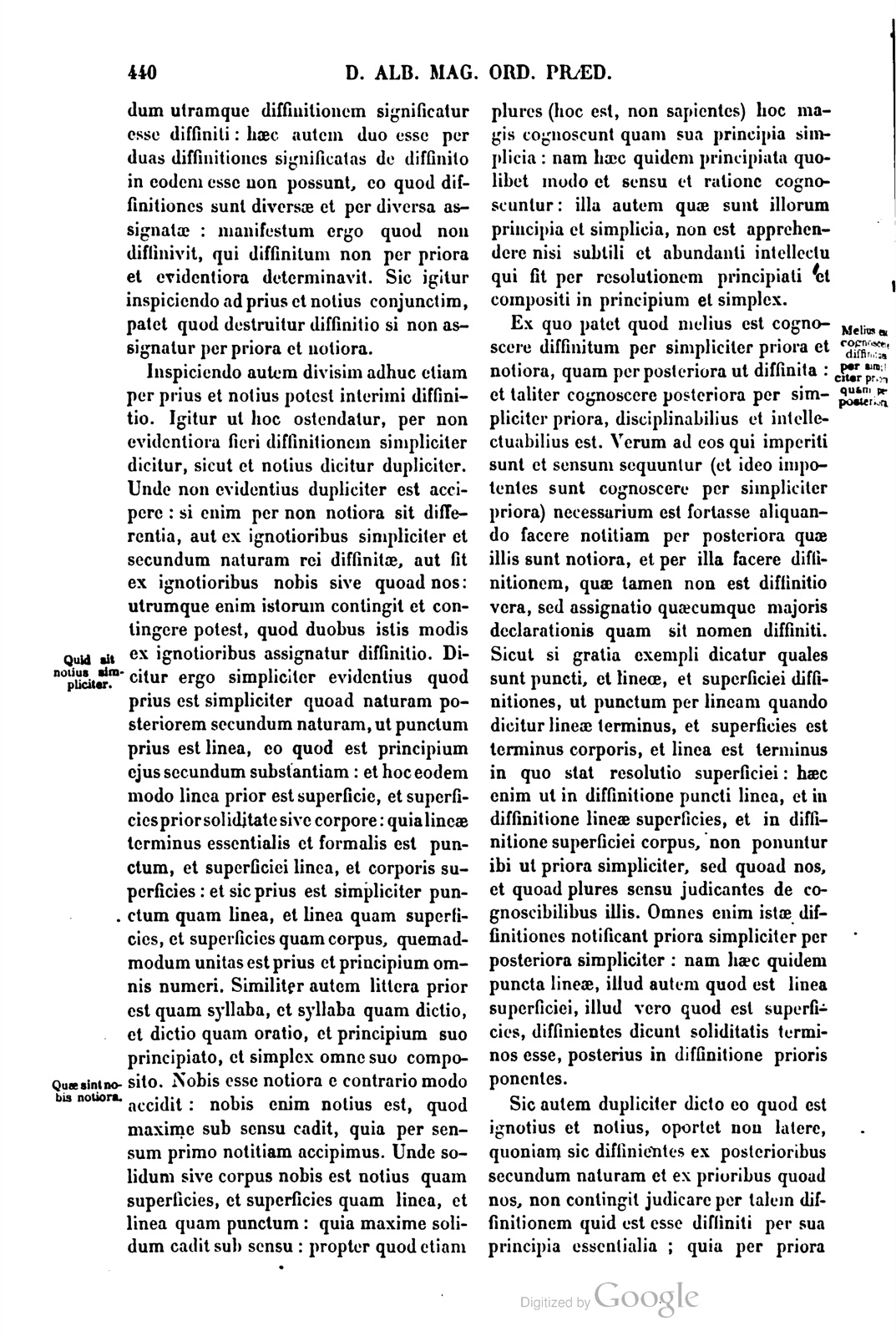
Ex quo patet quod melius est cognoscere diffinitum per simpliciter priora et notiora, quam per posteriora ut diffinita: et taliter cognoscere posteriora per simpliciter priora, disciplinabilius et intellectuabilius est. Verum ad eos qui imperiti sunt et sensum sequuntur, et ideo impotentes sunt cognoscere per simpliciter priora, necessarium est fortasse aliquando facere notitiam per posteriora quae illis sunt notiora, et per illa facere diffinitionem, quae tamen non est diffinitio vera, sed assignatio quaecumque majoris declarationis quam sit nomen diffiniti. Sicut si gratia exempli dicatur quales sunt puncti, et lineae, et superficiei diffinitiones, ut punctum per lineam quando dicitur lineae terminus, et superficies est terminus corporis, et linea est terminus in quo stat resolutio superficiei: haec enim ut in diffinitione puncti linea, et in diffinitione lineae superficies, et in diffinitione superficiei corpus, non ponuntur ibi ut priora simpliciter, sed quoad nos, et quoad plures sensu judicantes de cognoscibilibus illis. Omnes enim istae diffinitiones notificant priora simpliciter per posteriora simpliciter: nam haec quidem puncta lineae, illud autem quod est linea superficiei, illud vero quod est superficies, diffinientes dicunt soliditatis terminos esse, posterius in diffinitione prioris ponentes.
Sic autem dupliciter dicto eo quod est ignotius et notius, oportet non latere, quoniam sic diffinientes ex posterioribus secundum naturam et ex prioribus quoad nos, non contingit judicare per talem diffinitionem quid est esse diffiniti per sua principia essentialia: quia per priora quoad nos esse non accipit, sed notitiam quamdam quae est ex parte cognoscentis et non rei cognitae: nisi forte contingat idem et nobis notius esse et simpliciter notius, quod non convenit apud plures, sed apud sapientes solum, et in sensu prius esse universali particulare deprehensibile, sicut in principio Physicorum dicit Aristoteles. Cujus ratio siquidem haec est: quia certe oportet per genus proprium et differentias essentiales diffinire eum qui diffinit bene: genera autem et differentiae priora sunt simpliciter, quam species cujus est genus et cujus sunt differentiae. Hujus autem probatio est, quia a genere et differentia non convertitur consequentia ad speciem: genus enim interemptum et differentiae interemptae interimunt speciem, et non e converso. Cujus causa est, quia simpliciora sunt genus et differentia, et simpliciora secundum naturam quam species. Priora igitur et notiora sunt genus et differentia, quam species diffinita per haec tanquam per evidentiora. Cujus est et alia ratio: quia specie quidem nota per diffinitionem, necesse est et genus et differentias notas esse: quia ignotum non fit notum nisi per notum: species autem ignota per genus et differentias fit nota: necesse ergo est genus et differentiam ante sive prius cognosci. Nam qui hominem scit per diffinitionem, necesse est ut sciat animal gressibile prius, quia per ista notificatur homo, sed non convertitur: quia genere ut in se et differentia ut in se notis, non necesse est speciem continue cognosci: propter quod sequitur, quod species posterior sit secundum naturam genere et differentia. Igitur qui non per haec diffinivit diffinitionem speciei, secundum naturam diffiniti et esse ipsius substantiale non dicit.
From this it is clear that it is better to know the defined thing through things prior and better known simply than through posterior things as definitions, and to know posterior things in such a way through things prior simply is more teachable and more intelligible. Yet for those who are unskilled and follow sense, and therefore are unable to know through things prior simply, it is perhaps sometimes necessary to make knowledge through posterior things which are better known to them, and through those things to make a definition, which nevertheless is not a true definition, but some assignment of a greater declaration than the name of the defined thing has. Thus, for the sake of example, if it is said what the definitions of point, line, and surface are, as when point is called the terminus of line, and surface is the terminus of body, and line is the terminus at which the resolution of surface stands: for these, as line in the definition of point, surface in the definition of line, and body in the definition of surface, are not put there as prior simply, but with respect to us, and with respect to the many who judge by sense about those knowable things. For all these definitions make known things prior simply through things posterior simply; for those who define say that points are the termini of line, that what is line is the terminus of surface, and that what is surface is the terminus of solidity, placing the posterior in the definition of the prior.
But with that which is more unknown and better known said in two ways in this manner, one must not be unaware that those defining thus from things posterior according to nature and from things prior with respect to us cannot judge through such a definition what the being of the defined thing is through its essential principles, because through things prior with respect to us it does not receive being, but a certain knowledge which is on the part of the knower and not of the thing known; unless perhaps it happens that the same thing is both better known to us and better known simply, which does not belong among the many but among the wise alone, and that in sense the particular is apprehensible prior to the universal, as Aristotle says at the beginning of the Physics. The reason of this indeed is this: because surely one who defines well must define through the proper genus and essential differences; but genera and differences are prior simply to the species whose genus they are and whose differences they are. The proof of this is that consequence is not converted from genus and difference to species; for genus destroyed and differences destroyed destroy the species, but not conversely. The cause of this is that genus and difference are simpler, and simpler according to nature than species. Therefore genus and difference are prior and better known than the species defined through these as through more evident things. There is also another reason for this: because, once the species is known through definition, the genus and differences must also be known, since the unknown is not made known except through the known; but an unknown species is made known through genus and differences; therefore genus and difference must be known before or prior. For one who knows man through definition must first know walkable animal, because through these man is made known, but this is not converted; because with genus known as in itself and difference known as in itself, it is not necessary that the species be known continuously. Therefore it follows that species is posterior according to nature to genus and difference. Therefore one who has not defined the definition of the species through these does not state according to the nature of the defined thing and its substantial being.
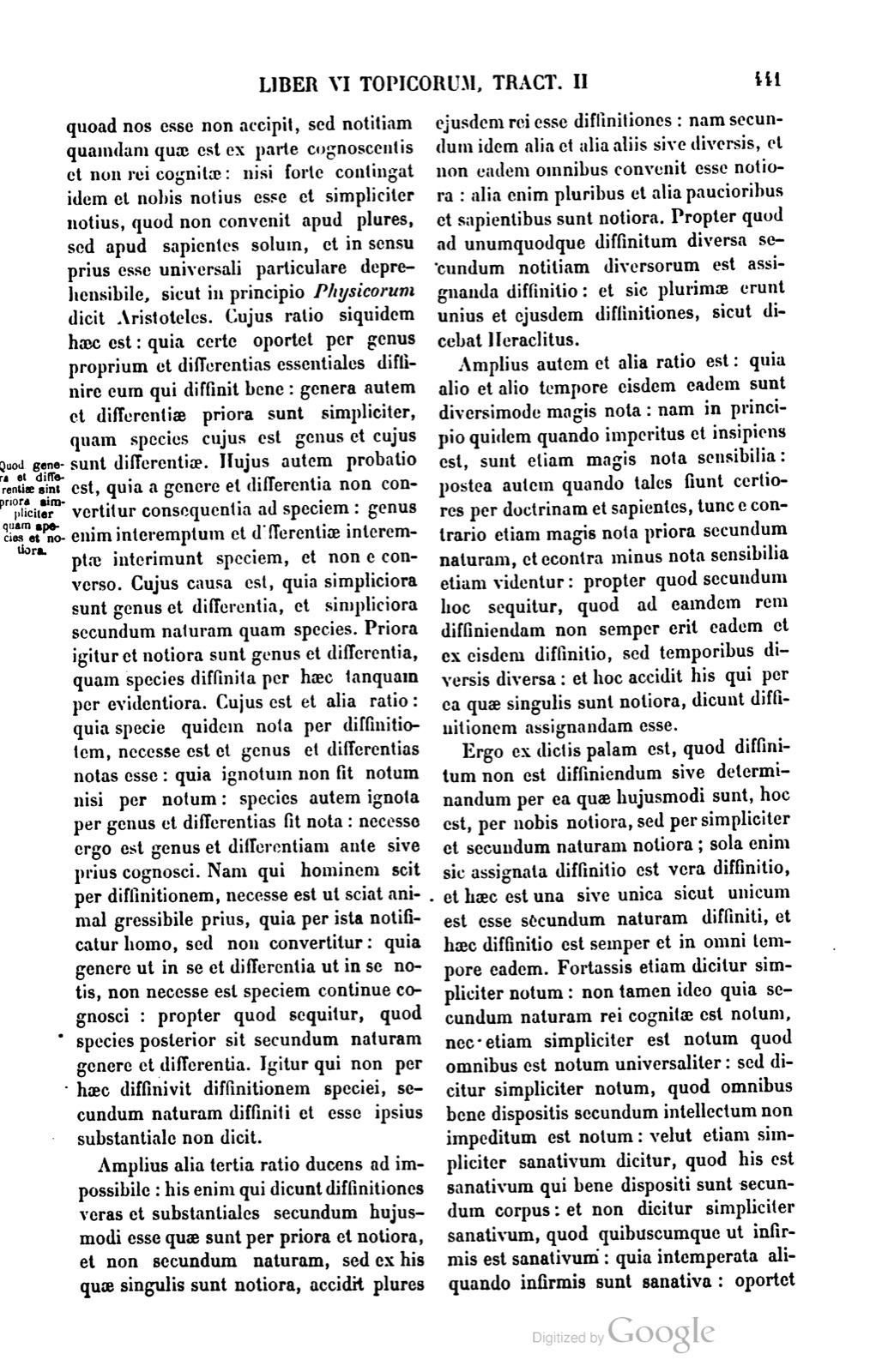
Amplius alia tertia ratio ducens ad impossibile: his enim qui dicunt diffinitiones veras et substantiales secundum hujusmodi esse quae sunt per priora et notiora, et non secundum naturam, sed ex his quae singulis sunt notiora, accidit plures ejusdem rei esse diffinitiones: nam secundum idem alia et alia aliis sive diversis, et non eadem omnibus convenit esse notiora: alia enim pluribus et alia paucioribus et sapientibus sunt notiora. Propter quod ad unumquodque diffinitum diversa secundum notitiam diversorum est assignanda diffinitio: et sic plurimae erunt unius et ejusdem diffinitiones, sicut dicebat Heraclitus.
Amplius autem et alia ratio est: quia alio et alio tempore eisdem eadem sunt diversimode magis nota: nam in principio quidem quando imperitus et insipiens sunt etiam magis nota sensibilia: postea autem quando tales fiunt certiores per doctrinam et sapientes, tunc e contrario etiam magis nota priora secundum naturam, et e contra minus nota sensibilia etiam videntur: propter quod secundum hoc sequitur, quod ad eamdem rem diffiniendam non semper erit eadem et ex eisdem diffinitio, sed temporibus diversis diversa: et hoc accidit his qui per ea quae singulis sunt notiora, dicunt diffinitionem assignandam esse.
Ergo ex dictis palam est, quod diffinitum non est diffiniendum sive determinandum per ea quae hujusmodi sunt, hoc est, per nobis notiora, sed per simpliciter et secundum naturam notiora; sola enim sic assignata diffinitio est vera diffinitio, et haec est una sive unica sicut unicum est esse secundum naturam diffiniti, et haec diffinitio est semper et in omni tempore eadem. Fortassis etiam dicitur simpliciter notum: non tamen ideo quia secundum naturam rei cognitae est notum, nec etiam simpliciter est notum quod omnibus est notum universaliter: sed dicitur simpliciter notum, quod omnibus bene dispositis secundum intellectum non impeditum est notum: velut etiam simpliciter sanativum dicitur, quod his est sanativum qui bene dispositi sunt secundum corpus: et non dicitur simpliciter sanativum, quod quibuscumque ut infirmis est sanativum: quia intemperata aliquando infirmis sunt sanativa: oportet enim unumquodque talium multipliciter dictorum subtiliter per distinctionem investigare: et postquam investigatum est, oportet eo uti ad id quod expedit proposito apud disputantes: quia hoc factum est de distinctione notioris prioris. Si autem per considerationem ad prius et notius factam interimi debeat diffinitio, maxime secundum rem, indubitanter quoad adversarium interimitur diffinitio si ostendatur ab opponente, quod contingit fieri sive assignari diffinitionem, nec ex simpliciter notioribus, nec ex nobis notioribus: quia tunc utroque modo destructa est.
Furthermore, there is a third reason leading to the impossible. For to those who say that true and substantial definitions are according to such things as are through prior and better known things, not according to nature, but from those things which are better known to individual persons, it happens that there are several definitions of the same thing; for according to the same thing, different things are better known to other or diverse persons, and the same things are not better known to all. For some things are better known to more people and others to fewer and to the wise. On account of this, for each defined thing a diverse definition must be assigned according to the knowledge of diverse persons, and so there will be many definitions of one and the same thing, as Heraclitus used to say.
Furthermore, there is also another reason: because at different times the same things are in diverse ways better known to the same persons. For in the beginning, when they are unskilled and foolish, sensible things are even better known; but afterward, when such persons are made more certain through teaching and wise, then on the contrary things prior according to nature are also seen as more known, and conversely sensible things as less known. On account of this it follows that for defining the same thing there will not always be the same definition and from the same things, but diverse definitions at diverse times; and this happens to those who say that definition must be assigned through those things which are better known to individual persons.
Therefore from what has been said it is plain that the defined thing must not be defined or determined through such things, that is, through things better known to us, but through things better known simply and according to nature; for a definition assigned in this way alone is a true definition, and this is one or unique just as the being according to the nature of the defined thing is unique, and this definition is always and at every time the same. Perhaps also something is said to be known simply, not however because it is known according to the nature of the thing known, nor even because what is known simply is known universally by all, but that is said to be known simply which is known to all well-disposed persons according to unimpeded intellect; just as also that is called simply curative which is curative for those who are well-disposed according to the body, and that is not called simply curative which is curative for anyone at all, as for the sick, because immoderate things are sometimes curative for the sick. Therefore each of such things said in many ways must be subtly investigated through distinction; and after it has been investigated, one must use it for that which is expedient to the proposal among disputants, because this has been done concerning the distinction of the prior better known. But if definition ought to be destroyed through the consideration made toward the prior and the better known, definition is destroyed most of all according to the thing, undoubtedly as regards the adversary, if it is shown by the opponent that a definition can be made or assigned neither from things better known simply nor from things better known to us, because then it has been destroyed in both ways.
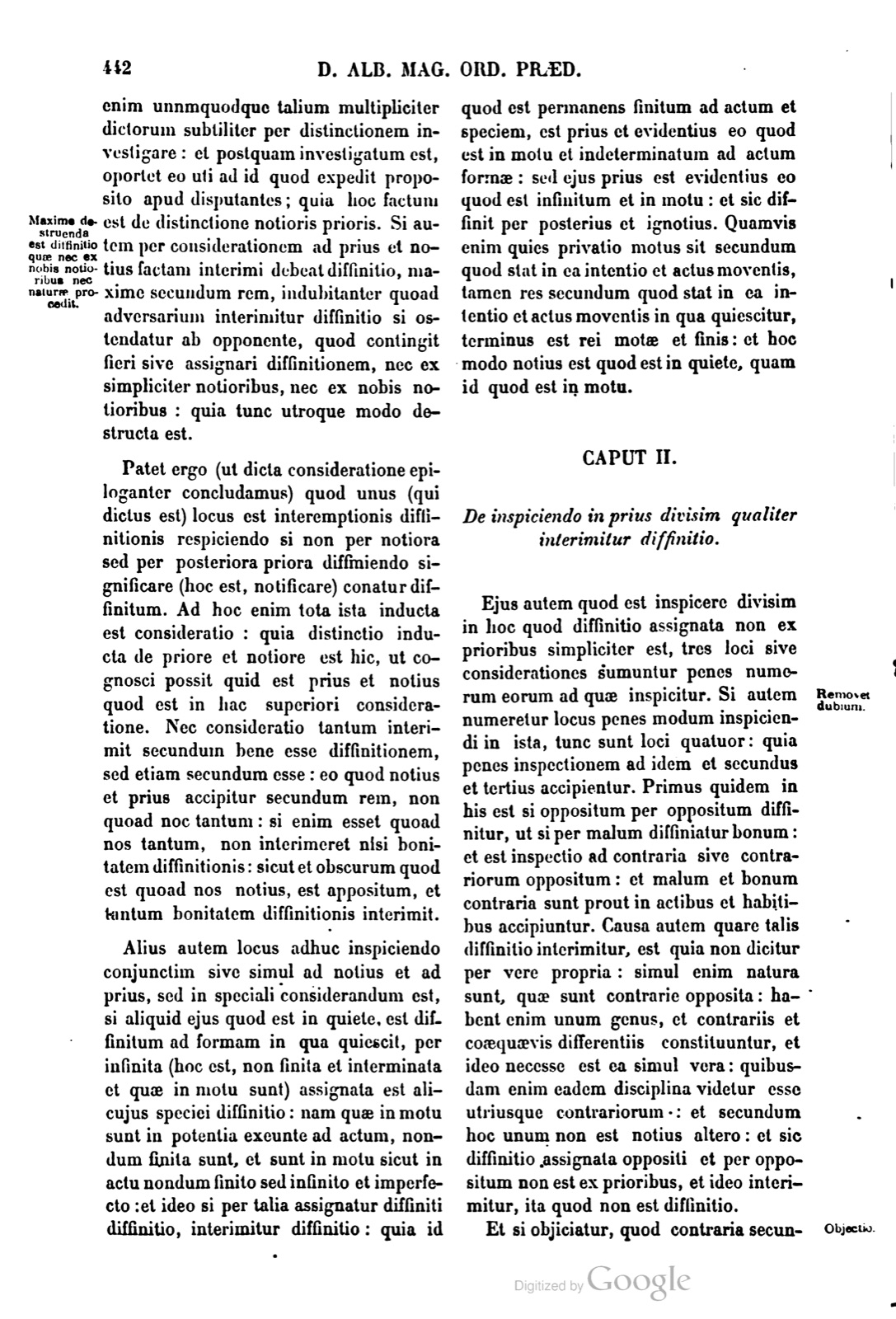
Patet ergo, ut dicta consideratione epiloganter concludamus, quod unus, qui dictus est, locus est interemptionis diffinitionis respiciendo si non per notiora sed per posteriora priora diffiniendo significare, hoc est, notificare, conatur diffinitum. Ad hoc enim tota ista inducta est consideratio: quia distinctio inducta de priore et notiore est hic, ut cognosci possit quid est prius et notius quod est in hac superiori consideratione. Nec consideratio tantum interimit secundum bene esse diffinitionem, sed etiam secundum esse: eo quod notius et prius accipitur secundum rem, non quoad nos tantum: si enim esset quoad nos tantum, non interimeret nisi bonitatem diffinitionis: sicut et obscurum quod est quoad nos notius, est appositum, et tantum bonitatem diffinitionis interimit.
Alius autem locus adhuc inspiciendo conjunctim sive simul ad notius et ad prius, sed in speciali considerandum est, si aliquid ejus quod est in quiete, est diffinitum ad formam in qua quiescit, per infinita, hoc est, non finita et interminata et quae in motu sunt, assignata est alicujus speciei diffinitio: nam quae in motu sunt in potentia exeunte ad actum, nondum finita sunt, et sunt in motu sicut in actu nondum finito sed infinito et imperfecto: et ideo si per talia assignatur diffiniti diffinitio, interimitur diffinitio: quia id quod est permanens finitum ad actum et speciem, est prius et evidentius eo quod est in motu et indeterminatum ad actum formae: sed ejus prius est evidentius eo quod est infinitum et in motu: et sic diffinit per posterius et ignotius. Quamvis enim quies privatio motus sit secundum quod stat in ea intentio et actus moventis, tamen res secundum quod stat in ea intentio et actus moventis in qua quiescitur, terminus est rei motae et finis: et hoc modo notius est quod est in quiete, quam id quod est in motu.
Therefore it is clear, to conclude by way of epilogue with the consideration stated, that one place, which has been stated, belongs to the destruction of definition by considering whether, in defining, one tries to signify, that is, to make known, the defined thing not through better known things but through posterior things as though they were prior. For the whole consideration introduced has been introduced for this: because the distinction introduced concerning the prior and the better known is here so that it can be known what is prior and better known, which is in this superior consideration. Nor does the consideration destroy definition only according to its well-being, but also according to being, because the better known and prior is taken according to the thing, not with respect to us alone. For if it were with respect to us alone, it would destroy only the goodness of definition, just as that which is obscure yet better known to us is appended and destroys only the goodness of definition.
But there is still another place by inspecting conjointly or simultaneously the better known and the prior, but it must be considered specially whether something which is at rest is defined with respect to the form in which it rests, by infinite things, that is, things not finished and not terminated and which are in motion, assigned as the definition of some species; for things which are in motion are in potency going out to act, are not yet finished, and are in motion as in an act not yet finished but infinite and imperfect. And therefore, if the definition of a defined thing is assigned through such things, the definition is destroyed, because that which is permanent, finite with respect to act and species, is prior and more evident than that which is in motion and indeterminate with respect to the act of form; but its prior is more evident than that which is infinite and in motion, and so he defines through what is posterior and more unknown. For although rest is the privation of motion according as the intention and act of the mover stand in it, nevertheless the thing according as the intention and act of the mover stand in it, in which it is at rest, is the terminus and end of the moved thing; and in this way that which is at rest is better known than that which is in motion.
If a page does not appear, its photograph has not been uploaded yet.