Volume 2 · pp. 444–446
Chapter III. How definition is destroyed by inspecting its parts, which are genus and difference.
A marker with ≈ is an approximate page boundary, placed by measure of the text; the page photographs remain the authority. In the paired views, clicking a page marker brings that page into view.
CAPUT III. Qualiter interimitur diffinitio inspiciendo in partes ejus, quae sunt genus et differentia.
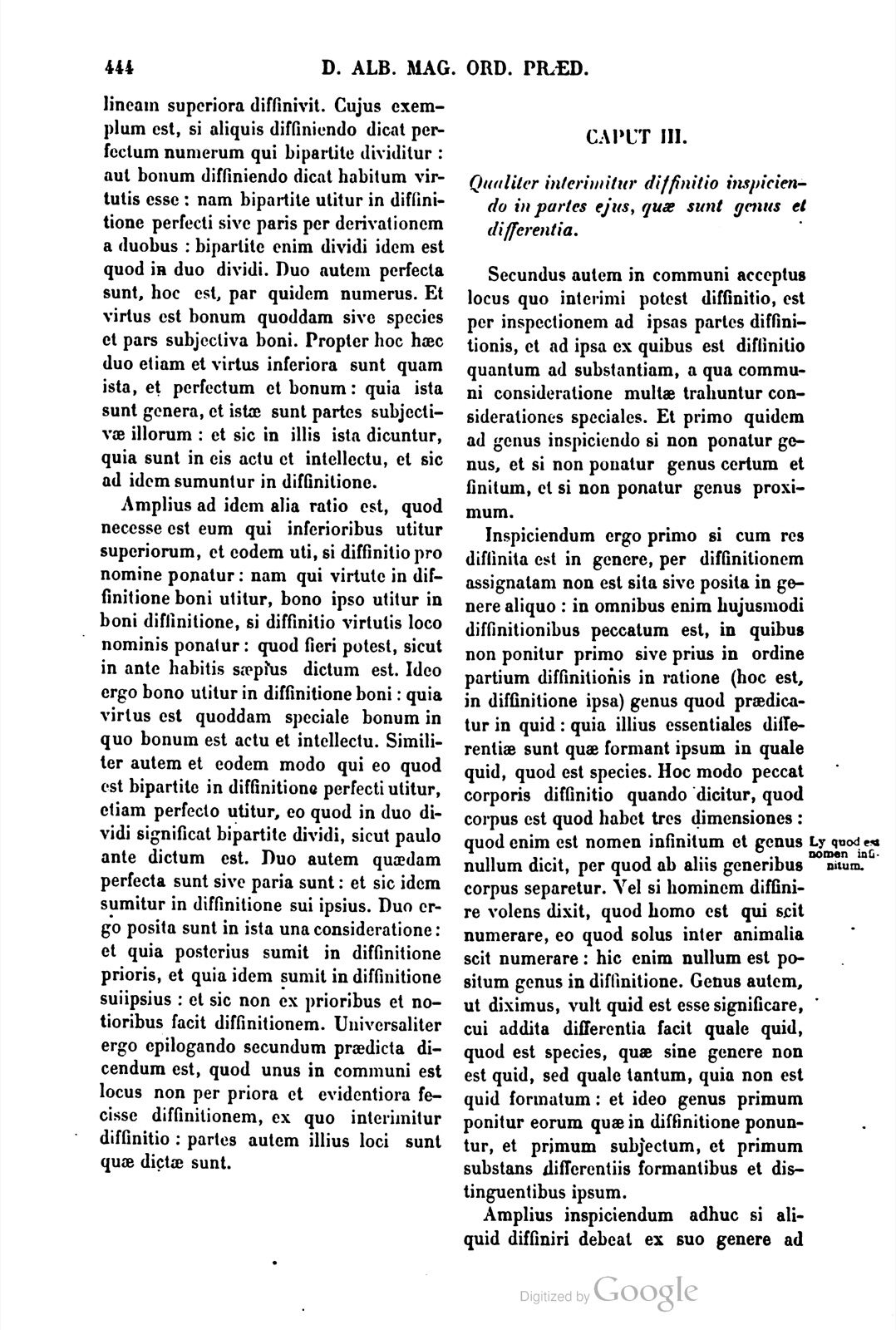
Secundus autem in communi acceptus locus quo interimi potest diffinitio, est per inspectionem ad ipsas partes diffinitionis, et ad ipsa ex quibus est diffinitio quantum ad substantiam, a qua communi consideratione multae trahuntur considerationes speciales. Et primo quidem ad genus inspiciendo si non ponatur genus, et si non ponatur genus certum et finitum, et si non ponatur genus proximum.
Inspiciendum ergo primo si cum res diffinita est in genere, per diffinitionem assignatam non est sita sive posita in genere aliquo: in omnibus enim hujusmodi diffinitionibus peccatum est, in quibus non ponitur primo sive prius in ordine partium diffinitionis in ratione, hoc est, in diffinitione ipsa, genus quod praedicatur in quid: quia illius essentiales differentiae sunt quae formant ipsum in quale quid, quod est species. Hoc modo peccat corporis diffinitio quando dicitur, quod corpus est quod habet tres dimensiones: quod enim est nomen infinitum et genus nullum dicit, per quod ab aliis generibus corpus separetur. Vel si hominem diffinire volens dixit, quod homo est qui scit numerare, eo quod solus inter animalia scit numerare: hic enim nullum est positum genus in diffinitione. Genus autem, ut diximus, vult quid est esse significare, cui addita differentia facit quale quid, quod est species, quae sine genere non est quid, sed quale tantum, quia non est quid formatum: et ideo genus primum ponitur eorum quae in diffinitione ponuntur, et primum subjectum, et primum substans differentiis formantibus et distinguentibus ipsum.
Amplius inspiciendum adhuc si aliquid diffiniri debeat ex suo genere ad plura sicut ad fines: dicto enim eo quod diffinitur ad plura ex ipso suo genere, considerandum est si aliquis in diffinitione assignata non ad omnia ad quae dictum est, assignavit: tunc enim peccavit, et interimitur diffinitio. Cujus exemplum est, ut si aliquis grammaticam diffinire volens, dicat eam scientiam esse scribendi: hic enim genus posuit, sed non omnia ad quae scientia est grammatica posuit: indiget enim adhuc quod apponatur, quoniam grammatica est scientia cognoscendi per constructionem ad intellectum relatum: et sic grammatica est scientia scribendi et cognoscendi ejus quod profertur in oratione et in partibus orationis, et nihil magis scribendi quam intelligendi declarat grammaticam esse scientiam ille qui assignat perfectam grammaticae diffinitionem. Propter quod non diffinit qui aliquid, hoc est, alterum illorum, ponit. Sed ille vere diffinit grammaticam, qui utraque haec ad quae ex integro est diffinitio, dixit sic: Grammatica est scientia recte scribendi et recte intelligendi quod profertur in oratione et partibus orationis. Hujus autem ratio est: quia plures non contingit esse diffinitiones substantiales ejusdem: et si diffinitur ad unum, eadem ratione diffinitur ad alterum, quando utrumque per suum genus et non per accidens: et sic non continget ejusdem plures esse diffinitiones et diversas. Est autem quod genus est aliud sicut scientia ad scitum.
CHAPTER III. How definition is destroyed by inspecting its parts, which are genus and difference.
But the second place taken in common, by which definition can be destroyed, is through inspection toward the very parts of definition and toward those things from which definition exists with respect to substance; from this common consideration many special considerations are drawn. And first, by inspecting genus, whether genus is not posited, whether a certain and determinate genus is not posited, and whether the proximate genus is not posited.
Therefore one must first inspect whether, when the defined thing is in a genus, through the assigned definition it has not been located or placed in some genus. For there is error in all definitions of this sort in which, first or prior in the order of the parts of definition in the account, that is, in the definition itself, there is not posited a genus which is predicated in what, because its essential differences are those which form it into a qualified what, which is the species. In this way the definition of body errs when it is said that body is what has three dimensions; for "what" is an indefinite name and says no genus through which body may be separated from other genera. Or if one wishing to define man said that man is one who knows how to number, because alone among animals he knows how to number; for here no genus has been posited in the definition. But genus, as we have said, wishes to signify what being is, to which an added difference makes a qualified what, which is species, which without genus is not a what but only of what quality, because it is not a formed what. And therefore genus is placed first of those things which are placed in the definition, and as the first subject and the first thing standing under the differences forming and distinguishing it.
Furthermore, one must still inspect whether something must be defined from its genus toward several things as toward ends; for when that which is defined is said toward several things from its very genus, one must consider whether someone in the assigned definition has not assigned it toward all the things toward which it has been stated; for then he has erred, and the definition is destroyed. The example of this is that, if someone wishing to define grammar says that it is the science of writing, he has posited a genus here, but he has not posited all the things toward which grammar is a science. For it still needs to be added that grammar is the science of knowing through construction related to understanding; and thus grammar is the science of writing and of knowing that which is uttered in speech and in the parts of speech, and one who assigns the perfect definition of grammar declares that grammar is a science no more of writing than of understanding. On account of this he who posits something, that is, one of those two, does not define. But he truly defines grammar who has stated both of these things toward which the definition is entire in this way: grammar is the science of rightly writing and rightly understanding what is uttered in speech and in the parts of speech. The reason for this is that there cannot be several substantial definitions of the same thing; and if it is defined toward one, it is defined by the same account toward the other, when each belongs through its genus and not by accident; and thus there will not happen to be several and diverse definitions of the same thing. But genus is something else as science is toward the thing known.
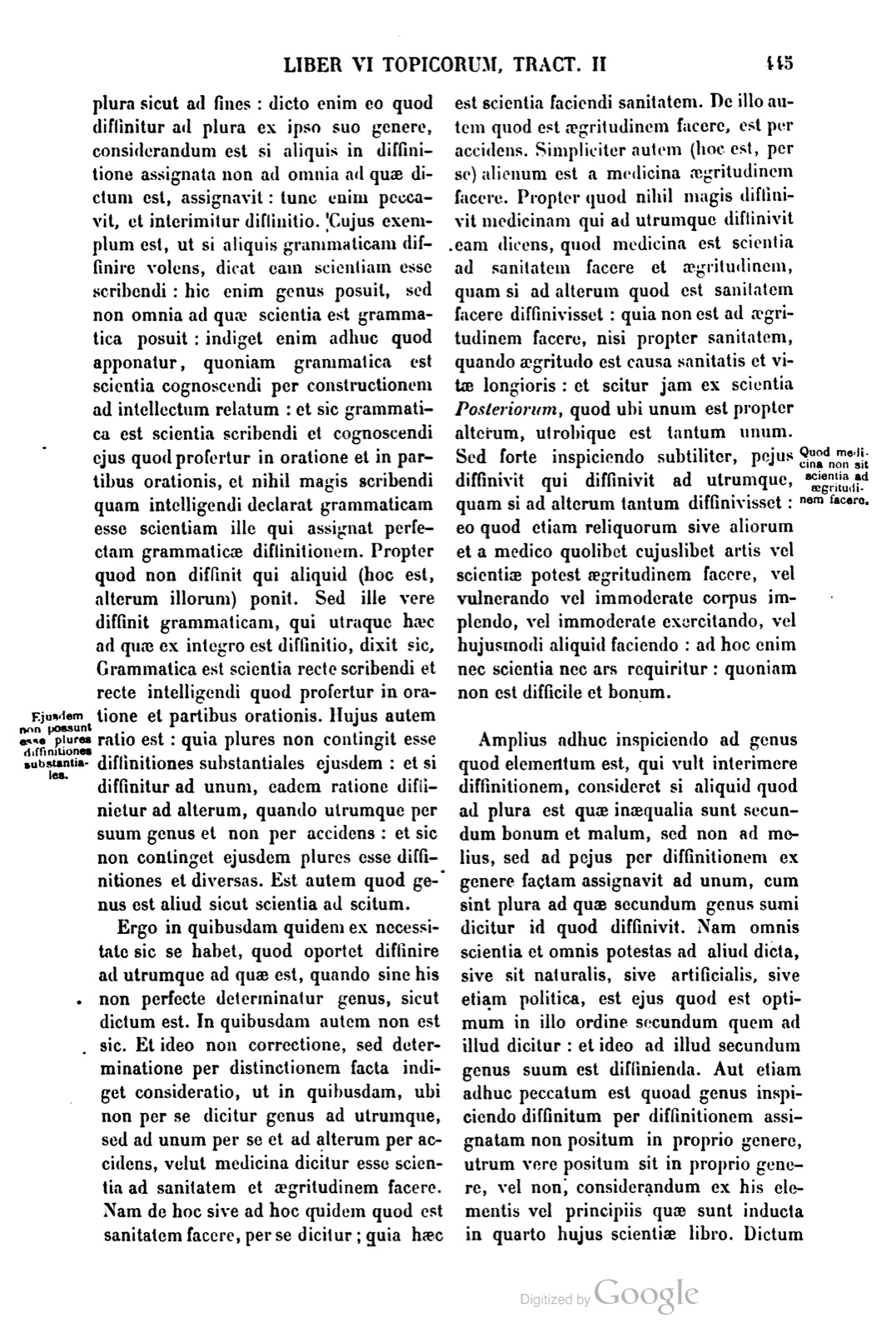
Ergo in quibusdam quidem ex necessitate sic se habet, quod oportet diffinire ad utrumque ad quae est, quando sine his non perfecte determinatur genus, sicut dictum est. In quibusdam autem non est sic. Et ideo non correctione, sed determinatione per distinctionem facta indiget consideratio, ut in quibusdam, ubi non per se dicitur genus ad utrumque, sed ad unum per se et ad alterum per accidens, velut medicina dicitur esse scientia ad sanitatem et aegritudinem facere. Nam de hoc sive ad hoc quidem quod est sanitatem facere, per se dicitur; quia haec est scientia faciendi sanitatem. De illo autem quod est aegritudinem facere, est per accidens. Simpliciter autem, hoc est, per se, alienum est a medicina aegritudinem facere. Propter quod nihil magis diffinivit medicinam qui ad utrumque diffinivit eam dicens, quod medicina est scientia ad sanitatem facere et aegritudinem, quam si ad alterum quod est sanitatem facere diffinivisset: quia non est ad aegritudinem facere, nisi propter sanitatem, quando aegritudo est causa sanitatis et vitae longioris: et scitur jam ex scientia Posteriorum, quod ubi unum est propter alterum, utrobique est tantum unum. Sed forte inspiciendo subtiliter, pejus diffinivit qui diffinivit ad utrumque, quam si ad alterum tantum diffinivisset: eo quod etiam reliquorum sive aliorum et a medico quolibet cujuslibet artis vel scientiae potest aegritudinem facere, vel vulnerando vel immoderate corpus implendo, vel immoderate exercitando, vel hujusmodi aliquid faciendo: ad hoc enim nec scientia nec ars requiritur: quoniam non est difficile et bonum.
Amplius adhuc inspiciendo ad genus quod elementum est, qui vult interimere diffinitionem, consideret si aliquid quod ad plura est quae inaequalia sunt secundum bonum et malum, sed non ad melius, sed ad pejus per diffinitionem ex genere factam assignavit ad unum, cum sint plura ad quae secundum genus sumi dicitur id quod diffinivit. Nam omnis scientia et omnis potestas ad aliud dicta, sive sit naturalis, sive artificialis, sive etiam politica, est ejus quod est optimum in illo ordine secundum quem ad illud dicitur: et ideo ad illud secundum genus suum est diffinienda. Aut etiam adhuc peccatum est quoad genus inspiciendo diffinitum per diffinitionem assignatam non positum in proprio genere, utrum vere positum sit in proprio genere, vel non, considerandum ex his elementis vel principiis quae sunt inducta in quarto hujus scientiae libro. Dictum autem est prius quando ponitur in aequivoco vel analogo sicut in genere.
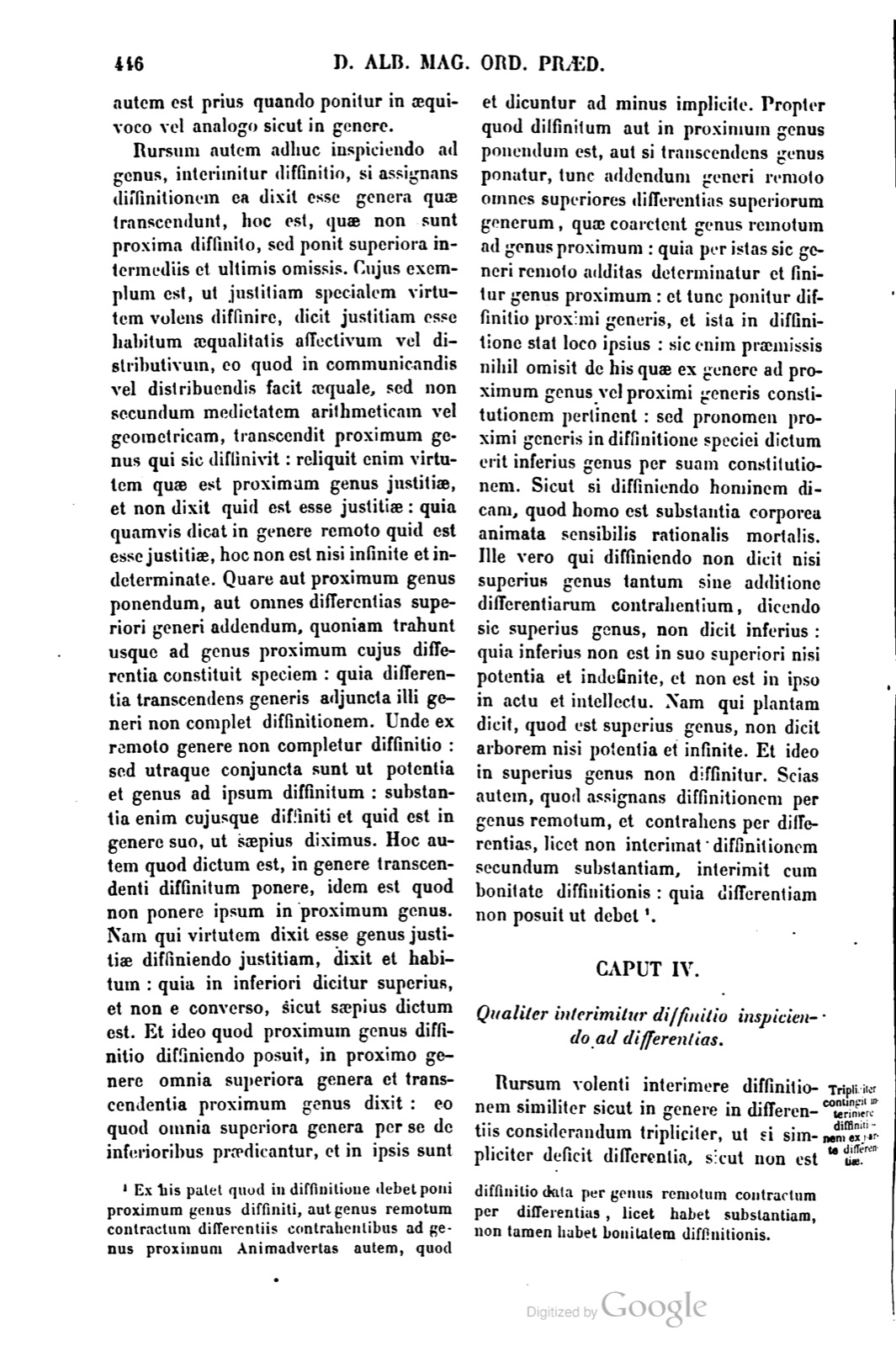
Rursum autem adhuc inspiciendo ad genus, interimitur diffinitio, si assignans diffinitionem ea dixit esse genera quae transcendunt, hoc est, quae non sunt proxima diffinito, sed ponit superiora intermediis et ultimis omissis. Cujus exemplum est, ut justitiam specialem virtutem volens diffinire, dicit justitiam esse habitum aequalitatis affectivum vel distributivum, eo quod in communicandis vel distribuendis facit aequale, sed non secundum medietatem arithmeticam vel geometricam, transcendit proximum genus qui sic diffinivit: reliquit enim virtutem quae est proximum genus justitiae, et non dixit quid est esse justitiae: quia quamvis dicat in genere remoto quid est esse justitiae, hoc non est nisi infinite et indeterminate. Quare aut proximum genus ponendum, aut omnes differentias superiori generi addendum, quoniam trahunt usque ad genus proximum cujus differentia constituit speciem: quia differentia transcendens generis adjuncta illi generi non complet diffinitionem. Unde ex remoto genere non completur diffinitio: sed utraque conjuncta sunt ut potentia et genus ad ipsum diffinitum: substantia enim cujusque diffiniti et quid est in genere suo, ut saepius diximus. Hoc autem quod dictum est, in genere transcendentis diffinitum ponere, idem est quod non ponere ipsum in proximum genus. Nam qui virtutem dixit esse genus justitiae diffiniendo justitiam, dixit et habitum: quia in inferiori dicitur superius, et non e converso, sicut saepius dictum est. Et ideo quod proximum genus diffinitio diffiniendo posuit, in proximo genere omnia superiora genera et transcendentia proximum genus dixit: eo quod omnia superiora genera per se de inferioribus praedicantur, et in ipsis sunt et dicuntur ad minus implicite. Propter quod diffinitum aut in proximum genus ponendum est, aut si transcendens genus ponatur, tunc addendum generi remoto omnes superiores differentias superiorum generum, quae coarctent genus remotum ad genus proximum: quia per istas sic generi remoto additas determinatur et finitur genus proximum: et tunc ponitur diffinitio proximi generis, et ista in diffinitione stat loco ipsius: sic enim praemissis nihil omisit de his quae ex genere ad proximum genus vel proximi generis constitutionem pertinent: sed pronomen proximi generis in diffinitione speciei dictum erit inferius genus per suam constitutionem. Sicut si diffiniendo hominem dicam, quod homo est substantia corporea animata sensibilis rationalis mortalis. Ille vero qui diffiniendo non dicit nisi superius genus tantum sine additione differentiarum contrahentium, dicendo sic superius genus, non dicit inferius: quia inferius non est in suo superiori nisi potentia et indefinite, et non est in ipso in actu et intellectu. Nam qui plantam dicit, quod est superius genus, non dicit arborem nisi potentia et infinite. Et ideo in superius genus non diffinitur. Scias autem, quod assignans diffinitionem per genus remotum, et contrahens per differentias, licet non interimat diffinitionem secundum substantiam, interimit cum bonitate diffinitionis: quia differentiam non posuit ut debet 1.
Therefore in some cases, indeed, it necessarily has itself so that one must define toward both things toward which it is, when without these the genus is not perfectly determined, as has been said. But in some cases it is not so. And therefore the consideration needs not correction, but determination made through distinction, as in certain cases where genus is not said through itself toward both, but toward one through itself and toward the other by accident, as medicine is said to be a science for making health and sickness. For concerning this, or toward this, namely to make health, it is said through itself, because this is the science of making health. But concerning that which is to make sickness, it is by accident. But simply, that is, through itself, to make sickness is alien to medicine. On account of this, the one who defined medicine toward both by saying that medicine is the science for making health and sickness did not define medicine any more than if he had defined it toward the other thing, which is to make health, because it is not for making sickness except on account of health, when sickness is the cause of health and of longer life; and it is already known from the science of the Posterior Analytics that where one thing is for the sake of another, in either place there is only one. But perhaps, by inspecting subtly, he defined worse who defined toward both than if he had defined toward one alone, because also any of the rest or of others, and any physician of any art or science, can make sickness, either by wounding or by filling the body immoderately or by exercising it immoderately or by doing something of this sort; for neither science nor art is required for this, since it is not difficult and good.
Furthermore, still by inspecting genus, which is an element, one who wishes to destroy a definition should consider whether, in the definition made from genus, he has assigned toward one something which is toward several things that are unequal according to good and evil, not toward the better but toward the worse, although there are several things toward which what he defined is said to be taken according to genus. For every science and every power said toward another, whether it is natural or artificial or even political, belongs to that which is best in that order according to which it is said toward that thing; and therefore it must be defined toward that according to its genus. Or there is still error with respect to genus by inspecting whether the defined thing, through the assigned definition, has not been placed in its proper genus; whether it has truly been placed in its proper genus or not must be considered from those elements or principles which were introduced in the fourth book of this science. But it was said before when it is placed in an equivocal or analogous term as in a genus.
Again, still by inspecting genus, definition is destroyed if the one assigning the definition has said those things to be genera which transcend, that is, which are not proximate to the defined thing, but he posits superior things while intermediate and ultimate things have been omitted. The example of this is that one wishing to define justice as a special virtue says that justice is a habit affective or distributive of equality, because in communicating or distributing it makes equality, but not according to arithmetical or geometrical middle. One who has defined in this way transcends the proximate genus; for he has left behind virtue, which is the proximate genus of justice, and has not stated what the being of justice is, because although he states what the being of justice is in a remote genus, this is only infinitely and indeterminately. Therefore either the proximate genus must be posited, or all differences must be added to the superior genus, because they draw it all the way to the proximate genus whose difference constitutes the species, since a transcendent difference of a genus joined to that genus does not complete the definition. Hence a definition is not completed from a remote genus; but both are conjoined as potency and genus toward the defined thing itself, for the substance and what of each defined thing is in its own genus, as we have often said. But this which has been said, to place the defined thing in a transcending genus, is the same as not placing it in the proximate genus. For he who said virtue to be the genus of justice, in defining justice, also stated habit, because the superior is said in the inferior and not conversely, as has often been said. And therefore because the definition, in defining, posited the proximate genus, in the proximate genus it stated all superior genera and things transcending the proximate genus, because all superior genera are predicated through themselves of inferiors and are and are said in them at least implicitly. On account of this, the defined thing must either be placed in the proximate genus, or, if a transcendent genus is posited, then all the superior differences of the superior genera must be added to the remote genus, which narrow the remote genus to the proximate genus; because through these, added in this way to the remote genus, the proximate genus is determined and delimited. And then the definition of the proximate genus is posited, and this stands in the definition in place of it. For in this way, with the premises made, he has omitted nothing of those things which pertain from the genus to the proximate genus or to the constitution of the proximate genus; but the pronoun of the proximate genus stated in the definition of the species will be the inferior genus through its constitution. As if, in defining man, I say that man is corporeal, animated, sensible, rational, mortal substance. But he who, in defining, states only the superior genus without the addition of contracting differences, by saying the superior genus in this way, does not state the inferior, because the inferior is in its superior only in potency and indefinitely, and is not in it in act and understanding. For one who says plant, which is a superior genus, does not state tree except in potency and infinitely. And therefore one is not defined into the superior genus. But know that one assigning a definition through a remote genus and contracting through differences, although he does not destroy the definition according to substance, destroys it with respect to the goodness of definition, because he has not posited the difference as he ought 1.
Notes
- From these things it is clear that in definition the proximate genus of the defined thing must be posited, or a remote genus contracted by differences contracting it to the proximate genus. But note that a definition given through a remote genus contracted by differences, although it has substance, nevertheless does not have the goodness of definition. (Ex his patet quod in diffinitione debet poni proximum genus diffiniti, aut genus remotum contractum differentiis contrahentibus ad genus proximum. Animadvertas autem, quod diffinitio data per genus remotum contractum per differentias, licet habet substantiam, non tamen habet bonitatem diffinitionis.) ↩
If a page does not appear, its photograph has not been uploaded yet.