Volume 2 · pp. 434–438
Chapter III. How the goodness of definition is destroyed through something superfluous posited in the definition.
A marker with ≈ is an approximate page boundary, placed by measure of the text; the page photographs remain the authority. In the paired views, clicking a page marker brings that page into view.
CAPUT III. Qualiter interimitur bonitas diffinitionis per superfluum in diffinitione positum.
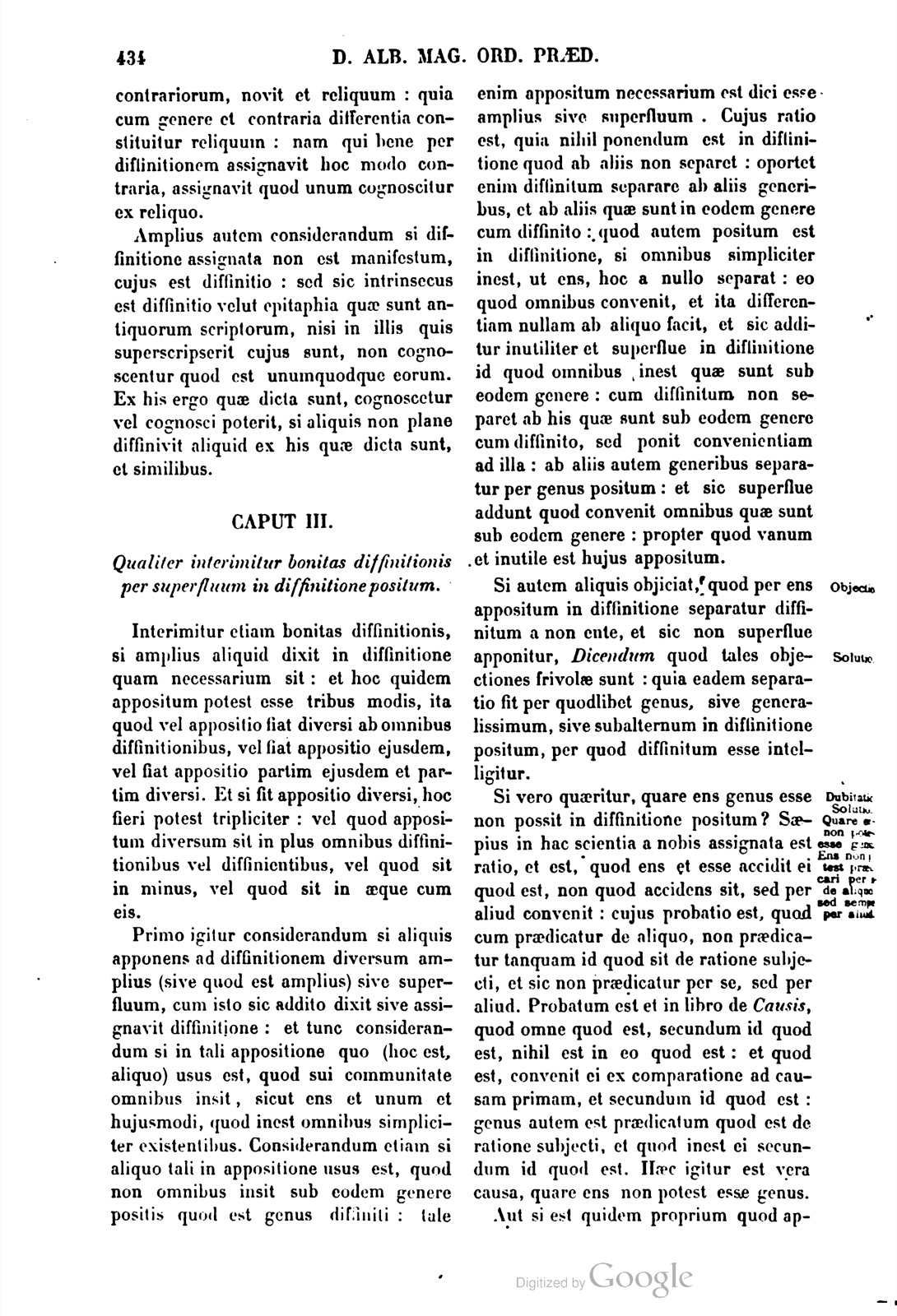
Interimitur etiam bonitas diffinitionis, si amplius aliquid dixit in diffinitione quam necessarium sit: et hoc quidem appositum potest esse tribus modis, ita quod vel appositio fiat diversi ab omnibus diffinitionibus, vel fiat appositio ejusdem, vel fiat appositio partim ejusdem et partim diversi. Et si fit appositio diversi, hoc fieri potest tripliciter: vel quod appositum diversum sit in plus omnibus diffinitionibus vel diffinientibus, vel quod sit in minus, vel quod sit in aeque cum eis.
Primo igitur considerandum si aliquis apponens ad diffinitionem diversum amplius, sive quod est amplius, sive superfluum, cum isto sic addito dixit sive assignavit diffinitione: et tunc considerandum si in tali appositione quo, hoc est, aliquo, usus est, quod sui communitate omnibus insit, sicut ens et unum et hujusmodi, quod inest omnibus simpliciter existentibus. Considerandum etiam si aliquo tali in appositione usus est, quod non omnibus insit sub eodem genere positis quod est genus diffiniti: tale enim appositum necessarium est dici esse amplius sive superfluum. Cujus ratio est, quia nihil ponendum est in diffinitione quod ab aliis non separet: oportet enim diffinitum separare ab aliis generibus, et ab aliis quae sunt in eodem genere cum diffinito: quod autem positum est in diffinitione, si omnibus simpliciter inest, ut ens, hoc a nullo separat: eo quod omnibus convenit, et ita differentiam nullam ab aliquo facit, et sic additur inutiliter et superflue in diffinitione id quod omnibus inest quae sunt sub eodem genere: cum diffinitum non separet ab his quae sunt sub eodem genere cum diffinito, sed ponit convenientiam ad illa: ab aliis autem generibus separatur per genus positum: et sic superflue addunt quod convenit omnibus quae sunt sub eodem genere: propter quod vanum et inutile est hujus appositum.
Si autem aliquis objiciat, quod per ens appositum in diffinitione separatur diffinitum a non ente, et sic non superflue apponitur, dicendum quod tales objectiones frivolae sunt: quia eadem separatio fit per quodlibet genus, sive generalissimum, sive subalternum in diffinitione positum, per quod diffinitum esse intelligitur.
Si vero quaeritur, quare ens genus esse non possit in diffinitione positum? Saepius in hac scientia a nobis assignata est ratio, et est, quod ens et esse accidit ei quod est, non quod accidens sit, sed per aliud convenit: cujus probatio est, quod cum praedicatur de aliquo, non praedicatur tanquam id quod sit de ratione subjecti, et sic non praedicatur per se, sed per aliud. Probatum est et in libro de Causis, quod omne quod est, secundum id quod est, nihil est in eo quod est: et quod est, convenit ei ex comparatione ad causam primam, et secundum id quod est: genus autem est praedicatum quod est de ratione subjecti, et quod inest ei secundum id quod est. Haec igitur est vera causa, quare ens non potest esse genus.
Aut si est quidem proprium quod appositum in diffinitione, hoc est, convertibile sit, ita tamen quod ablato illo a diffinitione, residuum adhuc convertibile sit cum diffinito, ita quod adhuc est propria diffinitio, et dicat adhuc substantiam diffiniti, superflue est additum. Simpliciter autem et universaliter esse illud superfluum est dicendum, quo ablato a diffinitione, quod reliquum est residuum, sufficienter manifestum facit id quod diffinitum est. Talis autem, ut exemplum ponamus, est animae Platonis diffinitio, si anima secundum Platonem dicatur numerus seipsum movens: nam, sicut diffinit, seipsum movens est anima, et convertitur cum anima seipsum movens esse, et separat animam a natura quae non movet seipsam, et est principium motus et quietis in anima per se et non secundum accidens: et ideo superflue ponitur numerus.
CHAPTER III. How the goodness of definition is destroyed through something superfluous posited in the definition.
The goodness of definition is also destroyed if someone has said something more in the definition than is necessary. And this appended thing can be in three ways: either an addition of something different from all definitions is made, or an addition of the same thing is made, or an addition partly of the same and partly of something different is made. And if an addition of something different is made, this can happen in three ways: either because the different thing appended is in more than all definitions or definers, or because it is in fewer, or because it is equal with them.
Therefore first one must consider whether someone, appending to the definition something different and more, or what is more, or superfluous, has stated or assigned with this so added by definition; and then one must consider whether in such an addition he used that by which, that is, some thing by which, it belongs to all through its commonness, as being and one and things of this sort, which belong to all things existing simply. One must also consider whether in the addition he used some such thing which does not belong to all things posited under the same genus, which is the genus of the defined thing; for such an appended thing must necessarily be said to be more or superfluous. The reason for this is that nothing should be placed in a definition which does not separate from others. For the defined thing must be separated from other genera, and from other things which are in the same genus with the defined thing. But if what is posited in the definition belongs to all simply, as being does, this separates from nothing, because it belongs to all, and so makes no difference from anything; and thus what belongs to all things which are under the same genus is added uselessly and superfluously in the definition, since it does not separate the defined thing from those things which are under the same genus with the defined thing, but posits agreement with them. But from other genera it is separated through the posited genus; and so they superfluously add what belongs to all things which are under the same genus; on account of which the appended thing of this sort is vain and useless.
But if someone objects that through being appended in the definition the defined thing is separated from non-being, and thus it is not appended superfluously, it must be said that such objections are frivolous, because the same separation is made through any genus whatever, whether most general or subaltern, posited in the definition, through which the defined thing is understood to be.
But if it is asked why being cannot be posited as a genus in a definition, the reason has very often been assigned by us in this science, and it is that being and to be happens to that which is, not because it is an accident, but because it belongs through another. The proof of this is that when it is predicated of something, it is not predicated as that which would be of the account of the subject, and so it is not predicated through itself, but through another. And it has been proved in the book On Causes that everything which is, according to that which it is, has nothing in that which it is; and what it is belongs to it from comparison to the first cause, and according to that which it is. But genus is a predicate which is of the account of the subject, and which belongs to it according to that which it is. This, therefore, is the true cause why being cannot be a genus.
Or if the thing appended in the definition is indeed proper, that is, convertible, yet in such a way that, when it has been removed from the definition, the remainder is still convertible with the defined thing, so that there is still a proper definition, and it still states the substance of the defined thing, it has been added superfluously. But simply and universally that is to be called superfluous by the removal of which from the definition the remaining residue sufficiently makes manifest that which has been defined. Such, to set down an example, is Plato's definition of the soul, if according to Plato the soul is called a number moving itself; for, as he defines it, self-moving is soul, and to be a self-moving soul is converted with soul, and separates soul from nature which does not move itself, and is the principle of motion and rest in soul through itself and not according to accident; and therefore number is posited superfluously.
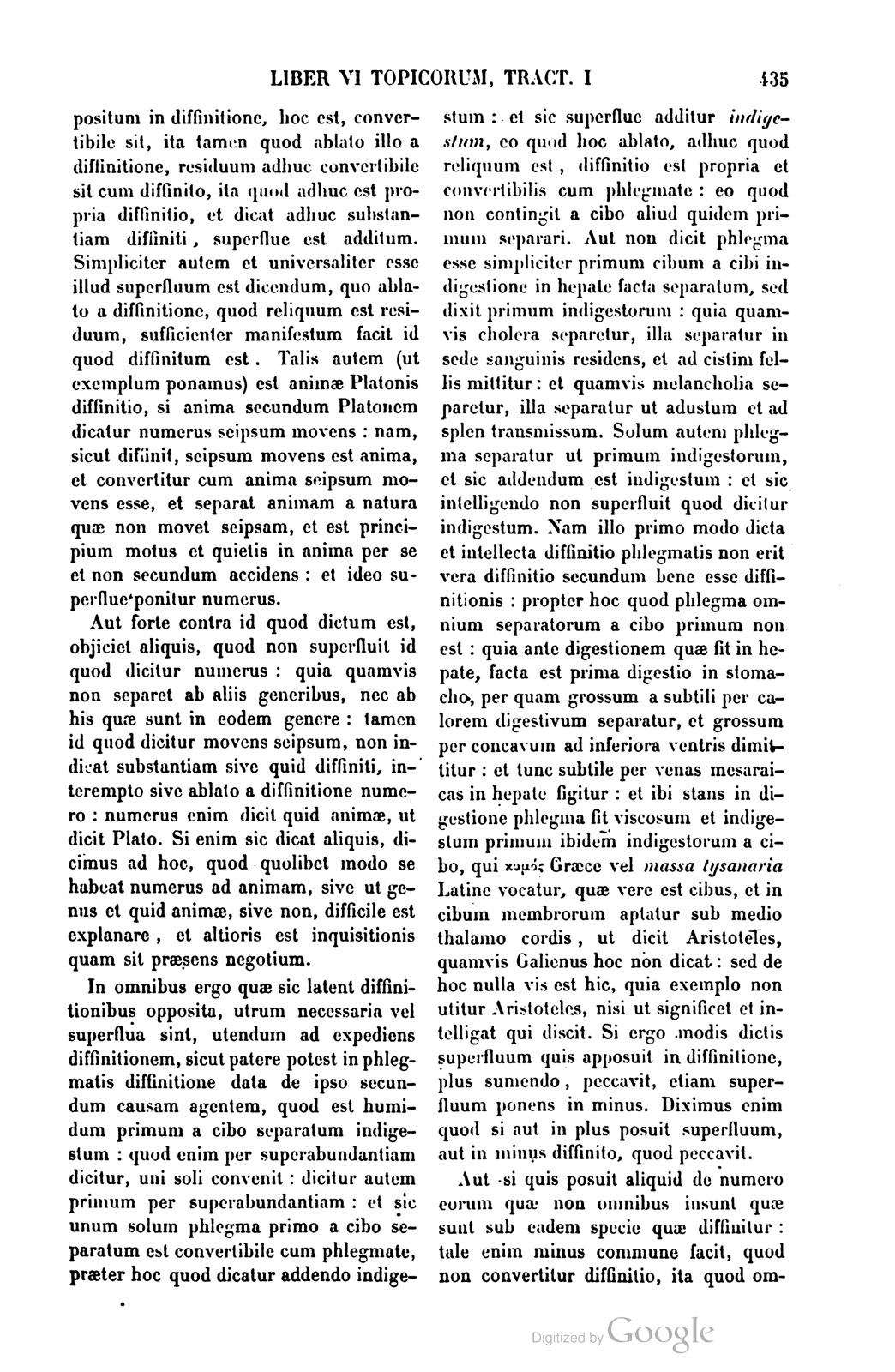
Aut forte contra id quod dictum est, objiciet aliquis, quod non superfluit id quod dicitur numerus: quia quamvis non separet ab aliis generibus, nec ab his quae sunt in eodem genere: tamen id quod dicitur movens seipsum, non indicat substantiam sive quid diffiniti, interempto sive ablato a diffinitione numero: numerus enim dicit quid animae, ut dicit Plato. Si enim sic dicat aliquis, dicimus ad hoc, quod quolibet modo se habeat numerus ad animam, sive ut genus et quid animae, sive non, difficile est explanare, et altioris est inquisitionis quam sit praesens negotium.
In omnibus ergo quae sic latent diffinitionibus opposita, utrum necessaria vel superflua sint, utendum ad expediens diffinitionem, sicut patere potest in phlegmatis diffinitione data de ipso secundum causam agentem, quod est humidum primum a cibo separatum indigestum: quod enim per superabundantiam dicitur, uni soli convenit: dicitur autem primum per superabundantiam: et sic unum solum phlegma primo a cibo separatum est convertibile cum phlegmate, praeter hoc quod dicatur addendo indigestum: et sic superflue additur indigestum, eo quod hoc ablato, adhuc quod reliquum est, diffinitio est propria et convertibilis cum phlegmate: eo quod non contingit a cibo aliud quidem primum separari. Aut non dicit phlegma esse simpliciter primum cibum a cibi indigestione in hepate facta separatum, sed dixit primum indigestorum: quia quamvis cholera separetur, illa separatur in sede sanguinis residens, et ad cistim fellis mittitur: et quamvis melancholia separetur, illa separatur ut adustum et ad splen transmissum. Solum autem phlegma separatur ut primum indigestorum, et sic addendum est indigestum: et sic intelligendo non superfluit quod dicitur indigestum. Nam illo primo modo dicta et intellecta diffinitio phlegmatis non erit vera diffinitio secundum bene esse diffinitionis: propter hoc quod phlegma omnium separatorum a cibo primum non est: quia ante digestionem quae fit in hepate, facta est prima digestio in stomacho, per quam grossum a subtili per calorem digestivum separatur, et grossum per concavum ad inferiora ventris dimittitur: et tunc subtile per venas mesaraicas in hepate figitur: et ibi stans in digestione phlegma fit viscosum et indigestum primum ibidem indigestorum a cibo, qui χυμός Graece vel massa tysanaria Latine vocatur, quae vere est cibus, et in cibum membrorum aptatur sub medio thalamo cordis, ut dicit Aristoteles, quamvis Galienus hoc non dicat: sed de hoc nulla vis est hic, quia exemplo non utitur Aristoteles, nisi ut significet et intelligat qui discit. Si ergo modis dictis superfluum quis apposuit in diffinitione, plus sumendo, peccavit, etiam superfluum ponens in minus. Diximus enim quod si aut in plus posuit superfluum, aut in minus diffinito, quod peccavit.
Or perhaps someone will object against what has been said, that what is called number is not superfluous, because although it does not separate from other genera, nor from those things which are in the same genus, nevertheless what is called moving itself does not indicate the substance or what of the defined thing when number has been destroyed or removed from the definition; for number states the what of soul, as Plato says. For if someone speaks thus, we say to this that in whatever way number has itself to soul, whether as the genus and what of soul or not, it is difficult to explain and belongs to a higher inquiry than the present business.
Therefore in all things which thus lie hidden as opposites in definitions, whether they are necessary or superfluous, one must use what is expedient for the definition, as can be clear in the definition of phlegm given about it according to the agent cause, namely that it is the first moisture separated from food, undigested. For what is said through superabundance belongs to one alone; but first is said through superabundance; and thus one phlegm alone, first separated from food, is convertible with phlegm, apart from this, that undigested is said by being added. And so undigested is added superfluously, because when this has been removed, what remains is still a proper definition and convertible with phlegm, since it does not happen that anything else first be separated from food. Or it does not say that phlegm is simply the first food separated from the indigestion of food made in the liver, but says it is the first of undigested things; because although choler is separated, it is separated while residing in the seat of the blood and is sent to the bladder of gall; and although melancholy is separated, it is separated as burned and transmitted to the spleen. But phlegm alone is separated as the first of undigested things, and thus undigested must be added; and understanding it in this way, what is called undigested is not superfluous. For in that first way the stated and understood definition of phlegm will not be a true definition according to the well-being of definition, because phlegm is not the first of all things separated from food; for before the digestion which is made in the liver, the first digestion has been made in the stomach, through which the gross is separated from the subtle by digestive heat, and the gross is sent down through the hollow into the lower parts of the belly; and then the subtle is fixed in the liver through the mesaraic veins; and standing there in digestion, phlegm becomes viscous and undigested, the first there of the things undigested from food, which is called χυμός in Greek or massa tysanaria in Latin, which truly is food and is fitted for food of the members beneath the middle chamber of the heart, as Aristotle says, although Galen does not say this. But there is no force in this here, because Aristotle uses the example only so that the one who learns may signify and understand. Therefore, if in the stated modes someone appended something superfluous in a definition, by taking more, he erred, also by positing a superfluous thing in fewer. For we have said that if he posited the superfluous either in more or in fewer than the defined thing, he erred.
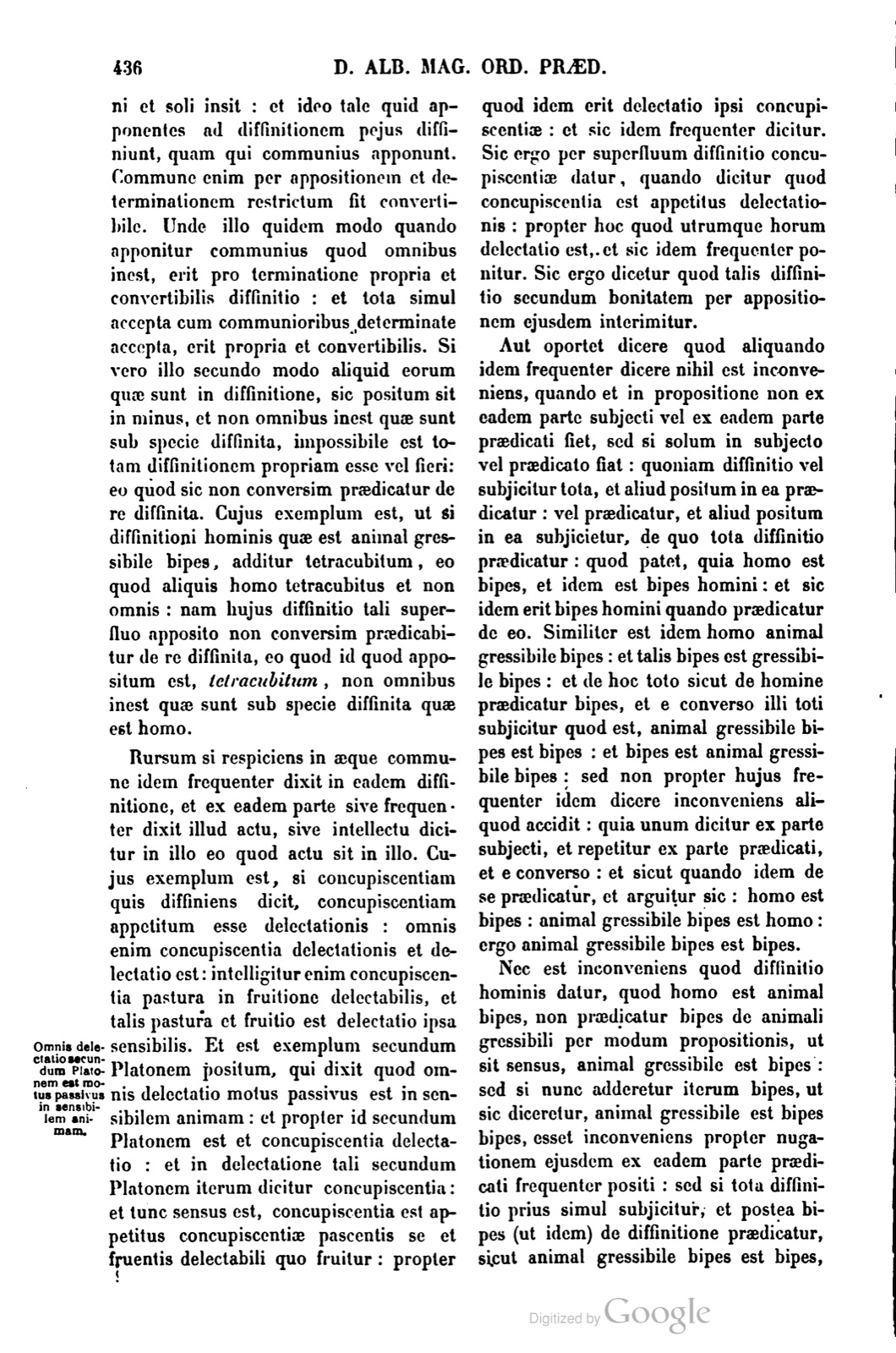
Aut si quis posuit aliquid de numero eorum quae non omnibus insunt quae sunt sub eadem specie quae diffinitur: tale enim minus commune facit, quod non convertitur diffinitio, ita quod omni et soli insit: et ideo tale quid apponentes ad diffinitionem pejus diffiniunt, quam qui communius apponunt. Commune enim per appositionem et determinationem restrictum fit convertibile. Unde illo quidem modo quando apponitur communius quod omnibus inest, erit pro terminatione propria et convertibilis diffinitio: et tota simul accepta cum communioribus determinate accepta, erit propria et convertibilis. Si vero illo secundo modo aliquid eorum quae sunt in diffinitione, sic positum sit in minus, et non omnibus inest quae sunt sub specie diffinita, impossibile est totam diffinitionem propriam esse vel fieri: eo quod sic non conversim praedicatur de re diffinita. Cujus exemplum est, ut si diffinitioni hominis quae est animal gressibile bipes, additur tetracubitum, eo quod aliquis homo tetracubitus et non omnis: nam hujus diffinitio tali superfluo apposito non conversim praedicabitur de re diffinita, eo quod id quod appositum est, tetracubitum, non omnibus inest quae sunt sub specie diffinita quae est homo.
Rursum si respiciens in aeque commune idem frequenter dixit in eadem diffinitione, et ex eadem parte sive frequenter dixit illud actu, sive intellectu dicitur in illo eo quod actu sit in illo. Cujus exemplum est, si concupiscentiam quis diffiniens dicit, concupiscentiam appetitum esse delectationis: omnis enim concupiscentia delectationis et delectatio est: intelligitur enim concupiscentia pastura in fruitione delectabilis, et talis pastura et fruitio est delectatio ipsa sensibilis. Et est exemplum secundum Platonem positum, qui dixit quod omnis delectatio motus passivus est in sensibilem animam: et propter id secundum Platonem est et concupiscentia delectatio: et in delectatione tali secundum Platonem iterum dicitur concupiscentia: et tunc sensus est, concupiscentia est appetitus concupiscentiae pascentis se et fruentis delectabili quo fruitur: propter quod idem erit delectatio ipsi concupiscentiae: et sic idem frequenter dicitur. Sic ergo per superfluum diffinitio concupiscentiae datur, quando dicitur quod concupiscentia est appetitus delectationis: propter hoc quod utrumque horum delectatio est, et sic idem frequenter ponitur. Sic ergo dicetur quod talis diffinitio secundum bonitatem per appositionem ejusdem interimitur.
Aut oportet dicere quod aliquando idem frequenter dicere nihil est inconveniens, quando et in propositione non ex eadem parte subjecti vel ex eadem parte praedicati fiet, sed si solum in subjecto vel praedicato fiat: quoniam diffinitio vel subjicitur tota, et aliud positum in ea praedicatur: vel praedicatur, et aliud positum in ea subjicietur, de quo tota diffinitio praedicatur: quod patet, quia homo est bipes, et idem est bipes homini: et sic idem erit bipes homini quando praedicatur de eo. Similiter est idem homo animal gressibile bipes: et talis bipes est gressibile bipes: et de hoc toto sicut de homine praedicatur bipes, et e converso illi toti subjicitur quod est, animal gressibile bipes est bipes: et bipes est animal gressibile bipes: sed non propter hujus frequenter idem dicere inconveniens aliquid accidit: quia unum dicitur ex parte subjecti, et repetitur ex parte praedicati, et e converso: et sicut quando idem de se praedicatur, et arguitur sic: homo est bipes: animal gressibile bipes est homo: ergo animal gressibile bipes est bipes.
Or if someone posited something from the number of those things which do not belong to all things which are under the same species which is defined, such a thing makes the definition less common, so that it is not converted, that it may belong to every one and to it alone. And therefore those who append such a thing to a definition define worse than those who append something more common. For what is common, restricted through addition and determination, becomes convertible. Hence in that first way, when something more common which belongs to all is appended, it will be a proper and convertible definition for the termination; and the whole taken together with the more common things taken determinately will be proper and convertible. But if in that second way something of those things which are in the definition is posited in this way in fewer and does not belong to all things which are under the defined species, it is impossible for the whole definition to be or become proper, because in this way it is not predicated conversely of the defined thing. The example of this is that, if to the definition of man which is walkable biped animal there is added four-cubit, because some man is four-cubit and not every man, then the definition of this with such a superfluous thing appended will not be predicated conversely of the defined thing, because that which is appended, four-cubit, does not belong to all things which are under the defined species which is man.
Again, if, looking to something equally common, he has said the same thing frequently in the same definition, and from the same part, whether he frequently said it in act, or it is said intellectually in that thing because it is actually in it. The example of this is if someone defining concupiscence says that concupiscence is an appetite of delight; for every concupiscence is of delight and is delight. For concupiscence is understood as feeding in the enjoyment of the delightful, and such feeding and enjoyment is sensory delight itself. And the example is posited according to Plato, who said that every delight is a passive motion into the sensible soul; and for this reason, according to Plato, concupiscence too is delight; and in such delight, according to Plato, concupiscence is again said, and then the sense is: concupiscence is the appetite of concupiscence feeding itself and enjoying the delightful thing which it enjoys; on account of this delight will be the same as concupiscence itself, and so the same thing is said frequently. Thus, therefore, through something superfluous the definition of concupiscence is given when it is said that concupiscence is an appetite of delight, because each of these is delight, and so the same thing is frequently posited. Thus, therefore, it will be said that such a definition, according to goodness, is destroyed through the addition of the same thing.
Or one must say that sometimes to say the same thing frequently is not unsuitable, when in the proposition it does not happen from the same part of the subject or from the same part of the predicate, but if it happens only in the subject or in the predicate; because either the whole definition is made subject and something else posited in it is predicated, or it is predicated and something else posited in it will be made subject, of which the whole definition is predicated. This is clear, because man is biped, and biped is the same as man; and so biped will be the same as man when it is predicated of him. Likewise man is the same as walkable biped animal; and such a biped is walkable biped; and of this whole, as of man, biped is predicated, and conversely that whole is made subject, namely, walkable biped animal is biped, and biped is walkable biped animal. But because of this frequent saying of the same thing, nothing unsuitable happens, because one thing is said on the part of the subject and is repeated on the part of the predicate, and conversely; and it is just as when the same is predicated of itself and one argues thus: man is biped; walkable biped animal is man; therefore walkable biped animal is biped.
Nec est inconveniens quod diffinitio hominis datur, quod homo est animal bipes, non praedicatur bipes de animali gressibili per modum propositionis, ut sit sensus, animal gressibile est bipes: sed si nunc adderetur iterum bipes, ut sic diceretur, animal gressibile est bipes bipes, esset inconveniens propter nugationem ejusdem ex eadem parte praedicati frequenter positi: sed si tota diffinitio prius simul subjicitur, et postea bipes, ut idem, de diffinitione praedicatur, sicut animal gressibile bipes est bipes, sicut animal gressibile bipes est animal, non est nugatio, quia repetitio non fit ex eadem parte: sed unum subjicitur, alterum praedicatur, ita quod de animali gressibili bipede bipes praedicatur: quod nihil est inconveniens, quia tunc semel tantum bipes praedicatur. Et similiter in priori exemplo de concupiscentia, cum dicitur, concupiscentia est delectationis appetitus, ut sit sensus, appetitus est delectatio, sed potius de tota diffinitione in subjecto posita et pro subjecto delectatio praedicatur: et sic non est in eadem parte concupiscentia et delectatio in praedicato: et hoc nihil inconveniens est: unde bis dicere idem nomen, non est semper de numero inconvenientium: sed de numero inconvenientium est dicere frequenter idem de eodem, et ex eadem parte praedicari. Exemplum autem hujus, sicut Xenocrates prudentiam diffinire volens dixit, quod prudentia est determinativa et contemplativa eorum quae sunt, dixit utrumque esse determinativum et contemplativum in praedicato ponens et praedicans de prudentia: nam determinativa contemplativa quaedam est, et non convertitur: quia contemplando quid faciendum sit, determinat quid sit agendum ex contemplatione: propter quod bis idem et de eodem dicit sive praedicat, quando post determinativa rursus praedicando addit dicens et contemplativa. Rursus autem idem ex eadem parte multoties dicit quicumque dicit, quod refrigidatio est privatio caloris qui secundum naturam: nam omnis privatio caloris vel refrigidatio dicitur apud medicos, non alterius, sed caloris ejus qui secundum naturam est: et qui ab exteriore calore refrigeratur, non infrigidatus, sed frigestus dicitur: et ideo addendo, qui secundum naturam, idem additur quod per intellectum erat in illo: et sic intelligitur exemplum hic inductum. Et non est curandum de dictis eorum qui student verificare qualiter omnis privatio sit privatio naturalis habitus, quia falsum est: sed verum est, quod haec privatio, quae in medicina refrigidatio vocatur, privatio est caloris qui est secundum naturam, nec privatur in eo calor nisi naturalis. Et propter hoc superfluum est addere, quod refrigidatio privatio caloris est qui est secundum naturam.
Nor is it unsuitable that the definition of man is given, that man is biped animal, and biped is not predicated of walkable animal by the mode of a proposition, so that the sense would be: walkable animal is biped. But if now biped were added again, so that it were said thus, walkable animal is biped biped, it would be unsuitable on account of trifling repetition of the same thing frequently posited from the same part of the predicate. But if the whole definition is first made subject at once, and afterward biped, as the same, is predicated of the definition, as walkable biped animal is biped, just as walkable biped animal is animal, there is no trifling, because the repetition is not made from the same part; rather one is made subject, the other is predicated, so that biped is predicated of walkable biped animal. This is in no way unsuitable, because then biped is predicated only once. And similarly in the prior example concerning concupiscence, when it is said, concupiscence is an appetite of delight, so that the sense would be, appetite is delight, but rather delight is predicated of the whole definition posited in the subject and in place of the subject; and so concupiscence and delight are not in the predicate in the same part. And this is in no way unsuitable. Hence to say the same name twice is not always among unsuitable things; but it is among unsuitable things to say the same thing frequently of the same thing and to be predicated from the same part. An example of this is as Xenocrates, wishing to define prudence, said that prudence is determinative and contemplative of the things that are. He said that each, namely determinative and contemplative, is in the predicate, placing and predicating them of prudence; for determinative is something contemplative, and it is not converted, because by contemplating what is to be done, it determines what is to be done from contemplation. On account of this he says or predicates the same thing twice and of the same thing, when after determinative he again adds by predicating, saying "and contemplative." Again, whoever says that cooling is the privation of heat which is according to nature says the same thing many times from the same part; for every privation of heat, or cooling, is called among physicians not of another heat, but of that heat which is according to nature; and one who is cooled from exterior heat is not called cooled, but frigestus. And therefore by adding "which is according to nature," the same thing is added which was in it by understanding; and thus the example introduced here is understood. And one need not care about the sayings of those who study how to verify that every privation is privation of a natural habit, because this is false. But it is true that this privation, which in medicine is called cooling, is the privation of heat which is according to nature, nor is heat deprived in it except natural heat. And on account of this it is superfluous to add that cooling is privation of heat which is according to nature.
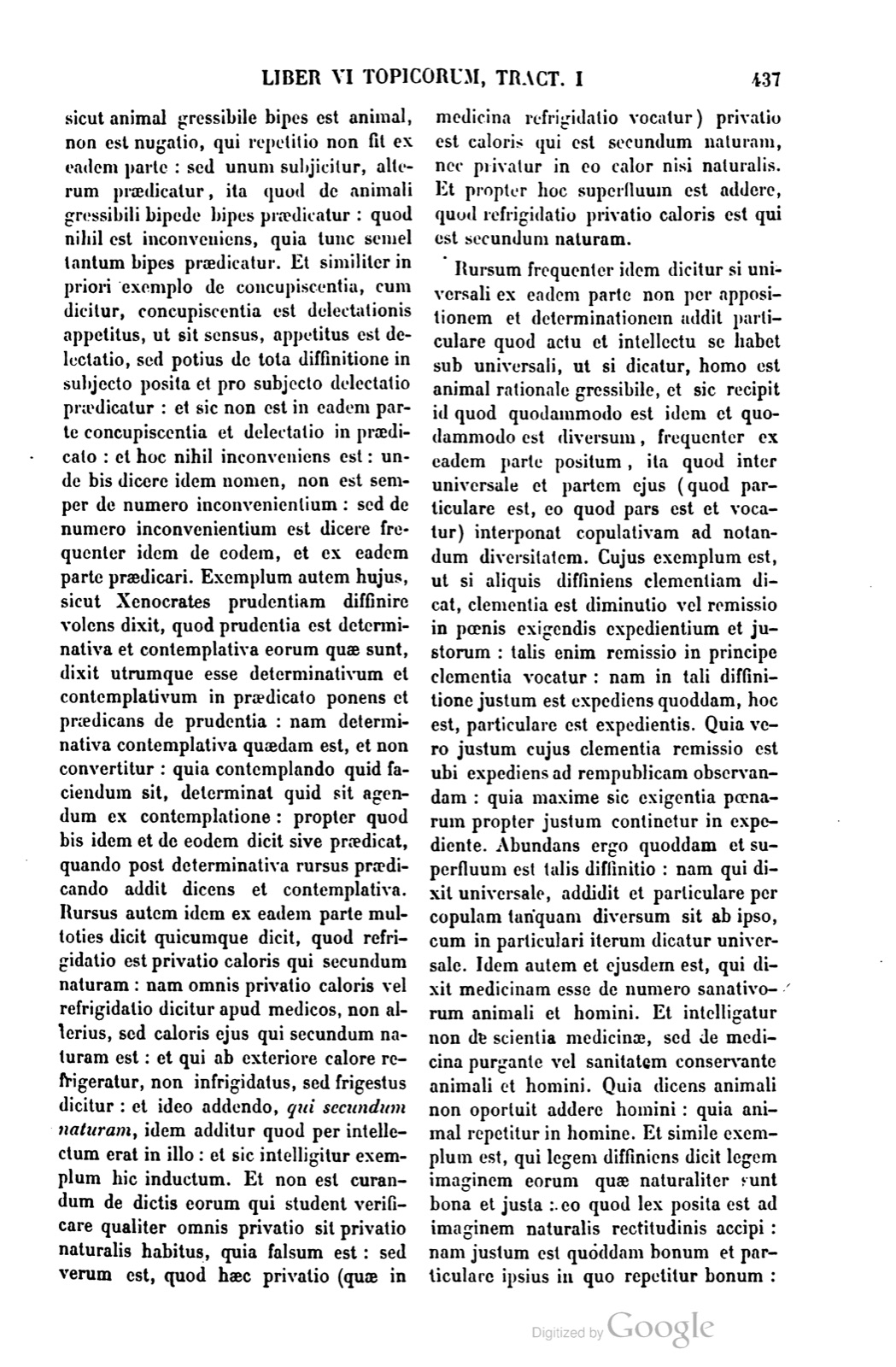
Rursum frequenter idem dicitur si universali ex eadem parte non per appositionem et determinationem addit particulare quod actu et intellectu se habet sub universali, ut si dicatur, homo est animal rationale gressibile, et sic recipit id quod quodammodo est idem et quodammodo est diversum, frequenter ex eadem parte positum, ita quod inter universale et partem ejus, quod particulare est, eo quod pars est et vocatur, interponat copulativam ad notandum diversitatem. Cujus exemplum est, ut si aliquis diffiniens clementiam dicat, clementia est diminutio vel remissio in poenis exigendis expedientium et justorum: talis enim remissio in principe clementia vocatur: nam in tali diffinitione justum est expediens quoddam, hoc est, particulare est expedientis. Quia vero justum cujus clementia remissio est ubi expediens ad rempublicam observandam: quia maxime sic exigentia poenarum propter justum continetur in expediente. Abundans ergo quoddam et superfluum est talis diffinitio: nam qui dixit universale, addidit et particulare per copulam tanquam diversum sit ab ipso, cum in particulari iterum dicatur universale. Idem autem et ejusdem est, qui dixit medicinam esse de numero sanativorum animali et homini. Et intelligatur non de scientia medicinae, sed de medicina purgante vel sanitatem conservante animali et homini. Quia dicens animali non oportuit addere homini: quia animal repetitur in homine. Et simile exemplum est, qui legem diffiniens dicit legem imaginem eorum quae naturaliter sunt bona et justa: eo quod lex posita est ad imaginem naturalis rectitudinis accipi: nam justum est quoddam bonum et particulare ipsius in quo repetitur bonum: et ideo sic diffiniens frequenter idem dixit, et sic contra diffinitionis bonitatem peccavit.
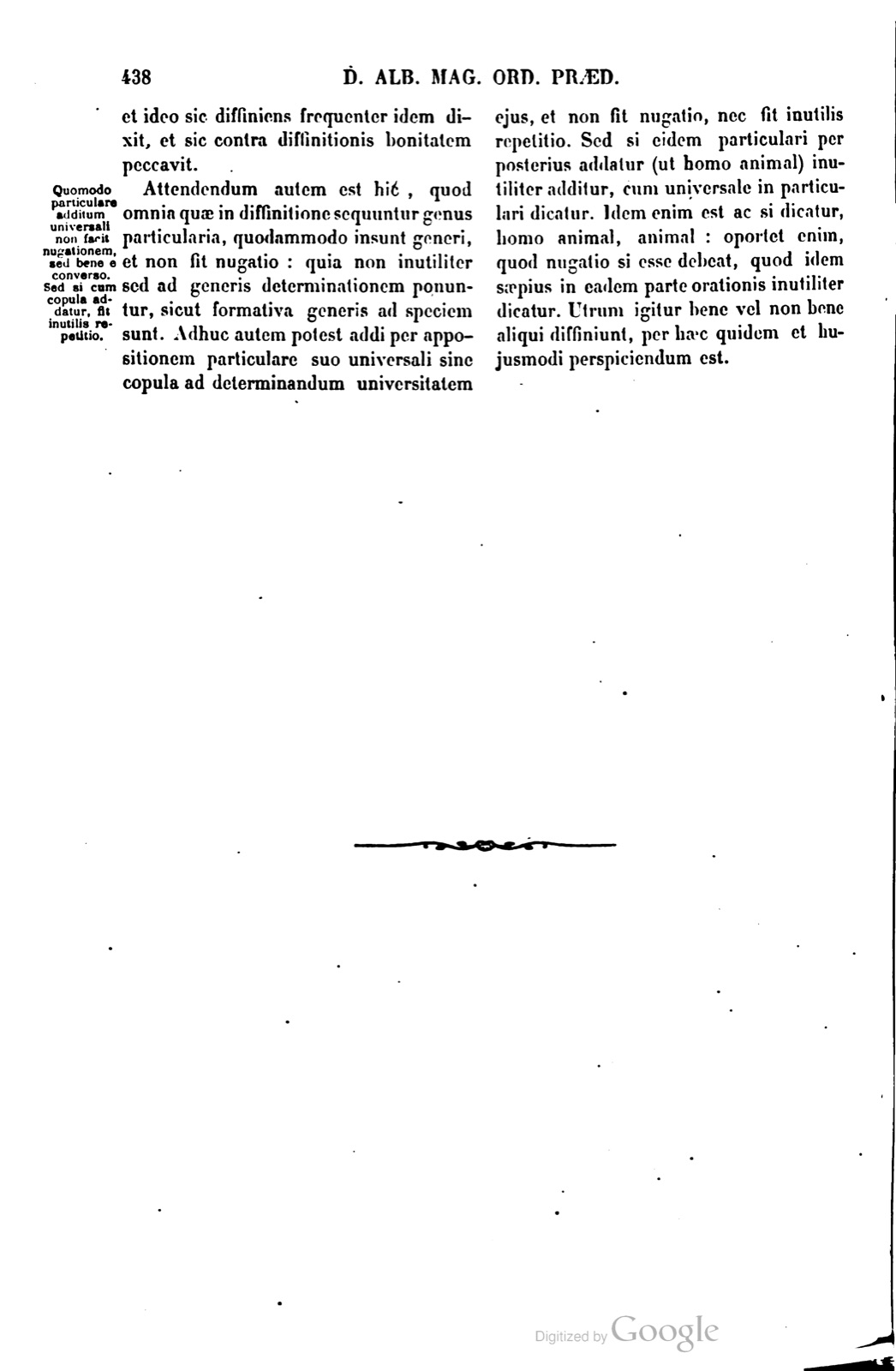
Attendendum autem est hic, quod omnia quae in diffinitione sequuntur genus particularia, quodammodo insunt generi, et non fit nugatio: quia non inutiliter sed ad generis determinationem ponuntur, sicut formativa generis ad speciem sunt. Adhuc autem potest addi per appositionem particulare suo universali sine copula ad determinandum universitatem ejus, et non fit nugatio, nec fit inutilis repetitio. Sed si eidem particulari per posterius addatur, ut homo animal, inutiliter additur, cum universale in particulari dicatur. Idem enim est ac si dicatur, homo animal, animal: oportet enim, quod nugatio si esse debeat, quod idem saepius in eadem parte orationis inutiliter dicatur. Utrum igitur bene vel non bene aliqui diffiniunt, per haec quidem et hujusmodi perspiciendum est.
Again the same thing is frequently said if, to a universal from the same part, one adds not by apposition and determination a particular which in act and in understanding has itself under the universal, as if it is said, man is a rational walkable animal; and thus it receives that which is in some way the same and in some way diverse, frequently posited from the same part, so that between the universal and its part, which is particular because it is and is called a part, he places a copulative to denote diversity. The example of this is if someone defining clemency says: clemency is a diminution or remission in exacting expedient and just punishments. For such remission in a ruler is called clemency; for in such a definition the just is a certain expedient, that is, it is a particular of the expedient. But because the just, of which clemency is a remission, is where the expedient is for preserving the commonwealth, since especially in this way the requirement of punishments on account of the just is contained in the expedient, such a definition is therefore abundant and superfluous; for one who stated the universal added also the particular through a copula as though it were diverse from it, although the universal is again said in the particular. The same thing and of the same thing is also true of one who said medicine to be from the number of things curative for animal and for man. And it should be understood not of the science of medicine, but of medicine purging or preserving health for animal and man. Because one saying animal ought not to add man, since animal is repeated in man. And a similar example is one who, defining law, says that law is an image of those things which are naturally good and just, because positive law is to be taken according to the image of natural rectitude. For the just is a certain good and a particular of that in which good is repeated; and therefore one defining thus frequently said the same thing, and so erred against the goodness of definition.
But it must be noted here that all particulars which follow genus in definition in some way belong to the genus, and trifling is not produced, because they are posited not uselessly but for the determination of the genus, as formative things of the genus toward species. Moreover a particular can be added by apposition to its universal without a copula for determining its universality, and no trifling is produced, nor is useless repetition produced. But if the universal is added later to the same particular, as man, animal, it is uselessly added, since the universal is said in the particular. For it is the same as if it were said: man, animal, animal; for if there is to be trifling, it is necessary that the same thing be said more often uselessly in the same part of the speech. Therefore whether some define well or not well must be inspected through these things and things of this sort.
If a page does not appear, its photograph has not been uploaded yet.