Volume 2 · pp. 431–434
Chapter II. In what ways the goodness of definition is destroyed because it is given through something obscure.
A marker with ≈ is an approximate page boundary, placed by measure of the text; the page photographs remain the authority. In the paired views, clicking a page marker brings that page into view.
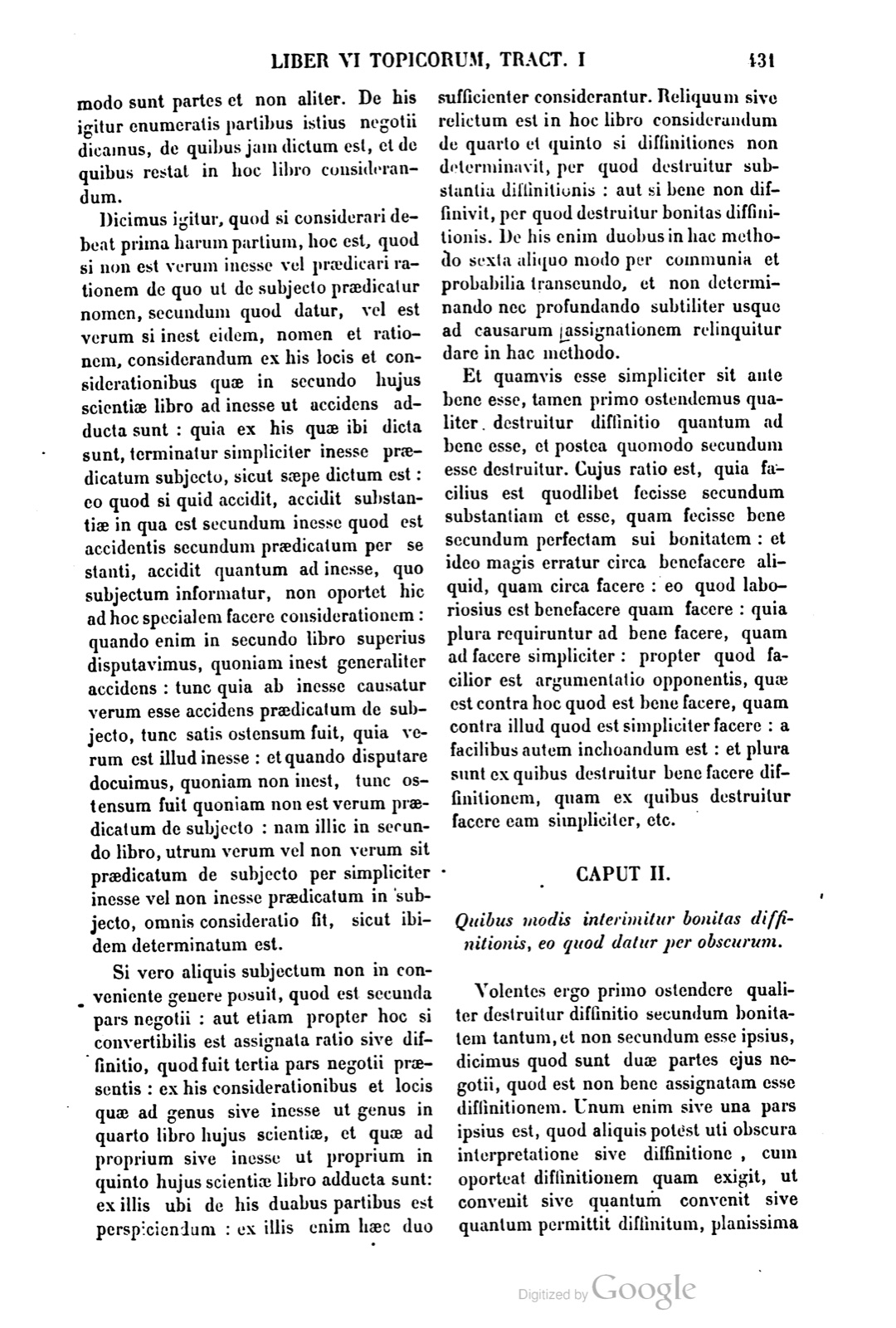
CAPUT II. Quibus modis interimitur bonitas diffinitionis, eo quod datur per obscurum.
Volentes ergo primo ostendere qualiter destruitur diffinitio secundum bonitatem tantum, et non secundum esse ipsius, dicimus quod sunt duae partes ejus negotii, quod est non bene assignatam esse diffinitionem. Unum enim sive una pars ipsius est, quod aliquis potest uti obscura interpretatione sive diffinitione, cum oporteat diffinitionem quam exigit, ut convenit sive quantum convenit sive quantum permittit diffinitum, planissima uti interpretatione. Dico vero convenit: quia, ut dicit Boetius, quod sicut intelligibilia propter sui excellentiam perfecto intellectu non capiuntur, ut perfecta interpretatione explanentur, ut causa prima a qua deficiunt linguae propter excellentiam esse ipsius: quaedam autem propter sui imperfectionem non perfecte intelliguntur, nec perfecte explanantur, ut materia prima, et motus, et tempus 1: sed cum in his ponitur explanatio quae fieri potest, planissima interpretatione utendum est: ideo quod innotescendi causa redditur diffinitio, et quando non facit innotescere diffinitum, caret bonitate finis sui, propter quod et ad quem assignatur.
Secundus autem modus peccandi contra bonitatem diffinitionis, si amplius dixerit diffinitionem per comparationem superflui quam oportuit: nam quod appositum est in diffinitione ultra esse diffiniti, superfluum est. Appositum autem est superfluum quod non est in esse diffiniti. Et hoc verum est de diffinitione dicente quid tantum, quia diffinitio ista dialectica est: quia quae dicit quid et propter quid, ad demonstratorem pertinet: et ideo quia ipse considerat causam quare passio inest subjecto, potius quam quid est passio, non est superfluum in illa diffinitione apponere causam quae non est de esse passionis.
Rursum autem quod in utrisque illis partibus prima etiam et secunda dictum est, in plures dividitur partes: obscurum enim dividitur in obscurum ex multiplicitate sermonis, et obscurum ex translatione dictum, et in hoc quod in resecatis sermonibus explicatur vel exponitur. Obscurum enim ex multiplici est, ut sit aliquid aequivocum quod in diffinitione ponitur, sicut qui diffinit generationem dicens, quod generatio est ductio in substantiam sive in esse substantiale. Omnia enim nomina in tio desinentia verbalia aequivoca sunt ad actionem agentis et passionem patientis. Unde ductio cum sit ducentis, actio est: et ductio ducti, passio. Hoc modo obscura est diffinitio quando diffinitur sanitas dicendo, quod sanitas est commensuratio calidorum, siccorum, frigidorum, et humidorum, e converso: cum enim est et ductio et commensuratio propter causam quae dicta est. Incertum ergo est utrum signatorum in aequivocatione positum in diffinitione velit dicere quando tale aequivocum ponit, et dividens per distinctionem multiplicis non dixit in quo sensu accipiat in diffinitione positum.
CHAPTER II. In what ways the goodness of definition is destroyed because it is given through something obscure.
Therefore, wishing first to show how definition is destroyed according to goodness only, and not according to its being, we say that there are two parts of that business which is that a definition has not been well assigned. For one, or one part of it, is that someone can use an obscure interpretation or definition, when the definition which he asks for must use the plainest interpretation, as is fitting, or as much as is fitting, or as much as the defined thing permits. I say "is fitting" because, as Boethius says, just as intelligible things on account of their excellence are not grasped by a perfect intellect so as to be explained by a perfect interpretation, as the first cause from which tongues fall short on account of the excellence of its being, while certain things on account of their imperfection are not perfectly understood nor perfectly explained, as prime matter, motion, and time 1, nevertheless, when in these things the explanation which can be made is posited, the plainest interpretation must be used. Therefore, because definition is rendered for the sake of making known, when it does not make the defined thing known, it lacks the goodness of its end, on account of which and toward which it is assigned.
But the second mode of erring against the goodness of definition is if he says more in the definition by way of comparison with what is superfluous than he ought. For what is appended in the definition beyond the being of the defined thing is superfluous. But an appended thing is superfluous when it is not in the being of the defined thing. And this is true of a definition that says what alone, because this definition is dialectical; for that which says what and on account of what belongs to the demonstrator. And therefore, because he considers the cause why the passion belongs to the subject rather than what the passion is, in that definition it is not superfluous to append the cause which is not of the being of the passion.
Again, what was said in both of those parts, the first and also the second, is divided into several parts. For the obscure is divided into the obscure from multiplicity of speech, and the obscure said from transfer, and into this, that it is explained or expounded in cut-off speeches. For the obscure from the multiple occurs when something equivocal is placed in the definition, as one who defines generation by saying that generation is a leading into substance or into substantial being. For all names ending in -tio are verbal equivocals with respect to the action of the agent and the passion of the patient. Hence leading, when it belongs to the one leading, is action; and the leading of the one led is passion. In this way a definition is obscure when health is defined by saying that health is a commensuration of hot, dry, cold, and wet things, and conversely, since both leading and commensuration exist on account of the cause which has been stated. Therefore it is uncertain which of the signified things posited in equivocation he means to state in the definition when he posits such an equivocal term, and by dividing through distinction of the multiple he has not said in what sense he takes the thing posited in the definition.
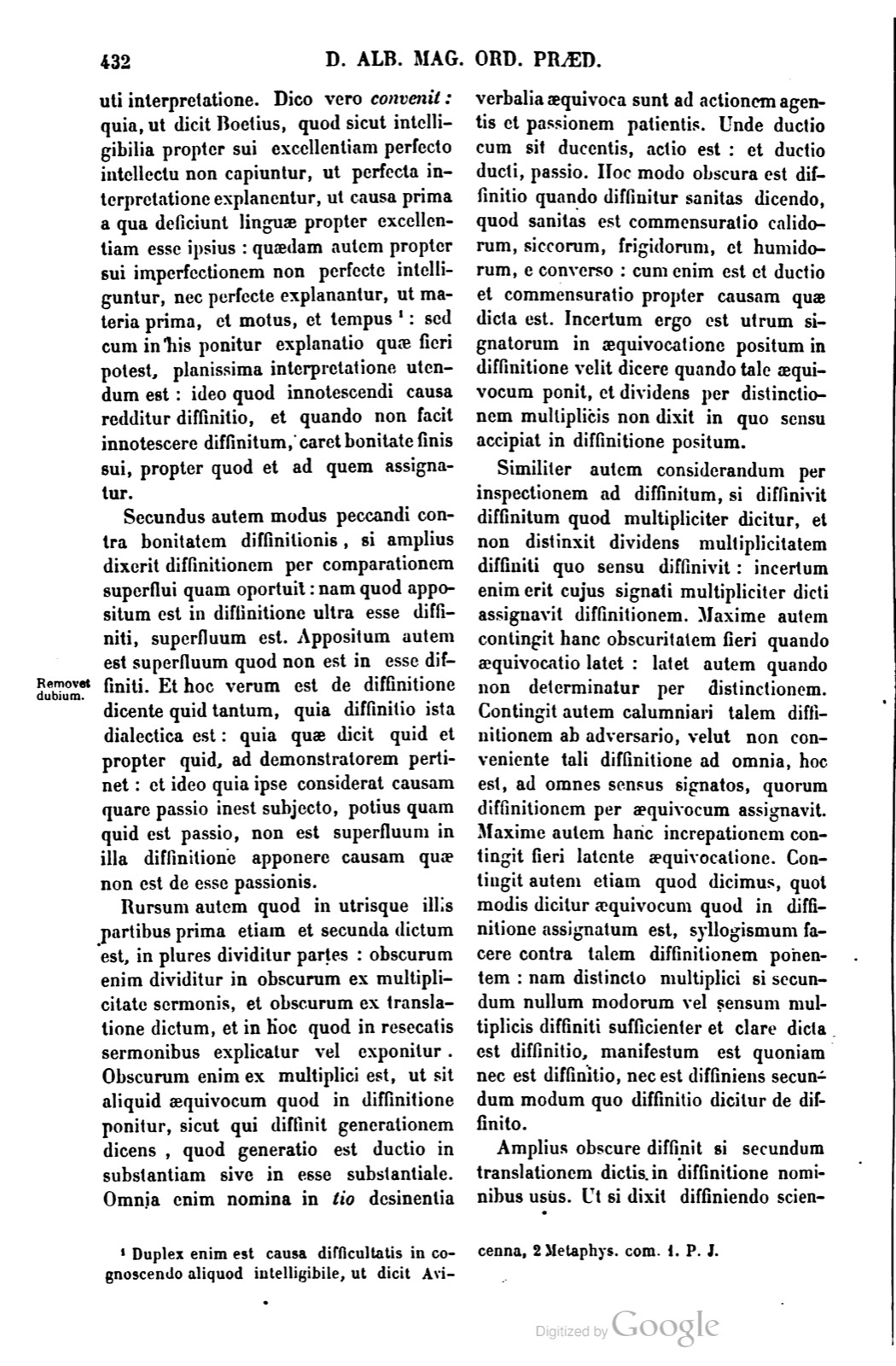
Similiter autem considerandum per inspectionem ad diffinitum, si diffinivit diffinitum quod multipliciter dicitur, et non distinxit dividens multiplicitatem diffiniti quo sensu diffinivit: incertum enim erit cujus signati multipliciter dicti assignavit diffinitionem. Maxime autem contingit hanc obscuritatem fieri quando aequivocatio latet: latet autem quando non determinatur per distinctionem. Contingit autem calumniari talem diffinitionem ab adversario, velut non conveniente tali diffinitione ad omnia, hoc est, ad omnes sensus signatos, quorum diffinitionem per aequivocum assignavit. Maxime autem hanc increpationem contingit fieri latente aequivocatione. Contingit autem etiam quod dicimus, quot modis dicitur aequivocum quod in diffinitione assignatum est, syllogismum facere contra talem diffinitionem ponentem: nam distincto multiplici si secundum nullum modorum vel sensum multiplicis diffiniti sufficienter et clare dicta est diffinitio, manifestum est quoniam nec est diffinitio, nec est diffiniens secundum modum quo diffinitio dicitur de diffinito.
Amplius obscure diffinit si secundum translationem dictis, in diffinitione nominibus usus. Ut si dixit diffiniendo scientiam incadibilem: aut terram diffiniens, dicat nutricem: aut temperantiam diffiniens, dixit consonantiam esse: quia quod secundum translationem dicitur, incertum esse dicitur, quia nescitur qua similitudine transferatur: et ideo contingit calumniari eum qui secundum translationem dicit diffiniendo aliquid, velut improprie dando diffinitionem: non enim ad diffinitum proprie sumptis terminis aptabitur dicta diffinitio: cum enim dicat temperantiam esse consonantiam, proprie adaptari non potest, quia omnis consonantia proprie dicta est in sonis. Amplius autem alia ratio ejusdem est, quod tale diffinitum in duplici ponitur genere, si genus temperantiae dicatur consonantia: propterea continget idem esse in duobus generibus non continentibus se invicem, hoc est, non subalternatim positis. Temperantia enim constat, quod est in genere virtutis, et est in genere consonantiae: cum nec consonantia contineat sub se virtutem, neque virtus proprie contineat consonantiam. Hoc autem inconveniens est, quia diversorum generum et non subalternatim positorum diversae sunt species et differentiae.
Likewise, one must consider by inspection toward the defined thing, if he has defined a defined thing which is said in many ways, and by dividing the multiplicity of the defined thing he has not distinguished in what sense he has defined it; for it will be uncertain of which signified thing said in many ways he assigned the definition. But this obscurity especially happens when the equivocation is hidden; and it is hidden when it is not determined through distinction. But it happens that such a definition is cavilled at by the adversary, as though such a definition does not fit all things, that is, all the signified senses, whose definition he assigned through an equivocal. This rebuke especially happens when the equivocation is hidden. It also happens that, in the ways we state an equivocal term which has been assigned in a definition is said, one makes a syllogism against one positing such a definition; for when the multiple has been distinguished, if according to none of the modes or senses of the multiple defined thing has the definition been sufficiently and clearly stated, it is manifest that it is neither a definition nor defining according to the mode in which definition is said of the defined thing.
Furthermore, he defines obscurely if he uses in the definition names said according to transfer. For example, if in defining knowledge he called it unfalling, or defining earth he called it nurse, or defining temperance he said that it is consonance; because what is said according to transfer is said to be uncertain, since it is not known by what likeness it is transferred. And therefore it happens that the one who says something according to transfer in defining is cavilled at, as though giving the definition improperly; for the stated definition will not be fitted to the defined thing by terms taken properly. For when he says that temperance is consonance, it cannot properly be adapted, because every consonance properly so called is in sounds. Furthermore, another reason for the same point is that such a defined thing is placed in a double genus, if consonance is called the genus of temperance; on account of this it will happen that the same thing is in two genera not containing one another, that is, not posited subalternately. For it is agreed that temperance is in the genus of virtue and is in the genus of consonance, although neither does consonance contain virtue under itself, nor does virtue properly contain consonance. But this is unsuitable, because of diverse genera not posited subalternately, the species and differences are diverse.
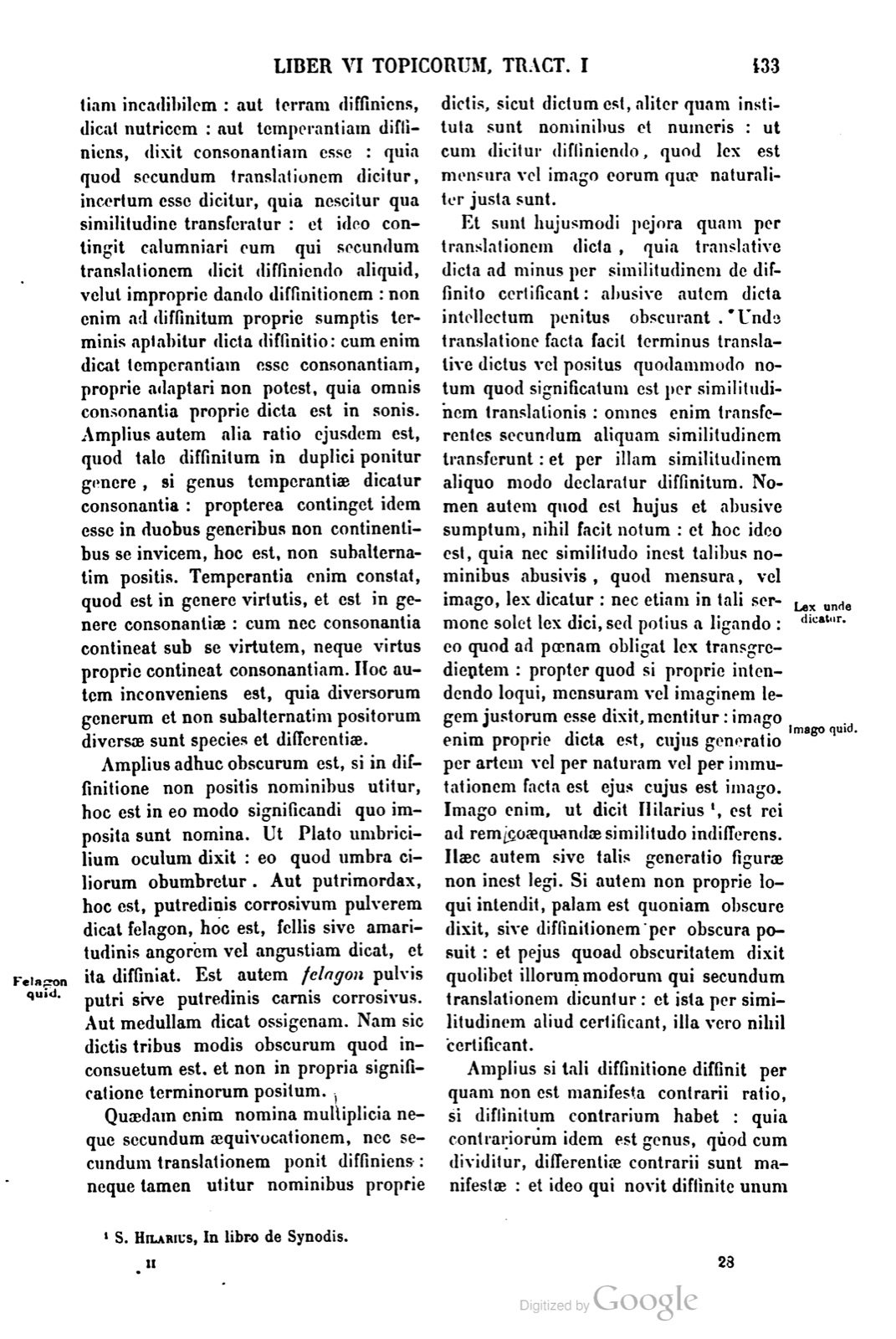
Amplius adhuc obscurum est, si in diffinitione non positis nominibus utitur, hoc est in eo modo significandi quo imposita sunt nomina. Ut Plato umbricilium oculum dixit: eo quod umbra ciliorum obumbretur. Aut putrimordax, hoc est, putredinis corrosivum pulverem dicat felagon, hoc est, fellis sive amaritudinis angorem vel angustiam dicat, et ita diffiniat. Est autem felagon pulvis putri sive putredinis carnis corrosivus. Aut medullam dicat ossigenam. Nam sic dictis tribus modis obscurum quod inconsuetum est, et non in propria significatione terminorum positum.
Quaedam enim nomina multiplicia neque secundum aequivocationem, nec secundum translationem ponit diffiniens: neque tamen utitur nominibus proprie dictis, sicut dictum est, aliter quam instituta sunt nominibus et numeris: ut cum dicitur diffiniendo, quod lex est mensura vel imago eorum quae naturaliter justa sunt.
Et sunt hujusmodi pejora quam per translationem dicta, quia translative dicta ad minus per similitudinem de diffinito certificant: abusive autem dicta intellectum penitus obscurant. Unde translatione facta facit terminus translative dictus vel positus quodammodo notum quod significatum est per similitudinem translationis: omnes enim transferentes secundum aliquam similitudinem transferunt: et per illam similitudinem aliquo modo declaratur diffinitum. Nomen autem quod est hujus et abusive sumptum, nihil facit notum: et hoc ideo est, quia nec similitudo inest talibus nominibus abusivis, quod mensura, vel imago, lex dicatur: nec etiam in tali sermone solet lex dici, sed potius a ligando: eo quod ad poenam obligat lex transgredientem: propter quod si proprie intendendo loqui, mensuram vel imaginem legem justorum esse dixit, mentitur: imago enim proprie dicta est, cujus generatio per artem vel per naturam vel per immutationem facta est ejus cujus est imago. Imago enim, ut dicit Hilarius 2, est rei ad rem icoaequandae similitudo indifferens. Haec autem sive talis generatio figurae non inest legi. Si autem non proprie loqui intendit, palam est quoniam obscure dixit, sive diffinitionem per obscura posuit: et pejus quoad obscuritatem dixit quolibet illorum modorum qui secundum translationem dicuntur: et ista per similitudinem aliud certificant, illa vero nihil certificant.
Moreover it is still obscure if in a definition he uses names not posited, that is, not in that mode of signifying according to which names have been imposed. Thus Plato called the eye an umbricilium, because it is overshadowed by the shadow of the eyelashes. Or he may call a putrid-biting thing, that is, a powder corrosive of putrefaction, felagon, that is, he may call it a grief or constriction of gall or bitterness, and thus define it. But felagon is a powder corrosive of putrid or putrefying flesh. Or he may call marrow bone-born. For in these three ways as stated, what is unusual and not posited in the proper signification of the terms is obscure.
For certain multiple names are posited by the one defining neither according to equivocation nor according to transfer; and nevertheless he does not use the names properly said, as has been said, but otherwise than they have been established by names and numbers; as when it is said in defining that law is the measure or image of those things which are naturally just.
And things of this sort are worse than things said through transfer, because things said by transfer at least certify something about the defined thing through likeness; but things said abusively utterly obscure the understanding. Hence, once transfer has been made, the term said or posited by transfer makes known in some way what has been signified through the likeness of the transfer; for all who transfer, transfer according to some likeness, and through that likeness the defined thing is in some way declared. But the name which is of this sort and abusively taken makes nothing known; and this is because no likeness belongs to such abusive names, so that law would be called measure or image; nor is law usually said in such speech, but rather from binding, because law binds the transgressor to punishment. On account of this, if, intending to speak properly, he said that law is the measure or image of just things, he lies; for an image properly so called is that whose generation by art or by nature or by alteration has been made of that of which it is the image. For image, as Hilary says 2, is an indifferent likeness of a thing to a thing to be made equal. But this, or such a generation of a figure, does not belong to law. But if he does not intend to speak properly, it is plain that he spoke obscurely, or posited the definition through obscure things; and with respect to obscurity he spoke worse than any of those modes which are said according to transfer, for those certify something else through likeness, but these certify nothing.
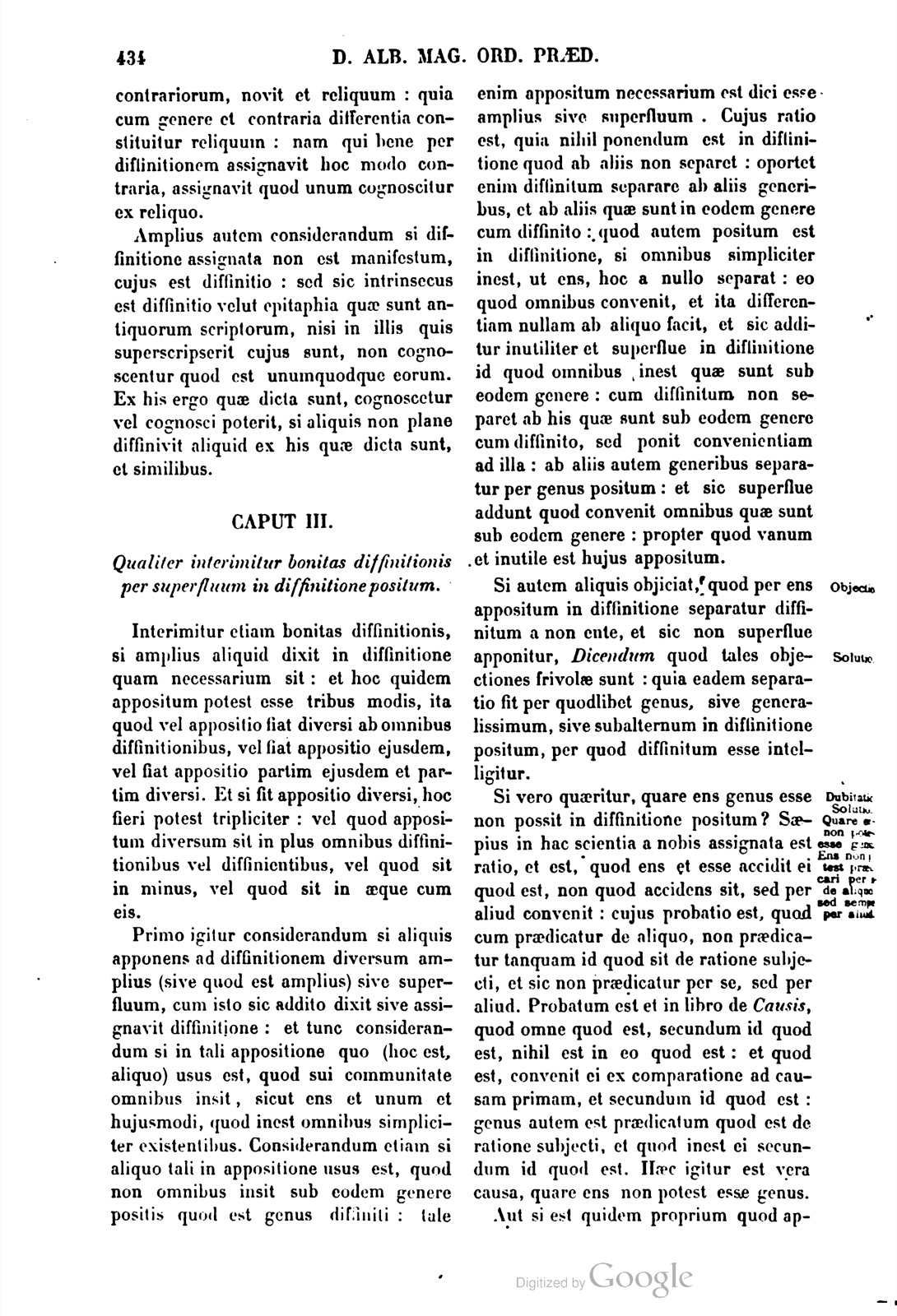
Amplius si tali diffinitione diffinit per quam non est manifesta contrarii ratio, si diffinitum contrarium habet: quia contrariorum idem est genus, quod cum dividitur, differentiae contrarii sunt manifestae: et ideo qui novit diffinite unum contrariorum, novit et reliquum: quia cum genere et contraria differentia constituitur reliquum: nam qui bene per diffinitionem assignavit hoc modo contraria, assignavit quod unum cognoscitur ex reliquo.
Amplius autem considerandum si diffinitione assignata non est manifestum, cujus est diffinitio: sed sic intrinsecus est diffinitio velut epitaphia quae sunt antiquorum scriptorum, nisi in illis quis superscripserit cujus sunt, non cognoscentur quod est unumquodque eorum. Ex his ergo quae dicta sunt, cognoscetur vel cognosci poterit, si aliquis non plane diffinivit aliquid ex his quae dicta sunt, et similibus.
Furthermore, if he defines by such a definition through which the account of the contrary is not manifest, if the defined thing has a contrary, this is obscure; because contraries have the same genus, and when that genus is divided, the differences of the contrary are manifest. And therefore one who knows one of the contraries definitively also knows the remaining one, because with the genus and the contrary difference the remaining one is constituted. For one who has well assigned contraries by definition in this way has assigned that one is known from the other.
Furthermore, one must consider whether, once a definition has been assigned, it is not manifest whose definition it is; but the definition is thus inwardly like the epitaphs of ancient writers, unless someone has written over them whose they are, it will not be known what each of them is. Therefore from the things that have been said it will be known, or will be able to be known, whether someone has not plainly defined something from the things that have been said and similar things.
Notes
- For there is a twofold cause of difficulty in knowing some intelligible thing, as Avicenna says, Metaphysics 2, commentary 1. P. J. (Duplex enim est causa difficultatis in cognoscendo aliquod intelligibile, ut dicit Avicenna, 2 Metaphys. com. 1. P. J.) ↩
- Saint Hilary, in the book On Synods. (S. Hilarius, In libro de Synodis.) ↩
If a page does not appear, its photograph has not been uploaded yet.