Volume 2 · pp. 424–425
Chapter IV. On the determination of property through the place from the similar.
A marker with ≈ is an approximate page boundary, placed by measure of the text; the page photographs remain the authority. In the paired views, clicking a page marker brings that page into view.
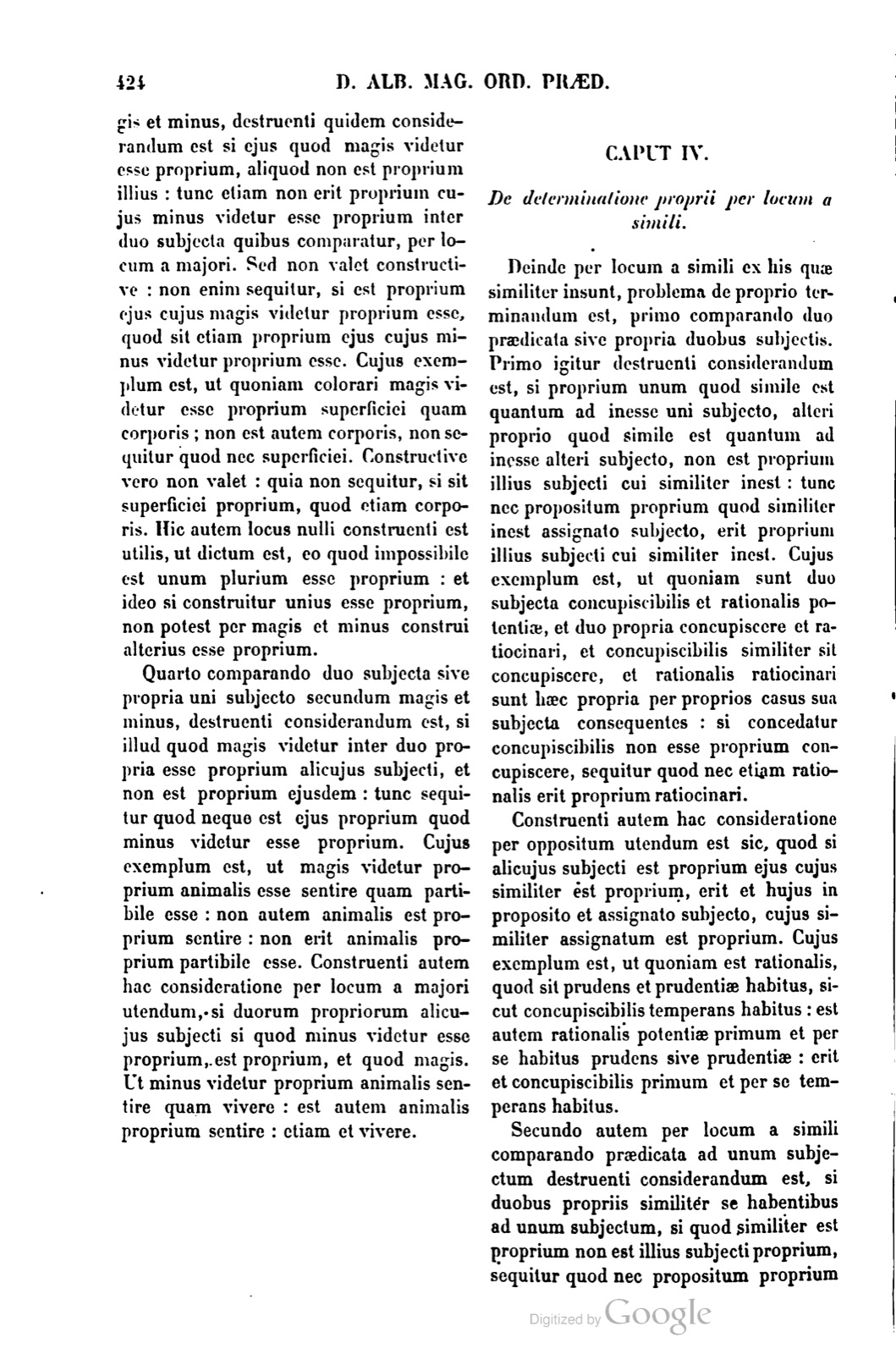
CAPUT IV. De determinatione proprii per locum a simili.
Deinde per locum a simili ex his quae similiter insunt, problema de proprio terminandum est, primo comparando duo praedicata sive propria duobus subjectis. Primo igitur destruenti considerandum est, si proprium unum quod simile est quantum ad inesse uni subjecto, alteri proprio quod simile est quantum ad inesse alteri subjecto, non est proprium illius subjecti cui similiter inest: tunc nec propositum proprium quod similiter inest assignato subjecto, erit proprium illius subjecti cui similiter inest. Cujus exemplum est, ut quoniam sunt duo subjecta concupiscibilis et rationalis potentiae, et duo propria concupiscere et ratiocinari, et concupiscibilis similiter sit concupiscere, et rationalis ratiocinari sunt haec propria per proprios casus sua subjecta consequentes: si concedatur concupiscibilis non esse proprium concupiscere, sequitur quod nec etiam rationalis erit proprium ratiocinari.
Construenti autem hac consideratione per oppositum utendum est sic, quod si alicujus subjecti est proprium ejus cujus similiter est proprium, erit et hujus in proposito et assignato subjecto, cujus similiter assignatum est proprium. Cujus exemplum est, ut quoniam est rationalis, quod sit prudens et prudentiae habitus, sicut concupiscibilis temperans habitus: est autem rationalis potentiae primum et per se habitus prudens sive prudentiae: erit et concupiscibilis primum et per se temperans habitus.
Secundo autem per locum a simili comparando praedicata ad unum subjectum destruenti considerandum est, si duobus propriis similiter se habentibus ad unum subjectum, si quod similiter est proprium non est illius subjecti proprium, sequitur quod nec propositum proprium quod similiter videtur esse proprium, erit proprium. Ut gratia exempli, quoniam similiter est hominis proprium videre et audire; non est hominis proprium videre, sequitur quod nec audire.
CHAPTER IV. On the determination of property through the place from the similar.
Next, through the place from the similar, from those things which belong similarly, the problem concerning property must be determined, first by comparing two predicates or properties to two subjects. Therefore first, one who is destroying must consider whether one property, which is similar as regards belonging to one subject, to another property, which is similar as regards belonging to another subject, is not the property of that subject to which it similarly belongs; then neither will the proposed property which similarly belongs to the assigned subject be the property of that subject to which it similarly belongs. The example of this is that there are two subjects, the concupiscible and rational power, and two properties, desiring and reasoning; and for the concupiscible, similarly, there is desiring, and for the rational there is reasoning; these are properties following their subjects through their proper cases. If it is conceded that desiring is not the property of the concupiscible, it follows that reasoning also will not be the property of the rational.
But one who is constructing must use this consideration through opposition thus: that if the property of some subject is the property of that of which it is similarly the property, it will also be the property of this in the proposed and assigned subject, of which the property has similarly been assigned. The example of this is that it belongs to the rational that it is prudent and the habit of prudence, just as the concupiscible is a tempering habit; but the first and through itself habit of the rational power is prudent or of prudence; therefore the first and through itself habit of the concupiscible will also be tempering.
Secondly, through the place from the similar, by comparing predicates to one subject, one who is destroying must consider whether, with two properties similarly related to one subject, if what is similarly a property is not the property of that subject, it follows that neither will the proposed property, which similarly seems to be a property, be a property. For the sake of example, since seeing and hearing are similarly properties of man, and seeing is not the property of man, it follows that neither is hearing.
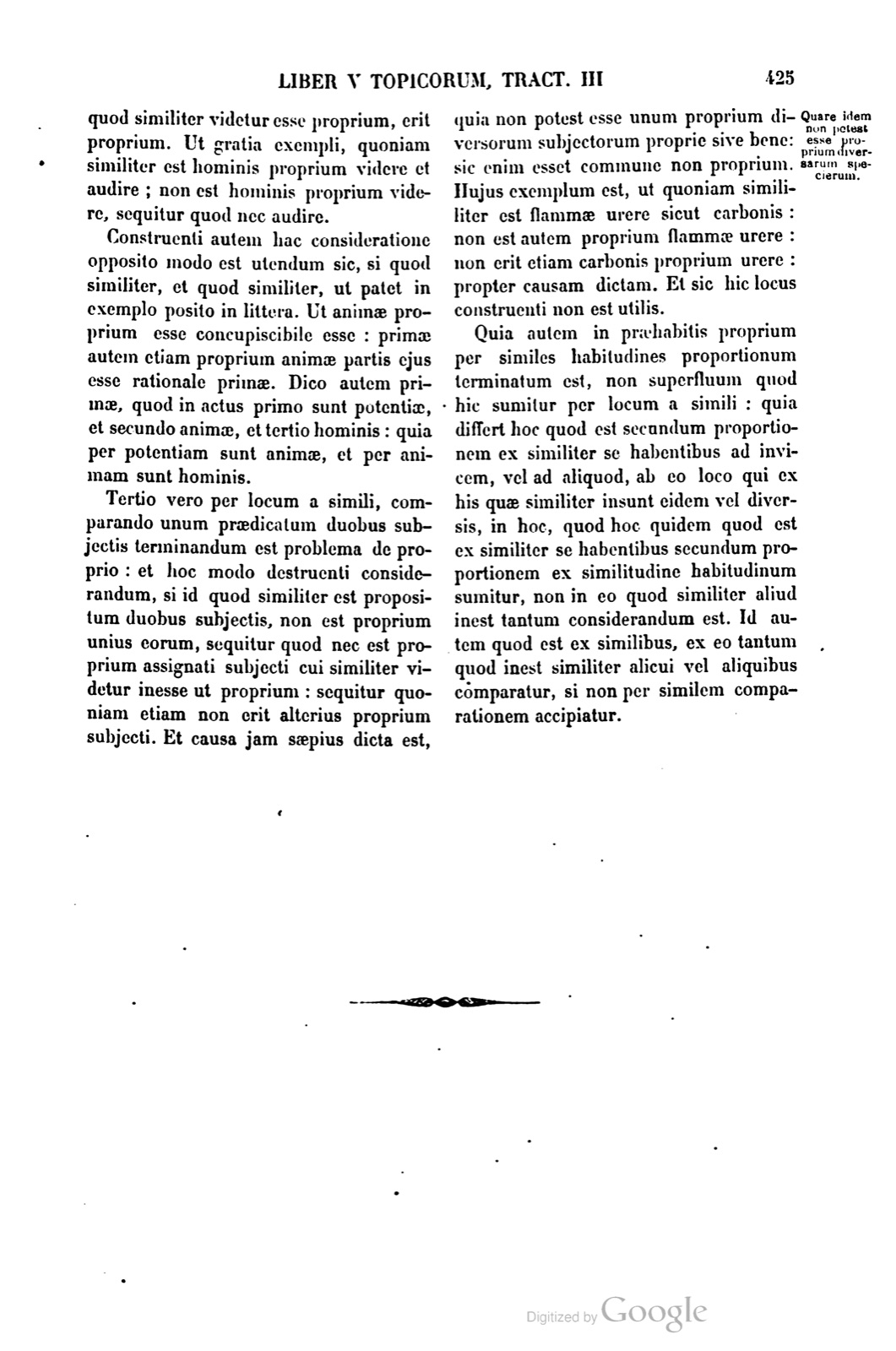
Construenti autem hac consideratione opposito modo est utendum sic, si quod similiter, et quod similiter, ut patet in exemplo posito in littera. Ut animae proprium esse concupiscibile esse: primae autem etiam proprium animae partis ejus esse rationale primae. Dico autem primae, quod in actus primo sunt potentiae, et secundo animae, et tertio hominis: quia per potentiam sunt animae, et per animam sunt hominis.
Tertio vero per locum a simili, comparando unum praedicatum duobus subjectis terminandum est problema de proprio: et hoc modo destruenti considerandum, si id quod similiter est propositum duobus subjectis, non est proprium unius eorum, sequitur quod nec est proprium assignati subjecti cui similiter videtur inesse ut proprium: sequitur quoniam etiam non erit alterius proprium subjecti. Et causa jam saepius dicta est, quia non potest esse unum proprium diversorum subjectorum proprie sive bene: sic enim esset commune non proprium. Hujus exemplum est, ut quoniam similiter est flammae urere sicut carbonis: non est autem proprium flammae urere: non erit etiam carbonis proprium urere: propter causam dictam. Et sic hic locus construenti non est utilis.
Quia autem in praehabitis proprium per similes habitudines proportionum terminatum est, non superfluum quod hic sumitur per locum a simili: quia differt hoc quod est secundum proportionem ex similiter se habentibus ad invicem, vel ad aliquod, ab eo loco qui ex his quae similiter insunt eidem vel diversis, in hoc, quod hoc quidem quod est ex similiter se habentibus secundum proportionem ex similitudine habitudinum sumitur, non in eo quod similiter aliud inest tantum considerandum est. Id autem quod est ex similibus, ex eo tantum quod inest similiter alicui vel aliquibus comparatur, si non per similem comparationem accipiatur.
But one who is constructing must use this consideration in the opposite way thus, if what is similar, and what is similar, as is clear in the example posited in the text. As, for the soul, to be concupiscible is a property; and also for the first part of the soul, to be rational belongs to the first. But I say "first" because in first act there are powers, in second act there are powers of the soul, and in third act of man; because through power they belong to the soul, and through the soul they belong to man.
Thirdly, through the place from the similar, by comparing one predicate to two subjects, the problem concerning property must be determined. And in this way one who is destroying must consider whether that which is similarly proposed to two subjects is not the property of one of them; it follows that neither is it the property of the assigned subject to which it seems similarly to belong as a property; for it follows that it will not be the property of the other subject either. And the cause, already stated rather often, is that one property cannot properly or well belong to diverse subjects; for in that way it would be common, not proper. The example of this is that burning belongs similarly to flame as to coal; but burning is not the property of flame; therefore burning will also not be the property of coal, on account of the stated cause. And thus this place is not useful to one constructing.
But because in the foregoing the property has been determined through similar relations of proportions, what is taken here through the place from the similar is not superfluous; because that which is according to proportion from things having themselves similarly toward each other, or toward something, differs from that place which is from those things which similarly belong to the same or to diverse things, in this: that what is from things having themselves similarly according to proportion is taken from the likeness of relations, and must not be considered only in that another thing similarly belongs. But what is from similars is compared only from this, that it belongs similarly to someone or to several, if it is not taken through a similar comparison.
If a page does not appear, its photograph has not been uploaded yet.