Volume 2 · pp. 422–424
Chapter III. On considerations taken from the greater and the lesser, for determining the problem concerning property.
A marker with ≈ is an approximate page boundary, placed by measure of the text; the page photographs remain the authority. In the paired views, clicking a page marker brings that page into view.
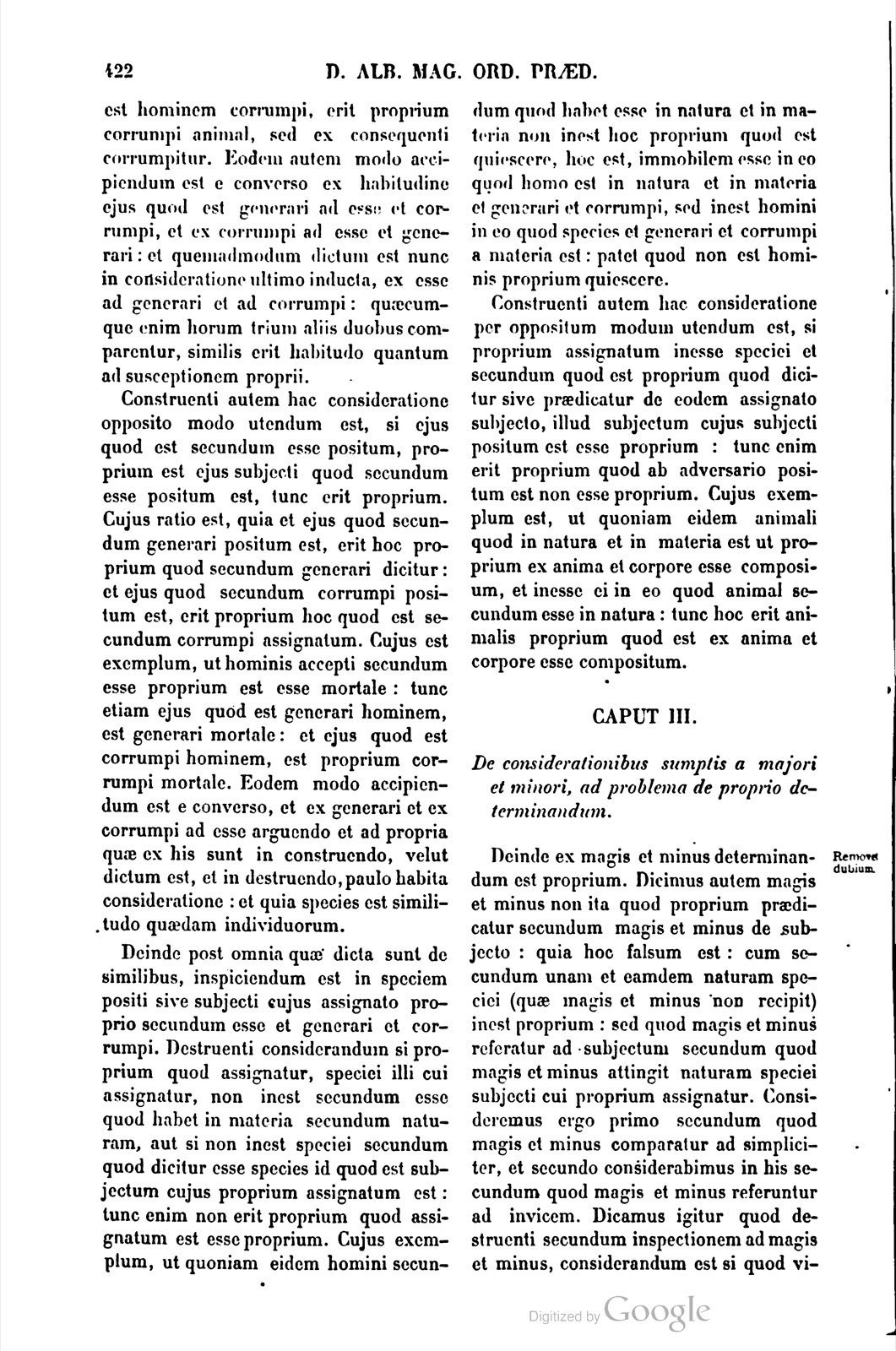
CAPUT III. De considerationibus sumptis a majori et minori, ad problema de proprio determinandum.
Deinde ex magis et minus determinandum est proprium. Dicimus autem magis et minus non ita quod proprium praedicatur secundum magis et minus de subjecto: quia hoc falsum est: cum secundum unam et eamdem naturam speciei, quae magis et minus non recipit, inest proprium: sed quod magis et minus referatur ad subjectum secundum quod magis et minus attingit naturam speciei subjecti cui proprium assignatur. Consideremus ergo primo secundum quod magis et minus comparatur ad simpliciter, et secundo considerabimus in his secundum quod magis et minus referuntur ad invicem. Dicamus igitur quod destruenti secundum inspectionem ad magis et minus, considerandum est si quod videtur esse proprium ejus quod est magis, et videtur magis esse subjectum, non est proprium, neque quod minus est et videtur esse proprium, erit proprium ejus quod minime videtur esse subjectum: neque quod maxime videtur esse proprium ejus quod maxime videtur esse subjectum, erit proprium: tunc neque quod simpliciter ejus quod simpliciter dicitur esse subjectum. Cujus exemplum est, ut quoniam id quod est magis colorari ejus quod magis dicitur esse subjectum ut corporis quod magis dicitur esse corpus, non est proprium: neque colorari omnino et simpliciter erit proprium ejus quod est simpliciter corpus et omnino.
Construenti autem hac consideratione per oppositum modum utendum est, quod si quod magis videtur esse proprium ejus quod magis videtur esse subjectum, est proprium, sequitur etiam quod id quod minus videtur esse proprium ejus quod minus videtur esse subjectum, est proprium: et quod minime videtur esse proprium, erit proprium ejus quod minime videtur esse subjectum, et quod maxime est proprium ejus quod maxime, et quod simpliciter proprium est ejus quod simpliciter. Cujus exemplum, ut quod magis viventis videtur esse proprium id quod est magis sentire, et minus viventis videtur esse proprium quod est minus sentire, et quod est maxime sentiens proprium est ejus quod maxime vivens, et ejus quod simpliciter proprium est quod simpliciter sentiens.
CHAPTER III. On considerations taken from the greater and the lesser, for determining the problem concerning property.
Next, property must be determined from more and less. But we say more and less not in such a way that property is predicated of the subject according to more and less, because this is false, since the property belongs according to one and the same nature of the species, which does not receive more and less; but in such a way that more and less is referred to the subject according as it attains more and less the nature of the species of the subject to which the property is assigned. Therefore let us consider first according as more and less is compared to simply, and secondly we shall consider in these according as more and less are referred to each other. Therefore let us say that, for one who is destroying according to inspection toward more and less, one must consider whether what seems to be the property of that which is more, and seems more to be the subject, is not a property; neither will what is less and seems to be a property be the property of that which seems least to be the subject; nor will what seems most to be the property of that which seems most to be the subject be a property; then neither will what is simply be the property of that which is simply said to be the subject. The example of this is that since that which is to be more colored, of that which is more said to be a subject, as of body which is more said to be body, is not a property, neither will to be colored wholly and simply be the property of that which is body simply and wholly.
But one who is constructing must use this consideration by the opposite mode: that if what seems more to be the property of that which seems more to be the subject is a property, it also follows that what seems less to be the property of that which seems less to be the subject is a property; and what seems least to be a property will be the property of that which seems least to be the subject, and what is most will be the property of what is most, and what is simply property will be the property of what is simply. An example is that of the more living, what seems to be the property is what is more sensing, and of the less living, what seems to be the property is what is less sensing, and what is most sensing is the property of what is most living, and of what is simply, the property is what is simply sensing.
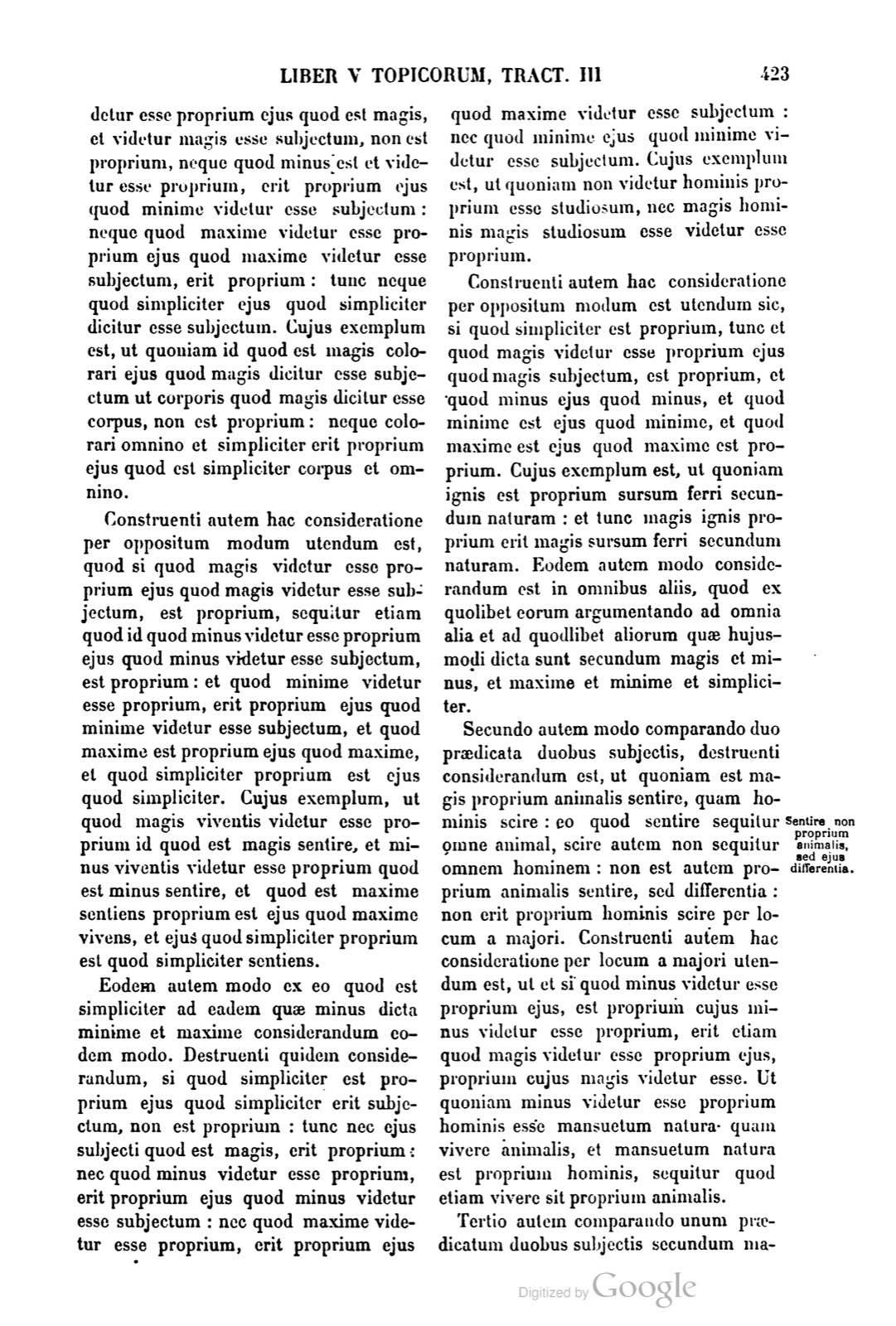
Eodem autem modo ex eo quod est simpliciter ad eadem quae minus dicta minime et maxime considerandum eodem modo. Destruenti quidem considerandum, si quod simpliciter est proprium ejus quod simpliciter erit subjectum, non est proprium: tunc nec ejus subjecti quod est magis, erit proprium: nec quod minus videtur esse proprium, erit proprium ejus quod minus videtur esse subjectum: nec quod maxime videtur esse proprium, erit proprium ejus quod maxime videtur esse subjectum: nec quod minime ejus quod minime videtur esse subjectum. Cujus exemplum est, ut quoniam non videtur hominis proprium esse studiosum, nec magis hominis magis studiosum esse videtur esse proprium.
Construenti autem hac consideratione per oppositum modum est utendum sic, si quod simpliciter est proprium, tunc et quod magis videtur esse proprium ejus quod magis subjectum, est proprium, et quod minus ejus quod minus, et quod minime est ejus quod minime, et quod maxime est ejus quod maxime est proprium. Cujus exemplum est, ut quoniam ignis est proprium sursum ferri secundum naturam: et tunc magis ignis proprium erit magis sursum ferri secundum naturam. Eodem autem modo considerandum est in omnibus aliis, quod ex quolibet eorum argumentando ad omnia alia et ad quodlibet aliorum quae hujusmodi dicta sunt secundum magis et minus, et maxime et minime et simpliciter.
Secundo autem modo comparando duo praedicata duobus subjectis, destruenti considerandum est, ut quoniam est magis proprium animalis sentire, quam hominis scire: eo quod sentire sequitur omne animal, scire autem non sequitur omnem hominem: non est autem proprium animalis sentire, sed differentia: non erit proprium hominis scire per locum a majori. Construenti autem hac consideratione per locum a majori utendum est, ut et si quod minus videtur esse proprium ejus, est proprium cujus minus videtur esse proprium, erit etiam quod magis videtur esse proprium ejus, proprium cujus magis videtur esse. Ut quoniam minus videtur esse proprium hominis esse mansuetum natura quam vivere animalis, et mansuetum natura est proprium hominis, sequitur quod etiam vivere sit proprium animalis.
But in the same way from that which is simply toward the same things which are called less, least, and most, it must be considered in the same way. One who is destroying must consider whether what is simply the property of that which will be the subject simply is not a property; then neither will it be the property of the subject which is more; nor will what seems less to be a property be the property of that which seems less to be the subject; nor will what seems most to be a property be the property of that which seems most to be the subject; nor what seems least, of that which seems least to be the subject. The example of this is that, since to be studious does not seem to be the property of man, neither does to be more studious seem to be the property of more man.
But one who is constructing must use this consideration through the opposite mode thus: if what is simply is a property, then also what seems more to be the property of that which is more the subject is a property, and what is less of what is less, and what is least of what is least, and what is most is the property of what is most. The example of this is that, since it is the property of fire to be borne upward according to nature, then it will be the property of more fire to be borne more upward according to nature. But in the same way one must consider in all other cases, by arguing from any one of them to all the others and to any of the others which have been said in this way according to more and less, and most and least and simply.
But in the second mode, by comparing two predicates to two subjects, one who is destroying must consider as follows: sensing is more the property of animal than knowing is the property of man, because sensing follows every animal, but knowing does not follow every man. But sensing is not the property of animal, but a difference; therefore knowing will not be the property of man through the place from the greater. But one who is constructing must use this consideration through the place from the greater, so that if what seems less to be its property is a property of that of which it seems less to be a property, what seems more to be its property will also be the property of that of which it seems more to be. Thus, since to be gentle by nature seems less to be the property of man than living is of animal, and gentle by nature is the property of man, it follows that living is also a property of animal.
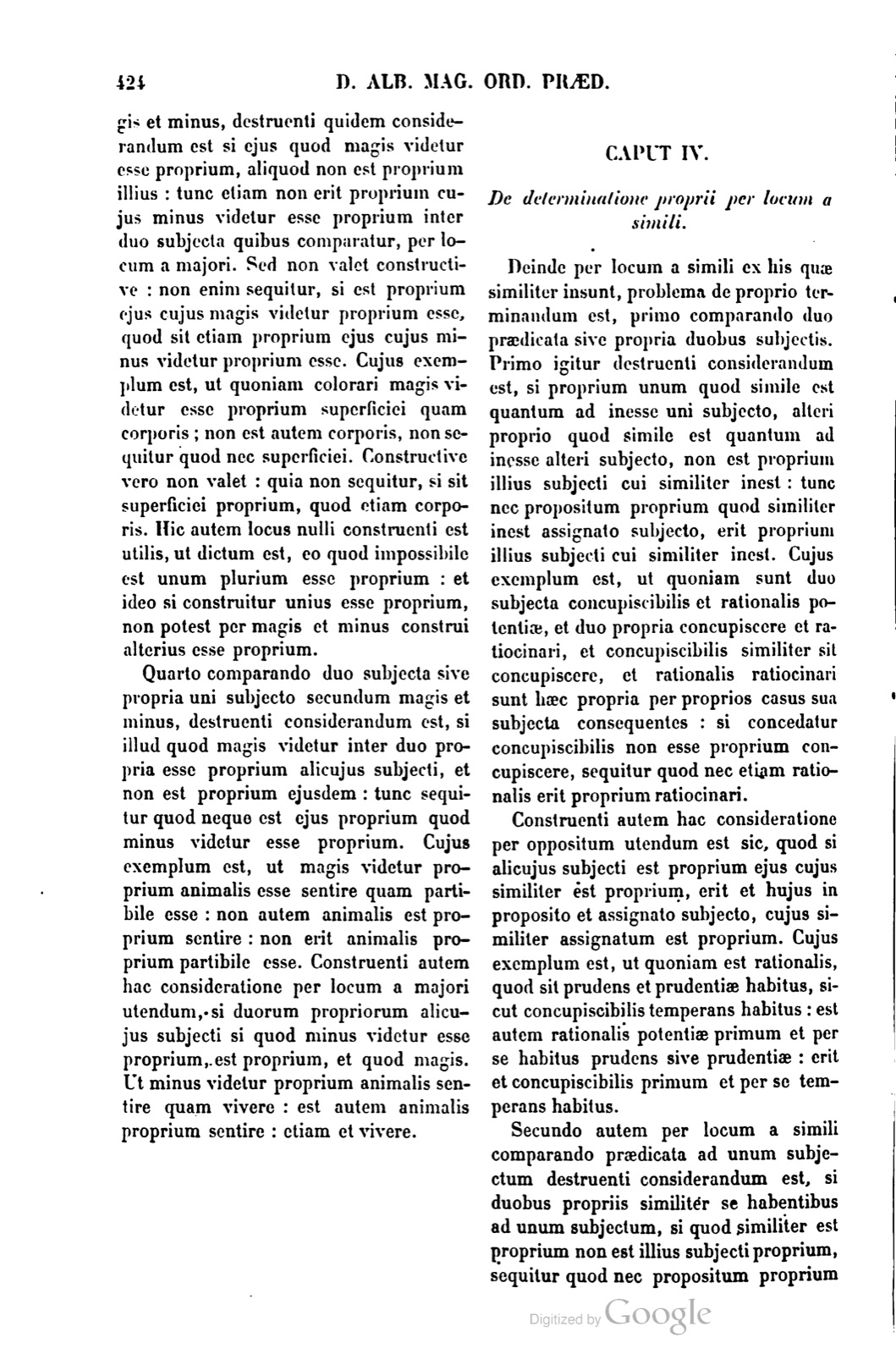
Tertio autem comparando unum praedicatum duobus subjectis secundum magis et minus, destruenti quidem considerandum est si ejus quod magis videtur esse proprium, aliquod non est proprium illius: tunc etiam non erit proprium cujus minus videtur esse proprium inter duo subjecta quibus comparatur, per locum a majori. Sed non valet constructive: non enim sequitur, si est proprium ejus cujus magis videtur proprium esse, quod sit etiam proprium ejus cujus minus videtur proprium esse. Cujus exemplum est, ut quoniam colorari magis videtur esse proprium superficiei quam corporis; non est autem corporis, non sequitur quod nec superficiei. Constructive vero non valet: quia non sequitur, si sit superficiei proprium, quod etiam corporis. Hic autem locus nulli construenti est utilis, ut dictum est, eo quod impossibile est unum plurium esse proprium: et ideo si construitur unius esse proprium, non potest per magis et minus construi alterius esse proprium.
Quarto comparando duo subjecta sive propria uni subjecto secundum magis et minus, destruenti considerandum est, si illud quod magis videtur inter duo propria esse proprium alicujus subjecti, et non est proprium ejusdem: tunc sequitur quod neque est ejus proprium quod minus videtur esse proprium. Cujus exemplum est, ut magis videtur proprium animalis esse sentire quam partibile esse: non autem animalis est proprium sentire: non erit animalis proprium partibile esse. Construenti autem hac consideratione per locum a majori utendum, si duorum propriorum alicujus subjecti si quod minus videtur esse proprium, est proprium, et quod magis. Ut minus videtur proprium animalis sentire quam vivere: est autem animalis proprium sentire: etiam et vivere.
Thirdly, by comparing one predicate to two subjects according to more and less, one who is destroying must consider whether some predicate of that of which it seems more to be the property is not its property; then it will also not be the property of that of which it seems less to be the property among the two subjects to which it is compared, through the place from the greater. But it does not hold constructively; for it does not follow, if it is the property of that of which it seems more to be the property, that it is also the property of that of which it seems less to be the property. The example of this is that being colored seems more to be the property of surface than of body; but it is not of body, and it does not follow that therefore it is not of surface. But constructively it does not hold, because it does not follow, if it is the property of surface, that it is also the property of body. But this place is useful to no one constructing, as has been said, because it is impossible that one thing be the property of several things; and therefore, if it is constructed to be the property of one, the property of another cannot be constructed through more and less.
Fourthly, by comparing two subjects or properties to one subject according to more and less, one who is destroying must consider whether that which among two properties seems more to be the property of some subject is not the property of the same subject; then it follows that neither is that its property which seems less to be a property. The example of this is that sensing seems more to be the property of animal than being divisible does; but sensing is not the property of animal; therefore being divisible will not be the property of animal. But one who is constructing must use this consideration through the place from the greater, if, of two properties of some subject, what seems less to be the property is a property, and also what seems more. Thus sensing seems less to be the property of animal than living; but sensing is the property of animal; therefore living also is.
If a page does not appear, its photograph has not been uploaded yet.