Volume 2 · pp. 417–420
Tractate III. Chapter I. On inspection in the four genera of opposites, and from disparates.
A marker with ≈ is an approximate page boundary, placed by measure of the text; the page photographs remain the authority. In the paired views, clicking a page marker brings that page into view.
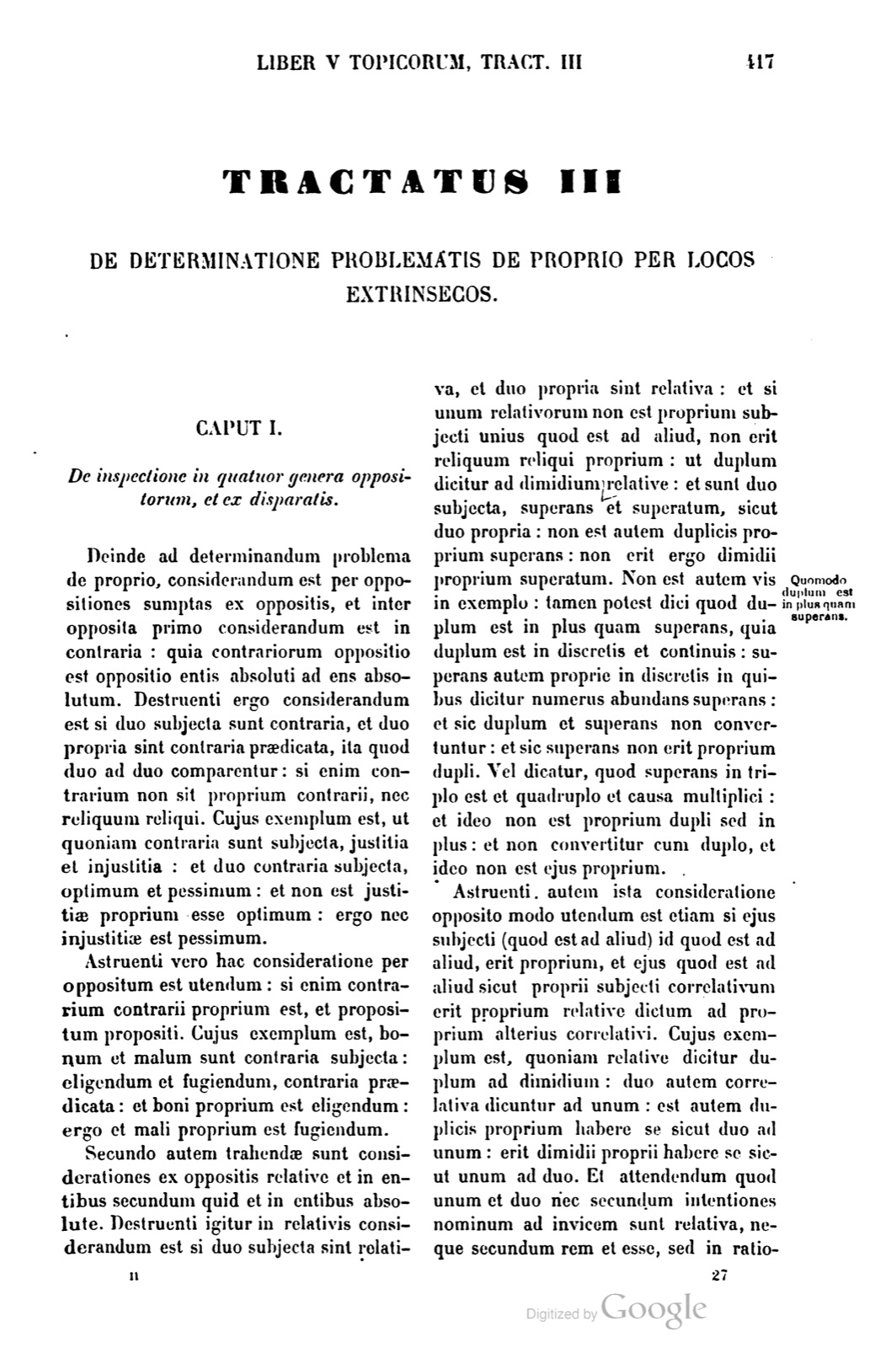
TRACTATUS III. DE DETERMINATIONE PROBLEMATIS DE PROPRIO PER LOCOS EXTRINSECOS.
CAPUT I. De inspectione in quatuor genera oppositorum, et ex disparatis.
Deinde ad determinandum problema de proprio, considerandum est per oppositiones sumptas ex oppositis, et inter opposita primo considerandum est in contraria: quia contrariorum oppositio est oppositio entis absoluti ad ens absolutum. Destruenti ergo considerandum est si duo subjecta sunt contraria, et duo propria sint contraria praedicata, ita quod duo ad duo comparentur: si enim contrarium non sit proprium contrarii, nec reliquum reliqui. Cujus exemplum est, ut quoniam contraria sunt subjecta, justitia et injustitia: et duo contraria subjecta, optimum et pessimum: et non est justitiae proprium esse optimum: ergo nec injustitiae est pessimum.
Astruenti vero hac consideratione per oppositum est utendum: si enim contrarium contrarii proprium est, et propositum propositi. Cujus exemplum est, bonum et malum sunt contraria subjecta: eligendum et fugiendum, contraria praedicata: et boni proprium est eligendum: ergo et mali proprium est fugiendum.
Secundo autem trahendae sunt considerationes ex oppositis relative et in entibus secundum quid et in entibus absolute. Destruenti igitur in relativis considerandum est si duo subjecta sint relativa, et duo propria sint relativa: et si unum relativorum non est proprium subjecti unius quod est ad aliud, non erit reliquum reliqui proprium: ut duplum dicitur ad dimidium relative: et sunt duo subjecta, superans et superatum, sicut duo propria: non est autem duplicis proprium superans: non erit ergo dimidii proprium superatum. Non est autem vis in exemplo: tamen potest dici quod duplum est in plus quam superans, quia duplum est in discretis et continuis: superans autem proprie in discretis in quibus dicitur numerus abundans superans: et sic duplum et superans non convertuntur: et sic superans non erit proprium dupli. Vel dicatur, quod superans in triplo est et quadruplo et causa multiplici: et ideo non est proprium dupli sed in plus: et non convertitur cum duplo, et ideo non est ejus proprium.
Astruenti, autem ista consideratione opposito modo utendum est etiam si ejus subjecti quod est ad aliud id quod est ad aliud, erit proprium, et ejus quod est ad aliud sicut proprii subjecti correlativum erit proprium relative dictum ad proprium alterius correlativi. Cujus exemplum est, quoniam relative dicitur duplum ad dimidium: duo autem correlativa dicuntur ad unum: est autem duplicis proprium habere se sicut duo ad unum: erit dimidii proprii habere se sicut unum ad duo. Et attendendum quod unum et duo nec secundum intentiones nominum ad invicem sunt relativa, neque secundum rem et esse, sed in ratione superantis et superati referuntur ad invicem.
TRACTATE III. ON THE DETERMINATION OF THE PROBLEM CONCERNING PROPERTY THROUGH EXTRINSIC PLACES.
CHAPTER I. On inspection in the four genera of opposites, and from disparates.
Next, for determining the problem concerning property, it must be considered through oppositions taken from opposites; and among opposites one must first consider contraries, because the opposition of contraries is the opposition of an absolute being to an absolute being. Therefore one who is destroying must consider whether two subjects are contrary, and whether two properties are contrary predicates, so that two are compared to two; for if the contrary is not the property of the contrary, neither will the remaining thing be the property of the remaining thing. The example of this is that justice and injustice are contrary subjects, and best and worst are two contrary subjects; and to be best is not the property of justice; therefore neither is worst the property of injustice.
But one who is constructing must use this consideration by opposition: for if the contrary is the property of the contrary, the proposed thing is also the property of the proposed thing. The example of this is: good and evil are contrary subjects; to-be-chosen and to-be-fled are contrary predicates; and to-be-chosen is the property of good; therefore to-be-fled is also the property of evil.
Secondly, considerations must be drawn from opposites relatively, both in beings in a qualified respect and in beings absolutely. Therefore one who is destroying must consider in relatives whether two subjects are relative, and whether two properties are relative; and if one of the relatives is not the property of one subject which is toward the other, the remaining thing will not be the property of the remaining thing. Thus double is said relatively toward half; and there are two subjects, exceeding and exceeded, just as two properties; but exceeding is not the property of double; therefore exceeded will not be the property of half. But there is no force in the example; nevertheless it can be said that double is in more things than exceeding, because double is in discrete and continuous things; but exceeding is properly in discrete things, in which an abounding number is called exceeding; and thus double and exceeding are not converted; and so exceeding will not be a property of double. Or let it be said that exceeding is in triple and quadruple and in a manifold cause; and therefore it is not a property of double, but is in more; and it is not converted with double, and therefore is not its property.
But one who is constructing must use that consideration in the opposite way, also if of the subject which is toward another, that which is toward another will be a property, and of that which is toward another, as the correlative of the proper subject, it will be the property said relatively toward the property of the other correlative. The example of this is that double is said relatively toward half; but two correlatives are said toward one; and it is the property of double to have itself as two to one; it will be the property of half to have itself as one to two. And it must be noted that one and two are relatives neither according to the intentions of the names toward each other, nor according to thing and being, but they are referred to each other in the account of exceeding and exceeded.
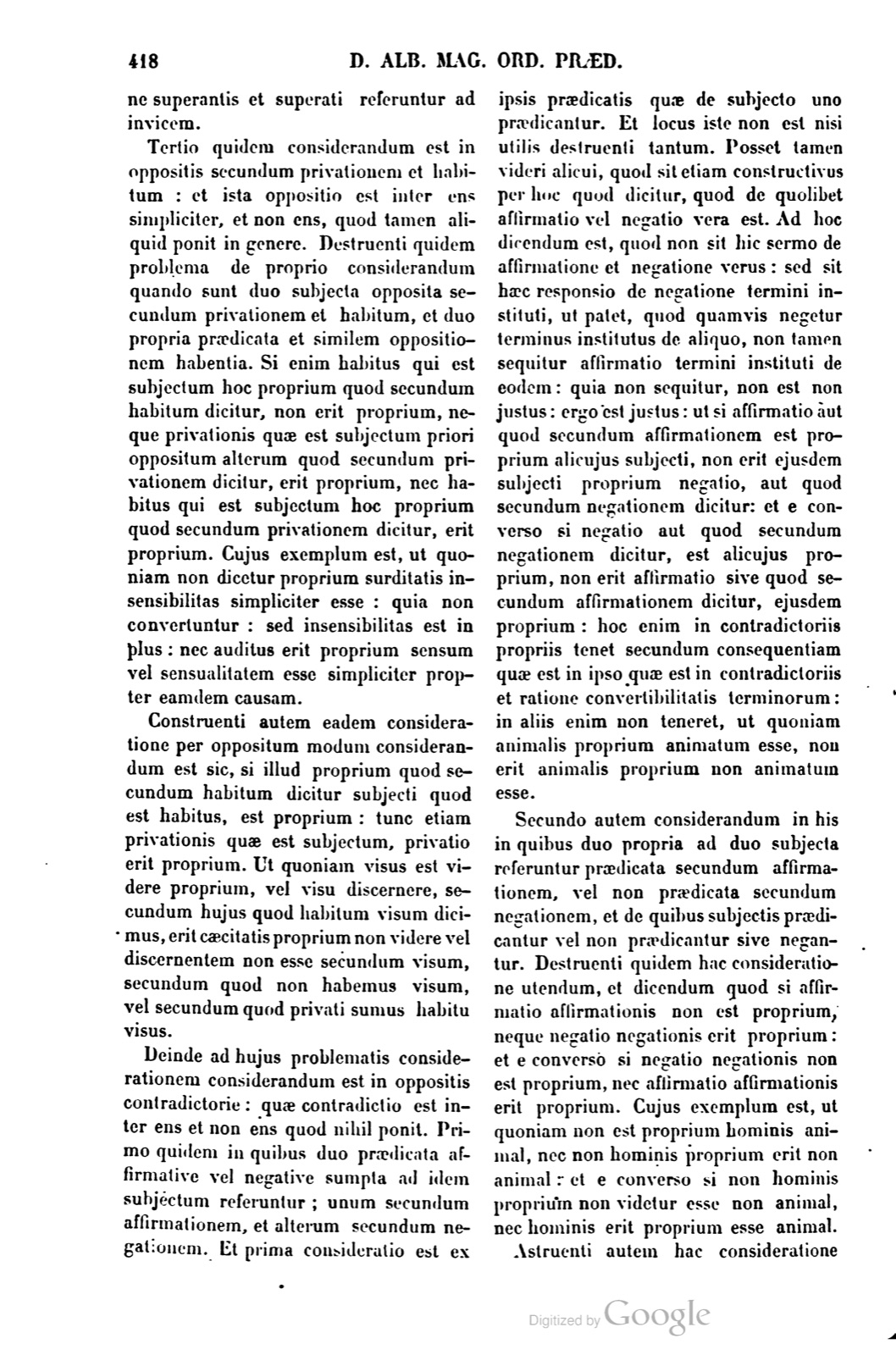
Tertio quidem considerandum est in oppositis secundum privationem et habitum: et ista oppositio est inter ens simpliciter, et non ens, quod tamen aliquid ponit in genere. Destruenti quidem problema de proprio considerandum quando sunt duo subjecta opposita secundum privationem et habitum, et duo propria praedicata et similem oppositionem habentia. Si enim habitus qui est subjectum hoc proprium quod secundum habitum dicitur, non erit proprium, neque privationis quae est subjectum priori oppositum alterum quod secundum privationem dicitur, erit proprium, nec habitus qui est subjectum hoc proprium quod secundum privationem dicitur, erit proprium. Cujus exemplum est, ut quoniam non dicetur proprium surditatis insensibilitas simpliciter esse: quia non convertuntur: sed insensibilitas est in plus: nec auditus erit proprium sensum vel sensualitatem esse simpliciter propter eamdem causam.
Construenti autem eadem consideratione per oppositum modum considerandum est sic, si illud proprium quod secundum habitum dicitur subjecti quod est habitus, est proprium: tunc etiam privationis quae est subjectum, privatio erit proprium. Ut quoniam visus est videre proprium, vel visu discernere, secundum hujus quod habitum visum dicimus, erit caecitatis proprium non videre vel discernentem non esse secundum visum, secundum quod non habemus visum, vel secundum quod privati sumus habitu visus.
Deinde ad hujus problematis considerationem considerandum est in oppositis contradictorie: quae contradictio est inter ens et non ens quod nihil ponit. Primo quidem in quibus duo praedicata affirmative vel negative sumpta ad idem subjectum referuntur; unum secundum affirmationem, et alterum secundum negationem. Et prima consideratio est ex ipsis praedicatis quae de subjecto uno praedicantur. Et locus iste non est nisi utilis destruenti tantum. Posset tamen videri alicui, quod sit etiam constructivus per hoc quod dicitur, quod de quolibet affirmatio vel negatio vera est. Ad hoc dicendum est, quod non sit hic sermo de affirmatione et negatione verus: sed sit haec responsio de negatione termini instituti, ut patet, quod quamvis negetur terminus institutus de aliquo, non tamen sequitur affirmatio termini instituti de eodem: quia non sequitur, non est non justus: ergo est justus: ut si affirmatio aut quod secundum affirmationem est proprium alicujus subjecti, non erit ejusdem subjecti proprium negatio, aut quod secundum negationem dicitur: et e converso si negatio aut quod secundum negationem dicitur, est alicujus proprium, non erit affirmatio sive quod secundum affirmationem dicitur, ejusdem proprium: hoc enim in contradictoriis propriis tenet secundum consequentiam quae est in ipso quae est in contradictoriis et ratione convertibilitatis terminorum: in aliis enim non teneret, ut quoniam animalis proprium animatum esse, non erit animalis proprium non animatum esse.
Thirdly, one must consider in opposites according to privation and habit; and this opposition is between being simply and non-being which nevertheless posits something in a genus. For destroying the problem concerning property, one must consider when there are two subjects opposed according to privation and habit, and two predicated properties having a like opposition. For if the habit which is the subject will not have as property this property which is said according to habit, neither will the privation which is the subject opposed to the former have as property the other thing which is said according to privation, nor will the habit which is the subject have as property this property which is said according to privation. The example of this is that insensibility simply will not be said to be the property of deafness, because they are not converted; rather insensibility is in more things. Nor will it be the property of hearing to be sense or sensitivity simply, on account of the same cause.
But one who is constructing must consider in the opposite mode by the same consideration thus: if that property which is said according to habit is the property of the subject which is the habit, then privation will also be the property of the privation which is the subject. Thus, since sight has seeing as property, or discerning by sight, according to this which we call the possessed habit of sight, it will be the property of blindness not to see, or not to be discerning according to sight, insofar as we do not have sight, or insofar as we are deprived of the habit of sight.
Next, for the consideration of this problem one must consider opposites contradictorily; this contradiction is between being and non-being which posits nothing. First, indeed, in those cases in which two predicates, taken affirmatively or negatively, are referred to the same subject, one according to affirmation and the other according to negation. And the first consideration is from the predicates themselves which are predicated of one subject. And this place is useful only for one who is destroying. Yet it could seem to someone that it is also constructive through this which is said, that of anything affirmation or negation is true. To this it must be said that the discourse here should not be about affirmation and negation as true, but that this response should be about the negation of an instituted term, as is clear, because although the instituted term is denied of something, nevertheless the affirmation of the instituted term of the same thing does not follow; for it does not follow: he is not not-just; therefore he is just. Thus, if affirmation, or what is according to affirmation, is the property of some subject, negation, or what is said according to negation, will not be the property of the same subject; and conversely, if negation, or what is said according to negation, is the property of something, affirmation, or what is said according to affirmation, will not be the property of the same thing. For this holds in contradictory properties according to the consequence which is in it, which is in contradictories, and by reason of the convertibility of the terms; for in others it would not hold, as since being animated is the property of animal, being not animated will not be the property of animal.
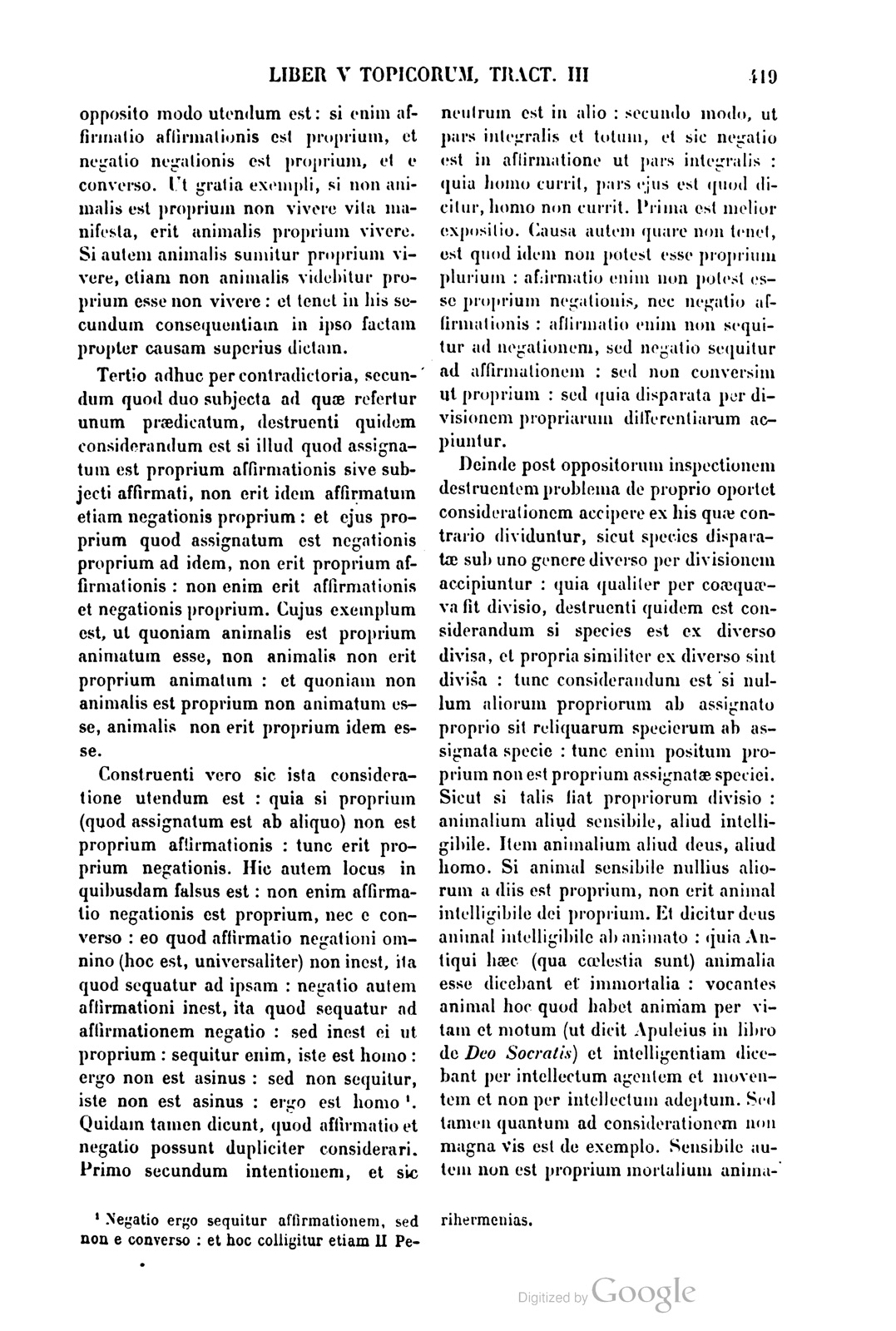
Secundo autem considerandum in his in quibus duo propria ad duo subjecta referuntur praedicata secundum affirmationem, vel non praedicata secundum negationem, et de quibus subjectis praedicantur vel non praedicantur sive negantur. Destruenti quidem hac consideratione utendum, et dicendum quod si affirmatio affirmationis non est proprium, neque negatio negationis erit proprium: et e converso si negatio negationis non est proprium, nec affirmatio affirmationis erit proprium. Cujus exemplum est, ut quoniam non est proprium hominis animal, nec non hominis proprium erit non animal: et e converso si non hominis proprium non videtur esse non animal, nec hominis erit proprium esse animal.
Astruenti autem hac consideratione opposito modo utendum est: si enim affirmatio affirmationis est proprium, et negatio negationis est proprium, et e converso. Ut gratia exempli, si non animalis est proprium non vivere vita manifesta, erit animalis proprium vivere. Si autem animalis sumitur proprium vivere, etiam non animalis videbitur proprium esse non vivere: et tenet in his secundum consequentiam in ipso factam propter causam superius dictam.
Tertio adhuc per contradictoria, secundum quod duo subjecta ad quae refertur unum praedicatum, destruenti quidem considerandum est si illud quod assignatum est proprium affirmationis sive subjecti affirmati, non erit idem affirmatum etiam negationis proprium: et ejus proprium quod assignatum est negationis proprium ad idem, non erit proprium affirmationis: non enim erit affirmationis et negationis proprium. Cujus exemplum est, ut quoniam animalis est proprium animatum esse, non animalis non erit proprium animatum: et quoniam non animalis est proprium non animatum esse, animalis non erit proprium idem esse.
Construenti vero sic ista consideratione utendum est: quia si proprium quod assignatum est ab aliquo non est proprium affirmationis: tunc erit proprium negationis. Hic autem locus in quibusdam falsus est: non enim affirmatio negationis est proprium, nec e converso: eo quod affirmatio negationi omnino, hoc est, universaliter, non inest, ita quod sequatur ad ipsam: negatio autem affirmationi inest, ita quod sequatur ad affirmationem negatio: sed inest ei ut proprium: sequitur enim, iste est homo: ergo non est asinus: sed non sequitur, iste non est asinus: ergo est homo 1. Quidam tamen dicunt, quod affirmatio et negatio possunt dupliciter considerari. Primo secundum intentionem, et sic neutrum est in alio: secundo modo, ut pars integralis et totum, et sic negatio est in affirmatione ut pars integralis: quia homo currit, pars ejus est quod dicitur, homo non currit. Prima est melior expositio. Causa autem quare non tenet, est quod idem non potest esse proprium plurium: affirmatio enim non potest esse proprium negationis, nec negatio affirmationis: affirmatio enim non sequitur ad negationem, sed negatio sequitur ad affirmationem: sed non conversim ut proprium: sed quia disparata per divisionem propriarum differentiarum accipiuntur.
Secondly, one must consider in those cases in which two properties are referred to two subjects as predicates according to affirmation, or as not predicated according to negation, and of which subjects they are predicated or not predicated or denied. One who is destroying must use this consideration and say that if the affirmation of the affirmation is not a property, neither will the negation of the negation be a property; and conversely, if the negation of the negation is not a property, neither will the affirmation of the affirmation be a property. The example of this is that animal is not a property of man, nor will non-animal be a property of non-man; and conversely, if non-animal does not seem to be the property of non-man, neither will being animal be the property of man.
But one who is constructing must use this consideration in the opposite way: for if the affirmation of the affirmation is a property, the negation of the negation is also a property, and conversely. For the sake of an example, if not living with manifest life is the property of non-animal, living will be the property of animal. But if living is taken as the property of animal, not living will also seem to be the property of non-animal; and it holds in these according to the consequence made in the very thing on account of the cause stated above.
Still thirdly through contradictories, according as two subjects to which one predicate is referred are concerned, one who is destroying must consider whether that which has been assigned as the property of affirmation, or of the affirmed subject, will not also be the same affirmed thing as the property of negation; and whether what has been assigned as the property of negation with respect to the same thing will not be the property of affirmation; for it will not be the property of affirmation and negation. The example of this is that, since being animated is the property of animal, being animated will not be the property of non-animal; and since being not animated is the property of non-animal, animal will not have as property being the same thing.
But one who is constructing must use this consideration thus: because if the property which has been assigned by someone is not the property of affirmation, then it will be the property of negation. But this place is false in certain cases; for affirmation is not the property of negation, nor conversely, because affirmation does not belong wholly, that is, universally, to negation, so that it follows upon it; but negation belongs to affirmation, so that negation follows upon affirmation, yet it belongs to it as a property. For it follows: this man is a man; therefore he is not an ass. But it does not follow: this man is not an ass; therefore he is a man 1. Nevertheless some say that affirmation and negation can be considered in two ways. First according to intention, and thus neither is in the other; secondly, as integral part and whole, and thus negation is in affirmation as an integral part, because "man runs" has as its part what is said, "man does not run." The first exposition is better. But the cause why it does not hold is that the same thing cannot be the property of several things; for affirmation cannot be the property of negation, nor negation of affirmation. For affirmation does not follow upon negation, but negation follows upon affirmation, yet not conversely as property, but because disparates are received by the division of proper differences.
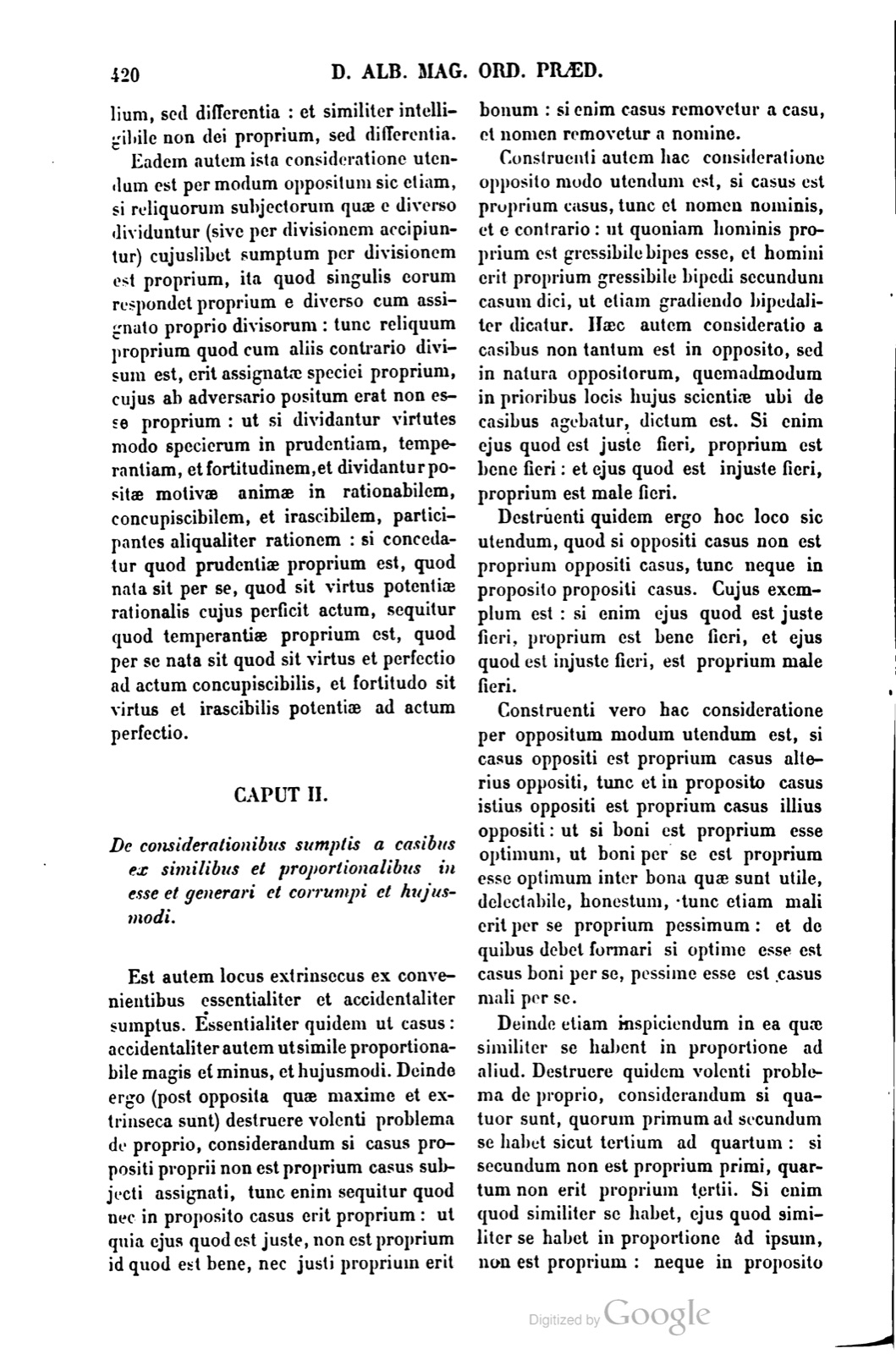
Deinde post oppositorum inspectionem destruentem problema de proprio oportet considerationem accipere ex his quae contrario dividuntur, sicut species disparatae sub uno genere diverso per divisionem accipiuntur: quia qualiter per coaequaeva fit divisio, destruenti quidem est considerandum si species est ex diverso divisa, et propria similiter ex diverso sint divisa: tunc considerandum est si nullum aliorum propriorum ab assignato proprio sit reliquarum specierum ab assignata specie: tunc enim positum proprium non est proprium assignatae speciei. Sicut si talis fiat propriorum divisio: animalium aliud sensibile, aliud intelligibile. Item animalium aliud deus, aliud homo. Si animal sensibile nullius aliorum a diis est proprium, non erit animal intelligibile dei proprium. Et dicitur deus animal intelligibile ab animato: quia Antiqui haec quae caelestia sunt animalia esse dicebant et immortalia: vocantes animal hoc quod habet animam per vitam et motum, ut dicit Apuleius in libro de Deo Socratis, et intelligentiam dicebant per intellectum agentem et moventem et non per intellectum adeptum. Sed tamen quantum ad considerationem non magna vis est de exemplo. Sensibile autem non est proprium mortalium animalium, sed differentia: et similiter intelligibile non dei proprium, sed differentia.
Eadem autem ista consideratione utendum est per modum oppositum sic etiam, si reliquorum subjectorum quae e diverso dividuntur, sive per divisionem accipiuntur, cujuslibet sumptum per divisionem est proprium, ita quod singulis eorum respondet proprium e diverso cum assignato proprio divisorum: tunc reliquum proprium quod cum aliis contrario divisum est, erit assignatae speciei proprium, cujus ab adversario positum erat non esse proprium: ut si dividantur virtutes modo specierum in prudentiam, temperantiam, et fortitudinem, et dividantur positae motivae animae in rationabilem, concupiscibilem, et irascibilem, participantes aliqualiter rationem: si concedatur quod prudentiae proprium est, quod nata sit per se, quod sit virtus potentiae rationalis cujus perficit actum, sequitur quod temperantiae proprium est, quod per se nata sit quod sit virtus et perfectio ad actum concupiscibilis, et fortitudo sit virtus et irascibilis potentiae ad actum perfectio.
Next, after the inspection of opposites, one who is destroying the problem concerning property must take a consideration from those things which are divided contrariwise, just as disparate species under one genus are received as diverse through division; because, in the way that division is made by coaequals, one who is destroying must consider whether the species is divided from what is diverse, and whether the properties are similarly divided from what is diverse. Then one must consider whether none of the other properties besides the assigned property belongs to the remaining species besides the assigned species; for then the posited property is not the property of the assigned species. For instance, if such a division of properties is made: of animals, one is sensible, another intelligible. Likewise of animals, one is god, another man. If sensible animal is the property of none of the others apart from the gods, intelligible animal will not be the property of god. And god is called an intelligible animal from being animated, because the ancients used to say that those things which are heavenly are animals and immortal; calling animal that which has soul through life and motion, as Apuleius says in the book On the God of Socrates, and they used to speak of intelligence through an agent and moving intellect and not through an acquired intellect. But nevertheless, as regards the consideration, there is not much force in the example. For sensible is not the property of mortal animals, but a difference; and similarly intelligible is not the property of god, but a difference.
But this same consideration must also be used in the opposite mode thus: if of the remaining subjects which are divided from what is diverse, or are taken through division, the thing taken for each through division is a property, so that to each of them there corresponds a property from what is diverse along with the assigned property of the divided things, then the remaining property which has been contrariwise divided with the others will be the property of the assigned species, of which it had been posited by the adversary not to be a property. Thus if virtues are divided in the manner of species into prudence, temperance, and fortitude, and the posited motive powers of the soul are divided into rational, concupiscible, and irascible, participating in reason in some way: if it is conceded that the property of prudence is that it is naturally fitted through itself to be the virtue of the rational power whose act it perfects, it follows that the property of temperance is that through itself it is naturally fitted to be the virtue and perfection for the act of the concupiscible power, and fortitude is the virtue and perfection for the act of the irascible power.
Notes
- Negation therefore follows affirmation, but not conversely; and this is also gathered in the second book of On Interpretation. (Negatio ergo sequitur affirmationem, sed non e converso: et hoc colligitur etiam II Perihermenias.) ↩
If a page does not appear, its photograph has not been uploaded yet.