Volume 2 · pp. 413–415
Chapter VII. On the errors which occur concerning the stated modes of properties.
A marker with ≈ is an approximate page boundary, placed by measure of the text; the page photographs remain the authority. In the paired views, clicking a page marker brings that page into view.
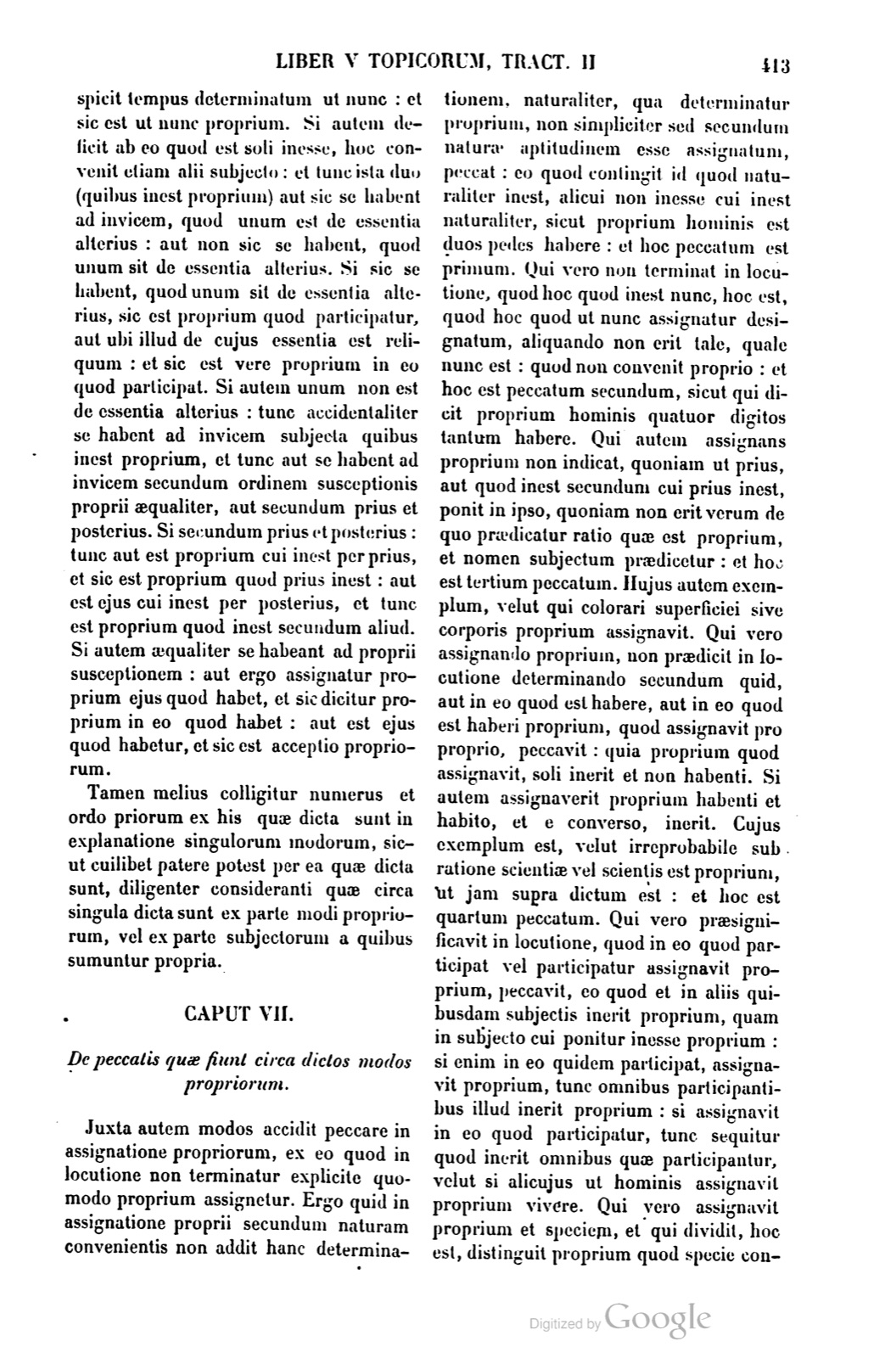
CAPUT VII. De peccatis quae fiunt circa dictos modos propriorum.
Juxta autem modos accidit peccare in assignatione propriorum, ex eo quod in locutione non terminatur explicite quomodo proprium assignetur. Ergo qui in assignatione proprii secundum naturam convenientis non addit hanc determinationem, naturaliter, qua determinatur proprium, non simpliciter sed secundum naturae aptitudinem esse assignatum, peccat: eo quod contingit id quod naturaliter inest, alicui non inesse cui inest naturaliter, sicut proprium hominis est duos pedes habere: et hoc peccatum est primum. Qui vero non terminat in locutione, quod hoc quod inest nunc, hoc est, quod hoc quod ut nunc assignatur designatum, aliquando non erit tale, quale nunc est: quod non convenit proprio: et hoc est peccatum secundum, sicut qui dicit proprium hominis quatuor digitos tantum habere. Qui autem assignans proprium non indicat, quoniam ut prius, aut quod inest secundum cui prius inest, ponit in ipso, quoniam non erit verum de quo praedicatur ratio quae est proprium, et nomen subjectum praedicetur: et hoc est tertium peccatum. Hujus autem exemplum, velut qui colorari superficiei sive corporis proprium assignavit. Qui vero assignando proprium, non praedicit in locutione determinando secundum quid, aut in eo quod est habere, aut in eo quod est haberi proprium, quod assignavit pro proprio, peccavit: quia proprium quod assignavit, soli inerit et non habenti. Si autem assignaverit proprium habenti et habito, et e converso, inerit. Cujus exemplum est, velut irreprobabile sub ratione scientiae vel scientis est proprium, ut jam supra dictum est: et hoc est quartum peccatum. Qui vero praesignificavit in locutione, quod in eo quod participat vel participatur assignavit proprium, peccavit, eo quod et in aliis quibusdam subjectis inerit proprium, quam in subjecto cui ponitur inesse proprium: si enim in eo quidem participat, assignavit proprium, tunc omnibus participantibus illud inerit proprium: si assignavit in eo quod participatur, tunc sequitur quod inerit omnibus quae participantur, velut si alicujus ut hominis assignavit proprium vivere. Qui vero assignavit proprium et speciem, et qui dividit, hoc est, distinguit proprium quod specie convenit, dicens in oratione, quod specie proprium assignavit, peccavit: quia secundum suam assignationem inerit uni soli quae sub specie illa subalterna, cujus speciei subalternae proprium assignavit. Et haec est ratio, quia quod secundum superabundantiam dicetur, uni soli convenit et inerit, ut ignis significat proprium levissimum esse corporum.
Unde aliquorum etiam qui assignant proprium specie, etiam quando determinando dicit, quod assignavit proprium specie, adhuc peccat: quia in talibus propriis unam solam speciem specialissimam illorum propriorum qui per superabundantiam propriam etiam dicuntur quando determinando secundum quid inest proprium addidit speciem, hoc est, specie proprium assignavit: hoc enim quibusdam speciebus subalternis non accidit ut tale conveniat ejus proprium, ut in igne: non enim est una species, hoc est, tantum species ignis: sed habet sub species specialissimas. Dividitur enim ignis in igne qui est carbo, et in igne qui est flamma, et in igne qui est lux: et dividitur in hac specie, eo quod istae sunt diversae species ignis. Et propter hoc oportet, quando determinando declaratur, quod specie assignatur proprium, diversam ab aliis et divisam speciem esse, et specialissimam ejus quod dicitur proprium esse specie: quoniam alius quidem ignis secundum magis, et alius secundum minus sive secundum magis et minus inerit, quam dictum est et assignatum inesse proprium, ut patet in igne, cujus proprium est subtilissimum esse corporum. Habet autem ignis species quae sunt lux, flamma, et carbo: et unumquodque istorum est ignis: et propter hoc non oportet esse diversam speciem quando dicitur determinando specie, sed esse specialissimam, quando id quod dictum est proprium in speciebus subalternis, aliis quidem speciebus inerit secundum magis, et alius secundum minus, velut in speciebus ignis subtilissimum est lux: est enim subtilior carbone et flamma. Hoc autem quod secundum magis et minus, non oportet praedicari proprium, quando nomen, hoc est, species secundum nomen speciei non secundum magis praedicatur de eo de quo ratio, hoc est, proprium praedicatur, et secundum magis et minus est verum. Si autem non oportet proprium de omni magis et minus de aliquo eodem specie, non erit etiam quod nomen, hoc est, species secundum magis et minus dicatur de eisdem. Hoc autem falsum est, quia secundum magis et minus dicitur ignis de carbone et flamma et luce. Ergo et proprium subtilissimum corporum esse quod secundum minus in carbone, et secundum magis in flamma, et secundum maxime erit in luce.
CHAPTER VII. On the errors which occur concerning the stated modes of properties.
Now, alongside the modes, error happens in the assignment of properties from the fact that in the expression it is not explicitly determined how the property is assigned. Therefore one who, in assigning a property belonging according to nature, does not add this determination, naturally, by which the property is determined to be assigned not simply but according to the aptitude of nature, errs; because it happens that what naturally belongs does not belong to someone to whom it belongs naturally, as it is proper to man to have two feet; and this is the first error. But one who does not determine in the expression that this which belongs now, that is, that this which is assigned as now and designated, at some time will not be such as it now is, which does not belong to property, this is the second error, as one who says that it is proper to man to have only four fingers. But one assigning a property who does not indicate that as prior, or that what belongs according to that to which it first belongs, he posits in it, because it will not be true that of that of which the account which is the property is predicated, the subject name is also predicated, this is the third error. The example of this is one who assigned being colored as the property of surface or of body. But one who, in assigning a property, does not state beforehand in the expression, by determining in a certain respect, either in that which is to have, or in that which is to be had, the property which he assigned as property, has erred, because the property which he assigned will belong to one alone and not to the one having. But if he assigned the property to the one having and the thing had, and conversely, it will belong. An example of this is that irreprovable under reason is the property of science or of the knower, as has already been said above; and this is the fourth error. But one who has pre-signified in the expression that he assigned the property in that which participates or is participated has erred, because the property will belong also in certain other subjects than in the subject to which the property is posited to belong. For if he assigned the property in that which indeed participates, then that property will belong to all participating things; if he assigned it in that which is participated, then it follows that it will belong to all things which are participated, for example if someone assigned living as the property of some one such as man. But one who assigned property and species, and who divides, that is, distinguishes the property which belongs by species, saying in the expression that he assigned the property by species, has erred, because according to his assignment it will belong to one alone which is under that subaltern species of whose subaltern species he assigned the property. And this is the reason: because what is said according to superabundance belongs and will belong to one alone, as fire signifies as property to be the lightest of bodies.
Hence even of some who assign a property by species, even when by determining he says that he assigned the property by species, he still errs; because in such properties he added one sole most special species of those properties which are also called by proper superabundance, when by determining according to a certain respect the property belongs, that is, he assigned the property by species. For it does not happen in certain subaltern species that such a property belongs to it as its property, as in fire; for there is not one species, that is, only the species of fire, but it has under itself most special species. For fire is divided into the fire which is coal, and into the fire which is flame, and into the fire which is light; and it is divided in this species because these are diverse species of fire. And on account of this, when by determining it is declared that the property is assigned by species, it is necessary that there be a species diverse from others and divided, and the most special species of that which is said to be the property by species; because one fire belongs according to more, and another according to less, or according to more and less, than what has been stated and assigned to belong as property, as is clear in fire, whose property is to be the most subtle of bodies. But fire has species which are light, flame, and coal, and each of these is fire; and on account of this it is not necessary that there be a diverse species when it is said by determining by species, but that it be most special, when that which has been stated as the property in subaltern species belongs to some species according to more and to another according to less. For example, among the species of fire, light is the most subtle, for it is subtler than coal and flame. But this, which is according to more and less, ought not to be predicated as property when the name, that is, the species according to the name of the species, is not predicated according to more of that of which the account, that is, the property, is predicated, and is true according to more and less. But if the property ought not to be said according to more and less of every thing of some same species, then neither will the name, that is, the species, be said according to more and less of the same things. But this is false, because fire is said according to more and less of coal and flame and light. Therefore also the property, to be the most subtle of bodies, will be according to less in coal, according to more in flame, and according to most in light.
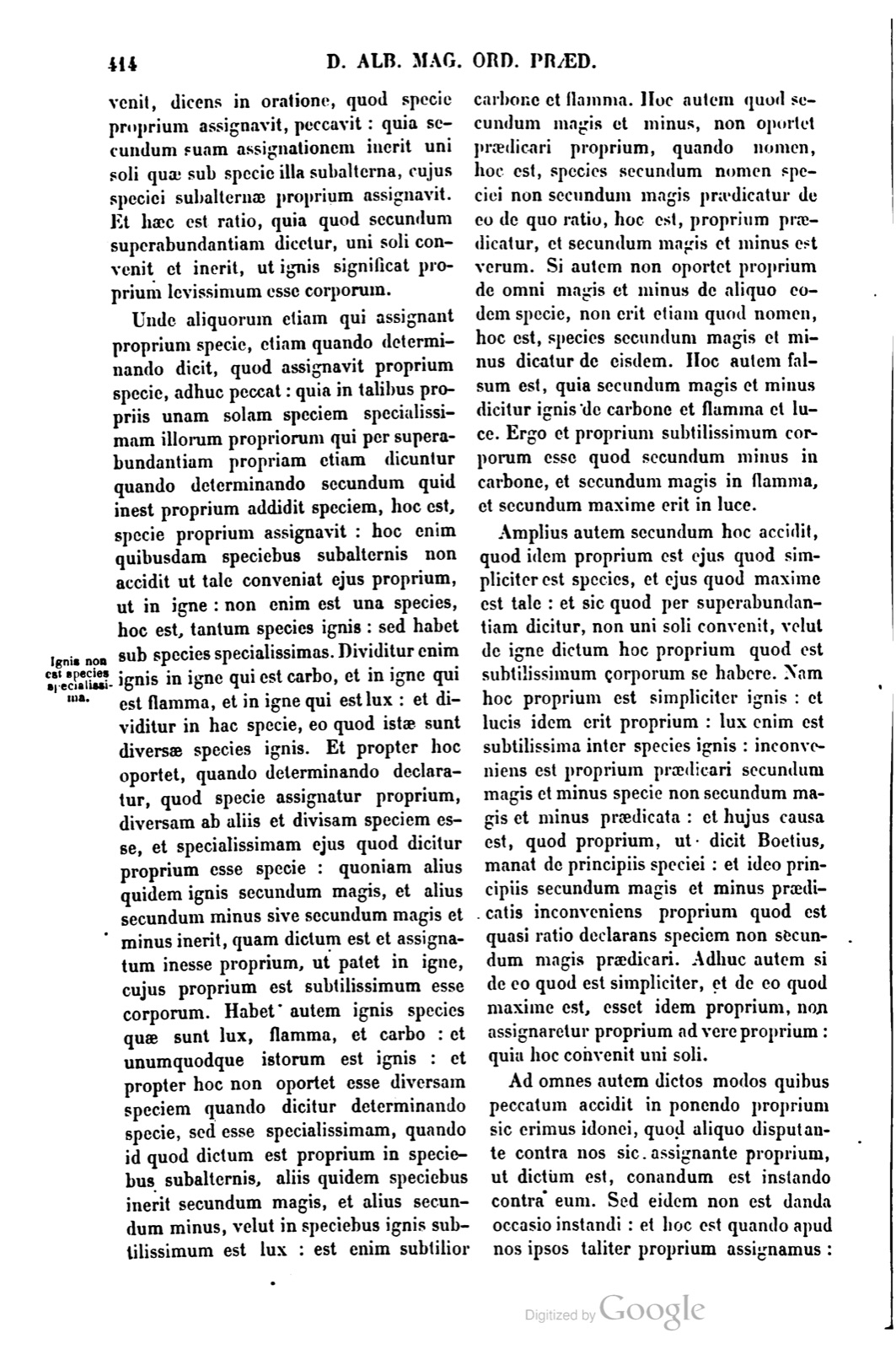
Amplius autem secundum hoc accidit, quod idem proprium est ejus quod simpliciter est species, et ejus quod maxime est tale: et sic quod per superabundantiam dicitur, non uni soli convenit, velut de igne dictum hoc proprium quod est subtilissimum corporum se habere. Nam hoc proprium est simpliciter ignis: et lucis idem erit proprium: lux enim est subtilissima inter species ignis: inconveniens est proprium praedicari secundum magis et minus specie non secundum magis et minus praedicata: et hujus causa est, quod proprium, ut dicit Boetius, manat de principiis speciei: et ideo principiis secundum magis et minus praedicatis inconveniens proprium quod est quasi ratio declarans speciem non secundum magis praedicari. Adhuc autem si de eo quod est simpliciter, et de eo quod maxime est, esset idem proprium, non assignaretur proprium ad vere proprium: quia hoc convenit uni soli.
Ad omnes autem dictos modos quibus peccatum accidit in ponendo proprium sic erimus idonei, quod aliquo disputante contra nos sic assignante proprium, ut dictum est, conandum est instando contra eum. Sed eidem non est danda occasio instandi: et hoc est quando apud nos ipsos taliter proprium assignamus:
Furthermore, according to this it happens that the same property belongs to that which is simply the species and to that which is most such; and thus what is said through superabundance does not belong to one alone, as was said of fire, this property which is to have itself as the most subtle of bodies. For this is the property of fire simply, and the same will be the property of light; for light is the most subtle among the species of fire. It is unsuitable for property to be predicated according to more and less while the species is not predicated according to more and less. And the cause of this is that property, as Boethius says, flows from the principles of the species; and therefore, when the principles are predicated according to more and less, it is unsuitable that the property, which is as it were an account declaring the species, not be predicated according to more. Furthermore, if there were the same property of that which is simply and of that which is most, the property would not be assigned toward true property, because this belongs to one alone.
But toward all the stated modes in which error occurs in positing a property, we will be fit in this way: when someone disputes against us while assigning a property in this way, as has been said, we must attempt to press against him. But occasion for pressing must not be given to the same person; and this is when we ourselves assign property in such a way:
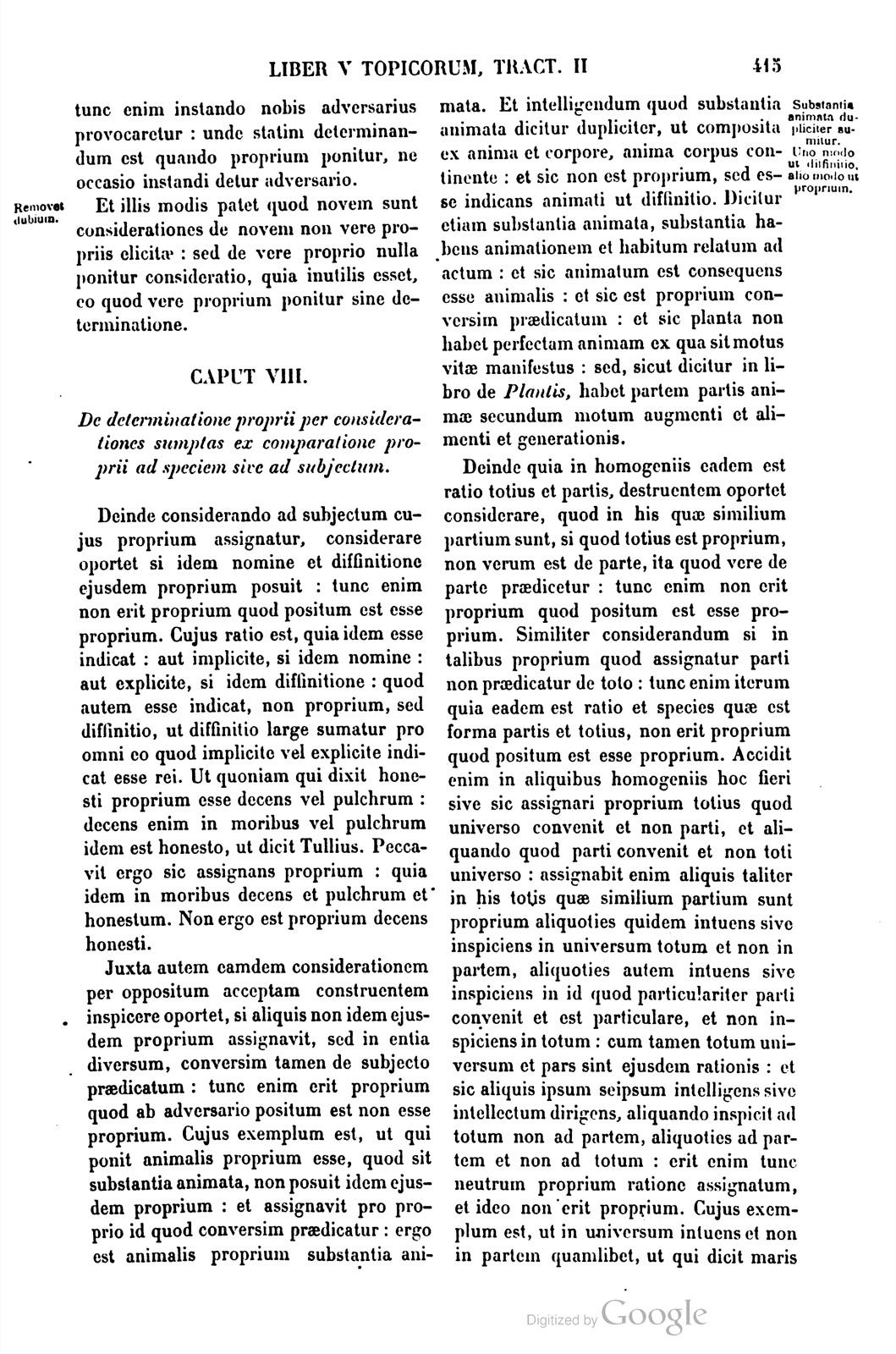
tunc enim instando nobis adversarius provocaretur: unde statim determinandum est quando proprium ponitur, ne occasio instandi detur adversario.
Et illis modis patet quod novem sunt considerationes de novem non vere propriis elicitae: sed de vere proprio nulla ponitur consideratio, quia inutilis esset, eo quod vere proprium ponitur sine determinatione.
for then our adversary would be provoked by pressing us; hence, when a property is posited, it must be determined at once, lest an occasion for pressing be given to the adversary.
And from those modes it is clear that there are nine considerations elicited concerning the nine things that are not truly properties; but concerning true property no consideration is posited, because it would be useless, since a true property is posited without determination.
If a page does not appear, its photograph has not been uploaded yet.