Volume 2 · pp. 410–413
Chapter VI. On the special modes of properties deficient from true property.
A marker with ≈ is an approximate page boundary, placed by measure of the text; the page photographs remain the authority. In the paired views, clicking a page marker brings that page into view.
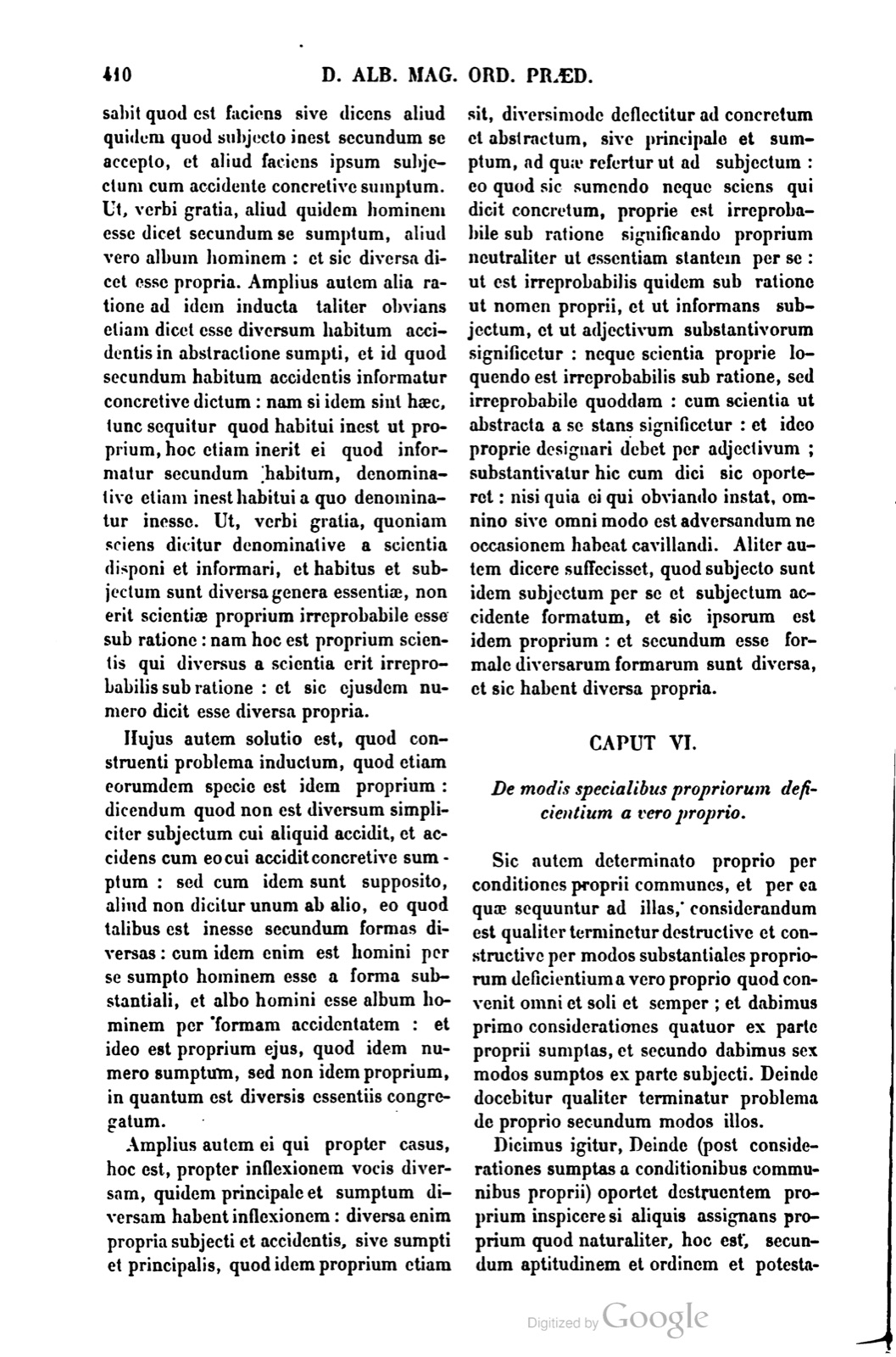
CAPUT VI. De modis specialibus propriorum deficientium a vero proprio.
Sic autem determinato proprio per conditiones proprii communes, et per ea quae sequuntur ad illas, considerandum est qualiter terminetur destructive et constructive per modos substantiales propriorum deficientium a vero proprio quod convenit omni et soli et semper: et dabimus primo considerationes quatuor ex parte proprii sumptas, et secundo dabimus sex modos sumptos ex parte subjecti. Deinde docebitur qualiter terminetur problema de proprio secundum modos illos.
Dicimus igitur, deinde post considerationes sumptas a conditionibus communibus proprii, oportet destruentem proprium inspicere si aliquis assignans proprium quod naturaliter, hoc est, secundum aptitudinem et ordinem et potestatem solam naturae inest, sicut in sermone assignavit hoc modo secundum locutionem, sicut quod semper inest secundum actum: tunc enim videbitur aliquando moveri, hoc est, a subjecto removeri, id quod positum est proprium: quod est contra proprii rationem, cujus est non derelinquere subjectum: secundum autem locutionem semper inesse significat qui in locutione non determinat modum specialem quo inest proprium, quia tunc non intelligitur in sermone nisi modus simpliciter proprii. Cujus exemplum est, ut qui dixit hominis proprium esse, quod sit bipes, vult quidem sive intendit assignare non simpliciter proprium, sed proprium quod naturaliter, hoc est, secundum naturae potestatem et ordinem, inest: locutioni autem quia non determinat modum specialem proprii, non relinquitur nisi modus proprii: simpliciter enim significat proprium quod simpliciter ex actu et semper inest, et tale est proprium: ideo quod est esse bipes, non erit hominis proprium: non enim omnis homo est duos pedes habens: quia per accidens violentiae, vel infirmitatis, vel materiae malitia in formatione generati potest non duos pedes habere secundum actum.
Construentem autem problema idem oportet per oppositum modum considerare si aliquis vult vel intendit de proprio assignare aliquid quod naturaliter inest, quod locutione significans determinat hoc modo inesse, ut dicat hoc esse naturaliter proprium et non simpliciter: quia tunc sequitur quod significat secundum naturam inesse, nec removeatur, hoc est, de subjecto removeatur, quin semper secundum naturae aptitudinem et potestatem insit. Cujus exemplum est, ut quoniam qui hominis proprium assignavit, quod secundum naturam est animal susceptibile disciplinae, vult locutionem significare, quod naturaliter est proprium, et ita proprium quod a subjecto non removebitur, sed in hoc quoniam est secundum naturam proprium hominis animal susceptibile disciplinae. Quamvis per occasionem et accidens violentiae vel infirmitatis non semper conveniat, ut patet in junioribus et apoplecticis et cerebro laesis, qui disciplinae non sunt susceptibiles.
CHAPTER VI. On the special modes of properties deficient from true property.
Now, with property determined in this way through the common conditions of property and through those things which follow upon them, one must consider how it is determined destructively and constructively through the substantial modes of properties deficient from true property, which belongs to every one, to it alone, and always. And first we shall give four considerations taken on the part of the property, and secondly we shall give six modes taken on the part of the subject. Then it will be taught how the problem concerning property is determined according to those modes.
Therefore we say that, after the considerations taken from the common conditions of property, one destroying a property must inspect whether someone assigning as property that which naturally, that is, according to the aptitude and order and power of nature alone, belongs, has assigned it in speech in this way according to the expression, as though it always belongs according to act. For then what has been posited as property will be seen sometimes to be moved, that is, removed from the subject; and this is contrary to the account of property, whose role is not to abandon the subject. But according to the expression, one who in the expression does not determine the special mode by which the property belongs signifies that it always belongs, because then in the speech nothing is understood except the mode of property simply. An example is one who said that it is proper to man to be two-footed. He indeed wishes or intends to assign not property simply, but a property that naturally, that is, according to the power and order of nature, belongs. But because he does not determine in the expression the special mode of property, there is left only the mode of property; for simply it signifies a property which simply belongs from act and always, and such is property. Therefore to be two-footed will not be the property of man, for not every man has two feet, because by accident of violence, or infirmity, or badness of matter in the formation of the generated thing, he can fail to have two feet according to act.
But one constructing the same problem must consider through the opposite mode whether someone wishes or intends to assign concerning property something which naturally belongs, and, signifying this by expression, determines it to belong in this mode, so that he says this to be naturally a property and not simply. For then it follows that he signifies that it belongs according to nature and is not removed, that is, not removed from the subject, but always belongs according to the aptitude and power of nature. An example is that one who assigned as the property of man that according to nature he is an animal capable of discipline wishes the expression to signify that it is naturally a property, and thus a property that will not be removed from the subject, but in this, that animal capable of discipline is the property of man according to nature. Although through occasion and accident of violence or infirmity it does not always belong, as is clear in youths and apoplectics and those injured in the brain, who are not capable of discipline.
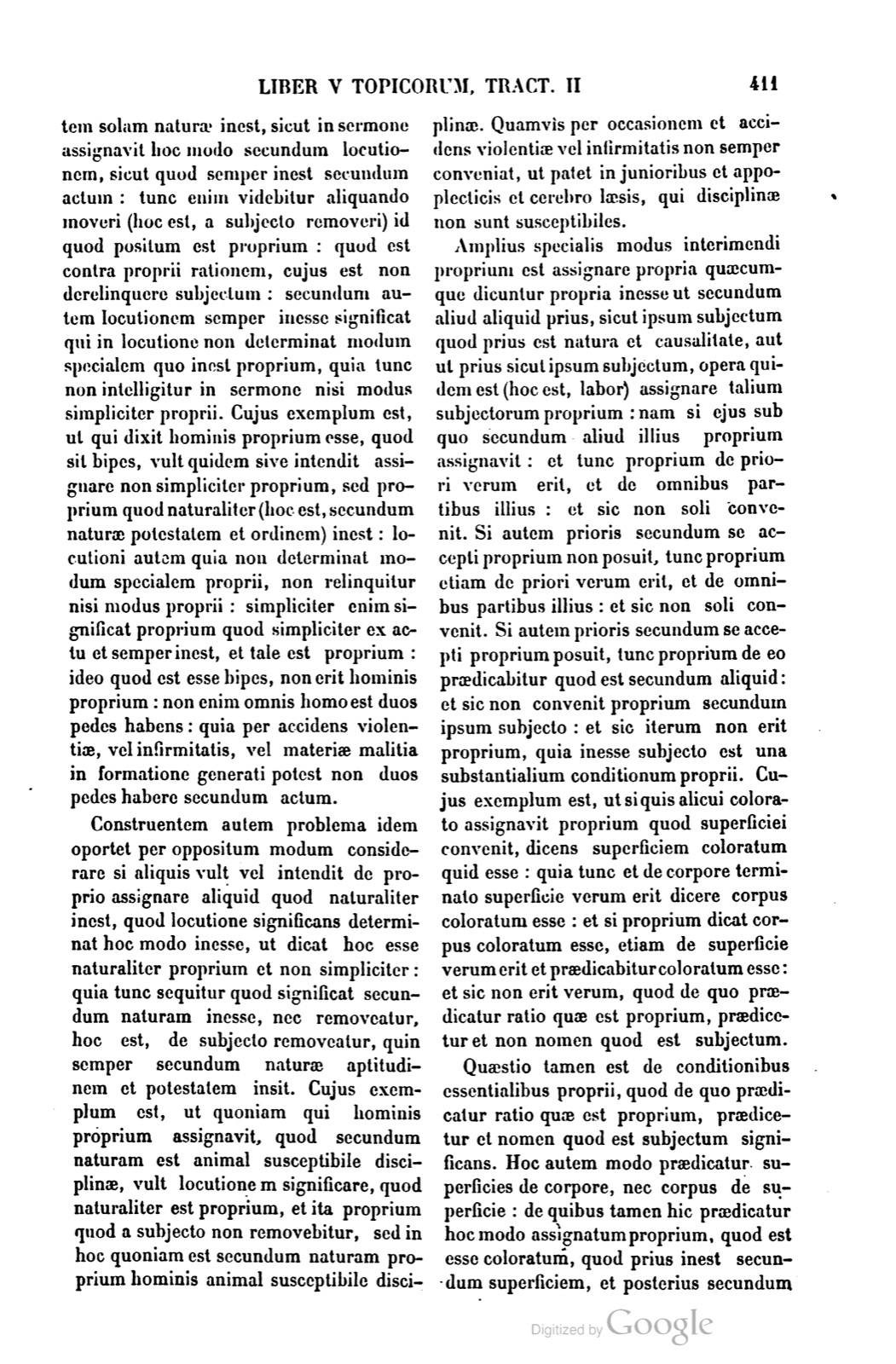
Amplius specialis modus interimendi proprium est assignare propria quaecumque dicuntur propria inesse ut secundum aliud aliquid prius, sicut ipsum subjectum quod prius est natura et causalitate, aut ut prius sicut ipsum subjectum, opera quidem est, hoc est, labor, assignare talium subjectorum proprium: nam si ejus sub quo secundum aliud illius proprium assignavit: et tunc proprium de priori verum erit, et de omnibus partibus illius: et sic non soli convenit. Si autem prioris secundum se accepti proprium non posuit, tunc proprium etiam de priori verum erit, et de omnibus partibus illius: et sic non soli convenit. Si autem prioris secundum se accepti proprium posuit, tunc proprium de eo praedicabitur quod est secundum aliquid: et sic non convenit proprium secundum ipsum subjecto: et sic iterum non erit proprium, quia inesse subjecto est una substantialium conditionum proprii. Cujus exemplum est, ut si quis alicui colorato assignavit proprium quod superficiei convenit, dicens superficiem coloratum quid esse: quia tunc et de corpore terminato superficie verum erit dicere corpus coloratum esse: et si proprium dicat corpus coloratum esse, etiam de superficie verum erit et praedicabitur coloratum esse: et sic non erit verum, quod de quo praedicatur ratio quae est proprium, praedicetur et non nomen quod est subjectum.
Quaestio tamen est de conditionibus essentialibus proprii, quod de quo praedicatur ratio quae est proprium, praedicetur et nomen quod est subjectum significans. Hoc autem modo praedicatur superficies de corpore, nec corpus de superficie: de quibus tamen hic praedicatur in hoc modo assignatum proprium, quod est esse coloratum, quod prius inest secundum superficiem, et posterius secundum corpus. Istae ergo sunt substantiales conditiones modorum proprii, quos per determinationem in locutione factam assignare oportet.
Ergo quidem accidit in quibusdam talibus propriis ut plurimum fieri peccatum aliquod: eo quod non determinatur in locutione circumloquente proprium, quo modo speciali et quibus: nam subjectis determinatur proprium, sive quorum subjectorum antecedentium vel consequentium ponitur proprium sive assignatur. Enumeratis ergo quatuor modis in quibus non determinatur talis modus vel talis in locutione, contingit peccare circa proprium. Dicimus ergo quod omnes conantur assignare aut quod naturaliter inest, eo quod proprium fluit a naturalibus et essentialibus subjecti: et iste est modus primus juxta naturam subjecti proprii acceptus, ut proprium hominis dicitur esse bipes. Aut quod ut nunc inest et alicui, ut alicujus hominis proprium ponitur quatuor digitos habere tantum per naturae defectum vel violentiae infirmitatis: et iste est modus secundus. Aut quod est consequens speciem, velut ignis est proprium subtilissimum esse corporum: quia non nisi in subtilissimo salvatur species ignis: et iste est modus tertius. Aut quod consequitur naturam simpliciter, hoc est, universaliter, velut animalis proprium dicitur esse vivere vita manifesta: quia vita occulta vivere habet plus modos corporis quam animae, cujus proprius effectus est vivere: et iste quidem sumitur vel causatur a substantialibus subjecti, vel deficientibus ab illis: et iste est modus quartus. Aut assignatur modus proprii inhaerentis secundum aliquid ipsi subjecto, velut animae assignatur, quod sit prudens, quod convenit secundum rationem: et iste modus est quintus. Per aliud enim quam per rationabilem partem non est quis prudens nisi per rationem, cui ut prius inest prudentia: et iste est modus sextus. Aut ut id quod convenit subjecto in eo quod aliud habet, ut scientis proprium dicatur irreprobabile esse sub ratione qua convenit quod convenit, et inest per scientiam quam habet prudens: et iste est modus septimus. Nihil enim aliud est scientem irreprobabilem esse sub ratione, quam habere aliquid quo sit irreprobabilis sub ratione. Aut assignatur in eo quod habetur cui convenit gratia ejus quod habetur, ut scientiae ponitur proprium irreprobabile esse sub ratione: hoc enim convenit scienti in eo quod habetur ab ipso scientia irreprobabilis sub ratione: et iste est modus octavus. Aut assignatur proprium in eo quod participatur ab aliquo, sicut essentialiter superius participatur ab inferiori aliquo, sicut animalis proprium dicitur esse sentire, quia participatur ab ipso sensibile: et iste est modus nonus. Sentit enim et aliud quod inferius illo est, ut homo: sed non sentit nisi ut jam hoc participans quod est sensibile. Aut significatur proprium in eo quod aliquid aliud participat ut inferius participat suum superius, sicut dicitur proprium alicujus animalis esse vivere in eo quod participat vitam vel vitae principium: et iste est modus decimus. Quatuor istorum modorum primi sunt juxta proprium sumpti. Sex autem posteriores sumpti sunt juxta modos subjecti, ut communiter dicitur.
Furthermore, a special mode of destroying property is to assign whatever properties are called properties as belonging according to something else prior, such as the subject itself which is prior by nature and causality, or as prior like the subject itself; indeed it is work, that is, labor, to assign the property of such subjects. For if he assigned the property of that thing under which, according to something else, the property of that thing belongs, then the property will be true of the prior and of all the parts of it, and thus it does not belong to it alone. But if he did not posit the property of the prior taken according to itself, then the property will also be true of the prior and of all the parts of it, and thus it does not belong to it alone. But if he posited the property of the prior taken according to itself, then the property will be predicated of that which is according to something, and thus the property does not belong to the subject according to itself; and thus again it will not be a property, because to belong to the subject is one of the substantial conditions of property. An example is this: if someone assigned to some colored thing a property which belongs to surface, by saying that surface is colored something, then it will be true also of body terminated by surface to say that body is colored; and if he says that the property is that body is colored, it will also be true of surface and it will be predicated that it is colored; and thus it will not be true that, of that of which the account which is the property is predicated, the name which is the subject is also predicated.
Nevertheless there is a question concerning the essential conditions of property, namely that of that of which the account which is the property is predicated, the name signifying the subject also be predicated. But in this way surface is predicated of body, and body is not predicated of surface; yet of these there is predicated here, in this assigned mode, the property which is to be colored, which belongs first according to surface and later according to body. These, therefore, are the substantial conditions of the modes of property, which must be assigned through a determination made in the expression.
Therefore, indeed, it happens in certain such properties that some error is made for the most part, because in the expression circumlocuting the property it is not determined by which special mode and for which subjects. For the property is determined by subjects, or the property is posited or assigned of those antecedent or consequent subjects. Therefore, when the four modes in which such and such a mode is not determined in expression have been enumerated, it is possible to err concerning property. Therefore we say that all attempt to assign either what naturally belongs, because property flows from the natural and essential things of the subject, and this is the first mode taken according to the nature of the proper subject, as it is said that to be two-footed is the property of man; or what belongs as now and to some one, as it is posited as the property of some man to have only four fingers through a defect of nature or through violence of infirmity, and this is the second mode; or what is consequent upon the species, for example, it is proper to fire to be the most subtle of bodies, because the species of fire is preserved only in the most subtle, and this is the third mode; or what follows nature simply, that is, universally, for example it is said to be the property of animal to live by manifest life, because to live by hidden life has more of the modes of body than of soul, whose proper effect is to live, and this indeed is taken or caused from the substantial things of the subject, or from things deficient from them, and this is the fourth mode. Or the mode of property inhering according to something in the subject itself is assigned, for example, it is assigned to soul that it is prudent, which belongs according to reason, and this mode is the fifth. For through something other than the rational part no one is prudent except through reason, to which prudence belongs as to what is prior; and this is the sixth mode. Or as that which belongs to the subject in that it has something else, as it may be said to be the property of the knower to be irreprovable under the reason by which what belongs belongs, and it belongs through the science which the prudent man has; and this is the seventh mode. For for the knower to be irreprovable under reason is nothing other than to have something by which he is irreprovable under reason. Or it is assigned in that which is had, to which it belongs by grace of that which is had, as it is posited as the property of science to be irreprovable under reason; for this belongs to the knower in that science irreprovable under reason is had by him, and this is the eighth mode. Or the property is assigned in that which is participated by something, as an essentially superior is participated by some inferior, as it is said to be the property of animal to sense, because the sensible is participated by it; and this is the ninth mode. For something else which is inferior to it also senses, as man does, but it senses only as already participating this which is sensible. Or property is signified in that something else participates, as an inferior participates its superior, as it is said to be the property of some animal to live in that it participates life or the principle of life, and this is the tenth mode. The first four of these modes are taken with respect to the property. But the six later modes are taken with respect to the modes of the subject, as is commonly said.
Possunt autem modi inducti sic assignari: omne enim proprium, aut est simpliciter proprium et in nullo deficiens a ratione proprii: et sic est vere proprium. Aut est in aliquo deficiens a proprii ratione: et tunc secundum quid est proprium, et non vere. Si autem deficit a proprii ratione, cum proprium simpliciter sit aut in eo quod est soli, aut in eo quod est omni inesse. Si deficit in eo quod est omni quod convenit omni et soli et semper: aut deficit in eo quod est omni, et est proprium species quod uni soli convenit, sicut patebit inferius. Si autem deficit ab eo quod est semper inesse: hoc contingit dupliciter. Aut enim respicit tempus simpliciter secundum naturae ordinem determinatum: et hoc est proprium quod naturaliter inest. Aut respicit tempus determinatum ut nunc: et sic est ut nunc proprium. Si autem deficit ab eo quod est soli inesse, hoc convenit etiam alii subjecto: et tunc ista duo quibus inest proprium aut sic se habent ad invicem, quod unum est de essentia alterius: aut non sic se habent, quod unum sit de essentia alterius. Si sic se habent, quod unum sit de essentia alterius, sic est proprium quod participatur, aut ubi illud de cujus essentia est reliquum: et sic est vere proprium in eo quod participat. Si autem unum non est de essentia alterius: tunc accidentaliter se habent ad invicem subjecta quibus inest proprium, et tunc aut se habent ad invicem secundum ordinem susceptionis proprii aequaliter, aut secundum prius et posterius. Si secundum prius et posterius: tunc aut est proprium cui inest per prius, et sic est proprium quod prius inest: aut est ejus cui inest per posterius, et tunc est proprium quod inest secundum aliud. Si autem aequaliter se habeant ad proprii susceptionem: aut ergo assignatur proprium ejus quod habet, et sic dicitur proprium in eo quod habet: aut est ejus quod habetur, et sic est acceptio propriorum.
But the introduced modes can be assigned thus: every property either is property simply and deficient in nothing from the account of property, and thus it is truly property; or it is deficient in some respect from the account of property, and then it is property in a certain respect and not truly. But if it is deficient from the account of property, since property simply consists either in belonging to it alone or in belonging to every one. If it is deficient in that which is every, which belongs to every one, to it alone, and always, then either it is deficient in that which is every, and it is property of the species which belongs to one only, as will be clear below. But if it is deficient from that which is to belong always, this happens in two ways. For either it regards time simply determined according to the order of nature, and this is the property which naturally belongs; or it regards time determined as now, and thus it is property as now. But if it is deficient from that which is to belong to it alone, this also belongs to another subject, and then those two to which the property belongs either are related to one another so that one is of the essence of the other, or they are not so related that one is of the essence of the other. If they are so related that one is of the essence of the other, then it is the property which is participated, or where that of whose essence the remaining thing is occurs; and thus it is truly property in that it participates. But if one is not of the essence of the other, then the subjects to which the property belongs are accidentally related to one another; and then they are related to one another according to the order of receiving the property either equally, or according to prior and posterior. If according to prior and posterior, then either it is the property of that to which it belongs through the prior, and thus it is the property which belongs first; or it belongs to that to which it belongs through the posterior, and then it is the property which belongs according to another. But if they are related equally to the receiving of the property, then either the property is assigned of that which has, and thus it is called property in that it has; or it belongs to that which is had, and thus there is an acceptance of properties.
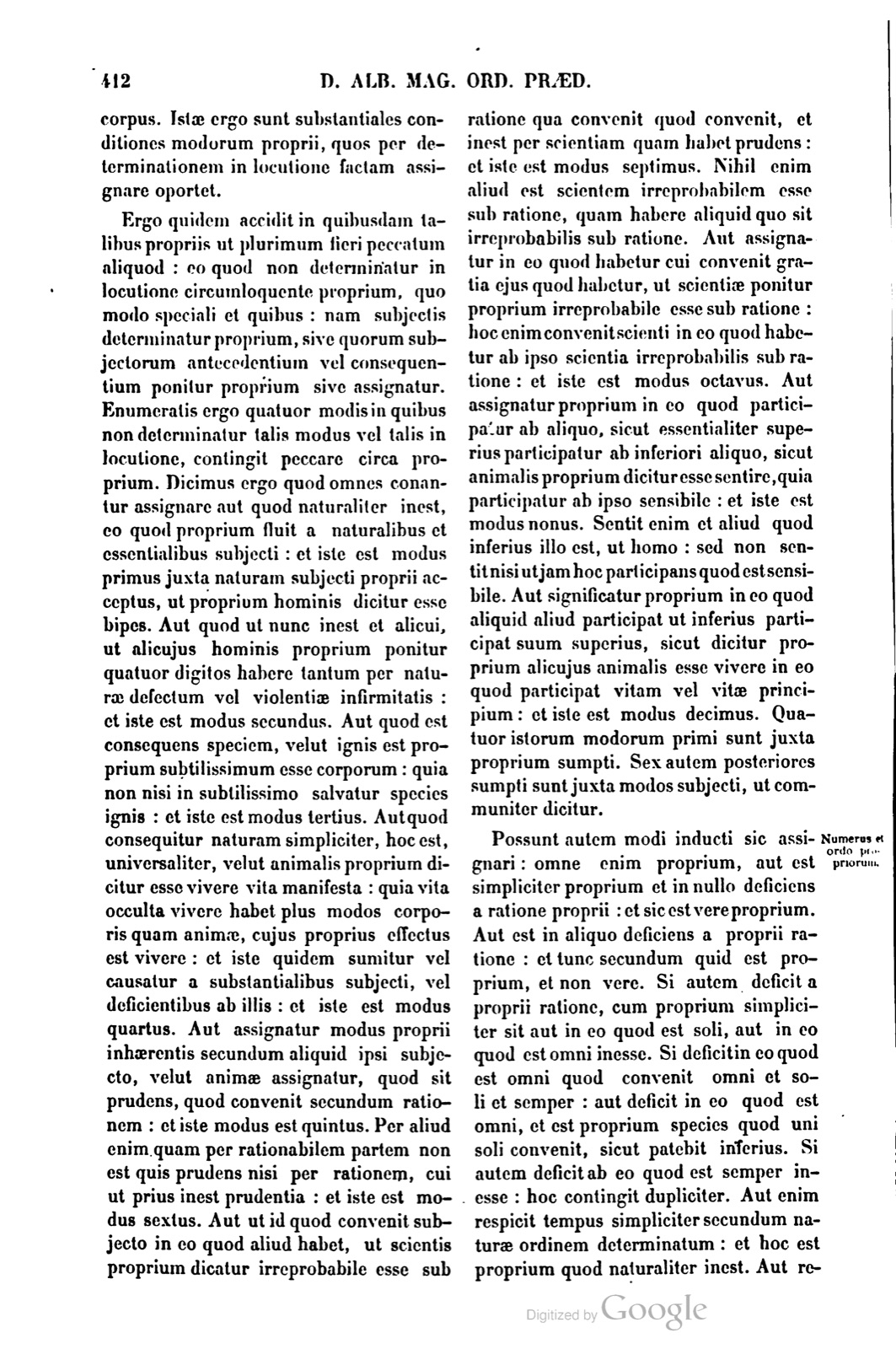
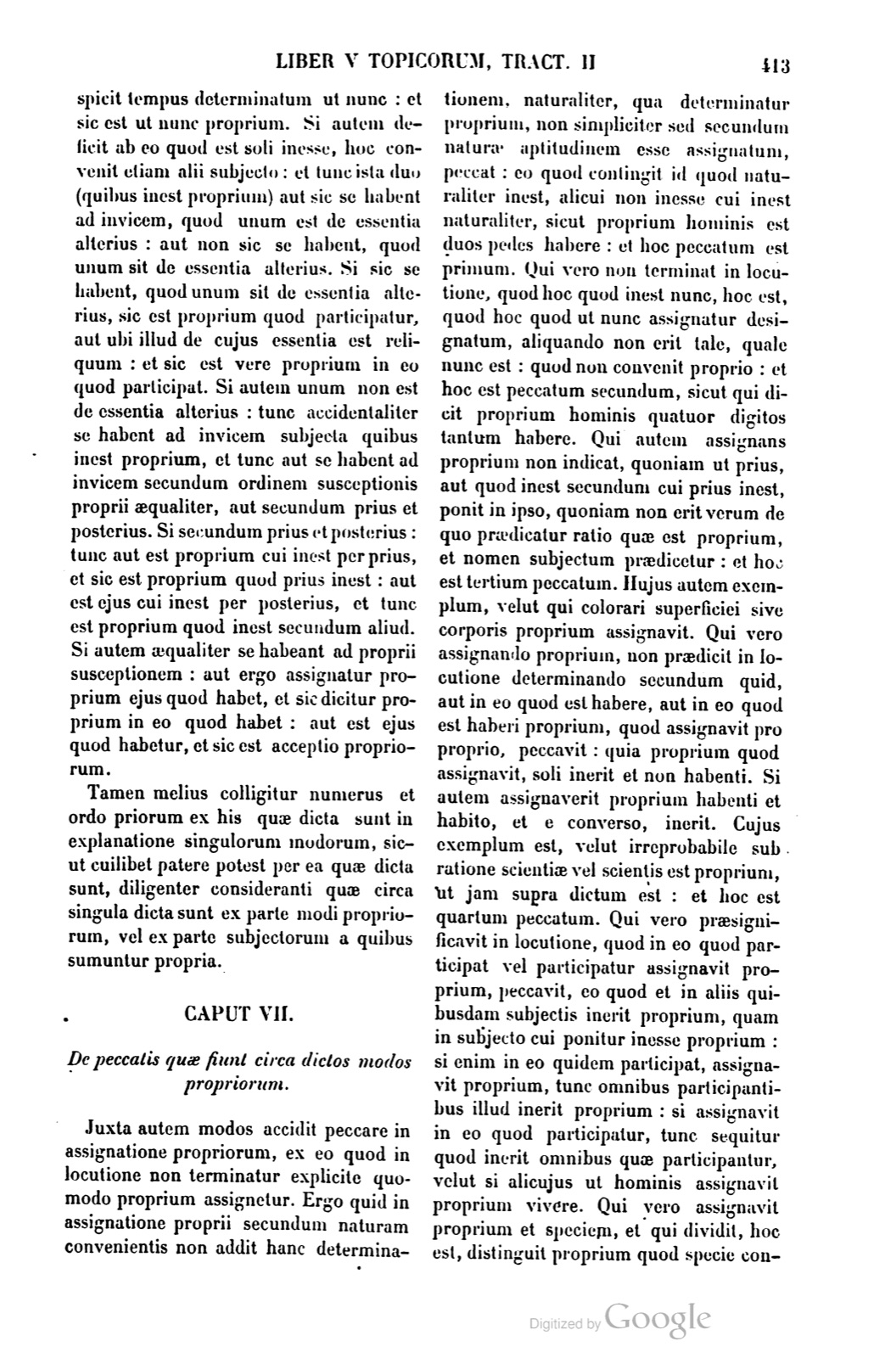
Tamen melius colligitur numerus et ordo priorum ex his quae dicta sunt in explanatione singulorum modorum, sicut cuilibet patere potest per ea quae dicta sunt, diligenter consideranti quae circa singula dicta sunt ex parte modi propriorum, vel ex parte subjectorum a quibus sumuntur propria.
Nevertheless the number and order of the prior modes is better gathered from those things which have been said in the explanation of the individual modes, as can be clear to anyone diligently considering, through the things which have been said, what has been said concerning the individual modes on the part of the mode of properties, or on the part of the subjects from which properties are taken.
If a page does not appear, its photograph has not been uploaded yet.