Volume 2 · pp. 409–410
Chapter V. On the removal of cavillations which can occur.
A marker with ≈ is an approximate page boundary, placed by measure of the text; the page photographs remain the authority. In the paired views, clicking a page marker brings that page into view.
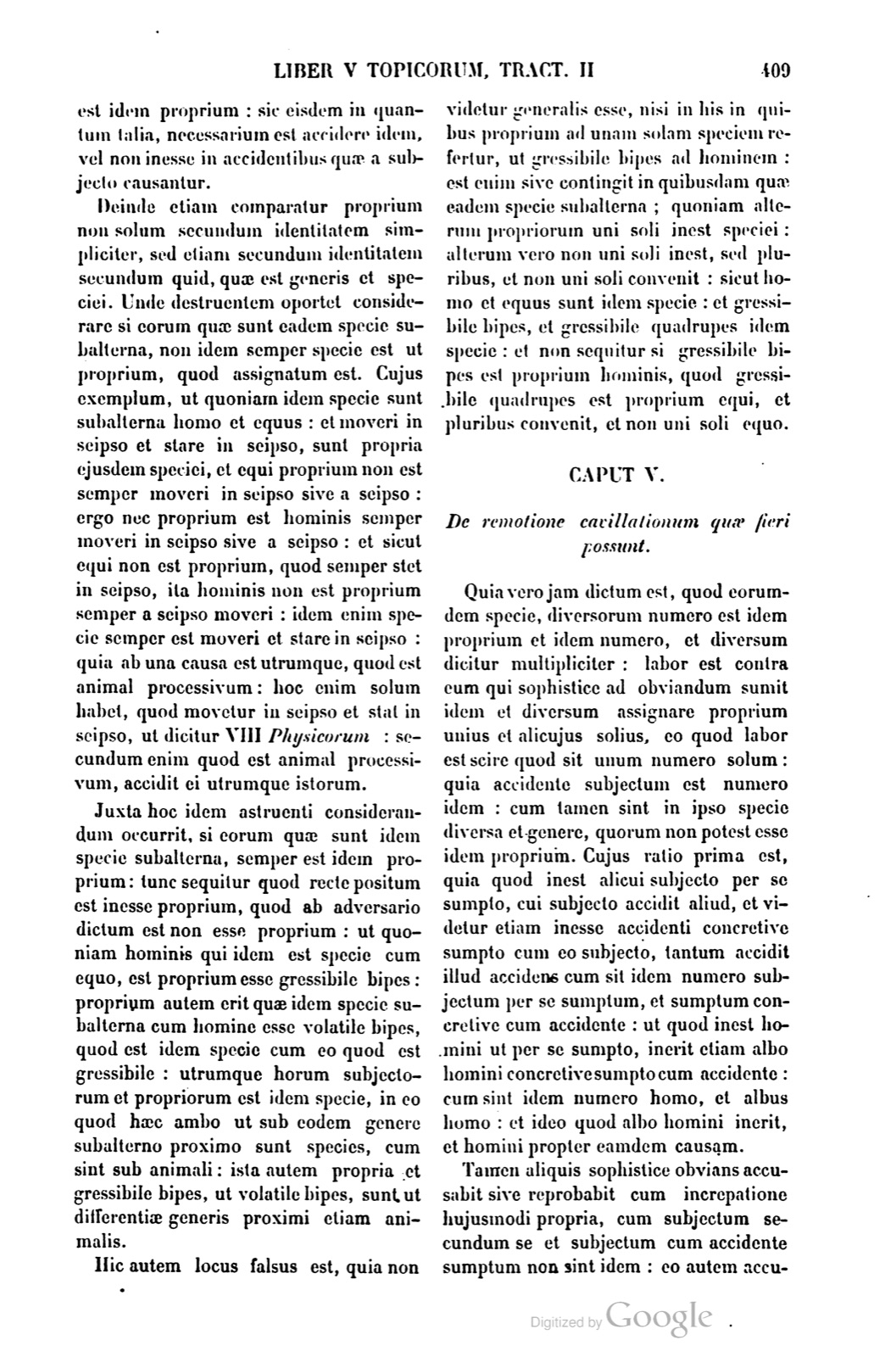
CAPUT V. De remotione cavillationum quae fieri possunt.
Quia vero jam dictum est, quod eorumdem specie, diversorum numero est idem proprium et idem numero, et diversum dicitur multipliciter: labor est contra cum qui sophistice ad obviandum sumit idem et diversum assignare proprium unius et alicujus solius, eo quod labor est scire quod sit unum numero solum: quia accidente subjectum est numero idem: cum tamen sint in ipso specie diversa et genere, quorum non potest esse idem proprium. Cujus ratio prima est, quia quod inest alicui subjecto per se sumpto, cui subjecto accidit aliud, et videtur etiam inesse accidenti concretive sumpto cum eo subjecto, tantum accidit illud accidens cum sit idem numero subjectum per se sumptum, et sumptum concretive cum accidente: ut quod inest homini ut per se sumpto, inerit etiam albo homini concretive sumpto cum accidente: cum sint idem numero homo, et albus homo: et ideo quod albo homini inerit, et homini propter eamdem causam.
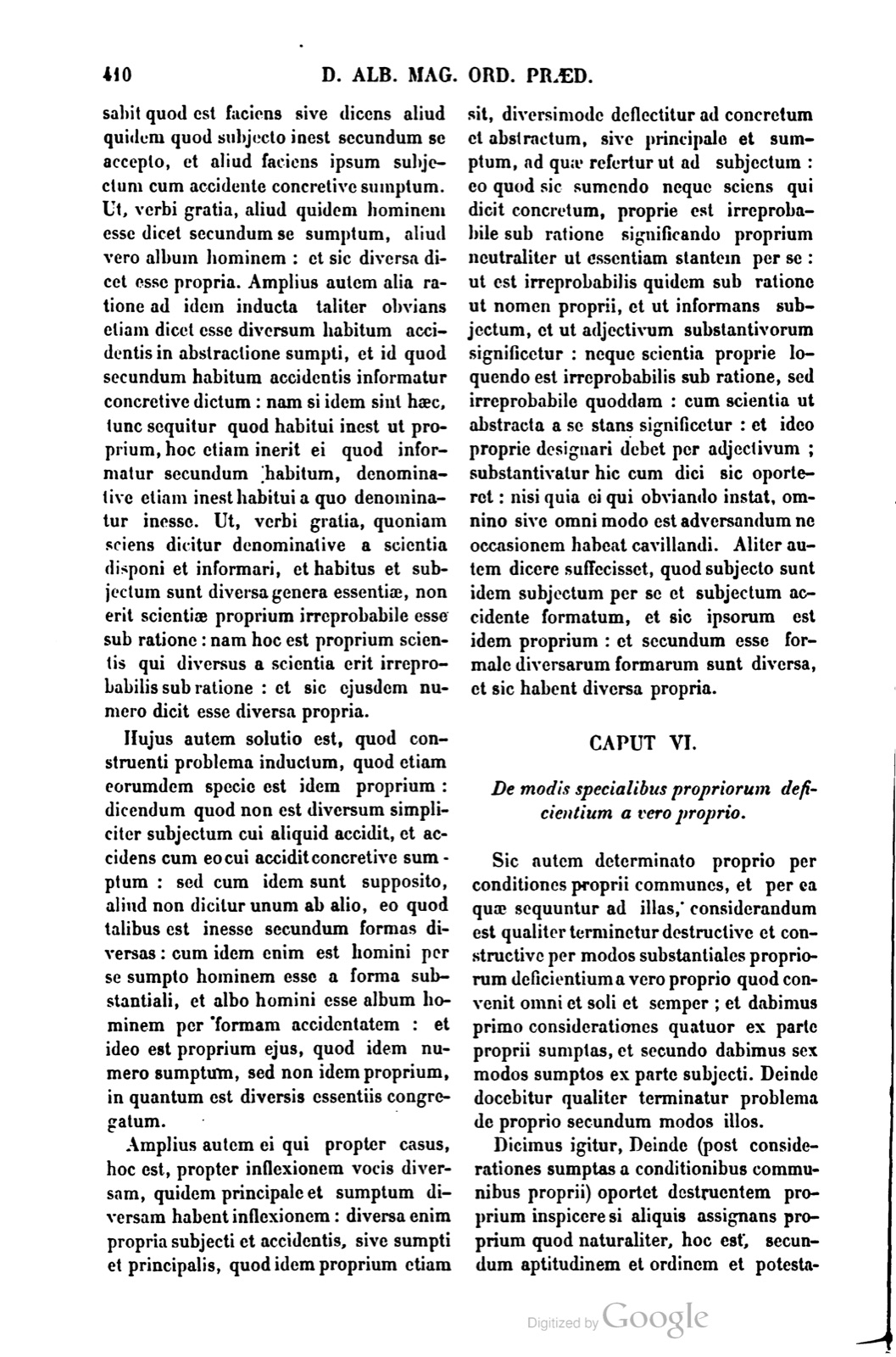
Tamen aliquis sophistice obvians accusabit sive reprobabit cum increpatione hujusmodi propria, cum subjectum secundum se et subjectum cum accidente sumptum non sint idem: eo autem accusabit quod est faciens sive dicens aliud quidem quod subjecto inest secundum se accepto, et aliud faciens ipsum subjectum cum accidente concretive sumptum. Ut, verbi gratia, aliud quidem hominem esse dicet secundum se sumptum, aliud vero album hominem: et sic diversa dicet esse propria. Amplius autem alia ratione ad idem inducta taliter obvians etiam dicet esse diversum habitum accidentis in abstractione sumpti, et id quod secundum habitum accidentis informatur concretive dictum: nam si idem sint haec, tunc sequitur quod habitui inest ut proprium, hoc etiam inerit ei quod informatur secundum habitum, denominative etiam inest habitui a quo denominatur inesse. Ut, verbi gratia, quoniam sciens dicitur denominative a scientia disponi et informari, et habitus et subjectum sunt diversa genera essentiae, non erit scientiae proprium irreprobabile esse sub ratione: nam hoc est proprium scientis qui diversus a scientia erit irreprobabilis sub ratione: et sic ejusdem numero dicit esse diversa propria.
CHAPTER V. On the removal of cavillations which can occur.
But because it has already been said that of things the same in species and diverse in number there is the same property and the same in number, and that diverse is said in many ways, there is work against the one who, sophistically in order to obstruct, takes same and diverse in assigning the property of one thing and of some one thing alone, because it is work to know what is one in number only. For by an accident the subject is the same in number, although nevertheless in it there are things diverse in species and genus, of which there cannot be the same property. The first reason for this is that what belongs to some subject taken through itself, to which subject something else happens, is also seen to belong to the accident taken concretively with that subject, only because that accident happens when the subject taken through itself and the subject taken concretively with the accident are the same in number. Thus what belongs to man as taken through himself will also belong to white man taken concretively with the accident, since man and white man are the same in number; and therefore what will belong to white man will belong also to man for the same cause.
Nevertheless someone obstructing sophistically will accuse or reject such properties with rebuke, since the subject according to itself and the subject taken with an accident are not the same. But he will accuse by doing or saying that what belongs to the subject taken according to itself is one thing, and by making the subject itself taken concretively with the accident another. For example, he will say that to be man taken according to himself is one thing, but white man another, and thus he will say that the properties are diverse. Furthermore, by another argument led to the same point, one obstructing in such a way will also say that the habit of an accident taken in abstraction is diverse from that which, said concretively, is informed according to the habit of the accident. For if these are the same, then it follows that what belongs to the habit as property will also belong to that which is informed according to the habit, and denominatively it also belongs to the habit from which it is denominated to belong. For example, since a knower is said denominatively to be disposed and informed by science, and habit and subject are diverse genera of essence, it will not be the property of science to be irreprovable under reason. For this is the property of the knower, who, diverse from science, will be irreprovable under reason; and thus he says that there are diverse properties of the same thing in number.
Hujus autem solutio est, quod construenti problema inductum, quod etiam eorumdem specie est idem proprium: dicendum quod non est diversum simpliciter subjectum cui aliquid accidit, et accidens cum eo cui accidit concretive sumptum: sed cum idem sunt supposito, aliud non dicitur unum ab alio, eo quod talibus est inesse secundum formas diversas: cum idem enim est homini per se sumpto hominem esse a forma substantiali, et albo homini esse album hominem per formam accidentem: et ideo est proprium ejus, quod idem numero sumptum, sed non idem proprium, in quantum est diversis essentiis congregatum.
Amplius autem ei qui propter casus, hoc est, propter inflexionem vocis diversam, quidem principale et sumptum diversam habent inflexionem: diversa enim propria subjecti et accidentis, sive sumpti et principalis, quod idem proprium etiam sit, diversimode deflectitur ad concretum et abstractum, sive principale et sumptum, ad quae refertur ut ad subjectum: eo quod sic sumendo neque sciens qui dicit concretum, proprie est irreprobabile sub ratione significando proprium neutraliter ut essentiam stantem per se: ut est irreprobabilis quidem sub ratione ut nomen proprii, et ut informans subjectum, et ut adjectivum substantivorum significetur: neque scientia proprie loquendo est irreprobabilis sub ratione, sed irreprobabile quoddam: cum scientia ut abstracta a se stans significetur: et ideo proprie designari debet per adjectivum; substantivatur hic cum dici sic oporteret: nisi quia ei qui obviando instat, omnino sive omni modo est adversandum ne occasionem habeat cavillandi. Aliter autem dicere suffecisset, quod subjecto sunt idem subjectum per se et subjectum accidente formatum, et sic ipsorum est idem proprium: et secundum esse formale diversarum formarum sunt diversa, et sic habent diversa propria.
But the solution of this is that, for the one constructing the introduced problem, namely that also of things the same in species there is the same property, it must be said that the subject to which something happens and the accident taken concretively with that to which it happens are not simply a diverse subject. But since they are the same in supposit, one is not said to be other than the other, because belonging to such things is according to diverse forms. For since to be man belongs to man taken through himself from the substantial form, and to be white man belongs to white man through an accidental form, therefore it is the property of that which is taken as the same in number, but not the same property insofar as it is gathered together by diverse essences.
Furthermore, to the one who says that because of cases, that is, because of the diverse inflection of the word, the principal and the taken term indeed have a diverse inflection: for diverse properties of subject and accident, or of the taken and the principal, so that there is also the same property, are bent in diverse ways to concrete and abstract, or principal and taken, to which they are referred as to subject. Because by taking it so, neither knower, which states the concrete, is properly irreprovable under reason, by signifying the property neutrally as an essence standing through itself, as irreprovable under reason is indeed the name of the property; and so that it may be signified as informing the subject and as an adjective of substantives. Nor, properly speaking, is science irreprovable under reason, but a certain irreprovable thing, since science is signified as an abstract standing by itself; and therefore it ought properly to be designated through an adjective. It is substantivized here, although it ought to be said in that way, except that one who presses by obstructing must be opposed wholly, or in every way, lest he have occasion for cavilling. Otherwise it would have sufficed to say that the subject through itself and the subject formed by an accident are the same as subject, and thus their property is the same; but according to the formal being of diverse forms they are diverse, and thus they have diverse properties.
If a page does not appear, its photograph has not been uploaded yet.