Volume 2 · pp. 402–409
Chapter IV. On the destruction and construction of the problem concerning property according to the conditions of property taken as compared to some subject.
A marker with ≈ is an approximate page boundary, placed by measure of the text; the page photographs remain the authority. In the paired views, clicking a page marker brings that page into view.
CAPUT IV. De interemptione et constructione problematis de proprio penes conditiones proprii sumptas comparati ad aliquod subjectum.
Deinde destruere volenti problema de bonitate proprii comparati ad aliud aliquod sicut ad subjectum, et in his conditionibus proprii comparati, primi inspiciendum est ad subjectum proprium ejusdem proprii, quod si bene esse assignavit. Inspiciendum ergo si eodem subjecto usus est in proprio, cujus proprium assignavit cum aliquo eorum quae sunt ejusdem subjecti vel partes essentiales, ut genus, et differentia: vel pars subjectiva, ut animalis pars est homo: tunc enim non erit bene positum proprium. Et hujus ratio est, quia causa discendi et notificandi subjectum assignatur proprium: si ergo assumat idem, assumet id quod similiter sive aequaliter ignotum est, et sic non potest declarare subjectum. Si autem assumat aliquid eorum quae sunt subjecti et pars subjecti, assumet in proprio quod posterius erit subjecto, et sic iterum declarare non poterit, quia non est notius illo: propter quod non fit sive non contingit per tale proprium magis aliquid discere sicut per declarans subjectum: et sic inutiliter assignatur proprium. Hujus exemplum est, si quis dixit animalis proprium esse, quod sit substantia, cujus species est homo: aliquo usus est illorum quae sunt animalis ut substantia cum adjunctis, et aliquo usus est quod est animalis pars ut homo: et ideo non bene positum est proprium.
Astruenti autem valet uti hac consideratione per oppositum, quod inspiciat si nec eodem subjecto, nec aliquo eorum quae sunt ejus, utitur in proprii assignatione: tunc enim erit bene positum proprium. Cujus exemplum est, ut qui ponit animalis esse proprium, quod sit ex anima et corpore, neque eodem subjecto
CHAPTER IV. On the destruction and construction of the problem concerning property according to the conditions of property taken as compared to some subject.
Next, for one wishing to destroy the problem concerning the goodness of a property compared to some other thing as to a subject, and in these conditions of the compared property, first one must inspect the subject proper to that same property, whether he has assigned its well-being. Therefore it must be inspected whether he has used the same subject in the property, of which he assigned the property, together with one of those things which belong to the same subject or are essential parts, as genus and difference; or a subjective part, as man is a part of animal. For then the property will not be well posited. And the reason for this is that property is assigned as a cause of learning and making known the subject. Therefore, if he assumes the same thing, he will assume that which is similarly or equally unknown, and thus he cannot declare the subject. But if he assumes something of those things which belong to the subject and are a part of the subject, he will assume in the property what is posterior to the subject, and thus again he will not be able to declare it, because it is not better known than that subject. For this reason through such a property there is not made, or it does not happen, that one learns something more, as through something declaring the subject; and thus the property is uselessly assigned. An example of this is if someone said that the property of animal is that it is a substance whose species is man. He used something of those things which belong to animal, namely substance with adjuncts, and he used something which is a part of animal, namely man; and therefore the property has not been well posited.
But for one establishing, it is useful to use this consideration by the opposite, namely that he inspect whether he uses neither the same subject nor any of those things which belong to it in the assignment of the property. For then the property will be well posited. An example is one who posits that it is proper to animal that it is from soul and body: he uses neither the same subject
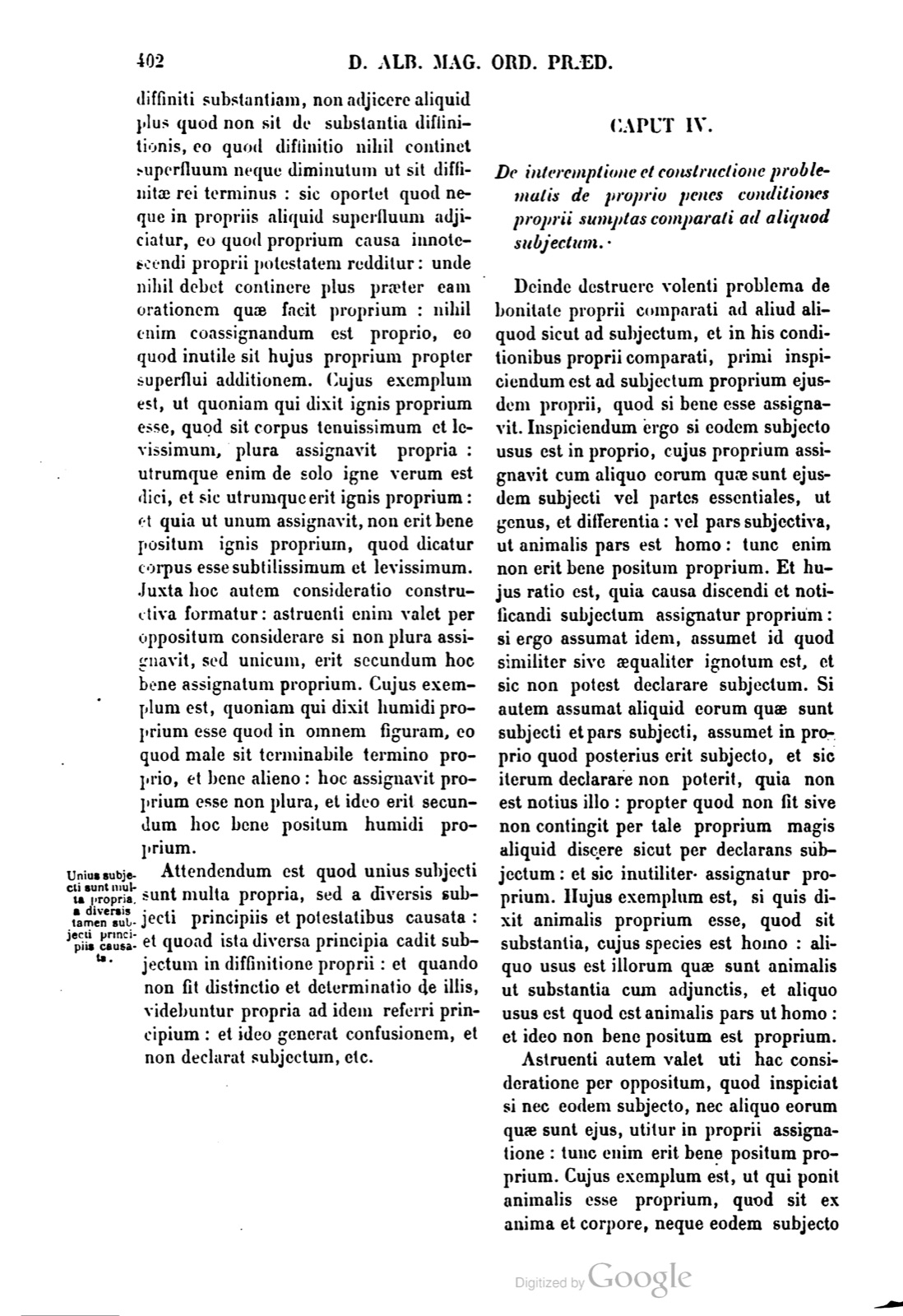
cujus assignatum est proprium, neque aliquo quod subjecti sit ut pars subjectiva, usus est in assignatione proprii: et ideo bene erit positum secundum hoc proprium. Eodem modo in aliis considerandum positis in assignatione proprii quae non faciunt notius subjectum.
Unde ad considerandum problema de bonitate proprii, considerandum si aliquis in assignatione proprii, aut opposito subjecti, aut eo quod simul natura est cum ipso, aut aliquo quod posterius est illo quoad cognitionem usus est: tunc enim non erit bene positum proprium: nam opposita simul sunt natura et neutrum notius est reliquo in quantum sunt opposita: tunc enim non erit bene positum proprium, quia quod est simul natura vel posterius subjecto, non potest facere notius subjectum. Cujus exemplum est, ut qui dixit boni proprium esse quod malo maxime opponitur, opposito usus est boni: non erit ergo secundum hoc bene assignatum boni proprium.
Astruenti autem per oppositum hac consideratione utendum est, inspiciendo si nullo usus est neque opposito, neque quod simul est natura, neque posteriore: erit enim secundum hoc bene assignatum proprium. Cujus exemplum est, qui posuit disciplinae proprium, quod sit opinio sive conceptus maxime faciens fidem, nullo usus est neque opposito, neque quod sit omnino simul natura, neque posteriore: erit ergo secundum hoc bene positum proprium disciplinae. Disciplinam autem dico eam quae in disciplinabilibus et demonstrationibus conclusionum acceptus est habitus, quae opinio est in opinante, et non ab opinabili dicta: eo quod accipit demonstrabile per medium non proprium et proximum, sed per effectum vel causam remotam vel communem.
Hic autem cavendum est, quia privatio et habitus sunt opposita: et tamen non sunt simul natura, quia privatio notificatur per habitum. Sed ad hoc dicendum est, quod opposita sunt simul natura in quantum opposita, et quod habitus notificat privationem, non est ex hoc quod opponitur, sed ex hoc quod est principium et materiale et naturale ad privationem: quia non est privatio nisi habitus, et est privatio in aptitudine ad habitum: unde quod opposita non debent poni in proprio, intelligendum est in quantum opposita sunt.
Et quod dictum est quod non debet esse posterius, cum tamen proprium sit de genere accidentium: et similiter particulae quae ponuntur in oratione circumloquente proprium, sunt accidentales, et sic posteriores subjecto. Intelligendum quoad illam cognitionem qua proprium notificat subjectum, et hoc est quoad cognitionem. Similiter proprium notificat subjectum cum cadat in ejus diffinitione. Et quod alicui dicunt quod species potest considerari secundum essentiam sive secundum substantiam, et quoad esse. Et si secundum substantiam, tunc nihil habet prius nisi genus et differentiam. Et si consideretur quoad esse, sic proprium prius: quia dicit aptitudinem ad esse quae prior est quam esse: non est curandum, quia falsum est, cum dicatur ab Avicenna, quod proprium est posterius ipso esse speciei, sicut id quod ab esse speciei fluit, et non est essentia quae sit ante esse. Et hoc patet, quia subjectum secundum esse acceptum cadit in diffinitione proprii: neque potest esse subjectum nisi secundum esse perfectum.
Deinde destruenti quidem inspiciendum est si quis assignaverit proprium, id quod non semper sequitur et non conversim ipsum subjectum: hoc enim posterius est et non prius secundum aliquem modum: nec potest esse proprium, nisi quando et in particulari, de quo non potest esse cognitio per rationem: unde hoc aliquando fit non proprium: unde non erit bene positum hujus proprium. Cujus ratio est, quia id in quo comprehendimus idem proprium inesse sicut in subjecto, de hoc non de necessitate et per se dicitur proprium, cum aliquando non insit: et sic non semper erit verum proprium praedicatum de subjecto, quia nomen proprii de subjecto aliquando non praedicatur secundum actum. Neque etiam comprehendimus ut nunc non inesse proprium: sed nomen negatum de ipso non de necessitate dicetur eidem non inesse, sed quando inest contingenter, quando abest contingenter, cum proprium debeat aut de necessitate inesse, aut de necessitate non inesse, propter hoc quia non servat maximas et regulas proprii, non erit bene positum proprium.
of which the assigned thing is the property, nor has he used in the assignment of the property anything which belongs to the subject as a subjective part; and therefore according to this the property will be well posited. In the same way one must consider, in the case of other things posited in the assignment of a property, those things which do not make the subject better known.
Hence, for considering the problem concerning the goodness of property, one must consider whether in the assignment of the property someone has used either the opposite of the subject, or that which is simultaneous in nature with it, or something which is posterior to it with respect to cognition. For then the property will not be well posited, because opposites are simultaneous by nature and neither is better known than the other insofar as they are opposites. Then, therefore, the property will not be well posited, because what is simultaneous by nature with the subject, or posterior to the subject, cannot make the subject better known. An example of this is one who said that it is proper to good that it is most opposed to evil; he used the opposite of good. Therefore according to this the property of good will not be well assigned.
But one establishing must use this consideration through the opposite, by inspecting whether he has used nothing opposite, nor something simultaneous by nature, nor something posterior; for according to this the property will be well assigned. An example is one who posited as the property of discipline that it is an opinion or concept most making faith; he used nothing opposite, nor anything wholly simultaneous by nature, nor posterior; therefore according to this the property of discipline will be well posited. By discipline, however, I mean that habit accepted in things capable of discipline and in demonstrations of conclusions, which opinion is in the one opining and is not named from the opinable; because it receives the demonstrable through a middle term not proper and proximate, but through an effect or remote or common cause.
Here, however, one must beware, because privation and habit are opposites, and yet they are not simultaneous by nature, because privation is made known through habit. But to this it must be said that opposites are simultaneous by nature insofar as they are opposites; and that habit makes privation known is not from the fact that it is opposed, but from the fact that it is a principle, material and natural, toward privation. For there is no privation except of a habit, and privation is in aptitude toward habit. Hence the statement that opposites ought not to be posited in a property must be understood insofar as they are opposites.
And as to what has been said, that what is posterior ought not to be, although property is of the genus of accidents, and similarly the particles which are placed in the expression circumlocuting the property are accidental and thus posterior to the subject: this must be understood with respect to that cognition by which the property makes the subject known, and this is with respect to cognition. Similarly, property makes the subject known when the subject falls in its definition. And as to what some say, that species can be considered according to essence or according to substance and with respect to being, and if according to substance, then it has nothing prior except genus and difference, but if it is considered with respect to being, then property is prior because it states aptitude to being, which is prior than being: this is not to be cared for, because it is false, since Avicenna says that property is posterior to the very being of the species, as that which flows from the being of the species, and is not an essence that exists before being. And this is clear, because the subject taken according to being falls in the definition of property; nor can there be a subject except according to perfect being.
Next, one destroying must inspect whether someone has assigned as property that which does not always follow and does not conversely follow the subject itself. For this is posterior and not prior according to some mode; nor can it be a property except when and in the particular, concerning which there cannot be cognition through reason. Hence this at some time becomes not a property; hence the property of this thing will not be well posited. The reason for this is that, concerning that in which we comprehend the same property to belong as in a subject, property is not said of it of necessity and through itself, since sometimes it does not belong. And thus the property predicated of the subject will not always be true, because the name of the property is sometimes not predicated of the subject according to act. Nor do we comprehend property as now not belonging; rather, the name negated of it will not be said to belong necessarily to that same thing, but when it belongs contingently and when it is absent contingently. Since property ought either to belong of necessity or not to belong of necessity, because it does not preserve the maxims and rules of property, the property will not be well posited.
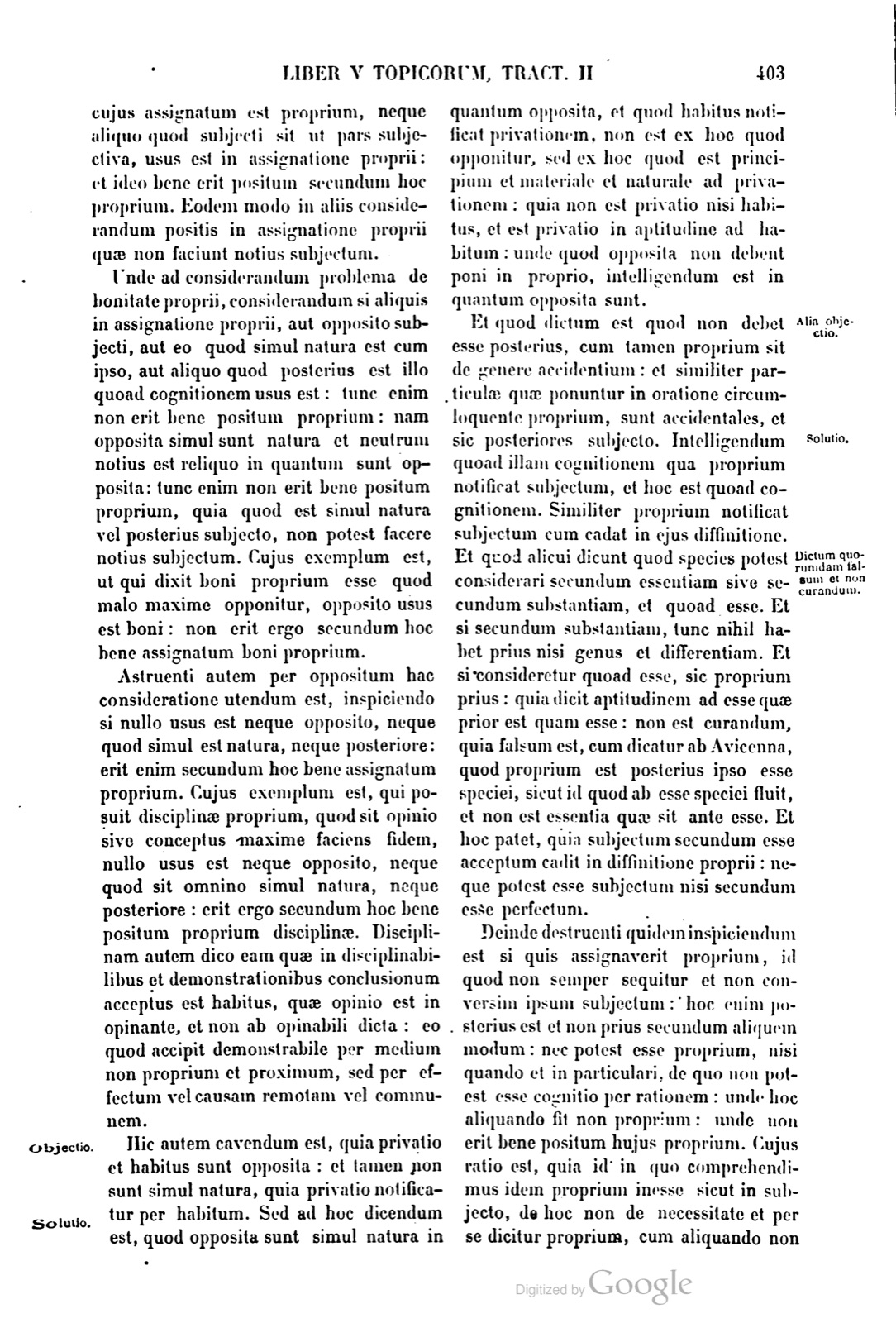
Amplius autem ad hoc alia ratio est: quia quando assignavit quis tale proprium, si quidem est tale ut ipsum quandoque inest, et quandoque non inest: vel si non est manifestum si inest, vel non inest: tamen tale sit proprium quod sit vel contingit amittere: non ergo erit planum et notum tale proprium quod semper non inest. Cujus exemplum est, ut qui posuit proprium animalis moveri quidem et stare. Quandoque enim movetur et quandoque stat: et ideo non erit bene positum proprium.
Astruenti autem eadem consideratione per oppositum utendum, et considerandum si aliquis tale proprium assignavit quod de necessitate semper inest et sequitur subjectum: erit enim bene positum secundum hoc proprium. Cujus exemplum est, ut qui posuit virtutis proprium in comparatione ad subjectum sive ad eum cujus est virtus, quod habentem facit studiosum sive virtuosum, assignavit proprium quod semper sequitur cujus est proprium: et ideo quoad hoc bene positum est proprium.
Deinde secundum eamdem considerationem destruenti est considerandum, si aliquis quod ut nunc proprium est assignans, non determinavit per aliud in sermone positum, quod ut nunc et non simpliciter: tunc non erit bene positum tale proprium. Cujus quidem prima ratio est: quoniam tale proprium fit extra morem sive consuetudinem assignandi proprium: hoc enim tale secundum omne tempus assignari consuevit: et quod fit extra morem sive consuetudinem assignandi proprium, indiget determinatione: quia aliter intelligitur secundum morem aliorum propriorum. Solent autem plerumque secundum morem omnes Philosophi proprium assignare id quod semper sequitur subjectum. Secunda autem consideratio sive ratio est, quia est obscurum utrum tale sit si non determinavit assignans tale proprium, quod ut nunc et non simpliciter voluit assignare proprium.
Eadem autem consideratio per oppositum modum inspecta valet astruenti, si aliquis ut nunc proprium assignans determinavit in sermone, quoniam ut nunc proprium assignavit: nec enim inconvenienter sic determinando dixit: et ideo erit secundum hoc bene positum tale proprium ut nunc. Cujus exemplum est, ut qui dixit, quoniam alicujus hominis proprium est ambulare nunc, vel ut nunc, hoc per hunc terminum segregans ut nunc proprium a simpliciter proprio: et ideo secundum hoc bene erit positum tale proprium.
Considerandum deinde destruenti si aliquod tale assignaverit proprium quod inesse alio modo non est manifestum quam sensu: tunc enim proprium non erit recte assignatum: sensibile enim quod ex solo sensu manifestum factum est, nec aliunde cognoscitur, incertum est: cum parum post amisso circa eum sensu ejus etiam cognitionem amittamus. Dubium est enim tunc, amisso circa eum sensu, utrum adhuc insit cui prius inerat: eo quod sensu solo cognoscitur. Erit autem hoc verum in his quae scimus consequi non ex necessitate, aut semper. Si enim ex necessitate sciremus ea consequi, amissa adhuc sensatione circa ipsa cognoscemus et quod insunt cui prius inerant. Hujus autem dicti exemplum est, ut si quis posuerit hoc solis proprium esse, scilicet astrum quod fertur super terram lucidissimum: hic enim tali aliquo usus est ut proprio, scilicet super terram ferri, quod, ut patet, sensu cognoscitur: et ideo per hoc non est assignatum solis proprium: quoniam ignotum est quantum ad sensum, quum sol iverit in occasum, utrum adhuc feratur super terram, eo quod tunc amisimus sensum circa ipsum.
Furthermore, there is another reason for this: because when someone has assigned such a property, if indeed it is such that it sometimes belongs and sometimes does not belong, or if it is not manifest whether it belongs or does not belong, yet such a property is or can be lost, then such a property which does not always belong will not be plain and known. An example is one who posited as the property of animal both to be moved and to stand still. For sometimes it is moved and sometimes it stands still, and therefore the property will not be well posited.
But one establishing must use the same consideration through the opposite, and one must consider whether someone has assigned such a property as belongs of necessity always and follows the subject; for according to this the property will be well posited. An example is one who posited the property of virtue in comparison to the subject, or to him whose virtue it is, namely that it makes the one having it studious or virtuous. He assigned a property which always follows that whose property it is, and therefore with respect to this the property is well posited.
Then, according to the same consideration, one destroying must consider whether someone, assigning that which is a property as now, has not determined by something else placed in the speech that it is as now and not simply; then such a property will not be well posited. The first reason for this is that such a property is made outside the manner or custom of assigning a property; for such a thing is customarily assigned according to all time. And what is done outside the manner or custom of assigning a property needs determination, because otherwise it is understood according to the manner of other properties. For the most part all the Philosophers are accustomed, according to custom, to assign as property that which always follows the subject. The second consideration or reason is that it is obscure whether such is the case if the one assigning such a property has not determined that he wished to assign a property as now and not simply.
But the same consideration inspected through the opposite mode is useful to one establishing, if someone, assigning a property as now, has determined in speech that he assigned it as a property as now. For he did not speak inconveniently by determining it in this way, and therefore according to this such a property as now will be well posited. An example is one who said that it is proper to some man to walk now, or as now, separating this property as now from property simply by this term; and therefore according to this such a property will be well posited.
Next, one destroying must consider whether he has assigned any such property whose belonging is not manifest in another way than by sense. For then the property will not be rightly assigned; for a sensible thing which has been made manifest by sense alone, and is not known from elsewhere, is uncertain, since a little later, when sense concerning it has been lost, we also lose cognition of it. For then, when sense concerning it has been lost, it is doubtful whether it still belongs to that to which it previously belonged, because it is known by sense alone. But this will be true in those things which we know to follow not of necessity or always. For if we knew that they follow of necessity, even when sensation about them has been lost, we would still know that they belong to those to which they previously belonged. An example of what has been said is if someone posited this to be the property of the sun, namely that it is the brightest star borne over the earth. For he used such a thing as property, namely being borne over the earth, which, as is clear, is known by sense; and therefore by this the property of the sun has not been assigned, because it is unknown with respect to sense, when the sun has gone into its setting, whether it is still borne over the earth, since then we have lost sense concerning it.
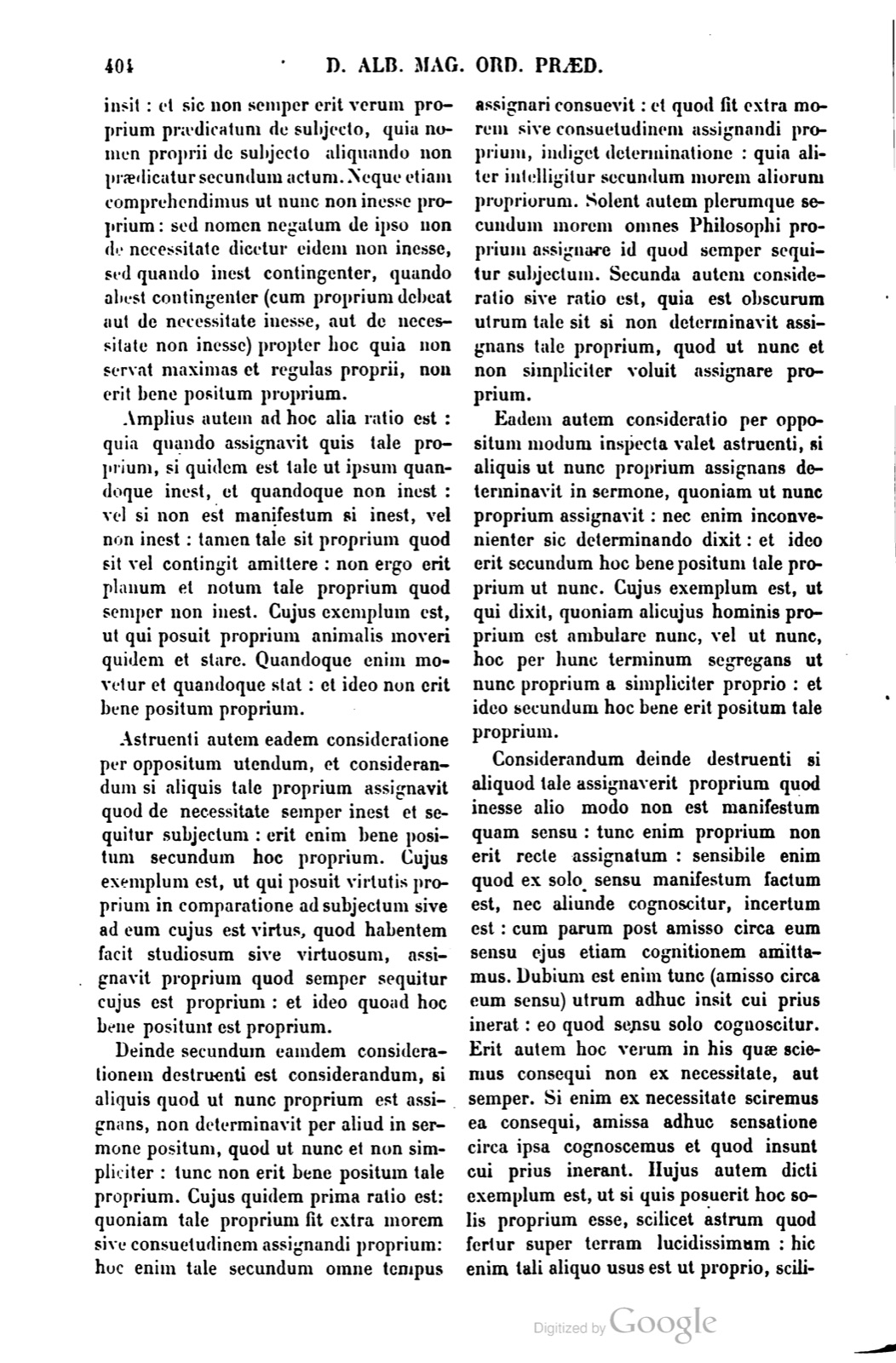
Sed per oppositum volenti astruere proprium inspiciendum si tale assignatum sit proprium, quod non solo sensu sit manifestum: sed si est sensibile cum hoc etiam ex necessitate inesse palam sit: hoc enim modo bene positum ac recte assignatum est proprium. Cujus exemplum est, ut si quis posuerit superficiei proprium esse hoc, quod est primum coloratum esse: est enim superficies immediatum subjectum coloris: tunc sensibili quidem aliquo usus est proprio: sed tali usus est proprio, quod licet sensibile sit, tamen manifestum est ipsum semper inesse superficiei etiam absque sensu: quare hoc modo convenienter erit assignatum superficiei proprium.
Destruenti postea valet quidem haec consideratio, ut si diffinitionem ut proprium assignavit: non enim oportet ipsum proprium quid est esse seu rei essentiam indicare. Cujus exemplum est: quoniam qui dixit animal gressibile bipes esse hominis proprium, assignans quid est esse hominis, assignavit, hoc est, assignare credidit, hominis proprium. Non igitur bene assignatum est hominis proprium. Diximus autem non oportere proprium indicare quid est esse rei: quoniam duplex est proprium, ut in primo hujus scientiae libro dictum est. Aliud quidem quod quid est esse rei indicans, ut diffinitio: aliud autem non, ut proprium de quo hic loquimur. Diximus etiam animal gressibile bipes esse hominis diffinitionem, et quid est esse ejus indicare, non curantes de exemplo, licet rei veritas sit alia.
Volenti autem astruere intuendum si illud ut proprium assignavit, quod conversim praedicatur et non indicat quid est esse rei: et si ita se habuerit, tunc erit secundum hoc bene assignatum proprium. Ut verbi gratia, qui posuit animal mansuetum natura esse hominis proprium, assignavit tale hominis proprium quod non est quid est esse significans: et tunc secundum hoc bene assignatum erit hominis proprium.
Confert deinde destruenti quidem si assignans proprium non posuerit ipsum in quid est, hoc est, in genere suo: nam oportet in propriis accidentalibus ita assignare proprium genus, sicut etiam in diffinitionibus et postea addere reliqua distinguentia et sic separare: et ideo quod non est hoc modo positum proprium, non erit bene assignatum. Cujus exemplum est, ut qui dixit animam habere, esse animalis proprium, iste non posuit in quid est omne animal: et ideo hoc non erit bene positum animalis proprium.
Sed si quidem cujus est proprium assignaverit, ponens in quid ipsum sit, et reliqua superaddat separantia et distinguentia, construenti proficit, et erit secundum hoc bene assignatum proprium, ut qui proprium hominis assignavit animal disciplinae susceptibile, proprium hominis assignavit, ponens ipsum in quid est, hoc est, in genere suo: animal enim genus hominis existens dicitur etiam genus in quod, hoc est, genus subjectum proprietatis hominis, licet non sit subjectum adaequatum: et secundum hunc modum erit bene positum hominis proprium.
But through the opposite, one wishing to establish a property must inspect whether such a property has been assigned which is not manifest by sense alone; but if it is sensible, whether together with this it is also clear that it belongs of necessity. For in this way the property has been well posited and rightly assigned. An example is if someone posited this to be the property of surface, that it is the first colored thing. For surface is the immediate subject of color. Then indeed he used something sensible as the property; but he used such a property that, although it is sensible, nevertheless it is manifest that it always belongs to surface even apart from sense. Therefore in this way the property of surface will suitably be assigned.
Afterward this consideration is useful to one destroying, namely if he has assigned a definition as property. For the property itself ought not to indicate what-it-is-to-be or the essence of the thing. An example is this: one who said that an animal walking and two-footed is the property of man, by assigning the what-it-is-to-be of man, assigned, that is, believed that he assigned, the property of man. Therefore the property of man has not been well assigned. But we have said that property ought not to indicate the what-it-is-to-be of a thing, because property is twofold, as was said in the first book of this science. One kind indicates the what-it-is-to-be of the thing, as definition does; another does not, as the property about which we are speaking here. We have also said that walking, two-footed animal is the definition of man and indicates his what-it-is-to-be, not caring about the example, although the truth of the thing is otherwise.
But one wishing to establish must look whether he assigned as property that which is predicated conversely and does not indicate the what-it-is-to-be of the thing; and if it has itself in this way, then according to this the property will be well assigned. For example, one who posited being an animal tame by nature as the property of man assigned such a property of man as does not signify what-it-is-to-be; and then according to this the property of man will be well assigned.
Next it is advantageous to one destroying if the one assigning the property has not posited it in what it is, that is, in its genus. For in accidental properties one ought to assign the genus of the property in the same way as also in definitions, and afterward to add the remaining things that distinguish, and thus to separate. And therefore a property which has not been posited in this way will not be well assigned. An example is this: one who said that having a soul is the property of animal did not posit every animal in what it is; and therefore this will not be well posited as the property of animal.
But if someone has assigned that of which it is the property by positing what it is, and adds the rest that separate and distinguish, this profits one establishing, and according to this the property will be well assigned. Thus one who assigned as the property of man an animal capable of discipline assigned the property of man by positing him in what he is, that is, in his genus. For animal, existing as the genus of man, is also called the genus into which, that is, the genus subject of the property of man, although it is not the adequate subject; and according to this mode the property of man will be well posited.
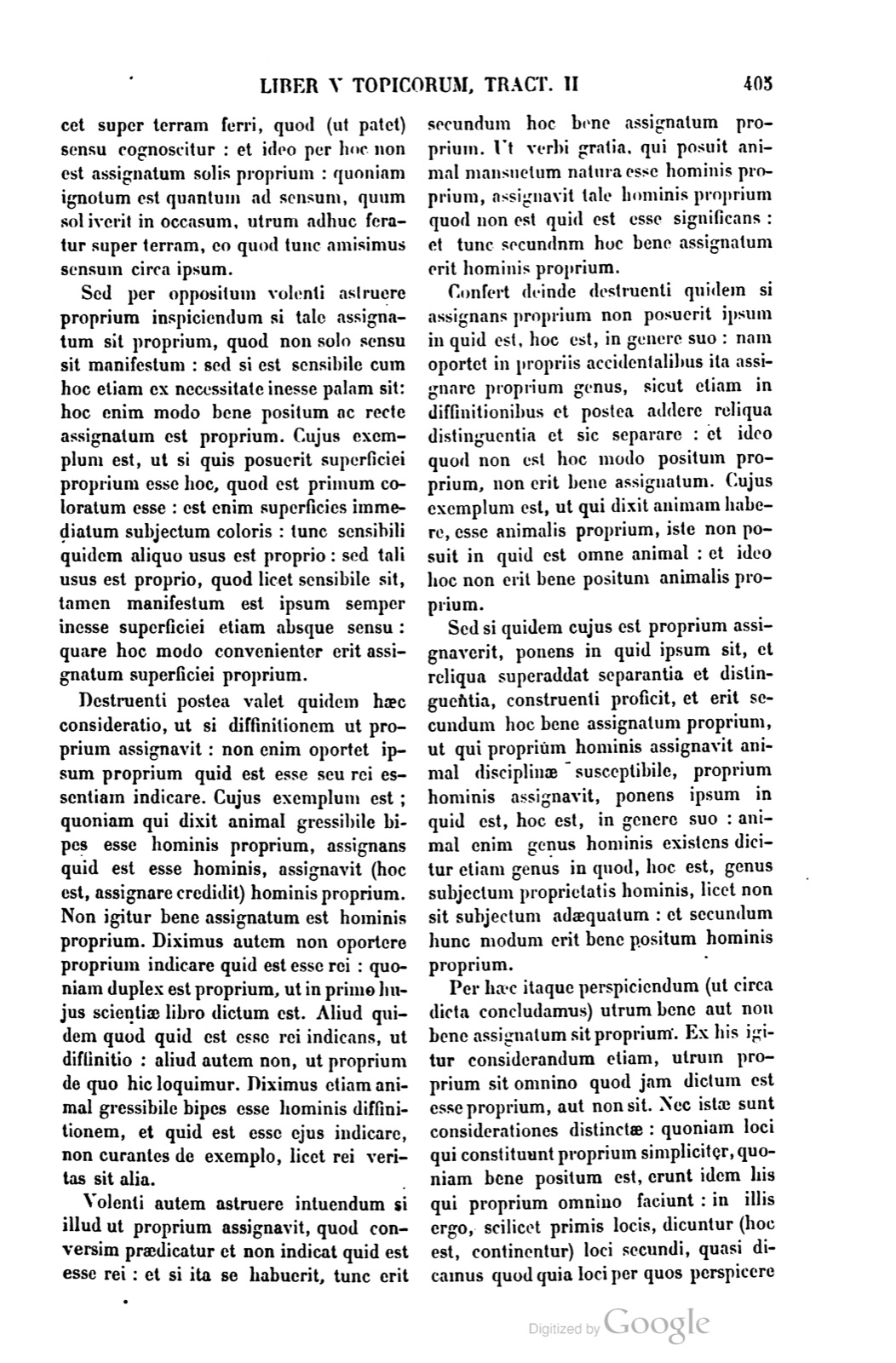
Per haec itaque perspiciendum, ut circa dicta concludamus, utrum bene aut non bene assignatum sit proprium. Ex his igitur considerandum etiam, utrum proprium sit omnino quod jam dictum est esse proprium, aut non sit. Nec istae sunt considerationes distinctae: quoniam loci qui constituunt proprium simpliciter, quoniam bene positum est, erunt idem his qui proprium omnino faciunt: in illis ergo, scilicet primis locis, dicuntur, hoc est, continentur, loci secundi, quasi dicamus quod quia loci per quos perspicere possumus utrum proprium sit bene assignatum, sunt loci facientes immediate cognoscere utrum proprium sit omnino quod jam assignatum est, ideo non sunt seorsum pertractandi: nam in dictis locis de constructione et destructione proprii continentur et loci de cognitione ejus quod assignatum est utrum sit proprium vel non.
In primis itaque oportet destruentem, hoc est, destruere volentem aliquid esse proprium, inspicere in unumquodque inferius cujus proprium assignavit utrum nulli insit, aut si non est verum hoc proprium secundum hoc, id est, si non conveniat alicui illorum inferiorum, hoc est, si illud quod proprium assignatum est, non conveniat alicui ex illis inferioribus, licet forte aliis conveniat: aut superiori dato quod omnibus illis inferioribus conveniat, non sit tamen proprium cujusque eorum secundum illud commune cujus assignatum fuit proprium: si enim aliquo istorum modorum se habuerit, non erit proprium quod positum est esse proprium. Cujus exemplum est, si assignetur proprium esse scientis infallibilem esse sub ratione sive argumentatione, inspiciendum si hoc omni scienti convenit, ut videndum si geometer qui est sciens sit infallibilis in sua argumentatione semper, et viso quod hoc non convenit geometrae, eo quod aliquando fallitur falso describendo figuras de quibus argumentatur. Non est ergo hoc scientis proprium quod dictum est, quod est infallibilem esse sub oratione, quia non convenit omni scienti.
Juxta hanc considerationem oportet astruentem sive astruere volentem considerare si de omni verum est proprium: quia si de omni verum est, tunc esset simpliciter verum etiam de ipso: quia quod per se omni convenit, convenit secundum quod ipsum et simpliciter et soli illi: et sic erit simpliciter proprium, quod positum est esse proprium. Cujus exemplum est, ut quoniam animal susceptibile disciplinae de omni homine verum est: et ideo quod de quolibet verum est, erit ergo proprium hominis. Ut autem idoneus sit aliquis ad discernendum quando convenit omni et secundum ipsum, dicimus quod hic locus istius considerationis utilis est destruenti quidem ut inspiciat si non dicitur ratio quae describit proprium de omni eo de quo dicitur nomen subjecti: ita etiam si de quocumque dicitur nomen, de illo eodem non dicitur ratio quae est proprii: et e converso si non dicitur ratio propria, neque nomen ejus, ita quod conversim praedicarentur de se invicem: tunc enim non erit proprium. Construenti autem utilis est opposito modo considerando, si de quo dicitur nomen, semper de eodem dicitur ratio proprii: et e converso si de quo dicitur ratio, et nomen sive subjectum praedicatur. Dicitur autem proprii ratio: quia ad determinandum ponitur, sicut ratio quae est diffinitio. Et dicitur subjectum nomen, quia sicut nomen diffiniti se habet ad diffinitionem, ita subjectum se habet ad proprium, quantum ad hoc quod declaratur per proprium quam ad quantitatem, sicut in ante habitis dictum est.
Therefore through these things, so that we may conclude about what has been said, one must examine whether the property has been well or not well assigned. From these things, therefore, one must also consider whether what has already been said to be a property is wholly a property, or is not. Nor are these distinct considerations, because the topics which establish property simply, since it is well posited, will be the same as those which make it wholly a property. Therefore in those, namely in the first topics, the second topics are said, that is, contained, as though we should say that, because the topics through which we can examine whether the property has been well assigned are topics that immediately make known whether what has already been assigned is wholly a property, therefore they are not to be handled separately; for in the stated topics concerning the construction and destruction of property there are also contained the topics concerning the cognition of that which has been assigned, whether it is a property or not.
Therefore first the one destroying, that is, wishing to destroy that something is a property, must inspect each inferior thing of that whose property he has assigned, whether it belongs to none, or whether this property is not true according to this, that is, whether it does not belong to some one of those inferiors, that is, whether that which has been assigned as property does not belong to one of those inferiors, although perhaps it belongs to others; or, given that it belongs to the superior, because it belongs to all those inferiors, nevertheless it is not the property of each of them according to that common thing of which it was assigned as property. For if it has itself in any of these ways, what was posited to be a property will not be a property. An example is this: if it is assigned as the property of one knowing to be infallible under reason or argumentation, one must inspect whether this belongs to every knower, as by seeing whether the geometer who is knowing is always infallible in his argumentation; and when it has been seen that this does not belong to the geometer, because he is sometimes deceived by falsely describing the figures about which he argues, then this is not the property of the knower, what was stated, namely to be infallible under expression, because it does not belong to every knower.
Next to this consideration, one establishing or wishing to establish must consider whether the property is true of every one; because if it is true of every one, then it would also be simply true of the thing itself, because what belongs through itself to every one belongs according to the thing itself, both simply and to it alone; and thus what was posited to be a property will simply be a property. An example is that, since animal capable of discipline is true of every man, therefore what is true of each will be the property of man. But so that someone may be fit to discern when it belongs to every one and according to the thing itself, we say that this topic of this consideration is useful to one destroying, namely that he inspect whether the account which describes the property is not said of every thing of which the name of the subject is said. Likewise, if of whatever the name is said, of that same thing the account which belongs to the property is not said; and conversely, if neither the proper account nor its name is said, so that they would be predicated conversely of one another, then it will not be a property. But for one establishing it is useful by considering in the opposite mode, if of whatever the name is said, the account of the property is always said of the same; and conversely, if of whatever the account is said, the name or subject is predicated. But it is called the account of the property because it is posited for determining, just as the account which is definition is. And it is called the subject name because, just as the name of the defined thing is related to the definition, so the subject is related to the property, with respect to this, that it is declared through the property rather than with respect to quantity, as was said in what preceded.
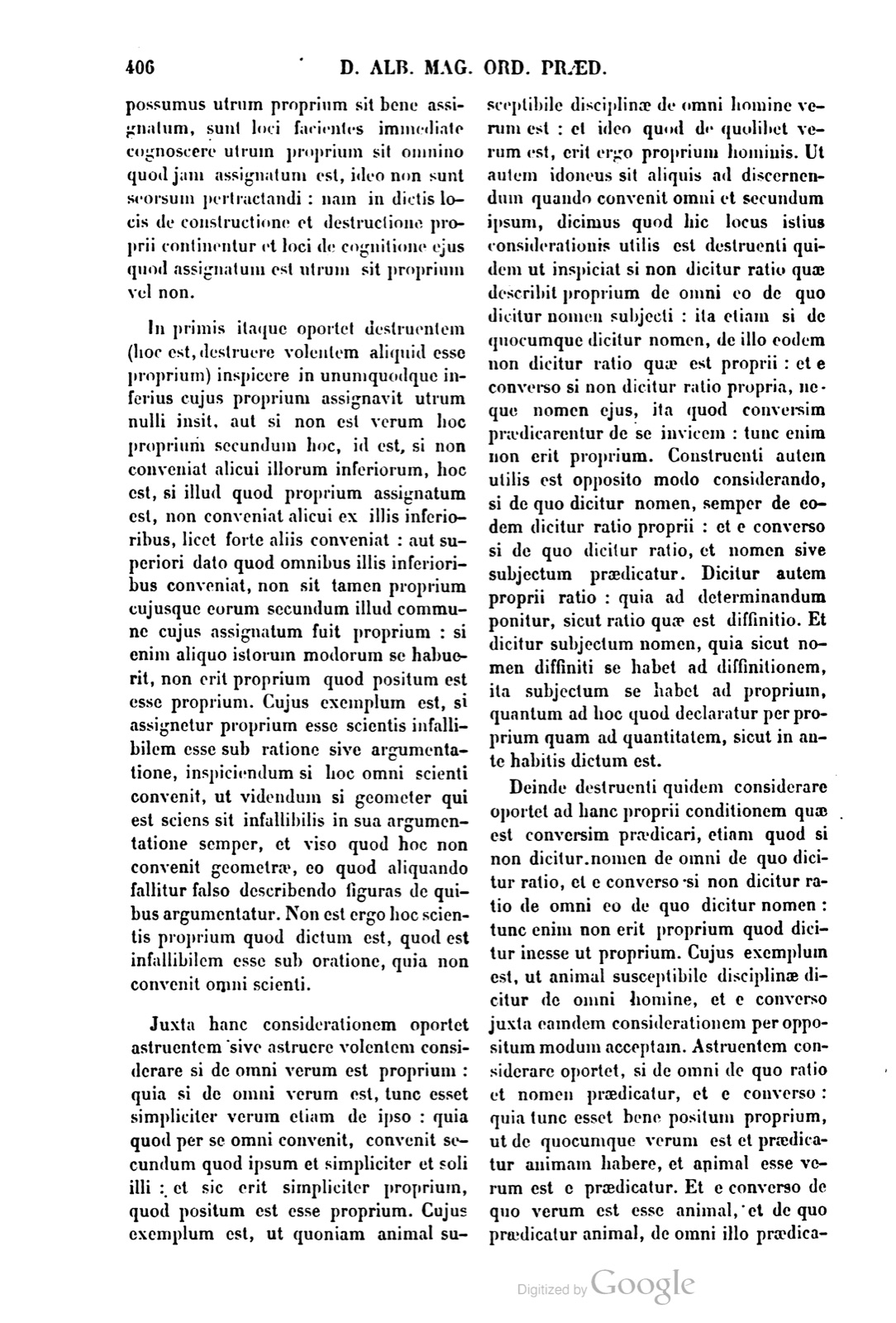
Deinde destruenti quidem considerare oportet ad hanc proprii conditionem quae est conversim praedicari, etiam quod si non dicitur nomen de omni de quo dicitur ratio, et e converso si non dicitur ratio de omni eo de quo dicitur nomen: tunc enim non erit proprium quod dicitur inesse ut proprium. Cujus exemplum est, ut animal susceptibile disciplinae dicitur de omni homine, et e converso tur animam habere: erit ergo animam habere animalis proprium.
Deinde destructive quidem oportet considerationem habere ad hanc proprii considerationem vel conditionem quae est non in quid praedicari: quid autem in diffinitione proprii est subjectum positum in diffinitione propriae passionis. Unde considerandum destruenti si aliquis assignavit ipsum subjectum cujus passio est propria, ut et ipsum subjectum sit proprium ejus quod est in subjecto: tunc enim non erit proprium quod sic ponitur. Cujus exemplum est, ut qui assignavit quod est ignis esse subtilissimum corpus, cum ignis sit subjectum, et subtilissimum corporum esse passio sive proprium, hoc tale subjectum assignavit praedicari ut proprium: non esset ignis proprium subtilissimum corpus. Ignis in quid, subtilissimum autem corporum esse in quale praedicatur: et propter subjectum erit proprium ejus passionis sive proprii quod in subjecto esse dicitur. Cujus ratio est, quia si hoc dicatur, sequitur quod unum et idem plurium etiam specie differentium proprium erit: nam eidem subjecto insunt plura etiam specie differentia, quae tamen ut propria de sola substantia sunt dicta: quorum omnium secundum hoc proprium erit, quod subjectum erit eorum.
Contra hoc tamen quidam objiciunt, quia si uni subjecto multa insunt propria, haec omnia convertuntur cum subjecto praedicato: sed quaecumque uni et eidem convertuntur, ipsa etiam inter se convertuntur: ergo ista propria inter se convertuntur: et sic unum est alterius proprium, quod falsum est. Sed ad hoc dicendum, quod propria large dicuntur hic quaecumque insunt omni et soli, ut grammatica et musica homini secundum aptitudinem: et tunc inconveniens est subjectum dici proprium eorum quae sunt in subjecto: quia sic homo erit proprium grammaticae, et proprium musicae et albedinis et aliorum multorum: quod est contra naturam proprii, quod convenit uni et soli secundum speciem.
Astruenti vero valet haec consideratio opposito modo considerando etiam et si id quod in subjecto est ut passio, assignavit quis esse proprium subjecti: hoc enim cum in quali et non in quod praedicatur, erit proprium quod ab adversario positum est non esse proprium: si quidem de solo secundum speciem, ut dictum est, praedicatur. Cujus exemplum est, ut qui dixit terrae proprium esse, quod sit corpus gravissimum in sua specie: hoc enim subjecto assignavit proprium quod de sola re subjecti dicitur, et ut proprium praedicatur in quale: et ideo erit recte positum terrae proprium.
Deinde alia consideratione penes eamdem conditionem proprii quae est non in quid praedicari respiciendo ad genus quod est quid in diffinitione, oportet destruentem considerare si aliquis assignavit proprium quod secundum participationem refertur ad subjectum: tunc enim non erit proprium quod positum est esse: eo quod secundum participationem inesse conducit ad aliquid inesse substantialiter ut genus et differentia: unde tale quid participat subjectum, non erit proprium, sed substantialis differentia quaedam de aliqua specie generis dicta quam constituit. Cujus exemplum est, ut quoniam non assignavit ut proprium qui dixit proprium hominis esse gressibile bipes: hic enim differentiam assignavit ut proprium hominis secundum participationem ejus quod quid est esse conducit: et ideo non erit hominis proprium gressibile bipes, sed substantialis differentia.
Then one destroying must consider, with respect to this condition of property, namely to be predicated conversely, also that if the name is not said of every thing of which the account is said, and conversely, if the account is not said of every thing of which the name is said, then what is said to belong as property will not be a property. An example is that animal capable of discipline is said of every man, and conversely to have a soul; therefore to have a soul will be the property of animal.
Then destructively one ought to have consideration with respect to this consideration or condition of property, namely not to be predicated in what it is; but the what in the definition of property is the subject posited in the definition of its proper passion. Hence one destroying must consider whether someone has assigned the very subject whose passion is proper, so that the subject itself also is the property of that which is in the subject. For then what is posited in this way will not be a property. An example is one who assigned that it is fire to be the most subtle body: since fire is the subject, and being the most subtle of bodies is a passion or property, he assigned such a subject to be predicated as the property; the most subtle body would not be the property of fire. Fire is predicated in what it is, but to be the most subtle of bodies is predicated in what quality; and on account of the subject it will be the property of that passion or property which is said to be in the subject. The reason for this is that, if this is said, it follows that one and the same thing will be the property of many things differing even in species; for in the same subject there are many things differing even in species, which nevertheless are said as properties of the substance alone. According to this, therefore, the property of all these will be that it will be their subject.
Against this, however, certain people object that, if many properties belong to one subject, all these are converted with the subject predicated; but whatever things are converted with one and the same thing are also converted among themselves; therefore those properties are converted among themselves, and thus one is the property of another, which is false. But to this it must be said that properties are here spoken of broadly, namely whatever things belong to every one and to it alone, as grammar and music belong to man according to aptitude; and then it is unsuitable for the subject to be called the property of those things which are in the subject, because in this way man will be the property of grammar, and the property of music and whiteness and of many other things, which is contrary to the nature of property, which belongs to one and to it alone according to species.
But for one establishing, this consideration is useful by considering in the opposite mode also if someone has assigned that which is in the subject as a passion to be the property of the subject. For since this is predicated in what quality and not in what, it will be the property which was posited by the adversary to be not a property, provided that it is predicated of one thing alone according to species, as has been said. An example is one who said that it is proper to earth that it is the heaviest body in its species. For he assigned a property to the subject which is said of the thing of the subject alone, and as property is predicated in what quality; and therefore the property of earth will be rightly posited.
Then, by another consideration under the same condition of property, namely that it is not predicated in what it is, looking to the genus which is the what in the definition, one destroying must consider whether someone has assigned a property which is referred to the subject according to participation. For then what has been posited to be a property will not be a property, because belonging according to participation conduces to something belonging substantially as genus and difference do. Hence such a what participates in the subject, and will not be a property, but a certain substantial difference said of some species of a genus which it constitutes. An example is that one who said that the property of man is walking and two-footed did not assign it as a property; for here he assigned a difference as the property of man according to participation of that which conduces to what-it-is-to-be; and therefore walking and two-footed will not be the property of man, but a substantial difference.
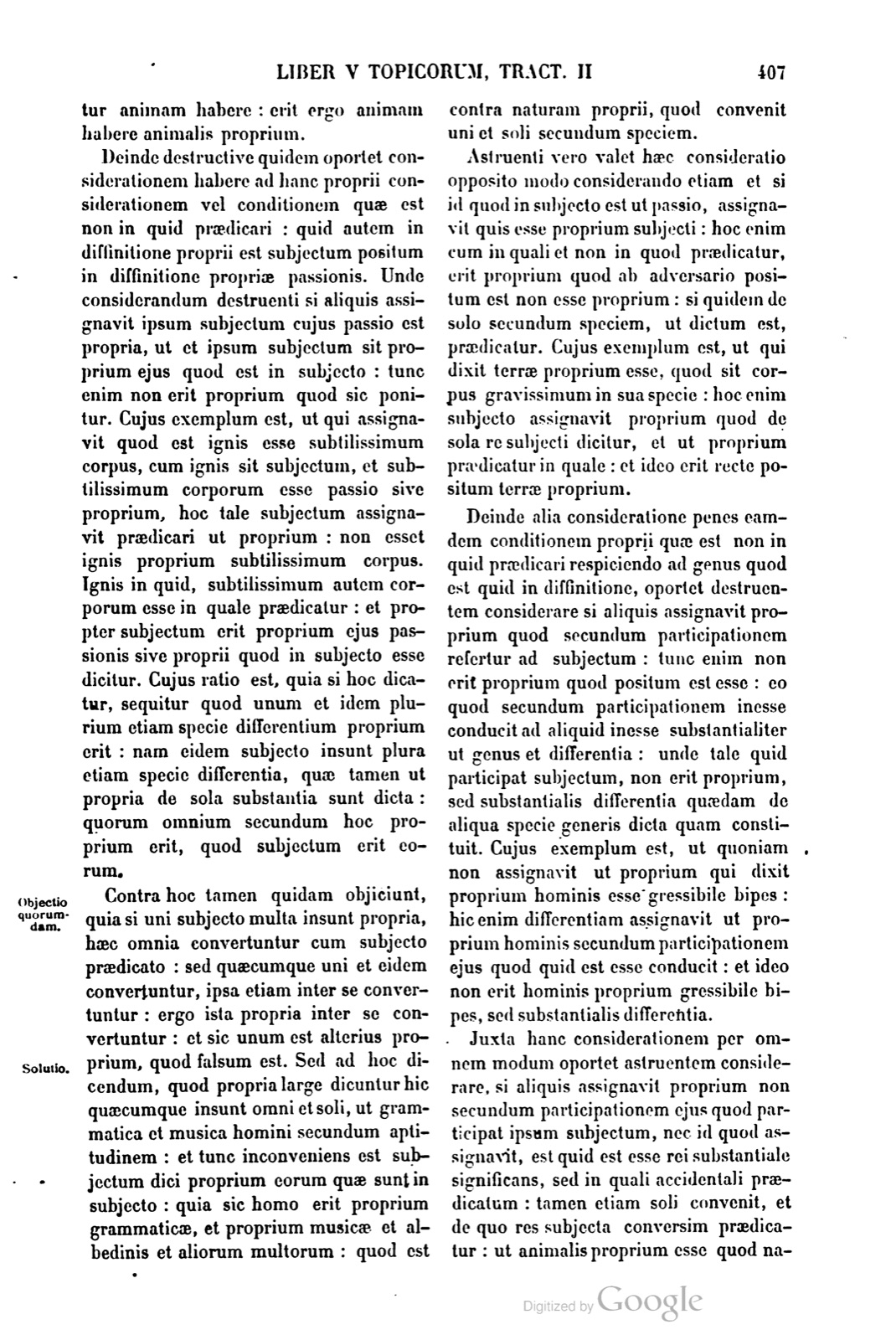
Juxta hanc considerationem per omnem modum oportet astruentem considerare, si aliquis assignavit proprium non secundum participationem ejus quod participat ipsum subjectum, nec id quod assignavit, est quid est esse rei substantiale significans, sed in quali accidentali praedicatum: tamen etiam soli convenit, et de quo res subjecta conversim praedicatur: ut animalis proprium esse quod natum est sentire: hoc enim neque participative dictum de specie assignavit proprium, neque quid sit esse significans: et tamen de quo res subjecta conversim praedicatur: erit ergo animalis positum recte quod sentire natum est.
Deinde considerando proprium ad id quod consequitur conditionem proprii quae est omni et soli inesse: ad id enim sequitur simul inesse proprium situm cum subjecto, et non prius, nec posterius. Oportet igitur considerare destruentem si contingit subjecto posito inesse proprium simul. Dico tempore et consequentia, et non causa simul et natura: sed contingit vel prius vel posterius inesse ei subjecto cujus est nomen quod innotescit per proprium: tunc non erit proprium quod positum est esse proprium: sed quando erit proprium, quia aliquando non sequitur ad ipsum: sed quando contingit prius ejus inesse vel posterius, non erit proprium quandoque neque semper: quia non semper sequitur ad subjectum et antecedit ad ipsum, ut id quod contingit et prius alicui subjecto inesse quam subjectum, sive posterius alicui inesse quam subjectum, non est proprium. Cujus exemplum est, ut ambulare per forum, quod contingit prius et posterius esse quam hominem: et ideo non erit ambulare per forum hominis proprium quandoque, neque semper erit proprium, hoc est, quandoque erit non proprium, neque semper erit proprium. Et non intelligitur istud sicut quidam dicunt, quod nec sit proprium quando, nec proprium semper, sed potius quod non est, nec erit proprium: et ideo semper non erit proprium: ut quoniam contingit et prius alicui inesse ambulare per forum quam homini, et alicui contingit posterius inesse quam homini: et ideo ambulare per forum hominis, nec quandoque erit proprium, nec semper.
Astruenti autem juxta eamdem considerationem per oppositum modum considerandum: quod assignatum est proprium simul cum subjecto inesse ex necessitate secundum tempus et consequentiam: cum tamen nec differentia substantialis sit nec diffinitio, sed nihil sit de esse substantiali: erit enim tunc proprium quod ab adverso oppositum est non esse proprium. Cujus exemplum est, ut quoniam animal susceptibile disciplinae quod proprium est hominis, et homo quod est subjectum simul, et ex necessitate consequentiae simul est, posito uno ponitur alterum, et e converso: cum tamen animal susceptibile disciplinae, nec differentia hominis sit, nec genus, nec diffinitio hominis sit. Erit ergo verum et rectum proprium hominis quod dictum est.
Deinde iterum considerando in id quod sequitur hanc conditionem quae est soli inesse, et destruitur proprium. Oportet igitur destruentem considerare proprium si eorumdem in specie in eo quod idem sunt specie, non est idem proprium. Proprium enim, ut dicit Boetius, est accidens speciei: et ideo est unum proprium omnium illam speciem participantium: et si sit non idem, non erit proprium quod positum est. Cujus exemplum est in moribus: et quoniam ejus quod assequendum est, non est proprium quod videatur quibusdam bonum, ita quod assequendum sit id quod quibusdam bonum esse videatur: assequendum enim et eligendum eadem sunt specie appetibilis: et eligendi non est proprium videri quibusdam bonum: ergo nec assequendi: quia multa assequenda quae eligenda sunt, non videntur quibusdam esse bona. Idem autem species assequendum et eligendum.
According to this consideration, in every way, one establishing must consider whether someone has assigned a property not according to participation of that which participates in the subject itself, and whether what he assigned does not signify the substantial what-it-is-to-be of the thing, but is an accidental predicate in what quality; yet it also belongs to it alone, and the subject thing is predicated conversely of it. For example, to be naturally apt to sense is the property of animal. For this neither assigned the property as said participatively of the species, nor as signifying what it is to be; and yet the subject thing is predicated conversely of it. Therefore what has been posited of animal, namely that it is naturally apt to sense, will be right.
Then, considering property with respect to that which follows upon the condition of property which is to belong to every one and to it alone, for upon that follows that the property posited belongs simultaneously with the subject, and neither before nor after. Therefore one destroying must consider whether it happens that, once the subject is posited, the property belongs simultaneously. I mean simultaneously in time and consequence, and not simultaneously in cause and nature. But if it happens that it belongs either before or after the subject whose name becomes known through the property, then what was posited to be a property will not be a property. But when it will be a property, this is because it sometimes does not follow upon it; but when it happens that the belonging of it is earlier or later, it will not be a property sometimes nor always, because it does not always follow upon the subject and precede it, as that which happens to belong to some subject before the subject, or to belong to something after the subject, is not a property. An example is walking through the forum, which happens to be before and after man; and therefore walking through the forum will not be a property of man sometimes, nor will it always be a property, that is, sometimes it will not be a property, nor will it always be a property. And this is not understood as certain people say, that it is neither property when nor property always, but rather that it is not and will not be a property; and therefore it will always not be a property. For it happens both that walking through the forum belongs to someone before it belongs to man, and that it happens to someone later than to man; and therefore walking through the forum will be a property of man neither sometimes nor always.
But for one establishing, according to the same consideration, one must consider through the opposite mode that the assigned property belongs simultaneously with the subject of necessity according to time and consequence, although nevertheless it is neither a substantial difference nor a definition, but is nothing of substantial being. For then it will be the property which, from the opposite side, has been posited not to be a property. An example is that animal capable of discipline, which is the property of man, and man, which is the subject, exist simultaneously and of necessity according to the consequence: when one is posited the other is posited, and conversely. Yet animal capable of discipline is neither the difference of man, nor the genus, nor the definition of man. Therefore what has been stated will be a true and right property of man.
Then again, by considering that which follows this condition, namely to belong to it alone, the property is destroyed. Therefore one destroying must consider the property if, of things the same in species insofar as they are the same in species, there is not the same property. For property, as Boethius says, is an accident of the species; and therefore there is one property of all those participating in that species. And if it is not the same, what has been posited will not be a property. An example is in morals: because it is not proper to what is to be pursued that it seems good to certain people, so that what is to be pursued would be that which seems good to certain people. For what is to be pursued and what is to be chosen are the same in the species of the appetible; and it is not proper to what is to be chosen to seem good to certain people. Therefore neither is it proper to what is to be pursued, because many things to be pursued, which are to be chosen, do not seem good to certain people. But what is to be pursued and what is to be chosen are the same species.
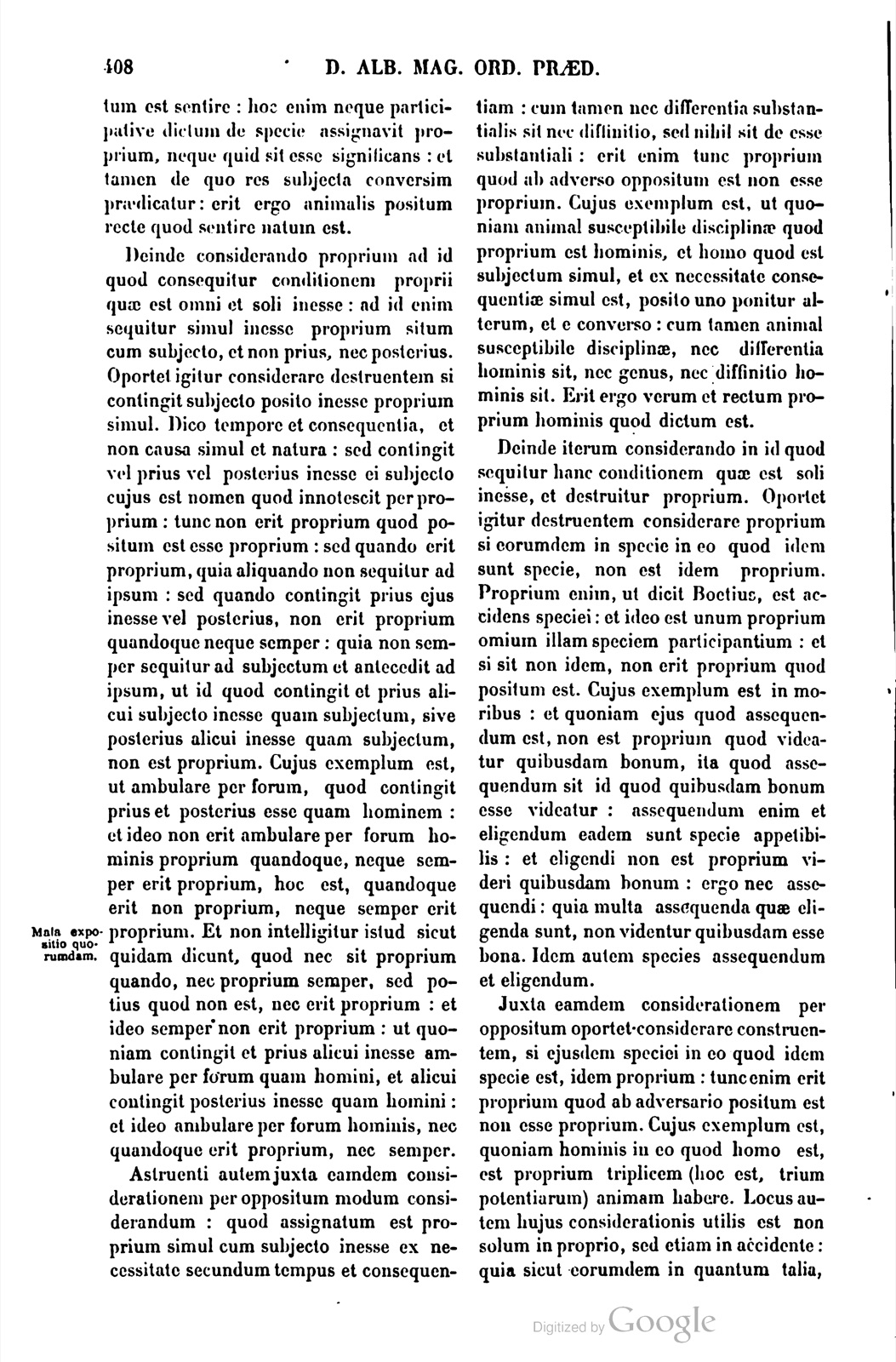
Juxta eamdem considerationem per oppositum oportet considerare construentem, si ejusdem speciei in eo quod idem specie est, idem proprium: tunc enim erit proprium quod ab adversario positum est non esse proprium. Cujus exemplum est, quoniam hominis in eo quod homo est, est proprium triplicem, hoc est, trium potentiarum, animam habere. Locus autem hujus considerationis utilis est non solum in proprio, sed etiam in accidente: quia sicut eorumdem in quantum talia, est idem proprium: sic eisdem in quantum talia, necessarium est accidere idem, vel non inesse in accidentibus quae a subjecto causantur.
Deinde etiam comparatur proprium non solum secundum identitatem simpliciter, sed etiam secundum identitatem secundum quid, quae est generis et speciei. Unde destruentem oportet considerare si eorum quae sunt eadem specie subalterna, non idem semper specie est ut proprium, quod assignatum est. Cujus exemplum, ut quoniam idem specie sunt subalterna homo et equus: et moveri in seipso et stare in seipso, sunt propria ejusdem speciei, et equi proprium non est semper moveri in seipso sive a seipso: ergo nec proprium est hominis semper moveri in seipso sive a seipso: et sicut equi non est proprium, quod semper stet in seipso, ita hominis non est proprium semper a seipso moveri: idem enim specie semper est moveri et stare in seipso: quia ab una causa est utrumque, quod est animal processivum: hoc enim solum habet, quod movetur in seipso et stat in seipso, ut dicitur VIII Physicorum: secundum enim quod est animal processivum, accidit ei utrumque istorum.
Juxta hoc idem astruenti considerandum occurrit, si eorum quae sunt idem specie subalterna, semper est idem proprium: tunc sequitur quod recte positum est inesse proprium, quod ab adversario dictum est non esse proprium: ut quoniam hominis qui idem est specie cum equo, est proprium esse gressibile bipes: proprium autem erit quae idem specie subalterna cum homine esse volatile bipes, quod est idem specie cum eo quod est gressibile: utrumque horum subjectorum et propriorum est idem specie, in eo quod haec ambo ut sub eodem genere subalterno proximo sunt species, cum sint sub animali: ista autem propria et gressibile bipes, ut volatile bipes, sunt, ut differentiae generis proximi etiam animalis.
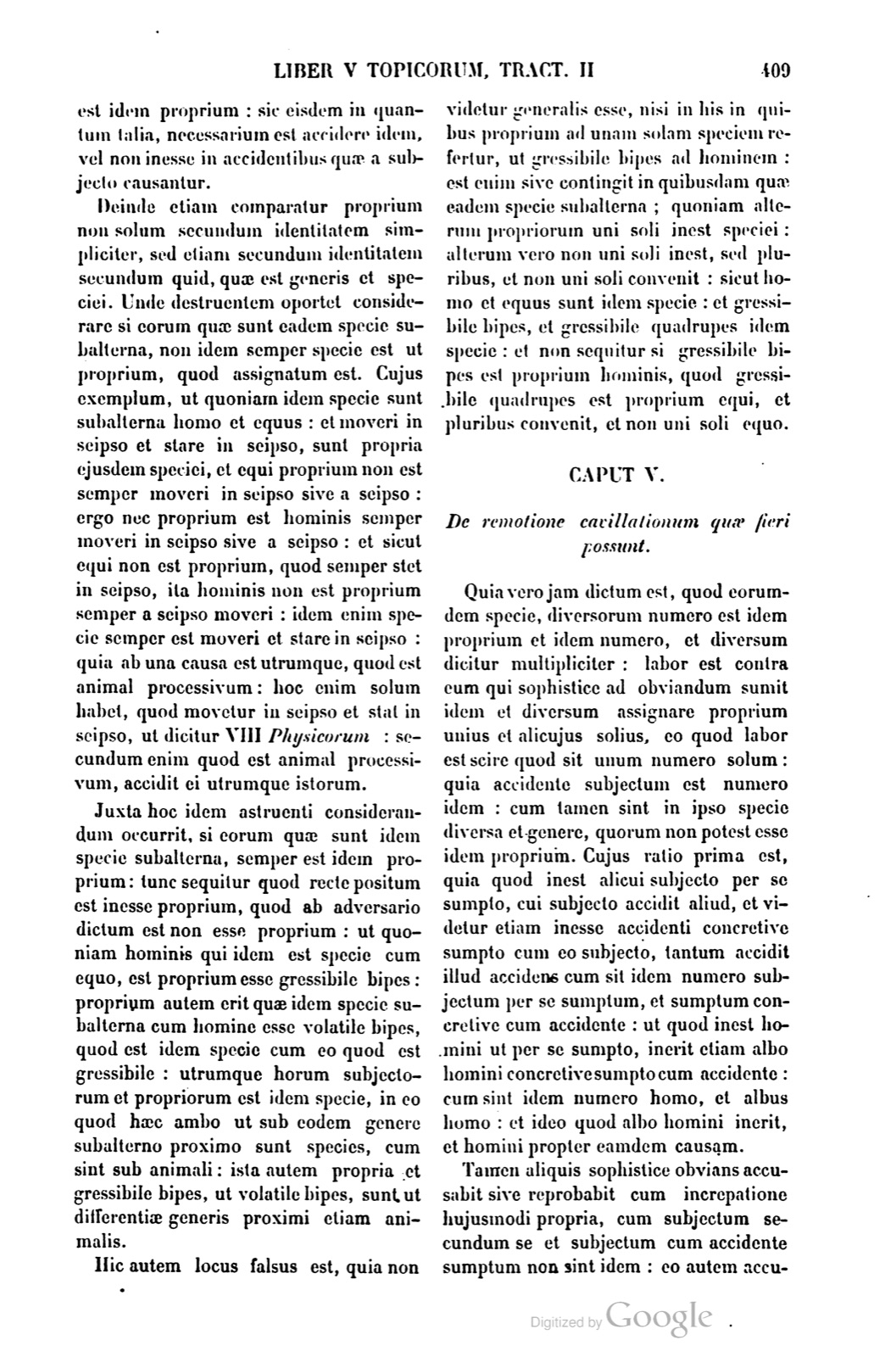
Hic autem locus falsus est, quia non videtur generalis esse, nisi in his in quibus proprium ad unam solam speciem refertur, ut gressibile bipes ad hominem: est enim sive contingit in quibusdam quae eadem specie subalterna; quoniam alterum propriorum uni soli inest speciei: alterum vero non uni soli inest, sed pluribus, et non uni soli convenit: sicut homo et equus sunt idem specie: et gressibile bipes, et gressibile quadrupes idem specie: et non sequitur si gressibile bipes est proprium hominis, quod gressibile quadrupes est proprium equi, et pluribus convenit, et non uni soli equo.
According to the same consideration, through the opposite, one constructing must consider whether, for the same species insofar as it is the same in species, there is the same property. For then it will be the property which was posited by the adversary not to be a property. An example is that of man insofar as he is man, it is proper to have a threefold soul, that is, a soul of three powers. But the topic of this consideration is useful not only in property, but also in accident, because just as of the same things insofar as they are such there is the same property, so for the same things insofar as they are such, it is necessary for the same thing to happen, or not to belong, in accidents which are caused by the subject.
Then property is also compared not only according to identity simply, but also according to identity in a certain respect, which is identity of genus and species. Hence one destroying must consider whether, of those things which are the same in subaltern species, the assigned property is not always the same in species. An example is this: since man and horse are the same in subaltern species, and being moved in itself and standing in itself are properties of the same species, and it is not the property of horse always to be moved in itself or by itself, therefore neither is it the property of man always to be moved in itself or by itself. And just as it is not the property of horse always to stand in itself, so it is not the property of man always to be moved by itself. For to be moved and to stand in itself is always the same in species, because each is from one cause, namely that it is a processive animal. For this alone has the fact that it is moved in itself and stands in itself, as is said in Physics VIII; for according as it is a processive animal, each of these happens to it.
Next to this same point, it occurs that one establishing must consider whether, of those things which are the same in subaltern species, there is always the same property. Then it follows that what was said by the adversary not to be a property is rightly posited as belonging as property. For example, since man, who is the same in species with horse, has as property being walking and two-footed, but the property of that which is the same in subaltern species with man will be being flying and two-footed, which is the same in species with that which is walking; each of these subjects and properties is the same in species, in that both of these are species under the same proximate subaltern genus, since they are under animal; but these properties, walking and two-footed, as also flying and two-footed, are as differences of the proximate genus, namely animal.
But this topic is false, because it does not seem to be general except in those cases in which property is referred to one species alone, as walking and two-footed is referred to man. For it is or happens in certain things which are the same in subaltern species that one of the properties belongs to one species alone, while the other does not belong to one alone, but to several, and does not belong to one alone. Thus man and horse are the same in species, and walking two-footed and walking four-footed are the same in species; and it does not follow, if walking two-footed is the property of man, that walking four-footed is the property of horse, since it belongs to several and not to horse alone.
If a page does not appear, its photograph has not been uploaded yet.