Volume 2 · pp. 400–402
Chapter III. On destructive and constructive considerations through inspection of what is superfluous in speech and understanding and the commonness of a name.
A marker with ≈ is an approximate page boundary, placed by measure of the text; the page photographs remain the authority. In the paired views, clicking a page marker brings that page into view.
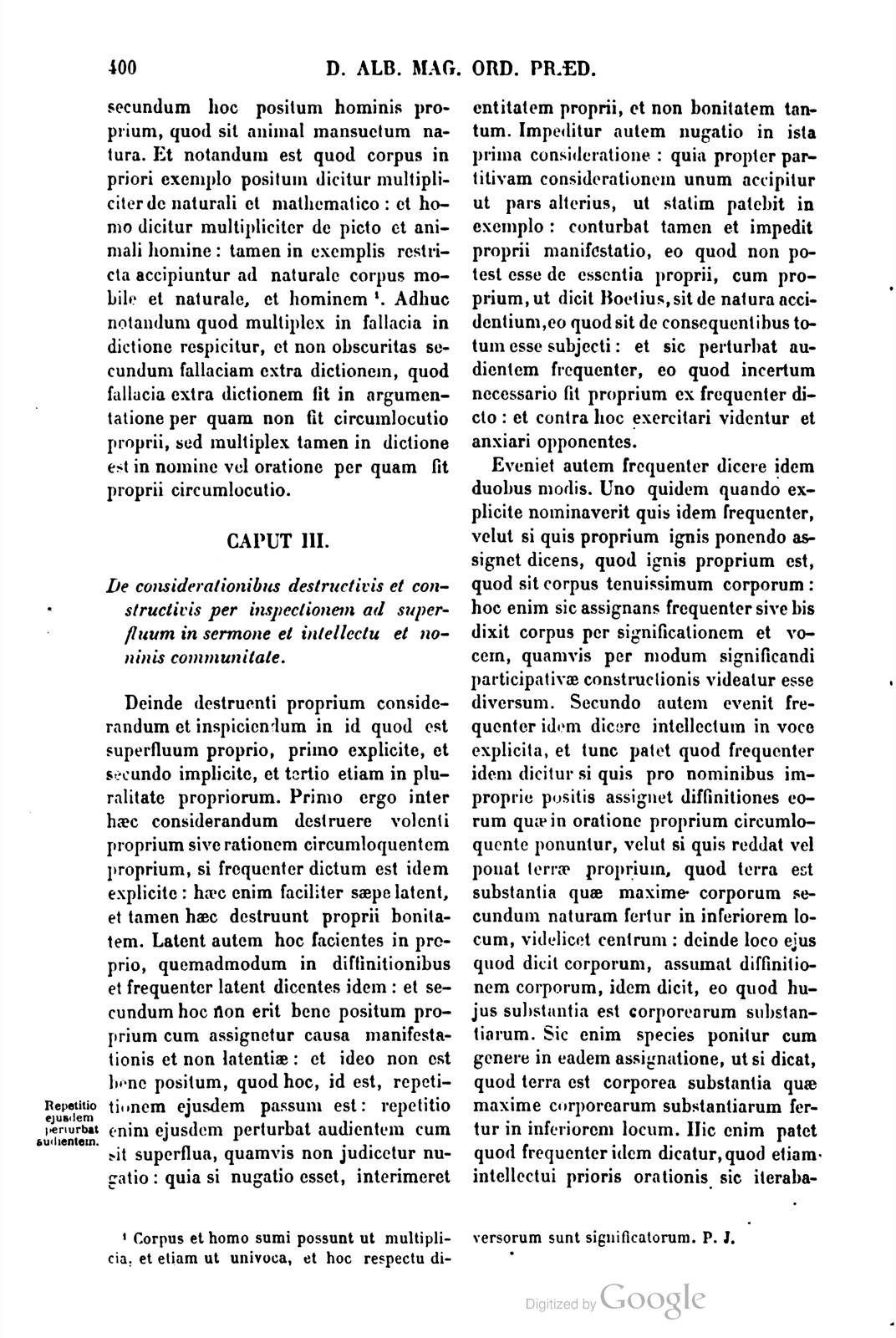
CAPUT III. De considerationibus destructivis et constructivis per inspectionem ad superfluum in sermone et intellectu et nominis communitate.
Deinde destruenti proprium considerandum et inspiciendum in id quod est superfluum proprio, primo explicite, et secundo implicite, et tertio etiam in pluralitate propriorum. Primo ergo inter haec considerandum destruere volenti proprium sive rationem circumloquentem proprium, si frequenter dictum est idem explicite: haec enim faciliter saepe latent, et tamen haec destruunt proprii bonitatem. Latent autem hoc facientes in proprio, quemadmodum in diffinitionibus et frequenter latent dicentes idem: et secundum hoc non erit bene positum proprium cum assignetur causa manifestationis et non latentiae: et ideo non est bene positum, quod hoc, id est, repetitionem ejusdem passum est: repetitio enim ejusdem quamvis non judicetur nugatio: quia si nugatio esset, interimeret entitatem proprii, et non bonitatem tantum. Impeditur autem nugatio in ista prima consideratione: quia propter partitivam considerationem unum accipitur ut pars alterius, ut statim patebit in exemplo: conturbat tamen et impedit proprii manifestatio, eo quod non potest esse de essentia proprii, cum proprium, ut dicit Boetius, sit de natura accidentium, eo quod sit de consequentibus totum esse subjecti: et sic perturbat audientem frequenter, eo quod incertum necessario fit proprium ex frequenter dicto: et contra hoc exercitari videntur et anxiari opponentes.
Eveniet autem frequenter dicere idem duobus modis. Uno quidem quando explicite nominaverit quis idem frequenter, velut si quis proprium ignis ponendo assignet dicens, quod ignis proprium est, quod sit corpus tenuissimum corporum: hoc enim sic assignans frequenter sive bis dixit corpus per significationem et vocem, quamvis per modum significandi participativae constructionis videatur esse diversum. Secundo autem evenit frequenter idem dicere intellectum in voce explicita, et tunc patet quod frequenter idem dicitur si quis pro nominibus improprie positis assignet diffinitiones eorum quae in oratione proprium circumloquente ponuntur, velut si quis reddat vel ponat terrae proprium, quod terra est substantia quae maxime corporum secundum naturam fertur in inferiorem locum, videlicet centrum: deinde loco ejus quod dicit corporum, assumat diffinitionem corporum, idem dicit, eo quod hujus substantia est corporearum substantiarum. Sic enim species ponitur cum genere in eadem assignatione, ut si dicat, quod terra est corporea substantia quae maxime corporearum substantiarum fertur in inferiorem locum. Hic enim patet quod frequenter idem dicatur, quod etiam intellectui prioris orationis sic iterabatur: unum enim quantum ad significatum secundum intellectum est corpus, et hujus, hoc est, corporea substantia. Patet ergo quod substantia hoc modo secundum intellectum erit frequenter dicta: et sic conturbatio fit in audientes: quare neutrum et neque frequenter dictum in voce, neque frequenter iteratum secundum intellectum, est bene positum proprium.
CHAPTER III. On destructive and constructive considerations through inspection of what is superfluous in speech and understanding and the commonness of a name.
Next, one destroying a property must consider and inspect that which is superfluous in the property, first explicitly, secondly implicitly, and thirdly also in a plurality of properties. Therefore first among these, one who wishes to destroy a property or the account circumlocuting the property must consider whether the same thing has frequently been said explicitly. For these things are often easily hidden, and nevertheless they destroy the goodness of the property. Those who do this are hidden in a property, just as they are hidden in definitions and frequently hidden when they say the same thing; and according to this the property will not be well posited, since a cause of manifestation and not of hiddenness is being assigned. And therefore that which has undergone this, that is, repetition of the same thing, is not well posited. For repetition of the same, although it is not judged to be nugation, since if it were nugation it would destroy the entity of the property and not only the goodness. But nugation is impeded in this first consideration, because on account of the partitive consideration one is taken as a part of the other, as will immediately be clear in the example. Nevertheless it confuses and impedes the manifestation of the property, because it cannot be of the essence of property, since property, as Boethius says, is of the nature of accidents, because it is among those things that follow the whole being of the subject; and so it frequently disturbs the hearer, because from what is frequently said the property necessarily becomes uncertain; and against this the opponents seem to be exercised and anxious.
Now it happens that the same thing is frequently said in two ways. In one way, when someone explicitly names the same thing frequently, for example if someone, in positing the property of fire, assigns it by saying that it is proper to fire to be the thinnest body of bodies. For one assigning it thus has frequently or twice said body by signification and word, although by the mode of signifying of the participative construction it seems to be diverse. Secondly, it happens that the same thing understood is frequently said in an explicit word; and then it is clear that the same thing is frequently said if someone, in place of names improperly posited, assigns definitions of the things which are placed in the expression circumlocuting the property. For example, if someone renders or posits as the property of earth that earth is a substance which among bodies is especially borne according to nature to the lower place, namely the center; then, in place of that which he says, bodies, he assumes the definition of bodies, he says the same thing, because the substance of this is one of corporeal substances. For thus species is posited with genus in the same assignment, as if he says that earth is a corporeal substance which among corporeal substances is especially borne to the lower place. Here indeed it is clear that the same thing is frequently said, which was also repeated in this way for the understanding of the prior expression: for one thing as to the signified according to understanding is body, and the substance of this, that is, corporeal substance. Therefore it is clear that substance in this way will be frequently said according to understanding; and thus confusion arises in the hearers. Therefore neither frequently said in word, nor frequently repeated according to understanding, is a well-posited property.
Constructiva consideratio juxta hanc accepta est: quia astruenti proprium considerandum est, si nullo eodem frequenter usus est in nomine quod ponitur in proprii assignatione: et sic erit secundum hoc sive quantum ad hoc bene assignatum proprium dictum, veluti qui dixit hominis proprium esse disciplinae susceptibile: sic enim dicens, non est usus frequenter eodem nomine: et secundum hoc erit bene assignatum proprium hominis.
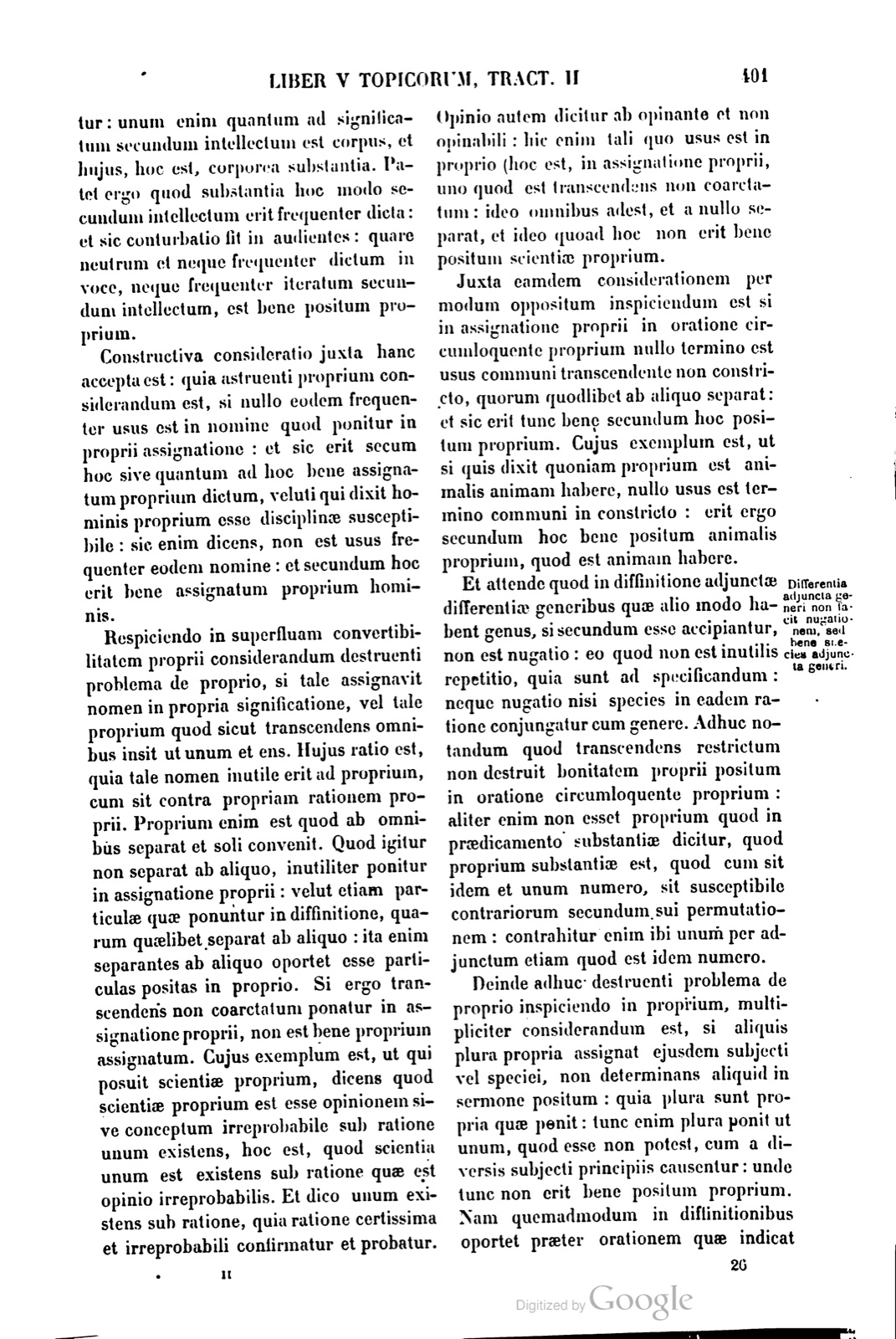
Respiciendo in superfluam convertibilitatem proprii considerandum destruenti problema de proprio, si tale assignavit nomen in propria significatione, vel tale proprium quod sicut transcendens omnibus insit ut unum et ens. Hujus ratio est, quia tale nomen inutile erit ad proprium, cum sit contra propriam rationem proprii. Proprium enim est quod ab omnibus separat et soli convenit. Quod igitur non separat ab aliquo, inutiliter ponitur in assignatione proprii: velut etiam particulae quae ponuntur in diffinitione, quarum quaelibet separat ab aliquo: ita enim separantes ab aliquo oportet esse particulas positas in proprio. Si ergo transcendens non coarctatum ponatur in assignatione proprii, non est bene proprium assignatum. Cujus exemplum est, ut qui posuit scientiae proprium, dicens quod scientiae proprium est esse opinionem sive conceptum irreprobabile sub ratione unum existens, hoc est, quod scientia unum est existens sub ratione quae est opinio irreprobabilis. Et dico unum existens sub ratione, quia ratione certissima et irreprobabili confirmatur et probatur. Opinio autem dicitur ab opinante et non opinabili: hic enim tali quo usus est in proprio, hoc est, in assignatione proprii, uno quod est transcendens non coarctatum: ideo omnibus adest, et a nullo separat, et ideo quoad hoc non erit bene positum scientiae proprium.
Juxta eamdem considerationem per modum oppositum inspiciendum est si in assignatione proprii in oratione circumloquente proprium nullo termino est usus communi transcendente non constricto, quorum quodlibet ab aliquo separat: et sic erit tunc bene secundum hoc positum proprium. Cujus exemplum est, ut si quis dixit quoniam proprium est animalis animam habere, nullo usus est termino communi in constricto: erit ergo secundum hoc bene positum animalis proprium, quod est animam habere.
Et attende quod in diffinitione adjunctae differentiae generibus quae alio modo habent genus, si secundum esse accipiantur, non est nugatio: eo quod non est inutilis repetitio, quia sunt ad specificandum: neque nugatio nisi species in eadem ratione conjungatur cum genere. Adhuc notandum quod transcendens restrictum non destruit bonitatem proprii positum in oratione circumloquente proprium: aliter enim non esset proprium quod in praedicamento substantiae dicitur, quod proprium substantiae est, quod cum sit idem et unum numero, sit susceptibile contrariorum secundum sui permutationem: contrahitur enim ibi unum per adjunctum etiam quod est idem numero.
The constructive consideration is taken alongside this: because one establishing a property must consider whether he has used no same term frequently in the name which is placed in the assignment of the property; and thus according to this or with respect to this, the property stated will be well assigned, as when someone said that it is proper to man to be capable of discipline. For speaking in this way, he has not frequently used the same name; and according to this the property of man will be well assigned.
With regard to superfluous convertibility of property, one destroying the problem concerning property must consider whether he has assigned such a name in its proper signification, or such a property, which as a transcendent belongs to all things, as one and being do. The reason for this is that such a name will be useless for a property, since it is contrary to the proper account of property. For property is that which separates from all and belongs to one alone. Therefore what does not separate from anything is uselessly posited in the assignment of a property; just as also the particles which are posited in a definition, each of which separates from something. Thus the particles posited in a property ought to be separating from something. Therefore, if an uncontracted transcendent is posited in the assignment of a property, the property has not been well assigned. An example is one who posited the property of science by saying that the property of science is to be an opinion or irreprovable concept existing as one under reason, that is, that science is one thing existing under a reason which is irreprovable opinion. And I say existing as one under reason because it is confirmed and proved by a most certain and irreprovable reason. But opinion is so called from the one opining and not from the opinable; for in this case, in that which he used in the property, that is, in the assignment of the property, he used one, which is an uncontracted transcendent. Therefore it is present to all things and separates from nothing, and therefore with respect to this the property of science will not be well posited.
Alongside the same consideration, in the opposite mode, one must inspect whether, in the assignment of property in the expression circumlocuting the property, he has used no common transcendent term not restricted, each of which separates from something; and thus then, according to this, the property will be well posited. An example is that, if someone said that it is proper to animal to have soul, he has used no common term in the restricted expression; therefore according to this the property of animal, which is to have soul, will be well posited.
And note that in the definition of an adjoined difference to genera which have genus in another way, if they are taken according to being, there is no nugation, because the repetition is not useless, since they are for specifying; nor is there nugation unless species is joined with genus in the same account. It must also be noted that a restricted transcendent does not destroy the goodness of a property posited in the expression circumlocuting the property; otherwise what is said in the predicamental category of substance would not be a property, namely that it is proper to substance that, although it is the same and one in number, it is susceptible of contraries according to its own alteration. For there one is contracted by the adjunct which is also the same in number.
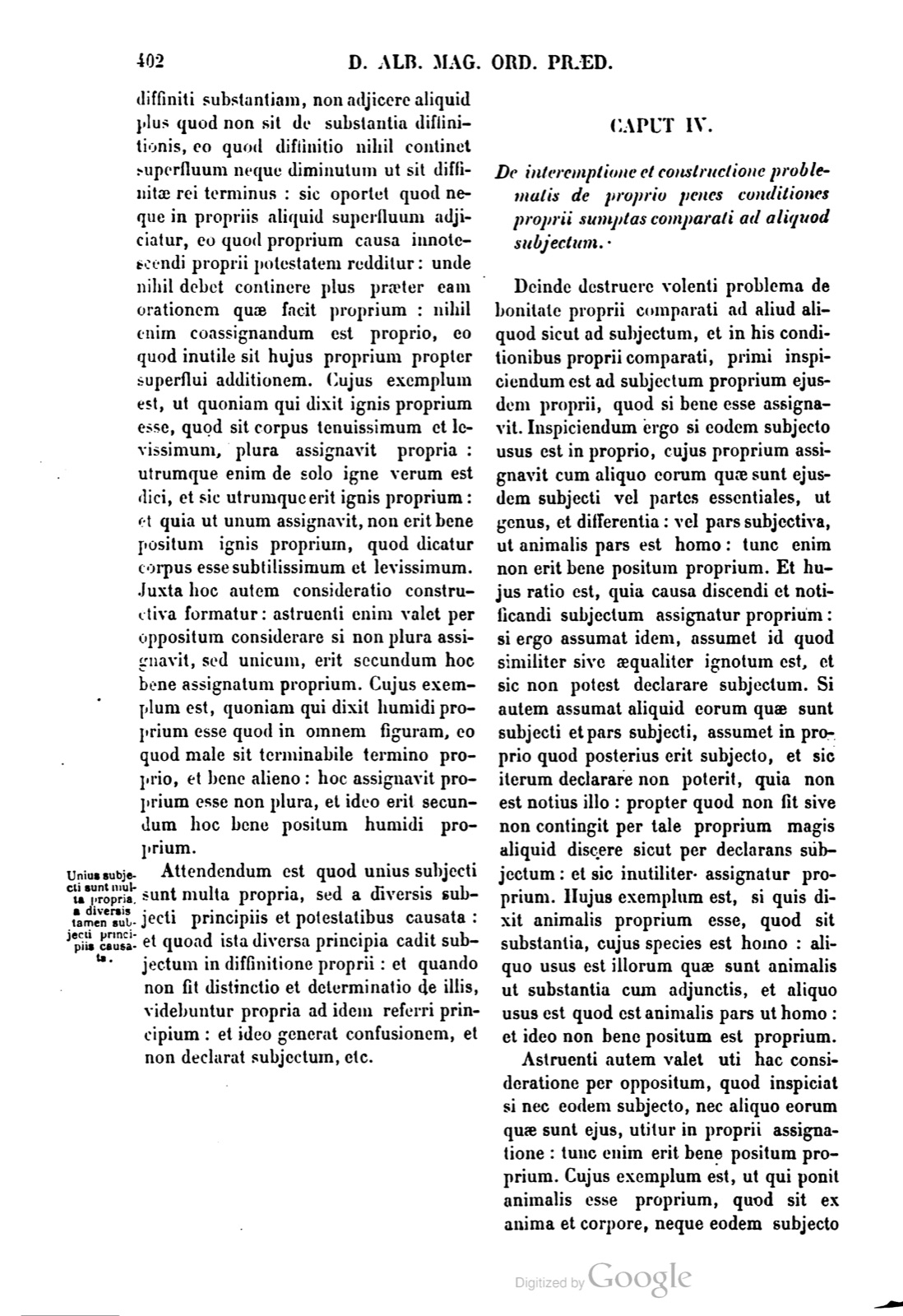
Deinde adhuc destruenti problema de proprio inspiciendo in proprium, multipliciter considerandum est, si aliquis plura propria assignat ejusdem subjecti vel speciei, non determinans aliquid in sermone positum: quia plura sunt propria quae ponit: tunc enim plura ponit ut unum, quod esse non potest, cum a diversis subjecti principiis causentur: unde tunc non erit bene positum proprium. Nam quemadmodum in diffinitionibus oportet praeter orationem quae indicat diffiniti substantiam, non adjicere aliquid plus quod non sit de substantia diffinitionis, eo quod diffinitio nihil continet superfluum neque diminutum ut sit diffinitae rei terminus: sic oportet quod neque in propriis aliquid superfluum adjiciatur, eo quod proprium causa innotescendi proprii potestatem redditur: unde nihil debet continere plus praeter eam orationem quae facit proprium: nihil enim coassignandum est proprio, eo quod inutile sit hujus proprium propter superflui additionem. Cujus exemplum est, ut quoniam qui dixit ignis proprium esse, quod sit corpus tenuissimum et levissimum, plura assignavit propria: utrumque enim de solo igne verum est dici, et sic utrumque erit ignis proprium: et quia ut unum assignavit, non erit bene positum ignis proprium, quod dicatur corpus esse subtilissimum et levissimum.
Juxta hoc autem consideratio constructiva formatur: astruenti enim valet per oppositum considerare si non plura assignavit, sed unicum, erit secundum hoc bene assignatum proprium. Cujus exemplum est, quoniam qui dixit humidi proprium esse quod in omnem figuram, eo quod male sit terminabile termino proprio, et bene alieno: hoc assignavit proprium esse non plura, et ideo erit secundum hoc bene positum humidi proprium.
Attendendum est quod unius subjecti sunt multa propria, sed a diversis subjecti principiis et potestatibus causata: et quoad ista diversa principia cadit subjectum in diffinitione proprii: et quando non fit distinctio et determinatio de illis, videbuntur propria ad idem referri principium: et ideo generat confusionem, et non declarat subjectum, etc.
Then further, for one destroying the problem concerning property by inspecting the property, it must be considered in many ways whether someone assigns several properties of the same subject or species, while not determining something posited in the speech; because the properties which he posits are several. For then he posits several as one, which cannot be, since they are caused by diverse principles of the subject; hence then the property will not be well posited. For just as in definitions one must not add anything more beyond the expression which indicates the substance of the thing defined, anything which is not of the substance of the definition, because a definition contains nothing superfluous nor diminished if it is to be the term of the defined thing; so also it is necessary that nothing superfluous be added in properties, because property is rendered as the power of a cause for making the property known. Hence it ought to contain nothing more beyond that expression which makes the property; for nothing must be coassigned with the property, because the property of this thing is made useless through the addition of what is superfluous. An example is that one who said the property of fire to be that it is the thinnest and lightest body assigned several properties. For each of these can truly be said of fire alone, and so each will be a property of fire; and because he assigned them as one, the property of fire will not be well posited, namely to be called a body that is most subtle and most light.
Next to this, however, the constructive consideration is formed. For it is useful to one establishing by the opposite to consider whether he has not assigned several properties but one only; according to this the property will be well assigned. An example is that one who said that it is proper to the wet to be in every figure, because it is badly terminable by its own term and well by another, assigned this to be not several properties; and therefore, according to this, the property of the wet will be well posited.
It must be attended to that one subject has many properties, but caused by diverse principles and powers of the subject; and with respect to those diverse principles the subject enters into the definition of the property. And when no distinction and determination is made concerning them, the properties will seem to be referred to the same principle; and therefore it generates confusion and does not declare the subject, etc.
If a page does not appear, its photograph has not been uploaded yet.