Volume 2 · pp. 398–400
Chapter II. On the determination of property destructively and constructively by looking to multiplicity on the side of speech both in the property and in the subject.
A marker with ≈ is an approximate page boundary, placed by measure of the text; the page photographs remain the authority. In the paired views, clicking a page marker brings that page into view.
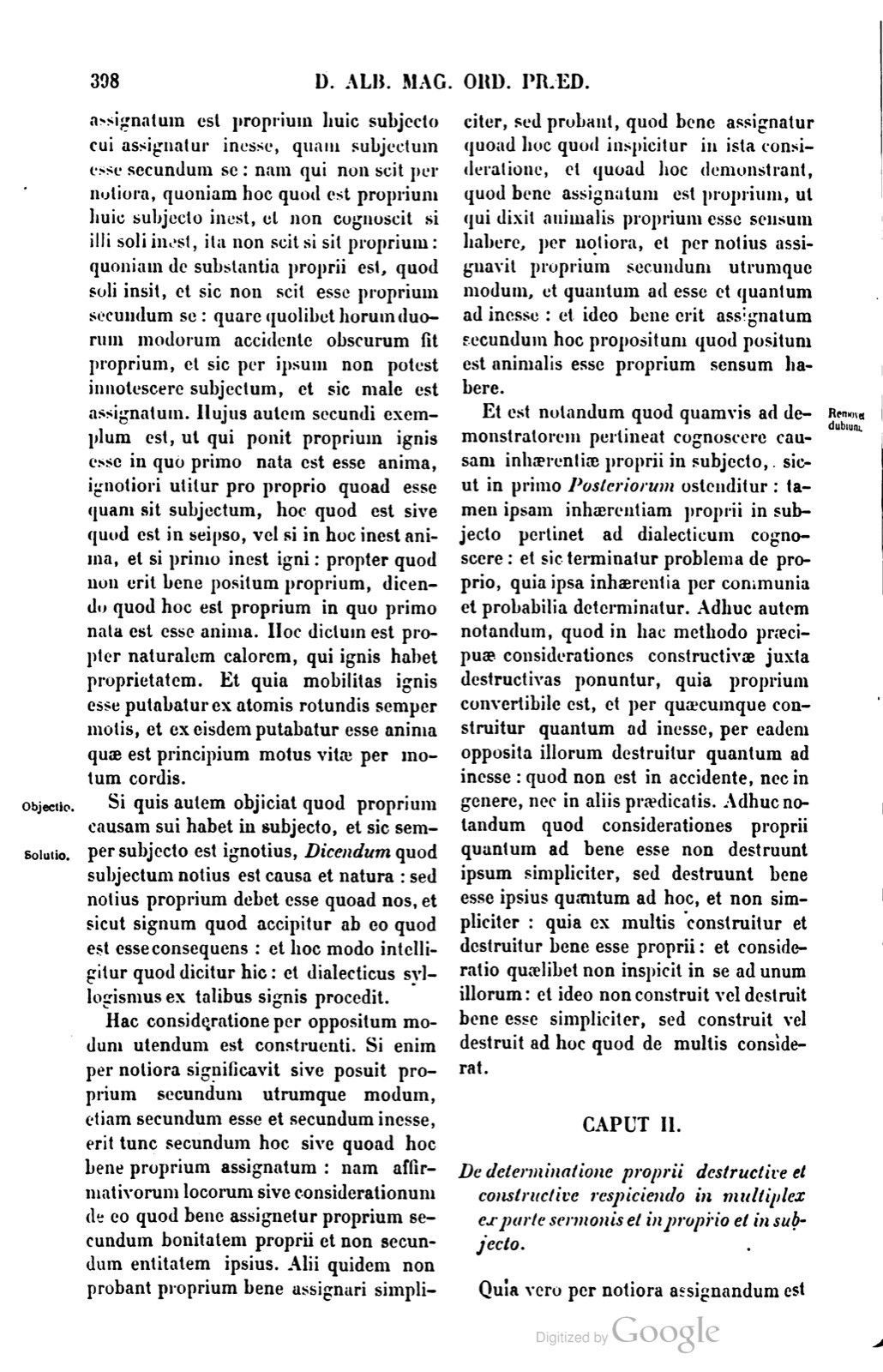
CAPUT II. De determinatione proprii destructive et constructive respiciendo in multiplex ex parte sermonis et in proprio et in subjecto.
Quia vero per notiora assignandum est proprium, et multiplex ex parte sermonis facit obscuritatem, deinde post considerationem ad notius, destruenti vel destruere volenti problema de proprio, inspiciendum est si quid vel aliquod nominum quae in proprio sunt assignata ad circumloquendum ipsum proprium multipliciter dicitur secundum aequivocationem, vel etiam considerandum si tota oratio plura significat secundum amphibologiam vel aliam multiplicitatem: et si sic, non est secundum hoc bene positum proprium. Cujus exemplum est, quoniam sentire aequivoce multa significat. Uno quidem modo significat sensum habere in habitu. Uno quidem sive alio modo sentire significat sensu uti secundum agere. Et ideo male assignatur proprium animalis esse sentire. Propter quod autem in assignatione proprii non est utendum multiplici, nec nomine quod multipliciter dicitur, neque oratione quae multa significat: quia id quod multipliciter dicitur, obscurum facit id quod dictum est ad proprii circumlocutionem: quia dubitat opponens qui debet arguere ad proprium terminandum utrum forte sensum dicat vel dicere intendit eorum quae multipliciter dicuntur: et ideo male per multiplex assignatur proprium. Nam proprium docendi gratia assignatur: multiplex non docet, sed obscurat.
Amplius autem adhuc alia ratio est ad hoc: quoniam necessarium aliquam increpationem ad hoc fieri semper si multiplex assignatur proprium: quia sunt mali socii opus commune impedientes, et transferentes disputationem dialecticam ad sophisticam: quia sic assignare proprium opponens in dissonanti sensu quem non intendit respondens, facit syllogismum de eo sive ad aliud quod multipliciter dicitur: et ut hanc increpationem evadat, per simpliciter dicta debet assignare proprium.
CHAPTER II. On the determination of property destructively and constructively by looking to multiplicity on the side of speech both in the property and in the subject.
But because a property must be assigned through better-known things, and multiplicity on the side of speech causes obscurity, then, after the consideration toward what is better known, one who is destroying, or who wishes to destroy, the problem concerning property must inspect whether any thing or any of the names which are assigned in the property for circumlocuting the property itself is said in many ways according to equivocation; or it must also be considered whether the whole expression signifies several things according to amphibology or some other multiplicity. And if so, the property is not well posited according to this. An example is that to sense signifies many things equivocally. In one mode it signifies to have sense in habit. In one mode, or rather in another mode, to sense signifies to use sense according to act. And therefore the property of animal is badly assigned as being to sense. The reason why one must not use the multiple in the assignment of property, nor a name which is said in many ways, nor an expression which signifies many things, is that what is said in many ways makes obscure that which has been stated for the circumlocution of the property. For the opponent, who ought to argue for determining the property, doubts whether perhaps it says sense, or intends to say, one of the things which are said in many ways; and therefore a property is badly assigned through something multiple. For a property is assigned for the sake of teaching; the multiple does not teach but obscures.
Furthermore there is still another reason for this: because some rebuke must always arise for this if a multiple property is assigned. For such things are bad companions, hindering the common work and transferring dialectical disputation to sophistical disputation; because by assigning a property in this way, the opponent, in a dissonant sense which the respondent does not intend, makes a syllogism about it or toward something else that is said in many ways. And in order to avoid this rebuke, one ought to assign property through things said simply.
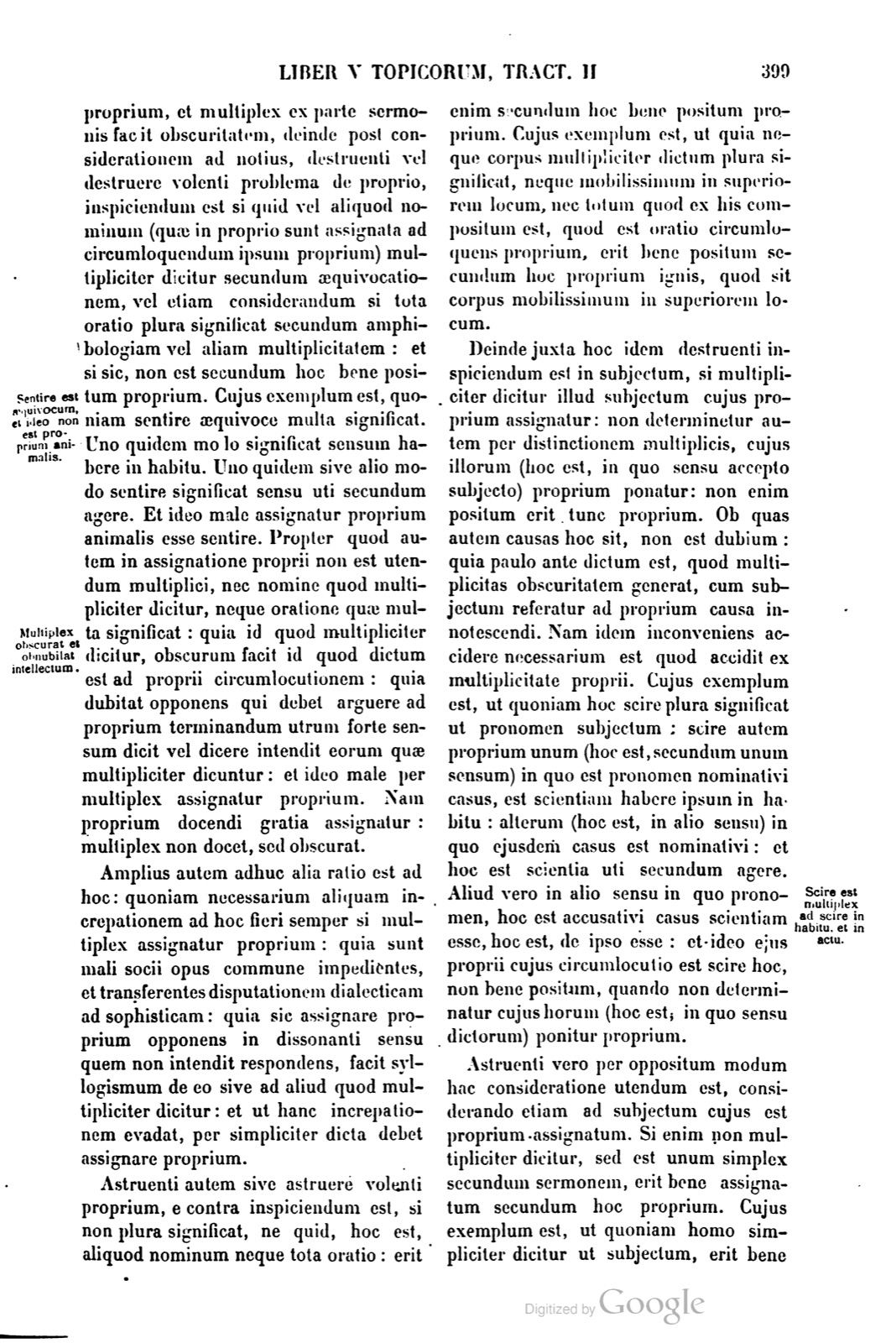
Astruenti autem sive astruere volenti proprium, e contra inspiciendum est, si non plura significat, ne quid, hoc est, aliquod nominum neque tota oratio: erit enim secundum hoc bene positum proprium. Cujus exemplum est, ut quia neque corpus multipliciter dictum plura significat, neque nobilissimum in superiorem locum, nec totum quod ex his compositum est, quod est oratio circumloquens proprium, erit bene positum secundum hoc proprium ignis, quod sit corpus mobilissimum in superiorem locum.
Deinde juxta hoc idem destruenti inspiciendum est in subjectum, si multipliciter dicitur illud subjectum cujus proprium assignatur: non determinetur autem per distinctionem multiplicis, cujus illorum, hoc est, in quo sensu accepto subjecto, proprium ponatur: non enim positum erit tunc proprium. Ob quas autem causas hoc sit, non est dubium: quia paulo ante dictum est, quod multiplicitas obscuritatem generat, cum subjectum referatur ad proprium causa innotescendi. Nam idem inconveniens accidere necessarium est quod accidit ex multiplicitate proprii. Cujus exemplum est, ut quoniam hoc scire plura significat ut pronomen subjectum: scire autem proprium unum, hoc est, secundum unum sensum, in quo est pronomen nominativi casus, est scientiam habere ipsum in habitu: alterum, hoc est, in alio sensu, in quo ejusdem casus est nominativi: et hoc est scientia uti secundum agere. Aliud vero in alio sensu in quo pronomen, hoc est accusativi casus scientiam esse, hoc est, de ipso esse: et ideo ejus proprii cujus circumlocutio est scire hoc, non bene positum, quando non determinatur cujus horum, hoc est, in quo sensu dictorum, ponitur proprium.
But one who establishes or wishes to establish the property must, on the contrary, inspect whether it does not signify several things, neither anything, that is, any of the names, nor the whole expression; for then according to this the property will be well posited. An example is that, because neither body said in many ways signifies several things, nor most noble toward an upper place, nor the whole thing composed from these, which is the expression circumlocuting the property, according to this the property of fire will be well posited, namely that it is a body most mobile toward an upper place.
Then, next to the same consideration, one destroying must inspect the subject, whether that subject whose property is assigned is said in many ways; and let it not be determined by distinguishing the multiple which of those meanings, that is, with the subject taken in which sense, the property is posited. For then the property will not have been posited. For what causes this happens is not doubtful, because a little earlier it was said that multiplicity generates obscurity, since the subject is referred to the property as the cause of becoming known. For the same inconvenience must necessarily happen which happens from multiplicity of the property. An example is that this scire signifies several things as the subject pronoun. But scire one property, that is, according to one sense in which the pronoun is of the nominative case, is to have science itself in habit; another, that is, in another sense, in which it is of the same nominative case, is to use science according to act. But another is in another sense in which the pronoun, that is, of the accusative case, is to be science, that is, concerning the very being of it. And therefore the property whose circumlocution is this scire is not well posited when it is not determined to which of these, that is, in which sense of the things said, the property is posited.
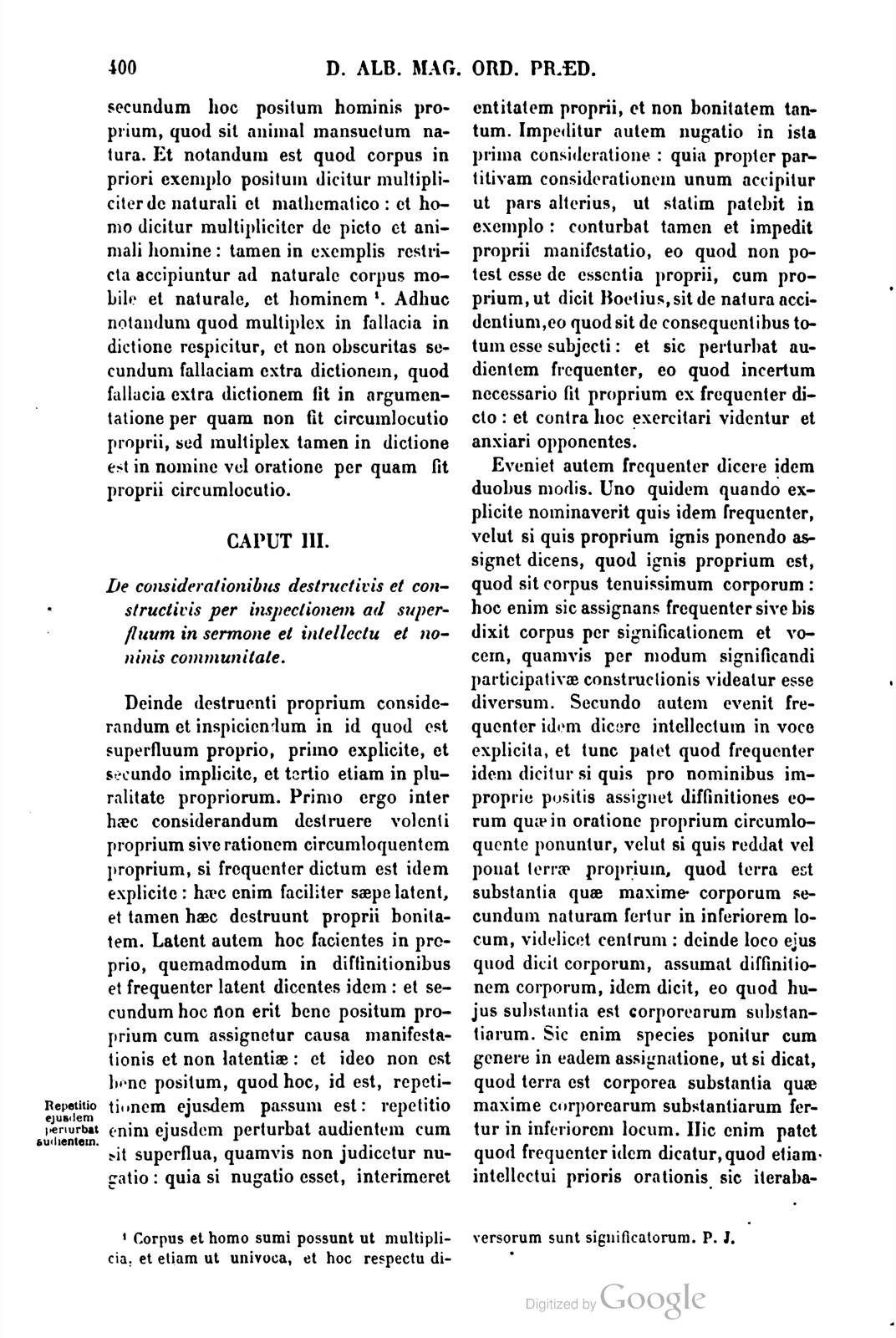
Astruenti vero per oppositum modum hac consideratione utendum est, considerando etiam ad subjectum cujus est proprium assignatum. Si enim non multipliciter dicitur, sed est unum simplex secundum sermonem, erit bene assignatum secundum hoc proprium. Cujus exemplum est, ut quoniam homo simpliciter dicitur ut subjectum, erit bene secundum hoc positum hominis proprium, quod sit animal mansuetum natura. Et notandum est quod corpus in priori exemplo positum dicitur multipliciter de naturali et mathematico: et homo dicitur multipliciter de picto et animali homine: tamen in exemplis restricta accipiuntur ad naturale corpus mobile et naturale, et hominem.1 Adhuc notandum quod multiplex in fallacia in dictione respicitur, et non obscuritas secundum fallaciam extra dictionem, quod fallacia extra dictionem fit in argumentatione per quam non fit circumlocutio proprii, sed multiplex tamen in dictione est in nomine vel oratione per quam fit proprii circumlocutio.
But one who establishes must use this consideration in the opposite mode, considering also with respect to the subject of which the property has been assigned. For if it is not said in many ways, but is one simple thing according to speech, the property will be well assigned according to this. An example is that, since man is said simply as subject, according to this the property of man will be well posited, that he is an animal tame by nature. And it must be noted that body, posited in the earlier example, is said in many ways of natural and mathematical body; and man is said in many ways of a painted man and an animal man; nevertheless in the examples the terms are taken as restricted to a natural body, mobile and natural, and to a man.1 It must further be noted that the multiple is considered in the fallacy in diction, and not obscurity according to a fallacy outside diction, because a fallacy outside diction occurs in argumentation through which the circumlocution of a property is not made. But the multiple in diction is in the name or expression through which the circumlocution of a property is made.
Notes
- Body and man can be taken as multiple, and also as univocal, and this with respect to diverse significates. P. J. (Corpus et homo sumi possunt ut multiplicia, et etiam ut univoca, et hoc respectu diversorum sunt significatorum. P. J.) ↩
If a page does not appear, its photograph has not been uploaded yet.