Volume 2 · pp. 397–398
Treatise II. On the determination of property according to the goodness of property. Chapter I. On the inspection of property with respect to those things which are, that property must be posited through better-known things.
A marker with ≈ is an approximate page boundary, placed by measure of the text; the page photographs remain the authority. In the paired views, clicking a page marker brings that page into view.
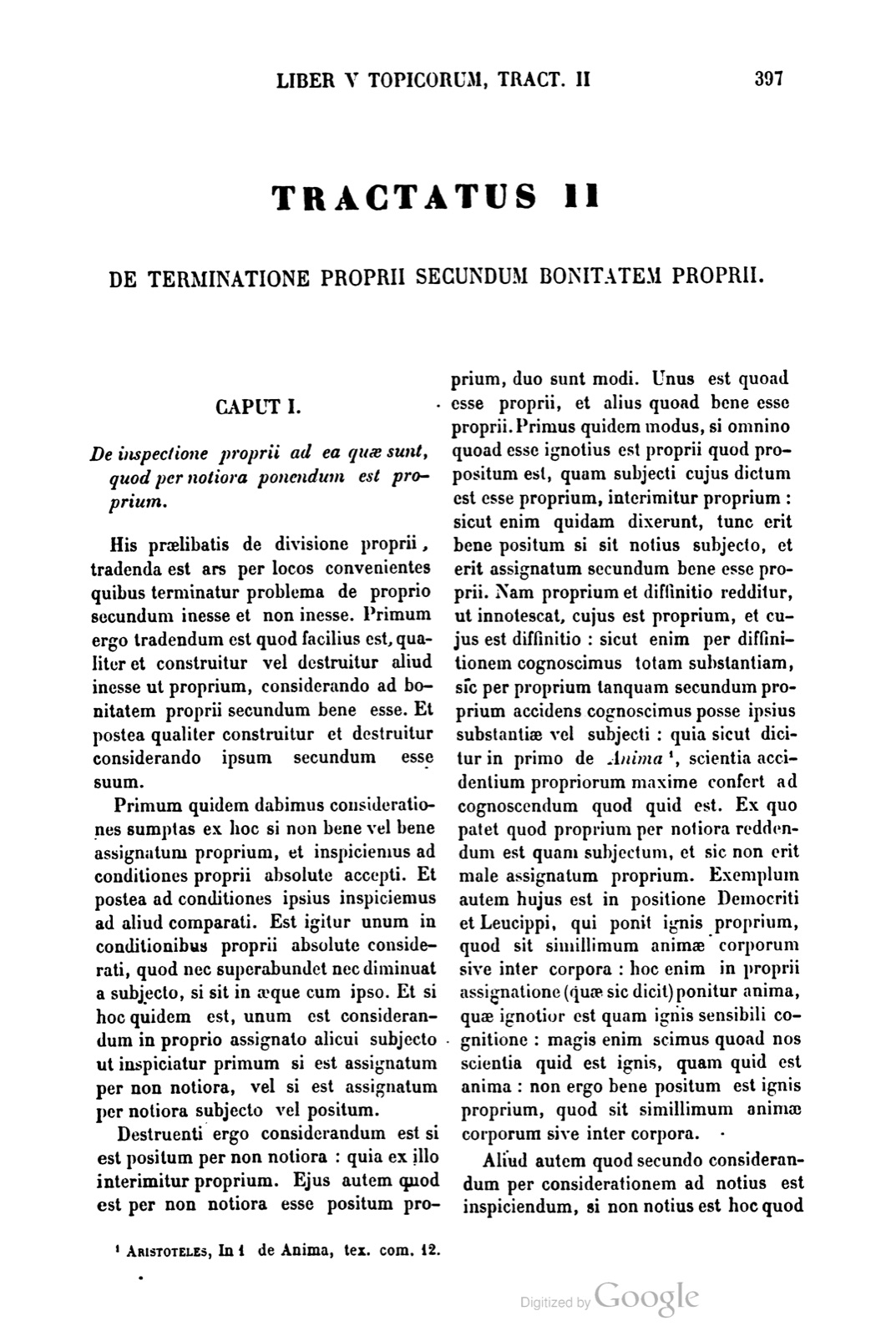
TRACTATUS II. DE TERMINATIONE PROPRII SECUNDUM BONITATEM PROPRII.
CAPUT I. De inspectione proprii ad ea quae sunt, quod per notiora ponendum est proprium.
His praelibatis de divisione proprii, tradenda est ars per locos convenientes quibus terminatur problema de proprio secundum inesse et non inesse. Primum ergo tradendum est quod facilius est, qualiter et construitur vel destruitur aliud inesse ut proprium, considerando ad bonitatem proprii secundum bene esse. Et postea qualiter construitur et destruitur considerando ipsum secundum esse suum.
Primum quidem dabimus considerationes sumptas ex hoc si non bene vel bene assignatum proprium, et inspiciemus ad conditiones proprii absolute accepti. Et postea ad conditiones ipsius inspiciemus ad aliud comparati. Est igitur unum in conditionibus proprii absolute considerati, quod nec superabundet nec diminuat a subjecto, si sit in aeque cum ipso. Et si hoc quidem est, unum est considerandum in proprio assignato alicui subjecto ut inspiciatur primum si est assignatum per non notiora, vel si est assignatum per notiora subjecto vel positum.
Destruenti ergo considerandum est si est positum per non notiora: quia ex illo interimitur proprium. Ejus autem quod est per non notiora esse positum proprium, duo sunt modi. Unus est quoad esse proprii, et alius quoad bene esse proprii. Primus quidem modus, si omnino quoad esse ignotius est proprii quod propositum est, quam subjecti cujus dictum est esse proprium, interimitur proprium: sicut enim quidam dixerunt, tunc erit bene positum si sit notius subjecto, et erit assignatum secundum bene esse proprii. Nam proprium et diffinitio redditur, ut innotescat, cujus est proprium, et cujus est diffinitio: sicut enim per diffinitionem cognoscimus totam substantiam, sic per proprium tanquam secundum proprium accidens cognoscimus posse ipsius substantiae vel subjecti: quia sicut dicitur in primo de Anima,1 scientia accidentium propriorum maxime confert ad cognoscendum quod quid est. Ex quo patet quod proprium per notiora reddendum est quam subjectum, et sic non erit male assignatum proprium. Exemplum autem hujus est in positione Democriti et Leucippi, qui ponit ignis proprium, quod sit simillimum animae corporum sive inter corpora: hoc enim in proprii assignatione, quae sic dicit, ponitur anima, quae ignotior est quam ignis sensibili cognitione: magis enim scimus quoad nos scientia quid est ignis, quam quid est anima: non ergo bene positum est ignis proprium, quod sit simillimum animae corporum sive inter corpora.
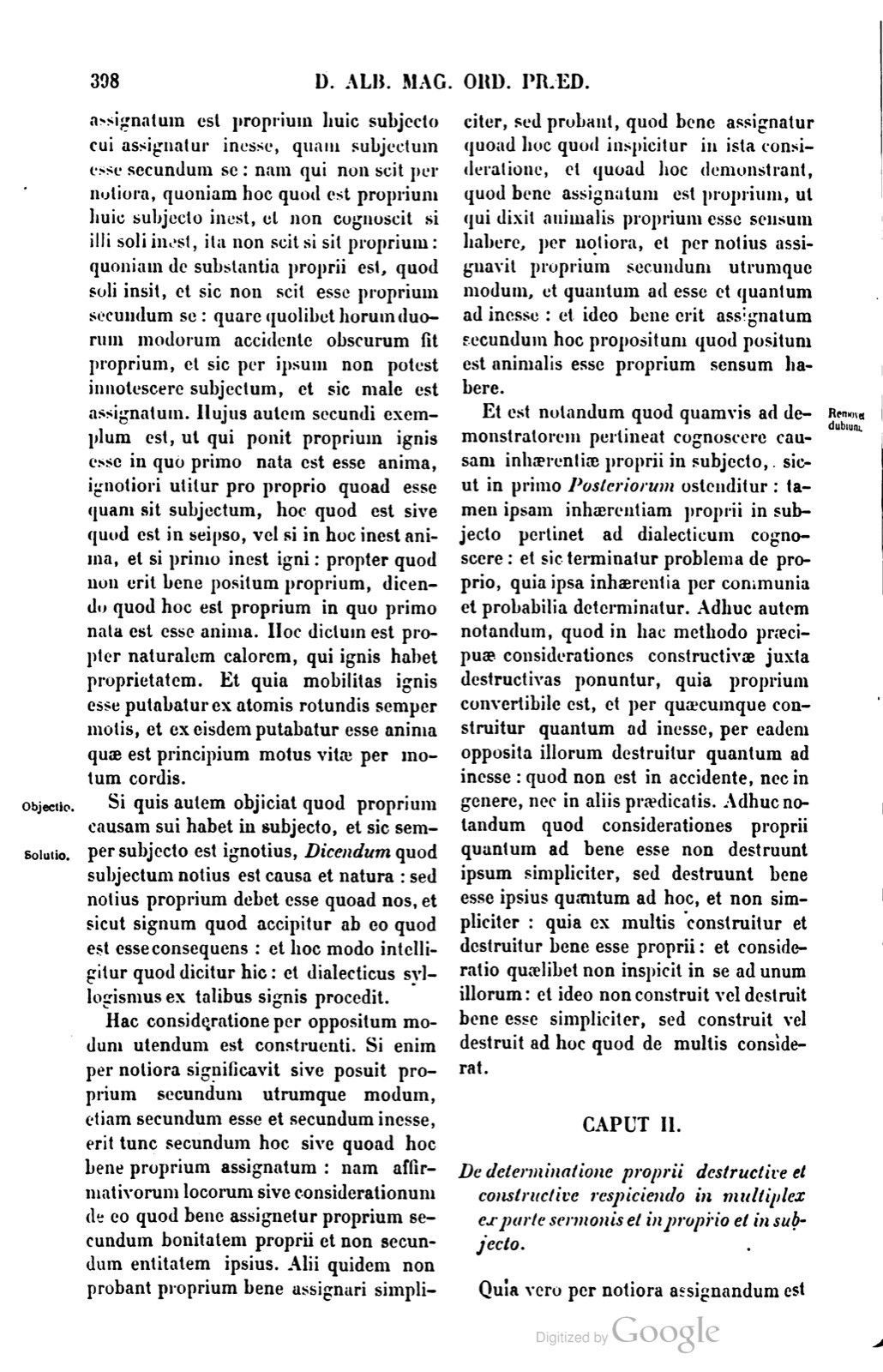
Aliud autem quod secundo considerandum per considerationem ad notius est inspiciendum, si non notius est hoc quod assignatum est proprium huic subjecto cui assignatur inesse, quam subjectum esse secundum se: nam qui non scit per notiora, quoniam hoc quod est proprium huic subjecto inest, et non cognoscit si illi soli inest, ita non scit si sit proprium: quoniam de substantia proprii est, quod soli insit, et sic non scit esse proprium secundum se: quare quolibet horum duorum modorum accidente obscurum fit proprium, et sic per ipsum non potest innotescere subjectum, et sic male est assignatum. Hujus autem secundi exemplum est, ut qui ponit proprium ignis esse in quo primo nata est esse anima, ignotiori utitur pro proprio quoad esse quam sit subjectum, hoc quod est sive quod est in seipso, vel si in hoc inest anima, et si primo inest igni: propter quod non erit bene positum proprium, dicendo quod hoc est proprium in quo primo nata est esse anima. Hoc dictum est propter naturalem calorem, qui ignis habet proprietatem. Et quia mobilitas ignis esse putabatur ex atomis rotundis semper motis, et ex eisdem putabatur esse anima quae est principium motus vitae per motum cordis.
TREATISE II. ON THE DETERMINATION OF PROPERTY ACCORDING TO THE GOODNESS OF PROPERTY.
CHAPTER I. On the inspection of property with respect to those things which are, that property must be posited through better-known things.
These things having been stated beforehand concerning the division of property, the art must now be handed down through the suitable topics by which the problem concerning property is determined according to belonging and not belonging. Therefore first that which is easier must be handed down, namely how another belonging as property is both constructed and destroyed, by considering the goodness of property according to its well-being. And afterward, how it is constructed and destroyed by considering it according to its own being.
First, then, we shall give considerations taken from this, whether a property has been assigned badly or well, and we shall inspect the conditions of property taken absolutely. And afterward we shall inspect the conditions of it as compared to another. Therefore one point in the conditions of property considered absolutely is that it neither exceeds nor falls short of the subject, if it is equal with it. And if this is so, one thing must be considered in a property assigned to some subject: first, whether it has been assigned through things not better known, or whether it has been assigned through things better known to the subject, or posited.
Therefore, one destroying it must consider whether it has been posited through things not better known, because from that the property is destroyed. But there are two modes of the property being posited through things not better known. One is with respect to the being of the property, and the other with respect to the well-being of the property. The first mode is this: if, altogether with respect to being, that of the property which has been proposed is less known than the subject of which it has been said to be the property, the property is destroyed. For as certain persons have said, then it will be well posited if it is better known than the subject, and it will be assigned according to the well-being of the property. For property and definition are rendered so that that of which it is the property and that of which it is the definition may become known. For just as through definition we know the whole substance, so through property as through a second proper accident we know the potency of the substance itself or subject, because, as is said in the first book On the Soul,1 the science of proper accidents contributes most of all to knowing what a thing is. From this it is clear that a property must be rendered through things better known than the subject, and thus the property will not be badly assigned. An example of this is in the position of Democritus and Leucippus, who posits as the property of fire that it is most like the soul among bodies or between bodies. For in the assignment of property which speaks in this way, soul is posited, which is less known than fire by sensible cognition; for with respect to us we know scientifically what fire is more than what soul is. Therefore it is not well posited as a property of fire that it is most like soul among bodies or between bodies.
But the other point, which must be considered secondly by consideration toward what is better known, is to inspect whether that which has been assigned as property to this subject to which it is assigned to belong is not better known than the subject is according to itself. For one who does not know through better-known things that this which is the property belongs to this subject, and does not know whether it belongs to it alone, does not in that way know whether it is a property, because it is of the substance of property that it belong to it alone; and thus he does not know that it is property according to itself. Therefore, when either of these two modes happens, the property becomes obscure, and thus through it the subject cannot become known, and so it is badly assigned. The example of this second point is this: one who posits that the property of fire is to be that in which soul is first naturally apt to be, uses something less known for the property as to being than the subject is, either what it is or what it is in itself, or whether soul belongs in this, and whether it first belongs in fire. For this reason the property will not be well posited by saying that this is the property in which soul is first naturally apt to be. This was said because of natural heat, which has the property of fire. And because the mobility of fire was thought to be from round atoms always in motion, and from the same atoms the soul was thought to be, which is the principle of the motion of life through the motion of the heart.
Si quis autem objiciat quod proprium causam sui habet in subjecto, et sic semper subjecto est ignotius, dicendum quod subjectum notius est causa et natura: sed notius proprium debet esse quoad nos, et sicut signum quod accipitur ab eo quod est esse consequens: et hoc modo intelligitur quod dicitur hic: et dialecticus syllogismus ex talibus signis procedit.
Hac consideratione per oppositum modum utendum est construenti. Si enim per notiora significavit sive posuit proprium secundum utrumque modum, etiam secundum esse et secundum inesse, erit tunc secundum hoc sive quoad hoc bene proprium assignatum: nam affirmativorum locorum sive considerationum de eo quod bene assignetur proprium secundum bonitatem proprii et non secundum entitatem ipsius. Alii quidem non probant proprium bene assignari simpliciter, sed probant quod bene assignatur quoad hoc quod inspicitur in ista consideratione, et quoad hoc demonstrant, quod bene assignatum est proprium, ut qui dixit animalis proprium esse sensum habere, per notiora, et per notius assignavit proprium secundum utrumque modum, et quantum ad esse et quantum ad inesse: et ideo bene erit assignatum secundum hoc propositum quod positum est animalis esse proprium sensum habere.
Et est notandum quod quamvis ad demonstratorem pertineat cognoscere causam inhaerentiae proprii in subjecto, sicut in primo Posteriorum ostenditur: tamen ipsam inhaerentiam proprii in subjecto pertinet ad dialecticum cognoscere: et sic terminatur problema de proprio, quia ipsa inhaerentia per communia et probabilia determinatur. Adhuc autem notandum, quod in hac methodo praecipuae considerationes constructivae juxta destructivas ponuntur, quia proprium convertibile est, et per quaecumque construitur quantum ad inesse, per eadem opposita illorum destruitur quantum ad inesse: quod non est in accidente, nec in genere, nec in aliis praedicatis. Adhuc notandum quod considerationes proprii quantum ad bene esse non destruunt ipsum simpliciter, sed destruunt bene esse ipsius quantum ad hoc, et non simpliciter: quia ex multis construitur et destruitur bene esse proprii: et consideratio quaelibet non inspicit in se ad unum illorum: et ideo non construit vel destruit bene esse simpliciter, sed construit vel destruit ad hoc quod de multis considerat.
But if someone objects that property has its own cause in the subject, and thus is always less known than the subject, it must be said that the subject is better known in cause and nature, but the property ought to be better known with respect to us, and as a sign which is taken from that which is a consequent being. And in this way what is said here is understood; and a dialectical syllogism proceeds from such signs.
A constructor must use this consideration in the opposite mode. For if he has signified or posited the property through better-known things according to both modes, namely according to being and according to belonging, then according to this, or with respect to this, the property will be well assigned. For affirmative topics or considerations concern that a property be well assigned according to the goodness of the property and not according to its entity. The others indeed do not prove that a property is well assigned simply, but they prove that it is well assigned with respect to what is inspected in that consideration; and with respect to this they demonstrate that the property has been well assigned. For example, one who said that it is proper to animal to have sense assigned the property through better-known things and through something better known according to both modes, both as to being and as to belonging; and therefore according to this the proposition that it has been posited as proper to animal to have sense will be well assigned.
And it must be noted that although it belongs to the demonstrator to know the cause of the inherence of the property in the subject, as is shown in the first book of the Posterior Analytics, nevertheless it belongs to the dialectician to know the inherence itself of the property in the subject; and so the problem concerning property is determined, because that inherence itself is determined through common and probable things. It must also be noted that in this method the chief constructive considerations are placed next to the destructive ones, because property is convertible, and by whatever things it is constructed as to belonging, by the opposite of those same things it is destroyed as to belonging. This is not so in accident, nor in genus, nor in the other predicates. It must further be noted that considerations of property with respect to well-being do not destroy it simply, but destroy its well-being with respect to this, and not simply; because from many things the well-being of property is constructed and destroyed, and any given consideration does not inspect in itself with respect to one of those things; and therefore it does not construct or destroy well-being simply, but constructs or destroys with respect to that which it considers from many things.
Notes
- Aristotle, On the Soul I, text/comment 12. (ARISTOTELES, In I de Anima, tex. com. 12.) ↩
If a page does not appear, its photograph has not been uploaded yet.