Volume 2 · pp. 393–396
Chapter II. On the reduction of the four-membered division to a two-membered division.
A marker with ≈ is an approximate page boundary, placed by measure of the text; the page photographs remain the authority. In the paired views, clicking a page marker brings that page into view.
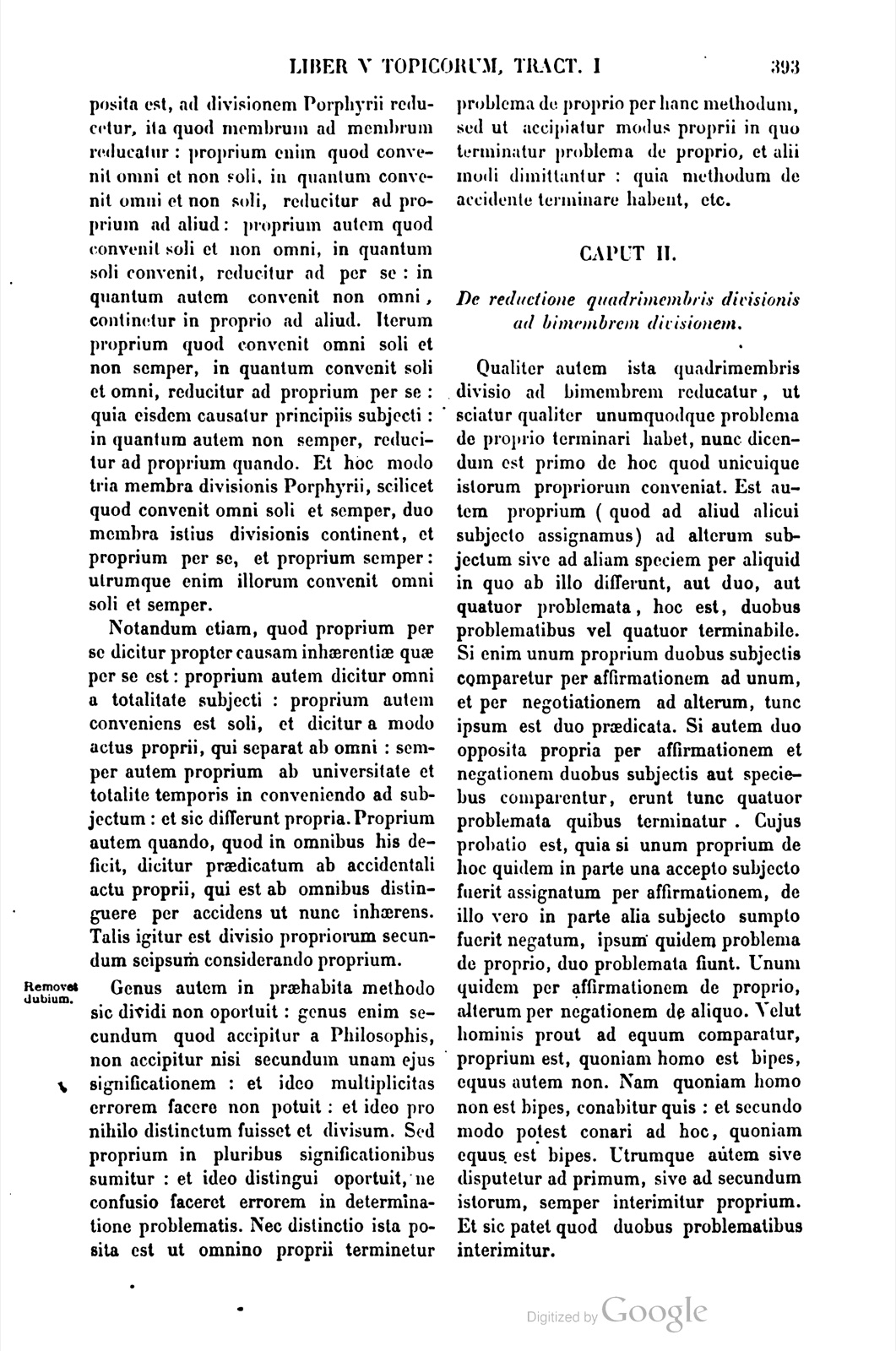
CAPUT II. De reductione quadrimembris divisionis ad bimembrem divisionem.
Qualiter autem ista quadrimembris divisio ad bimembrem reducatur, ut sciatur qualiter unumquodque problema de proprio terminari habet, nunc dicendum est primo de hoc quod unicuique istorum propriorum conveniat. Est autem proprium, quod ad aliud alicui subjecto assignamus, ad alterum subjectum sive ad aliam speciem per aliquid in quo ab illo differunt, aut duo, aut quatuor problemata, hoc est, duobus problematibus vel quatuor terminabile. Si enim unum proprium duobus subjectis comparetur per affirmationem ad unum, et per negationem ad alterum, tunc ipsum est duo praedicata. Si autem duo opposita propria per affirmationem et negationem duobus subjectis aut speciebus comparentur, erunt tunc quatuor problemata quibus terminatur. Cujus probatio est, quia si unum proprium de hoc quidem in parte una accepto subjecto fuerit assignatum per affirmationem, de illo vero in parte alia subjecto sumpto fuerit negatum, ipsum quidem problema de proprio duo problemata fiunt. Unum quidem per affirmationem de proprio, alterum per negationem de aliquo. Velut hominis prout ad equum comparatur, proprium est, quoniam homo est bipes, equus autem non. Nam quoniam homo non est bipes, conabitur quis: et secundo modo potest conari ad hoc, quoniam equus est bipes. Utrumque autem sive disputetur ad primum, sive ad secundum istorum, semper interimitur proprium. Et sic patet quod duobus problematibus interimitur.
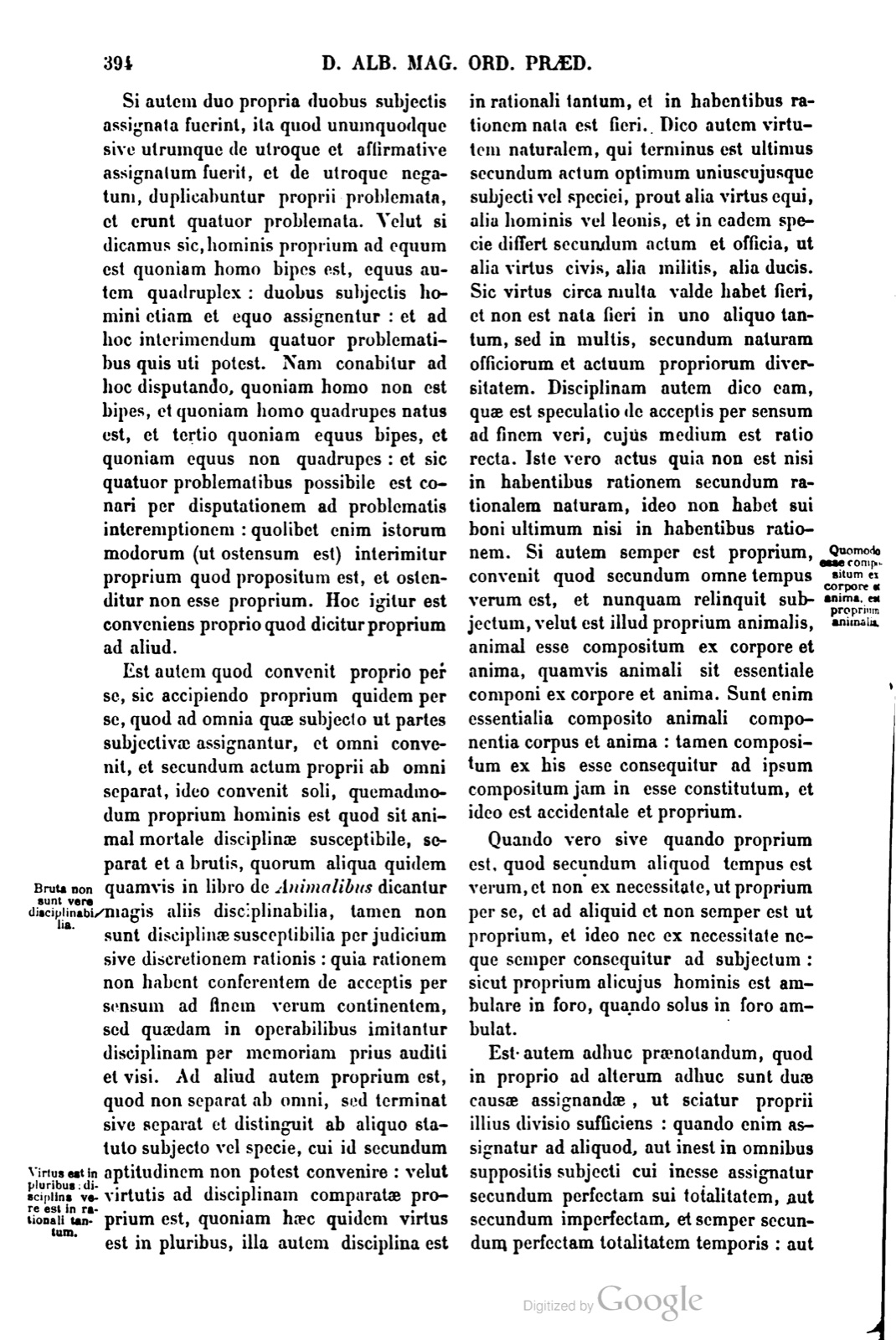
Si autem duo propria duobus subjectis assignata fuerint, ita quod unumquodque sive utrumque de utroque et affirmative assignatum fuerit, et de utroque negatum, duplicabuntur proprii problemata, et erunt quatuor problemata. Velut si dicamus sic, hominis proprium ad equum est quoniam homo bipes est, equus autem quadruplex: duobus subjectis homini etiam et equo assignentur: et ad hoc interimendum quatuor problematibus quis uti potest. Nam conabitur ad hoc disputando, quoniam homo non est bipes, et quoniam homo quadrupes natus est, et tertio quoniam equus bipes, et quoniam equus non quadrupes: et sic quatuor problematibus possibile est conari per disputationem ad problematis interemptionem: quolibet enim istorum modorum, ut ostensum est, interimitur proprium quod propositum est, et ostenditur non esse proprium. Hoc igitur est conveniens proprio quod dicitur proprium ad aliud.
Est autem quod convenit proprio per se, sic accipiendo proprium quidem per se, quod ad omnia quae subjecto ut partes subjectivae assignantur, et omni convenit, et secundum actum proprii ab omni separat, ideo convenit soli, quemadmodum proprium hominis est quod sit animal mortale disciplinae susceptibile, separat et a brutis, quorum aliqua quidem quamvis in libro de Animalibus dicantur magis aliis disciplinabilia, tamen non sunt disciplinae susceptibilia per judicium sive discretionem rationis: quia rationem non habent conferentem de acceptis per sensum ad finem verum continentem, sed quaedam in operabilibus imitantur disciplinam per memoriam prius auditi et visi. Ad aliud autem proprium est, quod non separat ab omni, sed terminat sive separat et distinguit ab aliquo statuto subjecto vel specie, cui id secundum aptitudinem non potest convenire: velut virtutis ad disciplinam comparatae proprium est, quoniam haec quidem virtus est in pluribus, illa autem disciplina est in rationali tantum, et in habentibus rationem nata est fieri. Dico autem virtutem naturalem, qui terminus est ultimus secundum actum optimum uniuscujusque subjecti vel speciei, prout alia virtus equi, alia hominis vel leonis, et in eadem specie differt secundum actum et officia, ut alia virtus civis, alia militis, alia ducis. Sic virtus circa multa valde habet fieri, et non est nata fieri in uno aliquo tantum, sed in multis, secundum naturam officiorum et actuum propriorum diversitatem. Disciplinam autem dico eam, quae est speculatio de acceptis per sensum ad finem veri, cujus medium est ratio recta. Iste vero actus quia non est nisi in habentibus rationem secundum rationalem naturam, ideo non habet sui boni ultimum nisi in habentibus rationem. Si autem semper est proprium, convenit quod secundum omne tempus verum est, et nunquam relinquit subjectum, velut est illud proprium animalis, animal esse compositum ex corpore et anima, quamvis animali sit essentiale componi ex corpore et anima. Sunt enim essentialia composito animali componentia corpus et anima: tamen compositum ex his esse consequitur ad ipsum compositum jam in esse constitutum, et ideo est accidentale et proprium.
CHAPTER II. On the reduction of the four-membered division to a two-membered division.
But how that four-membered division is reduced to a two-membered division, so that it may be known how each problem concerning property has to be determined, must now be stated, first concerning what belongs to each of those properties. Now the property which we assign to some subject toward another, namely toward another subject or toward another species through something in which they differ from it, is determinable by either two or four problems, that is, by two problems or four. For if one property is compared with two subjects, by affirmation to one and by negation to the other, then that property is two predicates. But if two opposite properties are compared through affirmation and negation with two subjects or species, then there will be four problems by which it is determined. The proof of this is that, if one property has been assigned affirmatively of this subject taken on one side, but denied of that subject taken on the other side, that one problem concerning property becomes two problems: one by affirmation concerning the property, the other by negation concerning something. For example, as man is compared to horse, it is proper to him that man is two-footed, but horse is not. For someone will attempt to show that man is not two-footed; and in a second way he can attempt this, that horse is two-footed. But whether dispute is directed to the first or to the second of these, the property is always destroyed. And so it is clear that it is destroyed by two problems.
But if two properties have been assigned to two subjects, so that each or both has been assigned affirmatively of each and denied of each, the problems of property will be doubled and there will be four problems. For example, if we speak thus: it is proper to man in relation to horse that man is two-footed, but horse four-footed; let these be assigned to two subjects, namely to man and to horse; then for destroying this someone can use four problems. For in disputing to this end he will attempt to show that man is not two-footed, and that man is by nature four-footed, and thirdly that horse is two-footed, and that horse is not four-footed. And thus by four problems it is possible to attempt through disputation the destruction of the problem; for by any one of these modes, as was shown, the property that was proposed is destroyed and is shown not to be a property. This, therefore, is what belongs to the property which is called property toward another.
But that which belongs to property through itself is this, taking property through itself in this way: it is assigned to all things which are assigned to the subject as subjective parts, and belongs to every one, and according to the act of property separates from every other; therefore it belongs to it alone. In this way it is proper to man to be a mortal animal capable of discipline, and it separates him also from brute animals. Although some brute animals are indeed said in the book On Animals to be more teachable than others, still they are not capable of discipline through judgment or discretion of reason, because they do not have reason comparing things received through sense to a containing true end; but certain of them in things to be done imitate discipline through memory of what was earlier heard and seen. But property toward another is that which does not separate from every other, but determines, or separates and distinguishes, from some established subject or species to which that cannot belong according to aptitude. For example, of virtue compared to discipline it is proper that this, namely virtue, is in many, but that, namely discipline, is only in the rational and is naturally apt to come to be in beings having reason. By natural virtue I mean that which is the ultimate term according to the best act of each subject or species, according as the virtue of horse is one, that of man or lion another; and in the same species it differs according to act and offices, as the virtue of a citizen is one, of a soldier another, of a leader another. Thus virtue has very much to be concerned with many things, and is not naturally apt to come to be in one thing only, but in many, according to the diversity of the nature of offices and proper acts. But by discipline I mean that which is speculation concerning things received through sense for the end of truth, whose middle term is right reason. Since this act exists only in beings having reason according to rational nature, therefore it has the ultimate of its good only in beings having reason. But if a property is always, it belongs according as it is true for every time and never leaves the subject, as that property of animal, that animal is composed of body and soul, although for animal it is essential to be composed of body and soul. For body and soul are essential components belonging to the composite animal; nevertheless to be composed of these follows upon the composite itself already constituted in being, and therefore it is accidental and proper.
Quando vero sive quando proprium est, quod secundum aliquod tempus est verum, et non ex necessitate, ut proprium per se, et ad aliquid et non semper est ut proprium, et ideo nec ex necessitate neque semper consequitur ad subjectum: sicut proprium alicujus hominis est ambulare in foro, quando solus in foro ambulat.
But when, or property when, is that which is true according to some time and not of necessity, as property through itself and toward something and not always is as property, and therefore it follows the subject neither of necessity nor always; for example, it is proper to some man to walk in the forum when he alone is walking in the forum.
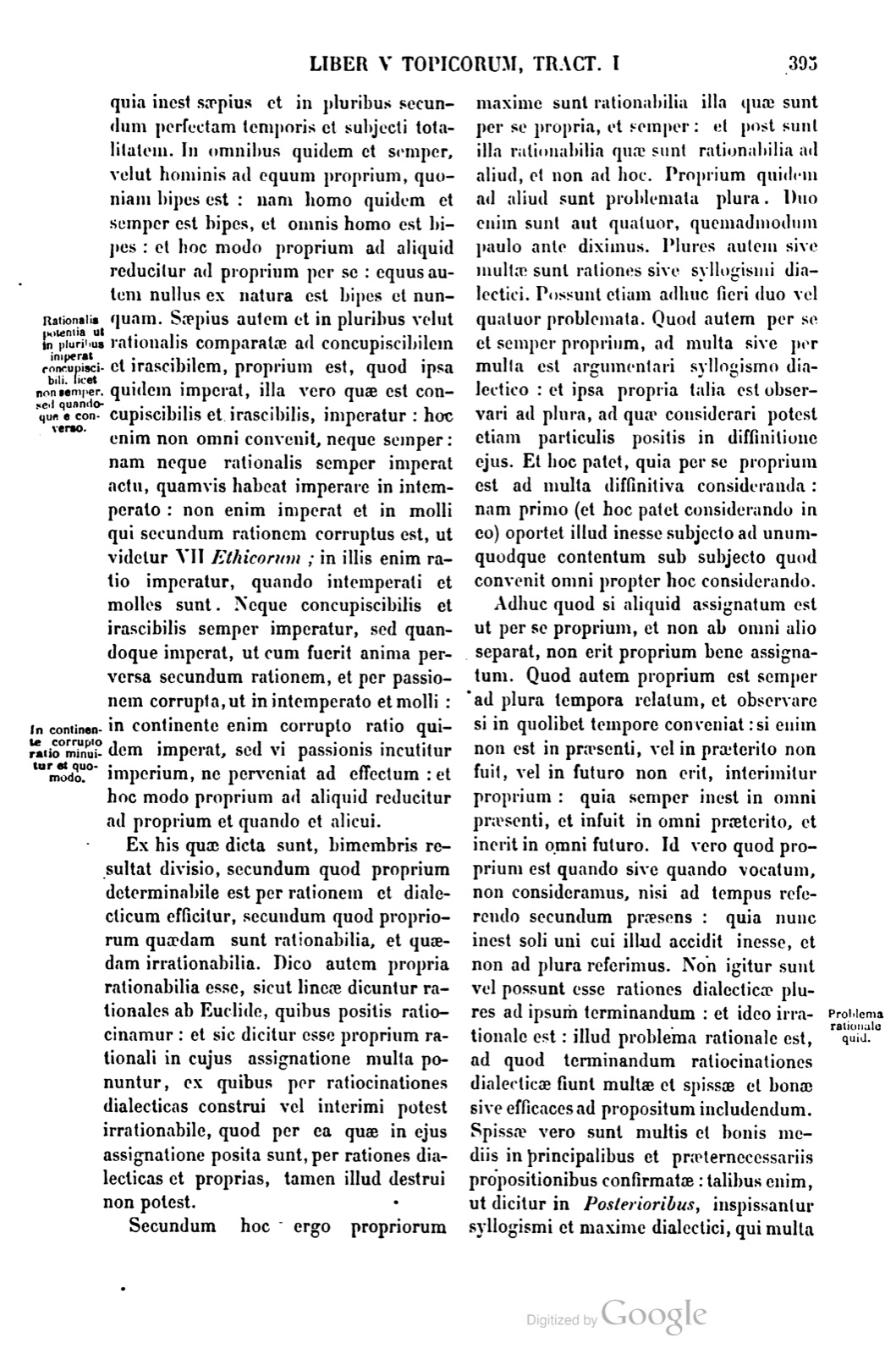
Est autem adhuc praenotandum, quod in proprio ad alterum adhuc sunt duae causae assignandae, ut sciatur proprii illius divisio sufficiens: quando enim assignatur ad aliquod, aut inest in omnibus suppositis subjecti cui inesse assignatur secundum perfectam sui totalitatem, aut quia inest saepius et in pluribus secundum perfectam temporis et subjecti totalitatem. In omnibus quidem et semper, velut hominis ad equum proprium, quoniam bipes est: nam homo quidem et semper est bipes, et omnis homo est bipes: et hoc modo proprium ad aliquid reducitur ad proprium per se: equus autem nullus ex natura est bipes et nunquam. Saepius autem et in pluribus velut rationalis comparatae ad concupiscibilem et irascibilem, proprium est, quod ipsa quidem imperat, illa vero quae est concupiscibilis et irascibilis, imperatur: hoc enim non omni convenit, neque semper: nam neque rationalis semper imperat actu, quamvis habeat imperare in intemperato: non enim imperat et in molli qui secundum rationem corruptus est, ut videtur VII Ethicorum; in illis enim ratio imperatur, quando intemperati et molles sunt. Neque concupiscibilis et irascibilis semper imperatur, sed quandoque imperat, ut cum fuerit anima perversa secundum rationem, et per passionem corrupta, ut in intemperato et molli: in continente enim corrupto ratio quidem imperat, sed vi passionis incutitur imperium, ne perveniat ad effectum: et hoc modo proprium ad aliquid reducitur ad proprium et quando et alicui.
Ex his quae dicta sunt, bimembris resultat divisio, secundum quod proprium determinabile est per rationem et dialecticum efficitur, secundum quod propriorum quaedam sunt rationabilia, et quaedam irrationabilia. Dico autem propria rationabilia esse, sicut lineae dicuntur rationales ab Euclide, quibus positis ratiocinamur: et sic dicitur esse proprium rationali in cujus assignatione multa ponuntur, ex quibus per ratiocinationes dialecticas construi vel interimi potest. Irrationabile, quod per ea quae in ejus assignatione posita sunt, per rationes dialecticas et proprias, tamen illud destrui non potest.
Secundum hoc ergo propriorum maxime sunt rationabilia illa quae sunt per se propria, et semper: et post sunt illa rationabilia quae sunt rationabilia ad aliud, et non ad hoc. Proprium quidem ad aliud sunt problemata plura. Duo enim sunt aut quatuor, quemadmodum paulo ante diximus. Plures autem sive multae sunt rationes sive syllogismi dialectici. Possunt etiam adhuc fieri duo vel quatuor problemata. Quod autem per se et semper proprium, ad multa sive per multa est argumentari syllogismo dialectico: et ipsa propria talia est observari ad plura, ad quae considerari potest etiam particulis positis in diffinitione ejus. Et hoc patet, quia per se proprium est ad multa diffinitiva consideranda: nam primo, et hoc patet considerando in eo, oportet illud inesse subjecto ad unumquodque contentum sub subjecto quod convenit omni propter hoc considerando. Adhuc quod si aliquid assignatum est ut per se proprium, et non ab omni alio separat, non erit proprium bene assignatum. Quod autem proprium est semper ad plura tempora relatum, et observare si in quolibet tempore conveniat: si enim non est in praesenti, vel in praeterito non fuit, vel in futuro non erit, interimitur proprium: quia semper inest in omni praesenti, et infuit in omni praeterito, et inerit in omni futuro. Id vero quod proprium est quando sive quando vocatum, non consideramus, nisi ad tempus referendo secundum praesens: quia nunc inest soli uni cui illud accidit inesse, et non ad plura referimus. Non igitur sunt vel possunt esse rationes dialecticae plures ad ipsum terminandum: et ideo irrationale est: illud problema rationale est, ad quod terminandum ratiocinationes dialecticae fiunt multae et spissae et bonae sive efficaces ad propositum includendum. Spissae vero sunt multis et bonis mediis in principalibus et praeternecessariis propositionibus confirmatae: talibus enim, ut dicitur in Posterioribus, inspissantur syllogismi et maxime dialectici, qui multa habent talia: tali enim divisione posita eliguntur in hac methodo ad proprium terminandum.
It must still be noted beforehand that, in property toward another, there are still two causes to be assigned, so that the sufficient division of that property may be known. For when it is assigned toward something, either it belongs in all the supposits of the subject to which it is assigned to belong according to the perfect totality of itself, or because it belongs more often and in more things according to the perfect totality of time and subject. In all and always, for example, there is the property of man toward horse, because he is two-footed; for man is both always two-footed and every man is two-footed, and in this way property toward something is reduced to property through itself; but no horse by nature is two-footed, and never. More often and in more things, however, as when the rational power is compared to the concupiscible and irascible, it is proper that the rational itself commands, while that which is concupiscible and irascible is commanded. For this belongs neither to every case nor always, for the rational does not always command in act, although it has commanding in the incontinent man; for it does not command also in the soft man who is corrupted according to reason, as appears in Ethics VII. For in those persons reason is commanded, when they are incontinent and soft. Nor are the concupiscible and irascible powers always commanded, but sometimes they command, as when the soul has become perverse according to reason and corrupted through passion, as in the incontinent and the soft man. For in the corrupted continent man reason indeed commands, but the command is struck down by the force of passion so that it does not arrive at effect. And in this way property toward something is reduced to property both when and to some one.
From the things that have been said, a two-membered division results, according as property is determinable by reason and is effected by dialectic, according as some properties are rational and some irrational. But I say that properties are rational as lines are called rational by Euclid, because when they have been posited we reason with them; and thus a property is said to be rational in whose assignment many things are posited, from which, through dialectical reasonings, it can be constructed or destroyed. The irrational is that which, through the things posited in its assignment and through dialectical and proper reasons, nevertheless cannot be destroyed.
Accordingly, among properties those are especially rational which are through-themselves properties and always; and afterward come those rational properties which are rational toward another, and not toward this. Indeed the problems concerning property toward another are several, for they are two or four, as we said a little earlier. But reasons or dialectical syllogisms are more numerous or many. Two or four problems can also still be made. But concerning that which is property through itself and always, one must argue by a dialectical syllogism toward many things or through many things; and such properties themselves must be observed with respect to the many things to which they can be considered, even with the particles set down in its definition. And this is clear, because a through-itself property must be considered with respect to many definitory things. For first, and this is clear by considering it, that thing must belong to the subject with respect to each thing contained under the subject, because of considering what belongs to every one. Further, if something is assigned as a through-itself property and does not separate from every other, it will not be a well-assigned property. But that which is a property always is referred to several times, and one must observe whether it belongs at any given time. For if it is not in the present, or was not in the past, or will not be in the future, the property is destroyed, because it always belongs in every present, has belonged in every past, and will belong in every future. But that which is property when, or is called when, we consider only by referring it to time according to the present, because now it belongs only to that one to which that belonging happens, and we do not refer it to several things. Therefore there are not, nor can there be, several dialectical reasons for determining it; and therefore it is irrational. That problem is rational for whose determination dialectical reasonings are made many and dense and good, or efficacious for enclosing the proposed point. But they are dense when confirmed by many and good middle terms in principal and preternatural propositions; for by such things, as is said in the Posterior Analytics, syllogisms are made dense, and especially dialectical syllogisms, which have many such things. Therefore, with such a division posited, the matters for determining property are chosen in this method.
Dicatur igitur determinando proprium, quod aliud quidem proprium dictum satis determinatur, et satis terminari potest ex his locis et considerationibus, qui dicti sunt in secundo hujus scientiae libro de accidente sive de inesse ut accidens, si consideratur qualiter huic et quidem accidit, et qualiter huic aliquando non accidit inesse. De proprio autem quando non oportet dicere: quia hoc jam in primo hujus scientiae libro ad accidens reductum est, et est irrationabile quantum ad hoc quod propria methodo non est per rationem terminabile. De his ergo propriis quae semper et per se sunt propria, remanet in primo libro per propria methodum considerandum, quantum ad considerationes haec propria determinantes, etc.
Therefore, in determining property, let it be said that property called other is determined sufficiently, and can be determined sufficiently, from these topics and considerations which were stated in the second book of this science concerning accident or concerning belonging as accident, if it is considered how it happens to this subject, and how at some time it does not happen to belong to this subject. But concerning property when one need not speak, because this has already been reduced to accident in the first book of this science, and it is irrational in this respect, that it is not determinable by reason through a proper method. Therefore, concerning those properties which are properties always and through themselves, it remains to be considered in the first book by a proper method, with respect to the considerations determining these properties, etc.
If a page does not appear, its photograph has not been uploaded yet.