Volume 2 · pp. 391–393
Book V of the Topics. Treatise I. Chapter I. On the intention and division of the property.
A marker with ≈ is an approximate page boundary, placed by measure of the text; the page photographs remain the authority. In the paired views, clicking a page marker brings that page into view.
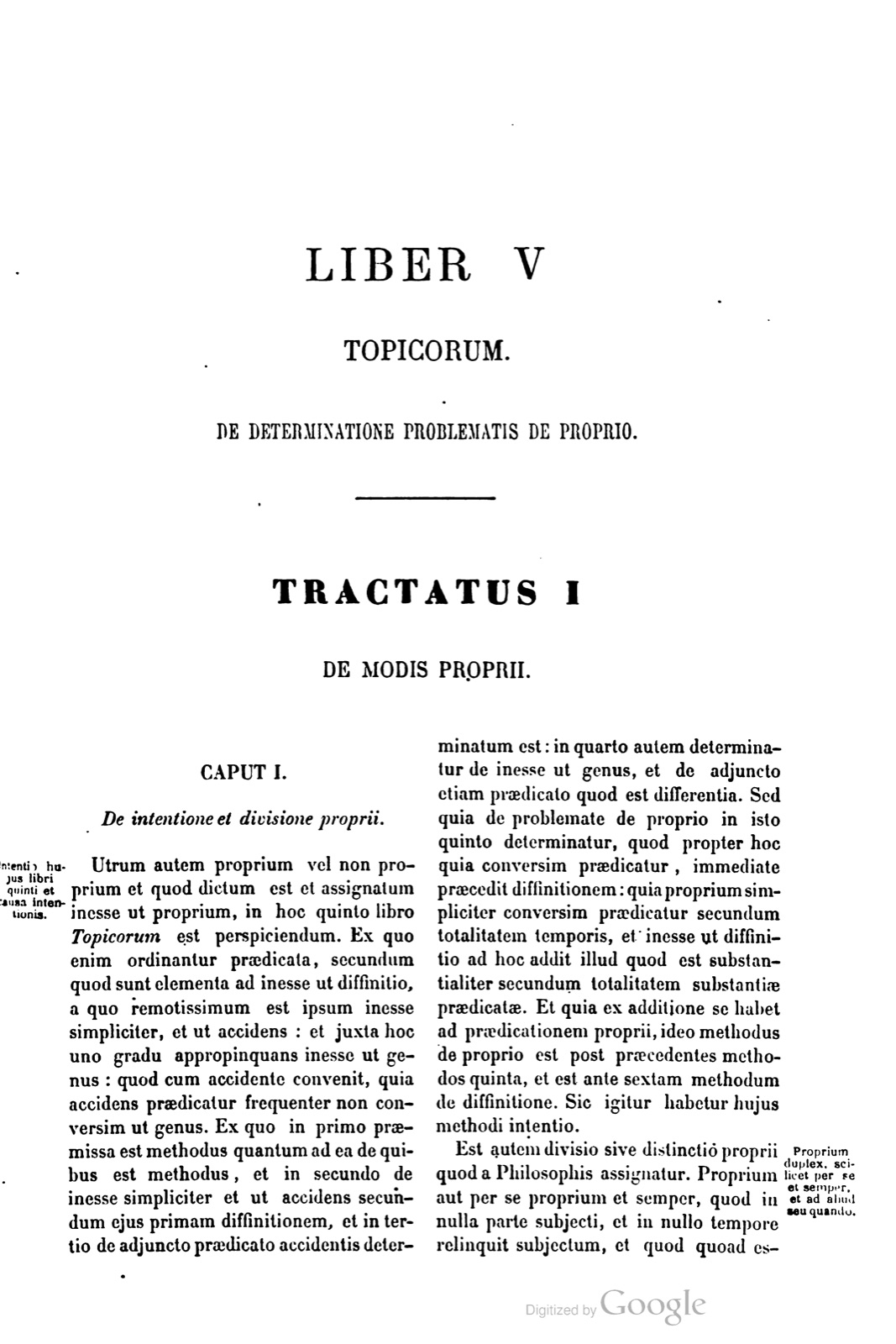
LIBER V TOPICORUM. DE DETERMINATIONE PROBLEMATIS DE PROPRIO.
TRACTATUS I. DE MODIS PROPRII.
CAPUT I. De intentione et divisione proprii.
Utrum autem proprium vel non proprium et quod dictum est et assignatum inesse ut proprium, in hoc quinto libro Topicorum est perspiciendum. Ex quo enim ordinantur praedicata, secundum quod sunt elementa ad inesse ut diffinitio, a quo remotissimum est ipsum inesse simpliciter, et ut accidens: et juxta hoc uno gradu appropinquans inesse ut genus: quod cum accidente convenit, quia accidens praedicatur frequenter non conversim ut genus. Ex quo in primo praemissa est methodus quantum ad ea de quibus est methodus, et in secundo de inesse simpliciter et ut accidens secundum ejus primam diffinitionem, et in tertio de adjuncto praedicato accidentis determinatum est: in quarto autem determinatur de inesse ut genus, et de adjuncto etiam praedicato quod est differentia. Sed quia de problemate de proprio in isto quinto determinatur, quod propter hoc quia conversim praedicatur, immediate praecedit diffinitionem: quia proprium simpliciter conversim praedicatur secundum totalitatem temporis, et inesse ut diffinitio ad hoc addit illud quod est substantialiter secundum totalitatem substantiae praedicatae. Et quia ex additione se habet ad praedicationem proprii, ideo methodus de proprio est post praecedentes methodos quinta, et est ante sextam methodum de diffinitione. Sic igitur habetur hujus methodi intentio.
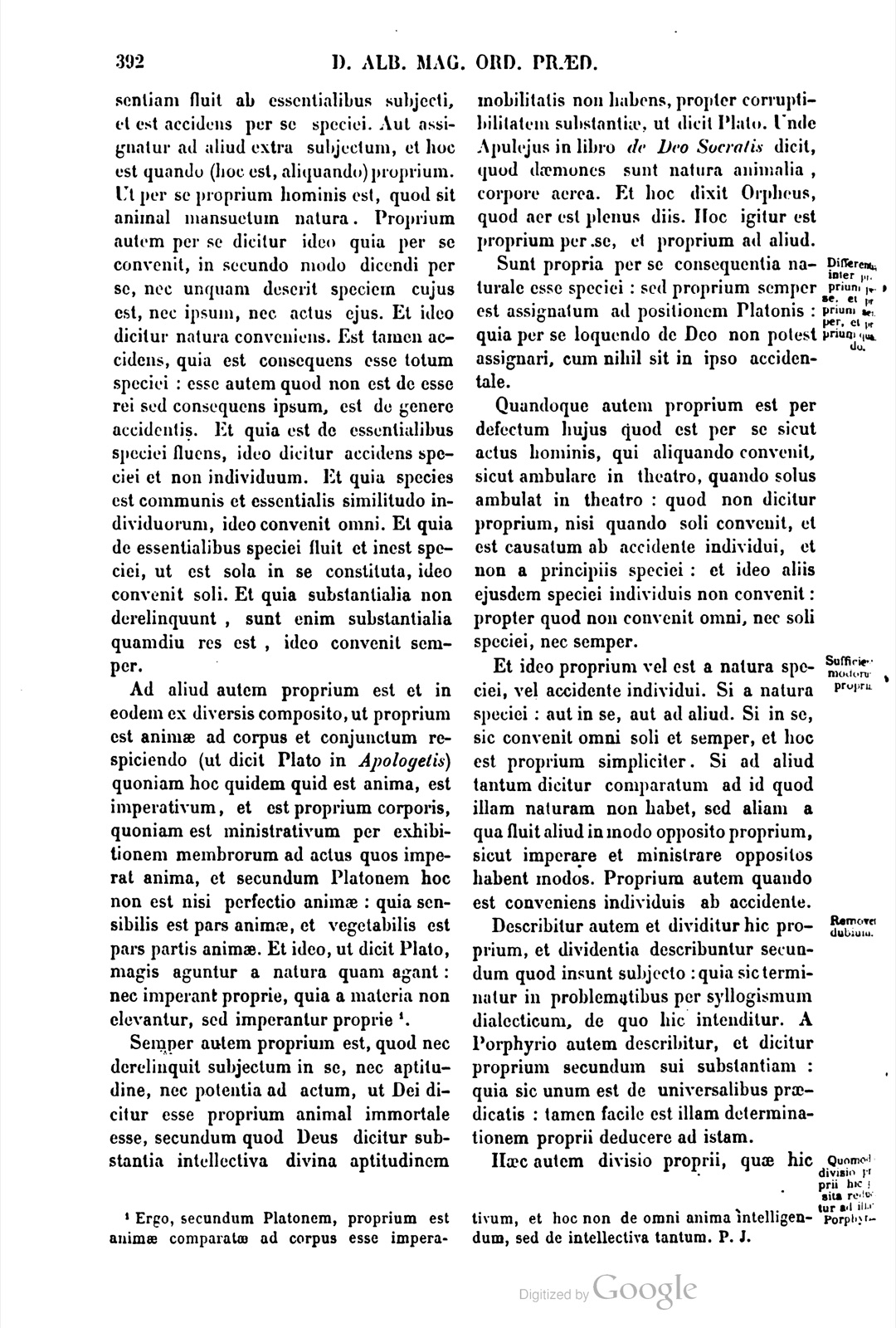
Est autem divisio sive distinctio proprii duplex, quod a Philosophis assignatur. Proprium aut per se proprium et semper, quod in nulla parte subjecti, et in nullo tempore relinquit subjectum, et quod quoad essentiam fluit ab essentialibus subjecti, et est accidens per se speciei. Aut assignatur ad aliud extra subjectum, et hoc est quando, hoc est, aliquando proprium. Ut per se proprium hominis est, quod sit animal mansuetum natura. Proprium autem per se dicitur ideo quia per se convenit, in secundo modo dicendi per se, nec unquam deserit speciem cujus est, nec ipsum, nec actus ejus. Et ideo dicitur natura conveniens. Est tamen accidens, quia est consequens esse totum speciei: esse autem quod non est de esse rei sed consequens ipsum, est de genere accidentis. Et quia est de essentialibus speciei fluens, ideo dicitur accidens speciei et non individuum. Et quia species est communis et essentialis similitudo individuorum, ideo convenit omni. Et quia de essentialibus speciei fluit et inest speciei, ut est sola in se constituta, ideo convenit soli. Et quia substantialia non derelinquunt, sunt enim substantialia quamdiu res est, ideo convenit semper.
BOOK V OF THE TOPICS. ON THE DETERMINATION OF THE PROBLEM CONCERNING PROPERTY.
TREATISE I. ON THE MODES OF PROPERTY.
CHAPTER I. On the intention and division of property.
Whether something is a property or not a property, and what has been stated and assigned to belong as a property, must be examined in this fifth book of the Topics. For predicables are ordered according as they are elements toward belonging as a definition, from which belonging simply and as accident is most remote; and next to this, by one degree drawing near, is belonging as genus, which agrees with accident because accident is frequently predicated not conversely, as genus also is. Therefore in the first book the method was set forth beforehand as to the matters about which there is a method, and in the second it was determined concerning belonging simply and as accident according to its first definition, and in the third concerning the adjunct predicate of accident; in the fourth, however, there is determination concerning belonging as genus, and also concerning the adjunct predicate which is difference. But because in this fifth book determination is made concerning the problem about property, which for this reason, because it is predicated conversely, immediately precedes definition: for property simply is predicated conversely according to totality of time, and belonging as a definition adds to this that which is substantial according to the totality of the substance predicated. And because from addition it is related to the predication of property, therefore the method concerning property is fifth after the preceding methods, and is before the sixth method concerning definition. Thus, therefore, the intention of this method is held.
Now the division or distinction of property which is assigned by the Philosophers is twofold. Property is either through itself property and always, which in no part of the subject and at no time leaves the subject, and which as to essence flows from the essentials of the subject and is an accident through itself of the species. Or it is assigned toward something else outside the subject, and this is property when, that is, at some time. For example, a through-itself property of man is that he is an animal tame by nature. But through itself property is so called because it belongs through itself, in the second mode of saying through itself, and never abandons the species of which it is, nor the very subject, nor its acts. And therefore it is called naturally belonging. Yet it is an accident, because it follows the whole being of the species; but being which is not of the being of the thing but follows it, is of the genus of accident. And because it flows from the essentials of the species, therefore it is called an accident of the species and not of the individual. And because species is the common and essential likeness of individuals, therefore it belongs to every one. And because it flows from the essentials of the species and belongs to the species as it is alone constituted in itself, therefore it belongs to it alone. And because substantial things do not abandon, for they are substantial as long as the thing is, therefore it belongs always.
Ad aliud autem proprium est et in eodem ex diversis composito, ut proprium est animae ad corpus et conjunctum respiciendo, ut dicit Plato in Apologetis, quoniam hoc quidem quid est anima, est imperativum, et est proprium corporis, quoniam est ministrativum per exhibitionem membrorum ad actus quos imperat anima, et secundum Platonem hoc non est nisi perfectio animae: quia sensibilis est pars animae, et vegetabilis est pars partis animae. Et ideo, ut dicit Plato, magis aguntur a natura quam agant: nec imperant proprie, quia a materia non elevantur, sed imperantur proprie.1
Semper autem proprium est, quod nec derelinquit subjectum in se, nec aptitudine, nec potentia ad actum, ut Dei dicitur esse proprium animal immortale esse, secundum quod Deus dicitur substantia intellectiva divina aptitudinem mobilitatis non habens, propter corruptibilitatem substantiae, ut dicit Plato. Unde Apulejus in libro de Deo Socratis dicit, quod daemones sunt natura animalia, corpore aerea. Et hoc dixit Orpheus, quod aer est plenus diis. Hoc igitur est proprium per se, et proprium ad aliud.
Sunt propria per se consequentia naturale esse speciei: sed proprium semper est assignatum ad positionem Platonis: quia per se loquendo de Deo non potest assignari, cum nihil sit in ipso accidentale.
Quandoque autem proprium est per defectum hujus quod est per se, sicut actus hominis, qui aliquando convenit, sicut ambulare in theatro, quando solus ambulat in theatro: quod non dicitur proprium, nisi quando soli convenit, et est causatum ab accidente individui, et non a principiis speciei: et ideo aliis ejusdem speciei individuis non convenit: propter quod non convenit omni, nec soli speciei, nec semper.
Et ideo proprium vel est a natura speciei, vel accidente individui. Si a natura speciei: aut in se, aut ad aliud. Si in se, sic convenit omni soli et semper, et hoc est proprium simpliciter. Si ad aliud tantum dicitur comparatum ad id quod illam naturam non habet, sed aliam a qua fluit aliud in modo opposito proprium, sicut imperare et ministrare oppositos habent modos. Proprium autem quando est conveniens individuis ab accidente.
Describitur autem et dividitur hic proprium, et dividentia describuntur secundum quod insunt subjecto: quia sic terminatur in problematibus per syllogismum dialecticum, de quo hic intenditur. A Porphyrio autem describitur, et dicitur proprium secundum sui substantiam: quia sic unum est de universalibus praedicatis: tamen facile est illam determinationem proprii deducere ad istam.
Property toward another, however, exists also in the same thing composed from diverse things, as property belongs to soul in relation to body and to the composite when these are considered, as Plato says in the Apology, because this certain thing which is soul is imperative, and it is proper to body because it is ministerial through the presenting of members for the acts which the soul commands; and according to Plato this is nothing except the perfection of soul, because the sensible part is a part of soul, and the vegetative part is a part of a part of soul. And therefore, as Plato says, they are acted upon by nature more than they act; nor do they command properly, because they are not raised above matter, but are properly commanded.1
But property always is that which does not abandon the subject in itself, nor in aptitude, nor in potency toward act, as it is said to be proper to God to be an immortal animal, according as God is called a divine intellective substance not having aptitude for motion, because of the corruptibility of substance, as Plato says. Hence Apuleius in the book On the God of Socrates says that demons are by nature animals, airy in body. And Orpheus said this, that the air is full of gods. This, therefore, is property through itself and property toward another.
Through-itself properties are consequences of the natural being of the species; but property always is assigned according to Plato's position, because, speaking through itself concerning God, it cannot be assigned, since nothing accidental is in him.
Sometimes, however, property exists through defect of that which is through itself, as an act of a man which belongs at some time, for instance walking in the theater, when he alone walks in the theater. This is not called a property except when it belongs to him alone, and it is caused by an accident of the individual and not by principles of the species; and therefore it does not belong to other individuals of the same species, for which reason it belongs neither to every one, nor to the species alone, nor always.
And therefore a property is either from the nature of the species or from an accident of an individual. If from the nature of the species, then either in itself or toward another. If in itself, it so belongs to every one, to it alone, and always, and this is property simply. If toward another, it is said only as compared to that which does not have that nature, but another nature from which another property flows in an opposite mode, just as commanding and ministering have opposite modes. But property when is something belonging to individuals from accident.
Here, then, property is described and divided, and the divisions are described according as they belong to the subject, because in this way it is determined in problems through the dialectical syllogism, about which the present intention is. But by Porphyry it is described, and is called property according to its substance, because in that way it is one of the universal predicates; nevertheless it is easy to reduce that determination of property to this one.
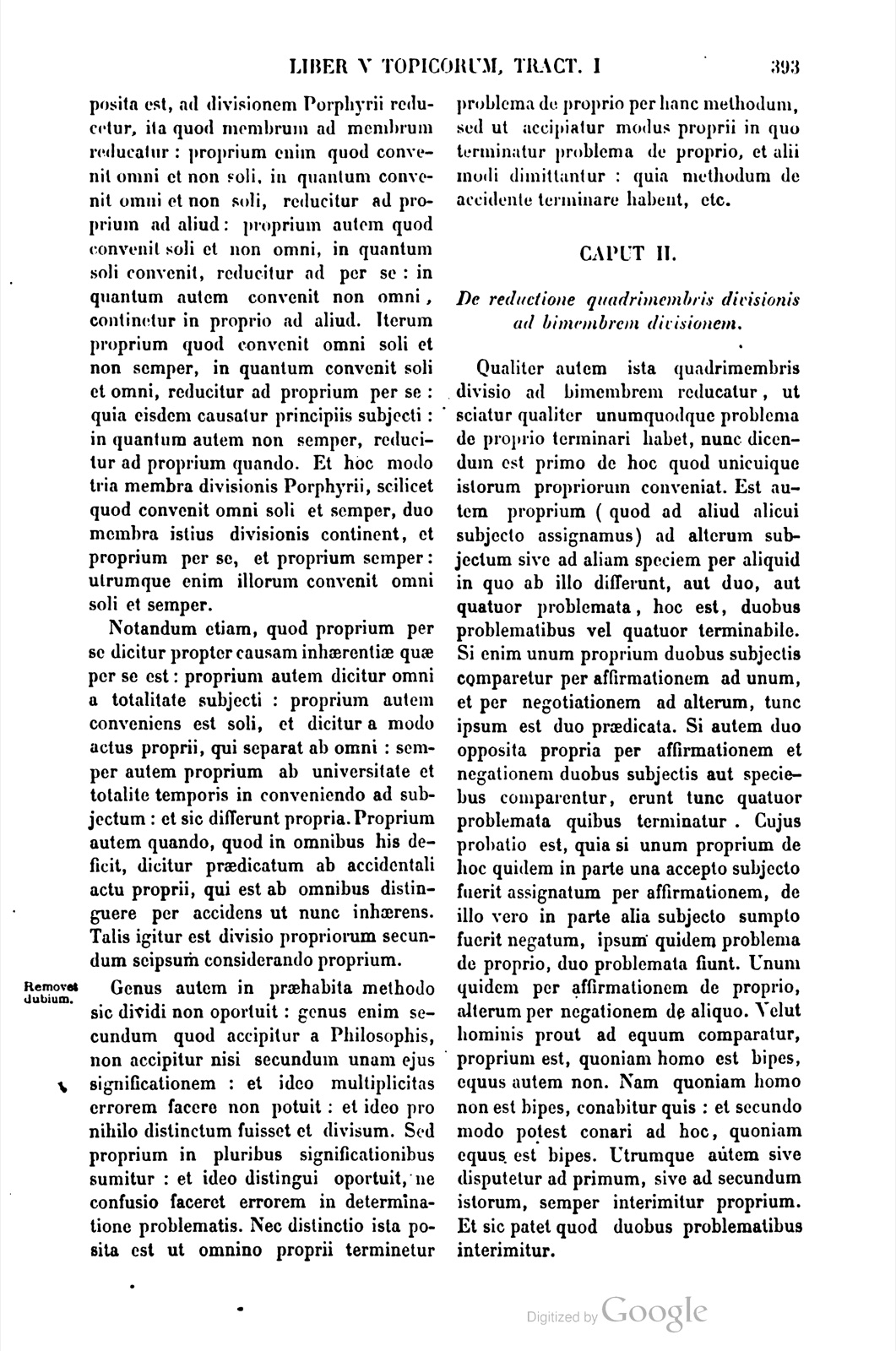
Haec autem divisio proprii, quae hic posita est, ad divisionem Porphyrii reducetur, ita quod membrum ad membrum reducatur: proprium enim quod convenit omni et non soli, in quantum convenit omni et non soli, reducitur ad proprium ad aliud: proprium autem quod convenit soli et non omni, in quantum soli convenit, reducitur ad per se: in quantum autem convenit non omni, continetur in proprio ad aliud. Iterum proprium quod convenit omni soli et non semper, in quantum convenit soli et omni, reducitur ad proprium per se: quia eisdem causatur principiis subjecti: in quantum autem non semper, reducitur ad proprium quando. Et hoc modo tria membra divisionis Porphyrii, scilicet quod convenit omni soli et semper, duo membra istius divisionis continent, et proprium per se, et proprium semper: utrumque enim illorum convenit omni soli et semper.
Notandum etiam, quod proprium per se dicitur propter causam inhaerentiae quae per se est: proprium autem dicitur omni a totalitate subjecti: proprium autem conveniens est soli, et dicitur a modo actus proprii, qui separat ab omni: semper autem proprium ab universitate et totalitate temporis in conveniendo ad subjectum: et sic differunt propria. Proprium autem quando, quod in omnibus his deficit, dicitur praedicatum ab accidentali actu proprii, qui est ab omnibus distinguere per accidens ut nunc inhaerens. Talis igitur est divisio propriorum secundum seipsum considerando proprium.
Genus autem in praehabita methodo sic dividi non oportuit: genus enim secundum quod accipitur a Philosophis, non accipitur nisi secundum unam ejus significationem: et ideo multiplicitas errorem facere non potuit: et ideo pro nihilo distinctum fuisset et divisum. Sed proprium in pluribus significationibus sumitur: et ideo distingui oportuit, ne confusio faceret errorem in determinatione problematis. Nec distinctio ista posita est ut omnino proprii terminetur problema de proprio per hanc methodum, sed ut accipiatur modus proprii in quo terminatur problema de proprio, et alii modi dimittantur: quia methodum de accidente terminare habent, etc.
But this division of property which has been set down here will be reduced to the division of Porphyry, so that member is reduced to member. For the property which belongs to every one and not to it alone, insofar as it belongs to every one and not to it alone, is reduced to property toward another. But the property which belongs to it alone and not to every one, insofar as it belongs to it alone, is reduced to through itself; insofar, however, as it belongs not to every one, it is contained under property toward another. Again, the property which belongs to every one, to it alone, and not always, insofar as it belongs to it alone and to every one, is reduced to through-itself property, because it is caused by the same principles of the subject; but insofar as it is not always, it is reduced to property when. And in this way three members of Porphyry's division, namely that which belongs to every one, to it alone, and always, contain two members of this division, both property through itself and property always; for each of those belongs to every one, to it alone, and always.
It must also be noted that property through itself is so called because of the cause of inherence which is through itself; property, however, is called every because of the totality of the subject; property belonging alone is so called from the mode of the act of property, which separates from every other; but property always is so called from the universality and totality of time in belonging to the subject. And thus properties differ. But property when, which is deficient in all these respects, is called a predicate from an accidental act of property, which is to distinguish from all things accidentally as now inhering. Such, therefore, is the division of properties when property is considered according to itself.
But in the previously treated method it was not necessary for genus to be divided in this way. For genus, according as it is taken by the Philosophers, is taken only according to one of its significations; and therefore multiplicity could not cause error, and for that reason it would have been distinguished and divided to no purpose. But property is taken in several significations; and therefore it had to be distinguished, lest confusion cause error in determining the problem. Nor was this distinction set down so that the problem concerning property might be wholly determined by this method, but so that the mode of property in which the problem concerning property is determined might be taken, and the other modes set aside, because they have to be determined by the method concerning accident, etc.
Notes
- Therefore, according to Plato, it is proper to soul, compared to body, to be imperative; and this is not to be understood of every soul, but only of the intellective soul. P. J. (Ergo, secundum Platonem, proprium est animae comparatae ad corpus esse imperativum, et hoc non de omni anima intelligendum, sed de intellectiva tantum. P. J.) ↩
If a page does not appear, its photograph has not been uploaded yet.