Volume 2 · pp. 389–390
Treatise IV. Chapters II-IV
A marker with ≈ is an approximate page boundary, placed by measure of the text; the page photographs remain the authority. In the paired views, clicking a page marker brings that page into view.
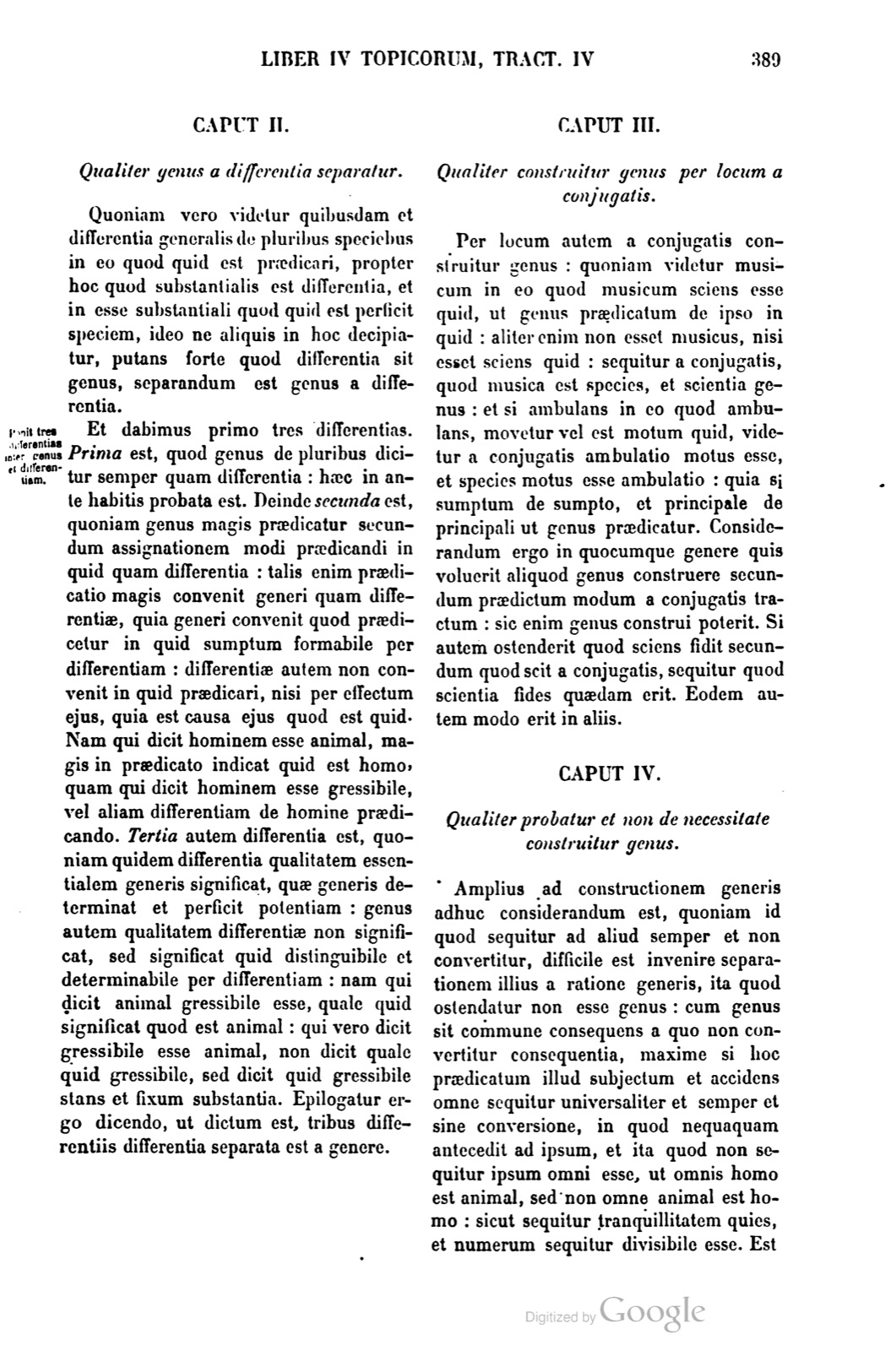
CAPUT II.
Qualiter genus a differentia separatur.
Quoniam vero videtur quibusdam et differentia generalis de pluribus speciebus in eo quod quid est praedicari, propter hoc quod substantialis est differentia, et in esse substantiali quod quid est perficit speciem, ideo ne aliquis in hoc decipiatur, putans forte quod differentia sit genus, separandum est genus a differentia.
[Marginal label, printed page 389: Ponit tres differentias inter genus et differentiam.]
Et dabimus primo tres differentias. Prima est, quod genus de pluribus dicitur semper quam differentia: haec in ante habitis probata est. Deinde secunda est, quoniam genus magis praedicatur secundum assignationem modi praedicandi in quid quam differentia: talis enim praedicatio magis convenit generi quam differentiae, quia generi convenit quod praedicetur in quid sumptum formabile per differentiam: differentiae autem non convenit in quid praedicari, nisi per effectum ejus, quia est causa ejus quod est quid. Nam qui dicit hominem esse animal, magis in praedicato indicat quid est homo, quam qui dicit hominem esse gressibile, vel aliam differentiam de homine praedicando. Tertia autem differentia est, quoniam quidem differentia qualitatem essentialem generis significat, quae generis determinat et perficit potentiam: genus autem qualitatem differentiae non significat, sed significat quid distinguibile et determinabile per differentiam: nam qui dicit animal gressibile esse, quale quid significat quod est animal: qui vero dicit gressibile esse animal, non dicit quale quid gressibile, sed dicit quid gressibile stans et fixum substantia. Epilogatur ergo dicendo, ut dictum est, tribus differentiis differentia separata est a genere.
CAPUT III.
Qualiter construitur genus per locum a conjugatis.
Per locum autem a conjugatis construitur genus: quoniam videtur musicum in eo quod musicum sciens esse quid, ut genus praedicatum de ipso in quid: aliter enim non esset musicus, nisi esset sciens quid: sequitur a conjugatis, quod musica est species, et scientia genus: et si ambulans in eo quod ambulans, movetur vel est motum quid, videtur a conjugatis ambulatio motus esse, et species motus esse ambulatio: quia si sumptum de sumpto, et principale de principali ut genus praedicatur. Considerandum ergo in quocumque genere quis voluerit aliquod genus construere secundum praedictum modum a conjugatis tractum: sic enim genus construi poterit. Si autem ostenderit quod sciens fidit secundum quod scit a conjugatis, sequitur quod scientia fides quaedam erit. Eodem autem modo erit in aliis.
CAPUT IV.
Qualiter probatur et non de necessitate construitur genus.
Amplius ad constructionem generis adhuc considerandum est, quoniam id quod sequitur ad aliud semper et non convertitur, difficile est invenire separationem illius a ratione generis, ita quod ostendatur non esse genus: cum genus sit commune consequens a quo non convertitur consequentia, maxime si hoc praedicatum illud subjectum et accidens omne sequitur universaliter et semper et sine conversione, in quod nequaquam antecedit ad ipsum, et ita quod non sequitur ipsum omni esse, ut omnis homo est animal, sed non omne animal est homo: sicut sequitur tranquillitatem quies, et numerum sequitur divisibile esse. Est enim omnis tranquillitas quies, sed non omnis quies tranquillitas, et omnis numerus divisibilis, et non omne divisibile est numerus, nec omnis quies tranquillitas: quia tranquillitas est quies in mari tantum: et ideo quod sic est semper consequens illius, contingit opposito uti ut genere tali praedicato, quod semper et universaliter est consequens tale subjectum, cum illud praedicatum in tali consequentia non convertatur ad alterum quod est subjectum vel species. Probabile est enim quod sit genus, sed non est necessarium, cum tale praedicatum possit esse accidens: est enim omnis nix alba, sed non omne album est nix, cum tamen album non sit genus nivis: et similiter est de albo et cygno et de multis aliis. Unde ista consideratione caute est utendum, sive cum cautela, ita ut nos disputantes utamur ea pro nobis: alio autem praecedente eamdem, sive proponente eam contra nos quando sustinemus disputationem, non oportet ut illi sic obediamus, quod suscipiamus in omnibus et universaliter esse veram: habet enim instantiam, ut diximus.
CHAPTER II.
How genus is separated from difference.
But since it seems to some that general difference too is predicated of several species in what a thing is, because difference is substantial and in substantial being perfects the species as to what it is, therefore, lest anyone be deceived in this, perhaps thinking that difference is genus, genus must be separated from difference.
[Marginal label, printed page 389: He posits three differences between genus and difference.]
And first we shall give three differences. The first is that genus is always said of more things than difference; this has been proved in the preceding matters. Then the second is that genus is more predicated according to the assignment of the mode of predicating in what a thing is than difference is; for such predication belongs more to genus than to difference, because it belongs to genus to be predicated in what a thing is as something taken as formable by difference. But it does not belong to difference to be predicated in what a thing is except through its effect, because it is the cause of that which is the what. For the one who says that a human being is animal indicates more in the predicate what a human being is than the one who says that a human being is capable of walking, or who predicates another difference of a human being. The third difference is that difference signifies the essential quality of the genus, which determines and perfects the potency of the genus; but genus does not signify the quality of the difference, but signifies a what distinguishable and determinable through difference. For the one who says that an animal is capable of walking signifies what sort of what an animal is; but the one who says that the walkable is animal does not say what sort of what the walkable is, but says what the walkable is, standing and fixed in substance. Therefore he epilogues by saying that, as has been said, difference has been separated from genus by three differences.
CHAPTER III.
How genus is constructed through the locus from conjugates.
But through the locus from conjugates genus is constructed: because musical, insofar as it is musical, seems to be a knowing what, as genus predicated of it in what it is; for otherwise he would not be musical unless he were some knower. It follows from conjugates that music is a species and science is the genus. And if the one walking, insofar as walking, is moved or is some moved thing, from conjugates walking seems to be motion, and walking seems to be a species of motion, because if the derived is predicated of the derived, and the principal of the principal, as genus. Therefore in whatever genus someone wishes to construct some genus according to the aforesaid mode drawn from conjugates, he must consider; for in this way genus will be able to be constructed. But if he shows that the one knowing has faith according as he knows from conjugates, it follows that science will be a certain faith. And in the same way it will be in the others.
CHAPTER IV.
How genus is proved and is not constructed of necessity.
Moreover, for the construction of genus one must further consider that, when something follows upon another always and is not converted, it is difficult to find a separation of it from the account of genus, so that it may be shown not to be genus, since genus is a common consequent from which consequence is not converted, especially if this predicate follows that subject and every accident universally and always and without conversion, in that it in no way precedes to it, and so that being is not consequent upon every instance of it, as every human being is animal, but not every animal is human being. Thus rest follows upon calm, and being divisible follows upon number. For every calm is rest, but not every rest is calm; and every number is divisible, and not every divisible thing is number, nor is every rest calm, because calm is rest only in the sea. And therefore what is thus always consequent upon that can be used by the opponent as a genus, as such a predicate which always and universally is consequent upon such a subject, since that predicate in such consequence is not converted to the other, which is subject or species. For it is probable that it is genus, but it is not necessary, since such a predicate can be an accident. For every snow is white, but not every white thing is snow, although white is not the genus of snow; and similarly it is with white and swan and many others. Hence this consideration must be used cautiously, or with caution, so that we disputing may use it for ourselves; but when another has introduced the same consideration, or proposed it against us when we are sustaining a disputation, we must not obey him in such a way that we receive it as true in all cases and universally, for it has an instance, as we have said.
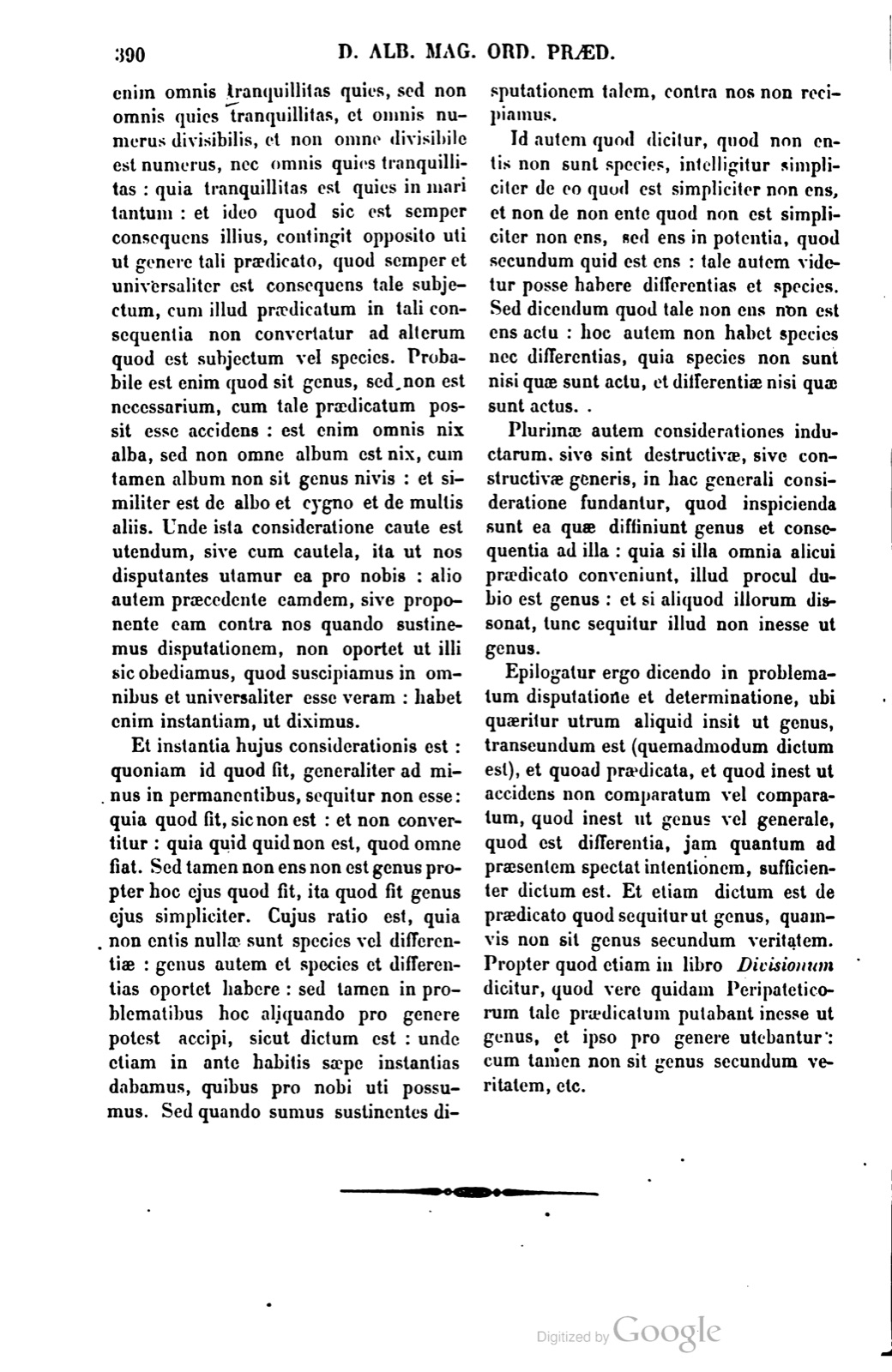
Et instantia hujus considerationis est: quoniam id quod fit, generaliter ad minus in permanentibus, sequitur non esse: quia quod fit, sic non est: et non convertitur: quia quid quid non est, quod omne fiat. Sed tamen non ens non est genus propter hoc ejus quod fit, ita quod fit genus ejus simpliciter. Cujus ratio est, quia non entis nullae sunt species vel differentiae: genus autem et species et differentias oportet habere: sed tamen in problematibus hoc aliquando pro genere potest accipi, sicut dictum est: unde etiam in ante habitis saepe instantias dabamus, quibus pro nobis uti possumus. Sed quando sumus sustinentes disputationem talem, contra nos non recipiamus.
Id autem quod dicitur, quod non entis non sunt species, intelligitur simpliciter de eo quod est simpliciter non ens, et non de non ente quod non est simpliciter non ens, sed ens in potentia, quod secundum quid est ens: tale autem videtur posse habere differentias et species. Sed dicendum quod tale non ens non est ens actu: hoc autem non habet species nec differentias, quia species non sunt nisi quae sunt actu, et differentiae nisi quae sunt actus.
Plurimae autem considerationes inductarum, sive sint destructivae, sive constructivae generis, in hac generali consideratione fundantur, quod inspicienda sunt ea quae diffiniunt genus et consequentia ad illa: quia si illa omnia alicui praedicato conveniunt, illud procul dubio est genus: et si aliquod illorum dissonat, tunc sequitur illud non inesse ut genus.
Epilogatur ergo dicendo in problematum disputatione et determinatione, ubi quaeritur utrum aliquid insit ut genus, transeundum est, quemadmodum dictum est, et quoad praedicata, et quod inest ut accidens non comparatum vel comparatum, quod inest ut genus vel generale, quod est differentia, jam quantum ad praesentem spectat intentionem, sufficienter dictum est. Et etiam dictum est de praedicato quod sequitur ut genus, quamvis non sit genus secundum veritatem. Propter quod etiam in libro Divisionum dicitur, quod vere quidam Peripateticorum tale praedicatum putabant inesse ut genus, et ipso pro genere utebantur: cum tamen non sit genus secundum veritatem, etc.
And an instance of this consideration is that what comes to be, generally at least in permanent things, follows upon not-being, because what comes to be is in that way not; and it is not converted, because not everything that is not comes to be. Nevertheless, on account of this, non-being is not the genus of that which comes to be, so that it is simply made its genus. The reason is that of non-being there are no species or differences; but genus must have species and differences. Nevertheless, in problems this can sometimes be accepted as a genus, as has been said; hence also in the preceding matters we often gave instances which we can use for ourselves. But when we are sustaining such a disputation, we should not receive them against us.
But what is said, that there are no species of non-being, is understood simply of that which is simply non-being, and not of non-being which is not simply non-being but being in potency, which is being in a certain respect. Such a thing, however, seems able to have differences and species. But one must say that such non-being is not being in act; and this does not have species or differences, because species are only those things that are in act, and differences only those which are acts.
But very many of the considerations introduced, whether they are destructive or constructive of genus, are founded on this general consideration: that one must inspect those things which define genus and the things consequent upon them. For if all those things belong to some predicate, that predicate is without doubt genus; and if one of them is discordant, then it follows that it does not inhere as genus.
Therefore he epilogues by saying that, in the disputation and determination of problems where it is asked whether something inheres as genus, one must pass through, as has been said, both with respect to predicates, and with respect to what inheres as accident, not compared or compared, what inheres as genus or general, and what is difference. As much as pertains to the present intention has now been sufficiently said. And it has also been said about the predicate which follows as genus, although according to truth it is not genus. For this reason also in the book On Divisions it is said that some of the Peripatetics truly thought such a predicate inhered as genus and used it as genus, although according to truth it is not genus, and so forth.
If a page does not appear, its photograph has not been uploaded yet.