Volume 2 · pp. 386–388
Chapter V on compared genus; Treatise IV Chapter I
A marker with ≈ is an approximate page boundary, placed by measure of the text; the page photographs remain the authority. In the paired views, clicking a page marker brings that page into view.
CAPUT V.
De interpretatione et constructione generis comparati.
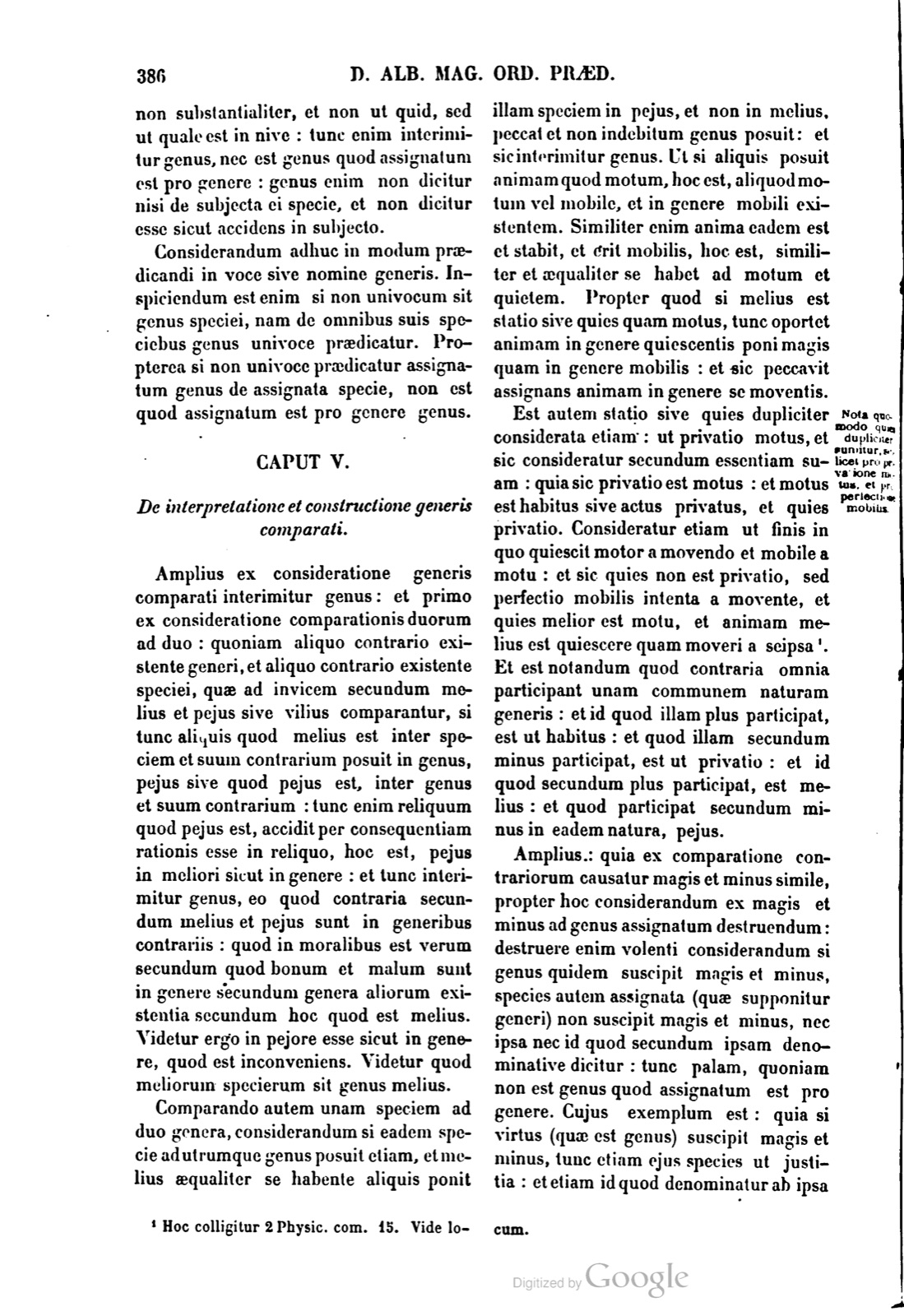
Amplius ex consideratione generis comparati interimitur genus: et primo ex consideratione comparationis duorum ad duo: quoniam aliquo contrario existente generi, et aliquo contrario existente speciei, quae ad invicem secundum melius et pejus sive vilius comparantur, si tunc aliquis quod melius est inter speciem et suum contrarium posuit in genus, pejus sive quod pejus est, inter genus et suum contrarium: tunc enim reliquum quod pejus est, accidit per consequentiam rationis esse in reliquo, hoc est, pejus in meliori sicut in genere: et tunc interimitur genus, eo quod contraria secundum melius et pejus sunt in generibus contrariis: quod in moralibus est verum secundum quod bonum et malum sunt in genere secundum genera aliorum existentia secundum hoc quod est melius. Videtur ergo in pejore esse sicut in genere, quod est inconveniens. Videtur quod meliorum specierum sit genus melius.
Comparando autem unam speciem ad duo genera, considerandum si eadem specie ad utrumque genus posuit etiam, et melius aequaliter se habente aliquis ponit illam speciem in pejus, et non in melius, peccat et non indebitum genus posuit: et sic interimitur genus. Ut si aliquis posuit animam quod motum, hoc est, aliquod motum vel mobile, et in genere mobili existentem. Similiter enim anima eadem est et stabit, et erit mobilis, hoc est, similiter et aequaliter se habet ad motum et quietem. Propter quod si melius est statio sive quies quam motus, tunc oportet animam in genere quiescentis poni magis quam in genere mobilis: et sic peccavit assignans animam in genere se moventis.
[Marginal label, printed page 386: Nota quomodo quies dupliciter sumitur, scilicet pro privatione motus, et pro perfectione mobilis.]
Est autem statio sive quies dupliciter considerata etiam: ut privatio motus, et sic consideratur secundum essentiam suam: quia sic privatio est motus: et motus est habitus sive actus privatus, et quies privatio. Consideratur etiam ut finis in quo quiescit motor a movendo et mobile a motu: et sic quies non est privatio, sed perfectio mobilis intenta a movente, et quies melior est motu, et animam melius est quiescere quam moveri a seipsa 1. Et est notandum quod contraria omnia participant unam communem naturam generis: et id quod illam plus participat, est ut habitus: et quod illam secundum minus participat, est ut privatio: et id quod secundum plus participat, est melius: et quod participat secundum minus in eadem natura, pejus.
Amplius quia ex comparatione contrariorum causatur magis et minus simile, propter hoc considerandum ex magis et minus ad genus assignatum destruendum: destruere enim volenti considerandum si genus quidem suscipit magis et minus, species autem assignata quae supponitur generi non suscipit magis et minus, nec ipsa nec id quod secundum ipsam denominative dicitur: tunc palam, quoniam non est genus quod assignatum est pro genere. Cujus exemplum est: quia si virtus quae est genus suscipit magis et minus, tunc etiam ejus species ut justitia: et etiam id quod denominatur ab ipsa ut justum, suscipit magis et minus: quia in denominatione est magis et minus, non autem in abstracto dicitur justior alter altero. Si ergo assignatum genus suscipit magis, species autem supponitur generi, nec ipsa nec quod secundum ipsam denominative dicitur, suscipit magis, non erit genus speciei illius quod assignatum est pro genere.
CHAPTER V.
On the interpretation and construction of compared genus.
Moreover, from the consideration of compared genus, genus is destroyed, and first from the consideration of the comparison of two to two. For when something contrary exists for the genus and something contrary exists for the species, and these are compared to one another according to better and worse or more base, if then someone has placed what is better between the species and its contrary in the worse genus, or in that which is worse, between the genus and its contrary, then by consequence of reason the remaining thing which is worse happens to be in the remaining, that is, the worse in the better as in genus. And then genus is destroyed, because contraries according to better and worse are in contrary genera; and this is true in morals insofar as good and evil are in a genus according to the genera of other things existing according to what is better. Therefore it seems to be in the worse as in a genus, which is unfitting. It seems that the genus of better species is better.
But by comparing one species to two genera, one must consider whether someone has placed the same species also toward each genus, and, when the better is equally related, places that species in the worse and not in the better; he sins and has placed an undue genus, and thus the genus is destroyed. For example, if someone posited soul as what is moved, that is, as something moved or mobile and existing in the genus of mobile. For the same soul both will stand and will be mobile, that is, it is related similarly and equally to motion and rest. Therefore if standing or rest is better than motion, then soul ought to be placed in the genus of the resting more than in the genus of the mobile; and thus the one assigning soul in the genus of what moves itself sinned.
[Marginal label, printed page 386: Note how rest is taken in two ways, namely for privation of motion and for perfection of the mobile thing.]
But standing or rest is also considered in two ways: as privation of motion, and thus it is considered according to its essence, because in this way privation is of motion, and motion is the habit or deprived act, and rest is privation. It is also considered as the end in which the mover rests from moving and the mobile thing from motion; and thus rest is not a privation but the perfection of the mobile thing intended by the mover, and rest is better than motion, and it is better for soul to rest than to be moved by itself 1. And one must note that all contraries participate one common nature of genus; and that which participates it more is as habit, and that which participates it according to less is as privation. And that which participates according to more is better; and that which participates according to less in the same nature is worse.
Moreover, because more and less similar is caused from the comparison of contraries, on this account one must consider from more and less for destroying the assigned genus. For one wishing to destroy must consider whether the genus indeed receives more and less, while the assigned species which is supposed under the genus does not receive more and less, neither itself nor that which is said denominatively according to it. Then it is plain that what has been assigned as genus is not genus. An example is that if virtue, which is a genus, receives more and less, then also its species, such as justice, and also that which is denominated from it, such as just, receive more and less; for in denomination there is more and less, but in the abstract one is not said to be more just than another. Therefore if the assigned genus receives more, but the species supposed under the genus, neither itself nor what is denominatively said according to it, receives more, it will not be the genus of that species which has been assigned as genus.
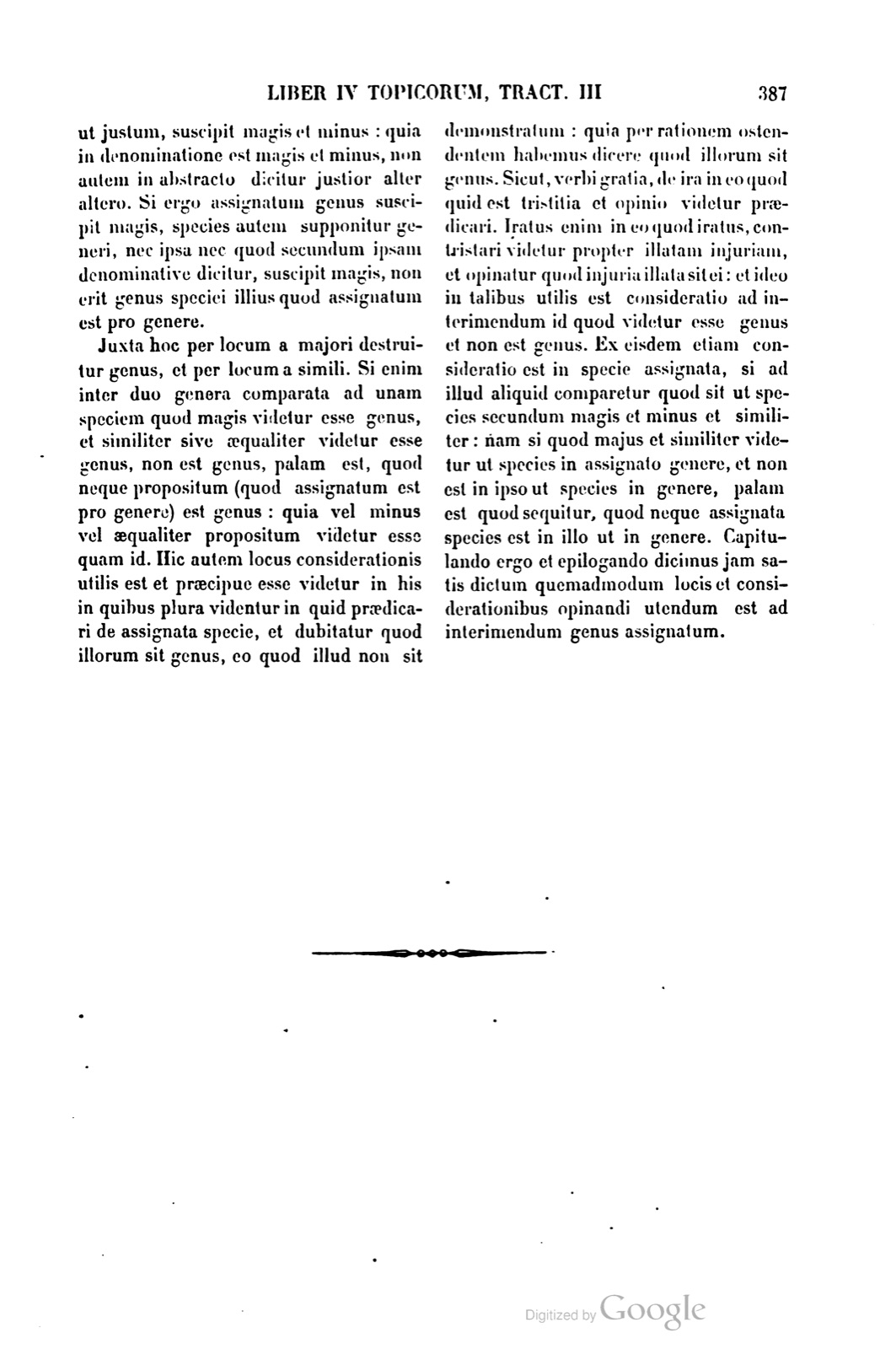
Juxta hoc per locum a majori destruitur genus, et per locum a simili. Si enim inter duo genera comparata ad unam speciem quod magis videtur esse genus, et similiter sive aequaliter videtur esse genus, non est genus, palam est, quod neque propositum, quod assignatum est pro genere, est genus: quia vel minus vel aequaliter propositum videtur esse quam id. Hic autem locus considerationis utilis est et praecipue esse videtur in his in quibus plura videntur in quid praedicari de assignata specie, et dubitatur quod illorum sit genus, eo quod illud non sit demonstratum: quia per rationem ostendentem habemus dicere quod illorum sit genus. Sicut, verbi gratia, de ira in eo quod quid est tristitia et opinio videtur praedicari. Iratus enim in eo quod iratus, contristari videtur propter illatam injuriam, et opinatur quod injuria illata sit ei: et ideo in talibus utilis est consideratio ad interimendum id quod videtur esse genus et non est genus. Ex eisdem etiam consideratio est in specie assignata, si ad illud aliquid comparetur quod sit ut species secundum magis et minus et similiter: nam si quod majus et similiter videtur ut species in assignato genere, et non est in ipso ut species in genere, palam est quod sequitur, quod neque assignata species est in illo ut in genere. Capitulando ergo et epilogando dicimus jam satis dictum quemadmodum locis et considerationibus opinandi utendum est ad interimendum genus assignatum.
TRACTATUS IV
CAPUT I.
Quibus considerationibus construitur genus.
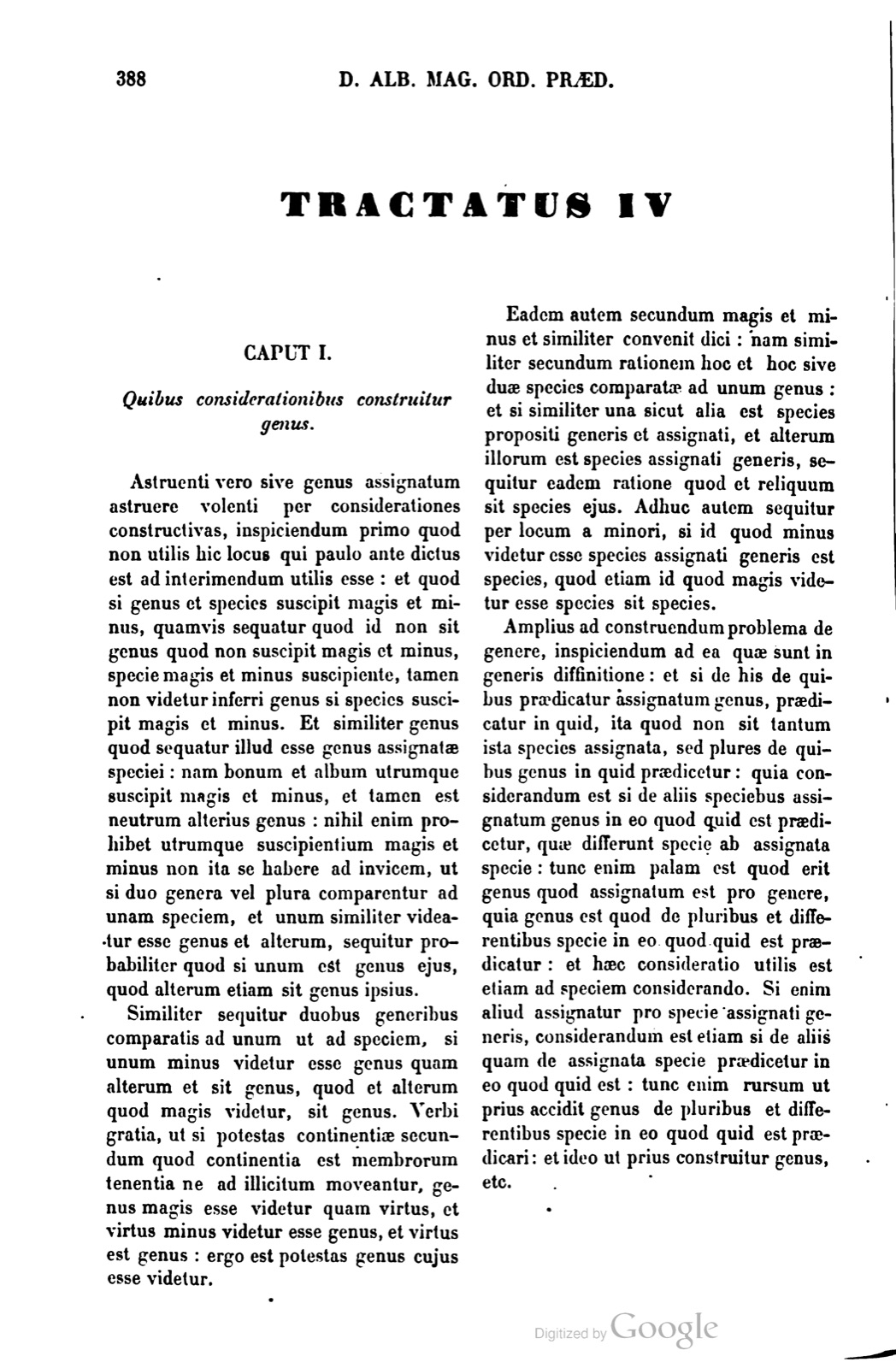
Astruenti vero sive genus assignatum astruere volenti per considerationes constructivas, inspiciendum primo quod non utilis hic locus qui paulo ante dictus est ad interimendum utilis esse: et quod si genus et species suscipit magis et minus, quamvis sequatur quod id non sit genus quod non suscipit magis et minus, specie magis et minus suscipiente, tamen non videtur inferri genus si species suscipit magis et minus. Et similiter genus quod sequatur illud esse genus assignatae speciei: nam bonum et album utrumque suscipit magis et minus, et tamen est neutrum alterius genus: nihil enim prohibet utrumque suscipientium magis et minus non ita se habere ad invicem, ut si duo genera vel plura comparentur ad unam speciem, et unum similiter videatur esse genus et alterum, sequitur probabiliter quod si unum est genus ejus, quod alterum etiam sit genus ipsius.
Next to this, genus is destroyed through the locus from the greater and through the locus from the similar. For if between two genera compared to one species what seems more to be genus, and similarly or equally seems to be genus, is not genus, it is plain that neither is the proposed thing, which has been assigned as genus, genus, because the proposed seems either less or equally to be genus than that. This locus of consideration is useful and seems especially so in those things in which several things seem to be predicated in what a thing is of the assigned species, and it is doubted which of them is genus, because that has not been demonstrated. For through the reason showing it we have to say which of them is genus. Thus, for example, concerning anger, sadness and opinion seem to be predicated in what it is. For the angry person, insofar as angry, seems to be saddened because of an inflicted injury and to opine that an injury has been inflicted on him; and therefore in such matters the consideration is useful for destroying what seems to be genus and is not genus. From the same things there is also a consideration in the assigned species, if something is compared to it which is as a species according to more and less and similarly; for if what seems greater and similarly as a species in the assigned genus is not in it as species in genus, it is plain that it follows that neither is the assigned species in that as in genus. Therefore, by capitulating and epiloguing, we say that enough has now been said about how loci and considerations of opining must be used for destroying the assigned genus.
TREATISE IV
CHAPTER I.
By which considerations genus is constructed.
But for one constructing, or wishing to construct the assigned genus through constructive considerations, one must first inspect that this locus which was said a little before is not useful here, although it is useful for destroying; and that, if genus and species receive more and less, although it follows that what does not receive more and less is not genus when the species receives more and less, nevertheless genus does not seem to be inferred if the species receives more and less. And similarly with the genus that would follow upon that being the genus of the assigned species: for good and white each receive more and less, and nevertheless neither is the genus of the other. For nothing prevents both things that receive more and less from not being related to one another in such a way that, if two or more genera are compared to one species and one seems to be genus similarly to the other, it follows probably that if one is its genus, the other also is its genus.
Similiter sequitur duobus generibus comparatis ad unum ut ad speciem, si unum minus videtur esse genus quam alterum et sit genus, quod et alterum quod magis videtur, sit genus. Verbi gratia, ut si potestas continentiae secundum quod continentia est membrorum tenentia ne ad illicitum moveantur, genus magis esse videtur quam virtus, et virtus minus videtur esse genus, et virtus est genus: ergo est potestas genus cujus esse videtur.
Eadem autem secundum magis et minus et similiter convenit dici: nam similiter secundum rationem hoc et hoc sive duae species comparatae ad unum genus: et si similiter una sicut alia est species propositi generis et assignati, et alterum illorum est species assignati generis, sequitur eadem ratione quod et reliquum sit species ejus. Adhuc autem sequitur per locum a minori, si id quod minus videtur esse species assignati generis est species, quod etiam id quod magis videtur esse species sit species.
Amplius ad construendum problema de genere, inspiciendum ad ea quae sunt in generis diffinitione: et si de his de quibus praedicatur assignatum genus, praedicatur in quid, ita quod non sit tantum ista species assignata, sed plures de quibus genus in quid praedicetur: quia considerandum est si de aliis speciebus assignatum genus in eo quod quid est praedicetur, quae differunt specie ab assignata specie: tunc enim palam est quod erit genus quod assignatum est pro genere, quia genus est quod de pluribus et differentibus specie in eo quod quid est praedicatur: et haec consideratio utilis est etiam ad speciem considerando. Si enim aliud assignatur pro specie assignati generis, considerandum est etiam si de aliis quam de assignata specie praedicetur in eo quod quid est: tunc enim rursum ut prius accidit genus de pluribus et differentibus specie in eo quod quid est praedicari: et ideo ut prius construitur genus, etc.
Similarly, with two genera compared to one thing as to a species, it follows, if one seems less to be genus than the other and is genus, that the other which seems more to be genus also is genus. For example, if the power of continence, insofar as continence is the holding of the members lest they be moved toward the illicit, seems more to be the genus than virtue, and virtue seems less to be the genus, and virtue is the genus, therefore power is the genus of that of which it seems to be.
But the same can be said according to more and less and similarly: for similarly, according to reason, this and this, or two species, are compared to one genus; and if one is similarly a species of the proposed and assigned genus just as the other is, and one of them is a species of the assigned genus, by the same reason it follows that the remaining one also is its species. Furthermore, it follows through the locus from the lesser that, if what seems less to be a species of the assigned genus is a species, then also what seems more to be a species is a species.
Moreover, for constructing the problem concerning genus, one must inspect those things that are in the definition of genus: and whether, of those things of which the assigned genus is predicated, it is predicated in what a thing is, so that there is not only that assigned species, but several things of which the genus is predicated in what a thing is. For one must consider whether the assigned genus is predicated in what a thing is of other species which differ in species from the assigned species. For then it is plain that what has been assigned as genus will be genus, because genus is what is predicated of several things differing in species in what they are; and this consideration is also useful by considering the species. For if something else is assigned as species of the assigned genus, one must also consider whether it is predicated in what a thing is of other things besides the assigned species. For then again, as before, it happens that genus is predicated of several things differing in species in what they are; and therefore, as before, genus is constructed, and so forth.
Notes
- This is gathered from book 2 of the Physics, comment 15. See the place. (Hoc colligitur 2 Physic. com. 15. Vide locum.) ↩
If a page does not appear, its photograph has not been uploaded yet.