Volume 2 · pp. 384–386
Chapters III-IV. On contracted genus in natural matter; on genus taken in common
A marker with ≈ is an approximate page boundary, placed by measure of the text; the page photographs remain the authority. In the paired views, clicking a page marker brings that page into view.
CAPUT III.
De consideratione generis contracti ad materiam naturalem.
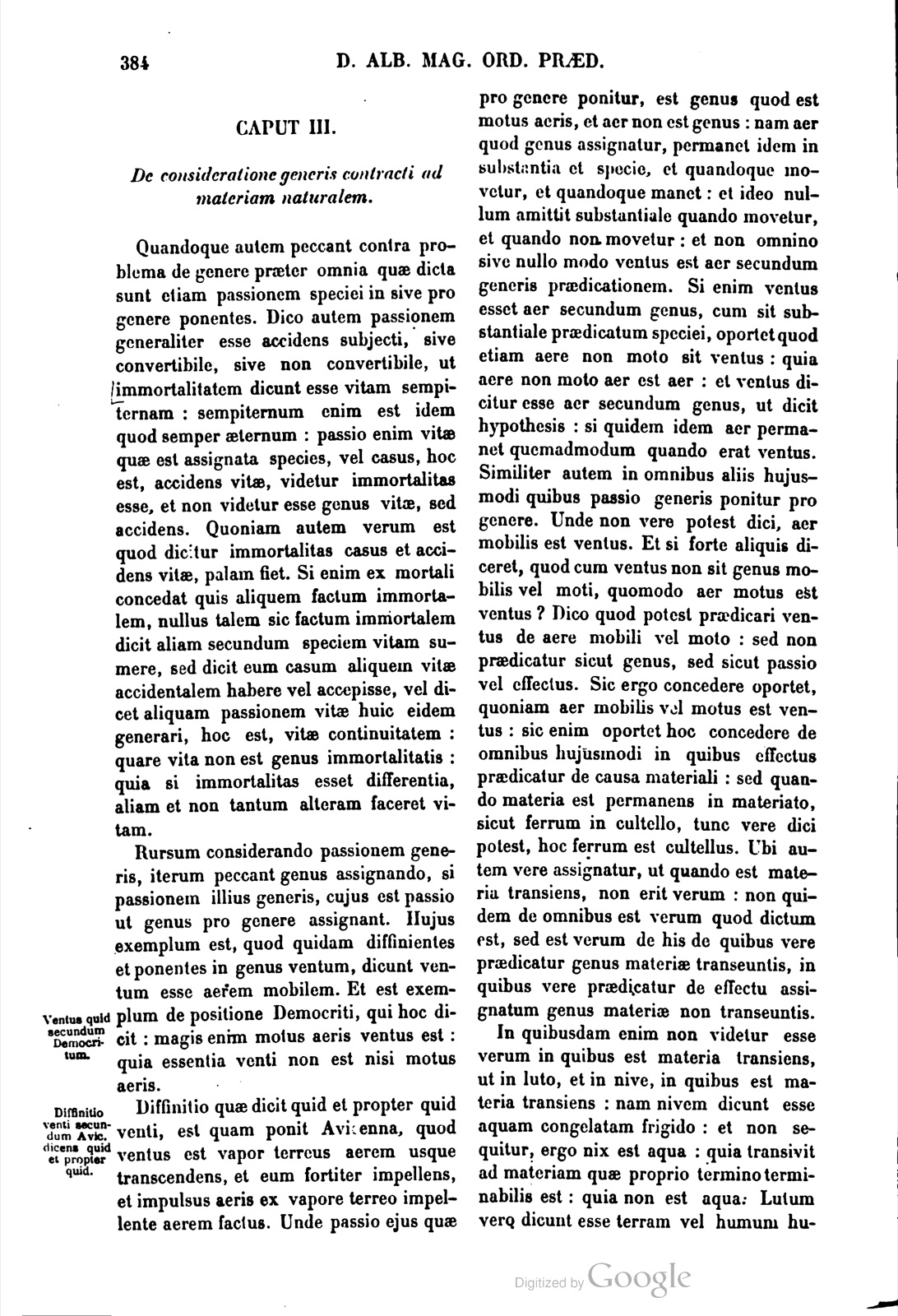
Quandoque autem peccant contra problema de genere praeter omnia quae dicta sunt etiam passionem speciei in sive pro genere ponentes. Dico autem passionem generaliter esse accidens subjecti, sive convertibile, sive non convertibile, ut immortalitatem dicunt esse vitam sempiternam: sempiternum enim est idem quod semper aeternum: passio enim vitae quae est assignata species, vel casus, hoc est, accidens vitae, videtur immortalitas esse, et non videtur esse genus vitae, sed accidens. Quoniam autem verum est quod dicitur immortalitas casus et accidens vitae, palam fiet. Si enim ex mortali concedat quis aliquem factum immortalem, nullus talem sic factum immortalem dicit aliam secundum speciem vitam sumere, sed dicit eum casum aliquem vitae accidentalem habere vel accepisse, vel dicet aliquam passionem vitae huic eidem generari, hoc est, vitae continuitatem: quare vita non est genus immortalitatis: quia si immortalitas esset differentia, aliam et non tantum alteram faceret vitam.
Rursum considerando passionem generis, iterum peccant genus assignando, si passionem illius generis, cujus est passio ut genus pro genere assignant. Hujus exemplum est, quod quidam diffinientes et ponentes in genus ventum, dicunt ventum esse aerem mobilem. Et est exemplum de positione Democriti, qui hoc dicit: magis enim motus aeris ventus est: quia essentia venti non est nisi motus aeris.
[Marginal label, printed page 384: Ventus quid secundum Democritum.]
[Marginal label, printed page 384: Diffinitio venti secundum Avicennam dicens quid et propter quid.]
Diffinitio quae dicit quid et propter quid venti, est quam ponit Avicenna, quod ventus est vapor terreus aerem usque transcendens, et eum fortiter impellens, et impulsus aeris ex vapore terreo impellente aerem factus. Unde passio ejus quae pro genere ponitur, est genus quod est motus acris, et aer non est genus: nam aer quod genus assignatur, permanet idem in substantia et specie, et quandoque movetur, et quandoque manet: et ideo nullum amittit substantiale quando movetur, et quando non movetur: et non omnino sive nullo modo ventus est aer secundum generis praedicationem. Si enim ventus esset aer secundum genus, cum sit substantiale praedicatum speciei, oportet quod etiam aere non moto sit ventus: quia aere non moto aer est aer: et ventus dicitur esse aer secundum genus, ut dicit hypothesis: si quidem idem aer permanet quemadmodum quando erat ventus. Similiter autem in omnibus aliis hujusmodi quibus passio generis ponitur pro genere. Unde non vere potest dici, aer mobilis est ventus. Et si forte aliquis diceret, quod cum ventus non sit genus mobilis vel moti, quomodo aer motus est ventus? Dico quod potest praedicari ventus de aere mobili vel moto: sed non praedicatur sicut genus, sed sicut passio vel effectus. Sic ergo concedere oportet, quoniam aer mobilis vel motus est ventus: sic enim oportet hoc concedere de omnibus hujusmodi in quibus effectus praedicatur de causa materiali: sed quando materia est permanens in materiato, sicut ferrum in cultello, tunc vere dici potest, hoc ferrum est cultellus. Ubi autem vere assignatur, ut quando est materia transiens, non erit verum: non quidem de omnibus est verum quod dictum est, sed est verum de his de quibus vere praedicatur genus materiae transeuntis, in quibus vere praedicatur de effectu assignatum genus materiae non transeuntis.
CHAPTER III.
On the consideration of genus contracted to natural matter.
Sometimes, beyond all the things that have been said, they also sin against the problem concerning genus by placing a passion of the species in or for the genus. But I generally call a passion an accident of the subject, whether convertible or not convertible; for example, they say that immortality is everlasting life. For everlasting is the same as always eternal. Immortality seems to be a passion of life, which is the assigned species, or a case, that is, an accident of life, and does not seem to be the genus of life, but an accident. But that what is said is true, that immortality is a case and accident of life, will become plain. For if someone grants that someone has been made immortal from being mortal, no one says that such a person, made immortal in this way, takes up another life according to species, but says that he has or has received some accidental case of life, or will say that some passion of life has been generated in this same one, that is, continuity of life. Therefore life is not the genus of immortality, because if immortality were a difference, it would make another life and not merely a different life.
Again, by considering a passion of the genus, they again sin in assigning genus if they assign the passion of that genus, of which it is the passion, as genus for genus. An example of this is that certain persons defining and placing wind in a genus say that wind is mobile air. And this is an example from the position of Democritus, who says this: for motion of air is more truly wind, because the essence of wind is nothing except motion of air.
[Marginal label, printed page 384: What wind is according to Democritus.]
[Marginal label, printed page 384: Definition of wind according to Avicenna, saying what it is and why.]
The definition which says what wind is and why is the one Avicenna posits, that wind is an earthy vapor transcending up to the air and strongly driving it, and an impulse of air made from earthy vapor driving the air. Hence the passion of it, which is posited as genus, is a genus which is sharp motion, and air is not the genus. For air, which is assigned as genus, remains the same in substance and species, and sometimes is moved and sometimes remains; and therefore it loses nothing substantial when it is moved and when it is not moved. And wind is not altogether, or in no way, air according to the predication of genus. For if wind were air according to genus, since it is a substantial predicate of the species, it would be necessary that there be wind even when the air is not moved, because when air is not moved, air is air; and wind is said to be air according to genus, as the hypothesis says, if indeed the same air remains as when it was wind. Similarly it is so in all other things of this kind in which a passion of the genus is posited for the genus. Hence it cannot truly be said, mobile air is wind. And if perhaps someone said that, since wind is not the genus of the mobile or moved, how is moved air wind? I say that wind can be predicated of mobile or moved air, but it is not predicated as genus, but as passion or effect. Therefore one must grant in this way that mobile or moved air is wind; for this must be granted in all such things in which the effect is predicated of the material cause. But when the matter is remaining in the thing made of matter, as iron in a knife, then it can truly be said, this iron is a knife. But where it is truly assigned, as when it is transient matter, it will not be true. What has been said is not true of all things, but is true of those things of which the genus of transient matter is truly predicated, in which the assigned genus of non-transient matter is truly predicated of the effect.
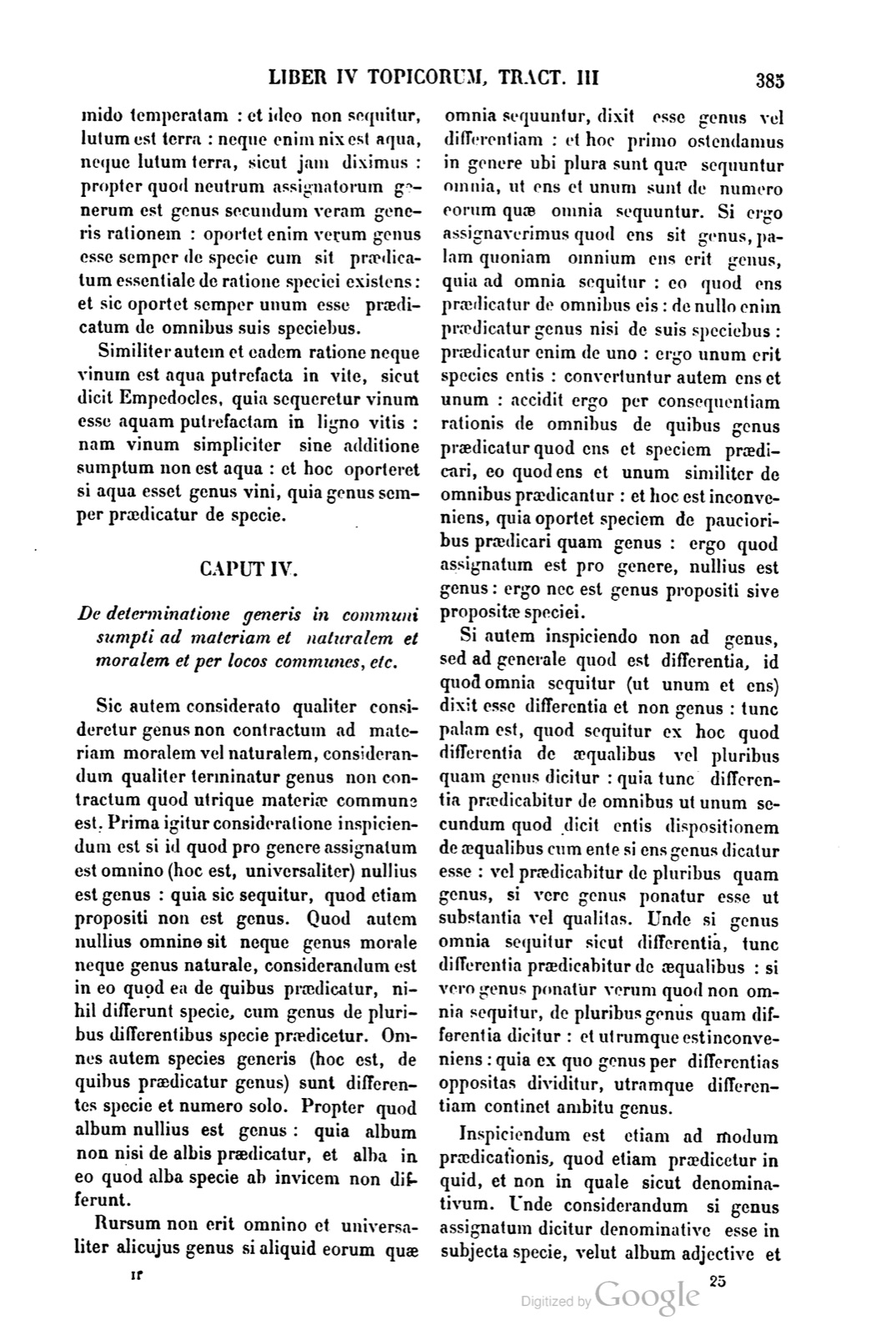
In quibusdam enim non videtur esse verum in quibus est materia transiens, ut in luto, et in nive, in quibus est materia transiens: nam nivem dicunt esse aquam congelatam frigido: et non sequitur, ergo nix est aqua: quia transivit ad materiam quae proprio termino terminabilis est: quia non est aqua. Lutum vero dicunt esse terram vel humum humido temperatam: et ideo non sequitur, lutum est terra: neque enim nix est aqua, neque lutum terra, sicut jam diximus: propter quod neutrum assignatorum generum est genus secundum veram generis rationem: oportet enim verum genus esse semper de specie cum sit praedicatum essentiale de ratione speciei existens: et sic oportet semper unum esse praedicatum de omnibus suis speciebus.
Similiter autem et eadem ratione neque vinum est aqua putrefacta in vite, sicut dicit Empedocles, quia sequeretur vinum esse aquam putrefactam in ligno vitis: nam vinum simpliciter sine additione sumptum non est aqua: et hoc oporteret si aqua esset genus vini, quia genus semper praedicatur de specie.
CAPUT IV.
De determinatione generis in communi sumpti ad materiam et naturalem et moralem et per locos communes, etc.
Sic autem considerato qualiter consideretur genus non contractum ad materiam moralem vel naturalem, considerandum qualiter terminatur genus non contractum quod utrique materiae commune est. Prima igitur consideratione inspiciendum est si id quod pro genere assignatum est omnino, hoc est, universaliter, nullius est genus: quia sic sequitur, quod etiam propositi non est genus. Quod autem nullius omnino sit neque genus morale neque genus naturale, considerandum est in eo quod ea de quibus praedicatur, nihil differunt specie, cum genus de pluribus differentibus specie praedicetur. Omnes autem species generis, hoc est, de quibus praedicatur genus, sunt differentes specie et numero solo. Propter quod album nullius est genus: quia album non nisi de albis praedicatur, et alba in eo quod alba specie ab invicem non differunt.
For in some things in which there is transient matter it does not seem to be true, as in mud and snow, in which there is transient matter. For they say that snow is water frozen by cold; and it does not follow, therefore snow is water, because it has passed over to matter terminable by its own term, because it is not water. But they say that mud is earth or soil tempered with moisture; and therefore it does not follow that mud is earth. For neither is snow water nor mud earth, as we have already said. Therefore neither of the assigned genera is genus according to the true account of genus, for a true genus must always be predicated of the species, since it is an essential predicate existing in the account of the species; and thus one predicate must always be predicated of all its species.
Similarly and by the same reason wine is not water putrefied in the vine, as Empedocles says, because it would follow that wine is water putrefied in the wood of the vine. For wine taken simply without addition is not water; but this would be necessary if water were the genus of wine, because genus is always predicated of species.
CHAPTER IV.
On the determination of genus taken in common with respect to both natural and moral matter and through common loci, etc.
With it thus considered how genus not contracted to moral or natural matter is considered, one must consider how non-contracted genus common to each matter is terminated. Therefore by the first consideration one must inspect whether that which has been assigned as genus is altogether, that is, universally, the genus of nothing; because thus it follows that it also is not the genus of the proposed thing. But that it is altogether the genus of nothing, neither a moral genus nor a natural genus, must be considered in the fact that the things of which it is predicated differ in no way by species, although genus is predicated of several things differing in species. But all species of a genus, that is, the things of which genus is predicated, are different in species and in number alone. Therefore white is the genus of nothing, because white is predicated only of white things, and white things, insofar as they are white, do not differ from one another in species.
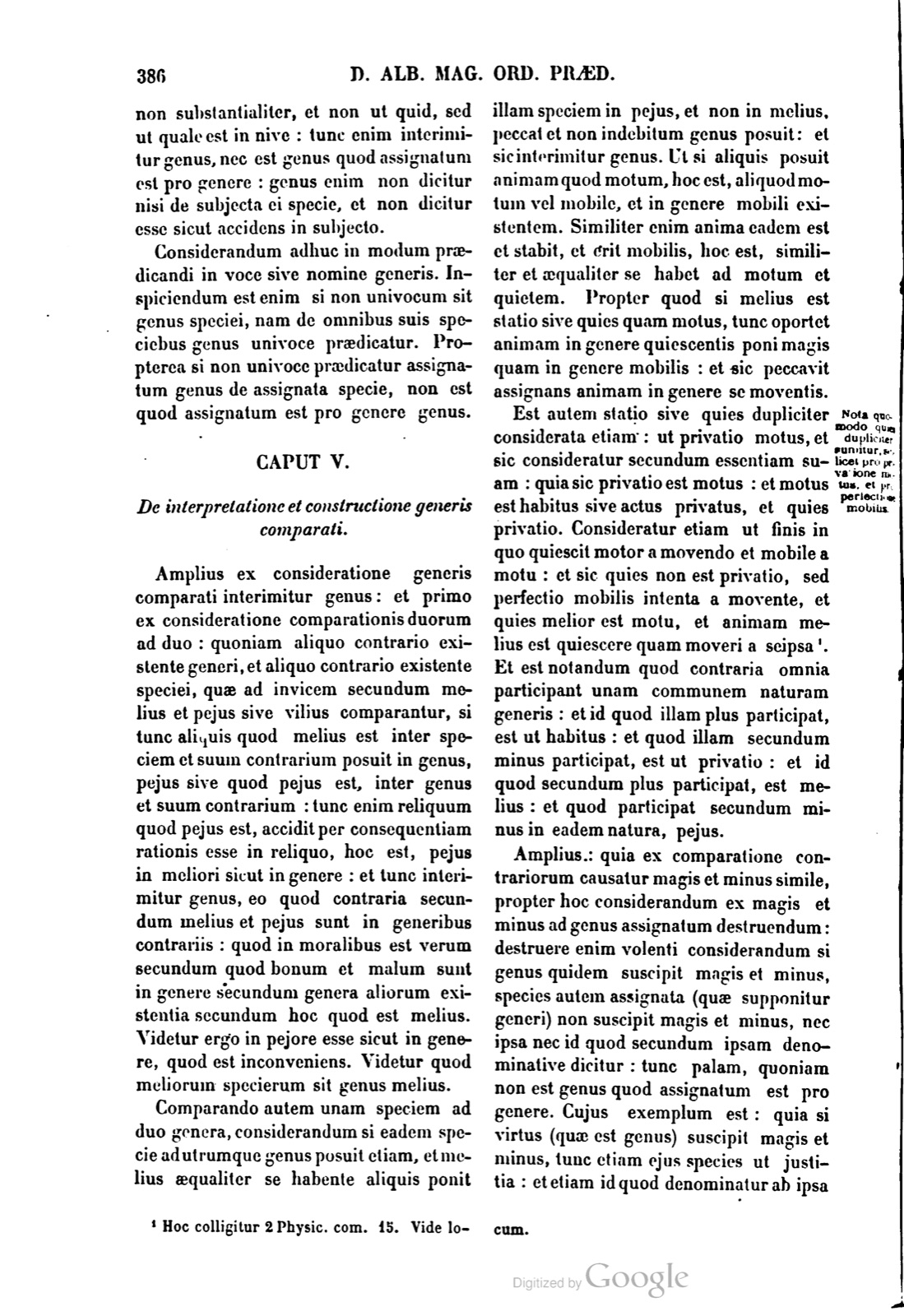
Rursum non erit omnino et universaliter alicujus genus si aliquid eorum quae omnia sequuntur, dixit esse genus vel differentiam: et hoc primo ostendamus in genere ubi plura sunt quae sequuntur omnia, ut ens et unum sunt de numero eorum quae omnia sequuntur. Si ergo assignaverimus quod ens sit genus, palam quoniam omnium ens erit genus, quia ad omnia sequitur: eo quod ens praedicatur de omnibus eis: de nullo enim praedicatur genus nisi de suis speciebus: praedicatur enim de uno: ergo unum erit species entis: convertuntur autem ens et unum: accidit ergo per consequentiam rationis de omnibus de quibus genus praedicatur quod ens et speciem praedicari, eo quod ens et unum similiter de omnibus praedicantur: et hoc est inconveniens, quia oportet speciem de paucioribus praedicari quam genus: ergo quod assignatum est pro genere, nullius est genus: ergo nec est genus propositi sive propositae speciei.
Si autem inspiciendo non ad genus, sed ad generale quod est differentia, id quod omnia sequitur, ut unum et ens, dixit esse differentia et non genus: tunc palam est, quod sequitur ex hoc quod differentia de aequalibus vel pluribus quam genus dicitur: quia tunc differentia praedicabitur de omnibus ut unum secundum quod dicit entis dispositionem de aequalibus cum ente si ens genus dicatur esse: vel praedicabitur de pluribus quam genus, si vere genus ponatur esse ut substantia vel qualitas. Unde si genus omnia sequitur sicut differentia, tunc differentia praedicabitur de aequalibus: si vero genus ponatur verum quod non omnia sequitur, de pluribus genus quam differentia dicitur: et utrumque est inconveniens: quia ex quo genus per differentias oppositas dividitur, utramque differentiam continet ambitu genus.
Inspiciendum est etiam ad modum praedicationis, quod etiam praedicetur in quid, et non in quale sicut denominativum. Unde considerandum si genus assignatum dicitur denominative esse in subjecta specie, velut album adjective et non substantialiter, et non ut quid, sed ut quale est in nive: tunc enim interimitur genus, nec est genus quod assignatum est pro genere: genus enim non dicitur nisi de subjecta ei specie, et non dicitur esse sicut accidens in subjecto.
Considerandum adhuc in modum praedicandi in voce sive nomine generis. Inspiciendum est enim si non univocum sit genus speciei, nam de omnibus suis speciebus genus univoce praedicatur. Propterea si non univoce praedicatur assignatum genus de assignata specie, non est quod assignatum est pro genere genus.
Again, something will not altogether and universally be the genus of anything if someone has said that one of those things which follow all things is genus or difference; and let us first show this in genus, where there are several things that follow all things, as being and one are from the number of those things that follow all things. Therefore if we assign that being is genus, it is plain that being will be the genus of all things, because it follows all things, since being is predicated of all of them. For genus is predicated of nothing except its species; but it is predicated of one; therefore one will be a species of being. But being and one are converted; therefore by consequence of reason it happens that being and species are predicated of all things of which the genus is predicated, because being and one are similarly predicated of all things. And this is unfitting, because species must be predicated of fewer things than genus. Therefore what has been assigned as genus is the genus of nothing; therefore neither is it the genus of the proposed thing or proposed species.
But if, by inspecting not genus but the general thing that is difference, someone has said that what follows all things, as one and being do, is difference and not genus, then it is plain that from this it follows that difference is said of things equal to or more than genus. For then difference will be predicated of all things, as one, according as it states a disposition of being, is predicated of things equal with being if being is said to be genus; or it will be predicated of more things than genus if true genus is posited to be substance or quality. Hence if genus follows all things just as difference does, then difference will be predicated of equal things; but if true genus is posited which does not follow all things, genus is said of more things than difference. And both are unfitting, because since genus is divided through opposed differences, the genus contains each difference within its range.
One must also inspect the mode of predication, that it is predicated in what a thing is and not in what sort of thing it is, as a denominative. Hence one must consider whether the assigned genus is said to be denominatively in the subject species, as white adjectivally and not substantially, and not as a what but as a quale in snow. For then the genus is destroyed, and what has been assigned as genus is not genus; for genus is said only of the species subject to it, and is not said to be like an accident in a subject.
One must also consider the mode of predicating in the word or name of the genus. For one must inspect whether the genus is not univocal to the species, since genus is predicated univocally of all its species. Therefore if the assigned genus is not predicated univocally of the assigned species, what has been assigned as genus is not genus.
If a page does not appear, its photograph has not been uploaded yet.