Volume 2 · pp. 382–383
Conclusion of Chapter I and Chapter II. On contracted genus when assigned as difference, or conversely
A marker with ≈ is an approximate page boundary, placed by measure of the text; the page photographs remain the authority. In the paired views, clicking a page marker brings that page into view.
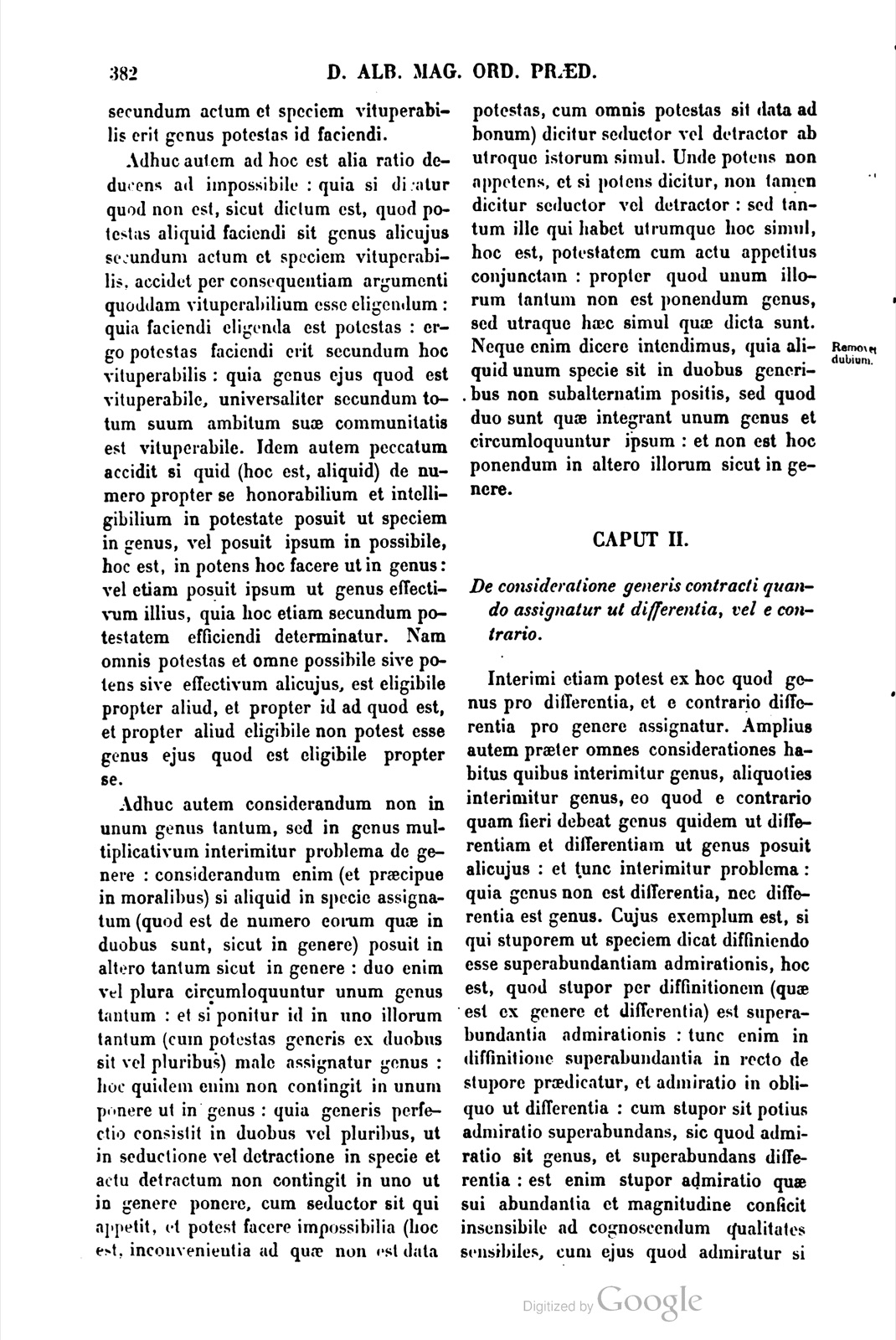
Adhuc autem ad hoc est alia ratio deducens ad impossibile: quia si dicatur quod non est, sicut dictum est, quod potestas aliquid faciendi sit genus alicujus secundum actum et speciem vituperabilis, accidet per consequentiam argumenti quoddam vituperabilium esse eligendum: quia faciendi eligenda est potestas: ergo potestas faciendi erit secundum hoc vituperabilis: quia genus ejus quod est vituperabile, universaliter secundum totum suum ambitum suae communitatis est vituperabile. Idem autem peccatum accidit si quid, hoc est, aliquid, de numero propter se honorabilium et intelligibilium in potestate posuit ut speciem in genus, vel posuit ipsum in possibile, hoc est, in potens hoc facere ut in genus: vel etiam posuit ipsum ut genus effectivum illius, quia hoc etiam secundum potestatem efficiendi determinatur. Nam omnis potestas et omne possibile sive potens sive effectivum alicujus, est eligibile propter aliud, et propter id ad quod est, et propter aliud eligibile non potest esse genus ejus quod est eligibile propter se.
Adhuc autem considerandum non in unum genus tantum, sed in genus multiplicativum interimitur problema de genere: considerandum enim, et praecipue in moralibus, si aliquid in specie assignatum quod est de numero eorum quae in duobus sunt, sicut in genere, posuit in altero tantum sicut in genere: duo enim vel plura circumloquuntur unum genus tantum: et si ponitur id in uno illorum tantum, cum potestas generis ex duobus sit vel pluribus, male assignatur genus: hoc quidem enim non contingit in unum ponere ut in genus: quia generis perfectio consistit in duobus vel pluribus, ut in seductione vel detractione in specie et actu detractum non contingit in uno ut in genere ponere, cum seductor sit qui appetit, et potest facere impossibilia, hoc est, inconvenientia ad quae non est data potestas, cum omnis potestas sit data ad bonum, dicitur seductor vel detractor ab utroque istorum simul. Unde potens non appetens, et si potens dicitur, non tamen dicitur seductor vel detractor: sed tantum ille qui habet utrumque hoc simul, hoc est, potestatem cum actu appetitus conjunctam: propter quod unum illorum tantum non est ponendum genus, sed utraque haec simul quae dicta sunt.
[Marginal label, printed page 382: Removet dubium.]
Neque enim dicere intendimus, quia aliquid unum specie sit in duobus generibus non subalternatim positis, sed quod duo sunt quae integrant unum genus et circumloquuntur ipsum: et non est hoc ponendum in altero illorum sicut in genere.
CAPUT II.
De consideratione generis contracti quando assignatur ut differentia, vel e contrario.
Interimi etiam potest ex hoc quod genus pro differentia, et e contrario differentia pro genere assignatur. Amplius autem praeter omnes considerationes habitus quibus interimitur genus, aliquoties interimitur genus, eo quod e contrario quam fieri debeat genus quidem ut differentiam et differentiam ut genus posuit alicujus: et tunc interimitur problema: quia genus non est differentia, nec differentia est genus. Cujus exemplum est, si qui stuporem ut speciem dicat diffiniendo esse superabundantiam admirationis, hoc est, quod stupor per diffinitionem, quae est ex genere et differentia, est superabundantia admirationis: tunc enim in diffinitione superabundantia in recto de stupore praedicatur, et admiratio in obliquo ut differentia: cum stupor sit potius admiratio superabundans, sic quod admiratio sit genus, et superabundans differentia: est enim stupor admiratio quae sui abundantia et magnitudine conficit insensibile ad cognoscendum qualitates sensibiles, cum ejus quod admiratur si est sensibile, est membrum stupidum ad hoc quod a sensibili permutetur ad cognitionem qualitatis sensibilis. Aliud exemplum est, si aliquis dixit esse fidem, diffiniendo per genus et differentiam, vehementiam opinionis, cum potius sit opinio vehemens, ita quod opinio sit genus, et vehemens differentia: nam neque superabundantia neque vehementia videntur esse genus stuporis et fidei, sed differentiae sunt superabundantia quidem cum admiratione stuporem constituens: vehementia autem cum opinione constituens fidem: videtur enim stupor esse admiratio superabundans diffinitione data per genus et differentiam: et hoc modo dicitur fides opinio vehemens. Propter quod genus est tam admiratio quam etiam opinio: superabundantia autem et vehementia differentiae sunt. Male ergo assignatum est genus quod non est genus, sed differentia.
Furthermore, there is another reason for this, leading to an impossibility: because if it were said, which is not so, as has been said, that the power of doing something is the genus of something blameworthy according to act and species, by consequence of the argument it would happen that some blameworthy thing is to be chosen, because the power of doing is to be chosen. Therefore the power of doing will according to this be blameworthy, because the genus of what is blameworthy is universally blameworthy according to the whole scope of its commonness. The same sin occurs if someone has placed something from the number of things honorable for their own sake and intelligible in power as a species in a genus, or has placed it in the possible, that is, in one able to do this, as in a genus; or even has placed it as the effective genus of that, because this too is determined according to the power of effecting. For every power and every possible or potent or effective thing of something is choiceworthy for the sake of another and for the sake of that to which it is ordered, and what is choiceworthy for the sake of another cannot be the genus of what is choiceworthy for its own sake.
Furthermore, one must consider that the problem concerning genus is destroyed not only with respect to one genus, but with respect to a multiplying genus. For one must consider, especially in moral matters, whether something assigned in species, which is from the number of things that are in two things as in a genus, has been placed in one of them alone as in a genus. For two or more things circumlocute one genus only; and if it is posited in one of them alone, since the power of the genus consists of two or more, the genus is badly assigned. For this cannot be placed in one as in a genus, because the perfection of the genus consists in two or more, as in seduction or detraction. In species and act, what is detracted cannot be placed in one as in a genus, since a seducer is one who desires and can do impossible things, that is, unfitting things for which power has not been given, since every power is given for good; a seducer or detractor is named from both of these at once. Hence one who is able but not desiring, even if he is called able, is nevertheless not called a seducer or detractor, but only the one who has both together, that is, power joined with the act of appetite. Therefore only one of those is not to be posited as genus, but both these together which have been named.
[Marginal label, printed page 382: He removes a doubt.]
For we do not intend to say that something one in species is in two genera not placed subalternately, but that there are two things which integrate one genus and circumlocute it; and this must not be placed in one of them as in a genus.
CHAPTER II.
On the consideration of contracted genus when it is assigned as difference, or conversely.
It can also be destroyed from the fact that genus is assigned for difference and conversely difference for genus. Moreover, beyond all the considerations of habit by which genus is destroyed, sometimes genus is destroyed because someone has posited, contrary to how it ought to be done, genus as difference and difference as genus of something; and then the problem is destroyed, because genus is not difference, nor is difference genus. An example is if someone, defining wonderment as a species, says that it is superabundance of admiration, that is, that wonderment through definition, which is from genus and difference, is superabundance of admiration. For then in the definition superabundance is predicated directly of wonderment, and admiration obliquely as difference, although wonderment is rather superabundant admiration, so that admiration is genus and superabundant is difference. For wonderment is admiration which by its abundance and greatness makes the sensible organ insensitive for knowing sensible qualities, since if the thing that is wondered at is sensible, the member is stupefied so that it may be changed by the sensible thing toward knowledge of the sensible quality. Another example is if someone said that faith, by defining through genus and difference, is vehemence of opinion, whereas it is rather vehement opinion, so that opinion is genus and vehement is difference. For neither superabundance nor vehemence seems to be the genus of wonderment and faith, but they are differences: superabundance together with admiration constituting wonderment, and vehemence together with opinion constituting faith. For wonderment seems to be superabundant admiration by a definition given through genus and difference; and in this way faith is called vehement opinion. Therefore both admiration and also opinion are the genus, while superabundance and vehemence are differences. Therefore the genus has been badly assigned, since it is not genus but difference.
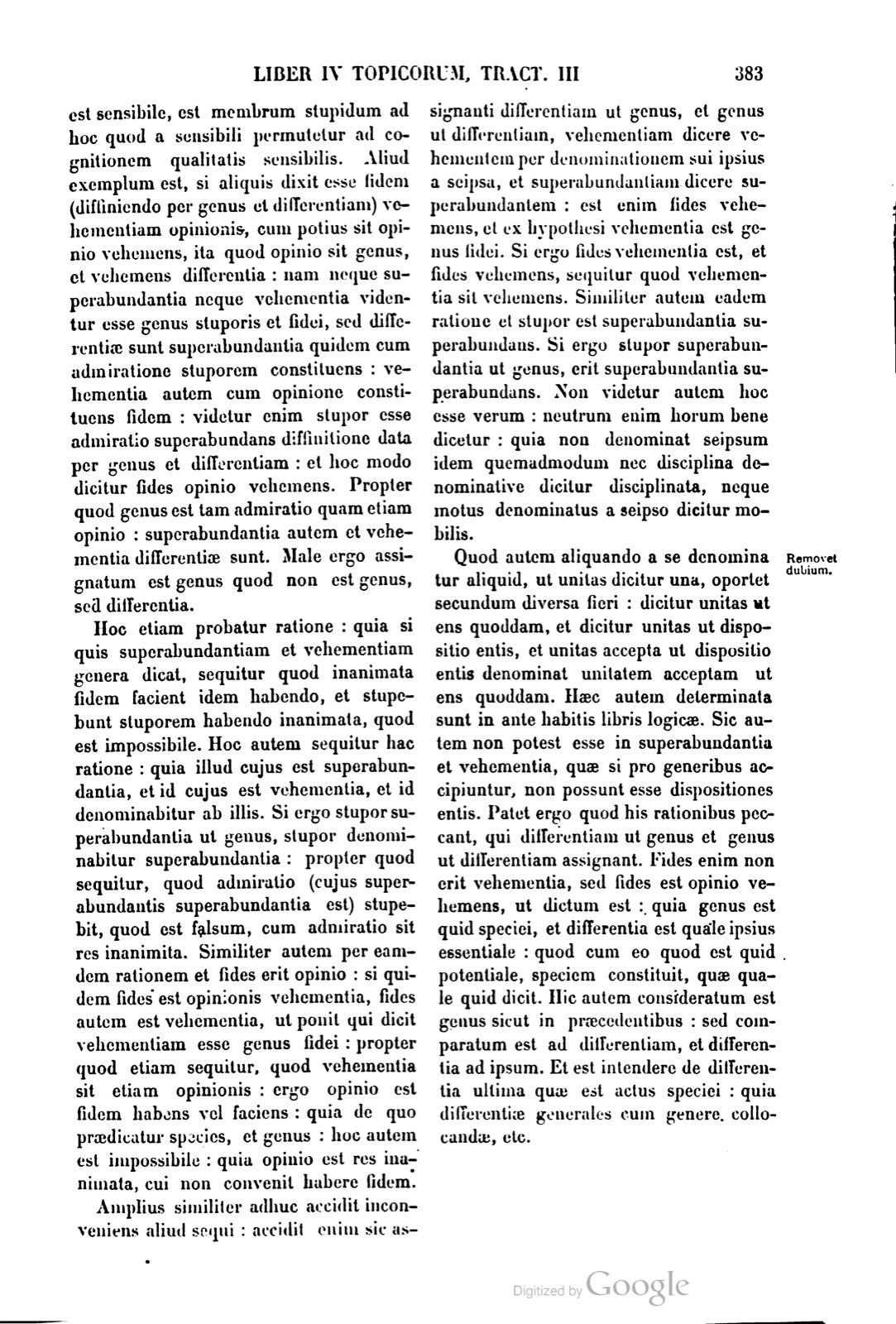
Hoc etiam probatur ratione: quia si quis superabundantiam et vehementiam genera dicat, sequitur quod inanimata fidem facient idem habendo, et stupebunt stuporem habendo inanimata, quod est impossibile. Hoc autem sequitur hac ratione: quia illud cujus est superabundantia, et id cujus est vehementia, et id denominabitur ab illis. Si ergo stupor superabundantia ut genus, stupor denominabitur superabundantia: propter quod sequitur, quod admiratio, cujus superabundantis superabundantia est, stupebit, quod est falsum, cum admiratio sit res inanimata. Similiter autem per eamdem rationem et fides erit opinio: si quidem fides est opinionis vehementia, fides autem est vehementia, ut ponit qui dicit vehementiam esse genus fidei: propter quod etiam sequitur, quod vehementia sit etiam opinionis: ergo opinio est fidem habens vel faciens: quia de quo praedicatur species, et genus: hoc autem est impossibile: quia opinio est res inanimata, cui non convenit habere fidem.
Amplius similiter adhuc accidit inconveniens aliud sequi: accidit enim sic assignanti differentiam ut genus, et genus ut differentiam, vehementiam dicere vehementem per denominationem sui ipsius a seipsa, et superabundantiam dicere superabundantem: est enim fides vehemens, et ex hypothesi vehementia est genus fidei. Si ergo fides vehementia est, et fides vehemens, sequitur quod vehementia sit vehemens. Similiter autem eadem ratione et stupor est superabundantia superabundans. Si ergo stupor superabundantia ut genus, erit superabundantia superabundans. Non videtur autem hoc esse verum: neutrum enim horum bene dicetur: quia non denominat seipsum idem quemadmodum nec disciplina denominative dicitur disciplinata, neque motus denominatus a seipso dicitur mobilis.
[Marginal label, printed page 383: Removet dubium.]
Quod autem aliquando a se denominatur aliquid, ut unitas dicitur una, oportet secundum diversa fieri: dicitur unitas ut ens quoddam, et dicitur unitas ut dispositio entis, et unitas accepta ut dispositio entis denominat unitatem acceptam ut ens quoddam. Haec autem determinata sunt in ante habitis libris logicae. Sic autem non potest esse in superabundantia et vehementia, quae si pro generibus accipiuntur, non possunt esse dispositiones entis. Patet ergo quod his rationibus peccant, qui differentiam ut genus et genus ut differentiam assignant. Fides enim non erit vehementia, sed fides est opinio vehemens, ut dictum est: quia genus est quid speciei, et differentia est quale ipsius essentiale: quod cum eo quod est quid potentiale, speciem constituit, quae quale quid dicit. Hic autem consideratum est genus sicut in praecedentibus: sed comparatum est ad differentiam, et differentia ad ipsum. Et est intendere de differentia ultima quae est actus speciei: quia differentiae generales cum genere, collocandae, etc.
This is also proved by reason: because if someone says that superabundance and vehemence are genera, it follows that inanimate things will make faith by having the same thing, and inanimate things will be stupefied by having wonderment, which is impossible. This follows by this reason: that of which there is superabundance, and that of which there is vehemence, will be denominated from them. Therefore if wonderment is superabundance as genus, wonderment will be denominated superabundance; and for this reason it follows that admiration, of which there is superabundance of the superabundant thing, will be stupefied, which is false, since admiration is an inanimate thing. Similarly, by the same reason faith will be opinion, if faith is vehemence of opinion and faith is vehemence, as the one who says that vehemence is the genus of faith posits. Therefore it also follows that vehemence is of opinion; therefore opinion is having or making faith, because where the species is predicated, the genus is also predicated. But this is impossible, because opinion is an inanimate thing, to which it does not belong to have faith.
Moreover, similarly another unfitting thing still happens to follow: for it happens to the one assigning difference as genus and genus as difference in this way to say that vehemence is vehement through denomination of itself from itself, and to say that superabundance is superabundant. For faith is vehement, and by hypothesis vehemence is the genus of faith. Therefore if faith is vehemence and faith is vehement, it follows that vehemence is vehement. Similarly, by the same reason wonderment is superabundant superabundance. Therefore if wonderment is superabundance as genus, superabundance will be superabundant. But this does not seem to be true, for neither of these will be well said, because the same thing does not denominate itself, just as neither is discipline denominatively called disciplined, nor is motion denominated from itself called mobile.
[Marginal label, printed page 383: He removes a doubt.]
But when something is sometimes denominated from itself, as unity is called one, this must occur according to diverse aspects: unity is spoken of as a certain being, and unity is spoken of as a disposition of being; and unity taken as a disposition of being denominates unity taken as a certain being. But these things have been determined in the preceding books of logic. In this way, however, it cannot be in superabundance and vehemence, which, if they are taken as genera, cannot be dispositions of being. Therefore it is clear by these reasons that those sin who assign difference as genus and genus as difference. For faith will not be vehemence, but faith is vehement opinion, as has been said, because genus is the what of the species, and difference is its essential quale, which together with that which is the potential what constitutes the species, which states a quale quid. But here genus has been considered as in the preceding matters, though compared to difference, and difference to it. And one must understand this of the ultimate difference which is the act of the species, because general differences must be placed together with the genus, and so forth.
If a page does not appear, its photograph has not been uploaded yet.